Our readers keep the lights on and my smoothie glass nicely filled. As an Amazon Associate, I earn from qualifying purchases.
Your tap water carries chlorine, sediment, and heavy metals that affect its taste, smell, and safety. An at-home filtration system is the only permanent solution for clean, great-tasting water on demand without buying plastic bottles.
I’m Mohammad Maruf — the founder and writer behind WellFizz. I’ve spent years analyzing water filtration hardware, from micron ratings and flow rates to NSF certifications and filter lifespans, so you can separate real performance from marketing claims.
This guide compares nine top-tier systems across countertop, under-sink, and whole-house setups to help you find the best at home water filtration system for your family’s unique needs and water conditions.
How To Choose The Best At Home Water Filtration System
Every home has different water chemistry — what works for a municipal supply in the city may fail on a private well. Focus on three core decisions: installation type, filtration technology, and certification level.
Installation Type: Countertop, Under-Sink, or Whole House
Countertop units like gravity filters need no plumbing and are ideal for renters. Under-sink systems deliver high flow rates with a dedicated faucet but require cold-water line access. Whole-house systems filter every tap in your home, protecting appliances from sediment and scale — expect larger filter housings and higher upfront cost.
Filtration Technology: Gravity, Carbon, UF, or RO
Gravity filtration uses only water weight and needs no electricity — perfect for emergency prep. Activated carbon removes chlorine and volatile organic compounds (VOCs) for taste improvement. Ultra-filtration (UF) at 0.01 microns grabs bacteria and cysts. Reverse osmosis (RO) with a 0.0001-micron membrane strips dissolved solids, heavy metals, and PFAS but wastes some water.
Certifications and Filter Lifespan
Look for NSF/ANSI 42 (aesthetic effects like chlorine taste), NSF/ANSI 53 (health-related contaminants like lead and cysts), and NSF/ANSI 372 (lead-free material). Filter lifespan is measured in months or gallons — multiply the replacement cost over three years to compute true cost of ownership.
Quick Comparison
On smaller screens, swipe sideways to see the full table.
| Model | Category | Best For | Key Spec | Amazon |
|---|---|---|---|---|
| Waterdrop T3-T RO | Under-Sink RO | Best Overall RO | 220 GPD | 2:1 Pure-to-Drain | Amazon |
| Brondell Coral UC300 | Under-Sink Carbon | PFAS & Lead Reduction | WQA Gold Seal | 600 gal/yr | Amazon |
| AquaTru Carafe RO | Countertop RO | No-Plumbing RO | 4-stage RO | 64 oz glass carafe | Amazon |
| iSpring WCB32C-KS Whole House | Whole House | Heavy Metal & PFAS | 30k gal | 12 GPM | Amazon |
| Purewell Gravity 2.25G | Countertop Gravity | No-Power Filtration | 0.01µm UF | 6k gal total | Amazon |
| Waterdrop TST-UF Under-Sink | Under-Sink UF | Mineral Retention | 0.01µm UF | 1.59 GPM | Amazon |
| SimPure DB20P-3 Whole House | Whole House | Well Water Sediment | 150k gal | 15 GPM | Amazon |
| Whole House 3-Stage R.O.R. | Whole House | Chlorine & Sediment | 10k gal | 5µm sediment | Amazon |
| iSpring WGB32B Whole House | Whole House | High-Flow Commercial | 100k gal | 15 GPM | Amazon |
In‑Depth Reviews
1. Waterdrop T3-T Reverse Osmosis System
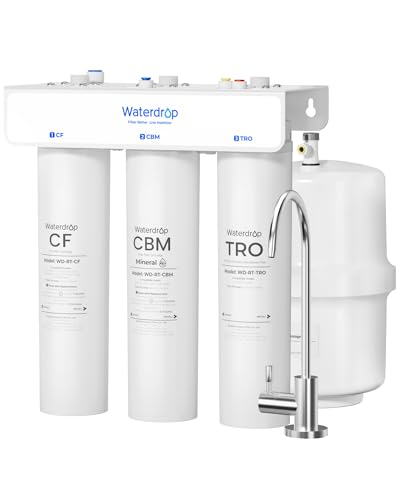
This 7-stage under-sink RO system delivers 220 gallons per day, refilling its tank in just 7.5 minutes. The 0.0001-micron membrane reduces TDS by up to 90%, stripping chlorine, heavy metals, PFOA, and PFOS while the final remineralization stage adds back essential minerals for a clean, crisp taste.
The 2:1 pure-to-drain ratio is among the most efficient in the mid-range category — most competing units waste 3 to 4 gallons for every gallon filtered. Twist-and-pull filter changes take seconds, and the built-in NFC tag lets you tap your phone for installation guides and real-time filter-life tracking.
No electricity is needed; the system runs entirely on line pressure. Faucet installation does require drilling a hole in the countertop, but the included chrome faucet is sleek and matches modern kitchens. Filter replacements are spaced at 6 months for the CF, 12 months for the CBM, and 24 months for the RO membrane.
Why it’s great
- Fast 220 GPD flow with 7.5-minute tank refill
- Efficient 2:1 pure-to-drain ratio saves water
- NFC tag for easy maintenance tracking
Good to know
- Countertop hole drilling required for faucet
- Remineralization cartridge adds ongoing cost
2. Brondell Coral UC300
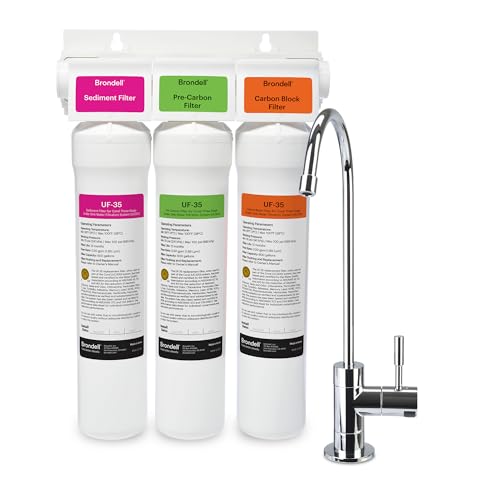
The Brondell Coral UC300 carries WQA Gold Seal certification and meets NSF/ANSI standards 42, 53, 372, and CSA B483.1 for lead reduction. Its three-stage carbon block filtration targets PFAS, lead, chlorine, and sediment while leaving beneficial minerals intact — unlike RO systems that strip everything.
The Twist & Seal filter changes are tool-free, and the integrated LED indicator on the designer chrome faucet tells you exactly when to swap filters. Each filter set lasts 12 months or 600 gallons, making yearly maintenance predictable. Dual quick-connect hoses speed installation, and the included metal T-connector includes its own shutoff valve.
Multiple reviewers report the water tastes noticeably better than refrigerator filtered water, and the independent contaminant testing sheet provides transparency on exactly what gets reduced. Some users note the faucet handle can feel slightly loose, but the filtration performance earns consistent praise across years of use.
Why it’s great
- WQA Gold Seal certified for lead and PFAS reduction
- Twist & Seal filters with 12-month lifespan
- LED filter change indicator on faucet
Good to know
- Filter replacement cost is higher than basic carbon units
- Faucet pivot can be overly sensitive
3. AquaTru Carafe Countertop RO
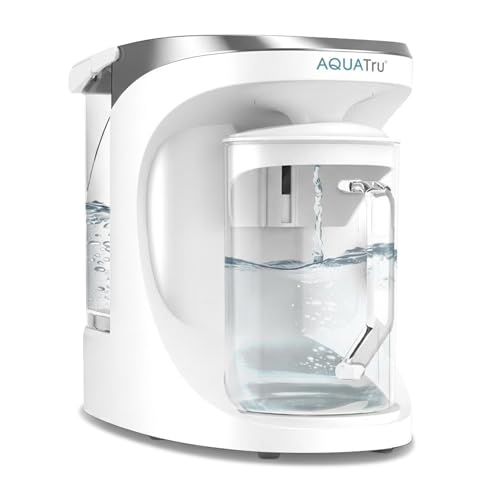
This countertop reverse osmosis system requires zero plumbing — just fill the input tank, plug it in, and it produces purified water into a 64-ounce borosilicate glass carafe. The 4-stage process reduces 84 contaminants including fluoride, lead, chlorine, microplastics, and PFOA/PFOS, certified by IAMPO to NSF standards.
The glass carafe eliminates plastic leaching concerns, and each filter set replaces roughly 4,500 single-use plastic bottles over its lifespan. The footprint is similar to a mid-size coffee maker, making it viable in small kitchens, apartments, and rental spaces where permanent modifications aren’t allowed. Wastewater is minimal but must be manually discarded from the input tank.
Filters last 6 to 12 months depending on usage, and replacement sets are available through the manufacturer at competitive prices. Some users report the input tank is on the small side for high-volume households, requiring more frequent refills, and the unit needs a power outlet.
Why it’s great
- No plumbing or drilling needed — truly portable
- Glass carafe avoids plastic contamination
- Reduces 84 contaminants including PFAS
Good to know
- Input tank is small for large families
- Requires power outlet and manual wastewater discard
4. iSpring WCB32C-KS Whole House System

This 3-stage whole-house system uses a 5-micron sediment pre-filter, a GAC/KDF composite filter for chlorine, PFAS, lead, chloramine, and hydrogen sulfide, followed by a CTO carbon block for final polish. The 12 GPM flow rate is sufficient for two bathrooms running simultaneously without noticeable pressure drop.
The transparent first-stage housing lets you visually inspect sediment buildup, and the system comes with three filters plus a housing wrench. At 30,000 gallons capacity per filter set, a family of four typically gets 6 months between changes. The compact wall-mount design fits in most utility closets or garages.
Customer feedback consistently highlights iSpring’s support — multiple users report rapid replacement of parts that leaked or failed, even beyond the warranty period. The system retains beneficial minerals and doesn’t reduce TDS, so pair with an RO system if dissolved solids are a concern.
Why it’s great
- GAC/KDF filter targets PFAS, lead, and chloramine
- Transparent housing for easy sediment inspection
- Excellent post-warranty customer support
Good to know
- Does not reduce TDS — consider a separate RO for drinking
- O-rings must be lubricated to prevent leaks during install
5. Purewell 2.25G Gravity Water Filter

The Purewell countertop gravity filter operates with zero electricity, using a 0.01-micron hollow fiber UF membrane that sieves out 99.99% of microscopic impurities including cysts, rust, and sediment. The 3-stage composite filter also includes a silver ion membrane and activated carbon block to reduce chlorine and heavy metals.
Its 2.25-gallon capacity serves a small family, and the water level window on the stainless steel body lets you see remaining water without opening the lid. Each pair of black carbon filters delivers up to 6,000 gallons total, with recommended replacement every 6 months. The flow rate is 0.06 GPM — slower than electric or pressurized systems but consistent.
Setup takes about 10 minutes with no tools. The gravity-fed design makes it suitable for camping, RVs, and emergency preparedness. The system does not lower TDS, so mineral content remains unchanged. Customers consistently report chlorine taste and odor disappear completely.
Why it’s great
- No electricity required — works off-grid
- 0.01-micron UF membrane removes 99.99% of impurities
- Water level window for easy monitoring
Good to know
- Slow flow rate — 0.06 GPM
- Total capacity reduced by filter displacement in lower chamber
6. Waterdrop TST-UF Under-Sink Filter

This 3-stage under-sink ultra-filtration system connects directly to existing cold water lines with 3/8-inch or 1/2-inch female NPT threads, delivering 1.59 GPM — enough to fill an 8-ounce cup in 2.3 seconds. The 0.01-micron UF membrane removes 99% of substances including chlorine, heavy metals, and bad odors while retaining beneficial minerals like potassium, calcium, and magnesium.
The system is crafted from NSF/ANSI-approved components with a lead-free 304 stainless steel body — no plastic housing to crack over time. Filter lifespans are generous: the PP sediment filter lasts 6-8 months, the UF filter lasts 12 months, and the CT filter lasts 12-24 months, totaling 8,000 gallons of capacity.
Installation is DIY-friendly with included hoses, a converter set, Teflon tape, and a wrench. It is not compatible with hot water or well water without pre-treatment. Some users note the push-connect fittings require careful clip installation to prevent leaks, and a separate faucet is not included — it shares your existing sink faucet.
Why it’s great
- Fast 1.59 GPM flow rate
- Stainless steel construction — BPA-free and leak-resistant
- Retains healthy minerals
Good to know
- Not compatible with well water or hot water lines
- Push-connect clips can be tricky to install correctly
7. SimPure DB20P-3 Whole House Filter
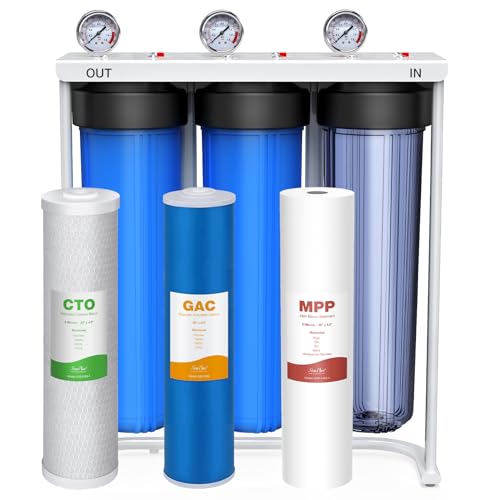
Built for well water, the SimPure DB20P-3 uses three 20×4.5-inch cartridges — a MPP sediment filter for sand and rust, a GAC filter for chlorine taste and odor, and a CTO carbon block for residual tastes and fine particles. The system delivers up to 150,000 gallons annually with a 15 GPM flow rate that won’t starve multiple showers or appliances.
Two of three housings are clear, letting you monitor cartridge condition without disassembly. The 1-inch NPT brass ports and double O-ring seals reduce leak risk. Each filter lasts 3-6 months, and the system accepts standard 20×4.5-inch replacement cartridges from various brands, avoiding proprietary markup.
At 48.5 pounds and 28.7 inches tall, it requires substantial under-stair or garage space. Several well-water users report dramatic reduction in iron discoloration and sediment, though some with persistent hydrogen sulfide smell needed to switch the second stage to a KDF85 filter for better results.
Why it’s great
- High 150,000-gallon capacity for large families
- Clear housings for visual filter monitoring
- Accepts standard 20×4.5-inch cartridges
Good to know
- Heavy unit — 48.5 pounds — needs solid mounting
- May need KDF upgrade for hydrogen sulfide removal
8. Whole House 3-Stage System (Reverse Osmosis Revolution)
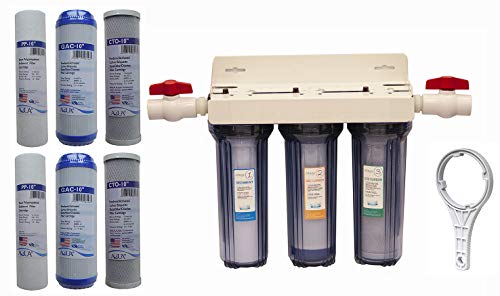
This budget-friendly whole-house system uses a 5-micron sediment pre-filter, a granular activated carbon (GAC) stage for chlorine and VOCs, and a CTO carbon block for final taste and odor polishing. The 3/4-inch brass ports connect to standard home plumbing, and the package includes two extra sets of replacement filters — six total — covering up to two years of operation.
The sediment filter traps dust, sand, rust, and scale particles, extending the life of the downstream carbon filters. Each stage is a standard 10-inch cartridge, keeping replacement costs low and widely available. The 10,000-gallon capacity handles average household needs for 4-6 months between changes.
Users report the system effectively reduces sulfur smell and improves overall taste. The included shutoff valves make installation and filter swaps straightforward. The metal bracket and housing are functional rather than premium — some reviews mention average build quality, but consistent leak-free operation is widely reported.
Why it’s great
- Comes with 2 extra filter sets for long-term value
- Standard 10-inch cartridges are easy to find
- Effectively reduces chlorine, sediment, and sulfur odors
Good to know
- 5-micron sediment only — not for fine particles
- Plastic housings may feel less durable than stainless steel
9. iSpring WGB32B Whole House System

The iSpring WGB32B is a commercial-grade 3-stage whole-house system using 20×4.5-inch industrial standard filters: a 5-micron sediment stage followed by two CTO carbon block filters made from coconut shell carbon. Third-party testing confirms NSF/ANSI compliance, and the system removes up to 99% of chlorine along with sediment, rust, tastes, and odors.
With 100,000 gallons of capacity and 15 GPM flow, this unit handles large families and high-demand situations without pressure drop. The 1-inch NPT inlet/outlet and included wrench make DIY installation feasible for those with basic plumbing skills. Each set of three filters typically lasts a full year under normal municipal water conditions.
Customer service is legendary — multiple users report iSpring replacing manifold heads and canisters free of charge years after purchase. The system retains healthy minerals and does not reduce TDS, so pair with an RO for drinking if dissolved solids are a concern. The blue canisters are heavy when full, so ensure enough clearance for removal during filter changes.
Why it’s great
- 100,000-gallon capacity with annual filter changes
- Industrial 20×4.5-inch filters with wide compatibility
- Exceptional long-term customer support
Good to know
- Heavy blue canisters can be awkward to unscrew
- O-rings require careful positioning to avoid leaks
FAQ
Will a whole-house filter reduce the TDS level of my water?
How often do I actually need to replace the filters in my home system?
Do countertop RO systems like the AquaTru waste water like under-sink RO models?
Can I install a whole-house water filter myself if I have no plumbing experience?
Final Thoughts: The Verdict
For most users, the best at home water filtration system winner is the Waterdrop T3-T RO because it combines 220 GPD speed, 2:1 water efficiency, and remineralization in a compact under-sink footprint. If you want certified protection against PFAS and lead without stripping minerals, grab the Brondell Coral UC300. And for whole-house coverage that protects appliances and every tap, nothing beats the iSpring WCB32C-KS for heavy metal reduction and long-term support.

Mo Maruf
I created WellFizz to bridge the gap between vague wellness advice and actionable solutions. My mission is simple: to decode the research and give you practical tools you can actually use.
Beyond the data, I am a passionate traveler. I believe that stepping away from the screen to explore new environments is essential for mental clarity and physical vitality.