Our readers keep the lights on and my smoothie glass nicely filled. As an Amazon Associate, I earn from qualifying purchases.
Discovering termite damage in your baseboard or finding a mud tube snaking up your foundation line is the kind of home-owner dread that usually triggers a frantic call to a pest control company, and a bill that runs well into four figures. The real shock, however, is learning how many of those treatments rely on the same active ingredients you can legally buy and apply yourself—if you know which formulation matches your infestation.
I’m Mohammad Maruf — the founder and writer behind WellFizz. I dig through manufacturer labels, EPA registration data, and thousands of verified buyer reports to separate the concentrated liquid barriers and expanding foams that actually kill subterranean, drywood, and dampwood termites from the watered-down perimeter sprays that merely delay the inevitable.
After comparing soil-trenching concentrates, void-filling foams, and dual-action perimeter killers, the best group of products for any homeowner battling a structural pest invasion is easily the at home termite treatment category we break down below.
How To Choose The Best At Home Termite Treatment
Termites are not random invaders — they follow a colony-to-wood superhighway, and your treatment choice must block that exact route. Whether you are dealing with mud tubes on a foundation slab or kick-out holes in a ceiling joist, the right formulation, application method, and active ingredient chain length determine if the colony dies or simply avoids the chemical for a season.
Liquid Concentrate vs. Expanding Foam
A liquid concentrate mixed with water and applied as a trench or perimeter spray creates a continuous chemical barrier in the soil. Termites that cross it pick up a lethal dose and carry it back to the colony — this works best for subterranean termites entering from ground level. Expanding foam, on the other hand, is designed for above-ground voids: wall cavities, door frames, and attic galleries where termites nest without direct soil contact. Foam expands up to 30 times its liquid volume, filling voids that a spray nozzle cannot reach.
Non-Repellent vs. Repellent Active Ingredients
Repellent termiticides (like cypermethrin in Demon Max) keep termites from entering treated zones, which can simply push the colony to find an untreated gap. Non-repellent actives like fipronil (found in Termidor and other professional-grade products) are odorless and invisible to termites, so they walk through the barrier, ingest or absorb the poison, and die slowly enough to transfer the toxin to other colony members. For a true colony elimination, a non-repellent active is almost always the smarter choice.
Concentration Ratio and Barrier Longevity
Every label specifies a mixing ratio in ounces of concentrate per gallon of water. A higher ratio creates a stronger, longer-lasting deposit in the soil. Products like Bonide 5686 claim up to a 7-year barrier, though real-world effectiveness depends on soil moisture, rainfall, and UV exposure. Perimeter-only sprays with lower concentration may only last a few months and require seasonal reapplication. Check the label for “soil treatment” instructions rather than “surface spray” if you want multi-year control.
Application Gear and Safety Requirements
Liquid concentrates require a garden sprayer, hand sprayer, or sprinkler can; foams come in aerosol cans with specialized nozzles for drilling into wood. Both chemical types demand full protective gear — nitrile gloves, long sleeves, goggles, and a respirator in enclosed spaces. Avoid applying during rain, near water runoff areas, or under direct sun. Read the entire EPA label before opening any product; the label is legally binding, not a suggestion.
Quick Comparison
On smaller screens, swipe sideways to see the full table.
| Model | Category | Best For | Key Spec | Amazon |
|---|---|---|---|---|
| Termidor Foam | Expanding Foam | Wall voids & attic spot treatments | 30:1 foam expansion ratio | Amazon |
| Bonide Termite & Ant Killer | Liquid Concentrate | Perimeter soil barrier & trenching | 32 oz concentrate; 7-year claim | Amazon |
| Ortho Home Defense Termite Killer | Liquid Concentrate | Perimeter spray & preventative use | 5-year claim; easy-mix formula | Amazon |
| Demon Max Insecticide | Liquid Concentrate | Broad pest control & scorpion/ant barrier | Cypermethrin (repellent) active | Amazon |
| Bayer Premise Foam | Expanding Foam | Spot treating visible kick-out holes | Foam disperses to nest & queen | Amazon |
In‑Depth Reviews
1. BASF Termidor Foam 20 oz

The Termidor brand has long been the go-to for professional exterminators, and this foam version brings that same non-repellent fipronil chemistry into a DIY aerosol can. The 30:1 expansion ratio means one 20-ounce can produces more than 600 cubic inches of dry foam — enough to treat multiple wall voids, attic galleries, or fence post cavities without a pump or hose. Users drilling into termite tubes and feeding the foam into stud voids consistently report zero live activity after a single application.
Where this foam shines over liquid concentrates is its ability to coat vertical and overhead surfaces. The ready-to-use formulation comes with a precision nozzle that slips into a quarter-inch drill hole, and the foam stays intact in the void for weeks rather than dripping into the bottom plate. It targets subterranean, drywood, and dampwood termites along with carpenter ants, old house borers, and powder post beetles, making it the most versatile single-product solution in this review.
Read the label carefully for state-specific restrictions, as termiticide registration varies by region. Some buyers note the foam may push back out of shallow holes if the void is too narrow or if the nozzle tip is jammed against the back wall — backing the nozzle out slightly during dispensing solves this. For an above-ground spot treatment that mirrors professional-grade efficacy, this is the clear leader.
Why it’s great
- Non-repellent fipronil active kills colony via transfer
- Expands 30:1 to fill deep voids and cracks
- One can covers multiple wall cavity treatments
- Works on both termites and carpenter ants
Good to know
- State-by-state shipping restrictions apply
- Foam blowback possible in shallow holes
- Not effective as a soil barrier — above ground only
2. Bonide Termite & Carpenter Ant Killer, 32 oz Concentrate

Bonide 5686 is a bifenthrin-based concentrate designed specifically for the trenching method — dig a 6-inch deep by 6-inch wide trench around your foundation, mix the concentrate with water, and pour or spray the emulsion into the trench before backfilling. The label claims up to 7 years of termite protection, though most real-world reports from cabin and post-and-beam homeowners find annual reapplication keeps subterranean termite activity at bay.
At 32 ounces of concentrate that makes several gallons of finished spray, this is the most cost-effective option per linear foot of treated soil. Users report great results against black ants, fire ants, and wood-boring beetles alongside termites, making it a general perimeter defense rather than a termite-specific single-target product. The dual-action contact kill works immediately on exposed insects while the residual barrier stops new foragers from crossing.
The main drawback is the manual labor involved: trenching around an entire foundation with a shovel or edger is a full weekend project. If your home has a slab foundation with no accessible soil trench, this product cannot be used. It also has a distinct chemical odor that takes a few hours to dissipate outside. For raw effectiveness in the ground at a price point that beats any professional quote, this remains a staple.
Why it’s great
- Long-term soil barrier; single concentrate makes gallons
- Works on termites, ants, beetles, and many other pests
- Application method is straightforward with standard sprayer
- Very low cost per treated linear foot
Good to know
- Requires digging a trench around the structure
- Odor is noticeable during and immediately after application
- Not for use on slab foundations without soil access
3. Ortho Home Defense Termite & Destructive Bug Killer, 16 oz
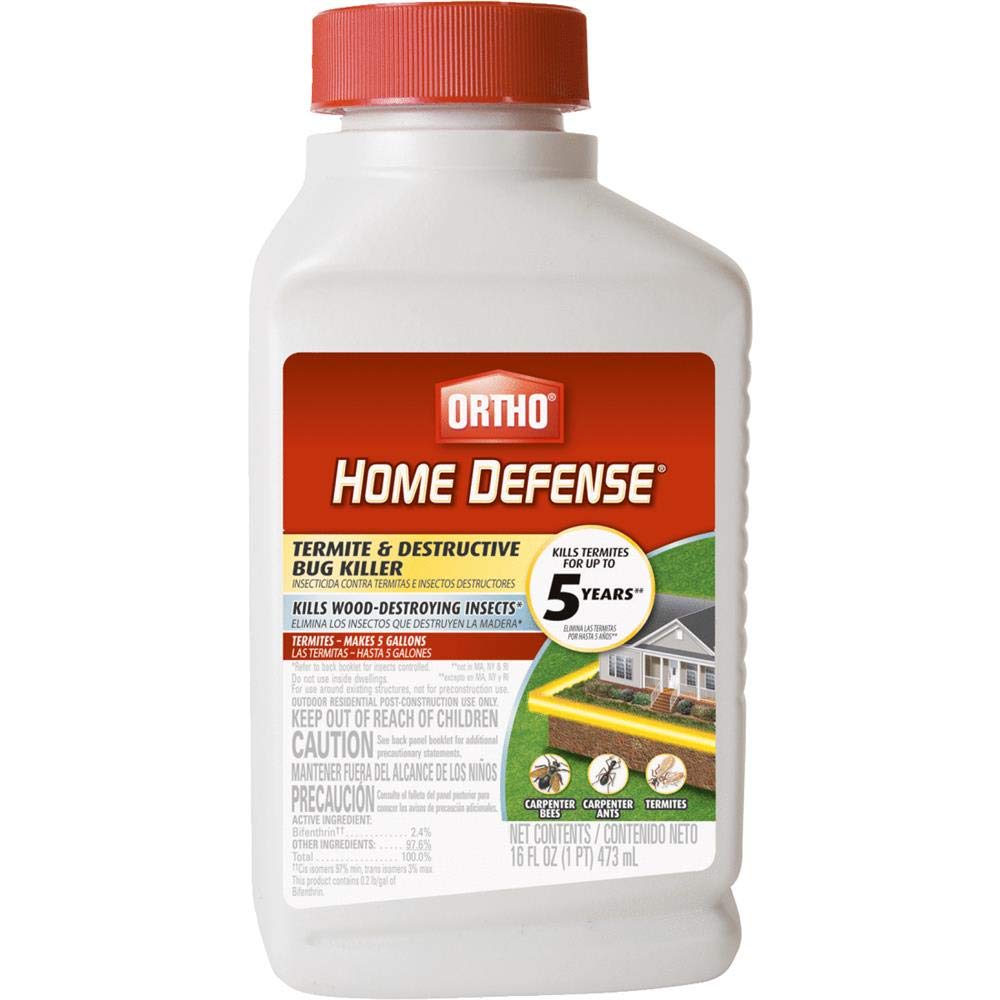
Ortho’s Termite Killer concentrate is designed for the homeowner who wants a straightforward perimeter spray without the heavy lifting of full trenching. The label directs you to mix with water in a garden sprayer and apply around the home’s foundation, on wooden surfaces, wood piles, and tree stumps. The active ingredients kill on contact and leave a residual barrier that the brand claims lasts up to 5 years in treated soil — though most users report that a repeat application after three to four weeks is necessary to catch any termites that bypassed the first layer.
The 16-ounce bottle is smaller than Bonide’s offering, but the formula is potent enough that users see immediate results against carpenter ants, spiders, and other home-invading insects. Many reviews highlight complete elimination of termite activity around the perimeter, though some caution that this product is not registered for use in Massachusetts, New York, or Rhode Island due to state-specific regulations. It works best as a preventative treatment or for light infestations around accessible areas like crawl spaces and garage entry points.
Because the concentrate is mixed to a specific ratio, you have control over strength — some buyers use a slightly stronger mixture for known hot spots around wooden fences or tree stumps. The main limitation is that this is a contact repellent rather than a non-repellent colony eliminator, so it will not solve a heavy, established infestation that has already penetrated wall voids. For ongoing perimeter maintenance at a reasonable investment, it is a reliable staple.
Why it’s great
- Easy mix-and-spray application using standard garden sprayer
- Works as both preventative and immediate contact killer
- Affordable per-treatment cost for whole perimeter
- Controls carpenter ants and spiders alongside termites
Good to know
- Not registered for use in MA, NY, or RI
- Repellent action may push termites to untreated gaps
- Needs repeat treatment after few weeks for full coverage
4. Syngenta Demon Max Insecticide, 16 oz

Demon Max uses cypermethrin, a synthetic pyrethroid that delivers a strong repellent effect — insects contact the dried residue and die rapidly, usually within minutes. Users report this product annihilating everything from bark scorpions in Arizona to crazy ants in the garage, often after just one application. The 16-ounce concentrate mixes with water to produce gallons of finished spray, making it a high-volume option for large perimeter treatments or indoor baseboard applications.
The repellent nature of cypermethrin means termites are less likely to walk through the barrier, which is effective at keeping them out of a structure but does not reliably eliminate an established colony. Buyer reviews highlight its exceptional performance on ants, stink bugs, carpenter bees, and roaches, making it more of a general home defense product than a dedicated termite colony killer. It also has a relatively long shelf life of 3 to 5 years under normal storage conditions.
The biggest downside is the hazard profile — users note that skin contact requires immediate 20-minute soap washing, and goggles and a respirator are mandatory during mixing. The measuring bottle design has been criticized for being spill-prone. If your primary threat is general perimeter pests with occasional termite pressure, this offers excellent value. For a focused colony-killing termite treatment, a non-repellent active is a better match.
Why it’s great
- Extremely fast kill on contact for many insect species
- Concentrate yields large volume of finished spray
- Long shelf life — 3 to 5 years stored properly
- Proven effective against tough pests like scorpions and crazy ants
Good to know
- Repellent formulation may not eliminate termite colony
- Requires full protective gear including respirator
- Bottle design makes measuring and pouring hazardous
5. Bayer Premise Foam Termiticide, 18 oz

Bayer Premise Foam is a non-repellent foam termiticide that works through a clever biological-delivery mechanism: termites pick up the foam on their bodies as they move through treated galleries, and the active ingredient is carried back to the nest where it spreads through the colony including the queen. The foam itself is odorless and does not create a mess, making it excellent for indoor use where a liquid spray would stain walls or drip through floorboards.
Real-world reviews from users who avoided professional treatments costing between and show consistent success. The standard method involves drilling 1/8-inch holes spaced every 6 to 16 inches along visible termite tubes or kick-out holes, dispensing foam for about 10 seconds per hole until the void is filled. Users report seeing dead termites within two days and no further activity for months afterward. The foam does not clog the nozzle and requires only basic gloves and goggles for safe handling.
The foam’s main limitation is that it is a spot treatment rather than a whole-structure barrier — it will not protect untreated areas of the home. It also comes in a smaller 18-ounce can that may not cover a large infestation across multiple rooms. Some users experienced blowback when the nozzle tip hit the back of a shallow hole; short, quick presses resolve the issue. For a DIY alternative to a professional foam injection, this product delivers the same active ingredient used by exterminators without the service call fee.
Why it’s great
- Non-repellent formula transfers to colony and queen
- No odor or staining — safe for indoor application
- Saves significant cost vs professional foam treatment
- Easy one-person operation with basic drill
Good to know
- Small can size may not cover large infestations
- Foam blowback if drill holes are too shallow
- Spot treatment only; not a full perimeter barrier
FAQ
Can I use a liquid concentrate and a foam treatment together?
How deep does the trench need to be for a soil barrier treatment?
What does “non-repellent” mean for termite control?
Final Thoughts: The Verdict
For most users, the at home termite treatment winner is the BASF Termidor Foam because its non-repellent fipronil active, 30:1 expansion ratio, and professional-grade formulation deliver colony-killing power through a simple aerosol can — no pumps, no mixing, no trenching required. If you need a long-term soil barrier that protects your foundation for years, grab the Bonide Termite & Carpenter Ant Killer concentrate. And for quick spot treatments in visible termite tubes where you want to avoid a whole-house fumigation, nothing beats the Bayer Premise Foam.

Mo Maruf
I created WellFizz to bridge the gap between vague wellness advice and actionable solutions. My mission is simple: to decode the research and give you practical tools you can actually use.
Beyond the data, I am a passionate traveler. I believe that stepping away from the screen to explore new environments is essential for mental clarity and physical vitality.