Our readers keep the lights on and my smoothie glass nicely filled. As an Amazon Associate, I earn from qualifying purchases.
If your garden looks tired, your lawn has patches, or your prize tomatoes are refusing to ripen, the problem is likely hiding right under your feet. Soil chemistry — pH balance and nutrient levels — dictates whether your plants can access the food they need. Without a proper test, every bag of fertilizer is a blind gamble. That’s where a dedicated analysis tool changes everything.
I’m Mohammad Maruf — the founder and writer behind WellFizz. I have spent hundreds of hours analyzing the accuracy, ease-of-use, and real-world repeatability of home soil diagnostics to compile this guide.
Whether you need a quick pH check or a full fertility panel, finding the right best at home soil test kit means choosing between probe-style meters, capsule-based chemical kits, and mail-in lab services—each with different strengths for your specific growing needs.
How To Choose The Best At Home Soil Test Kit
Not every kit is built for the same job. A weekend gardener managing a few flower beds has different needs than someone planning a full-season vegetable patch. Here is what separates a useful kit from a frustrating one.
What parameters does the kit actually measure
Many budget-friendly kits only measure pH. While pH is important, it gives you zero information about fertility. A quality kit should also test nitrogen (N), phosphorus (P), and potassium (K) — the three primary macronutrients. Some advanced kits also include ammonia, calcium, or magnesium. The more parameters you can test, the more targeted your fertilizer plan can be.
Testing method: probe vs. chemical vs. mail-in
Three distinct technologies exist. Probe meters (3-in-1 units) give instant readings for moisture, light, and pH, but they cannot measure nutrient levels at all. Chemical reagent kits use liquid drops or capsules that change color — you compare the result to a chart. These give real N-P-K data but require careful timing and clean technique. Mail-in kits like Soil Savvy provide a lab-analyzed report with precise ppm values and tailored fertilizer recommendations, but they take about a week. Each method trades convenience for depth of data.
Number of tests included and repeatability
Some kits give you only 10 tests per parameter, meaning you can test your whole yard only once or twice. If you plan to monitor soil changes throughout the growing season, look for higher test counts — 20 or more per nutrient. This allows you to test before and after amendments and track progress over weeks. A kit with fewer tests is fine for a single diagnostic check, but not for ongoing care.
Quick Comparison
On smaller screens, swipe sideways to see the full table.
| Model | Category | Best For | Key Spec | Amazon |
|---|---|---|---|---|
| Soil Savvy | Mail-In Lab | Precision fertilizer plan | 14 nutrients plus pH report | Amazon |
| Luster Leaf Rapitest | Capsule System | Reliable N-P-K at home | pH + N, P, K capsule tests | Amazon |
| Dewilde Trading Co 140 Tests | Liquid Reagent | High test count for monitoring | 40 tests per parameter | Amazon |
| Pawfly 4 in 1 | Strip & Tablet | Budget nutrient screening | 20 strips + 40 tablets | Amazon |
| Maxsolve 2-Pack 3-in-1 | Probe Meter | Quick moisture & pH check | No batteries, 3-in-1 probe | Amazon |
In‑Depth Reviews
1. Soil Savvy
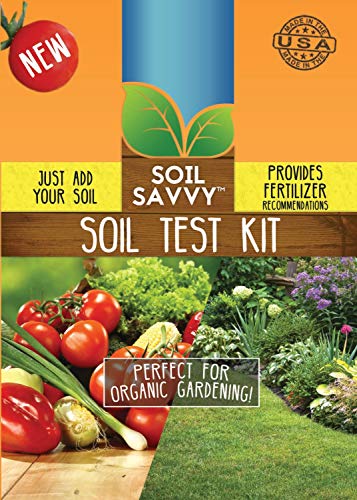
The Soil Savvy kit operates on a different level than other home tests. Instead of comparing colored liquids to a chart, you mail a soil sample to a real lab. The analysis covers pH and 14 nutrients including all three primary macros (N, P, K) plus secondary and micronutrients. The result comes back as a clear PDF report with a bar graph showing where your soil sits versus optimal range, and it includes a specific fertilizer recommendation in pounds per 1000 square feet.
Users report receiving results within three to six days via email. The kit uses a resin capsule that acts like a synthetic root, absorbing nutrients from the soil solution — the same technology commercial growers and turf managers rely on. This approach eliminates the subjective color-matching error that plagues capsule-based kits. Multiple long-term users have bought this kit season after season, finding it more actionable than county extension services for the same price range.
The main trade-off is time. You cannot get instant readings — you must mail the sample and wait. But for anyone serious about building a data-driven lawn care or vegetable garden plan, the precision and comprehensiveness of the lab report justify the wait. It is particularly valuable for diagnosing specific deficiencies like low iron in acid-loving plants such as blueberries.
Why it’s great
- Lab-grade precision with 14-nutrient analysis
- Clear emailed report with pounds-per-area recommendations
- Eliminates subjective color-matching errors
Good to know
- Requires mailing sample and waiting 3-6 days
- pH adjustment recommendations are not included in the report
2. Luster Leaf Rapitest Soil Test Kit

The Luster Leaf Rapitest has been a staple among home gardeners for years. It uses a water extraction process: you mix a soil sample with water, then add a capsule of reagent powder. The liquid changes color, and you match it against a printed comparator. The kit covers four parameters — pH, nitrogen, phosphorus, and potassium — which is the standard minimum for any useful fertility assessment.
Customer feedback consistently highlights the clear instructions and the fact that results correlate reasonably well with college lab tests. Multiple users have purchased this kit repeatedly, suggesting that the consistency is good enough for routine use. The capsule system is cleaner than loose powders or tablets, and the color charts are printed on durable card stock that resists fading. For beginner and intermediate gardeners, this is the most straightforward way to get N-P-K data without mailing a sample.
That said, the nitrogen test has drawn some criticism. A few users reported that the nitrogen capsule showed zero even on soil they knew was enriched with fertilizer. This suggests the nitrogen test may have a narrower detection range or be sensitive to specific soil conditions. For most users the other three parameters work reliably, but if precise nitrogen tracking is critical, the capsule method may not satisfy that need.
Why it’s great
- Easy water-extraction procedure with color comparator
- Tests all four core parameters: pH, N, P, K
- Proven track record with repeat purchasers
Good to know
- Nitrogen test occasionally reports false zeros
- Limited number of tests per kit
3. Dewilde Trading Co Soil Test Kit 140 Tests
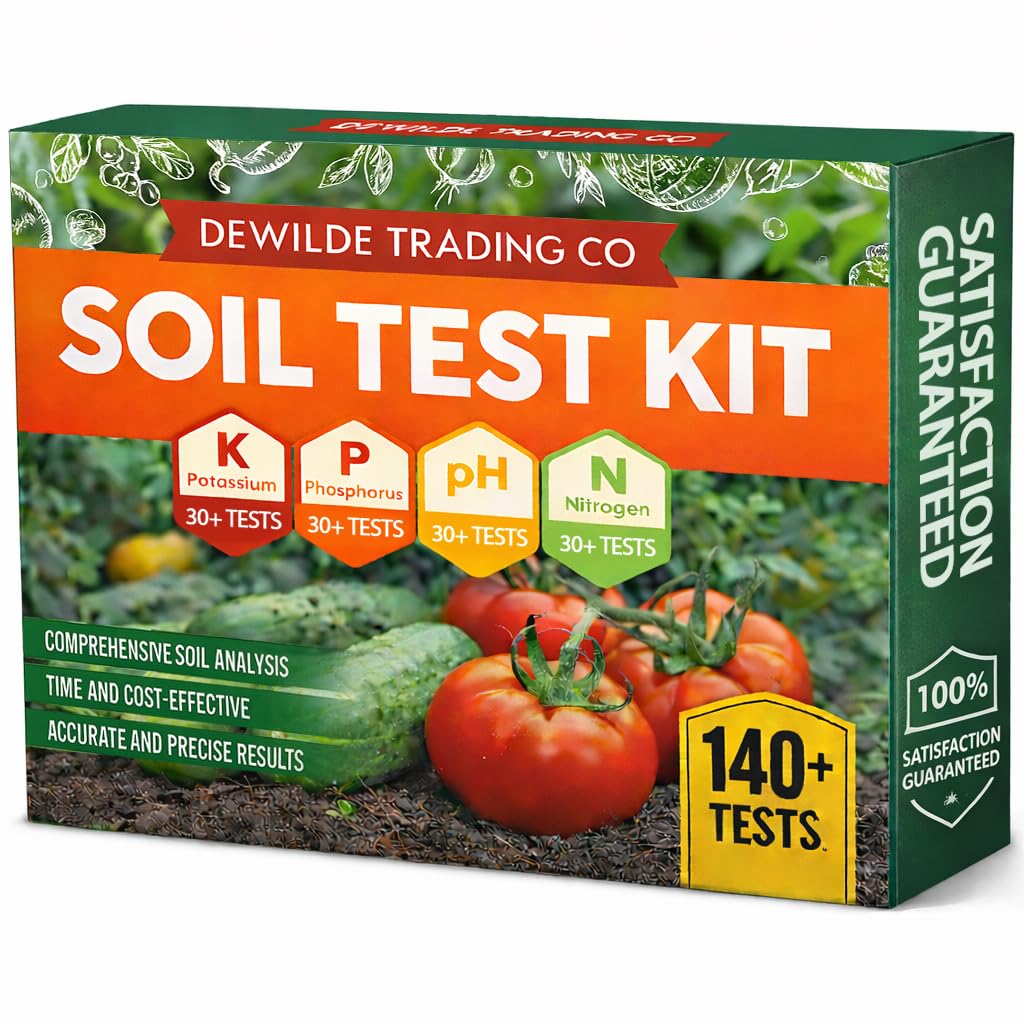
This kit packs the highest test count in this lineup — approximately 40 tests each for pH, ammonia, phosphorus, and potassium, plus about 20 tests for nitrogen, totaling around 140 individual tests. For gardeners managing large plots or multiple beds across a season, this volume allows you to test before planting, after fertilization, and throughout the growth cycle without running out of reagents.
The liquid reagent system works by adding precise drops to a soil-water mixture and comparing the resulting color against printed charts. Users report that the instructions are easy to follow and that results align well with expectations — one gardener discovered high pH was stunting their tomatoes and was able to take corrective action. The kit includes a wide range for all parameters, giving you a holistic fertility view rather than just a pH snapshot.
On the downside, some experienced gardeners noted that the nitrogen test feels less refined than dedicated aquarium testing solutions, which divide nitrogen into multiple categories (ammonia, nitrite, nitrate). The fertilizer recommendations based on test results are given as wide number spans, so some trial and error is still required to dial in the exact application rate. Still, for the per-test cost, this kit offers exceptional value for routine monitoring.
Why it’s great
- High test count for season-long monitoring
- Measures pH, N, P, K, and ammonia
- Low cost per test compared to capsule kits
Good to know
- Nitrogen test less granular than aquarium kits
- Fertilizer recommendations are broad ranges
4. Pawfly 4 in 1 Soil Test Kit
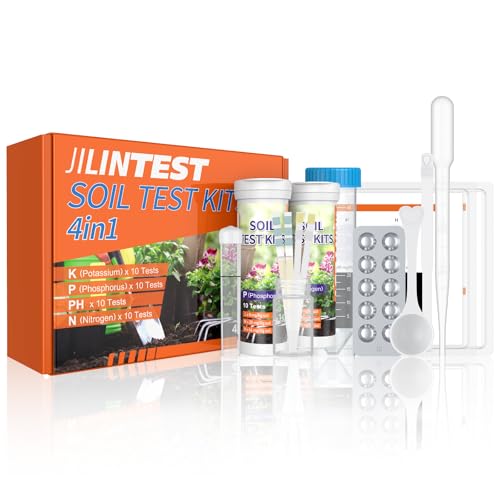
The Pawfly 4 in 1 kit uses a combination of test strips and dissolvable tablets to measure pH, nitrogen, phosphorus, and potassium. With 20 testing strips and 40 tablets included, you can run about 10 tests for each of the four parameters. The kit comes complete with centrifuge tubes, a glass vial, a dropper, a grinding rod, and a sample spoon — everything you need to process a sample is in the box.
The stated test ranges are specific: pH from 3.5 to 9, nitrogen from 40 to 320 mg/kg, phosphorus from 8 to 64 mg/kg, and potassium from 40 to 160 mg/kg. These narrow, field-relevant ranges mean the kit can detect meaningful soil deficiencies rather than just indicating “low” or “high.” The ultra-sensitive strips and tablets are designed to pick up even small variations in minutes, which is useful when tracking the effect of a recent fertilizer application.
However, the instructions are notably sparse in detail. Several users found the procedure confusing, feeling that some assumed soil chemistry knowledge was necessary. The color matching on the strips can be subjective, and without clearer diagrams or a step-by-step guide, the results may not be reliable for first-time users. This kit is better suited for someone who already understands the testing process and just wants the hardware at a low entry point.
Why it’s great
- Complete accessory set included in the box
- Specific numeric ranges for each nutrient
- Compact storage for garden shed or field use
Good to know
- Instructions lack detail for beginners
- Subjective color matching can cause inconsistent results
5. Maxsolve 2-Pack 3-in-1 Soil Tester

This is the simplest tool in the roundup — a dual-prong probe meter that measures moisture, light intensity, and pH. It requires no batteries and no chemical reagents. You push the metal probes into the soil, and the analog needle on the dial provides an instant reading. The two-pack lets you keep one in your indoor pots and one in the garden, or use one as a backup.
For plant parents managing houseplants, this meter is genuinely useful for one specific task: preventing overwatering. The moisture scale goes from dry to wet, and many users report that simply sticking the probe in a pot tells them with clarity whether the soil is still damp below the surface. The pH reading is a useful approximation — good enough to tell you if your soil is acid, neutral, or alkaline — but not calibrated to the precision of a chemical test.
Where this device falls short is depth of data. It cannot measure nitrogen, phosphorus, or potassium at all. The light meter function is also reported by some users as unreliable. One reviewer described the readings as inaccurate enough to throw the unit away. This tool is best understood as a quick diagnostic aid for moisture and rough pH, not as a substitute for a real soil analysis kit. If your goal is to build a fertilization plan, you need a different solution.
Why it’s great
- Instant readings with no batteries or chemicals
- Two-pack provides backup or separate indoor/outdoor use
- Excellent for monitoring soil moisture to prevent overwatering
Good to know
- Does not measure any nutrient levels (N, P, K)
- Light meter function has questionable accuracy
FAQ
Can a single home soil test kit measure both pH and all major nutrients?
How do I get reliable results from a color matching soil test?
When should I choose a mail-in lab service over a capsule kit?
How often should I test my soil during the growing season?
Final Thoughts: The Verdict
For most users, the best at home soil test kit winner is the Soil Savvy because it provides lab-grade accuracy and a clear fertilizer plan that eliminates guesswork entirely. If you want a reusable system you can use anytime in your garden, grab the Luster Leaf Rapitest. And for high-volume monitoring across multiple beds throughout the season, nothing beats the sheer test count of the Dewilde Trading Co 140 Tests.

Mo Maruf
I created WellFizz to bridge the gap between vague wellness advice and actionable solutions. My mission is simple: to decode the research and give you practical tools you can actually use.
Beyond the data, I am a passionate traveler. I believe that stepping away from the screen to explore new environments is essential for mental clarity and physical vitality.