Our readers keep the lights on and my smoothie glass nicely filled. As an Amazon Associate, I earn from qualifying purchases.
Wrist-based optical sensors on smartwatches are notoriously slow to react during interval training and can drift during steady-state runs, leaving you guessing about your actual effort. At-home heart rate monitors solve this by isolating the measurement with a dedicated sensor worn either on your arm or across your chest for a direct, real-time reading of your pulse.
I’m Mohammad Maruf — the founder and writer behind WellFizz. I’ve spent years analyzing the electro-optical and ECG sensor landscapes, comparing signal-to-noise ratios across multiple connectivity protocols to find which monitors actually deliver lab-grade reliability in a living-room or garage-gym setting.
Whether you need precise recovery metrics or zone-based coaching for your next endurance block, the best at-home heart rate monitor depends entirely on how you train and which data points matter most to your progress.
How To Choose The Best At-Home Heart Rate Monitor
Your choice hinges on the sensor type, how the data connects to your devices, and whether you care about advanced metrics like HRV or running dynamics. Below are the three factors that separate a buy-it-once monitor from a box you return within a week.
Optical Armband vs. ECG Chest Strap
Optical armbands clamp onto your forearm or bicep and shine LEDs through the skin to measure blood volume changes. They are comfortable, easy to put on and take off, and ideal for gym sessions and casual running. ECG chest straps, by contrast, use electrical sensors across your sternum to capture the heart’s electrical signal directly. This yields faster reaction to heart rate changes and superior accuracy for HRV data — critical for serious endurance athletes and recovery tracking.
Connectivity Protocol: Bluetooth vs. ANT+
Bluetooth is universal — every phone and tablet supports it. ANT+ is the standard for bike computers, many gym consoles, and Garmin watches. If you train indoors on a Peloton, Tacx, or Wattbike, an ANT+ connection ensures dropout-free pairing. Dual-protocol monitors (Bluetooth + ANT+) let you broadcast to a smartwatch and a phone simultaneously, which is essential for streaming to training apps like Zwift or TrainerRoad while keeping your watch in sync.
Data Depth: HRV, Running Dynamics, and Memory
Basic monitors simply display your heart rate number. Advanced models capture heart rate variability (HRV) — the beat-to-beat timing variation that reveals recovery status and stress load. The Polar H10 and Garmin HRM-Fit also log running dynamics (stride length, ground contact time) if paired with a compatible watch. Some straps, like the Garmin HRM 600, store workout data internally so you can leave your phone behind during a swim or field sport and sync later.
Quick Comparison
On smaller screens, swipe sideways to see the full table.
| Model | Category | Best For | Key Spec | Amazon |
|---|---|---|---|---|
| Scosche Rhythm+ 2.0 | Optical Armband | Training with apps | 24-hr battery | Amazon |
| COOSPO HW9 | Optical Armband | Zone-based coaching | ±1 BPM accuracy | Amazon |
| Fitbit Inspire 3 | Fitness Tracker | Daily wellness tracking | 10-day battery | Amazon |
| Wahoo TRACKR | Chest Strap | Long battery life | 200-hr battery | Amazon |
| Polar H10 | Chest Strap | Maximum accuracy | ECG sensor | Amazon |
| Garmin HRM-Fit | Clip-on | Women (sports bra) | Running dynamics | Amazon |
| Garmin HRM 600 | Chest Strap | Advanced running data | Rechargeable | Amazon |
In‑Depth Reviews
1. Polar H10 Heart Rate Monitor Chest Strap
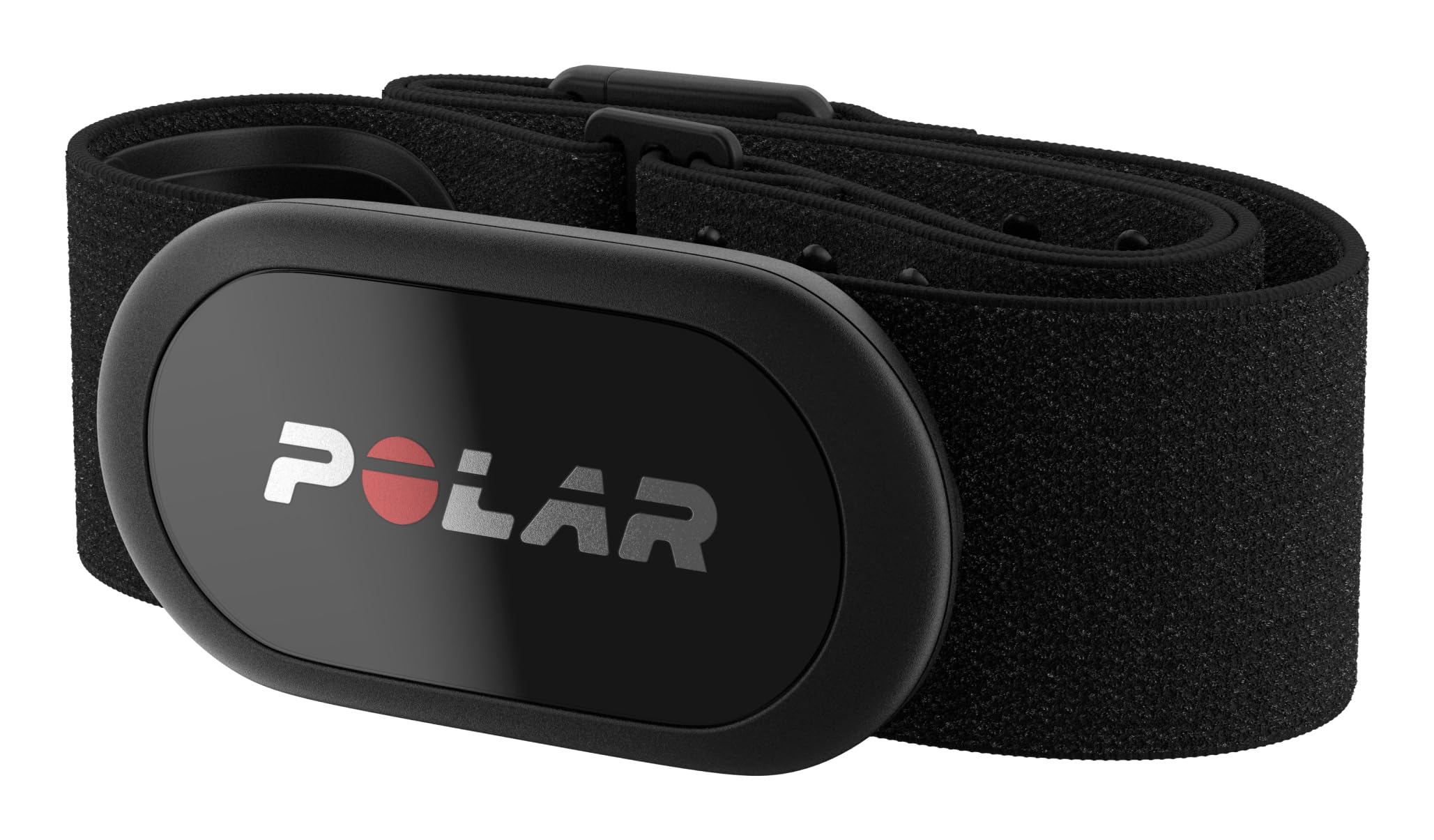
The Polar H10 remains the benchmark for ECG chest straps thanks to its industry-validated accuracy. Unlike optical sensors that can lag during rapid heart rate changes, the H10 captures electrical signals directly from the myocardium, making it the go-to choice for HRV analysis in apps like HRV4Training and Elite HRV. The dual Bluetooth connection allows you to broadcast to a phone and a smartwatch at the same time, while the ANT+ and 5 kHz (GymLink) channels ensure compatibility with older gym consoles.
The included Polar Pro strap uses silicone dots on the inner surface to stay put without constant rewetting — a huge improvement over the older fabric-only designs. The H10 also stores one full workout in its internal memory, which is useful when you want to run without a phone on your arm. Battery life is rated at roughly 400 hours from a single CR2025 coin cell, and the pod is fully waterproof to 30 meters.
Some users report that the strap fabric degrades after several months of heavy use, which can cause erratic readings until the strap is replaced. The coin-cell battery door is serviceable but requires a small screwdriver to open. If you need absolute gold-standard precision for recovery science or competitive training, the H10 is the unit every serious athlete should own.
Why it’s great
- ECG-level accuracy verified by multiple independent test labs
- Simultaneous dual Bluetooth + ANT+ + 5 kHz connectivity
- Internal memory stores one workout without a phone
Good to know
- Fabric strap may lose elasticity after months of frequent washing
- Battery compartment requires a tool to open (small screwdriver)
2. Garmin HRM 600

The Garmin HRM 600 is the most feature-rich chest strap on this list, designed for runners who want more than just heart rate. It captures advanced running dynamics — vertical oscillation, ground contact time, stride length, and a unique metric called step speed loss — all of which are transmitted in real time to compatible Garmin watches and cycling computers. That data is invaluable if you are working on form efficiency and want to see how your fatigue level affects your gait.
The strap uses a rechargeable lithium-ion battery that charges via a standard Garmin charging cable, eliminating the need for coin-cell replacements. Battery life is roughly two months per charge, depending on usage. The strap itself is machine-washable and available in XS-S and M-XL sizes to fit different body types. The pod is detachable, so you can buy a replacement strap if the original wears out without replacing the whole unit.
Because this is a premium Garmin-tier product, it is best paired with a Garmin watch to unlock all running dynamics; standalone use still gives you accurate HR and HRV data, but you lose the advanced metrics. The price is also notably higher than entry-level straps. If you already own a Garmin Forerunner or Edge series device and want the deepest possible biomechanical feedback, this is the monitor to buy.
Why it’s great
- Rechargeable battery (no coin-cell swaps) with Garmin cable
- Advanced running dynamics for form analysis
- Machine-washable strap with two size options
Good to know
- Full running dynamics require a compatible Garmin watch
- Premium price compared to standard chest straps
3. Garmin HRM-Fit Heart Rate Monitor Purpose Built for Women

The Garmin HRM-Fit solves the problem that has plagued chest straps for decades: they are uncomfortable for anatomy with breasts. Instead of an elastic band that wraps around the ribcage, the HRM-Fit clips directly onto the center front of a medium- or high-support sports bra. The sensor pod sits flat against the bra fabric and uses the tension from the bra to maintain skin contact, eliminating the need for a separate chest band entirely.
Despite the non-traditional mounting, the HRM-Fit still transmits accurate real-time heart rate and running dynamics (vertical oscillation, ground contact time, stride length) to compatible Garmin watches. It also captures pace and distance during treadmill runs and stores activity data for later sync when your watch is out of range. The battery is a standard coin cell rated for roughly one year of typical use.
The design works best with bras that have a snug, non-stretchy front panel — longline, front-zip, and light-support bralettes may not hold the pod securely. Some users note that the clip adds a visible bulge under tight workout tops, and floor exercises like push-ups can be slightly awkward. If you dislike the pressure of a chest strap and own a Garmin watch, this is the most comfortable alternative on the market.
Why it’s great
- No chest strap — clips onto sports bra
- Delivers running dynamics and treadmill pace
- Long one-year coin-cell battery life
Good to know
- Incompatible with longline, front-zip, or lightweight bras
- Bulky silhouette visible under tight clothing
4. Wahoo TRACKR Heart Rate Monitor

The Wahoo TRACKR is a modernized chest strap that replaces the disposable coin-cell battery with a high-capacity rechargeable cell. Wahoo claims up to 200 hours of active use per charge, which means you can train daily for months before needing to plug in. Charging is done via a USB-C cable — the same one you use for a phone or laptop — so there is no proprietary dock to lose.
The strap itself is slim and uses a soft, silicone-backed fabric that grips the skin without sliding down during sweaty indoor sessions. The sensor pod has intuitive LED indicators that show heart rate detection, battery status, and connection state at a glance. It supports both Bluetooth and ANT+, so it pairs seamlessly with Zwift, Peloton apps, and Garmin watches without any compatibility fuss.
Some users with larger chests found the included strap too short and had to buy a third-party replacement. The pod is also on the larger side compared to the tiny Polar H10 sensor unit. If you want the convenience of recharging instead of hunting for CR2032 batteries and you train mostly on indoor platforms that support Bluetooth or ANT+, the TRACKR delivers solid accuracy and excellent endurance.
Why it’s great
- USB-C rechargeable battery (200-hr capacity)
- Intuitive LED status indicators for connection and battery
- Dual Bluetooth + ANT+ connectivity
Good to know
- Strap may be too short for larger chest circumferences
- Sensor pod is physically larger than Polar H10
5. Scosche Rhythm+ 2.0 Heart Rate Monitor Armband

The Scosche Rhythm+ 2.0 is a third-generation optical armband that many endurance athletes consider the standard for non-chest-strap HR monitoring. It wraps around your forearm or upper arm with a breathable polyester band and uses dual-wavelength optical sensors to read heart rate even through darker skin tones, which is a genuine advantage over single-LED armbands that struggle with melanin absorption.
The Rhythm+ 2.0 supports both Bluetooth and ANT+ simultaneously, so you can send data to a smartwatch and a phone app at the same time. Battery life is rated at 24 continuous hours — enough for multi-day training camps. The IP68 rating means it is fully submersible and can handle any amount of sweat, rain, or even a dunk in the pool. It also transmits HRV and RR interval data for recovery apps like Morpheus and HRV4Training.
Some users report that the armband fit can be hard to dial in, especially on the upper arm where it may pinch or slide during heavy lifting. There are also isolated reports of Bluetooth dropouts and inaccurate spikes during high-intensity intervals. The proprietary charging cable is another minor frustration. If you want a comfortable, all-day wear optical monitor for general fitness and recovery tracking, this is a proven performer.
Why it’s great
- Dual-wavelength optical sensor works well on varied skin tones
- IP68 waterproof rating for pool use
- Streams HRV and RR interval data to recovery apps
Good to know
- Proprietary charging cable (not USB-C)
- Fit can be finicky on upper arm
6. COOSPO HW9 Bluetooth 5.0 ANT+ Heart Rate Monitor Armband

The COOSPO HW9 is an optical armband that competes directly with the Scosche Rhythm+ 2.0 but adds a smart twist: a five-color LED ring that shows your current heart rate zone at a glance. You can customize the max heart rate value in the CooSporide app, and the band will vibrate if you exceed that threshold — a useful safety feature for high-intensity interval training where you want to stay below a red-line zone.
Accuracy is rated at ±1 BPM, and the sensor uses Bluetooth 5.0 and ANT+ for dual-protocol pairing. That means you can connect simultaneously to a phone for app recording and a bike computer for live display. Battery life is a strong 35 hours on a single charge via the included magnetic charging cable. The kit also includes two arm straps (a short and a long) to accommodate different arm circumferences, plus a detailed manual.
Some units have reported early failures where the sensor began reading 50 BPM during actual high-effort intervals — a known defect with certain production batches. The strap material can also stretch out over time, requiring you to tighten it more aggressively. At its price point, the HW9 packs more features (zone LED, vibration alert, dual straps) than any other optical armband, but reliability consistency has not yet matched the Scosche or Polar names.
Why it’s great
- 5-color LED zone indicator for instant visual feedback
- Vibration warning when exceeding custom max heart rate
- Two arm straps included for different sizes
Good to know
- Early failure reports (stuck at 50 BPM) in some units
- Strap elasticity diminishes over extended use
7. Fitbit Inspire 3 Health & Fitness Tracker

The Fitbit Inspire 3 is not a dedicated heart rate monitor — it is a consumer fitness tracker with a wrist-based optical sensor. Its appeal for at-home monitoring lies in its all-day wearability: you can track 24/7 resting heart rate, receive high/low heart rate notifications, and get a daily Stress Management Score based on HR variability. The color touchscreen shows your heart rate in real time, and the small form factor is lighter than any armband or chest strap.
Battery life is an impressive 10 days with the always-on display turned off, which beats every dedicated HR monitor on this list. The Inspire 3 also provides automatic sleep stage tracking and a Smart Wake alarm. The included 3-month Google Health Premium membership adds personalized coaching, but the subscription is not required for any of the core heart rate features. It is water-resistant to 50 meters.
Wrist-based optical sensors are inherently slower to react than chest straps, and the Inspire 3 will lag behind during interval spurts — its readings are smoothed out for trend rather than instant spike response. The strap hinge on the included band has been reported to break after a few months of daily wear. If your primary goal is casual wellness tracking and occasional moderate-pace exercise, the Inspire 3 is a capable all-day companion. For serious HR zone training, a dedicated chest or arm monitor is more reliable.
Why it’s great
- Excellent 10-day battery life between charges
- Lightweight, comfortable for 24/7 wear
- Track sleep stages and stress management score
Good to know
- Wrist-based optical sensor lags behind chest/arm units
- Strap hinge durability is a known weak point
FAQ
Can I use an optical armband for heart rate variability (HRV) tracking?
Why does my wrist-based smartwatch show different heart rate than a chest strap?
Can I connect an ANT+ heart rate monitor to a phone?
How often should I replace the strap on a chest heart rate monitor?
Final Thoughts: The Verdict
For most users, the best at-home heart rate monitor winner is the Polar H10 because it combines ECG-level accuracy, universal connectivity (Bluetooth+ANT++5 kHz), and proven reliability for both HRV analysis and everyday training. If you want the convenience of recharging and a modern USB-C port, grab the Wahoo TRACKR. And for dedicated Garmin ecosystem users who demand running dynamics, nothing beats the Garmin HRM 600.

Mo Maruf
I created WellFizz to bridge the gap between vague wellness advice and actionable solutions. My mission is simple: to decode the research and give you practical tools you can actually use.
Beyond the data, I am a passionate traveler. I believe that stepping away from the screen to explore new environments is essential for mental clarity and physical vitality.