Our readers keep the lights on and my smoothie glass nicely filled. As an Amazon Associate, I earn from qualifying purchases.
Freshly milled flour changes your baking in a way you won’t understand until you taste it. That first loaf made from grains you ground yourself has a nutty sweetness and a lightness no bag from the store can match. The right machine determines whether this becomes a simple daily habit or a frustrating chore you abandon after two uses.
I’m Mohammad Maruf — the founder and writer behind WellFizz. My research into at-home milling has focused on burr types, motor durability, and the real-world output consistency that determines whether a machine turns hard wheat berries into usable flour batch after batch.
After evaluating seven different models on motor power, grinding chamber materials, and fineness range, I’ve narrowed the field to the machines that actually deliver on their promises. This guide breaks down the best at home grain mill for every kitchen setup and baking volume.
How To Choose The Best At Home Grain Mill
Picking a grain mill comes down to matching the machine’s grinding mechanism and duty cycle to how much flour you actually plan to make each week. Impact mills run at higher speeds and produce finer flour for bread, while burr mills offer more texture range. Your decision should start with the type of grains you mill most and the volume you need in a single session.
Impact vs Burr: Which Grinding Mechanism Fits
Impact mills like the NutriMill and The Kitchen Mill use high-speed stainless steel heads that smash grains into fine flour in one pass. They excel at producing consistent bread flour from hard wheat and handle large batches quickly. Burr mills, typically stone or steel, crush grains between two surfaces and offer better control over coarser grinds for cereals or cracked grains. If your primary goal is fine flour for baking, an impact mill wins. If you want porridge, cracked wheat, and variable textures, a burr mill gives you that flexibility.
Motor Power and Duty Cycle
A 1000W to 2000W motor is the sweet spot for home use. Lower wattage mills struggle with hard grains like kamut or spelt and overheat quickly. But raw wattage isn’t everything — the duty cycle matters more for batch bakers. Machines rated for continuous operation or with built-in cool-down timers prevent burnout. Most blade-based mills need a 5 to 10 minute rest after every 3 minutes of grinding. Impact mills typically run longer before needing a break, making them better for producing multiple loaves in one session.
Fineness Range and Adjustability
Look for a machine that delivers at least 70 to 300 mesh. The lower end gives you coarse meal for cereals and the high end produces flour fine enough for pastries and bread. Impact mills usually offer a dial or speed control that adjusts particle size. Blade-based mills rely on grinding time — longer runs yield finer flour. If precise texture control matters, a mill with discrete settings is easier to replicate batch after batch than one where you have to time every grind manually.
Capacity and Footprint
Hopper size determines how much grain you can load at once. A 6 to 8 cup hopper handles enough wheat for two standard loaves, while larger hoppers suit weekly batch milling. Counter space is also a factor — upright blade mills occupy less footprint than bulky impact machines with separate hoppers and flour canisters. Measure your counter depth before buying, especially for the taller swing-type models that need headroom for the lid to open fully.
Build Materials and Cleaning
304 stainless steel grinding chambers resist corrosion and won’t leach flavors between batches. Plastic components lower the weight but may crack over time, especially around lid latches and hopper attachments. Cleaning protocols vary dramatically — impact mills with cyclone filtration are simpler to wipe down, while blade mills require brushing every crevice to prevent rancid flour buildup. Avoid any mill whose chamber cannot be fully accessed for cleaning, as trapped particles eventually compromise grind quality and freshness.
Quick Comparison
On smaller screens, swipe sideways to see the full table.
| Model | Category | Best For | Key Spec | Amazon |
|---|---|---|---|---|
| NutriMill Impact Compact | Impact | High-volume bread flour | 8-cup hopper, 12-cup canister | Amazon |
| The Kitchen Mill | Impact | Fast fine flour in small footprint | 24 cups flour in under 10 min | Amazon |
| Beautiq HC-750Y | Blade | Large-batch spice and grain grinding | 750g capacity, 70-300 mesh | Amazon |
| INSELY 700g | Blade | Multi-purpose dry material grinding | 50-300 mesh, 3-layer blades | Amazon |
| VEVOR 500g | Swing Blade | Even grinding with swing action | 270° swing, 30-300 mesh | Amazon |
| OKF 550g | Blade | Fine spice and herb grinding | 2000W motor, 70-300 mesh | Amazon |
| HORUS 750g | Blade | Entry-level occasional milling | 1800W, 50-300 mesh, timer | Amazon |
In‑Depth Reviews
1. NutriMill Impact Compact
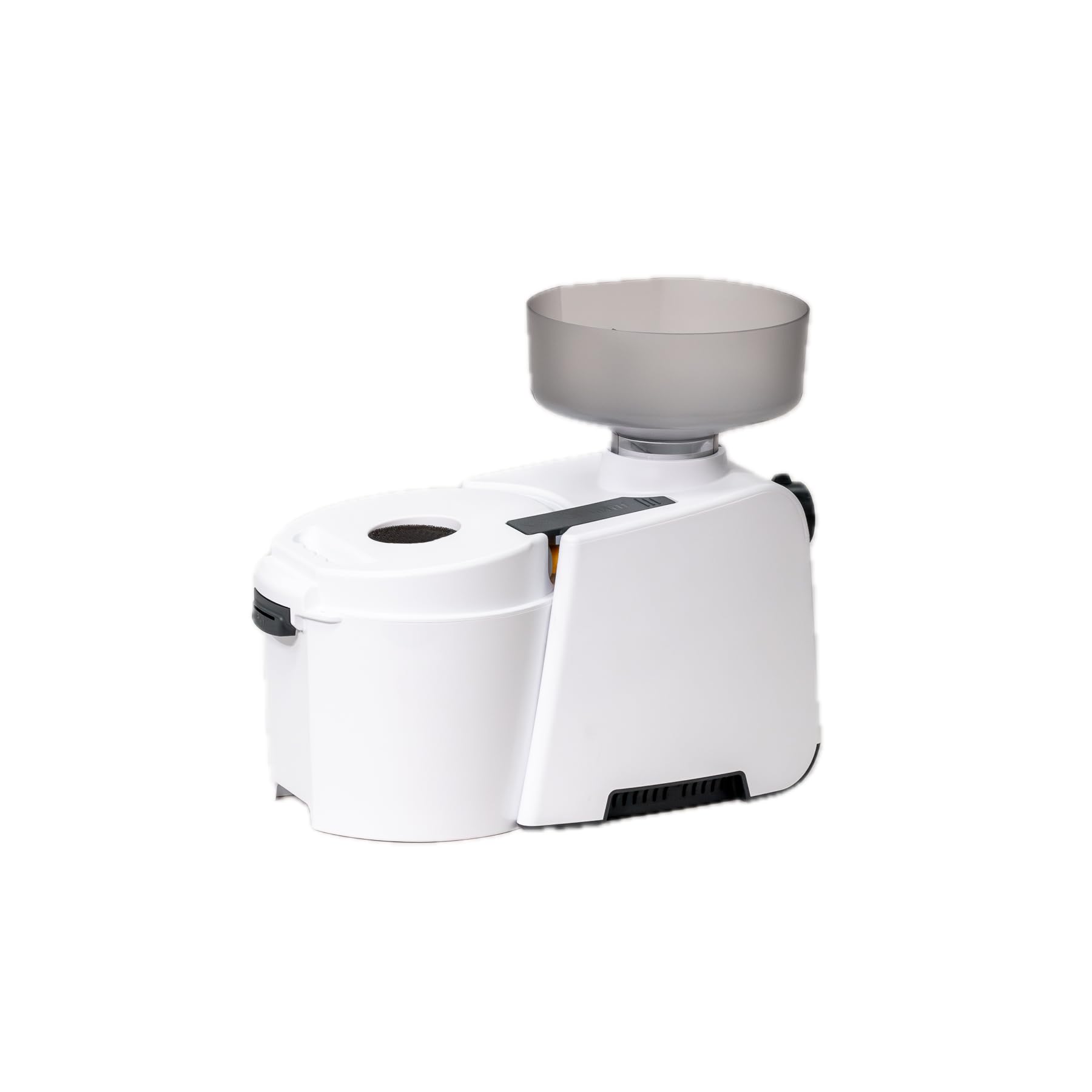
The NutriMill Impact Compact earns the top spot because it solves the biggest problem home bakers face: milling enough flour for multiple loaves without overheating or slowing down. Its 1200-watt motor and patented cyclone air filtration keep the milling heads cool even during extended runs, which preserves nutrient integrity in the flour. The 8-cup hopper feeds directly into the impact chamber, and the 12-cup flour canister catches everything without dust spillover.
What sets this machine apart is the texture control. Seven settings from coarse to ultra-fine let you dial in exactly the flour you need for bread, pastries, or cereals. The impact heads are stainless steel and designed specifically for hard wheat berries, delivering consistent particle size across the full range. Users report grinding 12 cups of flour in about 5 minutes, which is faster than any blade-based mill at this price.
The compact nesting design means the hopper, canister, and motor base fit together for storage, saving counter space. Cleaning is straightforward — a quick brush on the chamber and a wipe of the canister. The only caveat is that the lowest speed settings can struggle with grain feeding, so stick to settings 3 through 7 for reliable throughput. For anyone baking 2 to 4 loaves a week, this mill removes the friction from fresh flour production.
Why it’s great
- Cyclone air filtration prevents overheating during long sessions
- Seven texture settings from coarse cereal to ultra-fine pastry flour
- Compact nesting design saves major counter space
Good to know
- Low speed settings may struggle to feed grain consistently
- Not suited for oily seeds or wet ingredients
2. The Kitchen Mill

The Kitchen Mill has been in production since 1976, and that longevity speaks directly to the durability of its design. A 1000-watt commercial motor drives stainless steel impact heads that never gum or jam, even with glutinous grains like rice or millet. The machine produces up to 24 cups of flour in under 10 minutes, which makes it the fastest option in this roundup for bulk bakers.
The milling chamber is entirely stainless steel, and the transparent plastic pan lets you monitor flour output in real time. Cleaning is remarkably simple — a baker’s brush or dry towel is all you need because the impact mechanism doesn’t leave residue trapped in crevices. The mill is also the most compact and lightweight impact model available, measuring just 10 inches wide and weighing 8 pounds, so it tucks into tight kitchens easily.
There are two trade-offs to know. This mill only produces fine flour — there are no coarse or cracked grain settings, so it’s strictly for bakers who want bread or pastry flour. The clear plastic lid also feels less robust than the rest of the machine, and some users report wear at the attachment point over a year of use. But for straightforward, high-speed fine flour production, The Kitchen Mill is a workhorse that won’t quit.
Why it’s great
- Produces 24 cups of fine flour in under 10 minutes
- Stainless steel chamber never gums or jams
- Most compact and lightweight impact mill available
Good to know
- Only produces fine flour — no coarse or cracked grain settings
- Clear plastic lid has a relatively fragile attachment point
3. Beautiq HC-750Y
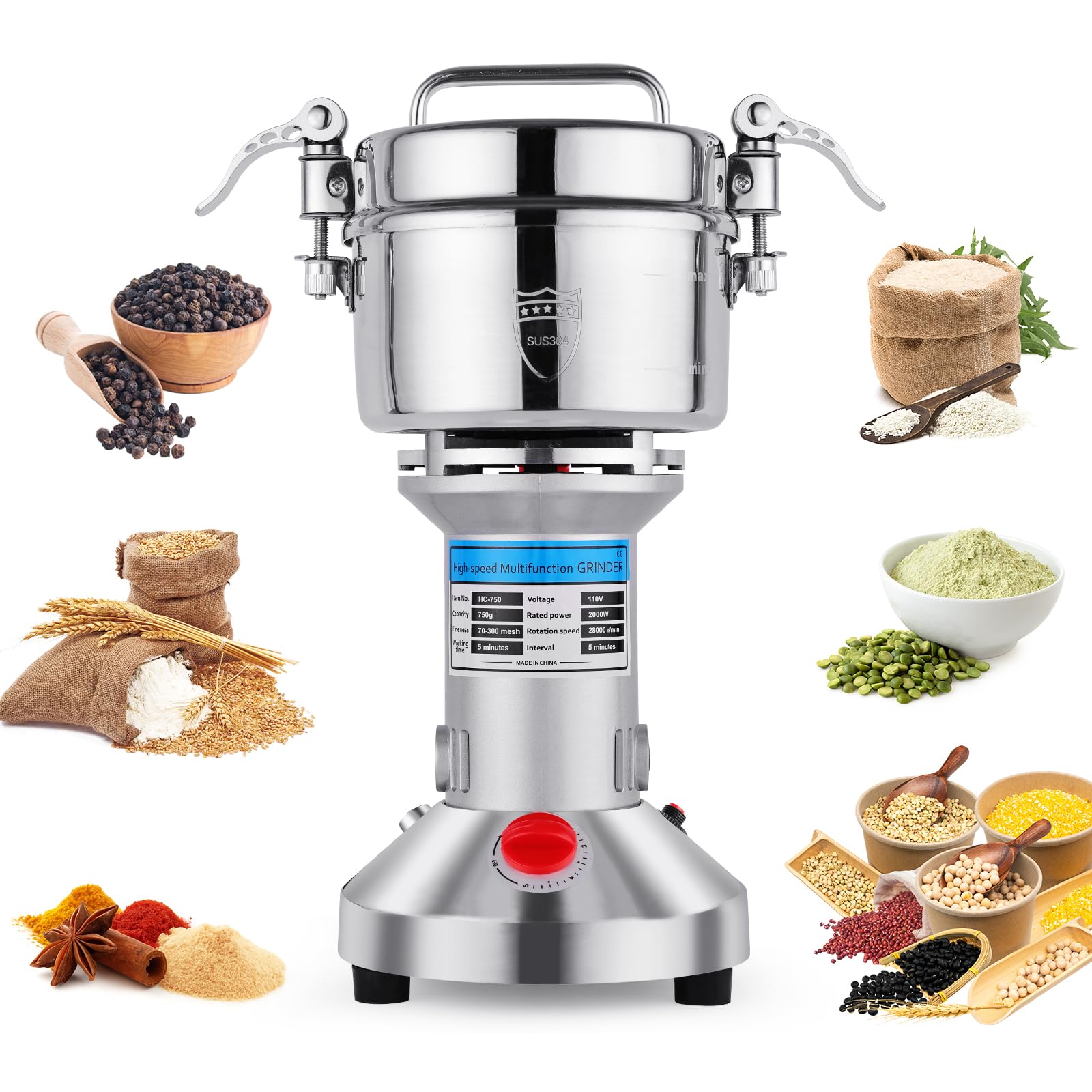
The Beautiq HC-750Y bridges the gap between home and light commercial use with its 750-gram grinding capacity and a 2000-watt copper motor that spins at 28,000 RPM. The multi-blade system includes powdering blades, turnabout blades, and a powder-sweeping blade that ensures uniform particle size from 70 to 300 mesh. Overload protection with a red reset button adds a layer of safety that budget mills often skip.
What makes this stand out is the user-friendly timer control and the safety interlock that prevents operation unless the lid is fully secured. The 304 stainless steel chamber resists staining and flavor transfer, which matters if you switch between spices, coffee, and grains. Users consistently report ultra-fine flour from hard white and durum wheat berries with minimal effort, and the included sifter lets you separate any coarse remnants for regrinding.
The main drawback is noise. At 28,000 RPM, this mill is loud enough that you’ll want to run it when the kitchen is empty. The duty cycle also requires a 3-minute max run time with a cool-down interval, so continuous large batches take longer. If you need a versatile machine that handles everything from cornmeal to espresso powder and can grind a full pound of grain in one go, the HC-750Y delivers solid value.
Why it’s great
- 750-gram capacity handles full-pound batches of grain
- Three-blade system delivers even 70-300 mesh results
- 304 stainless steel resists staining and flavor transfer
Good to know
- Noise level is significant at full RPM
- Max 3-minute run time before required cool-down
4. INSELY 700g

The INSELY 700g is built around a 2000-watt pure copper motor with a three-layer stainless steel blade system designed for wear resistance. It achieves fineness from 50 to 300 mesh within 60 seconds, which covers everything from coarse meal for porridge to ultra-fine flour for delicate pastries. The included spare blades, carbon brushes, and cleaning brush make this a self-sufficient kit for the long term.
Safety features include a dual-buckle locking lid and an overload protection circuit that cuts power and resets with a red button. The machine is stable during operation and the blades are removable for sharpening, which extends the mill’s useful life beyond what most blade mills offer. Users find it effective for sourdough starter prep, coffee grinding, and turning dried peas into flour for gluten-free baking.
The main concern is consistency across batches. Some users report that the timer switch feels less durable than the motor itself, and a few units trigger the overload protection after just 15 seconds of continuous use, which suggests quality control variation. The capacity is also listed differently depending on the source — the grinding bin holds 700 grams, but the official specs say 300 grams, so check the packaging. For occasional milling where you don’t need repeatable precision, this machine holds up well.
Why it’s great
- Three-layer stainless steel blades are removable for sharpening
- 50-300 mesh range covers all common flour textures
- Comprehensive accessory kit with spare blades and carbon brushes
Good to know
- Timer switch feels less durable than the motor
- Some units trigger overload protection prematurely
5. VEVOR 500g
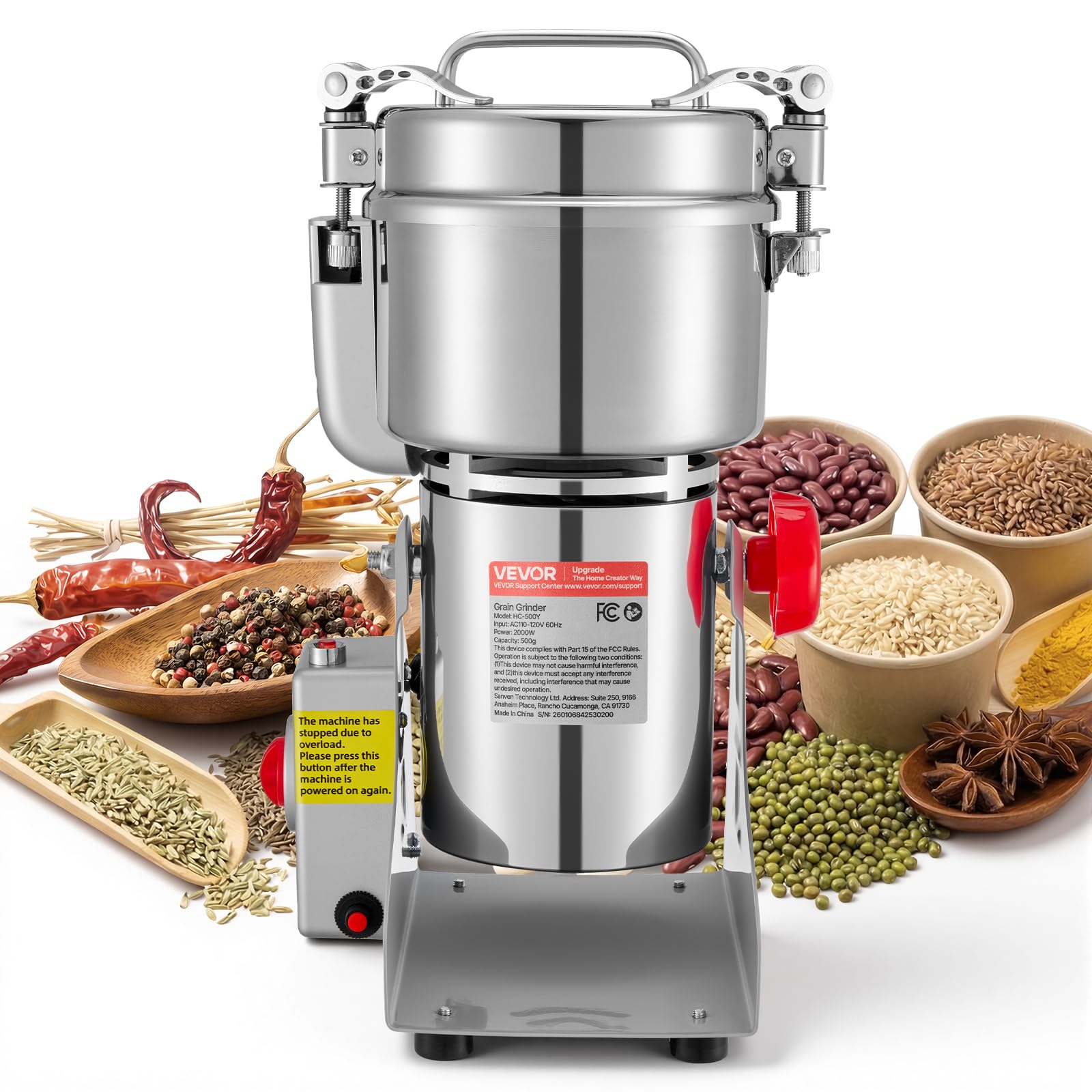
The VEVOR 500g distinguishes itself with a 270-degree swing design that agitates the grinding chamber during operation, preventing material from settling at the bottom and producing more uniform particle distribution. The 2000-watt motor drives upgraded three-layer stainless steel blades at 28,000 RPM, and the fineness is adjustable from 30 to 300 mesh via a three-stage timer system — 5, 15, or 30 seconds.
The build quality is a step above comparably priced mills. The housing is fully stainless steel with polished surfaces and no sharp edges, and the lid features a secure locking mechanism with an auto-stop sensor that halts the blades if the lid opens. Overload protection is built in, and the included sieve lets you check your grind consistency and decide whether to run another cycle.
Users consistently praise the quiet operation relative to other blade mills at this wattage. The machine handles wheat berries, coffee beans, nori seaweed, and hard spices without issue. The caveat is that the 500-gram capacity feels limiting if you regularly bake more than two loaves at once. It also cannot process semi-moist ingredients like fresh ginger or turmeric. For a compact, well-built mill that delivers even grinds without excessive noise, VEVOR delivers.
Why it’s great
- 270-degree swing action prevents material settling for even grinds
- Fully stainless steel body polished with no sharp edges
- Quieter operation than most 2000W blade mills
Good to know
- 500-gram capacity limits large batch production
- Not suitable for semi-moist ingredients like ginger or turmeric
6. OKF 550g

The OKF 550g packs a 2000-watt pure copper motor into a compact frame that measures just 5.5 inches wide and 14 inches tall, making it one of the most space-efficient blade mills available. The triple-blade system — powder blade, rotary blade, and dust removal blade — works together to pulverize dry materials from 70 to 300 mesh. The timer-based control lets you dial in fineness by adjusting grind duration rather than relying on a physical dial.
The 304 stainless steel construction is food-grade and heavy-duty, weighing 7.7 pounds with a stable base that won’t walk across the counter during operation. Users report that it grinds hard wheat to usable flour in under 60 seconds and handles cinnamon sticks, nutmeg, and other dense spices without strain. The cleaning protocol is simple — a dry brush or damp cloth on the inner chamber — and the included brush reaches the blade crevices effectively.
The primary limitation is the duty cycle. Continuous grinding should not exceed 5 minutes, after which the machine needs a 5 to 10 minute rest. This extends total milling time if you’re processing more than 550 grams. The lid also lacks a kill switch — it locks securely, but there’s no electronic interlock to stop the motor if opened during operation. For small to medium batches where counter space is at a premium, the OKF delivers reliable performance in a compact package.
Why it’s great
- Compact 5.5-inch footprint ideal for tight counter spaces
- Triple-blade system produces fine powder in under 60 seconds
- 304 food-grade stainless steel with heavy-duty build
Good to know
- No electronic lid interlock for safety during operation
- Max 5-minute continuous run time requires cool-down breaks
7. HORUS 750g
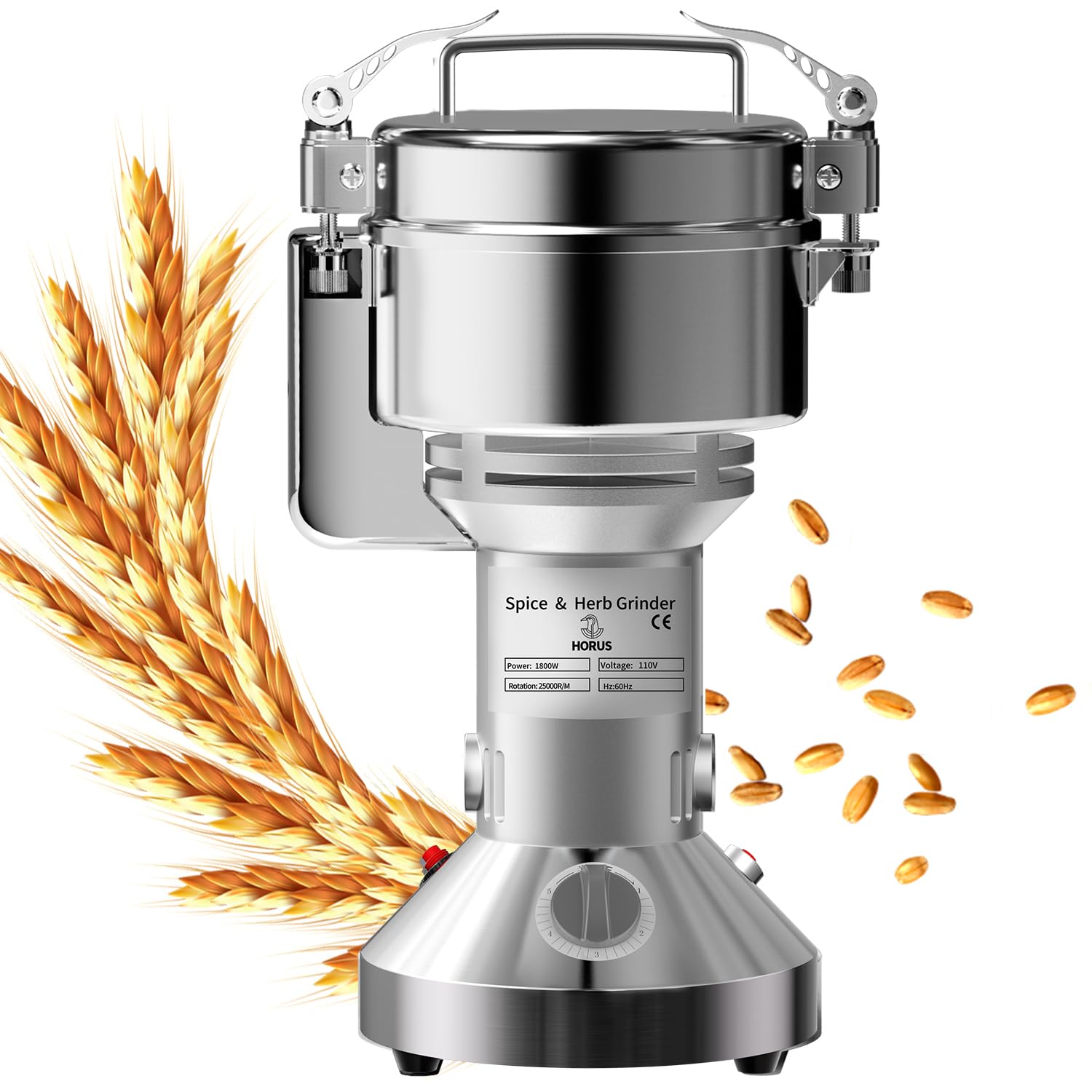
The HORUS 750g is the entry-level option in this roundup, but it brings genuine value through UL certification and a build quality that exceeds expectations at its tier. The 1800-watt copper motor spins at 25,000 RPM and produces fineness from 50 to 300 mesh, controlled by an auto-shutoff timer adjustable from 0 to 5 minutes. The high-temperature resistant motor and all-aluminum pedestal add durability that cheap plastic mills lack.
Safety features include a micro switch that prevents operation when the lid is open and overload protection that cuts power under excessive load. The included spare blades, carbon brushes, and cleaning kit make maintenance straightforward. Users find it effective for occasional home use — milling 2/3 cup of wheat berries yields about 1 cup of flour, which works for one loaf if you’re willing to run two batches. The manufacturer has sold over a million units overseas, which suggests a proven track record.
The grinding speed is slower than the 2000W models, and the flour tends to come out slightly grainy unless you run it through the included sifter or extend the grind time. The packaging also needs improvement — several units have arrived damaged due to flimsy shipping boxes. If you’re starting your home milling journey on a tight budget and only bake occasionally, the HORUS gives you a functional entry point without sacrificing safety certification.
Why it’s great
- UL-certified with micro switch and overload protection
- All-aluminum pedestal and high-temperature motor add durability
- Generous accessory kit includes spare blades and carbon brushes
Good to know
- Slower milling speed compared to 2000W alternatives
- Packaging is insufficient to prevent shipping damage
FAQ
Can a home grain mill grind oily seeds like flax or sesame?
What is the difference between 304 and 403 stainless steel in grain mills?
How long does fresh-milled flour stay fresh compared to store-bought?
Why does my grain mill smell like burning plastic the first time I use it?
Final Thoughts: The Verdict
For most users, the best at home grain mill winner is the NutriMill Impact Compact because it combines the speed and consistency of impact milling with a compact footprint and seven texture settings that cover every flour need. If you want a mill that delivers the fastest fine flour production and prioritizes a small counter footprint, grab the The Kitchen Mill. And for large-batch baking on a tighter budget where you need a versatile blade mill that handles spices and coffee alongside grains, nothing beats the Beautiq HC-750Y.

Mo Maruf
I created WellFizz to bridge the gap between vague wellness advice and actionable solutions. My mission is simple: to decode the research and give you practical tools you can actually use.
Beyond the data, I am a passionate traveler. I believe that stepping away from the screen to explore new environments is essential for mental clarity and physical vitality.