Our readers keep the lights on and my smoothie glass nicely filled. As an Amazon Associate, I earn from qualifying purchases.
The difference between a mediocre morning latte and a café-quality one comes down to pressure, temperature stability, and the burr grinder sitting on your counter. At-home espresso machines have evolved from bulky commercial clones into precision appliances that can pull a 25-second shot with programmable extraction curves, PID temperature control, and grind-by-weight dosing algorithms that would have seemed impossible a decade ago.
I’m Mohammad Maruf — the founder and writer behind WellFizz. I’ve spent years analyzing espresso machine specifications, studying pump curves, boiler materials, and grinder burr geometries to help home baristas separate genuine performance upgrades from marketing hype.
Whether you are chasing silky microfoam for latte art or a bold ristretto that cuts through oat milk, finding the right best at home coffee and espresso machine requires understanding which features actually affect your cup quality and which are just decorative dials.
How To Choose The Best At Home Coffee And Espresso Machine
The at-home espresso market spans from entry-level semi-automatics with pressurized baskets to super-automatic bean-to-cup systems that grind, tamp, brew, and steam with a single button press. The right choice depends on how much control you want, how much counter space you have, and whether you prefer manual artistry or push-button convenience.
Pump Pressure Group Head Dynamics
A 15-bar or 20-bar pump rating sounds impressive, but the actual extraction pressure at the group head should sit around 9 bars for standard espresso. Machines with an Over-Pressure Valve (OPV) allow you to tune or maintain that sweet spot, preventing channeling and over-extraction. Cheaper machines often advertise high pump ratings but lack the OPV to regulate that pressure down to the effective range.
Integrated Grinder vs. Separate Grinder
Built-in conical burr grinders save counter space and provide on-demand dosing directly into the portafilter. The trade-off is that cleaning the grind path is more cumbersome, and many integrated grinders lack the fine-step resolution of a dedicated grinder. If you drink one type of bean and value convenience, an integrated grinder works well. If you chase single-origin nuances or switch between light and dark roasts frequently, a separate grinder offers better consistency and easier cleaning.
Temperature Control PID vs. Thermostat
PID (Proportional-Integral-Derivative) controllers maintain water temperature within a fraction of a degree, eliminating the temperature swings that cause sour under-extraction or bitter over-extraction. Machines without PID rely on a simple thermostat that allows the brew temperature to drift several degrees during a shot. For consistent results across back-to-back drinks, PID control is non-negotiable.
Steam Wand Performance
Manual steam wands with a single-hole or two-hole tip produce the microfoam needed for latte art if you are willing to practice the technique. Automatic milk frothers and systems like Philips LatteGo steam and froth at the push of a button, which is ideal for beginners or busy mornings but limits control over milk texture. Insulated wands are safer to handle but take slightly longer to cool between uses.
Quick Comparison
On smaller screens, swipe sideways to see the full table.
| Model | Category | Best For | Key Spec | Amazon |
|---|---|---|---|---|
| Gevi 20 Bar Espresso Machine | Semi-Automatic | Home baristas wanting PID & OPV on a budget | 58mm portafilter + 20 bar Ulka pump | Amazon |
| Chefman Crema Supreme 15 Bar | Semi-Automatic | Fresh grinding with 30 grind settings in one package | Integrated conical burr grinder | Amazon |
| MIROX Espresso Machine 15 Bar | Semi-Automatic | Compact build with PID and lightweight ABS shell | PID temp control + 15 precision grinds | Amazon |
| De’Longhi La Specialista Arte Evo | Semi-Automatic | Cold brew in under 5 minutes plus espresso | Cold Extraction Technology | Amazon |
| Breville Barista Express BES870XL | Semi-Automatic | Industry standard for entry-level prosumer espresso | 54mm portafilter + PID + integrated tamper | Amazon |
| Philips 4400 Series EP4444/90 | Super-Automatic | One-touch lattes with minimal cleanup | LatteGo milk system + SilentBrew | Amazon |
| Ninja Luxe Café Pro ES701 | Semi-Automatic | Multi-drink versatility with drip coffee & cold brew | Barista Assist + weight-based dosing | Amazon |
| Philips 5500 Series EP5544/94 | Super-Automatic | 20 presets and 4 user profiles for family households | LatteGo + 4 profile storage | Amazon |
| Bosch VeroCafe 800 TPU60309 | Super-Automatic | App-connected brewing with 35 drink options | Home Connect app + 35 beverage menu | Amazon |
In‑Depth Reviews
1. Breville Barista Express BES870XL
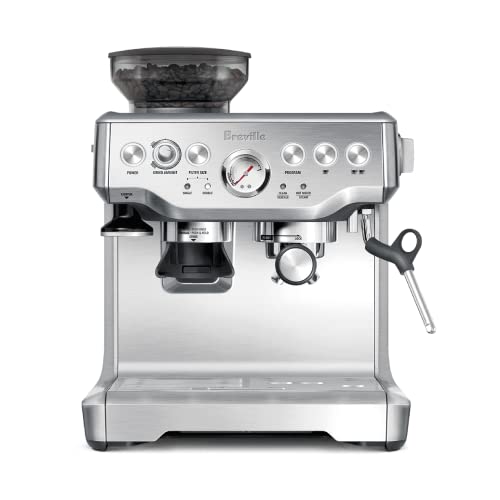
The Breville Barista Express remains the benchmark for entry-level prosumer espresso for good reason. Its integrated precision conical burr grinder feeds directly into the 54mm portafilter, and the low-pressure pre-infusion ramps up gradually to ensure even saturation before full extraction pressure hits the puck. The PID digital temperature control holds brew water within one degree of your set point, which eliminates the sour-bitter swing that plagues thermostat-based machines in this class.
Long-term owners report the machine surviving 2500-plus shots with only routine maintenance like o-ring replacement and showerhead cleaning. The Razor Dose Trimming Tool lets you dial in the perfect puck height, and the integrated tamper stores in the machine body so you never misplace it. The steam wand produces microfoam dense enough for latte art once you develop the technique, though it requires purging and wiping after each use to prevent milk residue buildup.
The 67-ounce water tank handles multiple back-to-back sessions, and the 1/2-pound bean hopper is ample for daily use. The main limitation is the grinder’s step resolution — it offers fine control but cannot match the micro-adjustments of a dedicated high-end grinder. For the home barista who wants one machine that does everything well without requiring a second mortgage, this is the proven workhorse.
Why it’s great
- PID temperature stability delivers consistent shots across different roast levels
- Integrated grinder with dose control eliminates the need for a separate grinding station
- Proven durability with thousands of documented long-term positive owner reviews
Good to know
- Grinder adjustment steps are coarser than dedicated espresso grinders
- Regular cleaning of the showerhead, gasket, and steam wand is mandatory for reliable operation
2. Gevi 20 Bar Espresso Machine
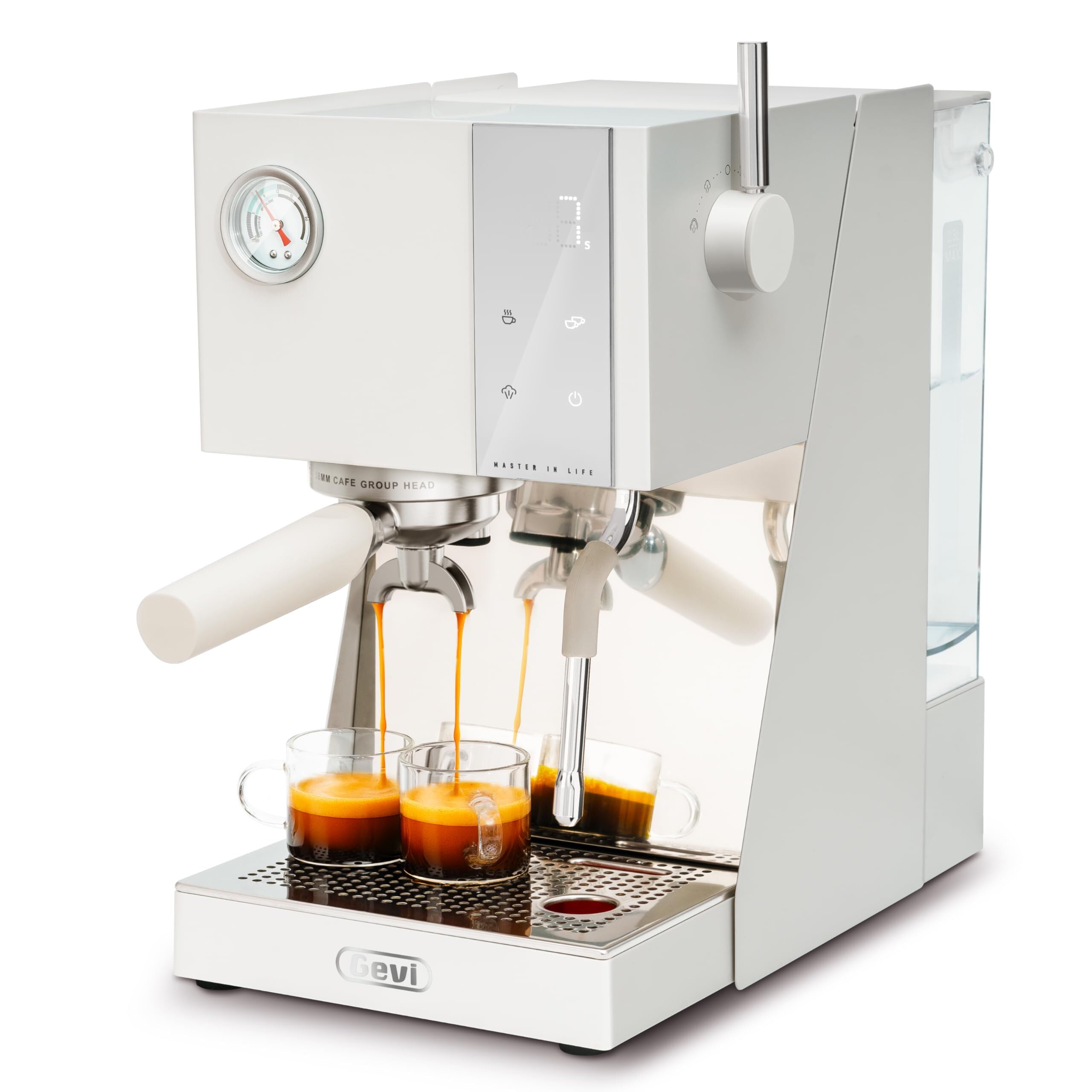
The Gevi 20 Bar machine punches above its tier by offering a commercial 58mm portafilter, an Italian Ulka pump, and PID temperature control with three presets at 92°C, 94°C, and 96°C. The 58mm basket diameter is the same size used in professional espresso machines, which allows for a deeper, more even extraction than the smaller 54mm or 51mm baskets found on many home machines. The real-time touch display shows live shot timer, temperature, and brew pressure so you can visualize your extraction curve as it happens.
The built-in Over-Pressure Valve (OPV) regulates the pump output down to the 9-to-12 bar sweet spot at the group head, and the 3-way solenoid valve releases residual pressure instantly after you stop the shot. The result is dry, solid pucks that knock out cleanly and less wear on the internal components over time. The 2.3-liter detachable water tank is generous for a machine in this price range, and the stainless steel housing gives it a reassuring heft at 21.6 pounds.
The steam wand produces adequate microfoam for cappuccinos and lattes, though it requires more technique than a dual-boiler machine to achieve barista-level silkiness. The included accessories — tamper, milk frothing pitcher, cleaning tools, and both single-wall filter baskets — are genuinely useful rather than filler. Some users note a learning curve to dial in the grind size and tamp pressure, but the PID and OPV combination provides a forgiving platform for developing your skills.
Why it’s great
- 58mm commercial portafilter provides better extraction depth than smaller home baskets
- PID with three temperature presets lets you match brew temp to roast darkness
- OPV and solenoid valve produce dry pucks and protect the machine’s longevity
Good to know
- Steam wand positioning requires some practice for consistent microfoam
- Pairing with an upgraded grinder improves shot consistency beyond the stock setup
3. Chefman Crema Supreme 15 Bar

The Chefman Crema Supreme incorporates a conical burr grinder with 30 grind settings and a pressure gauge display, two features that typically push a machine into a higher price tier. The 15-bar Italian pump provides sufficient pressure for standard espresso extraction, and the semi-automatic operation lets you start and stop the shot manually once you see the pressure gauge hit its target zone. The 58mm portafilter accepts both single and double shot baskets, which is a welcome inclusion at this price point.
The 3-liter water reservoir is the largest in this roundup, making it suitable for entertaining or households that go through multiple drinks in rapid succession. The detachable drip tray includes storage space for the included tamper, milk pitcher, cleaning tools, and grinding funnel, which helps keep the counter organized. Users report that the machine heats up quickly and produces crema-rich shots after a short learning period to dial in the grind setting.
The steam wand performs well for milk texturing, though some users note it is louder than competing models during frothing. The built-in grinder, while convenient, can produce inconsistent dose weights if you do not run it for the full cycle each time — a common trait of integrated grinders in this segment. The machine runs on 1450 watts and is cETL approved. For the price, the combination of a true burr grinder, pressure gauge, and 3-liter tank is competitive.
Why it’s great
- 30 grind settings provide enough resolution for most bean types and roast levels
- Pressure gauge gives real-time visual feedback for consistent shot extraction
- 3-liter water tank reduces refill frequency during multiple drink sessions
Good to know
- Grinder dose consistency benefits from running full cycles rather than partial fills
- Steam wand can be louder than some competitors during frothing
4. MIROX Espresso Machine 15 Bar
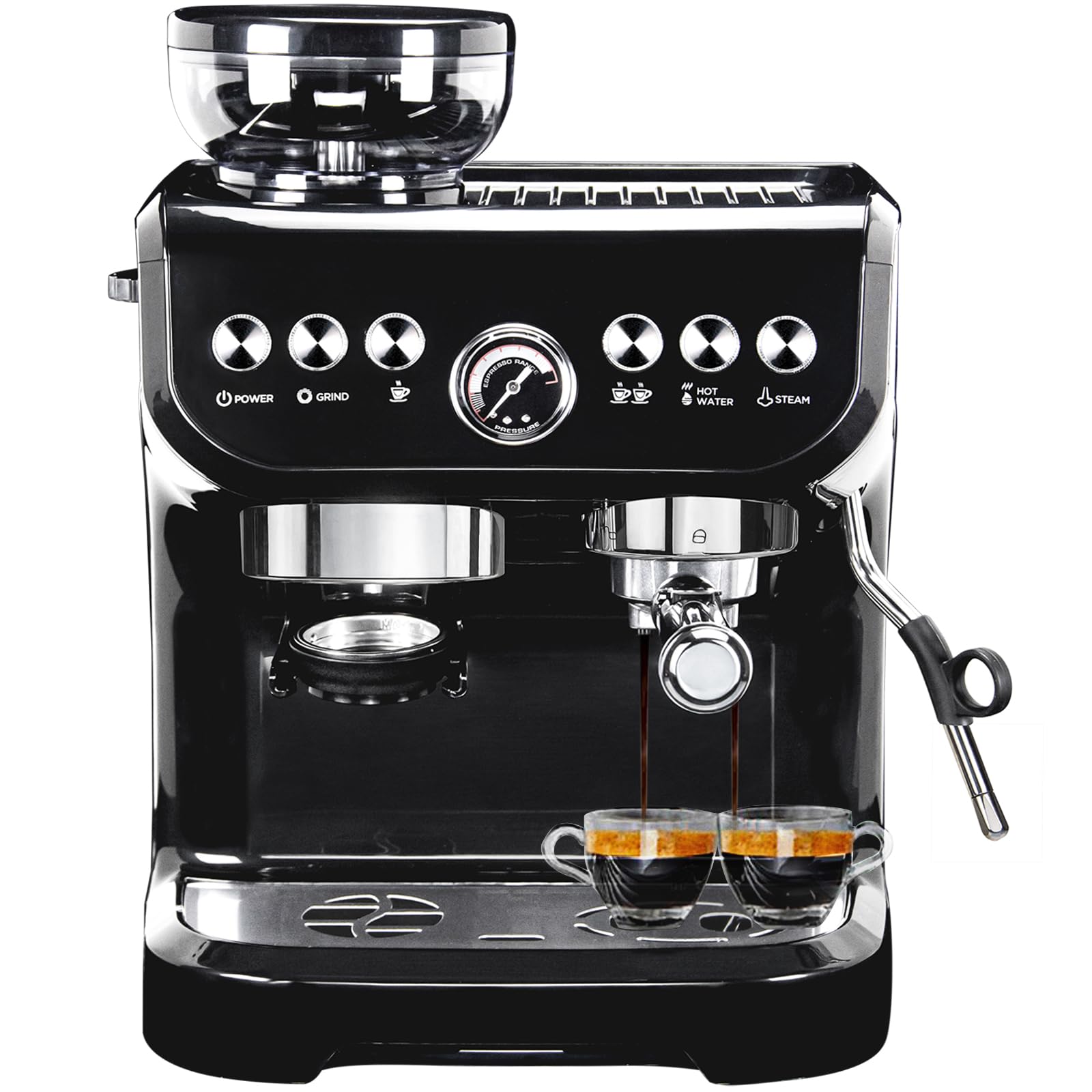
The MIROX 15 Bar machine uses an ABS high-strength plastic shell to keep weight at 17 pounds, making it easier to move and reposition than all-stainless alternatives. The weight reduction does not come at the cost of critical features — it includes PID digital temperature control, a precision conical burr grinder with 15 grind settings, and a low-pressure pre-infusion cycle that ramps up gradually. The 70-ounce water tank is above average for its footprint at 12 inches deep and 12 inches wide.
The integrated grinder delivers on-demand grinding directly into the portafilter, and the manual removable magnetic tamper simplifies the tamping step. The pressure gauge on the front panel provides feedback on extraction pressure, and the PID controller maintains brew temperature within a narrow band for consistent results across consecutive shots. Users report that the machine produces cafe-quality espresso with good crema once the grind setting is dialed in, typically around setting 7 for medium roasts.
The steam wand produces manual microfoam suitable for latte art, though some users note that the wand auto-stops before the milk reaches optimal temperature, requiring a second activation to finish heating. The grinder can produce a slight mess on the counter if the dosing funnel is not aligned carefully, and the lack of a low-water indicator means you have to check the tank manually. For small kitchens where counter space is at a premium, the compact dimensions and lighter build are genuine advantages.
Why it’s great
- PID temperature control prevents sour or bitter shots by maintaining stable brew water temp
- Compact 12×12-inch footprint fits tight counter spaces better than most competitors
- 15 grind settings provide useful range for exploring different bean varieties
Good to know
- Steam wand may auto-stop before milk reaches full temperature, requiring a restart
- ABS shell lacks the premium feel and heat retention of stainless steel
5. De’Longhi La Specialista Arte Evo

The De’Longhi La Specialista Arte Evo sets itself apart with Cold Extraction Technology, which brews a single cold brew coffee in under five minutes by using precisely measured water flow and pressure rates at specific extraction temperatures — developed in collaboration with the Specialty Coffee Association. This eliminates the 12-to-24 hour steep time required by traditional cold brew methods, making it practical for spontaneous iced coffee cravings. The machine also handles standard espresso, Americano, and hot water with four preset recipes.
The built-in conical burr grinder offers 8 grind settings, and the Active Temperature Control technology provides three infusion temperatures to match different roast levels. The barista kit includes a dosing and tamping guide along with a tamping mat to standardize your puck prep. The 15-bar Italian pump handles pre-infusion at low pressure before ramping to 9 bars during extraction, which helps prevent channeling. Users report that the machine produces consistent, repeatable shots with bright crema.
The commercial-style steam wand heats quickly and delivers enough steam pressure for smooth microfoam, though the wand’s range of motion is somewhat limited compared to prosumer machines. The compact design at 14.37 inches deep fits under standard cabinets, and the detachable, dishwasher-safe parts simplify cleanup. Some users note that the grinder can jam with very dark roasts if the setting is too fine, and the quick auto shutoff timer requires re-pressing the brew button for longer drinks. The cold brew feature alone makes this a compelling choice for iced coffee enthusiasts.
Why it’s great
- Cold Extraction Technology delivers concentrated cold brew in under five minutes
- Three infusion temperatures let you optimize extraction for different roast levels
- Included dosing guide and tamping mat help standardize puck preparation
Good to know
- Grinder may jam with very dark roasts at fine grind settings
- Steam wand range of motion is limited compared to standalone units
6. Philips 4400 Series EP4444/90
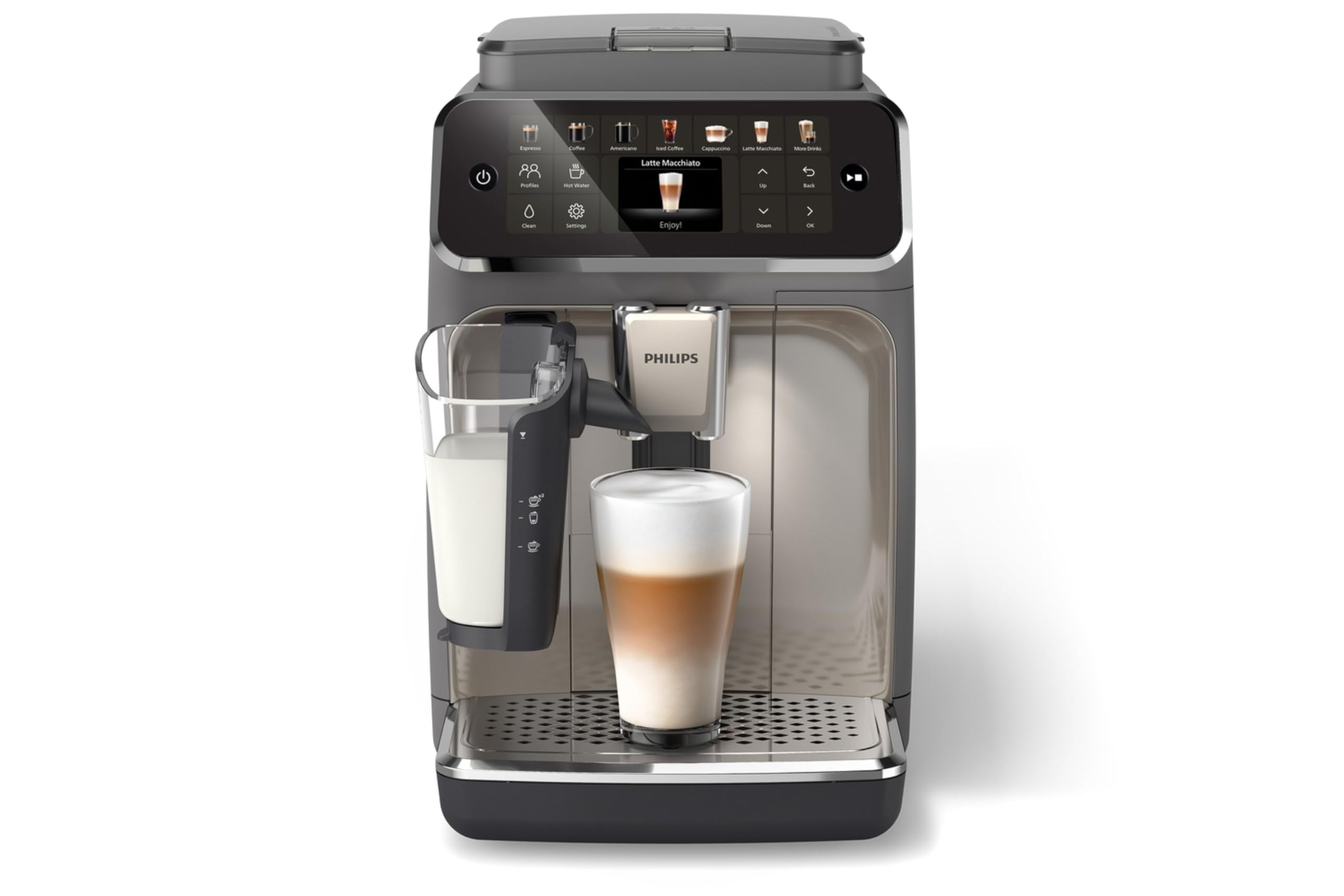
The Philips 4400 Series is a fully automatic super-automatic machine that grinds, tamps, and brews at the push of a button with 12 hot and iced coffee presets. The LatteGo milk system uses a two-chamber design that creates silky froth from both dairy and plant-based milks, and it disassembles into three parts with no internal tubes — rinseable in about 10 seconds or dishwasher safe. The SilentBrew technology uses sound shielding and a quiet grinding mechanism to reduce noise by about 40 percent compared to earlier models.
The intuitive color display lets you adjust strength, volume, and milk level, and you can save up to two user profiles for quick recall of your preferred drinks. The QuickStart feature means the machine is ready to brew in about three seconds, eliminating the warm-up wait. The AquaClean filter allows you to go up to 5000 cups before needing to descale, which significantly reduces long-term maintenance effort. The 1.8-liter water tank handles multiple drinks but requires more frequent refills if you are pulling shots for three or more people in a row.
The machine produces solid espresso with good crema, but the extraction pressure cannot match the controlled 9-bar output of a semi-automatic with an OPV — some users report the shot can come out slightly weak if the beans are not fresh enough. The grinding mechanism is reliable, but the sour pucks common to super-automatics are normal here due to the centrifugal brewing system. For households that prioritize speed, consistency, and easy cleanup over manual control, this is a strong contender.
Why it’s great
- LatteGo system cleans in 10 seconds with no hidden tubes or compartments
- SilentBrew reduces grinding noise significantly for quieter morning operation
- QuickStart reaches brew temperature in about three seconds
Good to know
- Extraction pressure is less controlled than semi-automatic machines with OPV valves
- Water tank requires frequent refills when making multiple consecutive drinks
7. Ninja Luxe Café Pro ES701

The Ninja Luxe Café Pro Series is a four-in-one system that handles espresso, drip coffee, cold brew, and hot water from a single base. The Barista Assist Technology monitors each brew and adjusts grind-size recommendations based on your previous extraction, eliminating the trial-and-error that frustrates beginners. The integrated tamper works with a lever mechanism — no manual pounding required — and the weight-based dosing uses a built-in scale to deliver precise gram measurements rather than relying on timed grinding.
The Dual Froth System Pro combines steaming and whisking simultaneously to create microfoam from dairy and plant-based milks without requiring manual technique. The machine offers 25 grind settings on the conical burr grinder and five espresso styles: single, double, quad shot, ristretto, and lungo. The drip coffee function produces classic, rich, or over-ice brews in sizes from 6 to 18 ounces, and the cold brew function makes cold-pressed espresso or cold brew coffee in minutes. The stainless steel construction weighs 27 pounds, giving it a solid, anchored feel on the counter.
The main drawback is that the machine cannot froth milk and brew espresso simultaneously — the Dual Froth system uses a separate process that adds time to sequential drink preparation. The grind measurement by weight is a step forward, but switching between brew types can overfill the basket if you do not clear the previous setting. Some users report that the quad shot setting produces watery over-extracted espresso with wet grounds if the grind is not dialed in perfectly. For households that want one machine capable of everything from pour-over style coffee to espresso-based drinks and cold brew, this is the most versatile option.
Why it’s great
- Barista Assist recommends grind adjustments based on your previous brew results
- Weight-based dosing ensures accurate grounds measurement without a separate scale
- Integrated tamper with lever mechanism eliminates inconsistent manual tamping
Good to know
- Cannot froth milk and brew espresso at the same time
- Quad shot setting can produce watery pulls if grind is not perfectly dialed in
8. Philips 5500 Series EP5544/94
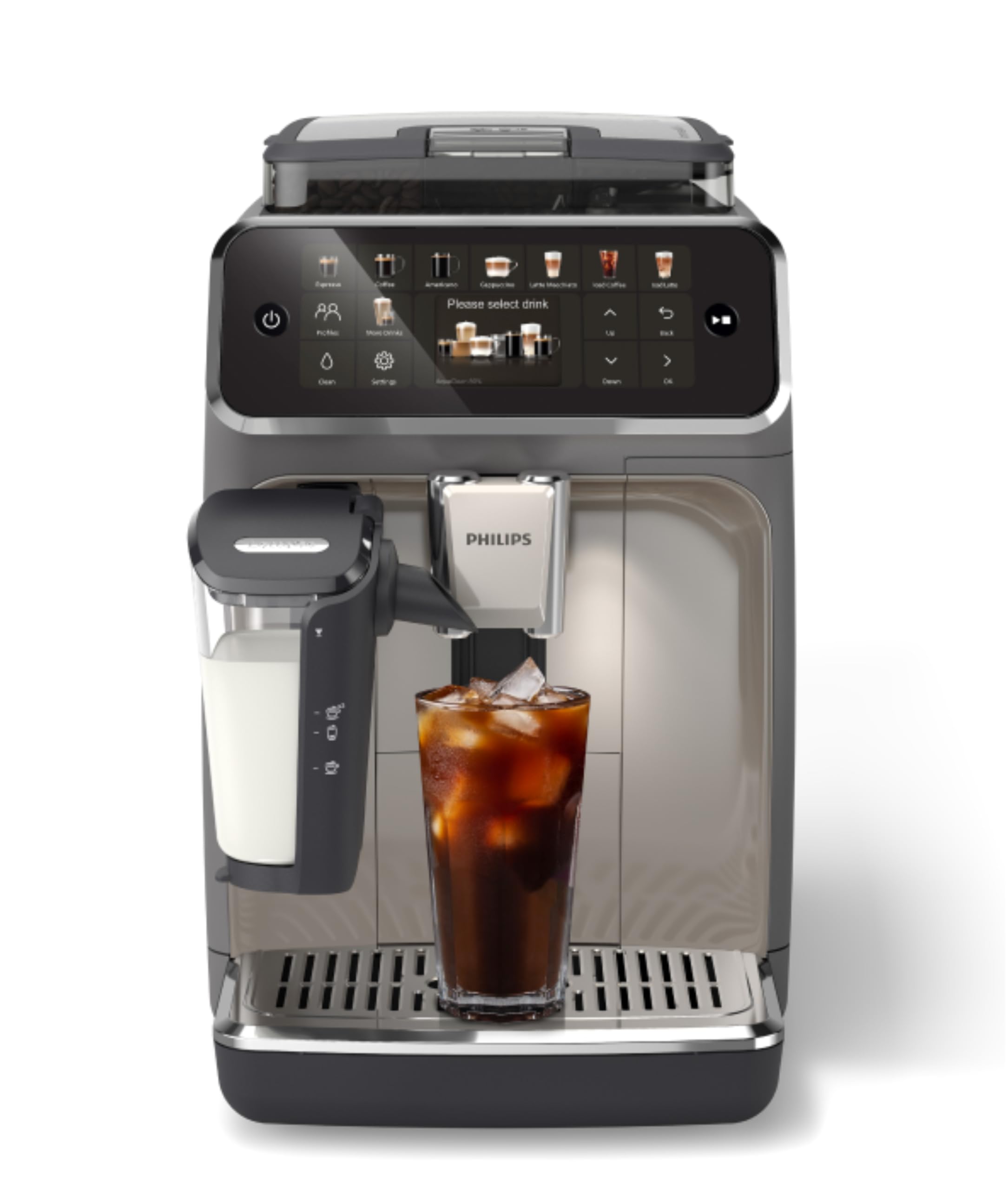
The Philips 5500 Series builds on the 4400 foundation by doubling the preset count to 20 and expanding user profile storage to four separate profiles. This makes it the better choice for multi-person households where each drinker prefers different strength, volume, and milk ratios. The LatteGo milk system is identical to the 4400 in performance and cleanability — three parts, dishwasher safe, no internal milk tubes — meaning you get the same fast cleanup with more programmable options.
The intuitive color display guides you through drink selection, and you can save your customized settings to your personal profile so the machine recalls them on your next use. The SilentBrew technology and QuickStart three-second warm-up are carried over, along with the 15-bar pump and AquaClean filter that reduces descaling frequency. The machine accepts both whole beans and pre-ground coffee through a separate bypass chamber, giving you flexibility if you want to use a decaf or flavored roast without emptying the hopper.
The extraction output is identical to the 4400 — good crema and solid flavor with fresh beans, but the super-automatic brew group cannot replicate the pressure profiling of a prosumer semi-automatic. Some users report that the machine produces smaller pucks and shy dosing compared to competitors like De’Longhi super-automatics, and the milk reservoir typically lasts two to three drinks before needing a refill. For a family of coffee drinkers who want personalized one-touch drinks with minimal maintenance, the additional profiles make the 5500 the more practical sibling.
Why it’s great
- Four user profiles let each household member save their exact drink preferences
- LatteGo milk system remains the fastest-cleaning option in the super-automatic category
- Bypass chamber allows use of pre-ground coffee without emptying the bean hopper
Good to know
- Dosing can be shy compared to some super-automatic competitors
- Milk reservoir requires refilling after two to three drinks
9. Bosch VeroCafe 800 TPU60309
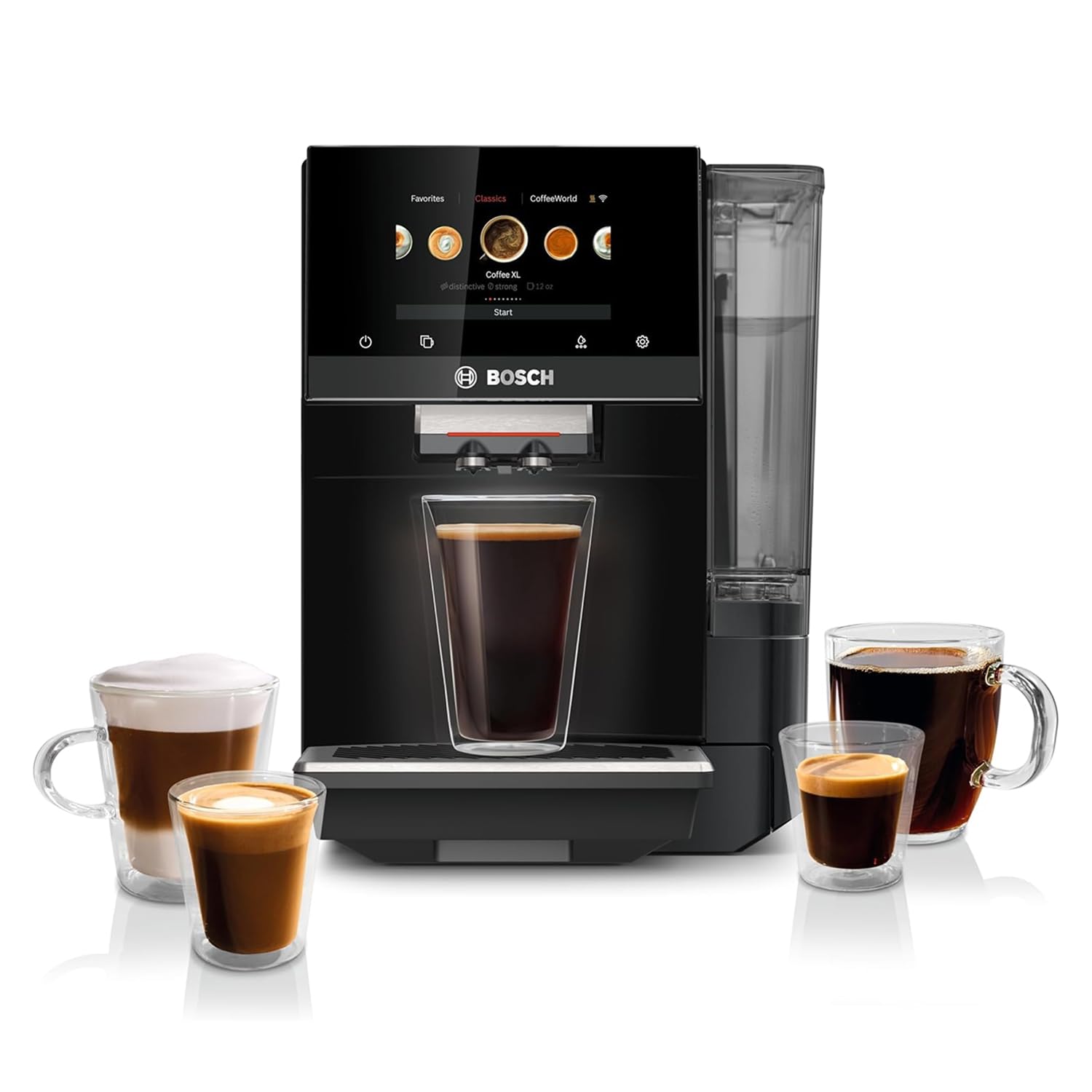
The Bosch VeroCafe 800 Series is a fully automatic super-automatic espresso machine with a 35-drink menu and connectivity through the Home Connect app. You can adjust strength, size, milk ratio, and even specific aroma levels from your phone, or start a brew remotely as you walk in the door. The large touchscreen display on the machine itself walks you through drink selection and customization without needing the app, and the interface is intuitive enough that most users do not consult the manual after the initial setup.
The machine features a combined cleaning and descaling program that guides you step-by-step with visual prompts, minimizing the guesswork in maintenance. The direct milk frothing system uses a flexible hose that can draw milk directly from a refrigerated container, avoiding the need to fill a dedicated milk reservoir that might sit at room temperature. Users consistently report that the grinder is exceptionally quiet — noticeably more so than other super-automatics in this class — and the brew temperature can be adjusted from 129°F to 158°F for slow-brew options.
The 5.1-pound bean hopper and large water tank reduce refill frequency, and the machine is capable of brewing double cups simultaneously for entertaining. Some users find the coffee temperature slightly lower than expected, especially for Americanos, and recommend microwaving the cup or milk before brewing to compensate. The inability to switch beans easily for a decaf shot is a practical limitation in multi-drinker households. For those who want the broadest beverage selection, remote control via smartphone, and the quietest grinding experience available, the Bosch is the premium choice.
Why it’s great
- 35 beverage presets cover espresso, milk drinks, and specialty recipes
- Home Connect app enables remote brewing and customization from your phone
- Grinder is exceptionally quiet compared to other super-automatic machines
Good to know
- Coffee temperature can run lower than some users expect, especially for Americanos
- Switching bean types for a decaf shot requires manual intervention rather than a bin system
FAQ
Do I need a grinder built into the espresso machine or should I buy a separate one?
What is the difference between 15 bar and 20 bar pump pressure for home espresso?
Can I make cappuccinos and lattes with a semi-automatic espresso machine?
Final Thoughts: The Verdict
For most users, the best at home coffee and espresso machine winner is the Breville Barista Express BES870XL because it combines PID temperature control, an integrated grinder, and proven durability in a single machine that has been refined through years of owner feedback. If you want to skip the manual process and get one-touch lattes with minimal cleaning, grab the Philips 4400 Series EP4444/90. And for a multi-drink arsenal that handles espresso, drip coffee, and cold brew from a single machine, nothing beats the Ninja Luxe Café Pro ES701.

Mo Maruf
I created WellFizz to bridge the gap between vague wellness advice and actionable solutions. My mission is simple: to decode the research and give you practical tools you can actually use.
Beyond the data, I am a passionate traveler. I believe that stepping away from the screen to explore new environments is essential for mental clarity and physical vitality.