Our readers keep the lights on and my smoothie glass nicely filled. As an Amazon Associate, I earn from qualifying purchases.
An asphalt patch that fails after the first rain or winter freeze isn’t a repair—it’s a delay. The real challenge in this category isn’t finding a product that fills a hole; it’s finding one that bonds chemically with the existing pavement, flexes through temperature swings without cracking, and creates a waterproof seal that stops the sub-base from washing out.
I’m Mohammad Maruf — the founder and writer behind WellFizz. I’ve spent years analyzing the chemical composition and field performance data of asphalt repair products, comparing polymer-modified emulsions, rapid-cure silicones, and elastomeric rubber blends to separate permanent fixes from temporary band-aids.
After examining hundreds of verified buyer reports across multiple freeze-thaw zones and traffic loads, the current market leaders are clear—this guide breaks down the exact formulations that deliver lasting adhesion and weather resistance for anyone searching for the best asphalt patch.
How To Choose The Best Asphalt Patch
Choosing the wrong asphalt patch formula is the most common reason repairs fail within two seasons. The category breaks down by chemistry—silicone gel, rubberized emulsion, and cementitious blend—and each excels in a specific crack width and climate zone. Here are the three specs that determine whether your repair lasts or delaminates.
Flexibility vs. Rigidity
Asphalt expands in summer heat and contracts in winter cold. A rigid patch will crack under that movement. Elastomeric rubber or polymer-modified formulas flex with the pavement, maintaining the seal through freeze-thaw cycles. Cement-based patches offer higher compressive strength but lack elasticity, making them better for stationary potholes than long, narrow cracks.
Cure Time and Application Window
Fast-dry formulas (tack-free in 2–4 hours) let you drive or walk on the repair the same day, but they require clean, dry conditions during application. Slower-curing emulsions demand 24–48 hours of dry weather. If you live in a rainy climate, a silicone gel that cures quickly with minimal prep is the safer bet.
Viscosity and Crack Width Match
Liquid emulsions flow deep into hairline cracks but run off steep slopes. Paste or gel formulas stay in place on vertical or angled surfaces and fill gaps up to one inch wide. Trowel-grade blacktop repair is ideal for shallow divots and wide depressions where self-leveling liquids would pool unevenly.
Quick Comparison
On smaller screens, swipe sideways to see the full table.
| Model | Category | Best For | Key Spec | Amazon |
|---|---|---|---|---|
| Jetcoat Premium Elastomeric | Liquid Emulsion | Large driveways with multiple cracks | 1 gallon (128 oz) polymer-modified rubber | Amazon |
| Wadities High Elasticity Filler | Liquid Rubber | Deep or wide cracks needing self-leveling | 2.65 lb, trowel-ready rubber compound | Amazon |
| Henry Driveway Elastomeric | Liquid Emulsion | Northeast winter freeze protection | 1 gal, EPDM rubber emulsion | Amazon |
| Sakrete Trowelable Blacktop Repair | Paste/Trowel Grade | Divots and shallow depressions | 1 quart, no-mix paste formula | Amazon |
| MuzeFansi Crack Filler Silicone | Silicone Gel | Small residential cracks and concrete joints | 2.2 lb, silicone self-leveling gel | Amazon |
In‑Depth Reviews
1. Jetcoat Premium Elastomeric Asphalt Crack Filler

This emulsion-based crack filler is fortified with plasticizers that keep the sealant flexible at low temperatures while resisting tracking in summer heat—a dual-performance trait uncommon in the mid-range price tier. The one-gallon volume translates to roughly 400 linear feet of ¼-inch crack coverage, making it the most economical choice for whole-driveway projects. It pours from the included spout with a thin consistency designed to settle into deep crevices; users report that a second application after 24 hours is often necessary for cracks deeper than half an inch.
The polymer-modified rubber base adheres aggressively to aged asphalt that has oxidised to a gray finish, which is where many cement-based patches delaminate. Verified buyers in regions with heavy rain noted the fill held without water infiltration after multiple storms, though reviewers in mountain freeze zones observed separation under repeated winter cycles. The product requires stirring before use and re-stirring throughout application to keep the emulsion homogenous—skipping this step leads to uneven drying and surface pitting.
For a homeowner tackling a long driveway with moderate cracking, the Jetcoat delivers the best balance of coverage volume, application ease, and weather durability. The polymer modifier provides the self-healing quality that keeps small hairline cracks from reforming, and the gallon size avoids the frustration of running out mid-project.
Why it’s great
- Gallon size covers whole driveways without needing multiple units
- Polymer-modified formula resists low-temperature cracking
- Self-leveling pour works well for narrow to medium-width cracks
Good to know
- Requires stirring during application to maintain consistency
- May separate in severe freeze-thaw mountain climates
2. Wadities High Elasticity Cement Crack Filler
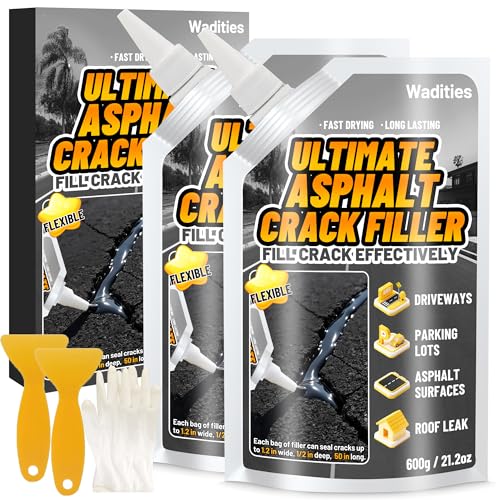
Wadities markets this crack filler as a high-elasticity rubber compound, and the verified reports back it up—one HOA president used it on deep manhole cracks and noted the cured material remained flexible enough to absorb ground vibration without crumbling. The 2.65-pound container includes a scraper and gloves, a thoughtful addition for DIY users who don’t want to hunt for tools mid-job. The formula flows as a thick liquid that self-levels in the crack but holds its shape on slightly angled surfaces without running off.
The product claims full cure in 24–48 hours and surface tack-free drying in 4–6 hours, which is competitive with the Jetcoat emulsion. Where it differentiates itself is the advertised water resistance level—listed as waterproof rather than water resistant. Multiple buyers confirmed the fill prevented water infiltration after heavy rain, and the adhesion held on surfaces that were damp during application, though the manufacturer still recommends a dry, clean crack for best results.
The biggest practical drawback is the per-ounce cost; buyers consistently reported needing more filler than expected for wide cracks because the rubber compound compresses into deep voids without bridging the top surface. For homeowners with a single deep crack or a small cluster of wide gaps, this formula produces a superior bond that justifies the premium placement.
Why it’s great
- Waterproof seal outperforms standard water-resistant emulsions
- Includes applicator tools for immediate use
- Elastic bond absorbs vibration and freeze-thaw movement
Good to know
- Coverage is less than expected for wide or deep cracks
- Requires multiple applications for gaps exceeding ½ inch
3. Henry Driveway Elastomeric Emulsion Crack Filler

Henry is a well-established name in pavement maintenance, and this EPDM rubber emulsion has a reputation among contractors for slowing crack propagation in harsh Northeastern winters. The material is noticeably thinner than the Jetcoat or Wadities—buyers describe it as the consistency of thin paint—which makes it excellent for penetrating hairline cracks but less effective for filling wide gaps in a single pass. Application requires a brush or cup pour rather than a caulking gun or spout, and the thin formula means deep cracks often need multiple summer applications to build up to the surface level.
The low viscosity works to its advantage on large areas with spider-webbing cracks because one gallon stretches further than thicker alternatives. However, the same thin consistency creates a vulnerability: the filler dries bright black quickly (within 10 minutes), but rain within 24 hours can wash out the uncured material. Verified users emphasized the need for a 3–4 day dry window for best results, which limits its usability in humid or rainy climates.
The packaging is an acknowledged weak point—multiple reviews reported leaking during shipment and half the product arriving hardened. For buyers in freeze-prone regions who want a flexible emulsion that binds well even to dusty surfaces, the Henry formula performs exceptionally when applied correctly.
Why it’s great
- Thin consistency penetrates hairline cracks deeply
- EPDM rubber remains flexible through severe freeze-thaw cycles
- Binds well to slightly dirty or damp surfaces
Good to know
- Packaging frequently leaks during shipment
- Needs multiple dry days and reapplications for deep cracks
4. Sakrete Trowelable Blacktop Repair

The Sakrete paste is the only product in this roundup that comes ready-to-use with zero mixing or dilution—you open the quart tub and trowel it directly into the crack. This makes it the fastest option for a quick repair on a divot, pothole, or jack-stand puncture where you don’t want to wait for a liquid to level out. The paste consistency stays put on vertical or sloped surfaces without sagging, which liquid fillers can’t match.
The material bonds and maintains elasticity through weather extremes, according to the manufacturer, and buyers reported good results filling depressions up to one inch wide. However, the paste shrinks slightly as it cures, and several reviewers noted the need to reapply in small areas where the filler pulled away from the edges. The 1-quart size covers roughly a square foot at a half-inch depth, so large repairs require multiple tubs.
The packaging issue is significant: the tub lid is not designed for rough handling, and several buyers received product that had leaked during shipping, with up to half the contents hardened and unusable. For small repairs where you need a thick fill that won’t run, the Sakrete formula is effective and simple, but you’re paying a premium per ounce compared to the gallon-sized emulsions.
Why it’s great
- No mixing required—apply straight from the tub
- Paste stays in place on sloped or vertical surfaces
- Maintains flexibility through temperature swings
Good to know
- Small quart size limits coverage for larger areas
- Shrinks during cure, often needs a second coat
5. MuzeFansi Asphalt Crack Filler Silicone Gel
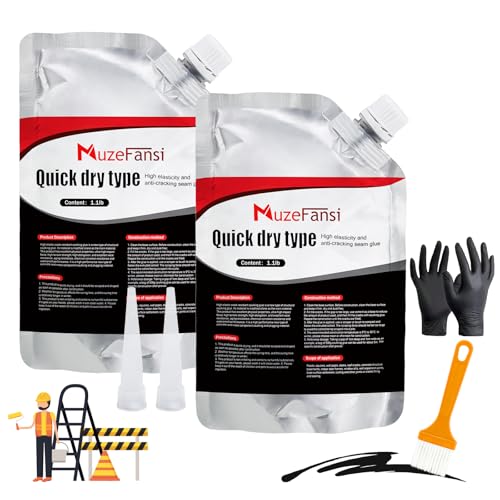
The MuzeFansi filler uses a silicone gel base rather than rubber or cement, giving it a unique advantage: it cures tack-free in 2–3 hours and reaches full hardness within 24–48 hours, making it the fastest-drying option for homeowners who can’t keep traffic off the repaired area. The gel self-levels into cracks without requiring a heat gun or flame, and it bonds to not just asphalt but also concrete, brick, metal, and wood—a versatility that liquid emulsions and pastes lack.
Buyers reported success filling cracks in concrete railings, asphalt driveways, and basement joints, with the cured material holding strong through 90°F summer temperatures. The gel’s cementitious adhesive blend provides high compression resistance, so it withstands vehicle loads on driveways without crumbling. However, the 2.2-pound total (two 1.1-pound tubes) covers a relatively small area—buyers consistently noted needing to order more than expected for anything beyond a single moderate crack.
The silicone formula is ideal for the homeowner who has one or two cracks to fix and wants a fast cure with minimal mess. It doesn’t require a caulking gun; the nozzle fits standard squeeze-tube applicators, and the gel flows smoothly without the need to massage the bag before use, though a quick knead helps maintain consistent flow.
Why it’s great
- Fast 2–3 hour tack-free cure allows same-day use
- Self-leveling gel fills cracks without heat or mixing
- Bonds to multiple surfaces beyond asphalt
Good to know
- Small total volume limits coverage for large repairs
- Gel thickens as the tube empties if not kneaded periodically
FAQ
Can I apply asphalt patch filler over damp or wet cracks?
How long does asphalt crack filler last before needing reapplication?
What’s the difference between cold patch and liquid crack filler?
Final Thoughts: The Verdict
For most users, the best asphalt patch winner is the Jetcoat Premium Elastomeric because the gallon volume and polymer-modified flexibility cover a whole driveway project with one purchase and withstand moderate freeze-thaw cycles. If you need a waterproof seal for a single deep crack, grab the Wadities High Elasticity Filler. And for fast weekend repairs on small residential cracks, nothing beats the MuzeFansi Silicone Gel for quick cure and multi-surface bonding.

Mo Maruf
I created WellFizz to bridge the gap between vague wellness advice and actionable solutions. My mission is simple: to decode the research and give you practical tools you can actually use.
Beyond the data, I am a passionate traveler. I believe that stepping away from the screen to explore new environments is essential for mental clarity and physical vitality.