Our readers keep the lights on and my smoothie glass nicely filled. As an Amazon Associate, I earn from qualifying purchases.
The right art kit for a three-year-old walks a tight line: it must be mess-free enough for a parent to say yes, yet engaging enough to hold a toddler’s fleeting attention for more than five minutes. Most beginner supplies fail on one side or the other — either the cleanup is punishing or the colors are too faint to feel satisfying. What actually works is a clever middle ground of washable formulas, chunky ergonomic tools, and a few built-in rewards to keep little fingers coming back.
I’m Mohammad Maruf — the founder and writer behind WellFizz. I’ve spent years analyzing consumer feedback and product specs across hundreds of children’s craft kits, focusing on safety certifications, material durability, and the real-world washability claims that matter for families.
After evaluating five leading kits side by side, this guide ranks what truly delivers on quality, ease of use, and toddler engagement — helping you find the best arts and crafts for 3 year olds without wading through dozens of nearly identical listings.
How To Choose The Best Arts And Crafts For 3 Year Olds
A three-year-old’s fine motor skills are still developing — they’re learning to control a pincer grip and coordinate hand movements with what they see. The right kit matches those skills with tools that are easy to hold and materials that forgive mistakes. Here are the three factors that matter most for this age group.
Washability vs. Stain Removal
Every toddler paint claims to be “washable,” but the real-world performance varies wildly. True washable tempera uses a water-based formula that lifts off skin, fabric, and hard surfaces with soap and water. Some lower-cost paints require a pre-treatment or scrubbing to remove once dried. Look for customer feedback that specifically mentions cleaning from walls, clothes, and tables — not just skin — to gauge how forgiving the product really is during a meltdown moment.
Grip Design and Barrel Thickness
A standard-sized crayon or paintbrush is too narrow for a 3-year-old’s developing pincer grip, which can lead to frustration and a dropped tool. The most effective kits use chunky barrels — often over half an inch thick — that sit securely in a toddler’s palm. Paint sticks and dot markers with ergonomic bodies reduce fatigue and help the child focus on the creative process rather than on maintaining a grip.
Open-and-Close Independence
Kits that require adult help for every cap or lid reduce the child’s sense of autonomy and can interrupt a creative flow. Look for paint sticks with twist-up mechanisms (no separate cap), dot markers with wide, easy-to-remove lids, or paint cups with pre-pierced seals. The less adult intervention needed per color change, the longer the independent play session lasts — and the less likely the child wanders off mid-project.
Quick Comparison
On smaller screens, swipe sideways to see the full table.
| Model | Category | Best For | Key Spec | Amazon |
|---|---|---|---|---|
| JUPITEARTH Paint Sticks | Paint Stick Set | Mess-free, fast-drying brilliance | 36 colors; dries in 90 seconds | Amazon |
| The Mega Deals Painting Set (10 Colors + Smock) | Paint Bundle | First liquid tempera experience | 10 paints, 7 brushes, palette, smock | Amazon |
| KRAFUN Safari Paper Craft Kit | Paper Craft Kit | Structured hands-on parent-child time | 16 complete animal projects | Amazon |
| Momo & Nashi Dot Markers | Dot Marker Set | Fine motor development without grip strain | 8 jumbo 40ml daubers | Amazon |
| The Mega Deals Paint Set (10 Cups + Brushes) | No-Spill Paint Set | Independent painting with minimal mess | 10 sealed cups with lids | Amazon |
In‑Depth Reviews
1. JUPITEARTH 36 Colors Tempera Paint Sticks
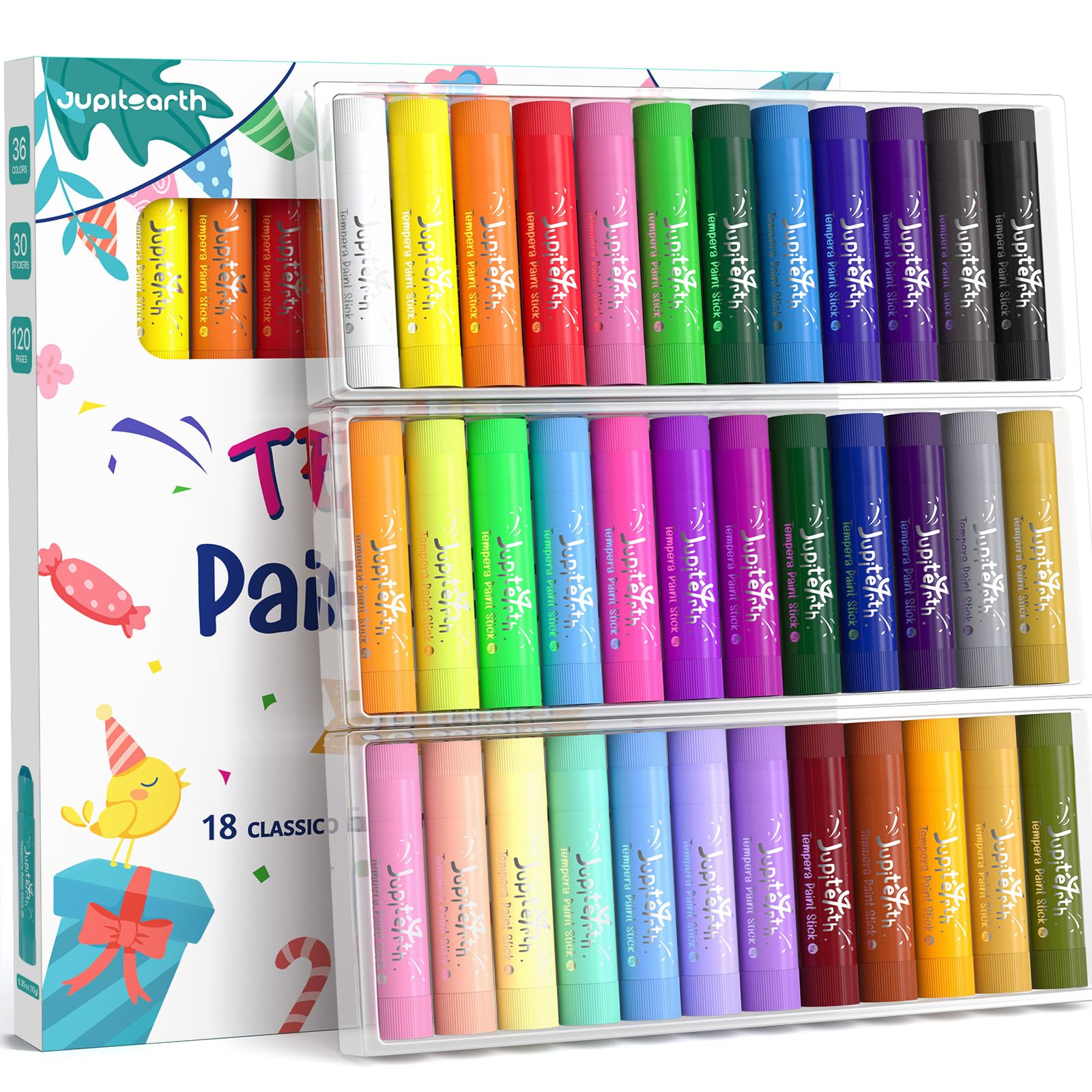
The JUPITEARTH paint sticks hit every requirement for this age group: a chunky, easy-grip barrel, a twist-up mechanism that eliminates losing a cap, and a formula that dries to the touch in about 90 seconds. With 36 colors spanning classic, neon, metallic, and pastel finishes, a toddler gets enough variety to feel like a real artist without needing to wash a brush or pour a cup. The color transfers with very gentle pressure — ideal for children who haven’t yet developed strong hand muscles.
Parents consistently report that these sticks clean off walls, tables, and skin with just soap and water, which is the most critical test for any kit in this category. The included 120 printable coloring pages via a QR code extend the value far beyond the initial box; you effectively get months of use from a single purchase. The 30 reward stickers also give a concrete incentive for finishing a page, which helps build focus habits in young children.
The only real downside is that the sticks can break if a child pushes down too hard or drops them on a hard floor. Because the formula is soft and creamy, it applies beautifully but also means the stick is more fragile than a crayon. For families who prioritize zero mess and quick drying above all else, this is the strongest all-round choice in the group.
Why it’s great
- Zero-mess application with 90-second dry time; nothing to spill or drip
- 36 colors in a single box means a toddler gets real variety without needing multiple purchases
- Included 120 printable coloring pages extend play value for months
Good to know
- Soft formula can snap if twisted out too far or dropped on tile
- Coloring pages require a printer and are digital downloads — not physical sheets in the box
2. The Mega Deals Kids Painting Set (10 Colors + Smock)

This paint set is the most complete all-in-one entry point into liquid tempera for a 3-year-old. It includes ten 2-ounce bottles of washable paint, seven paintbrushes in varying widths, a mixing palette, and — crucially — a machine-washable polyester smock. The smock alone removes the biggest psychological barrier for parents: fear of stained clothes. The colors themselves are rich and matte, with enough pigment to feel satisfying even on dark construction paper.
Customer feedback overwhelmingly confirms that the paint washes off skin, tables, and most fabrics with plain water, though dried paint on absorbent materials like unfinished wood may need a little soap. The brush variety is genuinely useful; the wide brushes work for broad strokes on large paper, while the fine-tipped options let older siblings or adults add detail. The plastic palette is sturdy enough for repeated use and encourages color mixing experiments — a key developmental activity for this age.
The main limitation is that liquid paint, even with a smock, is inherently messier than paint sticks or dot markers. A three-year-old may accidentally knock over a bottle or overload a brush. The 2-ounce bottles are a good size, but eight of them in a set means a determined toddler can create a surprising amount of chaos in about 90 seconds. This is best for families who are ready to embrace the occasional spill for the sake of real paint texture and color blending.
Why it’s great
- Complete kit with smock, palette, brushes, and paints — nothing else to buy
- Machine-washable smock gives parents confidence to say yes to paint
- Rich matte pigment shows up clearly on dark and light paper
Good to know
- Liquid paint format is inherently messier than sticks or dot markers
- 2-ounce bottles are small; heavy users may want extra paint within weeks
3. KRAFUN My First Safari Animal Paper Craft Kit

For families who want a guided, structured activity rather than open-ended painting, this paper craft kit delivers 16 complete safari animal projects using paper bags, plates, rolls, and straws. Each project builds a specific animal — lion, tiger, giraffe, elephant — and the instructions are clear enough that a 3-year-old can follow along with minimal adult reading. The kit is designed to train fine motor skills through cutting, folding, gluing, and assembling, all within a contained paper-based workflow that creates almost no mess beyond a few scraps.
The included materials are noticeably thick for a children’s craft kit; the paper bags and plates hold up to enthusiastic handling without tearing. The box itself converts into a reusable storage file with upright dividers, which keeps half-finished projects organized for the next play session. Parents report that a 4- or 5-year-old can complete most projects independently, while a 3-year-old needs help with cutting and gluing but can handle the decorating and assembling steps alone — making it a genuine parent-child bonding experience.
The trade-off is that the kit is entirely paper-based, so there’s no paint, no color mixing, and no sensory fluid-play that many toddlers love. If your child’s idea of fun is covering their hands in paint, this kit will feel too tidy. Also, some younger 3-year-olds may find the perforated pieces detach too easily during handling, which can be frustrating if a piece pops out before it’s supposed to. But for rainy days, playdates, or any situation where you want zero cleanup and a clear endpoint, this is the most reliable option in the group.
Why it’s great
- 16 complete projects with all materials included — nothing extra to source
- Thick paper construction holds up to enthusiastic toddler handling
- Reusable storage box keeps half-finished crafts organized
Good to know
- Perforated pieces can detach prematurely during handling
- No paint or fluid sensory element — may feel too tidy for some kids
4. Momo & Nashi Dot Markers For Toddlers
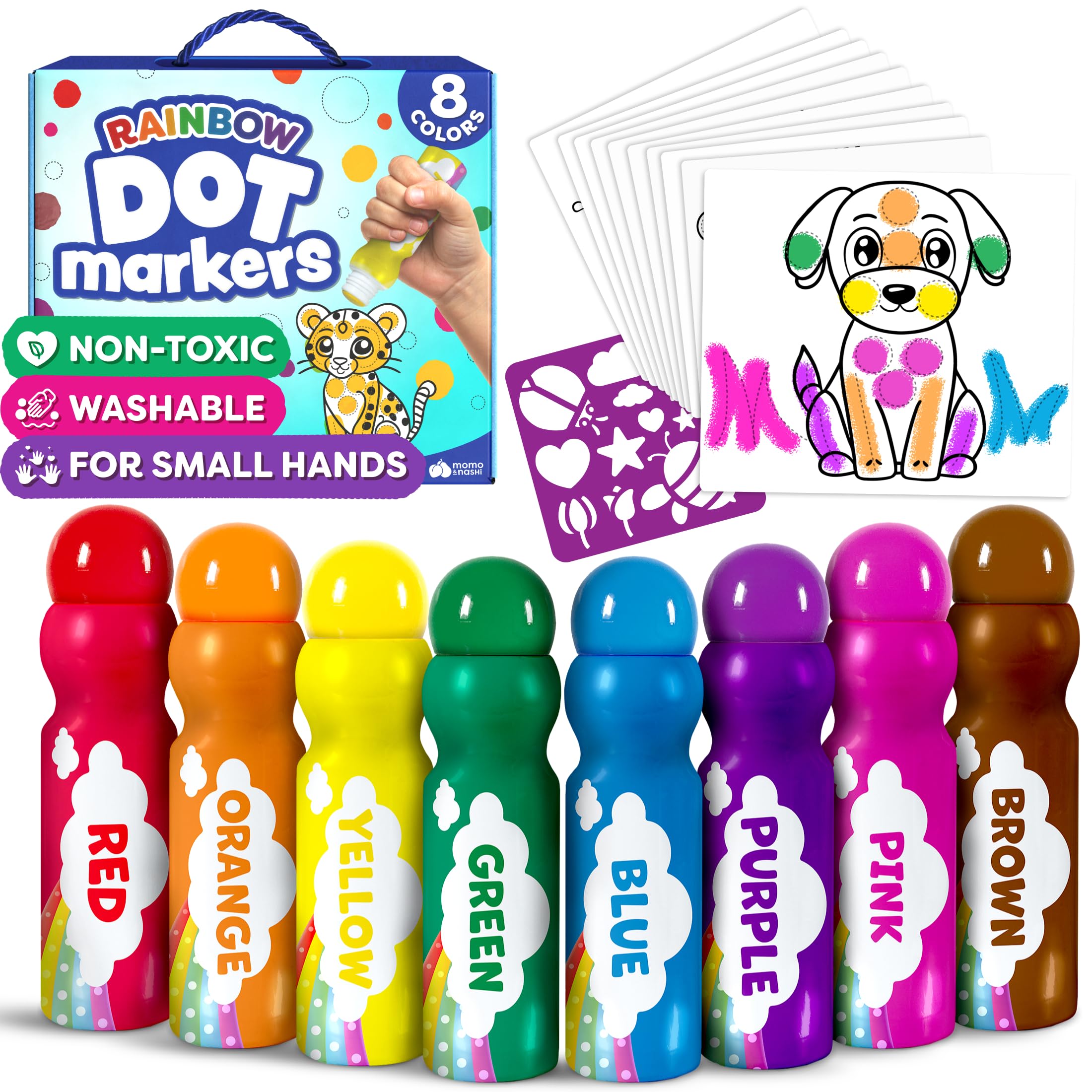
Dot markers are a brilliant bridge between free-form painting and structured coloring, and this set from Momo & Nashi executes the concept perfectly. Each jumbo dauber holds 40ml of water-based washable ink and features a wide, easy-grip barrel that fits comfortably in a 3-year-old’s palm. The technique is simple: press down on the foam tip, and a perfectly round dot appears. There’s no need to twist, cap, or squeeze — just press and lift. This makes it one of the most accessible craft tools for children who haven’t yet mastered a pincer grip.
The set includes eight markers, ten printed coloring sheets, a stencil plate, two extra foam tips, and a QR code for 150 printable PDF pages. The printed sheets use large circular targets designed specifically for dot marker patterns, which helps a child practice aim and hand-eye coordination without feeling like a test. Multiple parents note that the markers produce consistent, full circles on the first press and that the ink dries quickly enough to prevent smearing when the paper is accidentally touched. Cleanup is straightforward: any ink on skin or tables wipes away with a wet cloth.
The markers are refillable only to a limited extent — the foam tips can be replaced, but the ink reservoir is not designed for long-term refilling. Once the ink runs low, the dot pattern becomes inconsistent, and most users simply buy a new set. The eight-color range (classic rainbow) is good but lacks the variety of the JUPITEARTH paint sticks’ 36 colors. Additionally, some children may find the pressing motion tiring after 15–20 minutes of continuous use, though this usually indicates a good amount of focus rather than a design flaw.
Why it’s great
- Jumbo 40ml daubers with easy-grip barrels require no twisting or pinching
- Ink dries quickly and produces perfectly round dots on first press
- Stencil plate and 150 printable pages extend play value vastly
Good to know
- Not refillable — once ink runs low, purchase a new set
- Only 8 colors; lacks variety compared to 36-color paint stick sets
5. The Mega Deals Kids Painting Set (10 Cups + 10 Brushes)
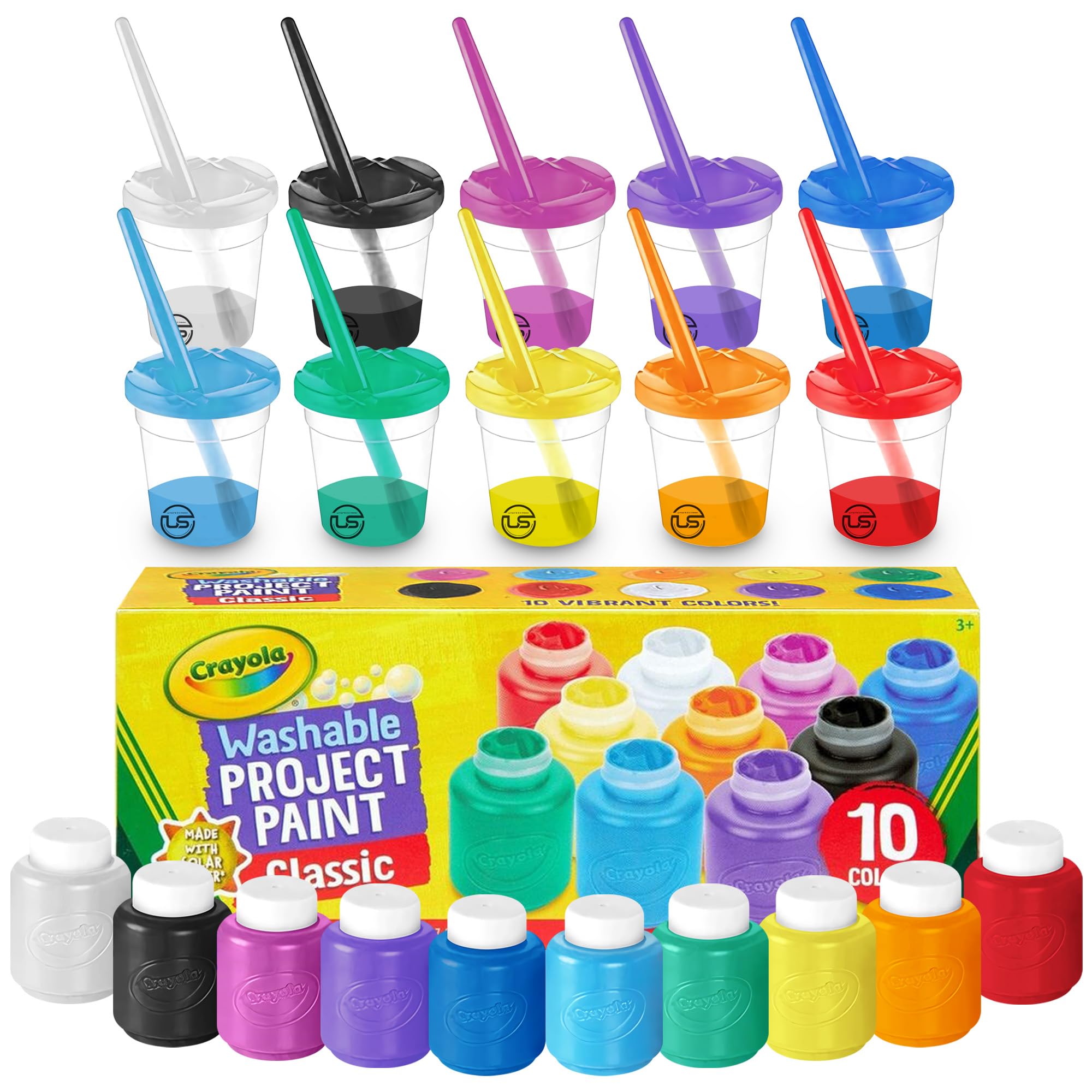
This kit is designed around a single smart insight: most toddler painting mess comes from spilled cups, not from the brush itself. The Mega Deals set solves that with ten individual paint cups, each sealed with a colorful lid that has a small hole for the brush. The child dips the brush in, the lid prevents the cup from tipping, and the airtight seal keeps leftover paint fresh for the next session. Each cup also has its own dedicated brush, so colors stay pure and there’s no need to rinse between shades — a huge time-saver for parents.
The paint itself is a standard non-toxic tempera that washes off skin and most surfaces with soap and water, but the standout feature is the organization. The cups snap into a lightweight tray, and the whole setup feels like a professional watercolor set scaled down for small hands. The 10-color range covers the full rainbow plus white, which is enough for a 3-year-old to mix secondary colors in the included palette. Parents consistently mention that the “no-spill” claim holds up — even when a toddler accidentally bumps the tray, the cups stay upright.
On the downside, the paint is thick straight out of the cup and may need a few drops of water to flow smoothly, especially if the child prefers light washes. The brushes are functional but thin-handled; a 3-year-old with a developing grip may find them harder to control than the chunky barrels of paint sticks or dot markers. Some users report that the lids on the cups can be difficult for small fingers to remove independently, which means an adult needs to set up each color ahead of time. For families that want the structure of individual color stations and hate spilled paint, this is the most practical liquid format available.
Why it’s great
- Sealed lid design genuinely prevents spills even when tray is bumped
- Individual brushes per cup eliminate color mixing and brush rinsing
- Airtight lids keep leftover paint fresh for days between sessions
Good to know
- Paint is thick and may need water dilution for smooth flow
- Brush handles are thin — less ergonomic for developing toddler grips
FAQ
Are paint sticks better than dot markers for a 3-year-old?
How long does the JUPITEARTH paint stick formula take to fully cure on paper?
Can the KRAFUN paper craft kit be used independently by a 3-year-old?
Final Thoughts: The Verdict
For most families, the true arts and crafts for 3 year olds winner is the JUPITEARTH 36 Colors Tempera Paint Sticks because it combines zero-mess application, the widest color variety in this group, and a fast-drying formula that gives parents confidence to say yes to daily art time. If you want a structured activity with a clear beginning and end that builds fine motor skills through assembly, grab the KRAFUN My First Safari Animal Paper Craft Kit. And for a no-spill liquid painting experience that lets a toddler explore color mixing without chaos, nothing beats the The Mega Deals Paint Set with 10 Sealed Cups.

Mo Maruf
I created WellFizz to bridge the gap between vague wellness advice and actionable solutions. My mission is simple: to decode the research and give you practical tools you can actually use.
Beyond the data, I am a passionate traveler. I believe that stepping away from the screen to explore new environments is essential for mental clarity and physical vitality.