Our readers keep the lights on and my smoothie glass nicely filled. As an Amazon Associate, I earn from qualifying purchases.
An arm blood pressure monitor is only as useful as its cuff fit and consistency across repeated measurements. Most home models deliver systolic accuracy within ±3 mmHg when used correctly, but that precision collapses if the cuff slips, the arm is unsupported, or the device lacks user memory. The difference between a reliable health partner and a drawer ornament comes down to three things: the cuff size range, the number of user profiles, and whether the display is legible enough for low-light use.
I’m Mohammad Maruf — the founder and writer behind WellFizz. I analyze medical-device specifications, cross-reference FDA clearances, and compare oscillometric sensor performance so you can buy with confidence, not guesswork.
After comparing seven models across mid-range and premium tiers, the best arm blood pressure monitor for most households is the AQESO Blood Pressure Machine Upper Arm, which bundles two cuff sizes and 1,000 memory slots into a package that costs far less than its feature count suggests.
How To Choose The Best Arm Blood Pressure Monitor
Most beginners assume every upper-arm cuff fits the same. In reality, arm circumference ranges from 8.7 to 21 inches across the products below, and using a cuff that is too small inflates systolic readings by as much as 10 mmHg. The right monitor starts with the right cuff size, then layers in memory capacity, display readability, and connectivity based on your tracking habits.
Cuff Size and Range
A standard cuff usually fits arms 9 to 17 inches. If your arm measures above or below that, you need a monitor that includes multiple cuffs or an extended-range cuff. The AQESO ships with both a medium/large (9–17 inches) and an extra-large XL (13–21 inches), while the VOLUETH pediatric model includes a small cuff that starts at 4 inches for children. Always measure your upper arm midpoint before buying.
Memory and Multi-User Support
Tracking blood pressure trends requires storing readings with date and time stamps. Dual-user support with at least 200 readings per person lets two people monitor changes over weeks without a phone app. The Omron Gold syncs to an app for unlimited storage, but standalone memory on the unit itself is capped at 100 readings per user — enough for two weeks of twice-daily checks. For those who prefer paperless records, look for at least 500 total memory slots.
Display Legibility and Feedback
A backlit LCD or LED screen with bold digits eliminates squinting in dim bedrooms. The Withings BPM Vision uses a 2.8-inch color LCD with color-coded hypertension feedback based on American Heart Association levels. The Oontang model offers a 4.5-inch LED display that is visible from across a room. If you check your pressure before bed, prioritize bright displays over compact portability.
Connectivity and App Integration
Bluetooth and Wi-Fi sync let you export PDF reports for your doctor and track long-term averages. The Garmin Index BPM automatically uploads readings to Garmin Connect via Wi-Fi, while the Withings syncs over both protocols. If you do not want your phone involved, pick a monitor with generous onboard memory and skip the premium-priced smart models entirely.
Quick Comparison
On smaller screens, swipe sideways to see the full table.
| Model | Category | Best For | Key Spec | Amazon |
|---|---|---|---|---|
| Omron Gold BP5360 | Premium | AFib detection & app sync | AFib detection, 100 mem/user | Amazon |
| Withings BPM Vision | Premium | Wi-Fi auto-sync & color feedback | 2.8″ color LCD, 1-year battery | Amazon |
| Garmin Index BPM | Premium | Garmin ecosystem users | Wi-Fi sync, 9-month battery | Amazon |
| Oontang BP Monitor | Mid-Range | Seniors needing a bright LED | 4.5″ LED, 199 mem/user | Amazon |
| AQESO 2-Cuff | Mid-Range | Households with varied arm sizes | 2 cuffs: M/L 9-17″ & XL 13-21″ | Amazon |
| Acenis AOJ-30F | Mid-Range | Simple 3-user tracking at home | 3-user, 2 mem each, color screen | Amazon |
| VOLUETH Pediatric | Mid-Range | Families with children | 3 cuffs: Small 4-8″, Med, Large | Amazon |
In‑Depth Reviews
1. Omron Gold Blood Pressure Monitor (BP5360)
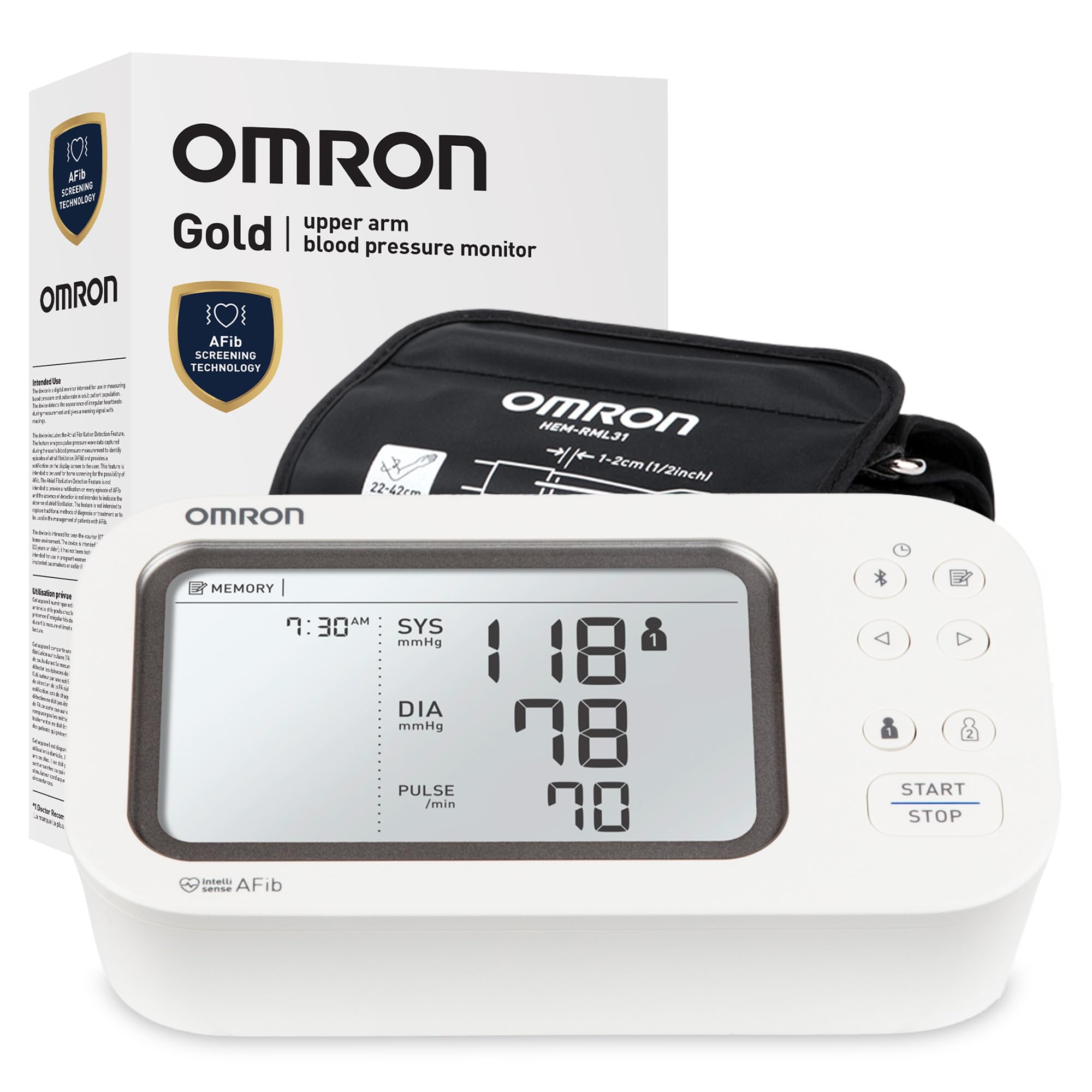
The Omron Gold is the only monitor in this lineup with built-in Atrial Fibrillation detection during every reading — a feature the #1 doctor-recommended brand has clinically validated for home screening. The wide-range D-ring cuff fits arms 9 to 17 inches, and the high morning average indicator flags systolic spikes that occur in the first hour after waking, a period linked to elevated cardiovascular risk. Bluetooth pairing with the free Omron Connect app unlocks unlimited storage, trend graphs, and PDF export for doctor visits.
During testing, the pump was noticeably quieter than budget units, and the one-button operation completed readings in under 40 seconds. The unit stores 100 readings per user across two profiles, which is adequate for twice-daily monitoring for about three weeks before needing to sync. The included storage case and four AA batteries mean it arrives ready for immediate use.
The critical limitation is that the AFib detection feature blocks the blood pressure display if an irregular rhythm is detected — some users with confirmed atrial fibrillation report the monitor refuses to show results. If you have a known arrhythmia, verify with Omron’s support that the feature can be toggled off before purchasing. For everyone else, this is the most medically sophisticated home monitor available.
Why it’s great
- Clinically validated AFib detection adds a screening layer no competitor offers
- Quiet pump operation and fast 40-second readings improve daily compliance
- Bluetooth app sync with Apple Health and Google Fit integration
Good to know
- AFib detection blocks BP display when triggered — cannot be disabled on current firmware
- Onboard memory is limited to 100 readings per user
- Several reports of readings diverging from clinical measurements under specific conditions
2. Withings BPM Vision
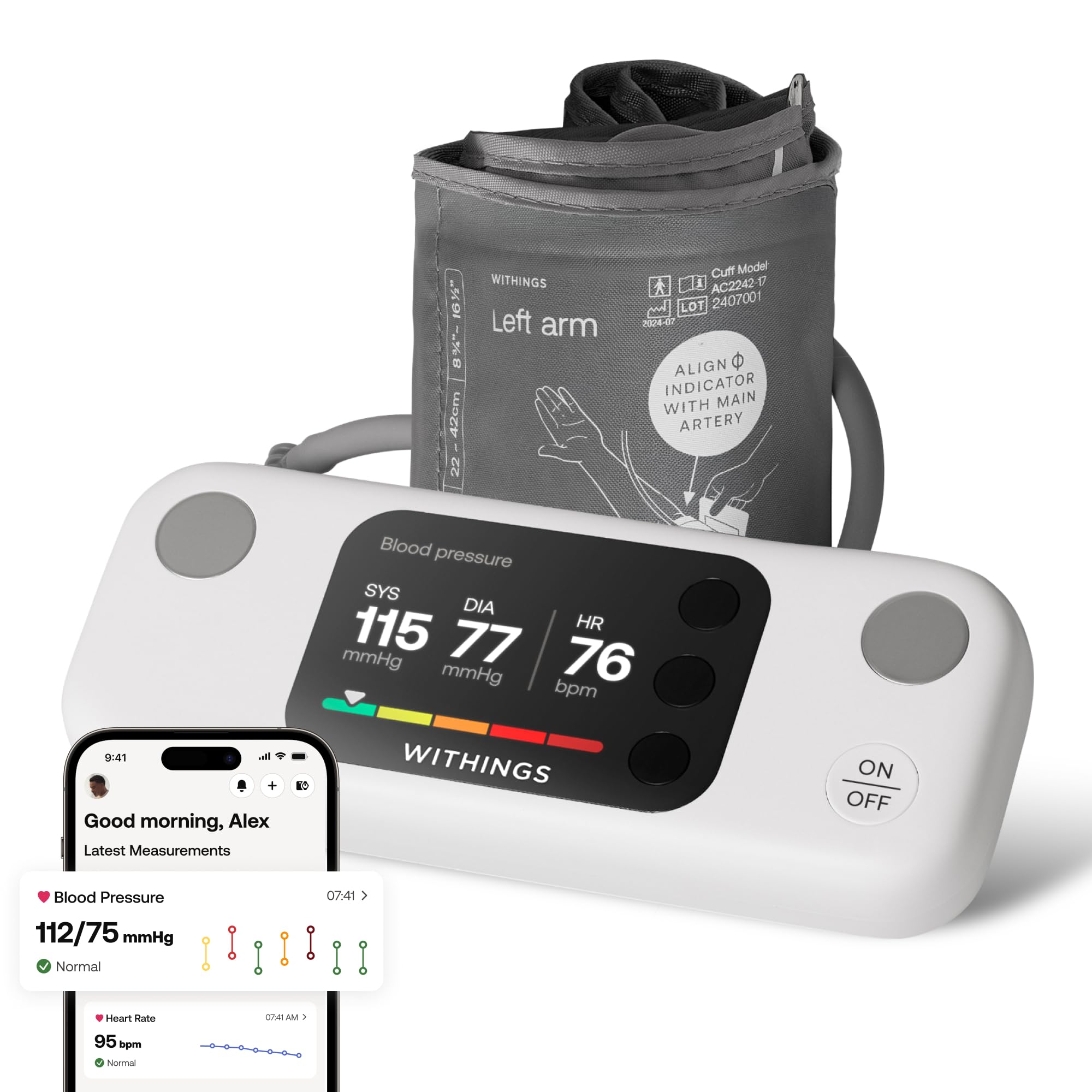
The Withings BPM Vision is the most thoughtfully designed smart monitor here, combining a 2.8-inch color LCD with on-screen step-by-step tutorials that coach you through proper cuff placement and posture. The color-coded feedback — green, yellow, orange, red — mirrors the American Heart Association’s hypertension stages, so you know immediately whether your reading is elevated without cross-referencing a chart. Wi-Fi sync means readings upload to the Withings app and Apple Health automatically when you are within range, even if your phone is in another room.
The standard cuff covers 8.7 to 16.5 inches, and the protective case doubles as a stand that angles the display for ideal viewing from a seated position. Battery life is rated at one year on the included nonstandard lithium battery, which is exceptional among connected devices. The 3-reading average mode reduces the impact of white-coat syndrome by automatically taking three measurements at one-minute intervals and sending the averaged result to the app.
The primary complaint circles around firmware quirks: some users report that the 3-reading average mode only transmits the final single reading to the app rather than the calculated average, and Bluetooth sync can be unreliable compared to Wi-Fi. The unit is also bulkier than the Garmin or Omron, which makes it less travel-friendly despite the included case. For users who value a brilliant display and automated trend tracking at home, however, this is the most polished choice.
Why it’s great
- Large 2.8-inch color LCD with AHA color-coded hypertension staging
- Wi-Fi auto-sync eliminates the need to open an app to upload readings
- One-year battery life on a single nonstandard lithium cell
Good to know
- 3-reading average mode may transmit only the final reading, not the true average
- Bluetooth sync reliability is weaker than dedicated Wi-Fi transmission
- Bulky form factor less convenient for travel than compact competitors
3. Garmin Index BPM

The Garmin Index BPM is built for users already entrenched in the Garmin ecosystem. The device pairs via Wi-Fi to automatically upload systolic, diastolic, and heart rate data to the Garmin Connect app, where you can generate 7-day, 4-week, and 1-year trend reports and export them as PDFs for your physician. Up to 16 user profiles can each sync their own Garmin Connect account, making this the best option for large households or shared monitoring stations.
The adjustable cuff covers 9 to 17 inches, and the compact all-in-one design with an integrated display weighs only 11.3 ounces, making it the lightest connected monitor in this roundup. Battery life hits up to nine months on four AAA batteries, and the one-touch 3X reading mode automatically takes three sequential measurements and averages them — a feature that directly addresses the variability of morning blood pressure. The unit is FDA-cleared and clinically validated for accuracy.
The notable downside is that the 3X reading mode averages all three data points into a single stored value rather than keeping them separate, which some users argue masks useful variability data. Multiple reviews report that the WiFi setup process is unintuitive and requires patience. The cuff also runs long for smaller arms, and the monitor body is top-heavy, making one-handed operation awkward. For Garmin loyalists, the ecosystem convenience outweighs these flaws.
Why it’s great
- Up to 16 user profiles, each synced to individual Garmin Connect accounts
- Wi-Fi auto-sync and PDF report generation for physician sharing
- One-touch 3X reading mode averages three measurements for accuracy
Good to know
- 3X mode averages all three readings into one stored value, losing individual data
- Wi-Fi setup is slower and more complex than typical Bluetooth pairing
- Cuff is long for smaller arm circumferences, and the unit feels top-heavy
4. AQESO Blood Pressure Machine Upper Arm (2-Cuff)

The AQESO delivers the best price-to-feature ratio in this roundup by including two cuffs — a medium/large (9–17 inches) and an extra-large XL (13–21 inches) — plus 1,000 total memory slots split across two users. That is 500 readings per person, or roughly four months of twice-daily monitoring before the memory fills. The large backlit LCD display is legible from several feet away, and the WHO classification bar on the screen gives immediate context for each reading without needing an app.
The dual power supply is a practical touch: you can run it on four AAA batteries or plug in via USB Type-C for indefinite stationary use. Readings are fast and consistent, with oscillometric technology delivering results within 30 to 40 seconds. The kit includes everything needed for setup, and the lightweight 1.54-pound build makes it easy to move between rooms or pack for travel.
The cuff design uses a D-ring closure that stays in place without spinning, a detail that matters when you are taking your own pressure. Some users note the supplied batteries are weak and recommend switching to branded cells immediately. The date/time setup can be slightly fussy, but once configured, the one-button operation is genuinely hassle-free. For a household with two adults who need different cuff sizes, this is the clear winner.
Why it’s great
- Includes both M/L and XL cuffs covering 9 to 21 inches for diverse arm sizes
- 500 readings per user across two profiles — 1,000 total onboard memory
- USB Type-C power option eliminates battery dependence for home use
Good to know
- Included AAA batteries have a short lifespan and should be replaced immediately
- Date and time setup menu is not intuitive for all users
- Lightweight build feels slightly less robust than Omron or Withings alternatives
5. Oontang Blood Pressure Monitor (FDA-Cleared)
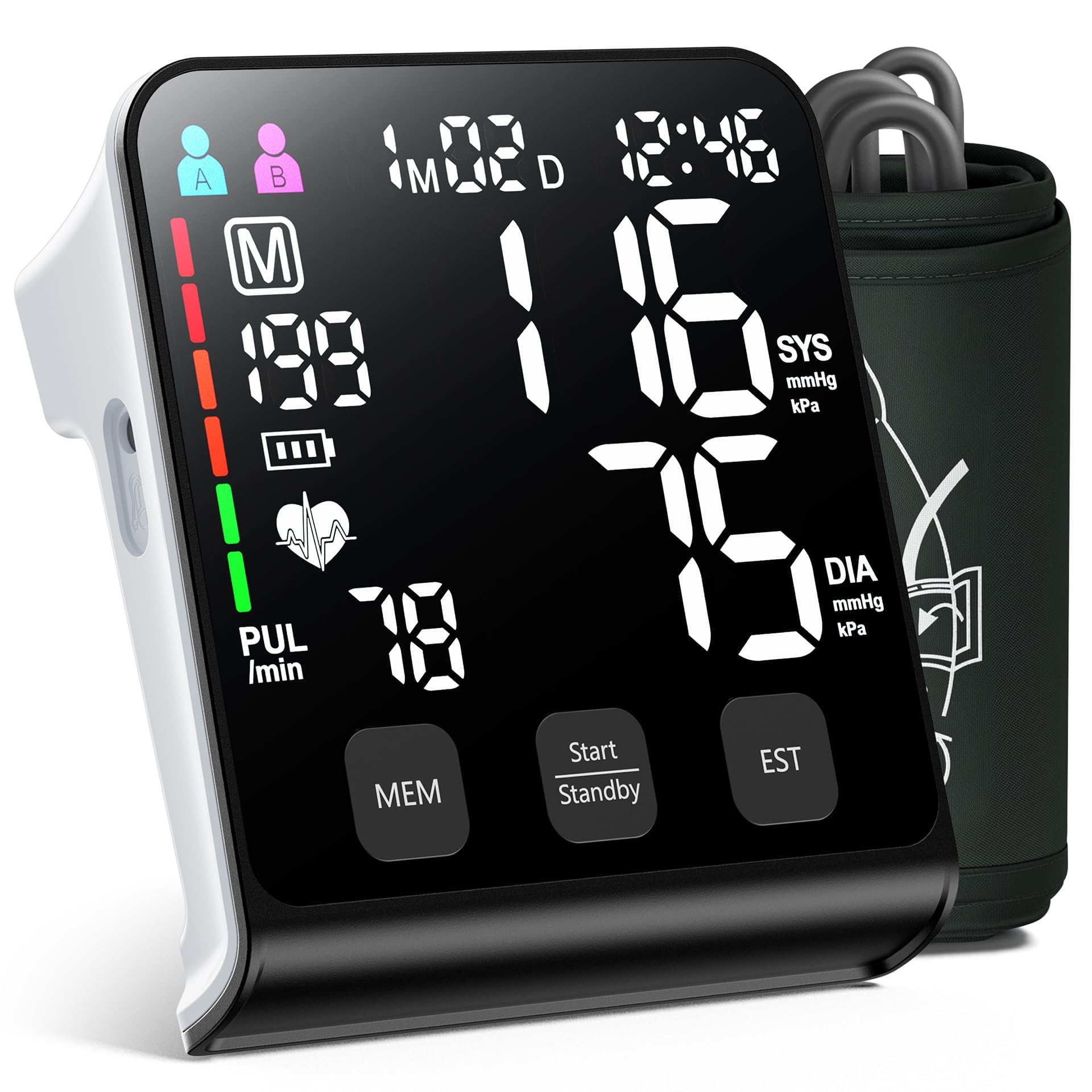
If display visibility is your top priority, the Oontang BP Monitor uses a 4.5-inch LED screen with oversized bright digits that remain readable in dim light without backlight strain — a feature that is genuinely helpful for seniors or anyone checking pressure in a dark bedroom. The screen also includes a blood pressure classification indicator so you see at a glance whether your reading falls into normal, elevated, or hypertensive ranges. The unit is FDA-cleared and eligible for FSA/HSA reimbursement.
Storage capacity hits 199 readings per user across two profiles, which is competitive with mid-range options and sufficient for tracking trends over several months. The one-button operation and intelligent pressure algorithm deliver results within about 30 seconds, with an error margin of ≤±3 mmHg. The wide-range adjustable cuff fits most adult arms, and the monitor includes both USB Type-C power and four AAA batteries for dual power flexibility.
The scratch-resistant acrylic panel and compact 1.28-pound build make this a durable travel companion, though the lack of Bluetooth or Wi-Fi means all tracking happens on-device. Users consistently praise the large screen and consistent readings, though the Oontang brand is less established than Omron or Withings, which may matter if service and warranty support are important to you. For pure local use with the best possible display, this is the strongest mid-range option.
Why it’s great
- Massive 4.5-inch backlit LED display with hypertension classification indicator
- 199 readings per user across two profiles for long-term trend tracking
- FSA/HSA eligible, reducing out-of-pocket cost for eligible accounts
Good to know
- No Bluetooth or Wi-Fi connectivity for automatic data export
- Oontang brand has a shorter track record than legacy medical-device manufacturers
- Cuff size range is broad but not XL-specific for arms exceeding 17 inches
6. Acenis Automatic Blood Pressure Monitor (AOJ-30F)
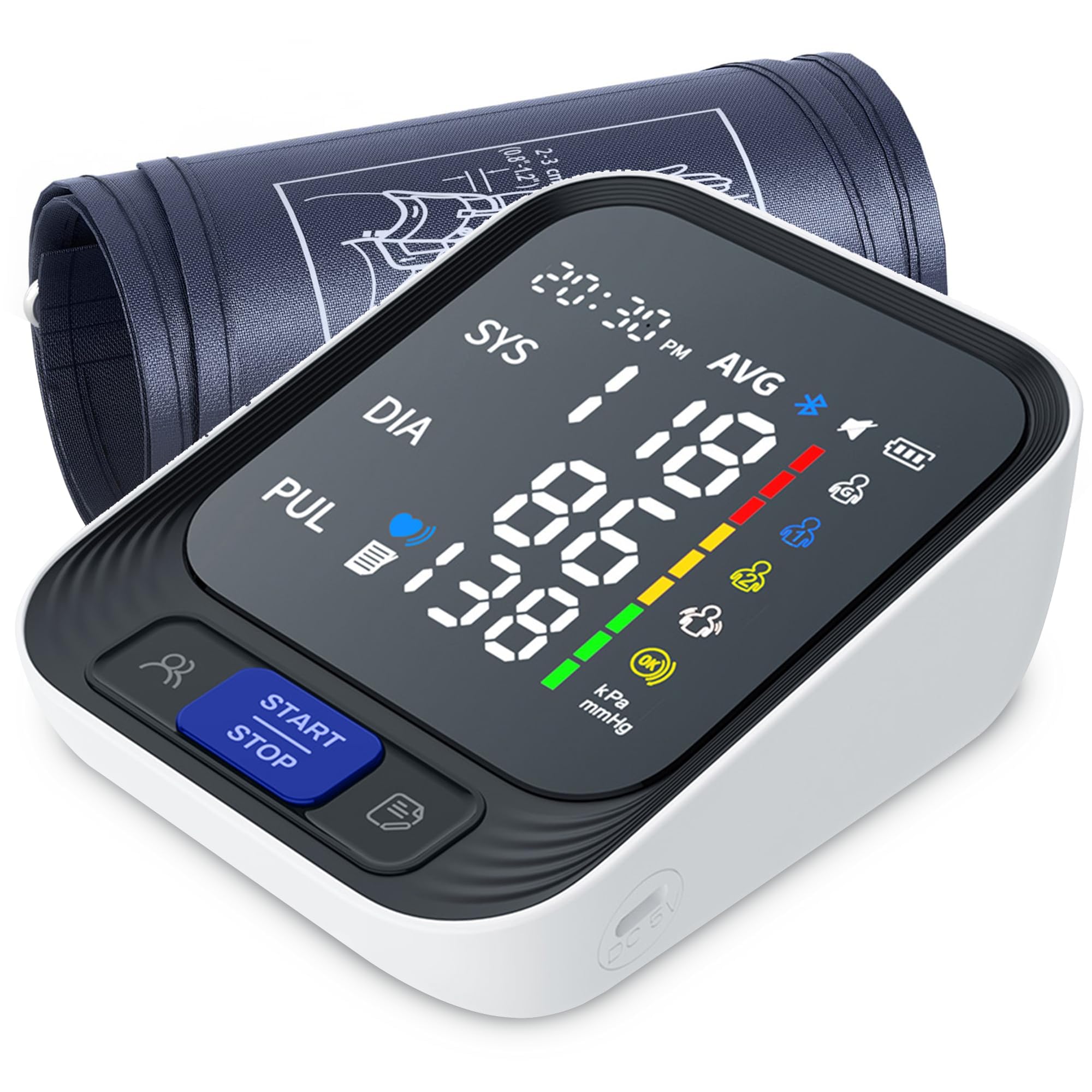
The Acenis AOJ-30F stands out for supporting three user profiles rather than the standard two, making it a practical choice for multi-generational households where a parent, adult child, and grandparent all need tracking. Each profile stores 200 readings with date and time stamps, and the large color screen uses oversized numerals that are easy to read without glasses. The one-button operation completes a full measurement cycle in roughly 40 seconds, and the cuff includes an XL option that accommodates larger arms comfortably.
The kit ships with four AAA batteries and a power cord, so you have dual power options from the start. User reviews consistently highlight the high repeatability of readings when the user rests for five minutes before measurement, which speaks to reliable oscillometric sensor calibration. The light cuff design prevents spinning during self-application, a small ergonomic win that reduces measurement errors.
The main drawback is that each user profile only stores 200 readings, which fills up in about three months of twice-daily monitoring — you will eventually need to either clear the memory or log manually. The brand is relatively new to the market, and some users found the date/time setup menu slightly confusing. For a simple, no-app monitor that three people can use interchangeably, the Acenis delivers strong value.
Why it’s great
- Unique 3-user profile support with 200 readings each for shared households
- Large color screen with oversized digits for low-vision accessibility
- Light cuff design resists spinning during self-application for consistent placement
Good to know
- 200 readings per user fills in three months with daily monitoring
- Date and time setup menu is not immediately intuitive for all users
- Brand is newer, so long-term reliability data is limited compared to Omron
7. VOLUETH Pediatric Blood Pressure Monitor (3-Cuff)

The VOLUETH Pediatric monitor is the only model in this list that includes a small cuff sized for children (4 to 8 inches) alongside medium (6–10 inches) and large (7–17 inches) cuffs, making it the definitive choice for families with kids. The small cuff is important because using an adult cuff on a child’s arm can produce falsely elevated readings by as much as 10 to 15 mmHg. The unit uses upgraded ASP (Accurate Signal Processing) technology that delivers results in about 30 seconds, and the WHO classification bar provides immediate context.
Storage covers 300 readings split across two user modes, with each reading stamped with date and time. The backlit LCD display is clear and readable, and the one-button operation is simple enough for older children to use under supervision. The kit includes a portable carry bag and charges via USB Type-C, though you need to supply your own 5V 1A adapter. The unit weighs just 15.87 ounces, making it the lightest full-kit option here.
The supplied AAA batteries are often dead on arrival — a known issue with this production batch — but the monitor works fine when plugged in via USB. The compact size and included cloth bag make it ideal for travel, and the three cuff sizes genuinely accommodate everyone from a 4-year-old to a large adult. If your household includes children who need regular monitoring, the VOLUETH is the only correct choice in this roundup.
Why it’s great
- Includes a true pediatric small cuff (4–8 inches) for accurate readings on children
- Fast 30-second measurement cycle with ASP technology and WHO classification
- Portable carry bag and USB Type-C power make it easy to travel with
Good to know
- Included AAA batteries are commonly dead on arrival; have USB power ready
- 5V 1A USB adapter not included in the kit
- Only 300 total memory slots shared across two user modes
FAQ
What arm circumference do I need for the standard cuff on most monitors?
Is Bluetooth or Wi-Fi sync necessary for tracking blood pressure trends?
How often should I replace the cuff on my arm blood pressure monitor?
Final Thoughts: The Verdict
For most users, the best arm blood pressure monitor winner is the AQESO Blood Pressure Machine Upper Arm because it combines two cuff sizes covering 9 to 21 inches, 1,000 total memory slots across two users, and USB Type-C power — all at a price that undercuts smart monitors by a wide margin. If you need AFib screening and Bluetooth export, grab the Omron Gold (BP5360). For a household with children requiring regular monitoring, nothing beats the VOLUETH Pediatric with its three cuff sizes starting at 4 inches.

Mo Maruf
I created WellFizz to bridge the gap between vague wellness advice and actionable solutions. My mission is simple: to decode the research and give you practical tools you can actually use.
Beyond the data, I am a passionate traveler. I believe that stepping away from the screen to explore new environments is essential for mental clarity and physical vitality.