Our readers keep the lights on and my smoothie glass nicely filled. As an Amazon Associate, I earn from qualifying purchases.
The difference between a photo fading in five years versus surviving five generations often comes down to the box it sleeps in. Standard cardboard and plastic bins leach acids that yellow paper, weaken fibers, and destroy the sentimental value of prints, documents, and newspapers you cannot replace. Archival storage boxes solve this with buffered, acid-free materials that neutralize the environment inside the container, making them the only safe long-term home for anything you want to outlast you.
I’m Mohammad Maruf — the founder and writer behind WellFizz. I analyze the material science, board thickness, and real-world certification data behind preservation products to separate museum-grade solutions from overpriced cardboard.
Whether you are protecting a newspaper collection from the 1940s or sorting decades of family photographs, the right container determines how long those memories stay intact. This guide covers the seven most capable options available today and explains exactly what makes a box archival versus merely decorative, so you can make a confident choice for your items after reading this review of the best archival storage boxes.
How To Choose The Best Archival Storage Boxes
Buying an archival box is not like picking a standard plastic tote. The wrong material can actively damage what you are trying to save. Focus on these four factors to ensure your items stay protected for decades, not months.
Material Composition: Acid-Free, Lignin-Free, and Buffered
The single most important spec is the pH of the board. Standard cardboard contains lignin and acids that migrate onto paper and photos, causing yellowing and brittleness. True archival boxes use acid-free, lignin-free board, often buffered with 3% calcium carbonate to neutralize future acid exposure from handling and the environment. Any box lacking these certifications is a storage bin, not an archival container.
Board Thickness and Construction
Boxboard thickness is measured in points (pt.), with 60 pt. being the industry standard for archival-grade storage. This thickness prevents sidewall collapse when stacking multiple boxes or pulling them off a shelf. Metal-edge reinforcement at the corners adds critical strength and prevents the board from splitting under weight — a feature that separates premium archival boxes from entry-level options.
Lid Style: Clamshell vs. Lift-Off
Clamshell lids are hinged and swing open fully, allowing you to access contents without removing the cover completely — useful when boxes are stored on high shelves. Lift-off lids provide a tighter seal against dust and light but require free space above the box to remove. For newspaper and large-format storage, clamshell designs are generally preferred because the deep lid stays aligned.
Size and Intended Contents
Measure your items before buying. Jumbo boxes around 15.5 x 12.5 x 5 inches work well for magazines and legal documents. Smaller 5 x 8 x 12 inch boxes fit photographs and index cards. Always leave a 0.75-inch buffer on all sides to avoid forcing items in, which stresses the board and compromises the preservation environment.
Quick Comparison
On smaller screens, swipe sideways to see the full table.
| Model | Category | Best For | Key Spec | Amazon |
|---|---|---|---|---|
| Lineco Document Storage Box (Jumbo) | Mid-Range | Large documents & magazines | 60 pt. buffered board, metal edges | Amazon |
| Lineco Photo Card Box | Mid-Range | 5×8 photos & cards | 60 pt. scuff-resistant board | Amazon |
| Gaylord Archival Clamshell Preservation Box | Mid-Range | Prints & historical documents | P.A.T. certified, 60 pt. barrier board | Amazon |
| HG Art Concepts Eternity Clamshell Box | Mid-Range | Artwork & delicate prints | Book cloth binding, archival paper lining | Amazon |
| Gaylord Archival Newspaper Box | Premium | Oversized newspapers & posters | Acid-free, pH 8.0-9.0 buffered board | Amazon |
| FAAYUCK Photo Storage Box Set | Budget | Large photo collections (5×7) | 18 inner boxes with dividers, BPA-free | Amazon |
| IRIS USA File Box 4-Pack | Budget | Hanging file organization & moving | 35 Qt., BPA-free, letter/legal ledge | Amazon |
In‑Depth Reviews
1. Lineco Archival Document Storage Box with Metal Edge (Jumbo)
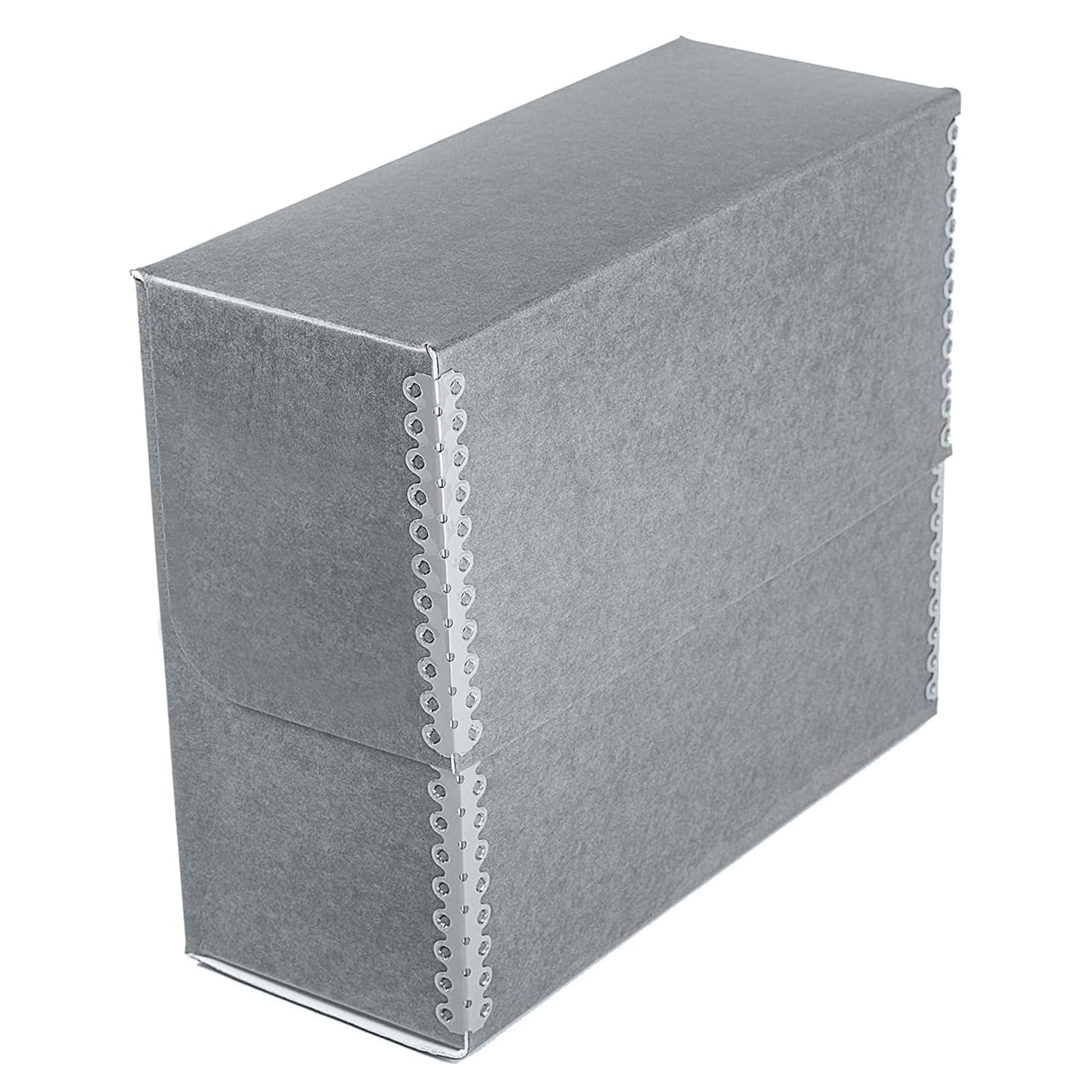
The Lineco Jumbo arrives with a reputation rooted in museum and archival institution use, and the build quality lives up to that billing — the 60 point gray boxboard resists warping even when fully loaded with magazines, while the metal-edge construction prevents corner crushing during shelf storage. The lift-off lid fits snugly enough to block dust but lifts off easily when you need access, and the attached nylon string makes sliding it off a shelf simple.
Dimensions of 15.5 x 12.5 x 5 inches give you just over 960 cubic inches of volume, which fits jumbo-sized documents, 1930s-era newspapers (which were wider than modern sheets), and stacks of photographic prints without forcing them against the sides. The acid-free, buffered material neutralizes environmental acids, which is critical for anything you want to pass down to the next generation.
One caution from buyer feedback: the box ships in a plastic bag rather than a protective shipping box, and some units arrived with crushed corners that prevented the lid from sitting flush. If packing damage occurs, the structural integrity of the lid seal is compromised, so inspect on arrival and request a replacement if needed.
Why it’s great
- Museum-grade 60 pt. buffered boxboard with metal-edge reinforcement
- Generous jumbo size fits oversized newspapers and magazines without bending
- Attached nylon pull string for easy removal from tight shelves
Good to know
- Ships in a plastic bag, leading to corner damage during transit without a box
- Lift-off lid requires overhead clearance to remove fully
2. Lineco Photo Card Box, Museum-Quality Archival Storage

Designed specifically for 5 x 8 inch photographs and index cards, the Lineco Photo Card Box uses the same 60 pt. acid-free board found in larger archival units but in a more compact footprint. The scuff-resistant exterior keeps the tan finish clean through years of handling, and the 3% calcium carbonate buffer compensates for any acidity introduced by fingers or storage environment over time.
The clamshell lid is a genuine advantage here — it hinges open fully without detaching, making this box ideal for shelves where you lack the vertical space to lift a cover off completely. Buyers report fitting tab dividers inside to separate decades of family snapshots, and the interior depth accommodates stacks of photos alongside archival tissue paper without causing lid lift.
At 5 inches tall by 12 inches wide, the internal volume is smaller than it looks — some users noted they needed multiple units for large collections. The price per cubic inch leans toward the premium side, but for heirloom photos dating back to the 1800s, the material certification justifies the investment.
Why it’s great
- Clamshell hinged lid stays attached, perfect for shelf access
- Scuff-resistant, buffered board with 3% calcium carbonate for acid protection
- Deep enough to accommodate tab dividers for organized sorting
Good to know
- Compact size means you may need several boxes for a large photo collection
- Some buyers expected larger dimensions relative to price per unit
3. Gaylord Archival Blue/Grey Clamshell Preservation Box

Gaylord Archival is a name known among cultural heritage institutions, and this clamshell box carries the Photographic Activity Test (P.A.T.) certification — a critical benchmark that verifies the box will not cause chemical fading or staining on photographic materials over decades. The deep lid wraps around the base to seal out dust and light, and the 60 pt. barrier board resists moisture ingress better than standard boxboard options.
At 10.25 x 15.25 x 3 inches, the slim profile is designed for flat storage of prints, documents, and fragile keepsakes rather than bulky stacks of papers. The clamshell hinge allows full 180-degree opening so you can flip through contents without removing them, which is invaluable when cataloging a historical collection of family bibles or vintage photographs.
Buyers noted the price feels high for a single box, especially when compared to flat-packed storage bins. However, the P.A.T. certification and lignin-free construction are non-negotiable for photographic materials — cheap boxes will actively fade your prints, while this one keeps them stable. Some users wished for a clear front insert to label contents without opening the lid.
Why it’s great
- P.A.T. certified for safe photographic storage — no chemical fading
- Deep clamshell lid blocks light and dust entirely
- Opens fully 180 degrees for easy content access without removal
Good to know
- Premium price per unit may feel steep for large collections
- No clear front insert holder for labeling contents externally
4. HG Art Concepts Eternity Archival Clamshell Box (Black)

The HG Art Concepts Eternity box takes a different approach from the utilitarian gray board of other archival options: it is bound in black book cloth and lined with matte black archival paper, making it attractive enough to sit visibly on a shelf rather than needing to be hidden away. The board resists denting and bending, and the clamshell lid swings up smoothly on a fabric hinge that feels more like a fine book than a storage container.
Internally, the box is sized to hold 8.5 x 11 inch artwork and documents with a 0.75-inch buffer on all sides, preventing edge crimping when papers shift during handling. The 2.25-inch interior depth provides enough volume for a stack of prints or a few bound journals, though it is not designed for deep storage of bulky files. The acid-free lining ensures that the fabric cover does not introduce off-gassing inside the box.
Price has risen significantly since early 2023, with some early buyers reporting a nearly 100% increase. The construction quality remains high, but the value proposition has shifted — this is now firmly a premium decorative preservation box rather than a budget workhorse. For users who want display appeal alongside archival safety, it is the best-looking option on this list.
Why it’s great
- Book cloth exterior and archival paper lining combine preservation with display aesthetics
- Sturdy board resists denting better than standard 60 pt. boxboard
- Generous 0.75-inch buffer prevents edge damage to contents
Good to know
- Price has increased significantly, reducing value-for-money compared to alternatives
- 2.25-inch depth limits capacity for larger file stacks
5. Gaylord Archival Blue/Grey Newspaper Preservation Box

Newspapers from the pre-1950 era were printed on wider sheets that do not fit standard document boxes, and this Gaylord newspaper preservation box solves that with 13 x 18 inch internal dimensions specifically designed for broadsheet storage. The acid-free, lignin-free board is buffered to a pH of 8.0-9.0, actively resisting the acid migration that causes newsprint to become brittle and brown over time.
The metal-edge reinforcement runs along the corners and top rim, giving the box the strength to hold heavy stacks of bound newspapers without bowing. The lift-off lid features a deep wrap-around design that keeps out dust and light effectively, and the lightweight board construction means a fully loaded box remains manageable for shelf transfer. Buyers have used it for storing vintage posters, concert prints, and even a valuable historical gown.
The price per box is similar to what you would pay ordering directly from archival supply companies, and the P.A.T.-passed certification confirms the materials inside will not interact chemically with your content. For serious newspaper and large-format preservation, this is the most size-appropriate option in the group — just ensure you pair it with archival tissue paper or sleeves for multiple layers.
Why it’s great
- 13 x 18 inch internal size fits broadsheet newspapers and large posters flat
- Buffered to pH 8.0-9.0 with P.A.T. certification for photographic safety
- Metal-edge corners prevent structural collapse under heavy loads
Good to know
- Cannot be shipped to PO Boxes due to carrier restrictions
- Lift-off lid requires open shelf space above for removal
6. FAAYUCK Photo Storage Box Set (5×7, 18 Inner Boxes)

The FAAYUCK system takes a modular approach with 18 individual inner boxes housed in a clear outer container, each inner box sized for 5 x 7 inch photos and capable of holding roughly 100-120 prints. The thick polypropylene material is BPA-free, PVC-free, and lignin-free, addressing chemical off-gassing concerns, though it does not carry the same P.A.T. certification as traditional paperboard archival boxes.
Transparency is the standout feature here — you can see exactly which inner box contains which era of photos without opening anything, and the included dividers help you separate events or years within each box. The secure latch on the outer container closes firmly enough to keep dust and humidity out, and the top handle makes transport simple for moving boxes between storage locations.
Some users noted that the plastic latch does not click shut with absolute confidence, and the handle on top has a tendency to drop from the upright position when the box shifts during carrying. For pure archival preservation of irreplaceable photos, the lack of buffered acid-neutralizing material is a gap compared to the 60 pt. boxboard options, but for organizing large volumes of modern photo prints, the modular system is tremendously practical.
Why it’s great
- 18 modular inner boxes with dividers for organized photo sorting
- Clear plastic allows instant visual identification of contents
- BPA-free and lignin-free construction reduces chemical off-gassing
Good to know
- Plastic latch feels less secure than ideal for long-term closure
- Not buffered — lacks active acid neutralization of paperboard archival boxes
7. IRIS USA File Box with Lid (Clear, 4-Pack)

The IRIS USA file box pack delivers four clear polypropylene bins with integrated hanging file ledges that accept both letter and legal file folders, making them the strongest option for active document organization rather than long-term passive storage. The BPA-free plastic does not contain the lignin or acids found in cardboard, but it also lacks the buffering capacity of archival paperboard — it will not actively harm papers, but it will not neutralize environmental acids either.
Stacking stability is excellent thanks to the grooved lid design that locks onto the bin below, and the 35-quart capacity per box provides substantial volume for moving boxes or storing banker box quantities of files. The transparent walls let you spot contents from any angle, which saves time when digging through archives for a specific folder.
The recurring issue across buyer feedback is shipping damage: the boxes ship inside a thin IRIS box without sufficient padding, and cracked lids or bases are common on arrival. Once received intact, the plastic holds up well for about 12-18 months of regular use before the thinner walls begin to crack under heavier loads. For budget-conscious organization of non-heirloom files, the value per bin is hard to beat, but do not trust them with irreplaceable originals.
Why it’s great
- 4-pack provides massive volume at the lowest per-unit cost
- Hanging file ledge accommodates both letter and legal folders
- Transparent walls and stackable design improve organization speed
Good to know
- Thinner polypropylene prone to cracking after 12-18 months of regular use
- Frequent shipping damage leaves boxes cracked or broken on arrival
FAQ
Can I store photographs in plastic archival boxes?
What is the difference between acid-free and buffered archival boxes?
How many photos fit in a typical 5×8 archival photo box?
Final Thoughts: The Verdict
For most users, the best archival storage boxes winner is the Lineco Jumbo Document Storage Box because it balances museum-grade 60 pt. buffered board and metal-edge reinforcement at a reasonable price point for the volume it provides. If you need a compact solution for photographs and cards, the Lineco Photo Card Box offers the same material quality in a clamshell format. And for oversized newspapers or large-format prints, nothing beats the Gaylord Archival Newspaper Box with its P.A.T.-certified, pH-buffered board specifically designed for broadsheet dimensions.

Mo Maruf
I created WellFizz to bridge the gap between vague wellness advice and actionable solutions. My mission is simple: to decode the research and give you practical tools you can actually use.
Beyond the data, I am a passionate traveler. I believe that stepping away from the screen to explore new environments is essential for mental clarity and physical vitality.