Our readers keep the lights on and my smoothie glass nicely filled. As an Amazon Associate, I earn from qualifying purchases.
For runners, the arch isn’t just a curve in your foot—it’s the critical suspension system that absorbs each stride’s impact and transfers energy forward. When that natural support weakens or falls, every run becomes a chain reaction of pain traveling up through the ankles, knees, hips, and lower back. High-arched runners land with shock concentrated on the heel and ball of the foot, while flat-footed runners fight overpronation that torques the entire kinetic chain. The solution isn’t a new shoe; it’s a properly engineered insole that restores the foot’s natural mechanical advantage.
I’m Mohammad Maruf — the founder and writer behind WellFizz. I spend my days dissecting the biomechanical claims of orthotic manufacturers, cross-referencing foam density data with real-runner reviews, and identifying which arch profiles pair best with specific motion-control features.
After analyzing foam rebound rates, heel cup depths, and customer durability data across dozens of models, these are the arch support insoles for runners that actually deliver structural correction without the adaptation agony.
How To Choose The Best Arch Support Insoles For Runners
Buying the wrong arch support can turn a runner’s remedy into a podiatrist’s paycheck. The three variables that separate a good insole from a bad one are your arch profile, the heel cup geometry, and the foam’s density gradient. Let’s break down what each means for your next run.
Match the Arch Profile to the Insole Design
Low arches require a medial post—a firm wedge along the inner edge—to prevent the foot from rolling inward (overpronation). High arches need deep heel cups and extra metatarsal cushioning to absorb shock at impact. Neutral arches get away with semi-rigid arches that support without forcing correction. Ignoring your arch type means fighting the insole all day.
Heel Cup Depth Determines Stability
A shallow heel cup lets the heel slide, causing blisters and reducing the insole’s ability to control supination or pronation. Look for cups that rise at least 15mm around the heel counter and cradle the calcaneus without biting into the Achilles. Proper depth also locks the insole in place so it doesn’t shift during a stride.
Foam Density and Cushioning Layers
Single-density EVA foam compresses quickly under a runner’s body weight, especially above the 200-pound threshold. Multi-layer designs with a firm base layer and a softer top layer—or gel inserts at the heel and forefoot—distribute impact more evenly. Too soft and you’ll bottom out; too hard and you’ll feel every pebble on the road.
Quick Comparison
On smaller screens, swipe sideways to see the full table.
| Model | Category | Best For | Key Spec | Amazon |
|---|---|---|---|---|
| Move Game Day Performance Insoles | Performance | Jumping sports and impact reduction | Composite heel with reactive stability | Amazon |
| Superfeet Run Cushion Low Arch | Low Arch | Low arches and daily training | 6mm heel-to-toe drop with moisture-wick | Amazon |
| PowerStep Pulse Plus Met | Metatarsal Support | Ball of foot pain and neuroma relief | Met pad with total contact foot support | Amazon |
| CRUVHEAL Sport Shock Absorbing | Neutral Arch | Active sports and training | Gel pad heel with deep heel cup | Amazon |
| BestHalo Heavy Duty Plantar Fasciitis | High Arch | Heavy users and high arches | EVA foam with gel cushioning for 220+ lbs | Amazon |
In‑Depth Reviews
1. Move Game Day Performance Insoles

Move’s Game Day insole sits at the intersection of orthotic rigidity and running-friendly cushion, a rare balance that explains why it’s co-founded by an NBA All-Pro and worn by athletes across multiple sports. The composite heel insert absorbs landing shock without deadening push-off responsiveness, which is exactly what you need when you’re cutting on the court or striding on pavement. Multiple reviewers with flat feet and shin splint histories reported symptom elimination after switching to these, which suggests the arch profile is aggressive enough to correct overpronation without forcing the foot into an unnatural posture.
The molded forefoot design is not a marketing gimmick—it wraps the metatarsal heads in a way that prevents the insole from buckling under lateral loads. That matters for runners who bank corners or run on cambered roads. The patented arch support mimics the contouring of custom orthotics, but at a fraction of the turnaround time and cost. One college basketball player put these through an entire season of practice and games and reported zero breakdown in support, indicating the polyurethane core holds its shape longer than standard EVA.
Reviewers note that the insoles add a slight weight penalty to already-light shoes, and some recommend sizing up half a size to accommodate the thickness. But for runners who prioritize joint protection and arch stability over minimalism, that trade-off is invisible after the first mile. The moisture-wicking top layer also keeps friction low during sweat-heavy sessions, reducing blister risk on long runs.
Why it’s great
- Composite heel absorbs high-impact landing forces without feeling mushy
- Patented arch design mimics custom orthotic contours for flat feet and shin splints
- Durable polyurethane core survives intense multi-sport training without collapsing
Good to know
- Adds noticeable weight to lightweight racing flats
- Some users need a half-size up to accommodate the thickness
2. Superfeet Run Cushion Low Arch Insoles

Superfeet has been a benchmark in the orthotic industry for decades, and the Run Cushion Low Arch—formerly known as the ADAPT—refines that legacy for distance runners specifically. The patented Adaptive Comfort Technology uses a flexible arch that moves with the foot during gait, promoting efficient heel-to-toe turnover rather than fighting it. That’s a meaningful engineering choice: many rigid orthotics create a hinge-point at the midfoot that can cause blisters or joint strain, but Superfeet’s approach bends just enough to maintain dynamic alignment without losing structural rigidity.
The moisture-wicking top cover addresses a practical pain point for runners who log double-digit mileage in humid conditions. Fungal and bacterial build-up in foam insoles accelerates breakdown, and the wicking layer keeps the footbed drier, extending the insole’s usable life beyond the typical six-month replacement cycle. One reviewer measured their arches at a specialty running store and found these matched custom orthotics within a millimeter of accuracy, which explains the enthusiastic fan base among runners with low arches who previously felt ignored by one-size-fits-all inserts.
Some users with mid-range arches report a slight burning sensation on the soles during longer walks, which may indicate the arch support is slightly too aggressive for neutral feet. The trim-to-fit design is straightforward, but runners should follow the cutting guide carefully because trimming too aggressively around the metatarsal ridge can flatten the arch profile. For low-arched runners, this is the closest you can get to a custom prescription without the podiatrist markup.
Why it’s great
- Adaptive Comfort flexes with the foot for natural heel-to-toe gait
- Moisture-wicking top layer keeps foam dry during long sweaty runs
- Matches custom orthotic arch measurements at a fraction of the cost
Good to know
- May cause sole burning sensation in neutral or high-arched runners
- Trimming must be precise to preserve the arch profile
3. PowerStep Pulse Plus Met Ball of Foot Pain Relief Insoles
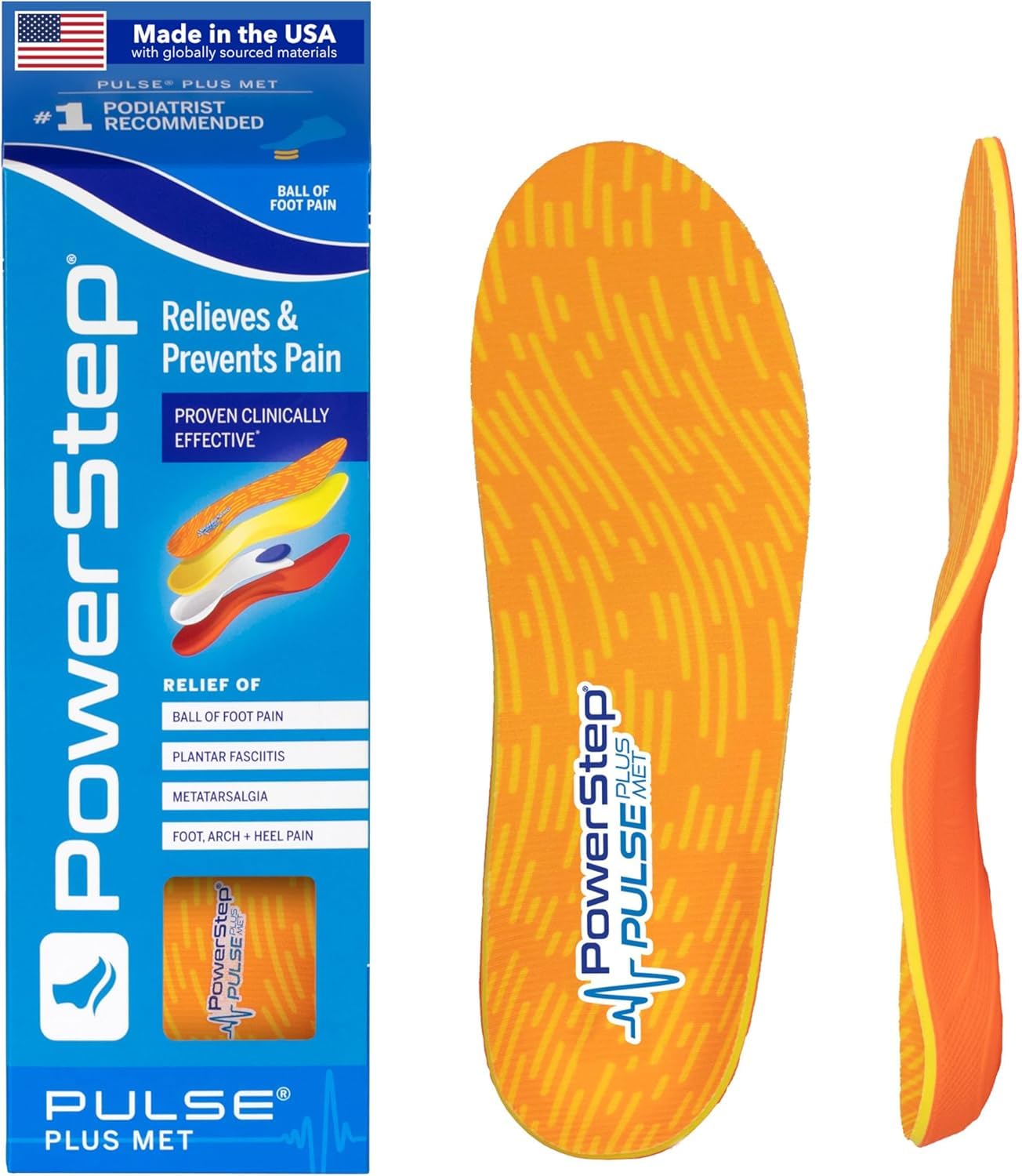
Most arch support insoles ignore the forefoot entirely, focusing all their engineering on the midfoot and heel. PowerStep’s Pulse Plus Met corrects this oversight with a built-in metatarsal pad that lifts the transverse arch just enough to offload pressure from the ball of the foot—a critical feature for forefoot strikers and runners dealing with Morton’s neuroma or metatarsalgia. The pad is positioned precisely under the second, third, and fourth metatarsal heads, which is where neuroma pain concentrates, and multiple podiatrist-recommended reviews confirm it provides genuine relief without creating a new pressure point.
The full-length total contact design supports the entire foot bed in a single layer, meaning there’s no hard plastic bridge that can dig into the arch during dorsiflexion. That’s important for runners who flex their toes upward during the propulsion phase. The odor-control top fabric is not just a hygiene bonus—it reduces heat and friction, which directly lowers blister formation during high-cadence runs in warm weather. One reviewer reported that a single pair lasted over a year of daily sneaker use before the bottom pad wore down, which is exceptional longevity for a foam-based insole in the mid-range tier.
The trade-off is width: some runners find the insole too wide for narrow running shoes, causing the edges to buckle upward or the footbed to bulge at the side. This is less of an issue in roomy trainers and more problematic in snug racing flats. The met pad’s effectiveness also depends on correct shoe sizing—if your toes are jammed against the front of the shoe, the pad can push the foot forward, causing toe jamming. Measure your shoe’s internal clearance before committing.
Why it’s great
- Met pad reduces Morton’s neuroma and metatarsalgia pain without digging in
- Full-length total contact design avoids hard plastic arch bridges
- Odor-control fabric reduces heat and friction for blister-prone runners
Good to know
- Insole width may cause bulging in narrow running shoe models
- Met pad can push toes forward if running shoes lack front clearance
4. CRUVHEAL Sport Shock Absorbing Insoles

CRUVHEAL’s Sport insoles take a more neutral approach to arch support, opting for shock absorption and heel stability over aggressive structural correction. The strategically placed gel pads at the heel and forefoot absorb impact energy without altering the foot’s natural pronation pattern, making them ideal for runners with neutral arches who need extra cushioning rather than motion control. One soccer referee and runner reported that these insoles provided “springy” acceleration and great comfort through a full 5k, which suggests the rebound rate of the foam-gel hybrid is tuned for responsive energy return, not just soft landing.
The deep heel cup and non-slip gel heel pads address a common complaint with athletic insoles: migration inside the shoe during explosive movements. The gel tackiness anchors the insole to the shoe’s internal lining, so even sprint intervals or lateral cuts won’t shift the footbed out of alignment. Multiple reviewers noted that these fit wide feet comfortably, which is a relief for runners in brands like New Balance or Brooks that already run wide in the toe box. The 3-7 day adaptation period is shorter than most rigid orthotics, and some users reported zero break-in discomfort, indicating the medium-density foam is forgiving from the first step.
The downsides are subtle but real. The insoles are slightly heavier than minimalist alternatives, which may be noticeable in lightweight speed trainers, and the neutral arch profile won’t provide enough support for runners with diagnosed flat feet or overpronation. The gel pads also have a finite lifespan—around 300 miles of running—before they begin to compress and lose their shock-absorbing properties. For the price point, they deliver solid entry-level performance for runners who want comfort without committing to a specific arch correction system.
Why it’s great
- Gel heel and forefoot pads absorb impact without altering natural pronation
- Non-slip gel heel pads prevent insole migration during sprints and cuts
- Zero break-in period with medium-density foam that fits wide feet
Good to know
- Heavier than minimalist alternatives, noticeable in speed trainers
- Neutral arch insufficient for runners with diagnosed flat feet or overpronation
- Gel pads compress after roughly 300 miles of running
5. BestHalo Heavy Duty Plantar Fasciitis Insoles
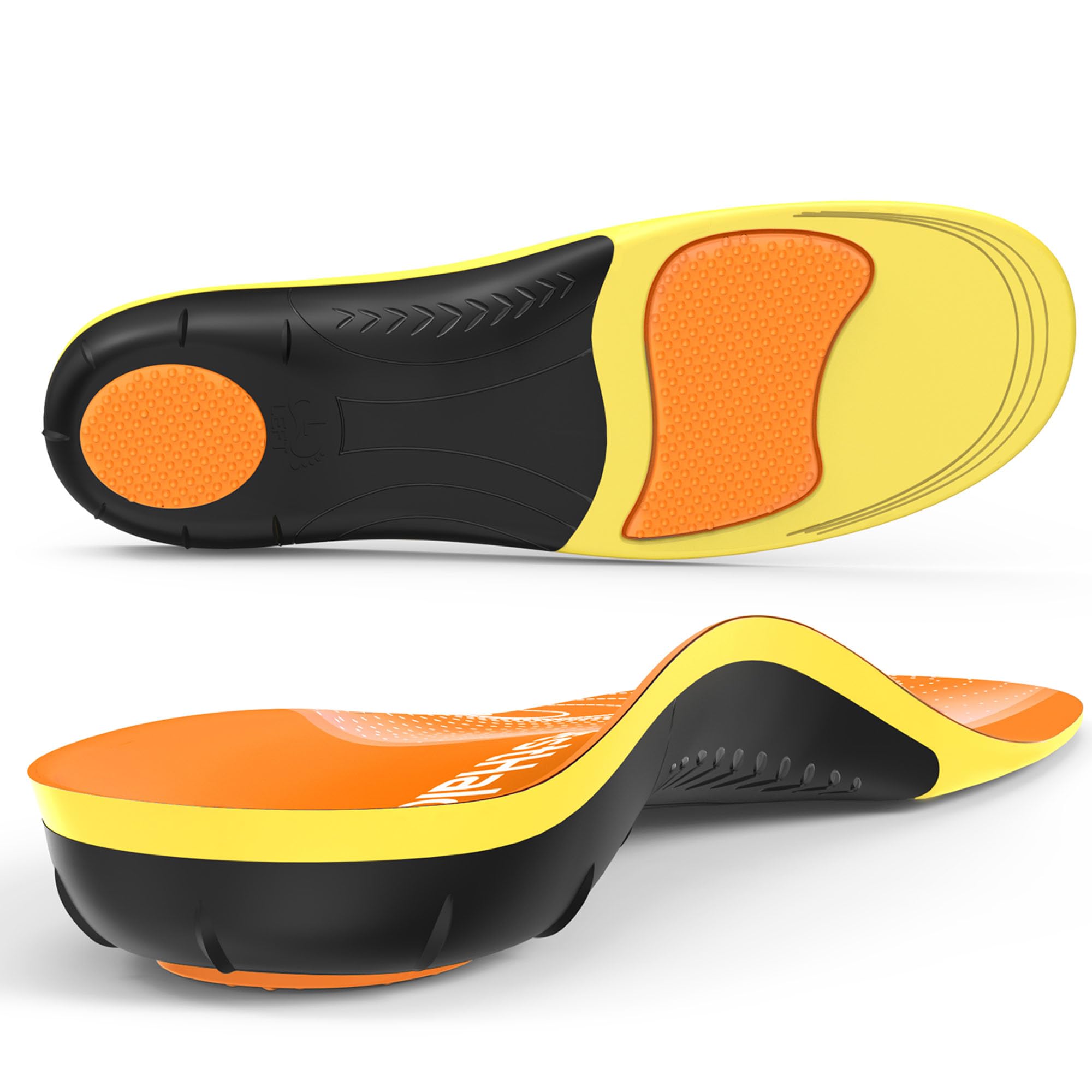
BestHalo’s Heavy Duty insole is engineered for a specific demographic: runners and standing workers who weigh 220 pounds or more and need an arch support that won’t collapse under that load. The EVA foam and gel cushioning foundation is layered at a density that resists bottoming out, and the high arch profile is aggressive enough to correct alignment for individuals with plantar fasciitis or fallen arches. One reviewer who recovered from foot surgery reported that this insole eliminated pain traveling from foot to hip, which indicates the structural correction chain reaches all the way up the kinetic chain, not just the foot.
The trim-to-fit design accommodates a wide range of shoe styles, from work boots to tennis shoes, which is rare for an insole focused on high arch support—most high-arch models are too narrow for boot toe boxes. The deep heel cup maintains heel positioning without sliding, even during lateral movements, and the biomechanical design principles referenced in the product description translate into a noticeable improvement in walking gait for users with overpronation. Multiple reviewers noted a significant reduction in heel and foot pain after a few days, though the “gradual adjustment” warning is genuine: the arch support is firm enough that jumping into full-day wear immediately can cause soreness.
The main caveat is that the arch height may be excessive for runners with neutral or low arches. One reviewer switching from Superfeet reported new foot and lower back pain after two weeks, suggesting the arch profile pushed their foot into an unnatural position. For runners who already have high arches or diagnosed plantar fasciitis, this is a cost-effective alternative to more expensive models, but it demands precise matching to your arch type to avoid creating new problems. The break-in period is longer than the CRUVHEAL or Superfeet options, so patience is required.
Why it’s great
- High-density EVA and gel foundation supports runners above 220 lbs
- Aggressive arch profile corrects plantar fasciitis and fallen arch alignment
- Trim-to-fit works for both work boots and athletic shoes
Good to know
- Arch height may be too aggressive for neutral or low-arched feet
- Requires 3-7 day gradual break-in to avoid muscle soreness
- Not ideal for shoe rotations if you have multiple arch types
FAQ
How often should I replace my arch support insoles as a runner?
Can I use the same arch support insoles for both road running and trail running?
Will high arch support insoles cause my plantar fasciitis to get worse before it gets better?
Final Thoughts: The Verdict
For most runners, the arch support insoles for runners winner is the Move Game Day Performance Insoles because they combine composite heel shock absorption with a reactive arch profile that suits both basketball and running gaits. If you have low arches and want a budget-friendly option that matches custom orthotics in measurement, grab the Superfeet Run Cushion Low Arch. And for forefoot pain from metatarsalgia or Morton’s neuroma, nothing beats the PowerStep Pulse Plus Met.

Mo Maruf
I created WellFizz to bridge the gap between vague wellness advice and actionable solutions. My mission is simple: to decode the research and give you practical tools you can actually use.
Beyond the data, I am a passionate traveler. I believe that stepping away from the screen to explore new environments is essential for mental clarity and physical vitality.