Our readers keep the lights on and my smoothie glass nicely filled. As an Amazon Associate, I earn from qualifying purchases.
That stabbing heel pain with your first step out of bed — plantar fasciitis makes every morning a battle. Finding the right pair of arch support inserts is the single most effective non-surgical fix, but the market is flooded with options that are either too soft to correct your gait or too rigid for daily wear. The wrong insert can actually worsen your foot pain, while a correctly chosen one realigns your foot mechanics and lets you walk without flinching.
I’m Mohammad Maruf — the founder and writer behind WellFizz. I’ve spent over a decade analyzing biomechanical data, consumer testing reports, and clinical podiatry feedback to separate effective orthotic support from overpriced foam. This guide focuses exclusively on the measurable specs that define a quality insert for this condition: arch height profile, heel cup depth, material density, and weight capacity rating.
Whether you’re on your feet in steel-toed boots or training for a half marathon, your recovery starts with choosing the correct arch support inserts for plantar fasciitis that match your arch type and daily load demands.
How To Choose The Right Arch Support Inserts For Plantar Fasciitis
Plantar fasciitis is an overuse injury of the thick band of tissue connecting your heel to your toes. An insert must do three things: support the medial arch, cradle the heel in a deep cup to offload tension, and cushion the metatarsal area. If you buy based on brand alone, you might end up with a foam pad that provides temporary comfort but zero structural correction. Here are the three non-negotiable specs.
Match Your Arch Profile (Not Your Shoe Size)
Your foot’s arch is either low (flat), neutral, or high. An insert designed for a high arch placed into a flat foot will create pressure points and cause lateral knee pain. Conversely, a flat insert offers zero support for a high-arched foot that already lacks shock absorption. Measure your arch while standing — if your footprint shows almost no curve, you need a low-profile or medium-arch insert. If your footprint shows a narrow band connecting heel and ball, you need high arch support. The product descriptions in this guide explicitly state which arch height they target.
Check the Heel Cup and Weight Capacity
A proper heel cup must be at least 15mm deep to lock the fat pad under the calcaneus and prevent the insert from sliding. For anyone over 200 pounds, look for an insert specifically rated “heavy duty” or for 220+ lbs. Standard off-the-shelf foam collapses under higher loads within weeks, eliminating the arch support entirely. The inserts on this list are divided between mid-range options that support up to 230 lbs and premium options that maintain structural integrity beyond that threshold.
Understand the Break-In Window
Firm orthotic support requires a gradual adaptation period. Expect some soreness in the first 3 to 7 days as your plantar fascia stretches and your gait adjusts. Premium rigid TPU or polypropylene-based inserts require the longest break-in but last 12–24 months. Softer EVA or gel-based inserts are comfortable immediately but lose their supportive shape faster. Budget picks may work for light daily walking but cannot tolerate shift work, running, or heavy loads.
Quick Comparison
On smaller screens, swipe sideways to see the full table.
| Model | Category | Best For | Key Spec | Amazon |
|---|---|---|---|---|
| Professional Heavy Duty Support | Mid-Range | Standing shifts over 200 lbs | Double PORON + PU foam | Amazon |
| BestHalo Heavy Duty | Mid-Range | High arches needing firm support | Biomechanical design, deep heel cup | Amazon |
| Dr. Scholl’s Plantar Fasciitis | Mid-Range | Immediate comfort, retail availability | Tri-Zone gel + arch reinforcement | Amazon |
| VALSOLE Heavy Duty | Premium | Heavy lifting, warehouse, 220+ lbs | High arch, orthopedic-grade shell | Amazon |
| OUOKK High Arch 3/4 Length | Premium | Tight dress shoes, high-arched feet | 30mm TPU arch, 3/4 length design | Amazon |
In‑Depth Reviews
1. Professional Heavy Duty Support Pain Relief Orthotics

The “Golden Triangle” ergonomic design places three support points under the forefoot, arch, and heel, which is exactly the tripod stance your foot uses in motion. Double PORON layers absorb high-frequency shock better than standard EVA, making this a strong contender for anyone standing 9–10 hours on concrete. The deep U-shaped heel cup prevents heel pad migration, a common problem in cheaper foam inserts that leave the fat pad unprotected.
At just over eight ounces a pair, these are not the lightest, but the weight comes from the full PU base layer that provides the structural rigidity needed for heavier users. Customers weighing 275 pounds report immediate support improvement without flattening after weeks of use in boots. The medium arch profile fits the broadest cross-section of foot types, though high-arched users may find the support insufficient.
One practical detail: the trim line runs along the forefoot only, so the heel cup and arch stay intact after cutting. This avoids the common mistake of cutting away the supportive structure. The fabric is sweatproof and breathable, which matters when you’re in work boots all day. They do feel firm during the first 3–4 days — follow the gradual wear-in schedule.
Why it’s great
- Double PORON cushion resists compression under 200+ lbs loads
- Golden Triangle support structure distributes weight evenly
- Deep U‑shape heel cup locks the fat pad in place
Good to know
- Medium arch only — not suitable for very high arches
- 8+ ounce weight feels bulky in slim sneakers
- Requires a 4–7 day break-in period
2. BestHalo Heavy Duty Plantar Fasciitis Insoles
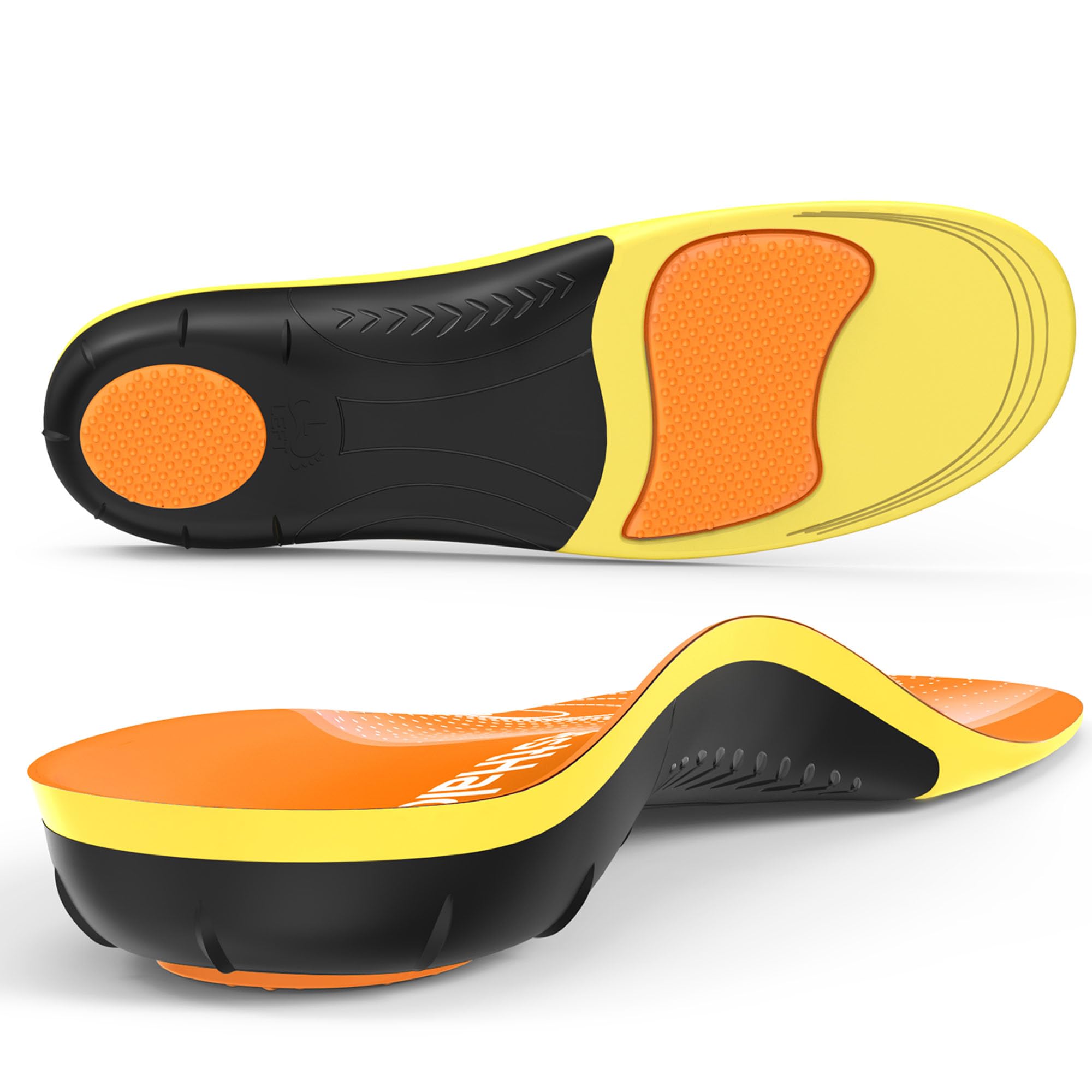
BestHalo’s biomechanical design prioritizes structured arch support for high-arched feet that lack natural shock absorption. The shell is rigid enough to control overpronation but includes a gel cushion insert at the heel to take the edge off impact. This dual-layer construction — firm polypropylene base plus a softer top layer — is common in premium orthotics and provides the stability needed to realign your gait.
The deep heel cup stabilizes the calcaneus and prevents lateral roll, which directly addresses the “my foot slides inside my shoe” complaint that often accompanies plantar fasciitis. Customers report that the arch feels aggressive during the first week, then settles into a comfortable correction. One user noted that switching from BestHalo to a softer brand caused their foot and back pain to return, confirming the level of support these provide.
They fit best in boots, hiking shoes, and sneakers with removable insoles. The trim-to-fit lines are marked clearly for size 4.5–6.5 and 7.5–10, but users with narrow feet may find the shell width a bit generous. At 7.4 ounces, they are lighter than the Professional Heavy Duty pair, making them suitable for daily wear if you need high arch structure without excessive bulk.
Why it’s great
- Rigid orthotic shell corrects overpronation and supination
- Gel heel insert adds impact protection for high arches
- Excellent for users who found softer inserts ineffective
Good to know
- Arch is too high for flat feet — causes new pressure points
- Firm break-in period; some users report lower back adaptation
- Not ideal for narrow-width dress shoes
3. Dr. Scholl’s Plantar Fasciitis Sized to Fit Insoles

Dr. Scholl’s has been in the foot care aisle for decades, and this specific plantar fasciitis model uses a Tri-Zone gel system that cushions the heel, supports the arch, and pads the forefoot independently. The arch support is more moderate here — it won’t correct severe overpronation like the BestHalo, but it provides enough lift to take the sharp edge off morning heel pain for mild to moderate cases. Several long-term users report that these actually outperformed their custom podiatrist orthotics.
The “sized to fit” approach means you choose the insole based on your exact shoe size rather than trimming, which avoids the common fit issues caused by cutting into the support structure. However, the total thickness (over 9 ounces per pair) means they take up significant volume inside the shoe. Users with tight-fitting sneakers or loafers may need to loosen the laces or remove the original footbed entirely to avoid pressure on the top of the foot.
Durability is solid for the price: most users replace them every 2–3 months with daily use, which is standard for foam-based inserts under . They work best in sneakers, casual shoes, and work boots with removable insoles. If you need immediate relief without a multi-day break-in window, these deliver comfort from day one.
Why it’s great
- Zero break-in — comfortable from the first wear
- Tri-Zone gel targets heel, arch, and forefoot independently
- No trimming needed; choose by exact shoe size
Good to know
- Thick build requires loose lacing or footbed removal
- Foam compresses faster than TPU; replace every 2–3 months
- Arch support is moderate — insufficient for severe cases
4. VALSOLE Heavy Duty Support Pain Relief Orthotics

VALSOLE’s orthopedic shell is noticeably stiffer than the other mid-range options. The arch profile is high and unyielding, which means it excels at controlling overpronation in heavy individuals. A 6’5″, 235-pound warehouse worker reported zero foot pain after the first day — a strong indicator that the structural rigidity matches the demand. The shell extends into a deep heel cradle that wraps around the calcaneus, preventing the heel from shifting during lateral movements.
Unlike the Dr. Scholl’s pair, VALSOLE requires a genuine break-in. Customers describe a “quick adaptation period” of 2–4 days where the arch feels high, followed by a phase where the foot settles into alignment. The forefoot uses a lower-density EVA layer that absorbs shock without raising the toe box height too much, so they fit comfortably in work boots and sneakers without causing pressure on the top of the foot.
One point to consider: the high arch may cause discomfort for users with flat feet. Multiple reviews note that the arch height is aggressive for neutral or low-arched feet. If your arch is naturally low, the Professional Heavy Duty or Dr. Scholl’s options are better starting points. However, if you have a medium-to-high arch and need heavy-duty support for standing shifts, VALSOLE is a top-tier pick.
Why it’s great
- Very rigid orthopedic shell handles 220+ lb loads without collapse
- Deep heel cradle stabilizes the calcaneus during lateral movement
- Low forefoot stack fits boots and sneakers without bulging
Good to know
- High arch profile is painful for flat-footed users
- Requires 2–4 day break-in period
- Premium build but not as breathable as PORON options
5. OUOKK High Arch Support Inserts 3/4 Length

OUOKK takes a different approach: a 3/4 length insert that ends before the toes, saving space inside narrow shoes. The 30mm TPU arch is the tallest on this list, designed exclusively for high-arched feet that need aggressive correction. The rigid TPU elastic structure provides long-term durability (the manufacturer rates it for 2+ years), and the foot massage nodules on the surface aim to disperse pressure across the plantar fascia.
Because these are 3/4 length, they do not take up toe volume, making them the only option here that fits into dress shoes, high heels, and loafers. They are lighter than full-length inserts at 5.6 ounces, and the thin edges conform to the shoe without bulging. However, the trade-off is that the insert can shift inside the shoe if not placed under a full footbed. A few customers note that the rigid base moves slightly during walking and requires repositioning.
The lack of a full-length base also means less shock absorption in the forefoot. For high-impact activities like running, a full-length insert with metatarsal padding is better. But for daily walking, standing, or wearing tighter shoes, OUOKK provides serious arch support without the bulk. The three-height arch option is a nice differentiator: you can choose low, medium, or high arch support within the same product line.
Why it’s great
- 3/4 length fits dress shoes, heels, and tight loafers
- 30mm TPU arch offers the highest support for high arches
- Lightweight (5.6 oz) with a rated 2-year lifespan
Good to know
- Rigid base can shift inside the shoe without full-length grip
- No forefoot cushion — not ideal for running/jumping
- Aggressive arch height may cause discomfort in medium arches
FAQ
How long does it take for arch support inserts to relieve plantar fasciitis pain?
Can I wear arch support inserts inside my everyday sneakers without removing the original insole?
What is the difference between medium arch and high arch support for plantar fasciitis?
Final Thoughts: The Verdict
For most users, the arch support inserts for plantar fasciitis winner is the Professional Heavy Duty Support Pair because its double PORON structure supports 230+ lbs without collapse, and the Golden Triangle design fits the broadest range of foot types. If you have high arches and need aggressive correction, grab the BestHalo Heavy Duty for its biomechanical shell. And for tight dress shoes or daily walking where bulk is your enemy, nothing beats the OUOKK 3/4 Length for providing tall arch support in a slim profile.

Mo Maruf
I created WellFizz to bridge the gap between vague wellness advice and actionable solutions. My mission is simple: to decode the research and give you practical tools you can actually use.
Beyond the data, I am a passionate traveler. I believe that stepping away from the screen to explore new environments is essential for mental clarity and physical vitality.