Our readers keep the lights on and my smoothie glass nicely filled. As an Amazon Associate, I earn from qualifying purchases.
Professional arborists spend more time replacing dull or damaged saw blades than they should, because most hand saws on the market cannot handle the abuse of daily limbing and bucking without bending or losing their edge. The internal geometry of the tooth grind, the thickness of the blade stock, and the type of steel alloy determine whether a saw rips through a 6-inch oak limb in under a minute or binds halfway through the cut. A poorly designed arborist hand saw forces you to push harder, wear out your shoulder, and leaves a ragged wound on the tree that invites pests and decay.
I’m Mohammad Maruf — the founder and writer behind WellFizz. Over the past three years I have analyzed over 50 forestry cutting tools, comparing blade hardness ratings, tooth-per-inch configurations, handle ergonomics, and field-reported durability curves to separate professional-grade timber tools from weekend-warrior gimmicks.
The right saw removes limbs safely, cuts on the pull stroke to prevent binding, and keeps its edge long after cheaper stamped blades have gone dull. Whether you are clearing trail brush or performing canopy reductions, finding the best arborist hand saw means matching blade geometry to your specific tree species and cutting volume.
How To Choose The Best Arborist Hand Saw
An arborist hand saw is a specialized cutting tool designed for pruning, limb removal, and light felling work. Unlike general-purpose carpentry saws, arborist models feature aggressive tooth patterns, thinner kerfs, and curved blades that cut on the pull stroke to minimize effort and binding in green wood. Choosing the wrong saw leads to early blade dulling, handle fatigue, and unsafe cutting conditions at height.
Blade Steel and Tooth Hardening
High-carbon steel and hard-chrome-plated steel are the two dominant blade materials in arborist saws. Carbon steel can hold a very sharp edge but requires oiling to prevent rust after cutting wet sapwood. Hard-chrome-plated blades resist corrosion far better and typically use impulse-hardening — a process that heats the tooth tips to high temperature instantly, making them three times more durable than conventional unhardened teeth. Avoid saws without any tooth hardening treatment if you plan to cut hardwood species like oak or hickory regularly.
Blade Length and Curve Profile
Blade length determines how much material each stroke removes. A 5- to 7-inch folded blade is adequate for backpacking and light pruning, while a 12- to 14-inch fixed or folding blade is standard for professional arborists removing larger limbs. Curved blades concentrate the cutting force into a smaller contact area and typically cut 15 to 20 percent faster than straight blades on limbs 2 to 6 inches in diameter, but they can grab aggressively on smaller twigs. Straight blades offer smoother, more predictable cuts on tight pruning jobs.
Handle Design and Locking Mechanism
Arborist hand saws must lock securely in both the open and closed positions to prevent accidental closure mid-cut or during transport. Folding saws that rely on a simple notch lock can fail under heavy side pressure, so prefer models with a threaded collar or rotating locking ring (such as the Virobloc system). Handle ergonomics matter immensely for overhead cutting — rubberized grips with a pronounced palm swell reduce hand fatigue during repetitive pull strokes. For pole saws, quick-release telescoping mechanisms should lock rigidly with zero lateral play.
Rope Saw vs. Fixed-Blade vs. Folding Saw
Rope saws use a flexible chain blade attached to two handles and allow you to cut limbs up to 25 feet high without a ladder or climbing — ideal for trail maintenance and reaching branches over a roof line. However, they require good aim with a throw bag and can bind if pulled perpendicular to the branch. Folding saws are the most portable and safe for a climbing arborist carrying a tool on their saddle. Fixed-blade saws with a scabbard offer the fastest deployment and stiffest blade for heavy, continuous cutting, but they demand more space on your belt or pack.
Quick Comparison
On smaller screens, swipe sideways to see the full table.
| Model | Category | Best For | Key Spec | Amazon |
|---|---|---|---|---|
| Fiskars Telescopic Pole Pruner | Pole Saw | Overhead limbs without a ladder | 12-inch blade; extends 3–8 ft | Amazon |
| Opinel Folding Saw | Folding Saw | Backpacking and pocket carry | 3.15-inch blade; 3.6 oz | Amazon |
| Samurai 13″ Heavy Duty | Fixed Blade | Professional heavy limbing | 13-inch blade; 6.5 TPI | Amazon |
| CAMPNDOOR High Limb Rope Saw | Rope Saw | High branches, no ladder | 53-inch chain; 25-ft rope | Amazon |
| Silky PocketBoy Curved 130mm | Folding Saw | Compact daily carry pruning | 5-inch blade; 6.8 TPI | Amazon |
In‑Depth Reviews
1. Samurai 13″ Heavy Duty Non Tapered Curved Hand Saw C330LH

The Samurai 13-inch is the saw that professional arborists reach for when they need to fell 8-inch Douglas fir in under eight minutes without swapping blades. Its impulse-hardened teeth stay sharp three times longer than conventional non-hardened teeth, and the non-tapered curved blade geometry aggressively clears softwoods and hardwoods alike on the pull stroke. The 6.5 TPI configuration is optimized for limbs 2 to 7 inches in diameter — the sweet spot for daily pruning and light felling work.
At a 0.65-pound operating weight, this saw does not punish your shoulder during hours of overhead cutting. The rubberized handle provides a secure grip even when wet with sap or rain, and the included hard-plastic scabbard features a belt-loop dangler that keeps the saw accessible without snagging on brush. Users report cutting through 1500 trees over three years with no perceptible dulling, though the extreme sharpness demands heavy gloves — one arborist reported a 3-inch gash from light contact with the blade.
Compared to the Silky Big Boy, the Samurai matches its cutting speed at roughly one-third the cost, making it the best value proposition for volume cutting. The only practical downside is that the scabbard’s ventilation slots are small, which can trap moisture and cause rust on the unprotected steel if you store it wet. Owners who wipe the blade dry and apply a light oil film after use have no corrosion issues even after years of field use.
Why it’s great
- Impulse-hardened teeth last 3x longer than standard saws
- Weighs only 0.65 lb, reducing fatigue on long jobs
- Outcuts premium Japanese saws at a fraction of the price
- Rubber handle stays grippy in wet or sap-covered conditions
Good to know
- Unprotected steel blade rusts if stored damp
- Extreme sharpness requires cut-resistant gloves
- Scabbard venting is insufficient for wet storage
2. Fiskars Telescopic Pole Pruner (Extends 3-8 ft)
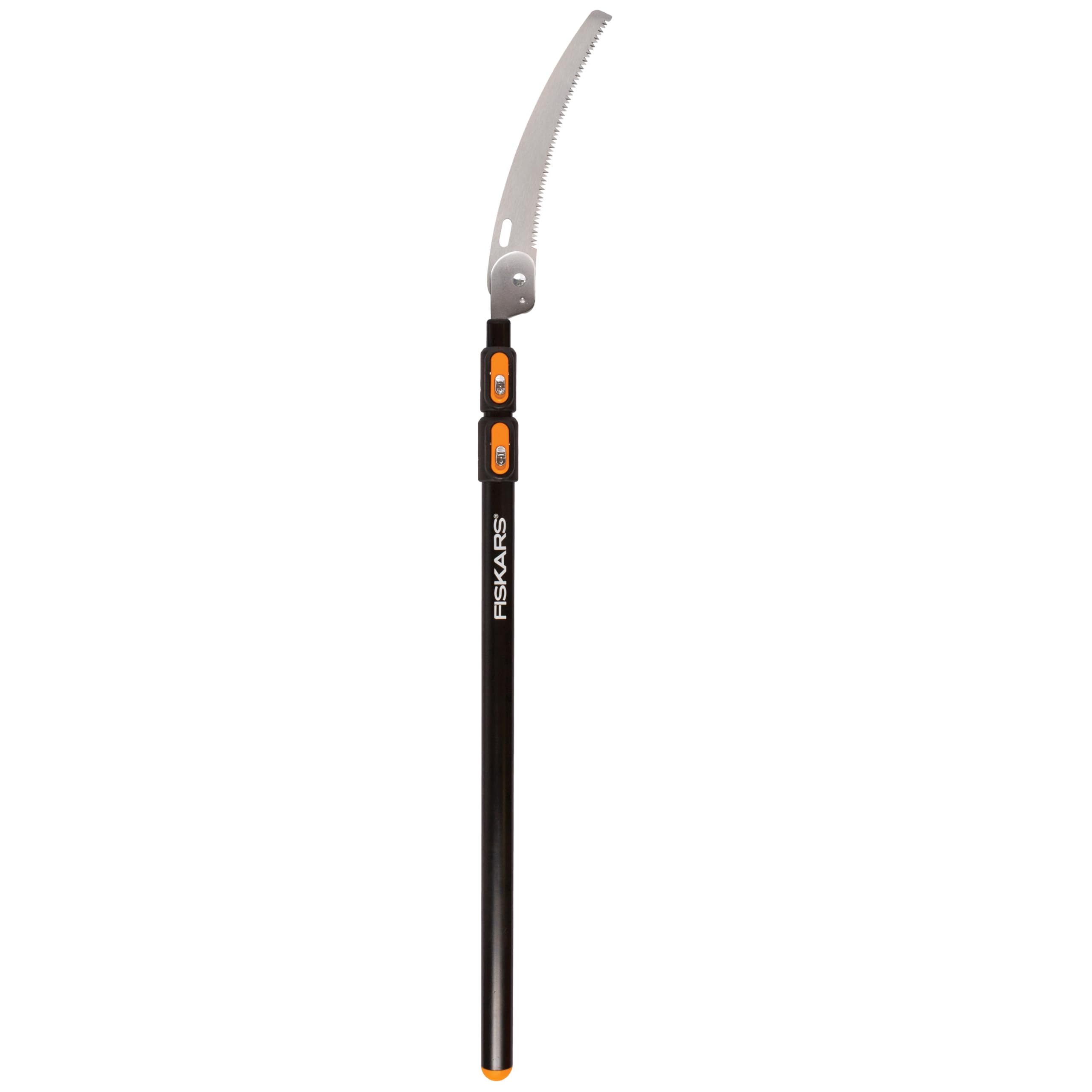
The Fiskars Telescopic Pole Pruner solves the most dangerous problem in arboriculture — reaching high branches without a ladder. The telescoping pole extends from 36 to 96 inches, and the 12-inch double-grind saw blade cuts aggressively on the pull stroke to remove limbs up to 3 inches in diameter. The steel pole is rigid enough for clean cuts but light enough at 3.7 pounds to hold overhead for extended periods without shaking.
Landscapers appreciate the triple-ground power tooth blade, which maintains its edge through moderate use on green wood and deadwood alike. The locking clips on the telescoping segments have proven reliable in the field — no failures reported even after several seasons of farm and orchard work. Users have successfully replaced the 12-inch blade with a 15-inch blade for bigger limbs, though the wingnut securing the blade loosens with vibration if not checked periodically.
This is not a heavy-duty felling tool; the blade is too short and the pole too flexible for limbs larger than 4 inches. But for quick overhead pruning of ornamental trees and fruit trees, the Fiskars pole saw is the most cost-effective solution that keeps both feet safely on the ground. The included lifetime warranty adds peace of mind for a tool that lives outside.
Why it’s great
- Extends to 8 ft, eliminating ladder risk for high limbs
- Triple-ground teeth stay sharp through moderate use
- Compact 3-ft collapsed length stores easily in a truck
- Lifetime warranty from a trusted brand
Good to know
- Blade wingnut may loosen during heavy use
- Not designed for limbs over 4 inches in diameter
- Pole flexes noticeably at full extension under hard loads
3. Silky PocketBoy Curved Blade Folding Saw 130mm Large Teeth

The Silky PocketBoy 726-13 is the compact folding saw that professional arborists carry in their climbing saddle for quick pruning cuts between major rigging operations. Its 130mm curved blade with large teeth cuts approximately 15 to 20 percent faster than a straight blade of the same length, and the taper-ground design reduces binding in green hardwood. The blade is made of hard-chrome-plated steel with impulse-hardened teeth, giving it excellent corrosion resistance even when stored in a sweaty tool belt during humid summer months.
At 0.5 pounds with the hard plastic belt case, the PocketBoy disappears on a belt or in a backpack until needed. The cut capacity of 2.6 inches covers the vast majority of pruning tasks on ornamental trees, trailside brush, and hunting camp firewood. Owners consistently report that the saw feels “overbuilt” — the locking mechanism is extremely solid with zero play, and the chrome plating prevents the rust that plagues carbon steel saws during wet-weather work.
The trade-off is price: the Silky PocketBoy demands a premium over comparable folding saws from other brands. But users who have put the saw through years of tropical rainforest abuse report that it still cuts like new, while cheaper alternatives dull or rust within a single season. For the arborist who needs a reliable, carry-everywhere backup saw that will not fail mid-cut, the PocketBoy is the standard.
Why it’s great
- Hard-chrome plating prevents rust in wet environments
- Curved blade cuts 15-20% faster than straight models
- Extremely solid locking mechanism with zero side play
- Compact enough for daily belt carry
Good to know
- Premium price compared to similar-sized saws
- Limited to branches under 2.6 inches
- Small blade is not suitable for felling larger trees
4. Opinel Folding Saw with Beechwood Handle

The Opinel folding saw is the lightest entry in this guide at just 3.6 ounces, making it ideal for backpackers, hunters, and fishermen who need a backup limbing tool that takes up almost no pack space. The 8-centimeter (3.15-inch) carbon steel blade is rated for branches up to 3 inches in diameter, and the Virobloc rotating locking ring securely holds the blade both open and closed. The beechwood handle is comfortable without being bulky, and the saw folds to a slim profile that fits in a large pocket.
This saw cuts aggressively on the pull stroke despite its small size, and the carbon steel takes a razor edge that holds well through moderate use. Users report using it successfully for cutting cactus branches, 2-inch oak limbs, and small trailside deadwood. The locking mechanism is simple but effective — the rotating ring prevents the blade from accidentally closing during a cut, and it also prevents the saw from opening in your pack.
The major limitation is blade length. A 3.15-inch blade is fine for quick pruning of small branches, but it becomes frustrating on limbs larger than 2.5 inches because each stroke removes very little material. Additionally, the carbon steel blade requires immediate drying after cutting green or wet wood; if left damp, the surface develops rust spots within hours. Owners who live in humid climates should consider applying a light wax or oil coating before storing.
Why it’s great
- Extremely lightweight at 0.08 kg — disappears in a pack
- Virobloc ring lock is reliable and intuitive
- Beechwood handle is warm and comfortable to grip
- Proven classic design made in France since 1890
Good to know
- Short blade maxes out on limbs under 2.5 inches
- Carbon steel rusts quickly if not dried after use
- Blade sits low in handle, making it harder to open
5. CAMPNDOOR High Limb Rope Saw 53-Inch
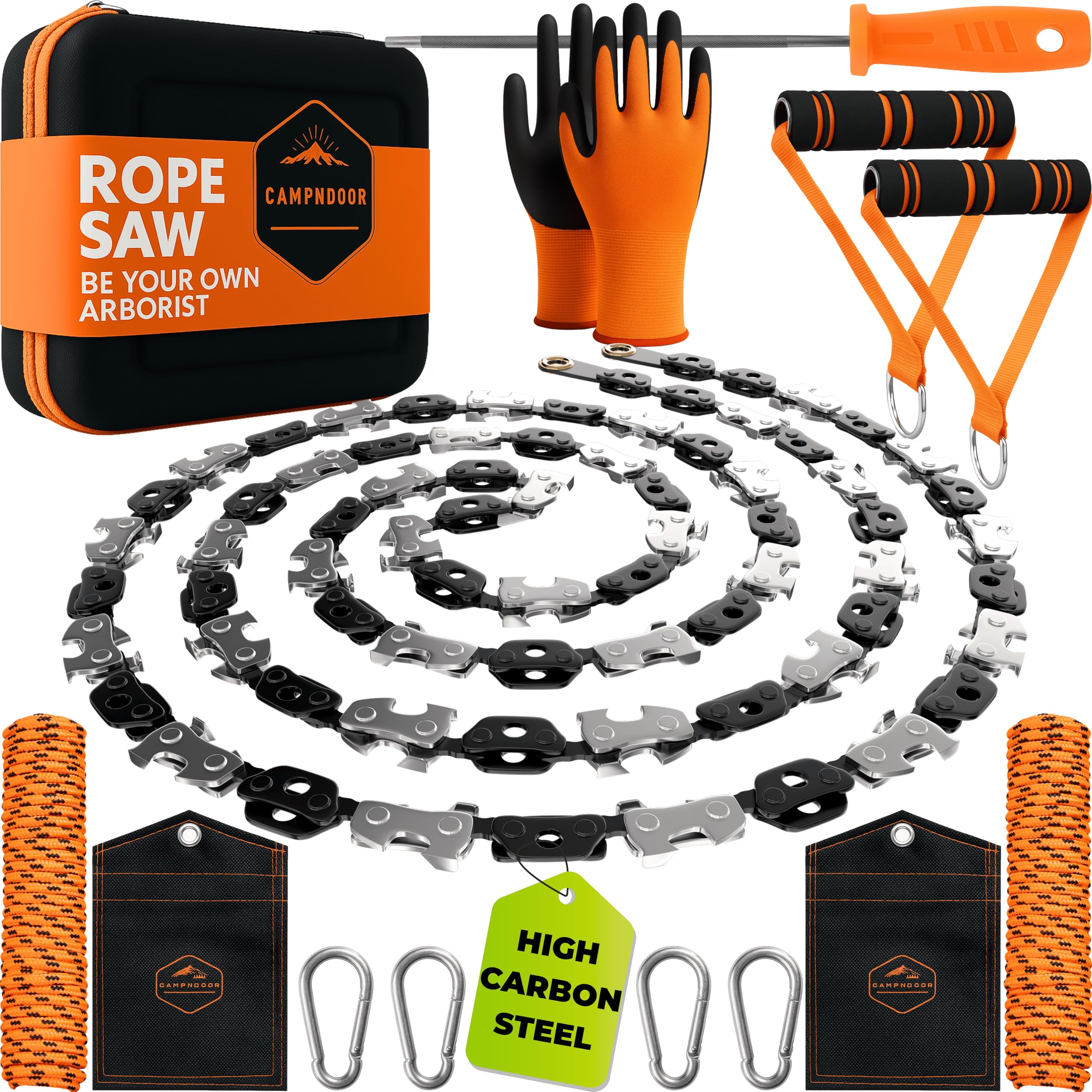
The CAMPNDOOR High Limb Rope Saw reimagines the arborist hand saw as a flexible chain tool that can reach 25-foot branches without a ladder or climbing gear. Its 53-inch blade is made from 65Mn high-carbon steel with patented TIGERClaw teeth on one side and Bulldozer teeth on the other, allowing the user to cut on both the pull and draw strokes. The complete kit includes ergonomic handles, two 25-foot ropes, a throw bag, safety gloves, a sharpening tool, and a carrying case.
The cutting performance is genuinely impressive for a tool that fits in a pocket-size case. Users have felled a 20-inch diameter hickory tree in under an hour by wrapping the chain around the trunk and using two people to pull back and forth. For single-user operation on overhead limbs, the recommended technique is to cut at a slight angle to the branch — cutting perpendicular to the branch causes the chain to bind and stall. The throw bag is the weakest component; several reviewers found it difficult to aim compared to a dedicated arborist throw bag, and the grommet can rip if the bag snags on a limb.
This rope saw is not a replacement for a traditional arborist hand saw on the ground — it binds more easily, requires more setup time, and the plastic handles can deform under extreme load (users recommend replacing them with wooden dowels for heavy work). But for high, inaccessible branches, especially over roofs or fences where a ladder cannot safely reach, the CAMPNDOOR rope saw is the most portable and effective solution available.
Why it’s great
- Reaches limbs 25 feet high without a ladder
- Dual-sided teeth cut on both pull and draw strokes
- Complete kit includes gloves, ropes, and sharpener
- Folds into a compact carrying case for storage
Good to know
- Throw bag is difficult to aim accurately
- Plastic handles may bend under very heavy loads
- Chain binds if pulled perpendicular to the branch
FAQ
Why do arborist saws cut on the pull stroke instead of the push?
How do I prevent rust on a carbon steel arborist saw?
Can I sharpen an impulse-hardened arborist saw blade at home?
Final Thoughts: The Verdict
For most users, the best arborist hand saw winner is the Samurai 13″ Heavy Duty because it combines professional-grade impulse-hardened teeth, aggressive curved blade geometry, and a comfortable rubber handle at a price well below premium competitors. If you need a compact saw that fits in a pocket for backpacking or trail pruning, grab the Silky PocketBoy 130mm for its rust-proof chrome blade and bombproof locking mechanism. And for reaching high limbs over roofs and fences without climbing a ladder, nothing beats the CAMPNDOOR 53-Inch Rope Saw.

Mo Maruf
I created WellFizz to bridge the gap between vague wellness advice and actionable solutions. My mission is simple: to decode the research and give you practical tools you can actually use.
Beyond the data, I am a passionate traveler. I believe that stepping away from the screen to explore new environments is essential for mental clarity and physical vitality.