Our readers keep the lights on and my smoothie glass nicely filled. As an Amazon Associate, I earn from qualifying purchases.
Keeping an aquarium thriving means staying ahead of invisible threats like ammonia spikes and nitrate buildup, which can stress or kill fish before you ever see a change in the water. A reliable test kit transforms guesswork into a simple, five-minute routine that protects your entire aquatic ecosystem.
I’m Mohammad Maruf — the founder and writer behind WellFizz. My research into aquarium chemistry and filter media analysis helps me separate accurate liquid reagent kits from less dependable strip-based options, so you can buy with confidence.
Whether you are cycling a new tank or troubleshooting a sick fish, you need a tool that delivers consistent readings. That is why I spent hours comparing test methods and real user feedback to build this guide to the best aquarium test kit options available right now.
How To Choose The Best Aquarium Test Kit
Not all test kits measure the same parameters with the same precision. Knowing which type of test to rely on and which readings matter most will prevent costly fish losses and keep your tank stable.
Liquid Reagent Kits vs. Test Strips
Liquid reagent kits use chemical reactions in a test tube to produce color changes that are read against a printed chart. These kits are far more accurate for critical parameters like ammonia and nitrite, especially during the nitrogen cycle. Test strips offer faster results and less mess, but they tend to lose sensitivity over time and cannot reliably detect trace ammonia levels below 0.25 ppm.
Essential Parameters to Monitor
Every freshwater aquarium needs regular checks on pH, ammonia, nitrite, and nitrate. Saltwater tanks require the same core tests plus high-range pH readings. A full kit should include at least these four parameters. Adding phosphate and general hardness (GH/KH) testing gives you deeper insight into buffering capacity and algae control.
Test Count and Longevity
The number of tests a kit can perform matters for long-term value. Entry-level kits offer around 100 to 200 tests, while premium bundles exceed 500 or even 900 tests. If you maintain multiple tanks or perform weekly checks on a large aquarium, a high-count kit saves money and reduces reordering frequency.
Quick Comparison
On smaller screens, swipe sideways to see the full table.
| Model | Category | Best For | Key Spec | Amazon |
|---|---|---|---|---|
| API 5-in-1 Test Strips | Test Strips | Quick weekly spot checks | 100 strips, 5 params | Amazon |
| Pawfly 5-in-1 Master Kit | Liquid Reagent | Budget-friendly full parameter testing | 265 tests, 5 params | Amazon |
| Gold Label Master Kit | Liquid Reagent | High-volume freshwater testing | 950+ tests, glass tubes | Amazon |
| API Saltwater Master Kit | Liquid Reagent | Saltwater aquarium monitoring | 550 tests, 4 params | Amazon |
| Fluval Master Test Kit | Liquid Reagent | Precision testing for sensitive tanks | pH/ammonia/nitrite/nitrate | Amazon |
In‑Depth Reviews
1. API Saltwater Master Test Kit

The API Saltwater Master Test Kit is the gold standard for marine tank owners, offering dedicated high-range pH testing alongside the ammonia, nitrite, and nitrate tests that saltwater systems demand. With six reagent bottles and four test tubes, the kit provides 550 individual tests — enough for weekly monitoring over a full year. Many hobbyists and local fish stores rely on this exact chemistry to catch imbalances before they trigger coral bleaching or fish loss.
Each test follows the same straightforward drop-and-shake method used in API’s freshwater kits, so transitioning between tank types feels seamless. The color chart is laminated and easy to read under standard aquarium lighting. While the high-range pH reagent is formulated specifically for the 7.4–8.8 range typical of marine environments, the ammonia, nitrite, and nitrate tests perform identically to the freshwater version, giving you flexibility if you maintain both systems.
Users consistently praise its reliability during tank cycling and after water changes. Some reviewers note the kit sometimes misreads trace ammonia levels below 0.25 ppm, but that margin of error is standard for colorimetric testing at this price tier. The plastic test tubes are durable enough for daily use, and the kit includes a multilingual instruction booklet. For serious saltwater aquarists who want a proven, lab-like reference without moving to electronic probes, this remains the most trusted choice.
Why it’s great
- High-range pH testing perfectly calibrated for saltwater
- 550-test capacity provides excellent long-term value
- Same trusted chemistry used by local fish stores
Good to know
- Does not test phosphate or alkalinity
- Trace ammonia readings can be slightly inconsistent
2. Gold Label Pet Care Master Test Kit
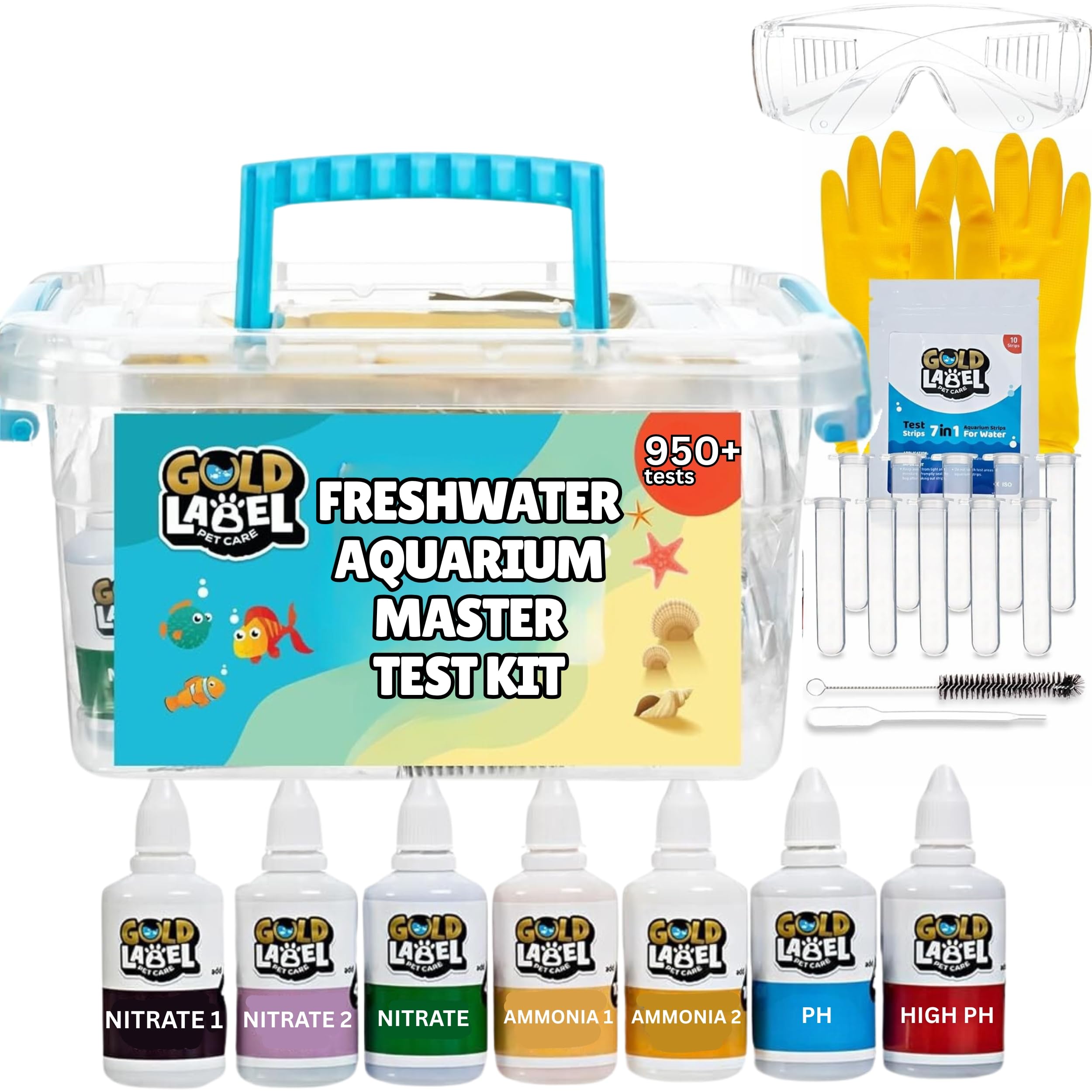
The Gold Label Master Test Kit delivers an astonishing 950-plus tests across pH, high pH, ammonia, nitrite, and nitrate, making it the highest-capacity liquid reagent kit in this roundup. The bundle goes beyond the basics by including safety glasses, gloves, a dropper, a cleaning pipe brush, and 10 bonus test strips — creating a complete workstation right out of the box. This kit is built for freshwater and saltwater use, and the 10 glass test tubes let you run several parameter checks simultaneously without rinsing between tests.
Glass test tubes are a serious upgrade over the plastic vials found in most competing kits. They resist scratching and clouding, which helps you read color matches more accurately over months of use. The included brush makes cleaning residue simple, and the compact storage case keeps everything organized. The standalone test strips serve as a convenient backup for quick checks, though the liquid reagents remain the primary source for precise readings.
Some users report that the dropper caps can separate from the bottles when twisted open, and a few reviewers found the nitrite color development leans pink instead of the expected blue-purple. This inconsistency suggests the kit’s manufacturing tolerances may be slightly looser than API or Fluval. Nonetheless, for aquarists running multiple tanks or performing daily testing during a fishless cycle, the sheer test count and comprehensive accessory set make this the best value proposition on the list.
Why it’s great
- Over 950 tests in one box — among the highest counts available
- 10 glass test tubes resist scratches and improve readability
- Includes safety gear, brush, and bonus test strips
Good to know
- Dropper tips can detach during cap removal
- Nitrite color reaction may differ from expected results
3. Fluval Master Test Kit

The Fluval Master Test Kit takes a science-first approach by requiring a full 20-minute ammonia test that factors in pH interaction — a method that impresses chemistry-minded hobbyists. Made in Canada, this kit covers pH, ammonia, nitrite, and nitrate for both freshwater and saltwater aquariums. The reagent formulas are proprietary, and Fluval’s customer support team provides phone-based guidance for anyone confused by the slightly longer wait times.
The kit includes just two glass test tubes, which is a noticeable limitation if you like running multiple parameter checks at once. You will need to rinse and reuse tubes between tests, adding about five minutes to your routine. The color charts are printed on thick card stock, and the individual reagent bottles use child-resistant caps. Several experienced aquarists trust Fluval over API, claiming the pH-ammonia correlation produces more biologically relevant data during the cycling phase.
However, accuracy complaints appear in roughly one in five reviews. Some users report discrepancies when comparing Fluval results against local fish store electronic meters, particularly for nitrate readings above 20 ppm. The limited tube count and single-test bottleneck can frustrate users managing large tanks. For planted tank enthusiasts or those who prefer a more deliberate, methodical testing protocol, this kit’s approach is a strength — but for fast weekly checks, simpler options may suit better.
Why it’s great
- Unique pH-adjusted ammonia test provides deeper cycle insight
- Canadian manufacturing with accessible customer support
- Glass test tubes resist staining
Good to know
- Only two test tubes included — frequent rinsing required
- Some nitrate readings conflict with store electronic tests
4. Pawfly 5-in-1 Master Test Kit
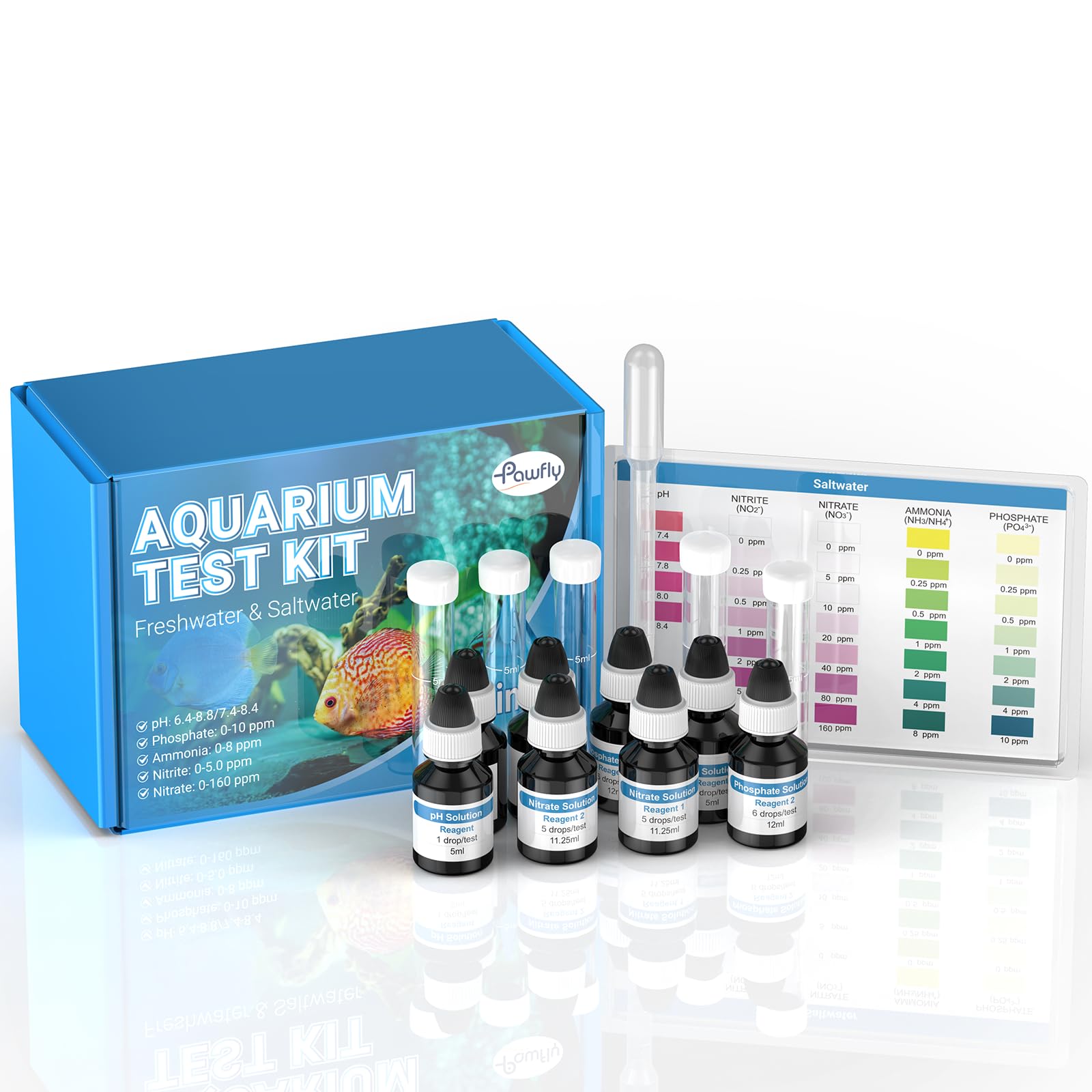
The Pawfly 5-in-1 Master Test Kit covers pH, nitrite, nitrate, ammonia, and phosphate using professional-grade liquid reagents — an unusual inclusion that helps algae-prone tank owners monitor nutrient levels. With 265 total tests (100 for pH alone), this kit supports several months of weekly testing without needing a refill. The glass vials provide better optical clarity than plastic, though they require careful handling to avoid breakage.
The kit works for both fresh and saltwater setups, and the color-matching charts are printed on both the instruction booklet and the storage box for quick reference. The foam insert holds each reagent bottle snugly, but the outer packaging is cardboard rather than plastic, so it may wear faster if exposed to moisture. Users appreciate the lower entry cost compared to API and Fluval kits, especially for hobbyists who only need basic parameter tracking for a single tank.
A common observation among reviewers is that the ammonia baseline reads around 0.25 ppm even in pure water, which means you need to mentally adjust your readings by that offset. The phosphate test adds real value for planted tank owners fighting green algae. For the price, the Pawfly kit delivers solid accuracy on the five most requested parameters, making it a smart entry point for new aquarists who do not want to commit to a premium system immediately.
Why it’s great
- Includes phosphate testing for algae management
- Glass vials improve color reading accuracy
- Works in both freshwater and saltwater tanks
Good to know
- Ammonia baseline shows a constant 0.25 ppm offset
- Cardboard packaging not water-resistant
5. API 5-in-1 Test Strips
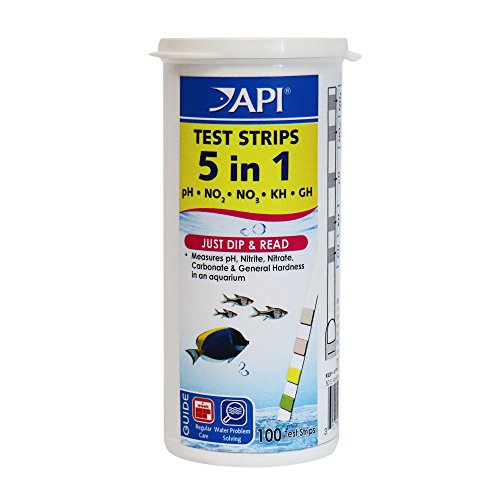
The API 5-in-1 Test Strips offer the fastest path to a five-parameter snapshot: pH, nitrite, nitrate, general hardness (GH), and carbonate hardness (KH). Simply dip a strip, wait 60 seconds, and compare the color pads to the printed chart. This 100-count box provides enough strips for nearly three months of weekly testing, making it the most convenient option for hobbyists who prioritize speed over pinpoint accuracy.
The strips are individually sealed in moisture-proof foil, which preserves sensitivity even after the box has been opened for months. They work for both freshwater and saltwater aquariums, though the pH range (6.5–8.0) does not cover the higher levels found in marine tanks. You must read the colors while the pads are still damp — once they dry, the colors shift and produce false readings. The biggest trade-off is that these strips do not test ammonia, so you must buy a separate liquid ammonia kit to monitor the nitrogen cycle during a fishless cycle or new tank setup.
Users with established, stable tanks rely on these strips for quick mid-week checks between detailed liquid reagent sessions. Shrimp keepers in particular value the KH and GH data for maintaining proper molt conditions. While the accuracy cannot match liquid reagent kits, the speed, ease, and zero cleanup make the API 5-in-1 Strips an essential tool for any aquarist who values regular, low-effort monitoring.
Why it’s great
- Fastest test method — results in 60 seconds
- Individually sealed strips stay fresh for months
- Includes KH and GH for shrimp and planted tanks
Good to know
- Cannot test ammonia — need a separate kit
- Color pads shift after drying, creating false reads
FAQ
How often should I test my aquarium water?
Can I use a freshwater test kit in a saltwater aquarium?
Why does my ammonia test always show 0.25 ppm?
Final Thoughts: The Verdict
For most users, the aquarium test kit winner is the Gold Label Master Test Kit because its 950-plus test capacity, glass vials, and included accessories deliver unmatched long-term value for both freshwater and saltwater keepers. If you need a saltwater-specific setup, grab the API Saltwater Master Test Kit for proven high-range pH accuracy. And for quick weekly spot checks without the mess of liquid reagents, nothing beats the convenience of the API 5-in-1 Test Strips.

Mo Maruf
I created WellFizz to bridge the gap between vague wellness advice and actionable solutions. My mission is simple: to decode the research and give you practical tools you can actually use.
Beyond the data, I am a passionate traveler. I believe that stepping away from the screen to explore new environments is essential for mental clarity and physical vitality.