Our readers keep the lights on and my smoothie glass nicely filled. As an Amazon Associate, I earn from qualifying purchases.
Adding CO₂ to a planted aquarium is the difference between plants that merely survive and those that thrive with deep reds, vibrant greens, and lush carpeting growth. But choosing the wrong system leads to unstable gas delivery, failed solenoids, and frustrating chemical ratios.
I’m Mohammad Maruf — the founder and writer behind WellFizz. I’ve analyzed hundreds of component specs, safety certifications, and user reports to find the systems that actually deliver consistent, controllable CO₂ injection for planted tanks.
After evaluating material thickness, solenoid reliability, and needle valve precision across dozens of models, I’ve narrowed the field to the seven kits worth your money. This guide covers the best aquarium co2 system options for every tank size and budget tier.
How To Choose The Best Aquarium CO2 System
The wrong CO₂ system wastes reactants, fluctuates pressure, and can nuke your fish overnight. Here are the three specifications that separate reliable gear from frustration-starters.
Material Thickness & Safety Certification
The reaction bottle must withstand 30–80 kg/cm² of internal pressure. Systems built with 1.5mm SUS304 stainless steel (like the Fzone) offer 25% more structural margin than 1.2mm tanks. Cheap plastic generators risk catastrophic failure. Always check for a pressure relief valve rated at 35 kg/cm² or higher, and confirm the cylinder meets DOT or equivalent safety standards if you plan to refill at a brewery or welding supply shop.
Needle Valve Precision & Solenoid Reliability
A quality needle valve lets you dial in 1–2 bubbles per second (bps) consistently — the difference between stable plant growth and CO₂ wastage. Stiff or sloppy valves make accurate tuning impossible. The solenoid must seal completely when powered off; a leaking solenoid dumps gas into the tank at night, when plants aren’t photosynthesizing, causing dangerous pH swings and fish kills. Look for 12V solenoids with user-replaceable diaphragms and verified o-ring seating.
Refill Method & Long-Term Cost
DIY chemical generators (citric acid + baking soda) cost roughly per refill but require precise measurement every 2–4 weeks. Pressurized canisters (5lb aluminum tanks) cost – to refill at a local brewery and last up to a year on a small tank. The upfront price is higher, but the consistency is better and the time saved is significant. Your choice depends on whether you prefer saving money or eliminating prep work.
Quick Comparison
On smaller screens, swipe sideways to see the full table.
| Model | Category | Best For | Key Spec | Amazon |
|---|---|---|---|---|
| Clscea G700S | DIY Chemical | Long-running chemical generation | 2.4L body, 4L-level runtime | Amazon |
| Fzone 2.5L | DIY Chemical | Thickest stainless build | 1.5mm SUS304 stainless steel | Amazon |
| MagTool 2.5-5L | DIY Chemical | Integrated solenoid & bubble counter | External thread bottle design | Amazon |
| Hygger 2L | DIY Chemical | Beginner-friendly kit | 1.2mm SUS304 stainless steel | Amazon |
| TMCRAFT 5lb | Pressurized Cylinder | Refillable, long-duration tank | 5lb aluminum, DOT approved | Amazon |
| VEVOR 5lb | Pressurized Cylinder | Budget pressurized CO₂ | 5lb aluminum, adjustable 0-60 PSI | Amazon |
In‑Depth Reviews
1. Clscea G700S 2.4L

The Clscea G700S uses a thickened SUS304 stainless steel body rated for high pressure, yet packs 2.4L that delivers double the runtime of standard 4L tanks — ideal for medium to large planted tanks. The integrated water-injection solenoid bubble counter simplifies daily refills without disassembly, and the triple stainless steel filter element protects the solenoid from debris that causes failure in cheaper plastic-filter designs.
Users report holding 20+ PSI for a full week on a 29-gallon tank, with consistent 1.75–2 bps output using 200g citric acid and 260g baking soda layered with ice-cold water. The John Guest quick-fit connections reduce leak points, and every accessory — solenoid, bubble counter, diffuser — is individually replaceable, extending the system’s usable life beyond a single season.
One long-term reviewer noted that after a year, the bubble counter valve opened wide during a recharge and dumped CO₂ into the tank, killing the fish. This risk exists with any solenoid-based chemical system, so pairing the G700S with a secondary shut-off valve and a pH controller provides insurance against valve failure. For the price, the build quality and customer service responsiveness make this the best-balanced pick for dedicated planted-tank keepers.
Why it’s great
- Thickened stainless steel bottle delivers 4L-level performance from a compact 2.4L body
- Triple stainless filter element eliminates solenoid clogging common with plastic filters
- Replaceable individual components extend system longevity beyond one year
Good to know
- Bubble counter valve can fail open after recharge, risking fish kill without a backup shut-off
- Solenoid requires periodic cleaning to maintain reliable seal — demand guide video from seller
2. Fzone 2.5L

The Fzone 2.5L stands apart from the DIY chemical pack because its bottle is formed from 1.5mm SUS304 stainless steel — 25% thicker than the 1.2mm used by most competitors. That extra material translates to a maximum pressure tolerance of 80 kg/cm², well above the typical reaction pressure of 30–50 kg/cm², giving you a significant safety margin for higher-temperature environments or slightly off-ratio chemical mixtures.
When loaded with 300–400g of raw materials, the Fzone generates CO₂ for roughly one month at 1 bps for 8 hours daily. The included needle valve is sensitive but workable, and a check valve built into the bubble counter prevents water backflow that causes internal rust. Users consistently report no seal issues out of the box, and customer support (Cheryl mentioned repeatedly) responds quickly to missing parts or questions.
The main downside is the same across all DIY chemical kits: the diffuser included with the kit is low-end, producing a mix of micro and large bubbles rather than the fine mist that maximizes dissolution. Replacing it with a quality inline or ceramic diffuser (many user choose the Clscea stainless steel 25cm) immediately improves CO₂ retention and plant pearling. For aquarists who prioritize safety margin and build thickness, the Fzone is the most reassuring choice.
Why it’s great
- 1.5mm SUS304 steel is the thickest wall in its class — rated for 80 kg/cm²
- One-month runtime at 1 bps on a single fill of 300–400g raw materials
- Replacement bubble counter and solenoid parts available from responsive customer service
Good to know
- Included diffuser underperforms — budget for an aftermarket upgrade
- Needle valve is very touchy; fine-tuning requires patience
3. MagTool 2.5-5L

The MagTool kit uses an external thread design on its 304 stainless steel bottle — a detail that prevents the cap from seizing due to residue buildup over time, a common frustration with internal-thread generators. The bottle is 50% thicker than previous MagTool generations, and the 2.5L version holds 200–300g of material while the 5L holds 600–800g, giving you flexibility based on tank size.
The standout feature is the all-in-one integrated solenoid and bubble counter, which reduces connection points and lowers leak risk. A built-in injection port lets you refill the bubble counter observation fluid without disassembling the unit — a small convenience that saves hassle during maintenance. The package also includes a manual shut-off valve and automatic pressure relief valve, plus all accessories except raw materials.
The supplier offers a one-year warranty on essential components, but multiple user reports describe solenoids arriving with missing o-rings that cause heavy CO₂ leaks. The remedy is straightforward (contact the seller for replacement), and the solenoid works fine when sealed properly. For budget-conscious plant keepers who want a complete kit with a thoughtful bottle design, the MagTool delivers good value provided you check and reseat the o-rings during initial setup.
Why it’s great
- External thread cap prevents seizing from residue buildup over months
- Integrated solenoid/bubble counter reduces leak-prone connection points
- Includes all accessories: diffuser, check valve, tubing, funnel, syringe
Good to know
- Several units arrive with missing o-ring in solenoid — verify seal at setup
- Long-term durability concerns reported; three units failed within six months for one user
4. Hygger 2L
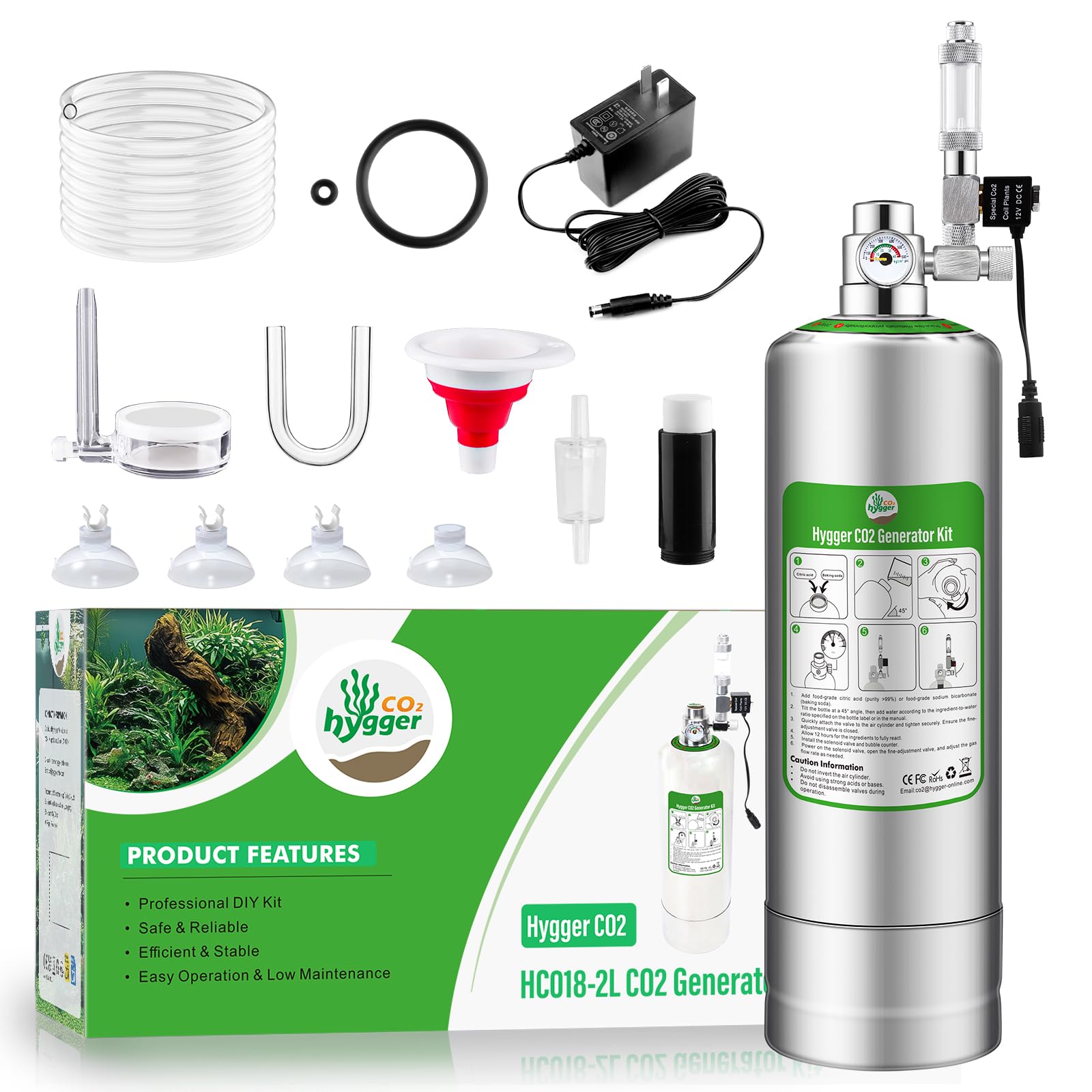
The Hygger 2L kit targets newcomers with a complete package: SUS304 bottle, regulator, solenoid, needle valve, and bubble counter for a price that undercuts most fully-featured competitors. The 1.2mm stainless steel wall is 20% thicker than standard plastic generators and sufficient for tanks up to 20 gallons, where internal pressures stay within the 30–35 kg/cm² relief valve threshold.
Users report straightforward setup: one cup each of citric acid and baking soda lasts over two weeks on a 20-gallon planted tank. The 12V solenoid operates quietly and seals reliably when connected to a timer — critical for preventing CO₂ injection after lights-out. The built-in check valve in the bubble counter stops water backflow, protecting the regulator and solenoid from moisture damage.
The needle valve and regulator on this entry-level kit are noticeably cheaper than premium alternatives, and some users report they are too imprecise for fine tuning below 1 bps. The included funnel is too small for the bottle opening, forcing you to use your own. For a budget-first approach on a small tank where exacting control isn’t critical, the Hygger works. Expect to replace the diffuser and needle valve if you upgrade to a high-light, high-CO₂ setup later.
Why it’s great
- Entry-level price with all essential components in one box
- 12V solenoid works reliably with a timer for day-only CO₂ injection
- Easy DIY chemistry — 1 cup citric acid + 1 cup baking soda lasts 2+ weeks
Good to know
- Needle valve is cheap and imprecise; difficult to dial in below 1 bps
- Funnel too small and instructions are sparse — plan to watch setup videos
5. TMCRAFT 5lb CO2 Tank

The TMCRAFT 5lb tank represents the pressurized-cylinder route: no chemistry mixing, no solenoid maintenance, just a DOT-approved Aluminum Alloy 6061 cylinder with a CGA-320 valve, pre-installed regulator thread, and a glossy black coating that resists scratches. It ships empty — you take it to a local brewery, welding supply, or hydroponics shop for a – fill that lasts up to a year on a small planted tank at 1–2 bps.
This is the route for aquarists who want set-and-forget CO₂ without measuring powders or cleaning reaction chambers. The 1800 PSI service pressure and 3000 PSI test pressure exceed anything a DIY chemical generator can produce, and the fresh hydrostatic test stamp on each unit ensures certification is valid for five years. Users pair it with a quality regulator/needle-valve/solenoid combo (from brands like GLA or CO₂Art) for precise, leak-free control.
The main drawback for the hobbyist is the upfront investment: you need to buy the tank, then a separate regulator kit, which pushes total cost higher than an all-in-one DIY system. The TMCRAFT itself is also heavy at 8.33 pounds — fine under a stand, but less portable than paintball tanks. For long-term reliability and zero chemistry fuss, this tank plus a good regulator is the upgrade path serious plant keepers eventually choose.
Why it’s great
- DOT-approved 6061 aluminum alloy with fresh hydro test stamp good for 5 years
- One – refill lasts up to a year at 1–2 bps on a small tank
- Glossy black coating is scratch-resistant and display-worthy under an open stand
Good to know
- Requires separate regulator, solenoid, and needle valve — higher total upfront cost
- 8.33 lb tank is heavier than DIY chemical bottles; less portable
6. VEVOR 5lb CO2 Tank

The VEVOR 5lb tank is designed primarily for beer dispensing, but its CGA-320 valve and adjustable 0–60 PSI regulator make it perfectly adaptable for aquarium CO₂ injection with the right secondary needle valve. The aluminum alloy cylinder is DOT approved with a light gray spray coating, and the included regulator features a pressure relief valve that vents at 65 PSI — well within aquarium-safe range when paired with a proper bubble counter and check valve.
Users report filling the tank at local homebrew or welding supply shops for under , and the same tank works with SodaStream adapters for dual use. The regulator includes gaskets and clamps to prevent leaks, and a check valve prevents beer or water backflow into the tank. Multiple reviewers confirm the build quality is excellent for the price and that recent hydro stamps mean 5 years of certification.
The caveat is that the tank ships empty and uses a CGA-320 valve, which requires a CGA-320-to-aquarium-regulator adapter (or a separate aquarium CO₂ regulator) to dial in the 1–4 bps range needed for planted tanks. If you already own a quality aquarium regulator with a CGA-320 fitting, this tank is a fantastic value. If you’re starting from scratch, you’ll need to budget for the regulator adapter, reducing the savings somewhat.
Why it’s great
- 5lb aluminum tank with DOT approval and fresh hydro certification
- Adjustable 0-60 PSI regulator and integrated check valve prevent backflow
- Can be refilled at any local brewery or welding supply for very low cost
Good to know
- Designed for beer dispensing — requires a CGA-320 to aquarium regulator adapter
- Tank ships empty; initial fill is not included in the purchase
FAQ
What is the exact citric acid to baking soda ratio for a DIY CO2 system?
Can I use a paintball CO2 tank for my aquarium instead of a DIY kit?
Why does my DIY CO2 generator stop producing bubbles after a few days?
Final Thoughts: The Verdict
For most users, the aquarium co2 system winner is the Clscea G700S because it packs 4L-level runtime into a compact 2.4L stainless body with a replaceable solenoid and bubble counter, balancing performance, longevity, and value. If you want the thickest, safest stainless steel build with a 25% wall advantage, grab the Fzone 2.5L. And for a zero-chemistry, set-and-forget solution that runs a year on one refill, nothing beats the TMCRAFT 5lb tank paired with your own regulator.

Mo Maruf
I created WellFizz to bridge the gap between vague wellness advice and actionable solutions. My mission is simple: to decode the research and give you practical tools you can actually use.
Beyond the data, I am a passionate traveler. I believe that stepping away from the screen to explore new environments is essential for mental clarity and physical vitality.