Our readers keep the lights on and my smoothie glass nicely filled. As an Amazon Associate, I earn from qualifying purchases.
Waiting weeks for a new aquarium to cycle is the single most frustrating hurdle in fishkeeping — that dreaded period where ammonia spikes, nitrites climb, and every test strip feels like a verdict on whether your fish will survive the night. A bacteria starter cuts that wait from weeks to days by introducing live nitrifying colonies directly into your filter media, skipping the slow natural build-up phase entirely.
I’m Mohammad Maruf — the founder and writer behind WellFizz. I’ve spent years dissecting the biological chemistry of aquarium cycling and analyzing how different bacterial strains, shipping logistics, and dosing protocols affect real-world performance across freshwater and marine systems.
This guide evaluates the top contenders to help you find the best aquarium bacteria starter for your specific tank size, livestock load, and timeline, whether you’re cycling from scratch or recovering from a crash.
How To Choose The Best Aquarium Bacteria Starter
Choosing the right bottled bacteria means understanding that not all nitrifying colonies are created equal. Some products rely on dormant spores that require days to activate, while others ship live nitrifiers that start consuming ammonia within hours of hitting the water.
Strain Diversity and Biological Coverage
A starter that contains only Nitrosomonas and Nitrobacter handles ammonia-to-nitrite and nitrite-to-nitrate conversion, but a product with added facultative and anaerobic strains — like those in Stability — can also break down sludge and handle organic overloads during crashes. For heavily stocked tanks, wider strain coverage reduces the risk of stalls.
Shipping and Storage Requirements
Refrigerated bacteria like Fritz’s Turbo Start 700 are fully alive upon arrival, but they are temperature-sensitive. If the cold pack thaws during transit, bacterial die-off reduces effectiveness. Shelf-stable liquids (API Quick Start, TLC StartSmart) tolerate heat better but may contain spores that need a 24- to 48-hour activation period before peak performance.
Dosing Versatility
Look at the recommended dose per gallon for both initial cycling and routine maintenance. Products that offer a single dose for both purposes simplify water change routines. A maintenance dose of 1 oz per 20 gallons (as with StartSmart) is more economical for large tanks than products requiring weekly bottle doses.
Quick Comparison
On smaller screens, swipe sideways to see the full table.
| Model | Category | Best For | Key Spec | Amazon |
|---|---|---|---|---|
| Seachem Stability 16.9 oz | Premium | Consistent daily cycling & crash recovery | 5 mL per 10 gal, 7-day dosing | Amazon |
| Fritz Turbo Start 700 4 oz | Premium | Ultra-fast cycle from scratch | Refrigerated live nitrifiers, 4 oz | Amazon |
| API Quick Start 16 oz | Mid-Range | Instant fish addition for new tanks | 16 oz, shelf-stable liquid | Amazon |
| TLC StartSmart Complete 12 oz | Mid-Range | Maintenance dosing & clarity support | 12 oz, 1 oz per 10 gal cycling | Amazon |
| Seachem SureStart 3-Pack | Mid-Range | Complete starter kit for beginners | 100 mL each of Prime/Stability/Pristine | Amazon |
In‑Depth Reviews
1. Seachem Stability Fish Tank Stabilizer 16.9 oz

Seachem Stability is the industry standard for a reason — its blend of aerobic, anaerobic, and facultative bacteria means it doesn’t just convert ammonia and nitrite, it also handles organic waste that other starters ignore. The 7-day dosing schedule (5 mL per 10 gallons on day one, then 5 mL per 20 gallons daily for a week) is forgiving enough for beginners but precise enough for experienced aquascapers who track every parameter.
Users report seamless cycling of planted freshwater tanks and reef marine setups alike, with fish introduced on day one showing no stress. The bacteria remain effective even under high organic loads — when a fish dies unnoticed, Stability actually works harder rather than stalling. It also excels at preventing mini-cycles after deep filter cleaning or heavy water changes.
The shelf-stable formula doesn’t require refrigeration, making it practical for long-term storage. However, it’s not an instant fix — you must follow the full 7-day protocol to establish a robust biofilter. Skip days or underdose, and a stall is likely. For most hobbyists, this is the most reliable, repeatable bacteria starter on the market.
Why it’s great
- Triple-strain blend covers aerobic, anaerobic, and facultative paths
- Effective for both freshwater and marine tanks
- Safe for fish, invertebrates, and plants from day one
Good to know
- Requires a full 7-day dosing schedule — not instant
- Large bottles can degrade slowly if stored past 12 months
2. Fritz Turbo Start 700 Freshwater 4 oz

If you need a tank cycled in 24 to 48 hours, Fritz Turbo Start 700 is the undisputed champion. Its live nitrifying bacteria are shipped refrigerated and remain fully active upon arrival — one dose can drop nitrite from 10 ppm to undetectable levels overnight. The 4-ounce bottle is small but highly concentrated, designed to seed biofilters quickly without the cloudiness that plagues some liquid starters.
Customer reports consistently describe this product as the one that worked after everything else failed. Several users who spent weeks stalled with Seachem Stability or API Quick Start saw their tanks fully cycle within a single day of adding Turbo Start 700. The bacteria are so resilient that even bottles that arrived warm (with melted ice packs) still outperformed shelf-stable competitors.
The trade-off is logistics. This product must be refrigerated from warehouse to delivery, and its shelf life is about six months in the fridge. Even short exposure to high temperatures reduces viability. The strong odor upon opening is normal — it’s the scent of active bacterial metabolism. If you have the shipping infrastructure for cold delivery, this is the fastest path to a cycled tank.
Why it’s great
- Crashes high ammonia/nitrite in under 24 hours
- Works when other bacteria products stall
- Ultra-concentrated formula — small dose, big effect
Good to know
- Requires refrigerated shipping — temperature-sensitive
- Short shelf life of ~6 months
- Strong biological odor when first opened
3. API Quick Start Freshwater and Saltwater 16 oz

API Quick Start is the most widely available shelf-stable bacteria starter in pet stores, and its 16-ounce bottle offers the best volume-per-dollar ratio in this list. The formula allows instant addition of fish when starting a new aquarium — you can add livestock immediately after dosing, though responsible cycling still requires monitoring ammonia and nitrite for the first week.
Real-world reports are mixed in a revealing way. Many users cycle new tanks seamlessly, with clear water and stable parameters within days. Others find the effect temporary, with tanks reverting to uncycled states after a week. This pattern suggests API Quick Start works best when paired with used filter media or a low bioload — it seeds the filter but may not establish a self-sustaining colony on its own in high-waste environments.
Where it shines is routine maintenance. A small dose after water changes or filter cleaning prevents mini-cycles without needing the 7-day protocol of Stability. The price is significantly lower than refrigerated alternatives, making it a practical choice for budget-minded hobbyists maintaining multiple tanks.
Why it’s great
- Largest bottle size at the most accessible price point
- Shelf-stable — no refrigeration needed
- Widely available and easy to find
Good to know
- May not establish a permanent colony in heavy bioload tanks
- Some users report temporary cycling — test regularly
4. TLC Products StartSmart Complete 12 oz
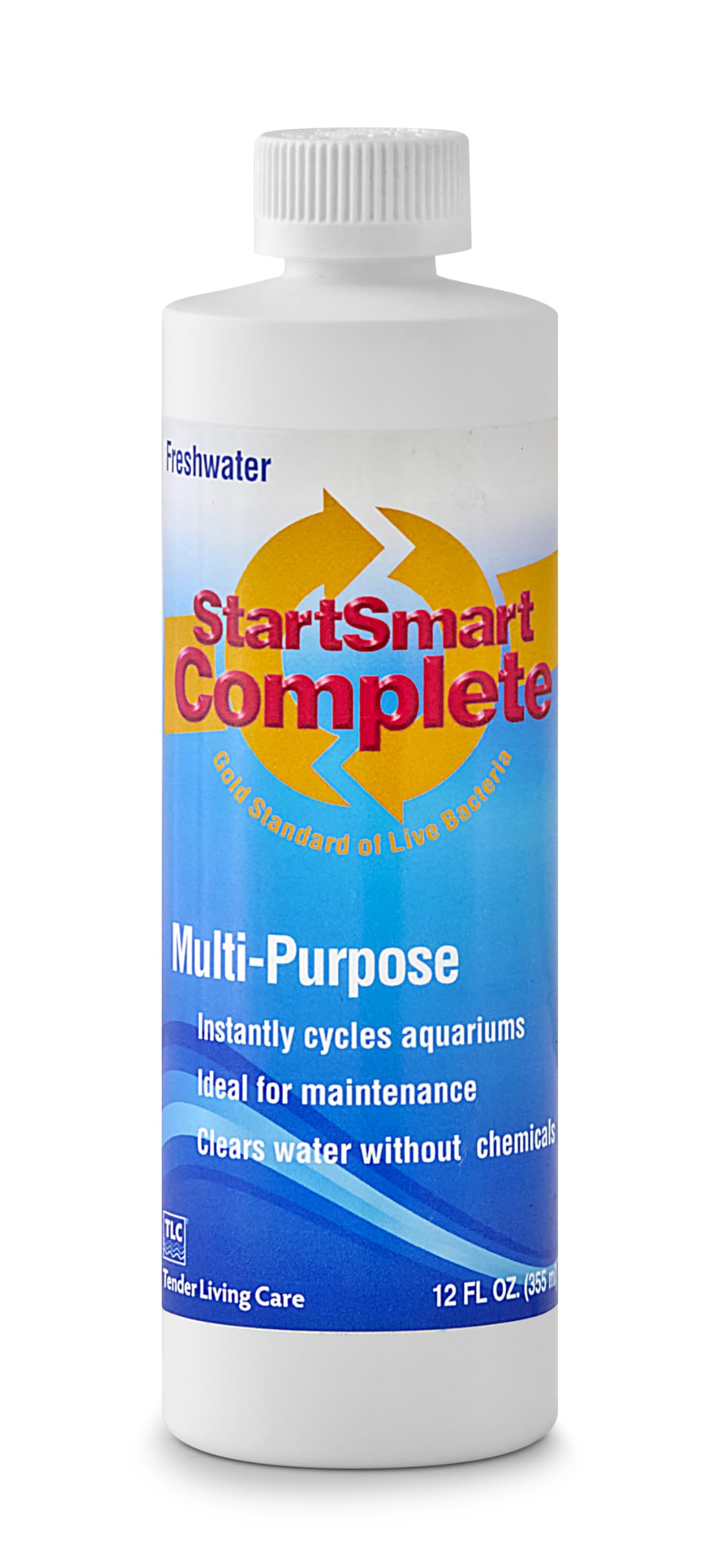
TLC StartSmart Complete positions itself differently from the competition — it’s built as much for water clarity and sludge control as it is for biological cycling. The formula breaks down excess organics, reducing the cloudiness that often occurs during new tank cycling. Users running densely planted tanks or heavy feeders report crystal-clear water within days of the first dose.
The dosing system is refreshingly simple: 1 oz per 10 gallons for new tank cycling, 1 oz per 20 gallons for ongoing water clarity, and 1 oz per 40 gallons for routine maintenance. This multi-tier approach makes it economical for large tanks — a single 12-ounce bottle can maintain a 40-gallon setup for months at the maintenance rate. Long-term users report the product has kept their tanks stable for years, with some using it continuously for four years without issues.
It is not the fastest cycling starter — cycling typically completes within 24–72 hours, which is competitive but not groundbreaking. The bacteria require a constant ammonia source (from fish food or waste) to survive; if you dose into a completely sterile tank with no bioload, the colony may not establish. For hobbyists who want a dual-purpose product that cycles and polishes simultaneously, it’s an outstanding choice.
Why it’s great
- Breaks down organics for improved water clarity
- Versatile dosing for cycling, clarity, and maintenance
- Safe for shrimp, snails, and planted tanks
Good to know
- Requires active ammonia source to establish bacteria
- Not the fastest cycling option — aim for 24-72 hours
5. Seachem SureStart 3-Pack (Prime, Stability, Pristine)

The Seachem SureStart pack bundles three essentials — Prime (dechlorinator), Stability (biofilter starter), and Pristine (sludge and detritus reducer) — into a single package designed for first-time aquarists. Each 100 mL bottle covers different aspects of water quality management, so a new tank owner doesn’t have to research compatibility between separate products.
Prime is the gold standard for removing chlorine, chloramine, and detoxifying ammonia, making it an ideal partner for Stability during the cycling phase. Pristine adds a biological boost by breaking down solid waste that conventional bacteria starters ignore, reducing the sludge that accumulates in filter media. Together, the trio creates a closed-loop system where water is conditioned, bacteria are seeded, and organic waste is continuously consumed.
The value proposition is strong for beginners — buying the three bottles individually costs significantly more. However, the 100 mL bottle of Stability is enough for roughly three 7-day cycles on a 20-gallon tank, so keepers with multiple or larger tanks will run out quickly and need to buy full-size refills. The SureStart pack is best viewed as a starter kit that teaches a maintenance routine, not a bulk economy option.
Why it’s great
- Complete water management in one purchase
- Prime detoxifies ammonia while Stability builds the biofilter
- Pristine reduces sludge and detritus buildup
Good to know
- Bottles are small — 100 mL each — not for large tanks
- You’ll need to buy full-size refills for long-term use
FAQ
Can I add fish immediately after dosing a bacteria starter?
Why did my tank not cycle despite using a bacteria starter?
Should I refrigerate my bacteria starter after opening?
Can I use a freshwater bacteria starter in a saltwater tank?
Final Thoughts: The Verdict
For most users, the best aquarium bacteria starter winner is the Seachem Stability 16.9 oz because its triple-strain blend, forgiving 7-day protocol, and shelf-stable convenience make it the most reliable choice for beginners and experienced keepers alike. If you want the absolute fastest cycle capable of crashing nitrite in under 24 hours, grab the Fritz Turbo Start 700. And for budget-conscious maintainers running multiple tanks who value water clarity alongside biological support, nothing beats the TLC StartSmart Complete.

Mo Maruf
I created WellFizz to bridge the gap between vague wellness advice and actionable solutions. My mission is simple: to decode the research and give you practical tools you can actually use.
Beyond the data, I am a passionate traveler. I believe that stepping away from the screen to explore new environments is essential for mental clarity and physical vitality.