Our readers keep the lights on and my smoothie glass nicely filled. As an Amazon Associate, I earn from qualifying purchases.
Anvil loppers solve a specific problem that bypass designs struggle with: dead, hard, or brittle wood. The single-sided blade slams into a flat metal plate, crushing rather than slicing—so you get maximum force concentrated into a small area.
I’m Mohammad Maruf — the founder and writer behind WellFizz. I’ve spent hours dissecting the mechanical specs, reading verified buyer feedback, and cross-referencing cutting capacities with real-world branch densities to find which models actually deliver on their promises.
Whether you are clearing fallen limbs after a storm or shaping thick hedges in the backyard, choosing the right pair of best anvil loppers means matching blade steel, handle length, and mechanical advantage to the specific wood you cut most often.
How To Choose The Best Anvil Loppers
Selecting an anvil lopper isn’t as simple as grabbing the longest handle you see. The blade geometry, mechanical multiplier, and handle stiffness all work together to determine whether you walk away from a pruning session with tired arms or sawed-off branches still on the ground. Focus on three factors that separate a one-season tool from a decade-long partner.
Cutting Capacity vs. Handle Length
A lopper rated for a 2-inch cut needs handles long enough to generate the leverage that makes that cut possible without tearing your shoulders. Short handles (under 28 inches) force you to use raw muscle. Extendable models let you trade portability for mechanical advantage when you need it, but every telescoping joint is a potential failure point—check that the locking collars are metal, not plastic.
Mechanical Advantage Systems
Compound-action gears multiply your hand force by redirecting the pivot point. Ratchet mechanisms let you cut in stages, squeezing multiple times to work through thick wood. Neither system makes you stronger; both make the tool more forgiving. If you prune more than 30 minutes at a time, a geared or ratchet design will keep your hands functional longer than a simple single-pivot lopper.
Blade Steel and Coating
Hardened carbon steel (SK5, 65Mn) holds an edge longer than stainless but can rust if neglected. A PTFE or low-friction coating reduces the force needed to push through wood and prevents sap from gumming the blade mid-cut. Replaceable blades extend the tool’s life—without them, a dull edge means buying an entirely new lopper.
Quick Comparison
On smaller screens, swipe sideways to see the full table.
| Model | Category | Best For | Key Spec | Amazon |
|---|---|---|---|---|
| Fiskars Ratchet Drive Anvil Lopper | Ratchet | Thick dead branches with minimal effort | Ratchet mechanism, 2-in capacity | Amazon |
| YRTSH Compound Action Lopper | Compound | Overhead pruning at extended reach | 28-41 in adjustable length | Amazon |
| WORKPRO Extendable Geared Lopper | Geared | Mid-height trimming with less force | Gear drive, 25-37 in handles | Amazon |
| JARDINEER Giant Ratchet Lopper | Ratchet | Heavy cleanup with spare blade backup | Ratchet jaw, SK5 spare blade | Amazon |
| Spear & Jackson Razorsharp Active | Compound | Rust resistance in damp conditions | PTFE coated, chrome-plated steel | Amazon |
| Original LÖWE Professional Anvil Pruner | Handheld | Precision cuts on dry twigs and small branches | German carbon steel, 22mm capacity | Amazon |
| Corona X Series Pro Bypass Lopper | Bypass | Healthy live-wood cuts (bypass style) | 2.25-in bypass, 2.09 kg weight | Amazon |
In‑Depth Reviews
1. Fiskars Ratchet Drive Anvil Lopper 32 Inch

Fiskars built the 376811 around a ratchet-drive system that turns one hard squeeze into a series of manageable bites. Each pull advances the blade deeper into the wood, which means a 2-inch dry oak limb doesn’t require the grip strength most loppers demand. The fully hardened steel blade arrives sharp enough to cut cleanly out of the box, and the low-friction coating resists the sap that gums up uncoated competitors mid-project.
Riveted steel handles feel rigid during use—no twisting or flex when you engage the ratchet on a stubborn knot. The 32-inch length provides enough leverage without becoming unwieldy for overhead work. Multiple reviewers noted they pruned dozens of fruit trees in a single season and the blade held its edge with minimal touch-up.
One experienced user with smaller hands mentioned the grip spread is wide but the ratchet makes the pull manageable even for someone with limited upper-body strength. The anvil design leaves a crushed cut surface, so this is best reserved for dead, dry, or dying wood rather than live green branches where a clean bypass slice promotes faster healing.
Why it’s great
- Ratchet drive compounds force across multiple squeezes, reducing hand fatigue
- Blade coating prevents sap adhesion and rust
- Riveted steel construction with no loose components
Good to know
- Wide grip spacing may challenge users with very small hands
- Anvil crushing action is not ideal for green live wood
2. YRTSH Compound Action Lopper 28-41 Inch
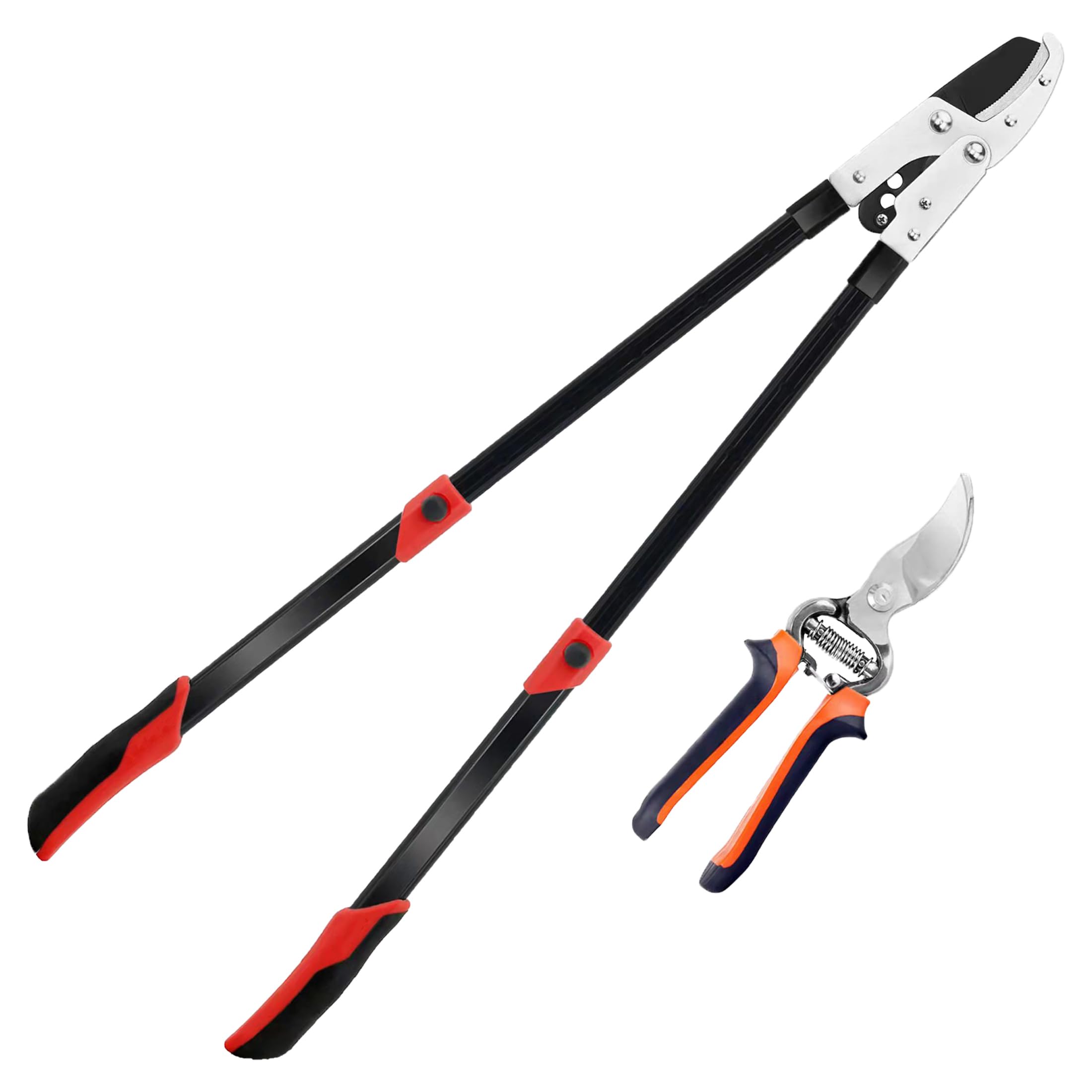
The YRTSH lopper uses compound-action technology to redirect the pivot point, multiplying the force your hands apply without needing a ratchet’s multi-squeeze cycle. That makes it a strong middle ground: you get more power than a basic single-pivot anvil without the incremental cutting pace of a ratchet. The 2-inch cutting capacity matches the Fiskars, but the handle extends in six steps from 28 to 41 inches, giving you overhead reach that fixed-length models can’t match.
The alloy steel blade carries a Teflon-infused low-friction coating. One reviewer in Hawaii, a 73-year-old woman on a half-acre property, reported cutting hibiscus branches and dry banana leaves effortlessly with the extension fully deployed. Another noted the handles flex noticeably when trying to cut green wood at the full 2-inch limit—so stay within 1.25 to 1.5 inches for clean cuts when working overhead.
The locking collars on the telescoping sections feel positive, and the soft rubber grip wraps reduce hand slipping even when wearing garden gloves. An included pair of smaller hand pruners comes in the package, though the locking mechanism on those secondary clippers received complaints about a metal loop that snags closed after every few cuts.
Why it’s great
- Extendable to 41 inches for high branches without a ladder
- Compound action multiplies force with a single squeeze
- Teflon-coated alloy steel blade resists rust and gumming
Good to know
- Handles flex near maximum cutting capacity and full extension
- Included small pruners have a sticky locking mechanism
3. WORKPRO Extendable Anvil Lopper 25-37 Inch
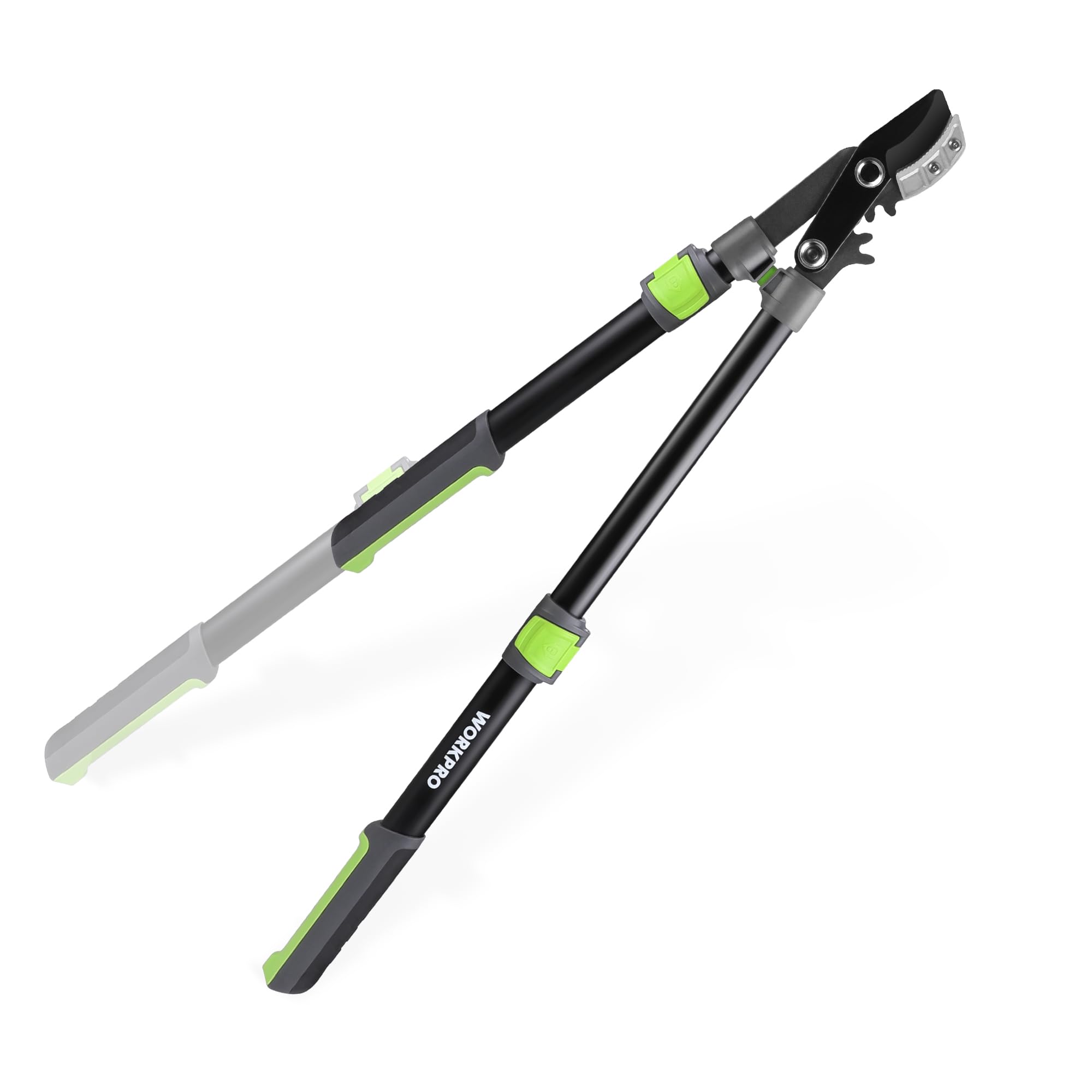
WORKPRO’s gear-driven lopper packs a sawtooth blade that bites into wood and holds it steady, preventing the branch from sliding out of the anvil as you squeeze. The gearing mechanism delivers noticeably higher cutting force than a standard pivot, so a 1.6-inch branch—the official capacity—becomes a single-cut event rather than a wrestling match. Several reviewers confirmed cutting green branches up to 3 cm wide without strain.
Handle extension runs from 25 to 37 inches with metal locking collars that stay tight during repeated cuts. The polypropylene and TPR soft-grip handles clean up easily with a hose. The black oxide finish on the SK-5 steel blade resists rust, and the blade is replaceable, extending the tool’s useful life well beyond the initial purchase.
One buyer’s unit was delivered to the wrong address, but after receiving it they reported cutting weeds under a deck with no blade dulling. Another noted the extendable handles are particularly useful for users who store the lopper in a tight shed—collapsed length is under 30 inches, making it easy to hang on a pegboard.
Why it’s great
- Sawtooth blade grips branches so they don’t slip off the anvil
- Replaceable SK-5 steel blade extends usable lifespan
- Collapsed 25-inch length stores in compact spaces
Good to know
- Cutting capacity of 1.6 inches is lower than 2-inch competitors
- Plastic locking collars feel less robust than all-metal designs
4. JARDINEER Giant Ratchet Lopper 30 Inch

Jardineer’s 30-inch anvil lopper is built around an oversized ratchet jaw that makes multiple cuts through the same branch without resetting your grip. The giant jaw catches and holds thick wood, then the ratchet advances the blade in stages. The carbon steel blade takes on dead, dry, and brittle branches without dulling quickly—one reviewer reported four years of heavy use on a Florida Keys property with over 100 trees, sharpening the included spare blade on a bench grinder.
The package includes a spare SK5 lopper blade, which is unusual at this price tier. That means when the primary edge eventually wears, you swap rather than discard. The hand pruners included in the set are smaller and useful for thin stems, though the main draw is the lopper’s ability to chew through 2-inch storm debris without the handles bending.
A single buyer noted a bolt coming loose after moderate use, requiring a return. That appears to be a quality-control variance rather than a design flaw, as the majority of reviews emphasize the durability and the value of the ratchet mechanism for users with arthritis or reduced grip strength.
Why it’s great
- Giant ratchet jaw handles thick stubborn branches without slipping
- Spare SK5 blade included doubles the tool’s service life
- Widely praised by users with arthritis for low-effort cutting
Good to know
- Quality control on bolts can be inconsistent
- At 5 pounds it is heavier than most anvil loppers
5. Spear & Jackson Razorsharp Active Anvil Lopper
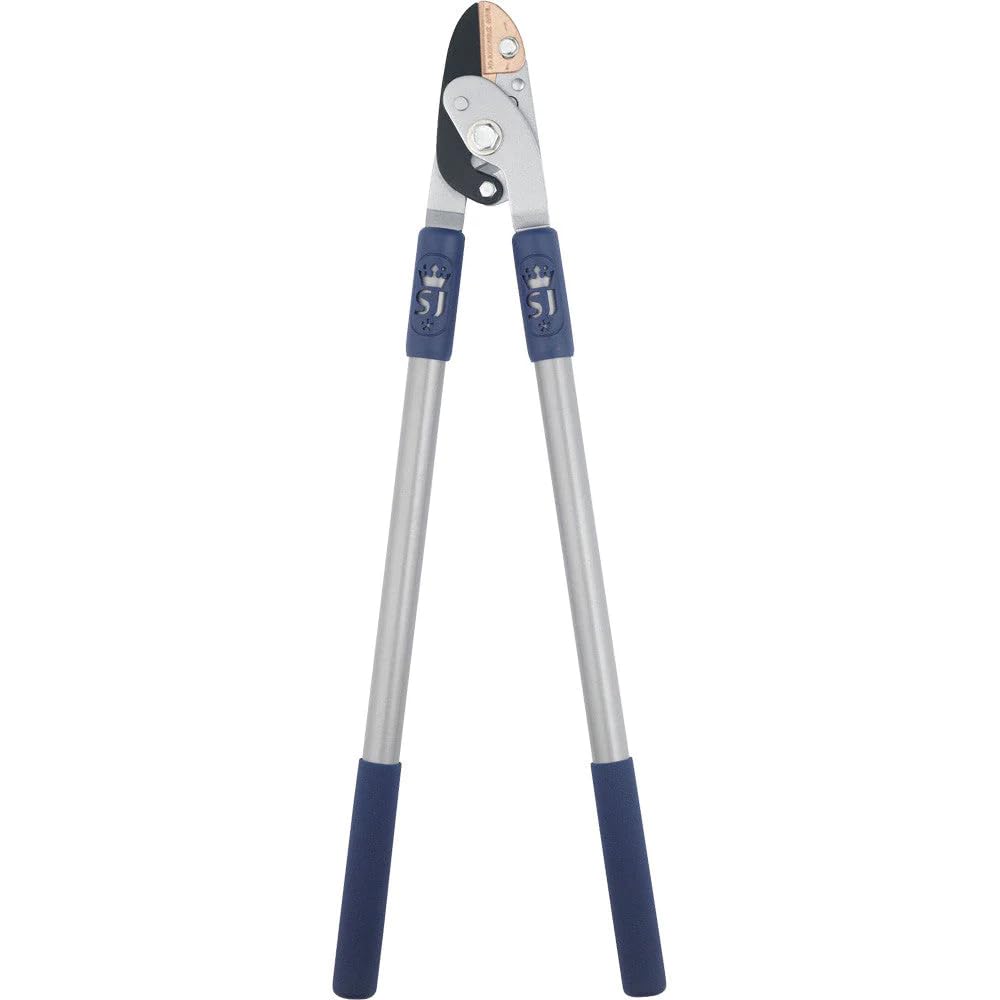
Spear & Jackson’s 4826RSA focuses on corrosion resistance and simple geometry. The hardened carbon steel blade is chrome-plated and then PTFE-coated, creating a dual barrier against rust—important if you store tools in a damp garage or work in consistently wet climates. The compound cutting action provides mechanical advantage without gears or ratchets, keeping the mechanism simple and less likely to jam with debris.
The tubular steel handles are vinyl-coated to prevent rust, and the shock absorber built into the head reduces vibration transfer to your hands on each cut. One reviewer noted the blade is easy to resharpen with a file, which means a near-infinite lifespan for a tool that costs well below premium territory. The 32-millimeter cutting width (roughly 1.25 inches) is smaller than the 2-inch models above, but the tradeoff is a lighter, more maneuverable tool for routine pruning.
Several buyers found the lopper struggled on branches approaching the rated limit—1-inch wood was comfortable, but green wood near 1.25 inches required significant effort. The serrated blade edge helps grip, but the compound action doesn’t multiply force as aggressively as a dedicated geared design.
Why it’s great
- Chrome plating plus PTFE coating creates excellent rust protection
- Simple compound mechanism with fewer failure points
- Blade is easy to sharpen by hand with a file
Good to know
- Cutting capacity of 1.25 inches is small for heavy cleanup
- Struggles near rated capacity on green wood
6. Original LÖWE Professional Anvil Pruner 1.104

This is a handheld anvil pruner rather than a long-handled lopper, but it deserves a spot here for anyone who needs precise, high-force cuts on branches up to 22 millimeters (roughly 7/8 inch) without the bulk of a two-hand tool. Made in Germany, the LÖWE 1.104 uses a carbon steel blade coated with sliding lacquer to reduce friction and protect against corrosion. The build is dense—290 grams—and feels solid with zero play in the pivot.
One reviewer called it the best pruner they had ever used, noting that it cut rose stems and small branches more cleanly than their worn-out Fiskars. The one-hand safety lock deploys with a single finger, making it easy to switch between cuts. Every part is replaceable, which is rare at this size. The anvil style makes it especially effective on dry, dead twigs where the blade’s crush action severs cleanly.
The short 8.27-inch length limits reach, so this is a companion tool for detail work, not a primary branch cutter. The plastic handle feels durable but provides less grip cushion than rubber-coated alternatives.
Why it’s great
- German carbon steel blade stays sharp longer than budget alternatives
- All parts are replaceable, extending tool life indefinitely
- One-finger safety lock works quickly during repetitive cuts
Good to know
- Only suitable for small branches under 7/8 inch
- Plastic handle offers less shock absorption than rubber
7. Corona X Series Pro Bypass Lopper 2-1/4 Inch

The Corona X Series is a bypass lopper, not an anvil, but it is included here because many shoppers cross-shop the two styles, and this model demonstrates why a bypass design is the better choice for live green wood. The scissor-like blade slides past a hook rather than crushing against a flat plate, leaving a smooth cut that heals faster. The high-carbon steel blade arrives sharp and maintains its edge through extended pruning sessions.
At 2.09 kilograms, it is heavier than most anvil loppers, but the aluminum handles keep the balance neutral enough for overhead work. The 2.25-inch cutting capacity is the largest in this roundup, and the serrated lower hook helps grip the branch during the cut. Reviewers noted the build quality is exceptional—one described it as a top-tier tool for landscape professionals.
The replaceable blade and pro-grade construction justify the higher investment. If you primarily cut live trees and shrubs, the bypass action will produce healthier results than any anvil design. But for deadwood, storm cleanup, or dry firewood limbs, an anvil lopper is still the faster, more effective choice.
Why it’s great
- Bypass action leaves smooth cuts that promote faster healing on live wood
- Replaceable high-carbon steel blade for sustained sharpness
- Serrated lower hook grips branches during cutting
Good to know
- Heavier than most anvil loppers at over 4.5 pounds
- Bypass design is less effective on dead, brittle, or dry wood than anvil
FAQ
What is the difference between anvil and bypass loppers?
Why do my anvil loppers bend when cutting thick branches?
How do I sharpen a dull anvil lopper blade?
Can I cut live green branches with anvil loppers?
What does cutting capacity mean on a lopper?
Final Thoughts: The Verdict
For most users, the best anvil loppers winner is the Fiskars Ratchet Drive Anvil Lopper 32 Inch because it combines a proven ratchet mechanism with a durable steel frame and a blade that stays sharp through heavy use. If you need overhead reach for high branches, grab the YRTSH Compound Action Lopper. And for a budget-conscious upgrade from basic loppers, the WORKPRO Extendable Geared Lopper delivers dependable cutting force at a accessible price.

Mo Maruf
I created WellFizz to bridge the gap between vague wellness advice and actionable solutions. My mission is simple: to decode the research and give you practical tools you can actually use.
Beyond the data, I am a passionate traveler. I believe that stepping away from the screen to explore new environments is essential for mental clarity and physical vitality.