Our readers keep the lights on and my smoothie glass nicely filled. As an Amazon Associate, I earn from qualifying purchases.
Ditching cable doesn’t mean giving up broadcast networks — local affiliates for ABC, CBS, NBC, Fox, and PBS still beam high-definition signals through the air for free. The trick is matching the right antenna to your home’s location, construction materials, and distance from transmission towers. A well-chosen unit pulls in crystal-clear 4K and 1080p channels without a monthly bill attached.
I’m Mohammad Maruf — the founder and writer behind WellFizz. I’ve analyzed over-the-air reception specs, signal-to-noise ratios, and real-world user data from hundreds of installations to separate antennas that deliver consistent HD from those that fall short.
After reviewing motorized rotators, ultra-thin indoor panels, and flagship directional arrays, I’ve narrowed the field to models that solve real reception problems at every range. This is the definitive guide to finding the best antenna for tv without cable for your specific setup and budget.
How To Choose The Best Antenna For TV Without Cable
Choosing an OTA antenna starts with understanding the two frequency bands: UHF (channels 14–36) carries most broadcast signals today, while VHF (channels 7–13) still carries many local stations. A balanced antenna handles both. Your distance to towers and the building materials between you and those signals will dictate whether you need a simple indoor panel or a motorized outdoor array.
Range vs. Real-World Reception
Manufacturers often advertise optimistic mile ranges like “200 miles.” Real-world reception depends on transmitter power, terrain, and obstacles. A 50-mile antenna placed in an attic with a clear line of sight to towers can outperform a 150-mile antenna stuck behind a brick wall. Use sites like rabbitears.info to check the actual distance and direction of your local towers before buying.
Amplified or Passive?
Amplifiers boost weak signals but can overload when towers are close, creating pixelation or dropouts. In urban or suburban areas within 20 miles of transmitters, an unamplified or switchable amplifier often works better. For fringe or rural setups beyond 35 miles, a high-gain preamp is usually necessary. Look for models with automatic gain control to avoid over-amplifying strong stations.
Quick Comparison
On smaller screens, swipe sideways to see the full table.
| Model | Category | Best For | Key Spec | Amazon |
|---|---|---|---|---|
| Televes Ellipse Mix | Premium | Fringe rural reception with auto gain | 75 mi range, built-in TForce preamp | Amazon |
| Antennas Direct ClearStream 4V | Premium | Multi-directional suburban coverage | 70+ mi range, four UHF loops | Amazon |
| Five Star 200 Mile | Premium | Extreme long-range with 360° rotation | 200 mi range, motorized rotator | Amazon |
| PBD Motorized 360° | Mid-Range | Powerful outdoor with remote rotation | 150 mi range, motorized 360° rotator | Amazon |
| Channel Master Omni+ 50 | Mid-Range | 360° reception in metro areas | 50 mi range, omnidirectional design | Amazon |
| Mohu Leaf Amplified | Budget-Friendly | Discreet indoor setup near towers | 60 mi range, ultra-thin panel | Amazon |
| Winegard FlatWave FL5500A | Budget-Friendly | Simple indoor/outdoor in suburbia | 60 mi range, dual-color design | Amazon |
In‑Depth Reviews
1. Televes Ellipse Mix 148883
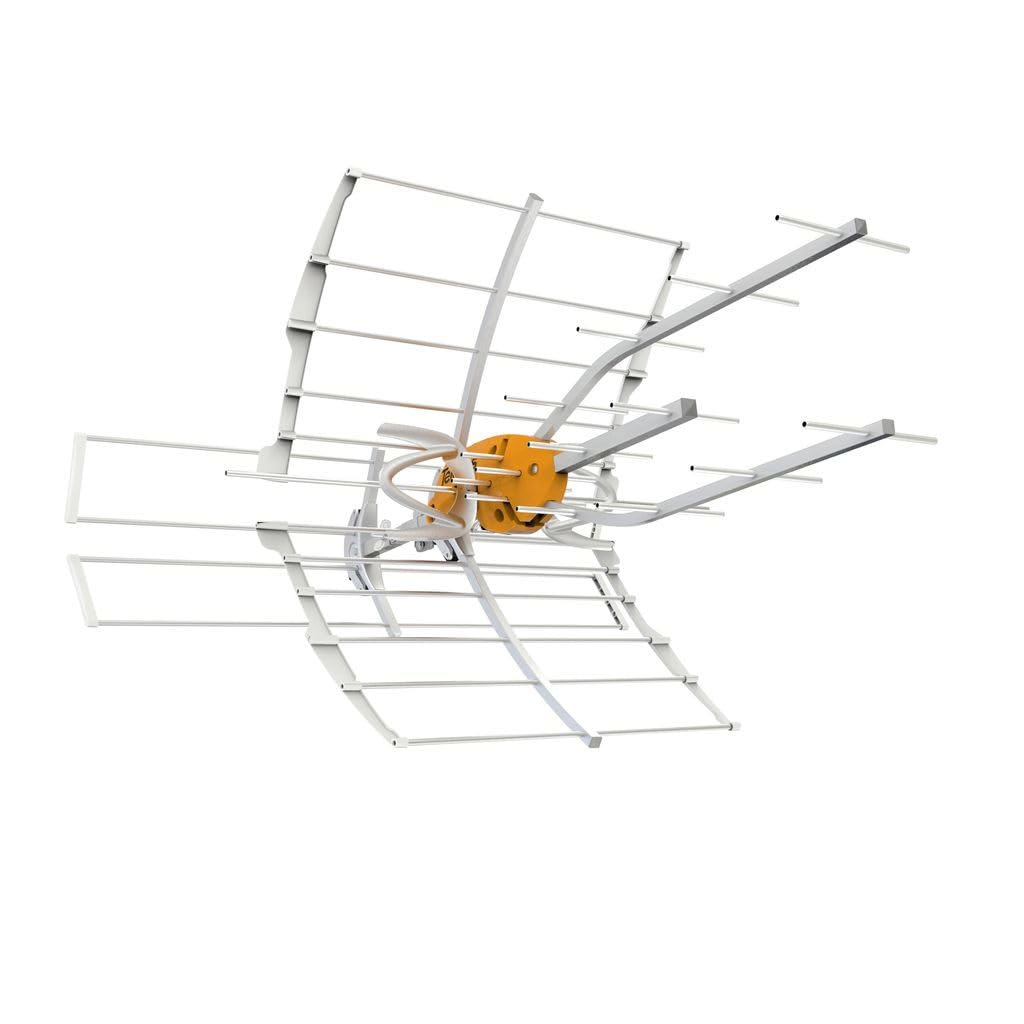
The Televes Ellipse Mix is a powerhouse for fringe reception, combining a triple-boom directional design with a built-in TForce preamp that independently adjusts gain for VHF and UHF bands. Its automatic gain control prevents overloading when strong signals mix with weak ones — a common pain point in rural areas. The integrated LTE/4G/5G filtering cleans up interference from cellular towers, which often plagues long cable runs.
Real-world users report pulling 100+ channels from over 40 miles away, often outperforming previous roof-mounted antennas despite being installed in an attic. The tool-free assembly clips together in under 60 seconds, and the dual-output power inserter feeds both the antenna and a second device like an HDHomeRun. The 7.8-pound frame uses corrosion-resistant aluminum and stainless steel hardware for years of outdoor exposure.
This antenna demands a clear directional aim — its 40-degree beamwidth means you must point it precisely at your broadcast towers. It also requires power for the preamp, though it will pass signals in passive mode if the power inserter fails. For anyone living 35 to 75 miles from transmitters who wants professional-grade reception without constant adjustments, this is the uncompromising choice.
Why it’s great
- Built-in TForce preamp with automatic gain control eliminates the need for separate amplifier hardware.
- Integrated LTE/4G/5G filtering dramatically reduces cellular interference on long coaxial runs.
Good to know
- Highly directional design requires precise aiming at broadcast towers — not ideal for scattered signal sources.
- Requires AC power for the preamp; passive bypass mode reduces signal strength significantly.
2. Antennas Direct ClearStream 4V
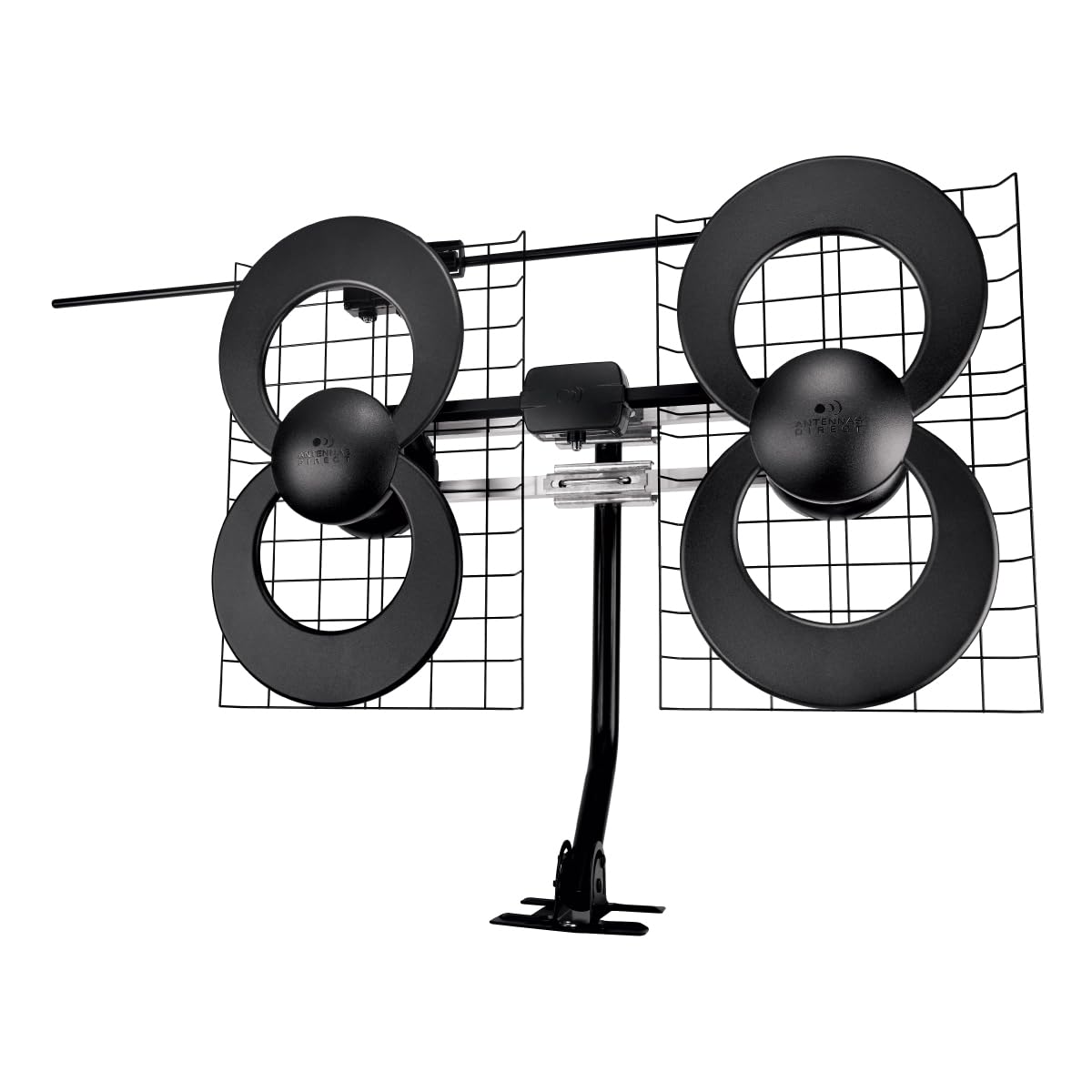
The ClearStream 4V uses four patented UHF loops and a separate VHF dipole to deliver strong multi-directional reception up to 70 miles from towers. Reflectors on the rear focus signal forward and block interference from behind, making it effective in suburban areas with moderate tree cover. It ships with a 20-inch mast and pivoting base for vertical or horizontal mounting.
Users consistently report 60+ channels from attic installations 35 miles away, often outperforming larger Yagi-style antennas. The build quality is notable — notched brackets, rigid combiners, and smooth threading make assembly straightforward. Many reviews note that adding a Channel Master amplified splitter helps maintain signal strength when feeding multiple TVs, as cheap splitters can cut channel count in half.
The 4V is less effective if towers are spread across opposite directions because its UHF loops are not fully omnidirectional — you may need to add a second antenna for complete coverage. The 4.1-pound frame is durable but the VHF reflector wire can be fiddly to attach. For suburban homes within 50 miles of clustered towers, this is a top-tier performer that rivals anything in its price bracket.
Why it’s great
- Four-loop UHF design provides excellent forward gain and rear interference rejection for consistent suburban reception.
- Included 20-inch mast with pivoting base simplifies installation on vertical or horizontal surfaces.
Good to know
- UHF loops are not fully 360-degree omnidirectional; separate towers in opposite directions may require a second antenna.
- VHF reflector wire attachment can be slightly fiddly during assembly.
3. Five Star Outdoor Digital Amplified HDTV Antenna
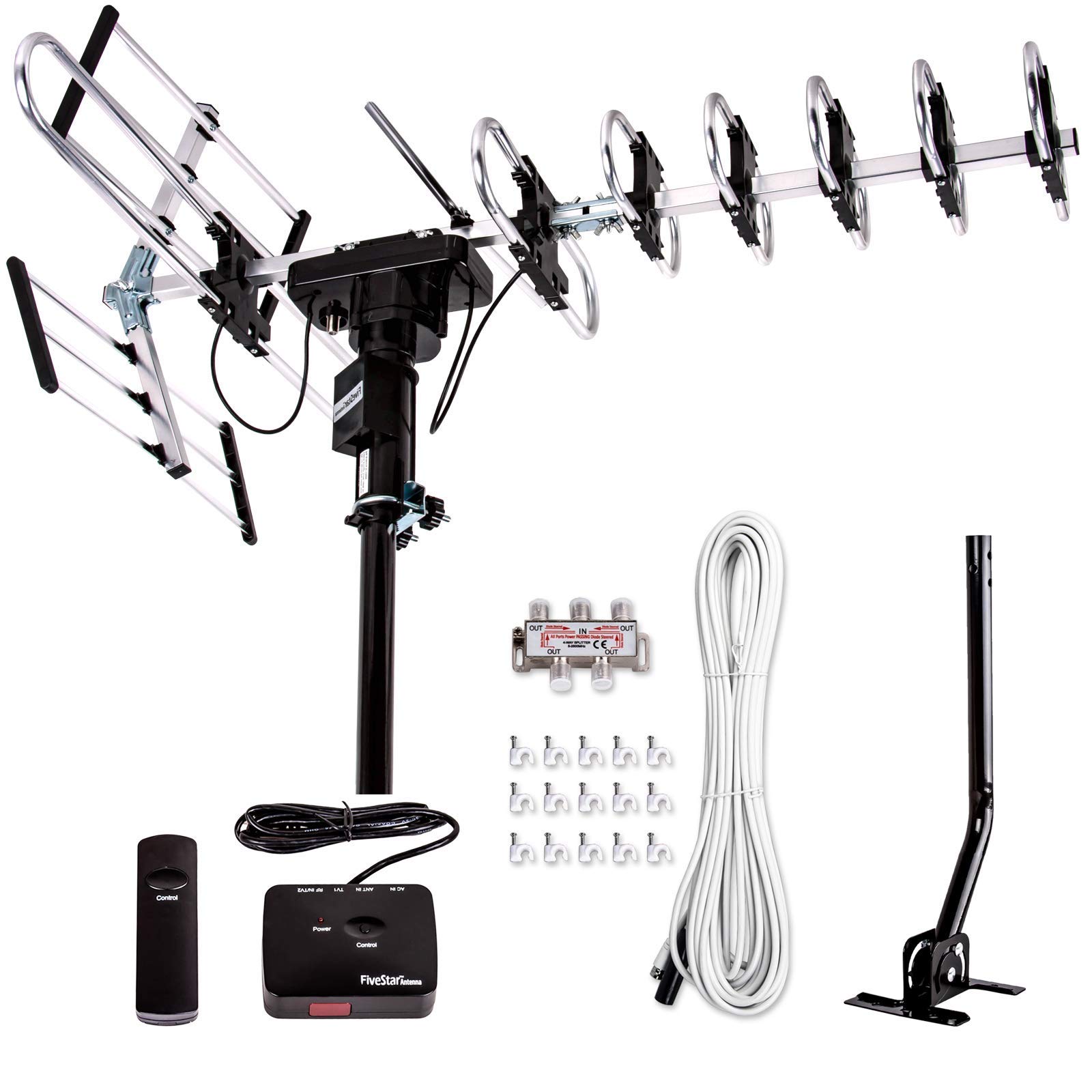
The Five Star antenna targets extreme long-range scenarios with a claimed 200-mile reception and a motorized 360-degree rotator that lets you adjust direction from a remote control. Six reflector elements boost UHF image quality by about 25% over four-element designs, while a dedicated V-band attachment improves VHF reception. The built-in auto-gain chip adjusts from 15 to 35 dB to handle varying signal strengths.
Real-world performance is strong: users 20 miles from towers report 56 solid channels after mounting in an attic, compared to 24 when placed indoors. The included installation kit — 40-foot RG6 coax, 4-way splitter, mounting pole, and cable clips — covers everything for a single-roof install. Several buyers note that the motor auto-rotates on power-on, which can be handy for initial scanning.
Quality control is a risk: a small number of units arrive with dead motors or missing mounting screws. The 40-foot coax cable may drop voltage to the motor over long runs, causing rotation failure. If you need to scan channels from a single direction and don’t rely on daily re-aiming, the Five Star delivers impressive channel counts at a competitive price — just verify the motor works immediately after assembly.
Why it’s great
- Six UHF reflector elements provide measurable image quality improvement over standard four-element designs.
- Comprehensive installation kit includes 40ft coax, 4-way splitter, J-pole, and cable clips for a complete setup.
Good to know
- Motor reliability is inconsistent — test rotation immediately, as some units arrive with dead or weak motors.
- 40ft included coax may cause voltage drop to the motor; shorter cable runs improve rotation performance.
4. PBD Amplified Outdoor TV Antenna with 360° Motorized Rotation

The PBD antenna packs a motorized 360-degree rotator, remote control, and dual TV outputs into a weatherproof outdoor package at a price that undercuts most competitors. It supports NEXTGEN TV (ATSC 3.0) and claims a 150-mile range, though real-world reception typically stabilizes around 35–50 miles with clear HD quality. The included 40-foot RG6 cable and mounting pole cover the essentials for a roof or chimney install.
User reports highlight a dramatic improvement over previous antennas — one buyer replaced a Mohu Sky 60 and picked up more channels without pixelation. Customer service is frequently praised, with representatives sending detailed channel maps and helping with placement. The dual output lets you feed two TVs without a splitter, though using the built-in amplifier to drive long runs may require an additional preamp.
The antenna is weatherproof and built for outdoor use, but the supplied RG6 cable is standard grade rather than quad-shielded, which can allow noise ingress in high-interference areas. Some users also wish for a white cable option for aesthetics. For anyone needing a reliable, motorized outdoor antenna at an approachable price point that includes dual TV support, this is a smart mid-range pick.
Why it’s great
- Motorized 360-degree rotator with remote control lets you re-aim without climbing onto the roof.
- Dual TV outputs allow simultaneous connection to two TVs without requiring an external splitter.
Good to know
- Included RG6 cable is standard grade; upgrading to quad-shielded coax improves interference rejection on long runs.
- No white cable option — the included gray cable may stand out against lighter siding or trim.
5. Channel Master Omni+ 50

The Channel Master Omni+ 50 is designed for 360-degree reception, making it ideal for urban and suburban areas where broadcast towers surround the home. It receives UHF and VHF signals without needing to be pointed, thanks to a separate rotatable VHF dipole and an omnidirectional UHF element. The 50-mile range is realistic for metro areas, and the lightweight design (under 2 pounds) mounts easily on a wall, mast, or existing satellite bracket.
Users in metropolitan areas report dramatic improvements — one buyer saw signal strength jump from 60% to 95% and noise margins from 70% to 98%, with no pixelation even during storms. The separate VHF dipole can be oriented independently to pull in weaker VHF-Low channels 2 and 6, a feature missing from many omnidirectional antennas. Several reviews note it survives heavy rain without signal loss and works with a splitter to feed a second TV.
The Omni+ 50 is not designed for rural or fringe reception — its omnidirectional nature trades raw gain for convenience, meaning signal capture is weaker than a comparable directional antenna at the same range. The included mounting bracket requires a separate mast (not included). For apartment dwellers, RV owners, or suburban homes within 35 miles of mixed-direction towers, this is a sleek, effective solution.
Why it’s great
- True 360-degree omnidirectional reception eliminates the need to aim the antenna at broadcast towers.
- Separately rotatable VHF dipole allows independent orientation for weak VHF-Low channels 2–6.
Good to know
- Not suitable for rural or fringe areas beyond 35 miles where directional gain is necessary for reliable reception.
- Mounting mast is not included; you must purchase one separately for roof or wall installation.
6. Mohu Leaf Amplified

The Mohu Leaf Amplified offers a minimalist solution for indoor TV reception, measuring just 0.04 inches thick with a warm gray finish that blends into walls or windows. Its Jolt Switch in-line USB amplifier lets you toggle the signal boost on or off depending on proximity to towers — useful for avoiding overload when broadcast stations are close. The multi-directional UHF and Hi-VHF elements receive signals from both front and back, covering 60 miles in ideal conditions.
Many users in suburban areas 10–20 miles from towers report 47 to 60 crystal-clear channels, including all major networks. The setup is genuinely simple: stick the panel to a window or wall, connect the coax, and plug the USB amplifier into the TV’s port. Some buyers note a significant improvement over cheaper antennas, with one user jumping from 21 to 47 channels. The 12-foot coaxial cable gives decent placement flexibility.
The Leaf struggles in challenging environments — users in brick homes or basements often report pixelation or fewer channels than expected. The ultra-thin design limits its ability to pull in VHF signals compared to larger panel antennas, and a few buyers found it outperformed by much older rabbit-ear designs. For apartments, condos, or second-floor rooms within 25 miles of transmitters, this is the discreetest option available.
Why it’s great
- Ultra-thin 0.04-inch panel with warm grey finish blends nearly invisibly into walls or windows.
- Jolt Switch in-line amplifier lets you toggle the signal boost on/off to prevent overload near strong towers.
Good to know
- Struggles with VHF signal reception compared to larger panel antennas or outdoor models.
- Performance degrades significantly in homes with brick, concrete, or metal roofing materials.
7. Winegard FlatWave FL5500A
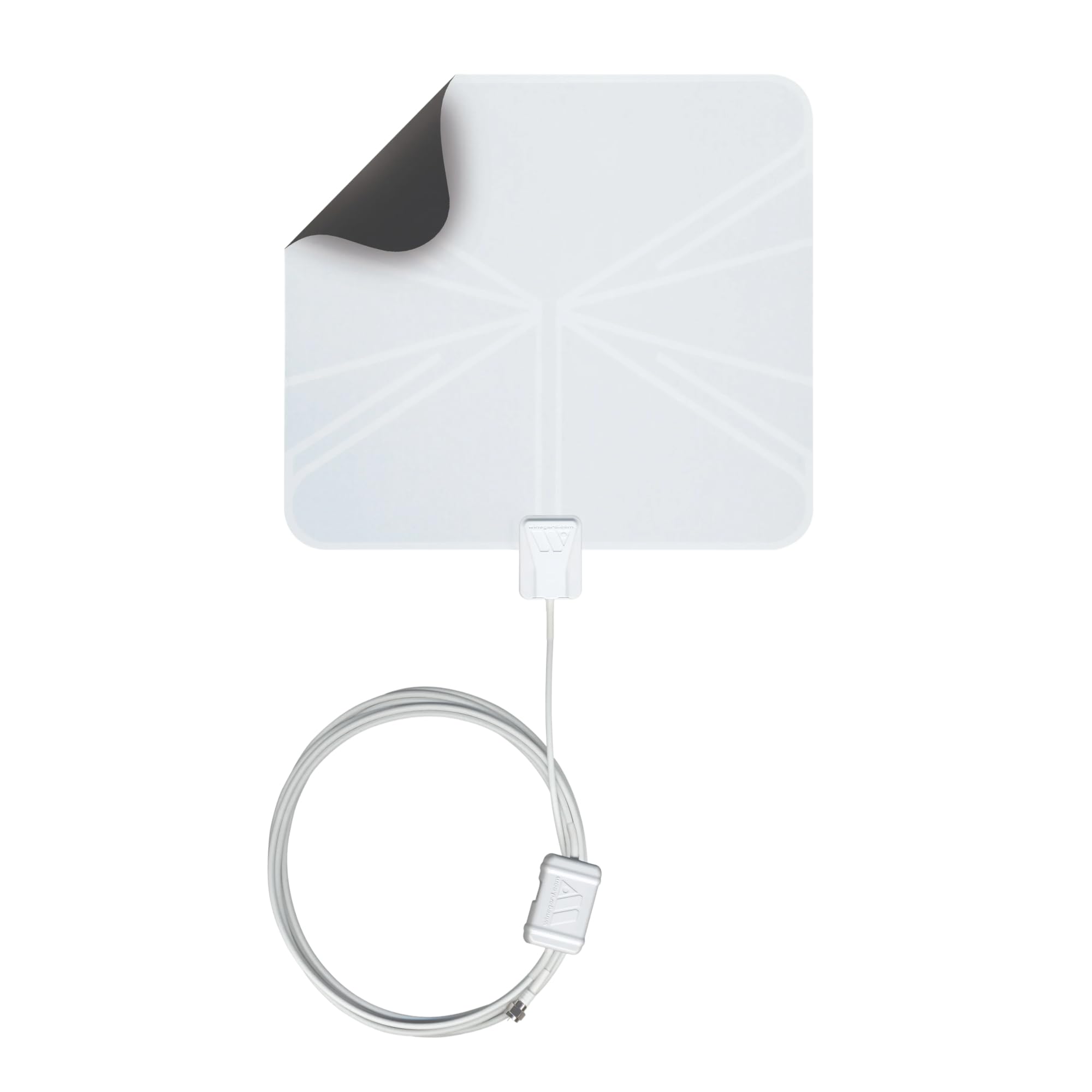
The Winegard FlatWave FL5500A is a straightforward amplified panel antenna designed for metro and suburban areas up to 60 miles from towers. Its dual-color design (black on one side, white on the other) lets you match your room’s decor by facing the preferred side outward. The Winegard app provides a guided setup process and helps locate channel availability for your address, which simplifies initial placement for first-time OTA users.
Buyers 10–30 miles from transmitters report reliable reception of 22 to 40 channels, with some achieving clear HD on all major networks. The ultra-thin 0.6-inch profile saves space, and the 18.5-foot coax cable offers ample reach. Several users note that careful positioning — moving the antenna one inch vertically or horizontally — can make the difference between a pixelated picture and a solid lock on a station.
The coax cable is permanently fixed to the antenna, preventing the use of a 90-degree adapter that could help clear a tight space behind furniture. Reception can be finicky for weaker or off-axis signals, particularly VHF stations. A few buyers found it outperformed by other models in the same price tier. For a budget-friendly, low-profile indoor antenna with a helpful app, the FlatWave delivers solid value without demanding a complex install.
Why it’s great
- Dual-color design (black/white) lets you choose which side faces outward to match your room decor.
- Winegard app guides setup and identifies local channel availability by address for easy first-time installation.
Good to know
- Coax cable is permanently fixed to the antenna, preventing the use of a 90-degree adapter for tight spaces.
- Reception of weaker VHF stations can be inconsistent; fine-tuning position is critical for full channel lock.
FAQ
Do I need a preamp if I live 40 miles from broadcast towers?
Why does my indoor antenna get fewer channels than my neighbor’s?
Do I need a motorized rotator if my towers are in two different directions?
Final Thoughts: The Verdict
For most users, the best antenna for TV without cable winner is the Televes Ellipse Mix 148883 because its built-in TForce preamp with automatic gain control delivers rock-solid reception in fringe areas without requiring external amplifier hardware. If you want a premium directional antenna for suburban towers within 50 miles, grab the Antennas Direct ClearStream 4V. And for a budget-friendly indoor solution near strong transmitters, nothing beats the Mohu Leaf Amplified for its ultra-thin design and switchable amplification.

Mo Maruf
I created WellFizz to bridge the gap between vague wellness advice and actionable solutions. My mission is simple: to decode the research and give you practical tools you can actually use.
Beyond the data, I am a passionate traveler. I believe that stepping away from the screen to explore new environments is essential for mental clarity and physical vitality.