Our readers keep the lights on and my smoothie glass nicely filled. As an Amazon Associate, I earn from qualifying purchases.
Pixelation, channel dropouts, and the constant need to re-aim a flimsy antenna are the daily frustrations of cord-cutting with over-the-air TV. The difference between a solid 80-channel lineup and a frustrating four-channel experience often comes down to one decision: choosing an antenna with the right gain pattern, filter set, and build quality for your specific location.
I’m Mohammad Maruf — the founder and writer behind WellFizz. My deep market research focuses on analyzing hardware specifications, customer validation data, and real-world performance patterns across OTA antennas to separate marketing claims from measurable reception quality.
This guide breaks down the specs, trade-offs, and real-world performance of seven distinct models so you can confidently select the best antenna for ota tv for your home, whether you are in a dense urban core or deep fringe territory.
How To Choose The Best Antenna For OTA TV
Picking the right OTA antenna is a geometry problem between your location, the distances to broadcast towers, and the type of signals they emit. The wrong choice means constant dropouts on network affiliates or missing entire bands of channels.
Analyze Your Tower Environment First
Use the FCC’s DTV Reception Maps or a tool like RabbitEars.info to identify the distance, direction, and signal strength of every major broadcast tower near you. If all towers are within 30 miles and clustered in one direction, a mid-range passive antenna is enough. For towers spread across 60-plus miles in multiple directions, you need either a multi-directional design or a motorized solution.
Match the Antenna to the Frequency Band
Most modern OTA signals live in the UHF band (channels 14-36), but many critical stations—especially NBC and CBS affiliates in certain markets—still broadcast on VHF-Hi (channels 7-13). An antenna that is optimized only for UHF will miss those VHF stations entirely. Look for a model that explicitly lists both UHF and Hi-VHF elements.
Filtering Is Not Optional Anymore
As cellular towers get denser, LTE and 5G signals bleed into TV frequencies, especially on UHF. An amplifier without a proper filter will actually make reception worse by amplifying interference alongside the desired signal. Built-in LTE/5G filtering is a must-have on any premium or amplified antenna you consider.
Quick Comparison
On smaller screens, swipe sideways to see the full table.
| Model | Category | Best For | Key Spec | Amazon |
|---|---|---|---|---|
| PBD Amplified Motorized | Motorized | Multi-direction towers | 360° rotator, 150 mi range claim | Amazon |
| ClearStream 1MAX | Passive | Urban/suburban 40 mi range | Multi-directional, unamplified | Amazon |
| PIBIDI UHD-8903 | Passive Large | Rural fringe reception | 200 mi range claim, VHF+UHF | Amazon |
| ClearStream MAX-V | Passive Mid | Suburban 60 mi range | Double-loop, 65° beam angle | Amazon |
| Five Star Outdoor | Passive Large | High gain, multi-TV | 200 mi range, 4 TV splitter inc. | Amazon |
| Televes DiNova Boss | Smart Amplified | Variable signal conditions | Auto gain control, LTE filter | Amazon |
| Televes Ellipse Mix | Premium Amplified | Fringe/deep fringe | 36.5 dBi VHF, 40 dBi UHF gain | Amazon |
In‑Depth Reviews
1. Televes Ellipse Mix 148883
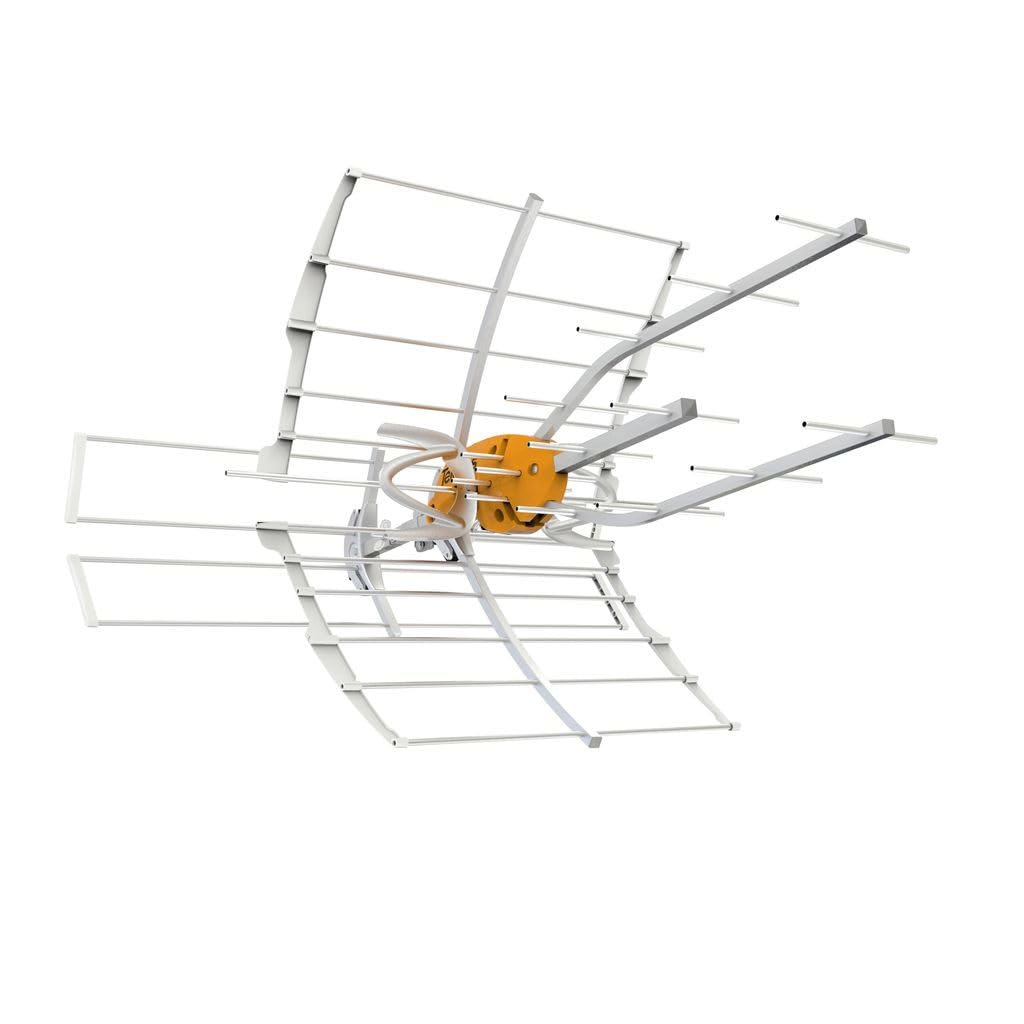
This is the most technically complete OTA antenna on the market today. The Televes Ellipse Mix uses a proprietary triple-boom layout with curved reflectors to achieve 36.5 dBi on VHF-Hi and 40 dBi on UHF. That raw gain, combined with TForce intelligent gain control, means the unit automatically adjusts amplification per band to prevent overload from strong local towers while still pulling in weak fringe signals.
Built-in LTE, 4G, and 5G filtering is critical in 2025; the Ellipse Mix filters everything above 608 MHz so cellular interference never reaches your tuner. The entire unit assembles tool-free in under 60 seconds. In practice, users 40 miles from Central Florida towers saw signal strength jump from 67 to 85 on major networks, and an attic install 35 miles west of Chicago locked 105 stations with 95 fully watchable.
The beamwidth is tight at around 40 degrees, so you need to aim it precisely, but the payoff is a clean, stable signal with no pixelation even on ATSC 3.0 channels. It is the clear choice for anyone who values reception reliability over convenience.
Why it’s great
- Industry-leading gain on both VHF and UHF bands.
- Intelligent auto-gain prevents overload in mixed signal environments.
- Full LTE/5G filtering protects the signal path.
- Tool-free assembly in under a minute.
Good to know
- Narrow 40-degree beamwidth requires careful aiming.
- Premium price point fits fringe or enthusiast budgets.
2. Televes DiNova Boss Mix 144286

The DiNova Boss Mix brings Televes’ TForce intelligent gain control into a more compact, weather-resistant radome housing that is far less conspicuous on a roof or balcony. It delivers 29 dBi on VHF and 34 dBi on UHF with automatic amplification adjustment by band. The 7-element UHF microstrip array paired with Hi-VHF elements gives it a solid directional pattern that reduces noise from off-axis interference.
Built-in FM, LTE, 4G, and 5G filtering means you do not have to worry about cellular towers bleeding into your UHF channels. The unit ships with a 12V dual-output power inserter and J-mount bracket. One user in a hilly rural area installed it indoors initially and later moved it below the roofline, gaining 20 extra channels and eliminating all pixelation with no reorientation needed.
The low-profile white radome also blends in better than exposed-element designs, making it practical for HOA communities.
Why it’s great
- Automatic gain control adapts to signal fluctuations.
- Weather-resistant radome protects all electronics.
- Full LTE/5G filtering built in.
- Compact and discreet for suburban mounting.
Good to know
- Lower max gain than the Ellipse series for fringe use.
- Mounting fasteners not included.
3. ClearStream MAX-V C2MVB
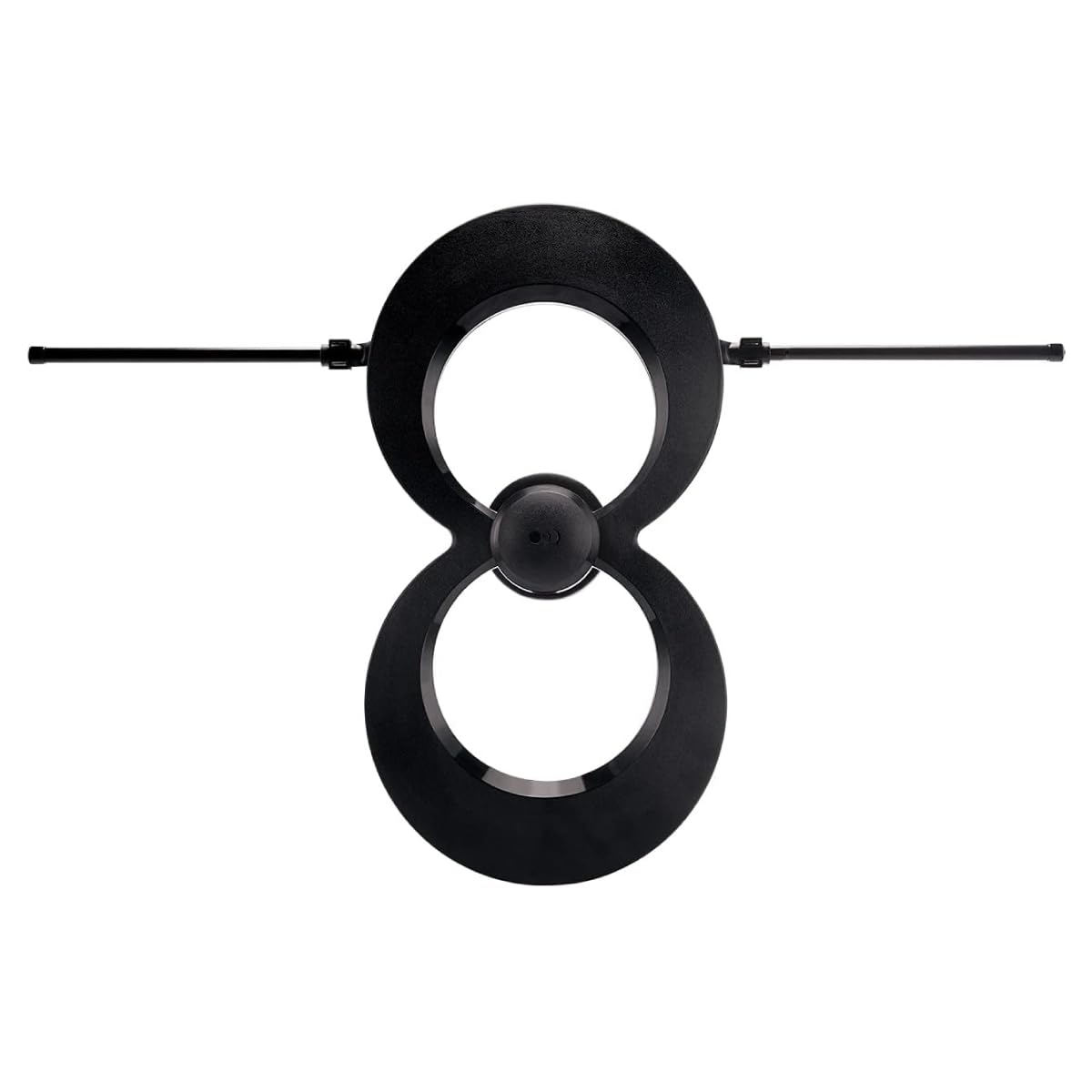
The ClearStream MAX-V is the sweet spot in the Antennas Direct lineup, offering a 60-plus mile range with a double-loop design for UHF and dedicated Hi-VHF elements. It has a 65-degree beam angle, which is wider than most directional antennas, so it can pull in signals from towers spread across a wider arc without needing a rotator.
It is completely passive, meaning no amplifier to introduce noise, which actually makes it a better performer in strong signal zones where an amp would overload. Reviews consistently show it beating amplified competitors by locking in major networks without pixelation. One user tested 10 different antennas and found this one delivered 85 channels from a ceiling mount, including difficult VHF stations like WABC and CW from 28 miles away in NJ.
The steel wall bracket included in the box allows for low-profile mounting on an exterior wall or existing mast, and the entire assembly takes minutes. It is the definition of a no-fuss, high-reliability antenna for suburban and rural environments where towers are within 60 miles.
Why it’s great
- Excellent UHF and Hi-VHF reception without an amplifier.
- Wider beam angle reduces aiming precision needed.
- Includes steel wall bracket for easy mounting.
- Lifetime manufacturer warranty.
Good to know
- Passive design may not be enough for deep fringe.
- Heavier than flat indoor antennas.
4. PBD Amplified Motorized Antenna

The PBD Amplified Motorized Antenna solves the single biggest problem in OTA reception: towers in opposite directions. With a wireless remote that rotates the antenna 360 degrees, you can point it east for ABC and NBC, then rotate it west for CBS and FOX without climbing onto the roof. This is a game-changer for homes where towers are not clustered in one azimuth.
It includes a built-in high-gain amplifier and 40 feet of RG6 coax cable, plus dual TV outputs so you can feed two televisions without a separate splitter. The unit is weatherproof for outdoor mounting and is ATSC 3.0 ready. Users report significant improvements over previous antennas, with one replacing a Mohu Sky 60 and gaining several channels without any pixelation. The motorization simplifies the setup process significantly.
The 150-mile range claim is optimistic in real-world conditions—expect solid performance out to 50-70 miles depending on terrain—but the rotator and dual-output features make it an excellent value for households with multiple TVs and non-clustered tower locations.
Why it’s great
- Motorized rotation solves multi-direction tower problems.
- Dual TV outputs eliminate need for external splitter.
- Includes 40ft RG6 and mounting pole.
- Lifetime warranty with 24/7 support.
Good to know
- Long-range claim is best interpreted as mid-range.
- Box may be missing coax cable in rare cases.
5. ClearStream 1MAX C1MV

The ClearStream 1MAX is the smallest and most discreet antenna in this lineup, but it punches well above its size. It has a compact single-loop design measuring just 10.1 inches high by 31.3 inches wide with a 40-plus mile range. It is multi-directional for UHF and has dedicated Hi-VHF elements, making it one of the best options for urban and near-suburban environments where towers are within 40 miles.
Because it is passive, it does not introduce amplifier noise, and its forgiving positioning makes it easier to install than larger directional units. One user 25 miles northwest of Chicago reported 20 percent greater signal strength than a 6-foot multi-element antenna. The kit includes adjustable mounting hardware for indoor, attic, or outdoor use, but note it does not include coax cable or a mast, so you need to supply those separately.
It is ideal for apartments, condos, or homes where a large antenna is impractical, yet you still want reliable reception of major networks and their subchannels. The industrial look actually appeals to users who prefer function over form.
Why it’s great
- Compact form factor fits tight spaces.
- Passive design performs well in strong signal zones.
- Easy to position with forgiving beam angle.
- Supports 4K, 8K, and ATSC 3.0.
Good to know
- No coax cable or mast included.
- Assembly holes for rods can be tight.
6. PIBIDI UHD-8903

The PIBIDI UHD-8903 relies on longer, larger receiving elements to capture weak signals from far distances. It is a passive antenna with no built-in amplification, and its extended element length gives it an advantage in fringe areas where signal strength is already low. Users 65-plus miles from Eugene and Portland reported receiving 64 to 86 channels, a massive improvement over the 15 to 50 channels from previous antennas.
It is weather-resistant with lightning protection and grounding done, and assembly requires no tools since most elements come pre-assembled. However, the lack of a built-in rotator means you have to manually climb onto the roof to adjust direction if your target towers are spread out. One user noted it could not get a specific channel (MeTV-toon) even with careful aiming.
For rural and exurban buyers on a budget who have a clear line of sight to a single cluster of towers, this antenna offers the best cost-per-channel ratio in the lineup. The 200-mile claim is aspirational, but the physical element size genuinely outperforms many mid-range competitors at half the price.
Why it’s great
- Extra-long elements capture weak distant signals.
- No-tools assembly with pre-assembled parts.
- Weather-resistant with lightning protection.
- Excellent value for rural reception.
Good to know
- No built-in rotator for multi-direction towers.
- Range claim is optimistic; expect 50-70 miles real-world.
7. Five Star Outdoor HDTV Antenna

The Five Star Outdoor Antenna is built around a large 46-inch by 28-inch element array designed for high gain on both VHF and UHF. It ships with a mounting bracket, J-pole, and a four-TV splitter, making it a turnkey solution for households that want to feed multiple televisions from a single outdoor antenna. The splitter is a real cost saver since you do not have to buy one separately.
Assembly is straightforward but the instructions miss a critical detail: the VHF vibrator alignment requires screw heads to face the same direction, which several users noted. Once correctly assembled, the antenna pulls in signals reliably. One user 45 miles from Houston towers picked up 128 channels, while another at 7,300 feet elevation 46 miles from towers received 90 channels with 72 coming in clearly. The included 40 feet of RG6 coax is adequate for most installations, though longer runs may require an external amplifier.
It is a large, physically imposing antenna that demands a sturdy roof or mast mount, and it does not have built-in amplification or LTE filtering. For multi-TV homes with a clear line of sight and a single tower cluster, it delivers the highest raw channel count of any unit in this roundup.
Why it’s great
- Comes with J-mount and 4-TV splitter included.
- High raw channel counts from favorable locations.
- Includes 40ft RG6 coax cable.
- Supports ATSC 3.0 and 4K.
Good to know
- Large size requires sturdy mounting.
- Assembly instructions miss a key alignment detail.
- No built-in LTE/5G filtering.
FAQ
Why does my indoor antenna not pick up VHF-Hi channels?
How do I tell if I need a directional or multi-directional antenna?
Final Thoughts: The Verdict
For most users, the best antenna for ota tv winner is the Televes Ellipse Mix because it delivers unmatched gain on both VHF and UHF bands with intelligent amplification and full LTE filtering. If you want a more affordable, no-fuss installation with great suburban range, grab the ClearStream MAX-V. And for multi-direction tower environments where you cannot re-climb the roof daily, nothing beats the PBD Amplified Motorized Antenna for its 360-degree rotator and dual TV outputs.

Mo Maruf
I created WellFizz to bridge the gap between vague wellness advice and actionable solutions. My mission is simple: to decode the research and give you practical tools you can actually use.
Beyond the data, I am a passionate traveler. I believe that stepping away from the screen to explore new environments is essential for mental clarity and physical vitality.