Our readers keep the lights on and my smoothie glass nicely filled. As an Amazon Associate, I earn from qualifying purchases.
The only thing worse than a monthly cable bill is an antenna that pixelates during the fourth quarter. If you live in a suburban valley, a dense urban apartment, or rural fringe territory, the difference between 8 channels and 68 comes down to one decision: which antenna you mount. Amplifier type, element design, directional vs. omni, and physical placement all dictate whether you watch the game in 1080p or stare at a frozen screen.
I’m Mohammad Maruf — the founder and writer behind WellFizz. I’ve spent years analyzing signal-to-noise specs, VHF/UHF element geometry, and real-world performance data across dozens of over-the-air antennas to separate marketing range claims from actual reception results.
Whether you are mounting in an attic, clamping to a deck rail, or sticking a flat panel to a window, finding the best antenna for free tv means matching the right design to your specific tower distance, obstructions, and channel mix.
How To Choose The Best Antenna For Free TV
Before you pick an antenna, you need to know what kind of signal your local towers emit and how many walls, trees, or hills sit between you and them. The prettiest antenna is worthless if its element array ignores the band your local stations use.
Determine Your Tower Distance and Terrain
Pull up a tool like AntennaWeb or the FCC’s DTV Reception Maps. Enter your address and look at the direction (azimuth) and frequency band for each major network. If you are within 30 miles with clear line-of-sight, a mid-range indoor or compact outdoor antenna works. Beyond 50 miles or with hills and dense foliage, you need a large Yagi-style element array with a dedicated pre-amp.
Match the Element Design to Your Signals
UHF channels (14-51) use short, looped or bow-tie elements. VHF channels (2-13) need longer straight rods. If you buy a flat panel that only claims UHF support, you will lose every VHF station, including many CBS and NBC affiliates. Pay attention to whether the antenna lists Hi-VHF (7-13) and Low-VHF (2-6) support.
Consider Amplifier Quality, Not Just Gain
A cheap amplifier boosts both signal and noise, washing out weak channels. Look for a built-in 4G LTE filter to block cellular interference, and remember that over-amplifying a strong signal can actually overload your TV tuner. In metro areas, a passive antenna often outperforms an amplified one.
Quick Comparison
On smaller screens, swipe sideways to see the full table.
| Model | Category | Best For | Key Spec | Amazon |
|---|---|---|---|---|
| ClearStream 2V | Premium | Multi-directional UHF/VHF | 60+ miles with reflector | Amazon |
| RCA ANT751Z | Mid-Range | Attic/long-range UHF | 75 miles, Yagi design | Amazon |
| PBD Motorized | Mid-Range | 360° motorized rotation | 150 miles, dual output | Amazon |
| Mohu Leaf Amplified | Mid-Range | Indoor, compact spaces | 60 miles, 0.04″ thin | Amazon |
| Winegard FL5500A | Mid-Range | Urban/suburban indoor | 60 miles, dual-color panel | Amazon |
| PIBIDI UHD-8903 | Budget | Rural, pre-assembled | 200 miles, VHF+UHF | Amazon |
| 1byone Omni | Budget | Easy omni-directional | 100+ miles, 39ft cable | Amazon |
In‑Depth Reviews
1. Antennas Direct ClearStream 2V
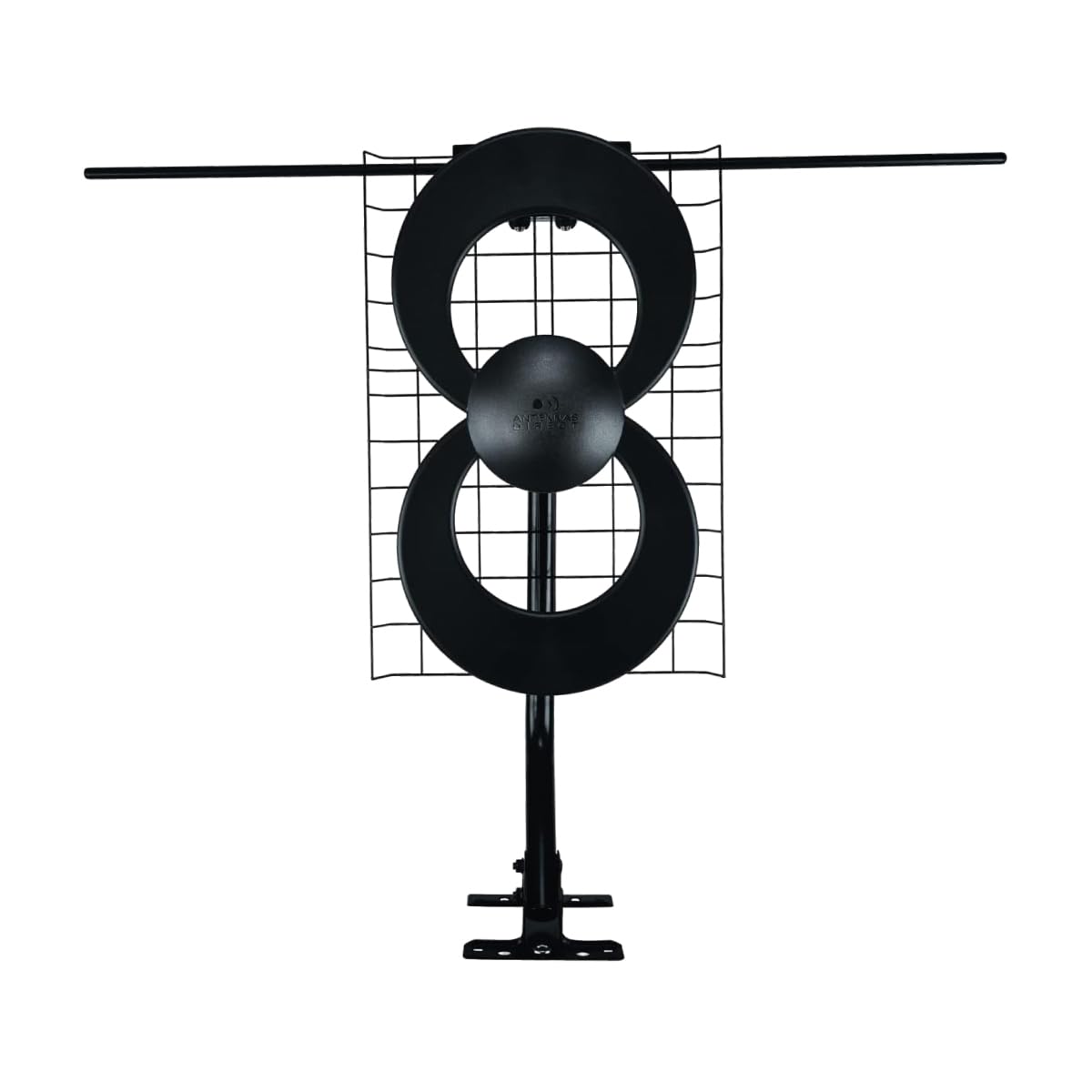
The ClearStream 2V uses a double-loop UHF element paired with a separate VHF dipole and a reflector panel that adds forward gain and blocks rear interference. This design pulls in signals from 60-plus miles without needing a motorized rotator, making it ideal for suburban homes where towers sit in two directions. At 31 inches wide, it is compact enough for an attic but powerful enough for an outdoor mast.
Real-world users regularly report 60-70 channels with crystal-clear HD from 40 miles away, even over hilly terrain with heavy tree cover. The included 20-inch mast and pivoting base simplify aiming on a vertical wall or horizontal joist. Many customers pair it with an inline pre-amp to push reception past 70 miles and capture fringe stations that weaker antennas miss entirely.
The reflector makes a measurable difference in signal stability by reducing pixelation from wind-blown trees or passing trucks. Owners consistently note that picture quality rivals or surpasses their old cable feed, and the lifetime manufacturer warranty removes long-term risk. For most households cutting the cord, this is the antenna to beat.
Why it’s great
- Dual-loop UHF plus dedicated VHF dipole for full-band coverage
- Reflector adds forward gain and cuts rear signal noise
- Versatile mount works indoors, attic, or outdoors
Good to know
- Coaxial cable sold separately
- Dish-shaped design may be too wide for small windows
2. RCA Compact Outdoor Yagi ANT751Z

This Yagi-style antenna from RCA is a proven performer for rural and deep-suburban setups where towers are 50-75 miles away. The pre-assembled folded UHF reflector and snap-lock elements cut installation time dramatically compared to traditional kit antennas. Its 2-pound weight and included mast clamp make it one of the easiest full-size outdoor antennas to mount solo.
Users consistently pull in 28-79 channels from 30 miles away while mounted in an attic, often without needing an additional amplifier. The VHF elements are long enough to grab Low-VHF channels (2-6) that many compact antennas miss entirely. The integrated 75-ohm matching transformer eliminates the need for an external balun.
Some units arrive with a fixed coax pigtail that cannot accept a 90-degree adapter, making tight corner installations slightly awkward. The wooden mounting screws are not included, so budget for stainless steel hardware if mounting outdoors. Despite those minor gripes, owners praise the rock-solid signal strength and clean 1080p picture even during heavy rain.
Why it’s great
- True Yagi elements for superior long-range VHF and UHF capture
- Pre-assembled with snap-lock parts — no tools needed
- Lightweight enough for a single-person attic install
Good to know
- Coaxial cable purchased separately
- Fixed pigtail prevents using right-angle adapters
3. PBD Motorized Outdoor Antenna

When your local towers are scattered in different directions, a fixed antenna forces you to choose which networks you sacrifice. The PBD Motorized antenna solves that with a 360-degree rotator controlled by a wireless remote, letting you swing the array to lock onto a different tower cluster without climbing onto the roof. The 150-mile range claim is optimistic in real conditions, but users 35 miles from Philadelphia report excellent reception on all major networks.
Dual output ports let you feed two TVs simultaneously without adding a signal-splitting amp, which is a rare feature at this level. The included 40-foot RG6 cable and mounting pole mean you have everything needed for a straightforward mast installation. Many owners mention that the customer support team responds quickly and helpfully, a plus when dealing with finicky signal alignment.
A few units arrive with the 40-foot coax missing from the box, and the mounting bolts can snap if over-tightened. The motorized base adds mechanical complexity that a passive Yagi avoids, so longevity depends on weather sealing. Still, for households that want access to every directional broadcast without compromise, the convenience of remote rotation is transformative.
Why it’s great
- 360-degree motor with wireless remote for on-demand aiming
- Dual outputs feed two TVs without an extra splitter
- Comes with 40ft RG6 cable and mounting pole
Good to know
- Mounting bolts can snap if over-tightened
- Motorized rotator adds a potential failure point outdoors
4. Mohu Leaf Amplified

If you rent an apartment or cannot run cabling outside, the Mohu Leaf Amplified is the most refined indoor option on the market. At 0.04 inches thick, the grey panel sticks to a window or wall with included adhesive tabs and disappears into the décor. The Jolt Switch inline amplifier lets you toggle the signal boost on or off instantly, which is crucial because over-amplifying a strong metro signal can overload the tuner.
Customers in brick rowhomes and Manhattan brownstones consistently report 45-60 channels including all major networks, with several mentioning they replaced a cheap flat antenna that gave them fewer than 20 stations. The 12-foot coaxial cable and USB-powered amp make placement flexible — you can route the wire around a door frame or under a rug without drilling. The multi-directional element array picks up signals from front and back, eliminating the need for precise aiming.
The amplifier is useful only when the base signal is weak; in strong-signal zones, the switch should stay off to avoid pixelation. The included push pins are small and bend easily, so keep standard pins handy. For viewers within 35 miles of towers who want a zero-profile installation, this antenna delivers the best balance of aesthetics and performance.
Why it’s great
- Paper-thin panel blends into any interior decor
- Jolt Switch lets you turn amplifier on/off per signal strength
- Multi-directional pickup works without precise aiming
Good to know
- Included push pins are flimsy
- Amplifier can overload in strong metro signal zones
5. Winegard FL5500A FlatWave
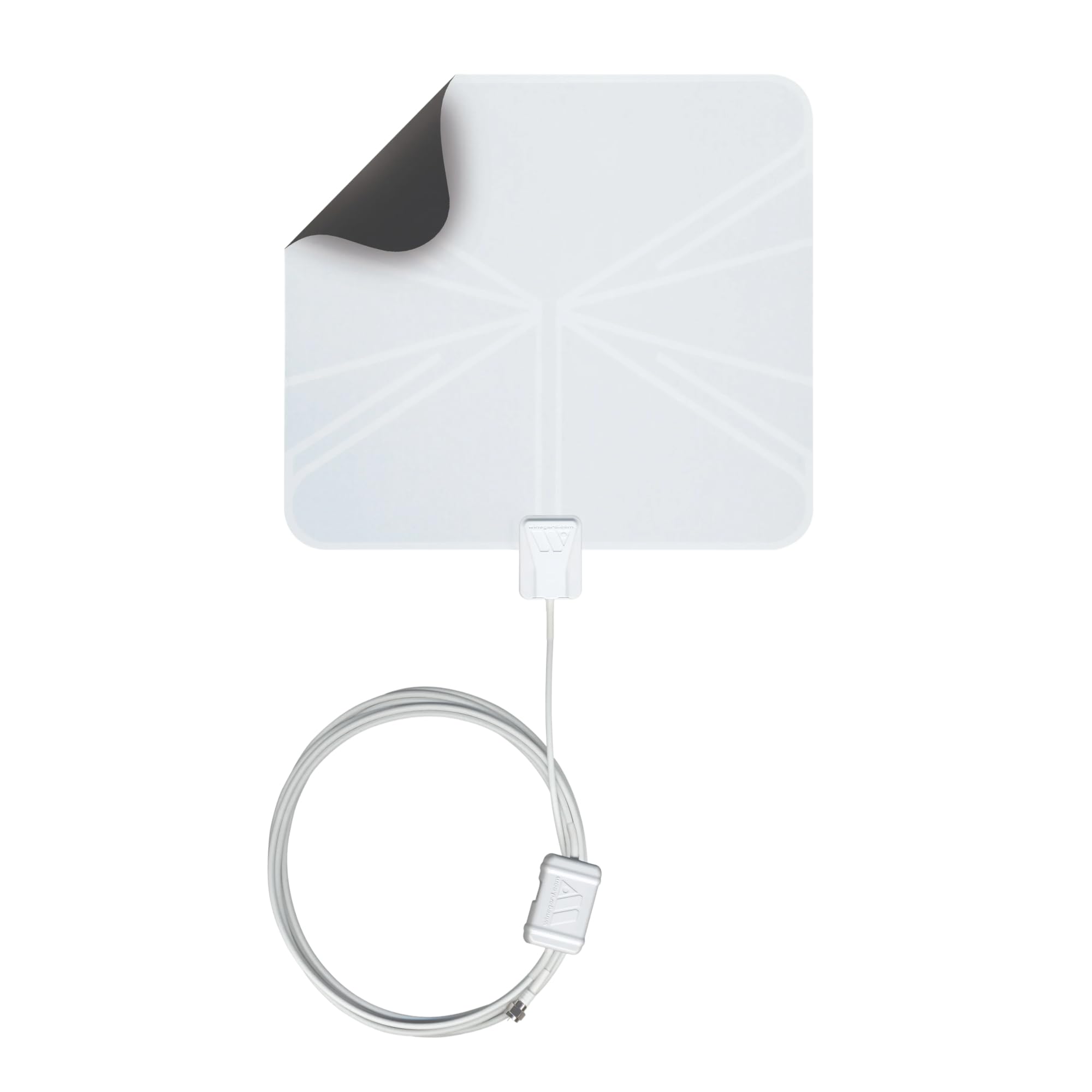
Winegard brings decades of RF engineering expertise to the FlatWave FL5500A, an amplified indoor panel that focuses on signal purity rather than inflated mile claims. The dual-color design (black on one side, white on the other) lets you match the room, and the ultra-thin profile hangs flush against the wall without protruding. The Winegard app helps you find optimal placement by analyzing local tower data.
Users 35-40 miles from Chicago report 40 channels upstairs and 27 downstairs, with most major networks coming in crisp and stable. The amplifier is effective but not overpowering — several owners noted that they could pull in every local network by fine-tuning placement in 1-inch increments. The 18.5-foot coax cable is permanently attached, which simplifies setup but limits your ability to use a right-angle adapter.
Some users in fringe areas found the non-removable cable a dealbreaker because they could not redirect the panel without the coax binding. Others noted that the amplifier struggled with one specific weak station that a competing antenna captured easily. For urban and suburban viewers within 35 miles, however, the FL5500A delivers clean HD with minimal fuss and a trusted brand name.
Why it’s great
- Reversible black/white panel blends with any room
- Winegard app guides optimal placement and aiming
- Clean, consistent reception in suburban environments
Good to know
- Coax cable permanently fixed — no right-angle adapter possible
- May miss a single weak station that other antennas pick up
6. PIBIDI UHD-8903 Outdoor Antenna

The PIBIDI UHD-8903 is a no-frills outdoor antenna that focuses on raw element length rather than fancy electronics. The extended aluminum rods provide better surface area for capturing weak distant signals, and the pre-assembled construction means you only need to snap on a few remaining elements before mounting. Multiple owners in rural South Carolina and upstate New York report jumping from 15-20 channels to 64-86 stations after swapping out their older compact antennas.
The absence of a built-in rotator means you must physically climb up and turn the mast to chase a different tower direction, which is the main compromise at this price tier. Weather resistance is adequate — the housing holds up against rain and wind — but the included mounting hardware is basic. Several users recommend pairing it with a separate pre-amp to reach true deep-fringe stations beyond 60 miles.
Range claims of 200 miles are unrealistic in typical terrain, but real-world performance at 40-100 miles is genuinely impressive for the price. The lack of a built-in amplifier keeps the signal chain simpler and avoids overloading, which is an advantage if you already own a quality pre-amp. For the budget-conscious cord-cutter with moderate DIY skills, this antenna delivers the most channels per dollar.
Why it’s great
- Extra-long elements for superior weak-signal capture
- Easy pre-assembled setup with minimal tools required
- Passive design avoids amplifier overload issues
Good to know
- No built-in rotator — manual adjustment needed
- Mounting hardware is basic; invest in quality mast clamps
7. 1byone Outdoor Omni-Directional Antenna

For viewers who want a one-and-done install without ever touching a compass, the 1byone Omni antenna receives signals from all 360 degrees simultaneously. The white dome housing is weatherproof and flame-retardant, and the integrated Smart Pass amplifier with 4G LTE filter blocks cell tower interference that causes channel dropouts. The 39-foot RG6 cable gives you plenty of slack to reach a second-story attic or a distant TV inlet.
Users in Manhattan and suburban New Jersey report 60-124 channels after placing the unit in a window or on a low roof, with most major networks coming through clearly. The omni design works best when towers surround your location; if all your broadcasters are in one direction, a directional Yagi will outperform this antenna by a significant margin. The amplifier is helpfully adjustable, but some owners found that weather conditions caused occasional signal drops that a rotator-based setup would avoid.
The enclosed pre-amp improves weak-signal reception but also introduces a potential corrosion point if the housing seal fails over time — several 2-year reviews mention water ingress in rainy climates. The unit supports only one TV output, so households wanting multi-room distribution will need an external splitter. For renters or RV owners who cannot install a large directional array, the 1byone offers a practical, low-effort path to free TV.
Why it’s great
- 360-degree omni reception — no aiming required
- Smart Pass amp with 4G LTE filter cleans up signal
- Includes a full 39ft RG6 coaxial cable for flexible placement
Good to know
- Single TV output only; add a splitter for multiple rooms
- Pre-amp housing susceptible to water ingress over years outdoors
FAQ
Does a higher mile range on the box mean better reception?
Can I mount an outdoor antenna in my attic instead?
Why do I lose signal during bad weather?
Final Thoughts: The Verdict
For most users, the best antenna for free tv winner is the Antennas Direct ClearStream 2V because its dual-loop UHF, dedicated VHF dipole, and included reflector deliver reliable multi-directional reception without needing a rotator. If you want a motorized solution that lets you chase towers across different directions from your couch, grab the PBD Motorized Antenna. And for indoor-only setups where aesthetics matter most, nothing beats the Mohu Leaf Amplified.

Mo Maruf
I created WellFizz to bridge the gap between vague wellness advice and actionable solutions. My mission is simple: to decode the research and give you practical tools you can actually use.
Beyond the data, I am a passionate traveler. I believe that stepping away from the screen to explore new environments is essential for mental clarity and physical vitality.