Our readers keep the lights on and my smoothie glass nicely filled. As an Amazon Associate, I earn from qualifying purchases.
If your over-the-air TV reception drops out whenever a truck rolls by, or a channel you used to watch is now a blocky mess, a weak antenna signal is the likely suspect. An antenna amplifier boosts that incoming signal, cleaning up the picture and often revealing channels your TV tuner couldn’t find on its own.
I’m Mohammad Maruf — the founder and writer behind WellFizz. I specialize in analyzing consumer electronics hardware specifications and market research, focusing on the RF engineering and signal processing that separate a well-designed amplifier from a noise generator.
After sorting through dozens of models and analyzing real-user reception reports, this guide breaks down the concrete specs and real-world performance differences you need to buy with confidence. This is your evidence-based roadmap to finding the best antenna amplifier for your home setup.
How To Choose The Best Antenna Amplifier
Not every amplifier improves every setup. In fact, adding one to a system that already has strong signal levels can overload the TV tuner and cause reception to collapse — a problem called over-amplification. The key is matching the amp type and gain to your specific cable length, number of TVs, and signal strength at your antenna.
Preamplifier vs Distribution Amplifier
A preamplifier mounts at the mast right where the antenna connects. It amplifies the fragile signal before it travels down the coax cable, overcoming inherent cable loss. A distribution amplifier, on the other hand, sits at your TV junction point and splits the already-amplified signal to multiple rooms. If you have a single TV with a short coax run, you likely need neither. If you run 50+ feet of cable or feed four TVs, you need one — but the right type.
Gain and Noise Figure: The Two Numbers That Matter
Gain, measured in dB, tells you how much the amplifier increases signal power. Too little gain and weak channels stay weak. Too much gain and strong channels swamp the tuner, forcing it to compress the signal and discard weak channels entirely. The noise figure (NF) is equally critical — a low NF (3 dB or less) means the amplifier adds very little of its own noise to the signal. A high NF can clean up the picture but actually destroy signal-to-noise ratio, making things worse. For distribution amps, 7 to 11 dB of gain per port is typical. For preamps, 16 to 31 dB is common depending on cable run length.
Filtering for Modern Interference
Cell towers (4G LTE and 5G) broadcast on frequencies close to UHF TV channels. Without a proper filter, an amplifier can overload on strong cellular signals and create constant pixelation and signal dropouts. Look for units with built-in LTE and FM band-reject filters — this is especially critical if you live within a mile of a cell tower. A preamplifier with sharp band-pass filtering (separate filters for Low VHF, High VHF, and UHF) is the gold standard for rejecting out-of-band interference.
Quick Comparison
On smaller screens, swipe sideways to see the full table.
| Model | Category | Best For | Key Spec | Amazon |
|---|---|---|---|---|
| Televes TForce Mast Preamp | Premium Mast Preamp | Maximum channels & interference rejection | 31 dB UHF gain, auto gain control | Amazon |
| Antennas Direct Juice+ Preamp | All-Weather Preamp | Rugged outdoor performance | Weatherproof housing, LTE filter | Amazon |
| Antennas Direct JUICE4 Dist. Amp | 4-Port Distribution | Feeding four TVs with clean signal | 1.2 GHz bandwidth, 4 outputs | Amazon |
| Channel Master CM-7778 Titan 2 Preamp | Mid-Gain Mast Preamp | Medium cable runs, clean 16 dB boost | 16 dB flat gain, FM trap | Amazon |
| Antronix MRA4-8 (Reliable Cable) | 4-Port Distribution | Cable & antenna multi-room setups | +7.5 dB per port, passive return | Amazon |
| Channel Master CM-3422 Booster 2 | 2-Port Distribution | Simple two-room OTA distribution | 11.5 dB gain, passive backup | Amazon |
| Reliable Cable 4-Port (Antronix) | Entry Distribution | Basic split/boost for budget builds | +7.5 dB gain per port, surge protected | Amazon |
In‑Depth Reviews
1. Televes 560383 TForce Mast Preamplifier
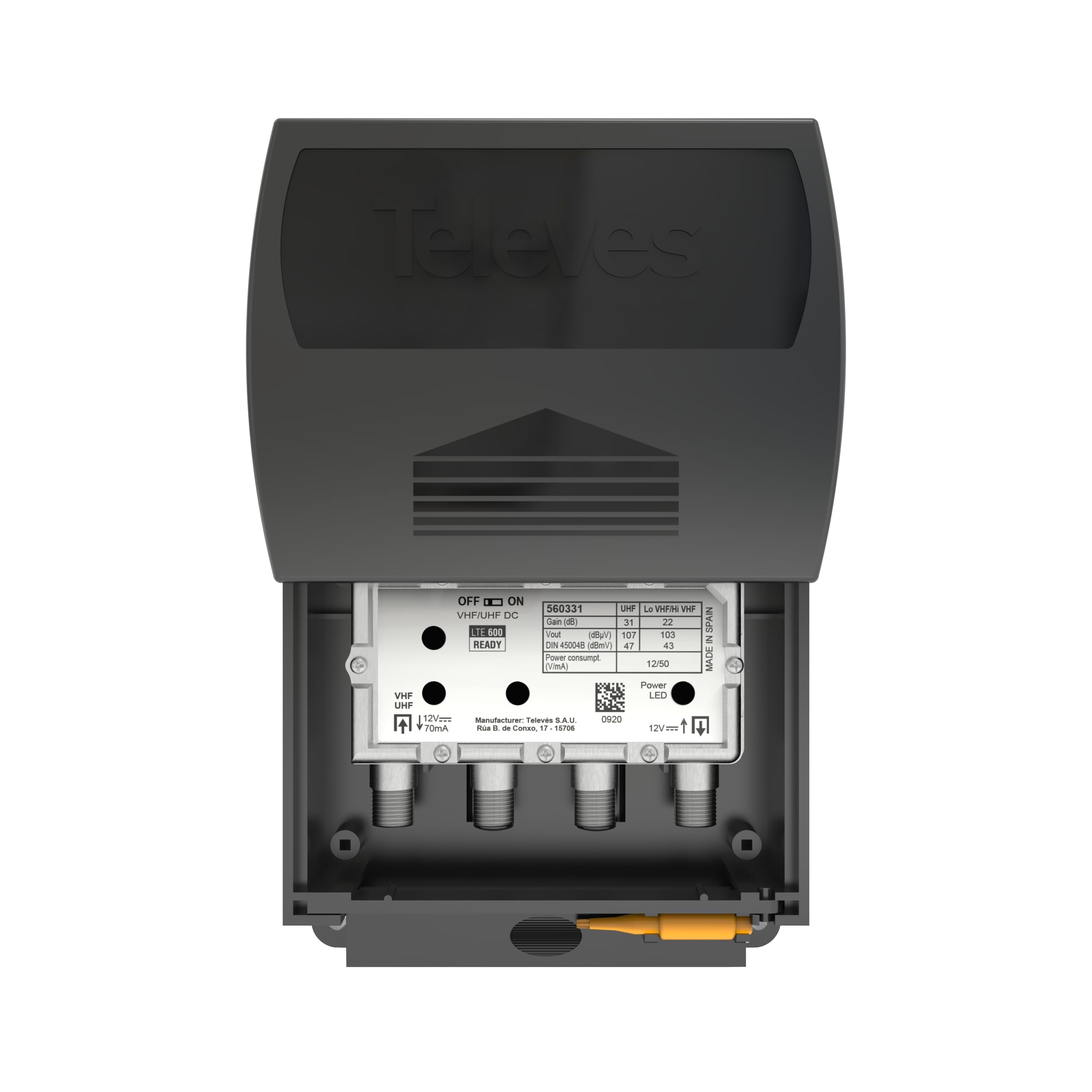
The Televes TForce is the most technically sophisticated amplifier in this lineup. Its proprietary auto gain control continuously monitors VHF and UHF bands independently, self-adjusting to prevent strong signals from burying weak ones. Real users report jumping from 93 to 118 channels after installation, with previously unwatchable stations like channel 2 and 3 coming in rock solid.
What sets this unit apart is its three separate band-pass filters — Low VHF, High VHF, and UHF — that block all non-OTA interference, including military, FM, and cellular signals. With 31 dB of UHF gain and 22 dB on VHF, it handles long cable runs and challenging terrain without adding noise. The cast metal and ABS housing rated IP23 is built for outdoor mounting, and the unit is fully compatible with ATSC 3.0 NextGen TV.
Installation is straightforward for a mast-mounted unit, though you will need to supply two separate coaxial cables for the input run. The instruction manual is compact, so you may want to check online guides beforehand. A few users reported units failing after several months, so the 90-day warranty is more limited than ideal given the premium price.
Why it’s great
- Automatic gain control prevents over-amplification
- Three independent band-pass filters reject all interference
- Very high gain (31 dB UHF) handles long cable runs
- Supreme build quality with IP23 weather rating
Good to know
- Requires two separate coax cables (not included)
- Limited 90-day warranty for a premium unit
- Manual is small and hard to read
2. Antennas Direct ClearStream Juice Plus Preamplifier
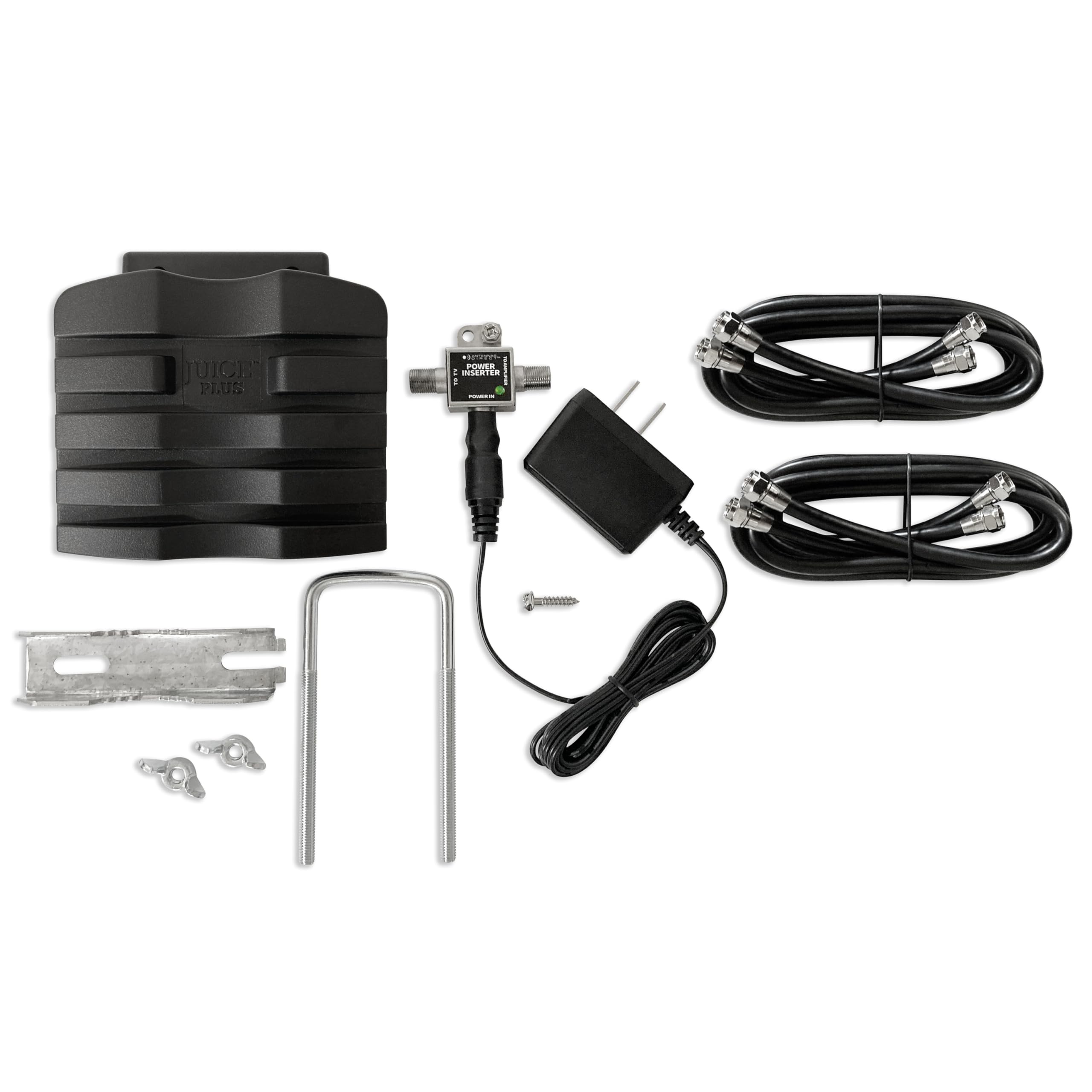
Antennas Direct redesigned the Juice Plus to live outdoors. The weatherproof housing tilts open for easy coax connection, then seals securely against snow and rain. Real-world feedback from users 50+ miles from broadcast towers confirms rock-solid reception in all weather — snow, rain, and high winds — with an external antenna mounted at 15 feet.
The unit filters out 5G and LTE interference before the signal hits the amplification circuit, preventing cell tower overload that ruins picture quality. Users 35 miles from towers report channel counts jumping from 35 to over 80 after a 15-minute setup. The included low-loss power inserter and two 3-foot coax cables simplify installation. It supports UHF, VHF, and FM bands, and is ATSC 3.0 and 4K/8K ready.
The 90-day parts warranty is short, and one user noted a professional installer could not get the unit to power on. That said, the overwhelming feedback from hundreds of users points to reliable long-term performance, with one user reporting 10+ years of use on a previous model. If you need a preamp exposed to the elements, this is a top contender.
Why it’s great
- Fully weatherproof housing seals out moisture and ice
- True pre-LTE/5G filtering prevents overload
- Simple 15-minute installation with included cables
- Supports FM, VHF, UHF, and ATSC 3.0
Good to know
- 90-day warranty is below average
- Power inserter must be kept indoors
- Remote reports of units DOA in rare cases
3. Antennas Direct ClearStream JUICE4 Distribution Amplifier
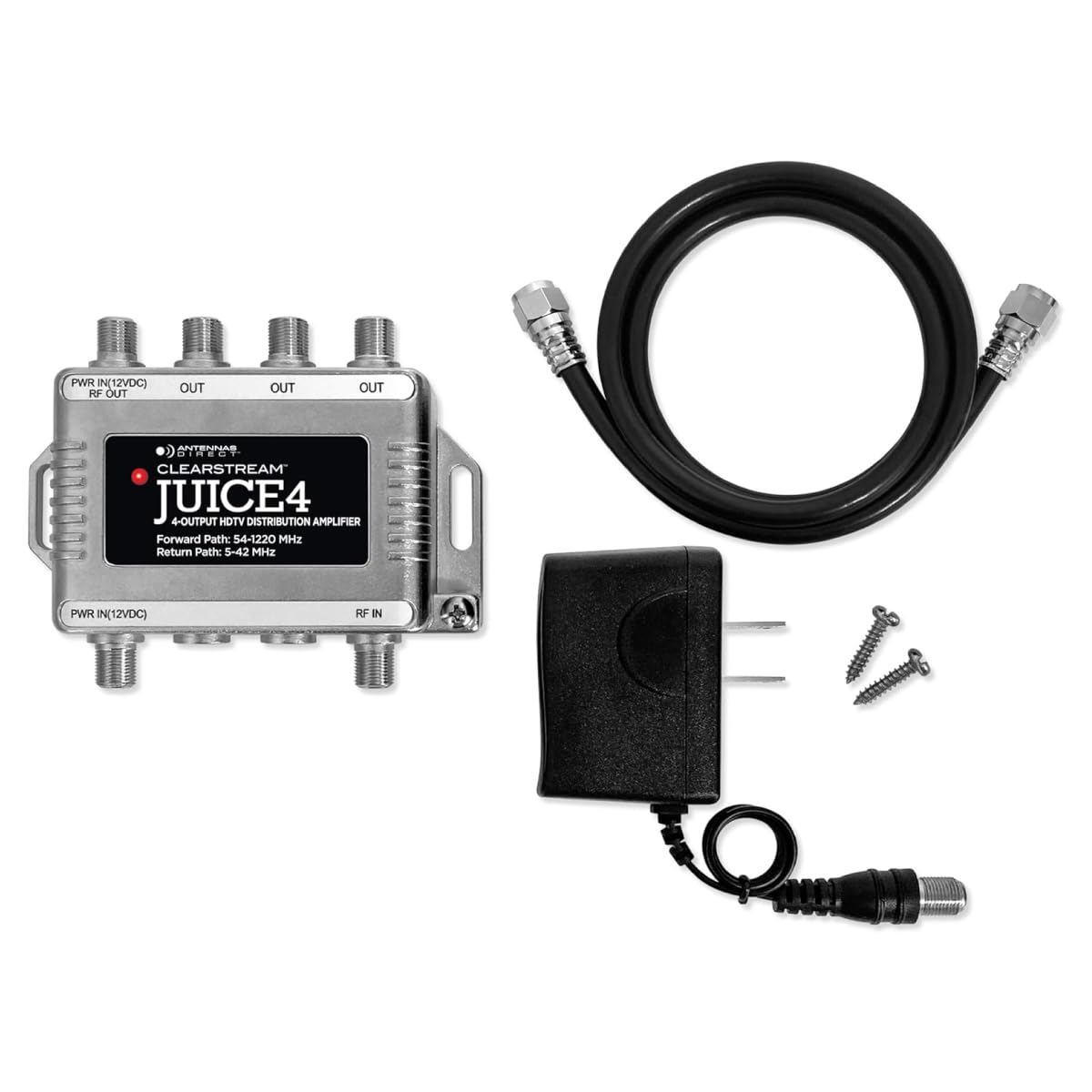
If your home has three or four TVs sharing a single antenna, the JUICE4 is the distribution amplifier to beat. It takes your antenna signal, boosts it, and splits it across four outputs without the signal loss you get from a passive splitter. The operating frequency extends to 1.2 GHz, making it suitable for CATV and cable broadband systems in addition to OTA antenna feeds.
Build quality is excellent — the machine-sealed zinc diecast housing provides electromagnetic shielding and surge protection on all ports. Real-world reviews show it pushes strong signals through 50+ feet of coax without degradation. Users report hitting 51 to 61 channels reliably across all four TVs. The compact form factor (3.8 x 1 x 3.5 inches) fits neatly behind an entertainment center or in a structured wiring panel.
It can be used outdoors with termination caps and weather boots, but standard installation is indoor. One unit stopped working after five days for a single user, and the manufacturer warranty policy routes returns through the seller rather than direct support. For multi-room OTA setups, however, this amplifier delivers clean, consistent results.
Why it’s great
- Cleanly splits antenna signal to four TVs
- Zinc diecast housing offers superior shielding
- 1.2 GHz bandwidth accommodates modern CATV
- Surge protected on all ports
Good to know
- Indoor design; outdoor install requires extra sealing
- Warranty handled through seller, not direct
- Rare reports of early failure
4. Channel Master Titan 2 Medium-Gain Preamplifier (CM-7778)

Channel Master’s CM-7778 is the right preamp for users who need a moderate, clean boost without the risk of over-driving their TV tuner. The 16 dB flat gain is intentionally lower than high-gain competitors — and that’s a feature, not a flaw. It prevents the strong-signal compression that can actually lose channels. One reviewer 65 miles from Atlanta reported that this lower gain allowed them to overcome feedline loss without losing Atlanta stations to overload.
The unit offers separate VHF and UHF amplification with a combined input, plus a switchable FM trap to cut interference from local radio stations. Mast-mounted with an indoor power supply, it handles temperatures from -40°C to 60°C. Real-world users confirm it solved weak CBS and FOX reception 25 miles from New York City with heavy tree interference, and it picks up signals reliably from 20 to 65 miles.
Installation is simple, though the instructions are in tiny print. Some users point out the slide switches feel less durable than the metal case suggests, and one user found it added noise on weak FM stations. For pure OTA TV use with moderate cable runs (under 100 feet), this is an elegant, purpose-built choice.
Why it’s great
- Flat 16 dB gain prevents over-amplification
- Switchable FM trap removes radio interference
- Proven 65-mile reception in rural terrain
- Wide temperature range for outdoor mounting
Good to know
- Slide switches feel less premium than housing
- No separate low/high VHF filtering
- Not ideal for very long coax runs (100+ ft)
5. Antronix MRA4-8 (Reliable Cable 4-Port Distribution Amplifier)

This four-port distribution amplifier from Antronix (sold under the Reliable Cable brand) is a workhorse for cable and OTA installations. It delivers +7.5 dB of gain per port, which is enough to offset the loss from splitting the signal to four TVs. The passive return path is a smart addition, allowing cable modem upstream data to pass through without amplification.
Build quality stands out — the nickel-plated housing resists salt fog corrosion, and every port is protected with 6 kV combination wave surge protection. The 3 dB noise figure keeps the signal clean, and the PTC self-resetting circuit breaker protects against short circuits without needing a fuse swap. Users consistently report solid 5-star results, with many stating it works better than the units their cable company installs.
This amplifier is not compatible with systems that already have a preamplifier or distribution amp in the signal path. It must be the first powered component. Additionally, it does not work well for cable TV in some installations — one user noted fuzzy results on cable while OTA signal splitting worked perfectly. If you are using it purely for OTA distribution, it is a reliable, well-protected choice.
Why it’s great
- Robust surge protection on all six ports
- Nickel-plated housing resists rust and salt fog
- Low 3 dB noise figure for clean amplification
- PTC self-resetting short circuit protection
Good to know
- Not compatible on systems with a preamplifier
- Can produce fuzzy results on cable TV feeds
- Requires RG6 quad shield cable for best results
6. Channel Master CM-3422 Booster 2 Distribution Amplifier
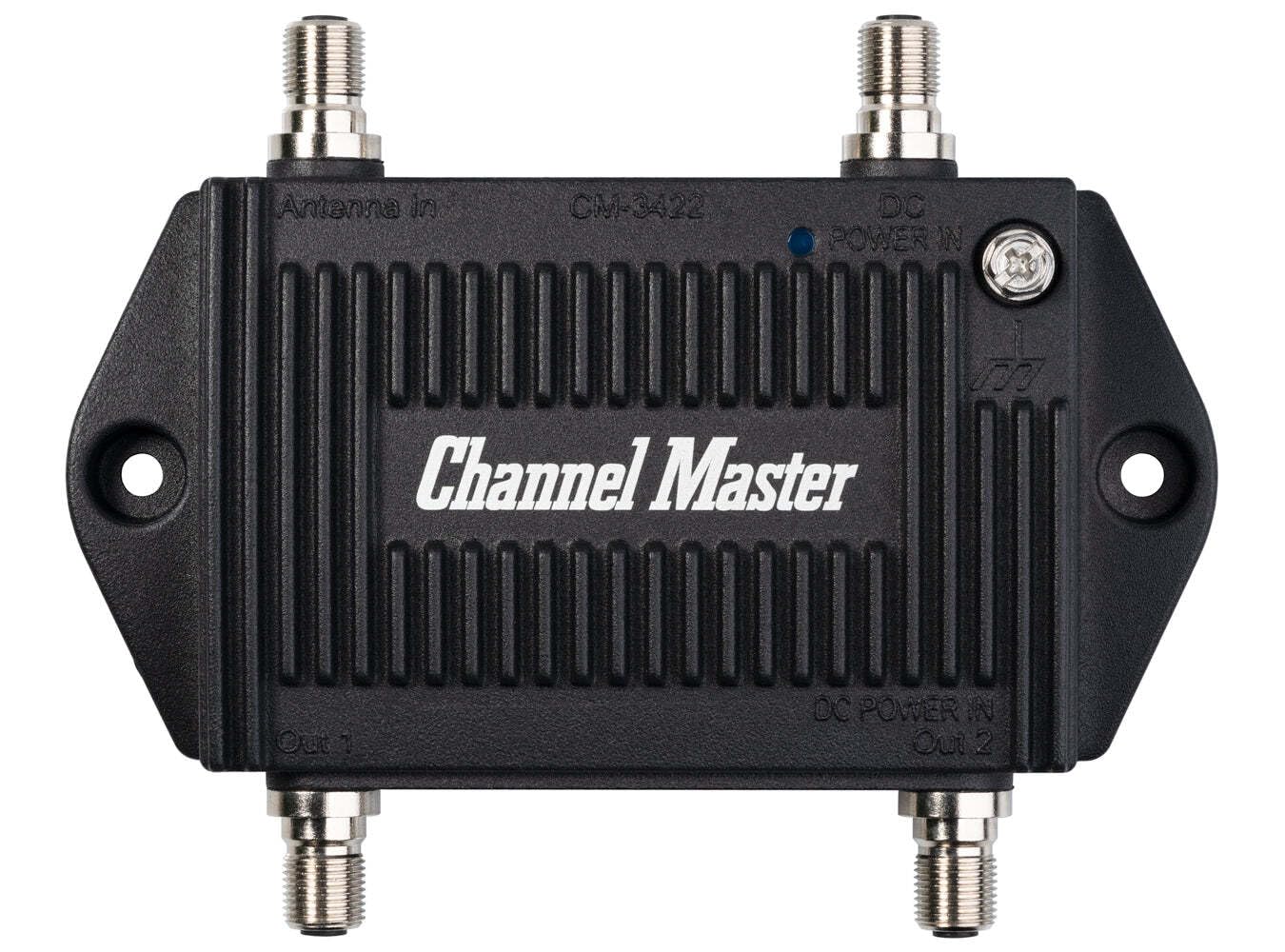
The Channel Master CM-3422 is a two-port distribution amplifier designed specifically for OTA antenna installations, not cable or satellite. It replaces a standard two-way splitter while boosting the signal by 11.5 dB. Real-world user reports are striking: one rural viewer in Northeast Ohio went from 3 channels with no amp to 72 channels after adding this unit to their attic antenna feeding a Tablo DVR.
The standout feature here is passive signal backup — if the power supply fails or power is lost, the unit passes the antenna signal through without amplification, so you do not lose all reception. The housing is heavy-duty metal, powder-coated and weather-sealed, making it suitable for attic or indoor use where moisture is a concern. The low gain (11.5 dB) is by design, reducing the risk of overloading the TV tuner.
It only supports two outputs, so you cannot expand to three or four TVs without an additional splitter. A few users noted the gain improvement was smaller than expected, though the stability and lack of interference were consistent wins. If you just need to feed two TVs or a TV and DVR, this is a clean, reliable solution.
Why it’s great
- Passive backup passes signal without power
- Weather-sealed metal housing for attic use
- Low 11.5 dB gain prevents overdriving tuner
- Proven to unlock 70+ channels from 3
Good to know
- Only two outputs — no expansion without splitter
- Not compatible with cable or satellite TV
- Gain may be lower than expected for some setups
7. Reliable Cable 4-Port Amplifier (Antronix MRA4-8)

The earlier version of the Antronix MRA4-8 is functionally very similar to the later Reliable Cable model, delivering +7.5 dB of gain per port across four outputs. It is designed to reduce pixelation and snow on digital cable and OTA antenna signals alike. The passive return path allows cable modem signals to flow back upstream, which is a useful feature for hybrid cable+internet households.
Surge protection is a highlight here: 6 kV combination wave protection on all ports, plus a PTC self-resetting circuit breaker in the UL-listed power supply. The 3 dB noise figure is solid, keeping the amplifier from introducing noise that degrades picture quality. Real-world feedback shows it works well for users with multiple TVs and moderate cable runs — one user 35 miles from towers reported stable signals to 5 TVs after installing this unit.
It is not compatible with systems that already have a preamplifier or another amplifier in the chain. Some users found it did not work well for cable TV, with fuzzy results, while OTA splitting worked perfectly. The included 36-inch coaxial cable and 75-ohm terminators make setup easy. For entry-level budgets needing a solid four-port split and boost, this is a capable starting point.
Why it’s great
- Affordable four-port distribution with solid gain
- 6 kV surge protection on every port
- Passive return preserves cable modem path
- Includes cables and 75-ohm terminators
Good to know
- Not compatible with pre-existing amplifiers
- May produce fuzzy results on cable TV
- Best results require RG6 quad shield coax
FAQ
Can too much amplifier gain cause poor reception?
Will an antenna amplifier work with cable TV or satellite?
What is the difference between a preamplifier and a distribution amplifier?
How do I know if I need an LTE or 5G filter?
Final Thoughts: The Verdict
For most users, the best antenna amplifier winner is the Televes TForce Mast Preamplifier because its automatic gain control and triple band-pass filters deliver the cleanest, most reliable signal in the widest range of conditions. If you need a weatherproof unit that can sit exposed on a roof, grab the Antennas Direct ClearStream Juice Plus. And for feeding four TVs from a single antenna without complications, nothing beats the Antennas Direct JUICE4 Distribution Amplifier.

Mo Maruf
I created WellFizz to bridge the gap between vague wellness advice and actionable solutions. My mission is simple: to decode the research and give you practical tools you can actually use.
Beyond the data, I am a passionate traveler. I believe that stepping away from the screen to explore new environments is essential for mental clarity and physical vitality.