Our readers keep the lights on and my smoothie glass nicely filled. As an Amazon Associate, I earn from qualifying purchases.
You spot a fresh dirt mound in the lawn — within hours, it’s crawling with aggressive ants ready to defend their territory. Standard sprays only kill what you see on the surface, while the queen deep underground just rebuilds the colony a few feet away. An effective ant mound killer needs to either bait the workers into carrying poison back to the nest or deliver a fast-acting drench that penetrates the entire colony structure.
I’m Mohammad Maruf — the founder and writer behind WellFizz. I’ve spent years analyzing pesticide formulations, active ingredient profiles, and application methods to separate products that actually eliminate entire colonies from those that only provide cosmetic relief.
After reviewing the top-rated granular baits and liquid concentrates on the market, these five formulations stand out for their ability to target the queen, larvae, and worker ants in a single treatment. This is the definitive guide to choosing a reliable best ant mound killer that stops colonies from bouncing back.
How To Choose The Best Ant Mound Killer
Not all mound treatments work the same way. Some rely on bait-and-delay strategies where workers carry poisoned granules to the nest over 24–72 hours. Others use contact-kill drenches that eliminate the colony within minutes of application. Understanding your ant species, the size of the infestation, and your tolerance for odor will narrow your choice quickly.
Bait Granules vs. Liquid Drenches
Bait granules (like the Spectracide and Terro products) rely on worker ants carrying the poison back to the nest. This method works best during active foraging hours — early morning or late evening. The poison must act slowly enough that workers survive the trip home. Liquid drenches (like the Hi-Yield formulation) flood the mound directly, killing on contact and penetrating deep into the tunnel system. Choose baits for large lawns with scattered mounds and drenches for visible, active mounds you can target individually.
Active Ingredient Performance
Acephate and Bifenthrin provide fast contact kill with residual protection lasting weeks on soil and concrete. Pyrethrins are botanical compounds that break down faster in sunlight and moisture but work well near vegetable gardens or livestock areas where synthetic chemicals raise concerns. Spinosad, found in some premium baits, targets the nervous system of ants specifically while posing lower risks to mammals and birds.
Odor and Application Comfort
Several high-performance ant mound killers produce a strong rotten egg or sulfur-like smell during and after application. This odor is a byproduct of the chemical reaction that makes the active ingredient so effective. If you are treating mounds near patios, play areas, or frequently used lawn spaces, choose a product labeled “odorless” (like the Neudorff option) even if that means slightly slower knockdown.
Quick Comparison
On smaller screens, swipe sideways to see the full table.
| Model | Category | Best For | Key Spec | Amazon |
|---|---|---|---|---|
| Hi-Yield Acephate | Liquid Concentrate | Deep colony elimination | 0.04% Bifenthrin | Amazon |
| Terro T901-2 | Granules | Perimeter + mound treatment | 2-Pack / 3 lb each | Amazon |
| Surrender Fire Ant | Spray/Granules | Fire ant specific | Rotten egg odor | Amazon |
| Spectracide One Shot | Granular Bait | Fire ant colony elimination | 3-month control | Amazon |
| Neudorff Ant Mound | Pellets | Pet/livestock friendly | Pyrethrins botanical | Amazon |
In‑Depth Reviews
1. Hi-Yield (33033) Fire Ant Control with Acephate
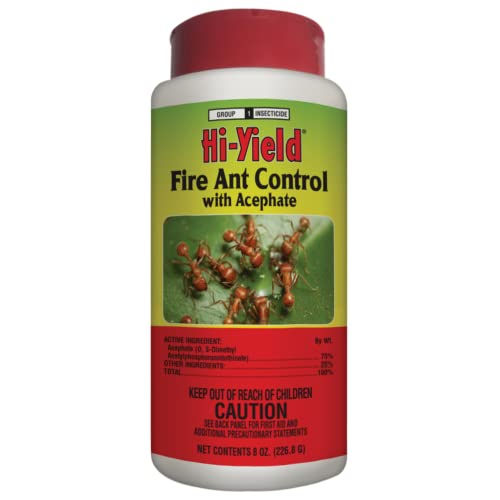
Hi-Yield’s Acephate-based concentrate is the closest thing to a surgical strike against fire ant mounds. Mixed at a ratio of 2 tablespoons per gallon of water, this liquid drench penetrates deep into the tunnel system — far beyond what dry granules can reach. The active ingredient Bifenthrin leaves a residual barrier lasting 8–10 weeks on concrete and 4–6 weeks under cabinets, which explains why reviewers report zero roach or ant activity for months after a single perimeter treatment.
The rotten egg smell is unmistakable and strong — multiple reviewers compare it to sulfur or spoiled food. That odor is actually the chemical marker that tells you the active compound is fresh and potent. When applied as a mound drench, fire ant colonies are eliminated within 48 hours. Users treating German roaches along baseboards found the same mix killed them overnight with no rebound after two weeks, even after rain exposure.
One caveat: the formula appears to have undergone a manufacturing change recently, with some batches producing an unusual cheese-and-broccoli odor and reduced efficacy. Buy from high-turnover sellers to ensure fresh stock. The product is labeled for fire ants specifically but functions as a broad-spectrum insecticide — keep away from livestock grazing areas and avoid over-application on edible garden soil.
Why it’s great
- Deep colony penetration via liquid drench — reaches queens at tunnel depth
- Residual protection lasts 8–10 weeks on hard surfaces
- Proven effective against roaches, ants, and spiders with one mix
Good to know
- Strong sulfur/rotten egg smell during and after application
- Batch consistency issues reported — check manufacturing date before purchase
- Not safe for use near livestock grazing areas
2. Terro T901-2 Ant Killer Plus Insect Control

Terro delivers six pounds of granular bait across two resealable shaker bags — enough to treat both scattered mounds and establish a perimeter barrier around an average suburban home. The granules kill ants, fire ants, cockroaches, fleas, and other crawling insects within 24 hours of ingestion. Users in Maryland and Delaware reported zero ant activity for a full season after a single spring application around the foundation and spot treatment on visible mounds.
The key advantage here is the shaker bag design — no spreader, no measuring cups, no mixing with water. You simply sprinkle the granules around the base of each mound (not on top, which ants treat as an attack) or broadcast along the home’s foundation. The resealable closure keeps the remaining product dry between uses, though one reviewer noted that an older batch appeared less effective the following year. Check the printed date on the bag before buying from clearance inventories.
Because these are bait granules rather than contact drenches, the poison must be carried back to the nest by foraging workers. This works best when ants are actively searching for food — early morning or late evening during warm weather. In cooler spring temperatures or after heavy rain, foraging slows down and results may feel delayed. Pair with a liquid drench for active mounds and use the granules for preventive perimeter coverage.
Why it’s great
- Two large 3-pound bags provide extensive coverage for large yards
- Shaker bag eliminates need for spreader or measuring tools
- Broad-spectrum control: ants, roaches, fleas, and fire ants
Good to know
- Granules may lose potency if bag is stored past labeled date
- Slow action in cool weather when ants are less active foragers
- Some users experienced reduced efficacy in second year of use
3. Spectracide One Shot Fire Ant Killer

Spectracide One Shot is the most straightforward option on this list: open the canister, shake four tablespoons around each fire ant mound, and walk away. No mixing, no watering, no special equipment. The granular bait formulation kills worker ants slowly so they survive long enough to carry the poison back to the colony, where it eliminates the queen within 48 hours and prevents new mounds from forming for up to three months.
The large granule size is a deliberate design choice — it prevents the product from being blown away by wind or inhaled as dust during application. Users consistently report seeing results within one to two days, with the mound collapsing as the colony dies off. The product targets fire ants specifically, though several reviewers confirmed it works on other common ant species as well. The lack of noticeable chemical smell makes it comfortable to use near patios or play areas.
The limitation is that this treatment is mound-specific — it does not work as a broadcast perimeter defense. If your lawn has new mounds appearing every few days, you will need to reapply individually each time you spot fresh activity. Also, because it relies on bait carry-back, it is critical to apply during active foraging hours. Sprinkle the granules around the mound openings, not on top of the mound itself, or ants will treat it as an attack and refuse to take the bait.
Why it’s great
- Zero mixing or watering — truly one-step application
- Large granules resist wind drift and dust inhalation
- Single application provides 3 months of mound suppression
Good to know
- Mound-only treatment — not suitable for perimeter broadcasting
- Requires precise timing during foraging hours for best results
- Does not work on all ant species — best for fire ants
4. Neudorff Ant Mound Treatment
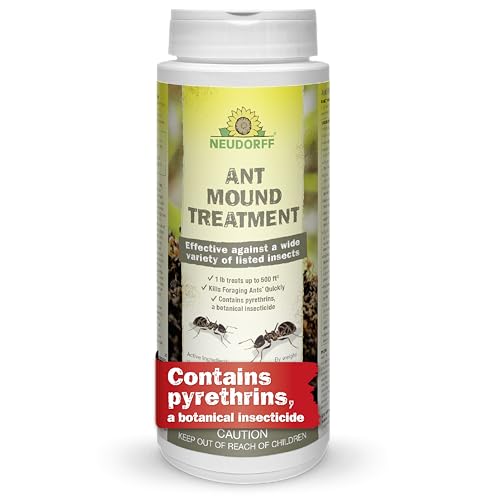
Neudorff takes a fundamentally different approach: instead of synthetic neurotoxins, it uses Pyrethrins — botanical compounds extracted from chrysanthemum flowers. This makes it one of the few ant mound treatments labeled safe for use around residential livestock, chicken coops, rabbit hutches, and animal dwellings. The pellets can be applied either as a dry broadcast scatter around nests and ant runs, or dissolved in water (2.5 oz per gallon) and poured directly onto mounds as a contact drench.
Users report visible results within 24–48 hours against pavement ants, odorous house ants, little black ants, and field ants. The “odorless and non-staining” claim holds up — no sulfur smell, no lingering chemical residue on grass or concrete. One reviewer with a severe pyramid ant infestation saw the colony wiped out within a week, though some ants attempted to enter the house as they died, possibly due to altered foraging behavior. This is common with slow-acting botanical formulas and can be managed by treating the home perimeter simultaneously.
The trade-off is that Pyrethrins break down quickly in sunlight and moisture — typically within a few days rather than weeks. This makes Neudorff unsuitable for long-term residual protection. It works best as a spot treatment for active mounds you can identify and drench directly. It also does not target carpenter ants, harvester ants, fire ants, or pharaoh ants, so confirm your pest species before purchasing. For homeowners with pets, kids, or edible gardens who need a one-time mound solution, this is the safest option available.
Why it’s great
- Botanical Pyrethrins formula safe around livestock and animal dwellings
- Completely odorless — no sulfur or chemical smell
- Works as both dry broadcast and liquid drench application
Good to know
- Not effective against fire ants, carpenter ants, or harvester ants
- Short environmental persistence — no long-term residual protection
- Dying ants may alter foraging behavior and enter structures
5. Surrender Fire Ant 1lb
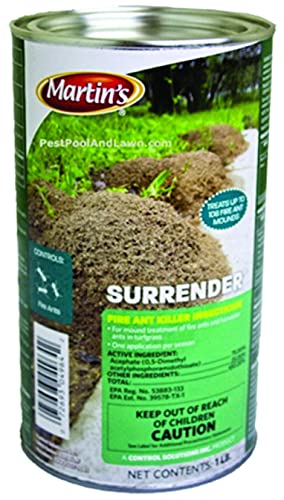
Surrender Fire Ant Killer has a cult following among Florida and Gulf Coast homeowners who deal with aggressive fire ant populations year-round. The formulation produces a distinctive rotten egg smell during application — multiple reviewers describe it as “stinky but worth it” and note that the odor dissipates after the granules settle. One user who has been buying the product for years confirms that once the sulfur smell fades, spiders and other insects also disappear from treated areas. The key is to sprinkle only a small amount per mound; over-application intensifies the smell without improving results.
Performance against Florida-grown fire ants is exceptional. A single application typically suffices for the season, with the colony dying within 48 hours and no new mounds forming in the treated radius for months. The product works by releasing a gas that penetrates the mound’s tunnel system, reaching the queen and brood chamber even without drenching. Users report that it kills fire ants “in their tracks” — visible activity stops within hours of application.
The main drawback is the smell, which can linger on clothing and shoes if applied on a windy day. The product also requires careful storage in sealed bags to prevent the odor from spreading indoors. It is marketed specifically for fire ants and may not work as well on other ant species or crawling insects. For homeowners whose primary pest is fire ants and who can tolerate a temporary strong odor, this is arguably the fastest knockdown option on the market.
Why it’s great
- Fast knockdown — visible results within hours of application
- Single application often sufficient for entire fire ant season
- Gas-penetration formula reaches deep tunnel systems
Good to know
- Strong rotten egg smell during and after application
- Requires airtight storage to prevent odor spreading indoors
- Optimized for fire ants — less effective on other ant species
FAQ
How soon will I see results after applying an ant mound killer?
Why do some ant mound killers smell like rotten eggs?
Can I use ant mound killer near my vegetable garden or chicken coop?
Final Thoughts: The Verdict
For most users, the best ant mound killer winner is the Hi-Yield Acephate Concentrate because its liquid drench penetrates deep tunnel systems and provides 8–10 weeks of residual protection. If you want a no-mix, no-smell solution for scattered mounds, grab the Spectracide One Shot. And for eco-conscious homeowners with pets or livestock who need a safe botanical option, nothing beats the Neudorff Ant Mound Treatment.

Mo Maruf
I created WellFizz to bridge the gap between vague wellness advice and actionable solutions. My mission is simple: to decode the research and give you practical tools you can actually use.
Beyond the data, I am a passionate traveler. I believe that stepping away from the screen to explore new environments is essential for mental clarity and physical vitality.