Our readers keep the lights on and my smoothie glass nicely filled. As an Amazon Associate, I earn from qualifying purchases.
Ants march in single file across your countertop, and you grab the nearest spray. That kills a dozen workers, but by tomorrow the trail is back—because the colony is still thriving underground, in your walls, or under the slab. The difference between a temporary fix and a real solution comes down to one thing: whether the active ingredient reaches the queen before she lays more eggs.
I’m Mohammad Maruf — the founder and writer behind WellFizz. I’ve spent years analyzing pest control formulations, studying how bait matrices, active ingredients, and application methods determine whether a product delivers colony elimination or just cosmetic relief.
Whether you need a fast knockdown for visible ants or a slow-acting bait that the entire colony will share, the best ant killers are defined by their ability to match your infestation type with the right delivery system—granule, gel, spray, or liquid concentrate—not by a catchy label.
How To Choose The Best Ant Killers
You cannot pick an ant killer the same way you pick a surface cleaner. The biology of the colony dictates the strategy. A product that works beautifully on pavement ants may not touch fire ants, and a granular bait that kills whole colonies of carpenter ants may be completely ignored by sugar ants. The three specs that matter most are active ingredient, delivery format, and residual duration.
The Active Ingredient Tells You What It Kills
Different chemicals target different biological systems. Spinosad works fast on contact but degrades quickly in sunlight. Acephate is a slow-acting organophosphate that gives workers time to share it with the colony. Bifenthrin leaves a long residual barrier on surfaces. If you need colony elimination, prioritize ingredients that are consumed and shared, not just sprayed on sight.
Delivery Format Determines Reach
Stationary bait stations work best for indoor trails because ants carry the gel back to the nest over several days, allowing the poison to spread. Granular baits are ideal for broadcast over lawns because the particles mimic food sources that ants naturally forage. Aerosol sprays give immediate knockdown of visible ants but rarely reach the queen unless you flood the mound directly.
Residual Protection Versus Fast Knockdown
If you want ants gone today and gone tomorrow, you need a product with lasting residual activity on the treated surface. Contact sprays that evaporate quickly may kill on impact but leave no barrier, so new ants will walk across the same path an hour later. Products with longer residual windows—some up to three months—give you continuous protection between treatments.
Quick Comparison
On smaller screens, swipe sideways to see the full table.
| Model | Category | Best For | Key Spec | Amazon |
|---|---|---|---|---|
| Wondercide Ant & Roach Aerosol Spray | Contact Spray | Pet-safe indoor knockdown | Plant-based essential oils | Amazon |
| Hi-Yield Fire Ant Control | Granular Concentrate | Full-season fire ant mounds | Acephate active ingredient | Amazon |
| Maggie’s Farm Ant Bait Stations | Bait Station | Indoor colony elimination | Gel bait, 6-count pack | Amazon |
| Spectracide One Shot Fire Ant Killer | Granular Bait | Outdoor fire ant mound treatment | 3-month residual control | Amazon |
| TERRO T1700 Outdoor Ant Killer Spray | Aerosol Spray | Large-area perimeter defense | 19 oz can, 15 ft spray | Amazon |
In‑Depth Reviews
1. Wondercide Ant & Roach Aerosol Spray 2-Pack

The Wondercide spray stands apart because its active ingredients are lemongrass oil and geraniol rather than synthetic neurotoxins. That matters if you have dogs that lick floors or toddlers who touch baseboards, because the residue stays effective against ants but carries minimal toxicity to mammals. Users consistently report that it kills sugar ants and roaches on contact while leaving a light botanical scent rather than a chemical fog.
On a five-acre property, this spray knocked down ants across multiple mounds and showed no re-infestation after ten days, which suggests the fast knockdown also carries some residual deterrence. The aerosol stream reaches into cracks and behind appliances without soaking carpets, though the nozzle can clog mid-can if you spray continuously without releasing the trigger.
Where the Wondercide falls short is in long-term colony elimination. As a contact killer, it stops visible ants immediately, but if the queen survives deep in the nest, the trail will return once the spray dries. The two-pack format gives you enough volume for regular perimeter treatment, but this is a maintenance product, not a one-and-done colony eradicator.
Why it’s great
- Safe around pets and children when used as directed
- Kills a broad spectrum of crawling insects on contact
- Light scent that dissipates quickly, no harsh chemical fumes
Good to know
- Aerosol nozzle may clog before the can is empty
- Oily residue can be slippery on smooth flooring surfaces
- Not formulated for colony-killing bait action
2. Hi-Yield Fire Ant Control with Acephate (8 oz.)
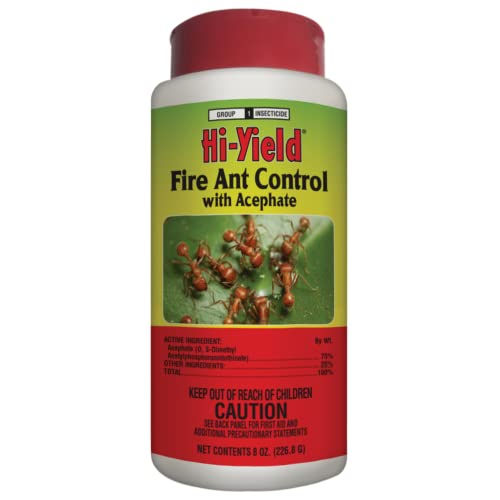
The Hi-Yield concentrate uses Acephate, an organophosphate that works slowly enough for foraging ants to carry it back to the colony before dying. One teaspoon to one tablespoon per mound, applied in early morning or late afternoon, wiped out fire ants within 48 hours in field reports, and the residual activity held for six to seven months in some cases. The granular formula dissolves when watered in, allowing the active ingredient to penetrate the mound rather than just coating the surface.
Users report a strong chemical odor during mixing, which is a trade-off for the potency. Several reviewers noted that this same product also eliminated German roaches from baseboards and door seals, suggesting the Acephate formulation works across multiple pest species even though the label primarily targets fire ants. The 8-ounce bottle mixes into gallons of finished spray, making it economical for large properties with multiple mounds.
There is a catch: some recent batches developed an unusual cheese-like odor according to a minority of buyers, and the product has occasionally shown inconsistency in manufacturing. The odor issue appears intermittent rather than systemic, but if you are sensitive to chemical smells or need a product for indoor use, this is better reserved for exterior turf and mound treatment only.
Why it’s great
- Colony-level elimination in 48 hours with proper mound drench
- Long residual protection lasting months after single application
- Concentrated format provides high value per treated mound
Good to know
- Strong chemical odor during mixing and application
- Some batches reported odd odor issues inconsistently
- Not suitable for indoor use or near livestock grazing areas
3. Maggie’s Farm Ant Bait Station, MNSK625

Maggie’s Farm bait stations use a gel matrix that ants find highly palatable, which is the critical factor for bait success. A bait that ants ignore accomplishes nothing no matter how toxic the active ingredient. User reports show that placing three stations along interior walls eliminated visible ant trails within four days, and the stations continued working as workers carried the gel back to the queen. The bait remains effective for three to six months before drying out, and users report reviving dried bait by adding a few drops of water.
The stations are manufactured in the United States with a formulation that prioritizes low odor and low toxicity to pets. Several reviewers noted that cats and dogs showed no interest in the stations, and the bait had no noticeable smell even when placed under kitchen cabinets. This makes the Maggie’s Farm stations a strong choice for households where chemical sprays are not an option due to pet concerns.
The six-count pack covers multiple rooms, but the bait stations are small and relatively inconspicuous, which is good for aesthetics but means you need to check them periodically to see if the gel has dried. Once the gel hardens, the station stops attracting ants, so the product requires periodic replacement rather than offering continuous long-term protection.
Why it’s great
- Pet-friendly formulation with no strong odor indoors
- Gel bait matrix is highly attractive to common household ants
- Colony elimination through bait sharing, not just contact kill
Good to know
- Bait gel dries out after 3-6 months, requiring replacement
- Small stations may need frequent refill checks for heavy infestations
- Takes 2-4 days to fully eliminate a colony, not instant
4. Spectracide One Shot Fire Ant Killer (1.5 lb)

The Spectracide One Shot is a granular bait engineered specifically for fire ants, and its key design choice is that the active ingredient kills workers slowly so they have time to forage back to the queen. The label’s instruction to sprinkle around the mound opening rather than on top is critical—mound disturbance signals danger and ants will avoid the granules. Users who followed that protocol saw fire ant mounds collapse within 48 hours, and the bait’s residual activity suppresses new mound formation for up to three months.
The granules are large enough that they do not become airborne dust during application, which means no inhalation risk during spreading, and there is no need to water the bait in after application. This makes the One Shot convenient for spot-treating scattered mounds across a lawn without hauling a hose or sprayer. The canister dispenses granules in a controlled shake, so you can apply exactly four tablespoons per mound without measuring tools.
One limitation is that the product is formulated specifically for fire ants and may not attract other ant species as effectively. Broadcast applications work best when ants are actively foraging in early morning or late evening, and the bait loses attractiveness if it gets wet from rain or irrigation before the ants find it. If you live in a wet climate, time your application carefully to avoid rain within 24 hours.
Why it’s great
- Single application suppresses fire ant mounds for up to three months
- No watering required, simple shake-and-sprinkle application
- Large granules reduce dust inhalation during spreading
Good to know
- Rain within 24 hours can wash away bait effectiveness
- Must apply around mound opening, not directly on mound
- Primarily targets fire ants; less effective on other ant species
5. TERRO T1700 Outdoor Ant Killer Spray (19 oz)
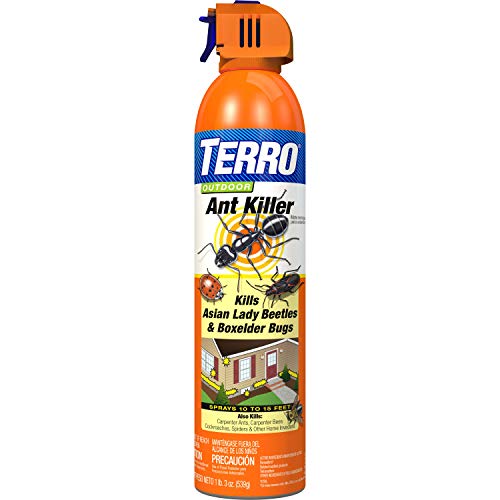
The TERRO T1700 delivers a wide-dispersing spray that reaches up to 15 feet, making it practical for treating ant trails along siding, between pavers, and around foundation perimeters without crouching or stepping into flower beds. The aerosol formulation provides rapid knockdown on contact, and users report that a single application to ant activity between patio stones eliminated the problem entirely with no return for days. The can is also labeled for carpenter ants, carpenter bees, boxelder bugs, spiders, and cockroaches, so it serves as a multi-pest perimeter spray.
Users on large properties, including a five-acre ranch, have sprayed twelve ant sites in one session and found no re-infestation after ten days. The adjustable spray nozzle lets you switch between a concentrated stream for cracks and a wider mist for surface coverage. The product is designed for outdoor use only, with a strong chemical residue that should not be applied near pets or livestock areas during active grazing.
The main complaint across multiple users is the sprayer mechanism itself, which some describe as physically difficult to operate, with a stiff trigger that can cause hand fatigue during extended use. Several users also noted that the can retains a small volume of liquid after the propellant runs out, wasting the final few ounces of product. If you need to treat a large area regularly, the trigger issue becomes a genuine annoyance rather than a minor quibble.
Why it’s great
- Long-range spray reaches 15 feet for hard-to-access areas
- Effective against multiple pest species in one product
- Rapid knockdown with residual barrier activity
Good to know
- Trigger mechanism is stiff and can cause hand fatigue
- Some liquid remains unusable after propellant runs out
- Not formulated for indoor use or near pet areas
FAQ
How long does it take for an ant bait to kill the entire colony?
Can I use fire ant bait on sugar ants or carpenter ants?
Why do ants avoid the bait I put out?
Are plant-based ant sprays as effective as synthetic chemical sprays?
Final Thoughts: The Verdict
For most users, the best ant killers winner is the Hi-Yield Fire Ant Control because it combines colony-killing Acephate with a concentrated format that treats multiple mounds for a full season. If you want a safe indoor option that pets cannot access, grab the Maggie’s Farm Ant Bait Stations. And for large-area perimeter defense against multiple pest species, nothing beats the TERRO T1700 Outdoor Ant Killer Spray.

Mo Maruf
I created WellFizz to bridge the gap between vague wellness advice and actionable solutions. My mission is simple: to decode the research and give you practical tools you can actually use.
Beyond the data, I am a passionate traveler. I believe that stepping away from the screen to explore new environments is essential for mental clarity and physical vitality.