Our readers keep the lights on and my smoothie glass nicely filled. As an Amazon Associate, I earn from qualifying purchases.
Ambient light is the sworn enemy of projector image quality, washing out blacks and desaturating colors the moment a lamp or window is on. An ambient light rejecting screen uses a precision optical surface—lenticular, Fresnel, or micro-structured—to block overhead and side light while reflecting the projector’s beam directly back to the viewer. The result is a daytime-visible image that rivals a flat-panel TV in contrast and clarity, without giving up the immense, immersive screen size only a projector can deliver.
I’m Mohammad Maruf — the founder and writer behind WellFizz. Over the past several years, I’ve analyzed the optical engineering, gain measurements, and frame construction of dozens of ALR screens across budget, mid-range, and premium tiers to understand what actually separates a transformative viewing upgrade from a mediocre panel.
For anyone building a home theater in a living room, family den, or conference space with uncontrolled lighting, picking the right best ambient light rejecting screen is the single most impactful investment you can make for picture quality.
How To Choose The Best Ambient Light Rejecting Screen
Not all ALR screens work with every projector type, and picking the wrong optical layer can leave you with a dim, directional image that looks worse than a basic matte white screen. Focus on three factors: optical structure, gain, and your projector’s throw ratio.
Optical Layer: Lenticular vs. Fresnel vs. Micro-Structured
Lenticular screens use vertical, sawtooth-like ridges that capture light from an ultra-short throw (UST) projector bouncing upward from below, while blocking ceiling light from above. Fresnel screens use concentric rings to focus light from a long-throw projector positioned at the back of the room, rejecting side and overhead ambient light. A micro-structured or PET-crystal layer offers a more balanced approach with wider viewing angles (up to 160–170°), suitable for both standard and short throw projectors but typically with lower peak gain.
Gain and Viewing Angle Trade-Off
Gain measures how much light the screen reflects compared to a standard matte white reference. High gain (1.5–1.8) boosts brightness significantly but narrows the sweet spot—anyone sitting off-center sees a dimmer image. Low gain (0.8–1.0) maintains consistent brightness across a wide seating arc but relies on a bright projector to punch through ambient light. Match the gain to your room layout: a central single-row cinema calls for high gain; a wide family room with side seating demands wider viewing angle and lower gain.
Frame Type and Surface Flatness
A fixed-frame ALR screen with a spring-tensioned or rod-tensioned system keeps the optical material perfectly flat and wrinkle-free—critical because any ripple in the micro-structured surface scatters light and defeats the rejection pattern. Look for a sturdy aluminum frame (ideally with a velvet or black-velvet border to absorb projector overshoot) and a black light-absorbing backing to prevent light bleed-through. Motorized and pull-down ALR screens exist but introduce surface waves over time; for permanent installations, a fixed frame is the gold standard.
Quick Comparison
On smaller screens, swipe sideways to see the full table.
| Model | Category | Best For | Key Spec | Amazon |
|---|---|---|---|---|
| AWOL VISION C100 | UBER-PREMIUM | ULTIMATE UST PICTURE QUALITY | 95% Ceiling Light Rejection | Amazon |
| Valerion 100″ Fresnel ALR | PREMIUM | BRIGHT LONG-THROW ROOMS | 1.8 Gain, 85% Rejection | Amazon |
| AWOL VISION C120 | HIGH-END UST | LARGE 120″ UST DAYLIGHT VIEWING | 95% Ceiling Light Rejection | Amazon |
| NothingProjector ALR 100″ | MID-RANGE UST | 85% REJECTION + WIDE VIEWING | 85% Ambient Light Rejection | Amazon |
| Elite Screens Aeon CineGrey 100″ | MID-RANGE FREEFLOAT | STANDARD THROW + FRAMELESS LOOK | 1.2 Gain, 65% Rejection | Amazon |
| Elite Screens Aeon CineGrey 120″ | MID-RANGE LARGE | BIG SCREEN STANDARD THROW | 1.2 Gain, 65% Rejection | Amazon |
| WonTeam ALR 100″ | VALUE UST | BUDGET UST DAYLIGHT VIEWING | 0.8 Gain, 0.39″ Bezel | Amazon |
| Akia Screens CineWhite 150″ | VALUE BIG SCREEN | LARGE NON-ALR FIXED FRAME | 1.3 Gain, 180° Viewing | Amazon |
| Elite Screens Spectrum Motorized 150″ | MOTORIZED VALUE | DROP-DOWN IN CONTROLLED LIGHT | 1.1 Gain, ISF Certified | Amazon |
In‑Depth Reviews
1. AWOL VISION Ambient Light Rejecting (ALR) Projector Screen C100

The AWOL VISION C100 uses a serriform optical surface with a microstructure lens that rejects up to 95% of ceiling ambient light, which is the highest rejection ratio in this roundup.
Its 170° ultra-wide viewing angle means the entire family room—not just the center seat—gets the same uniform picture quality, a rare combination in high-gain ALR screens. The HBSP black-grid TPU material is purpose-built for UST projectors only, so you get laser-focused optical performance without compromise.
Assembly is finicky—the manual’s bracket positioning guidance was reportedly incorrect, and the screen overhang tolerance is tight. Once dialed in, however, the flat, wrinkle-free surface and the sheer black-level improvement justify the installation patience. AWOL VISION backs this with US-based support from Delray Beach, Florida.
Why it’s great
- 95% ceiling light rejection—best in class.
- 100x contrast improvement over white screens.
- 170° wide viewing angle for side seating.
Good to know
- Assembly instructions have errors; use online video guides.
- Only compatible with ultra-short throw projectors.
2. Valerion 100-inch Fresnel ALR Projector Screen
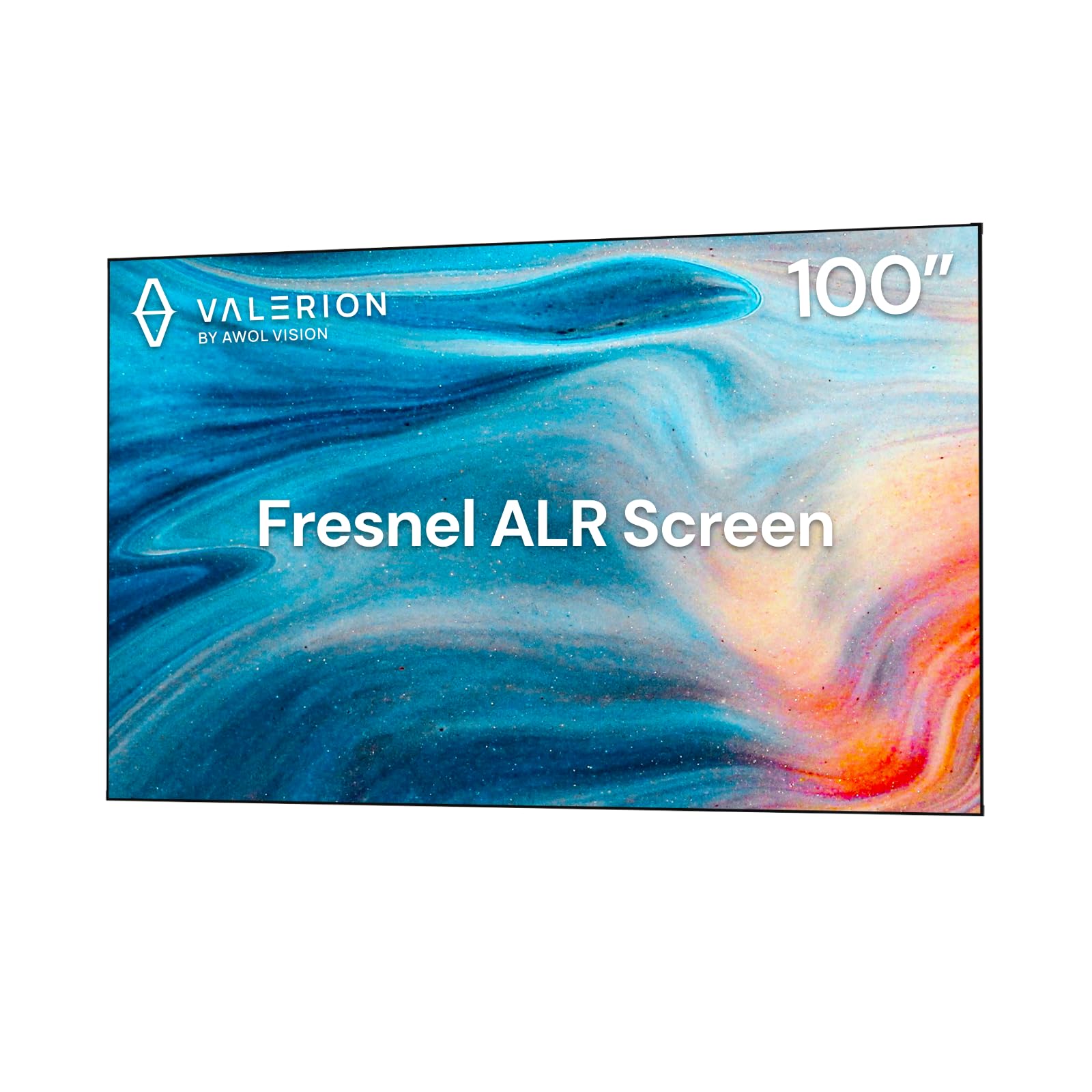
The Valerion Fresnel ALR screen takes a fundamentally different approach from lenticular UST designs: its 8-layer Fresnel structure is optimized exclusively for long-throw projectors and delivers a remarkable 1.8 gain. That gain figure is the highest in this collection, translating into an image that stays vibrant even under direct overhead and side lighting.
It rejects up to 85% of ambient light from both ceiling and side sources, and the precision Fresnel rings focus the projector’s light into a 90° viewing cone. This is directional by design, so it works best for dedicated home theaters with a central seating row rather than sprawling couches. The scratch-resistant, easy-to-clean PET surface adds day-to-day practicality that few ALR screens offer.
Assembly is straightforward thanks to the modular aluminum frame and tension bolts, though the instructions are sparse. The rollable design makes transport and DIY installation easier than rigid-frame competitors. Note: this screen is not compatible with UST projectors—long throw only.
Why it’s great
- 1.8 gain delivers exceptional brightness in lit rooms.
- 85% rejection of ceiling and side ambient light.
- Scratch-resistant, easy-to-clean surface.
Good to know
- Long-throw projectors only; no UST compatibility.
- 90° viewing angle limits side seating brightness.
3. AWOL VISION 120′ Fixed Frame Serriform ALR Projector Screen

The 120-inch sibling of the AWOL C100 shares the same serriform optical microstructure and 95% ceiling light rejection, but scales the viewing area to a massive 105.4″ x 59.6″ for dedicated theater rooms or large family spaces. The 170° viewing angle remains intact, so even expanded seating layouts maintain uniform contrast.
This screen delivers the same 80% image quality improvement over standard matte white and supports up to 100 times greater contrast levels. The specialized fabric-vinyl composition includes a black backing that prevents light leakage, which is critical when the panel is mounted on a light-colored wall. It is engineered exclusively for UST laser projectors, making it a perfect partner for AWOL’s own LTV-3000 Pro or similar premium UST units.
As with the smaller version, assembly requires patience—particularly aligning the screen overhang within the frame and positioning the wall brackets at the correct 55–65-inch spacing. AWOL’s US-based customer service and 1-year warranty provide welcome backup if issues arise.
Why it’s great
- 120-inch diagonal with 95% ceiling light rejection.
- Black backing prevents wall light bleed-through.
- 170° wide viewing angle for large rooms.
Good to know
- UST-only; not compatible with standard or long throw.
- Frame assembly requires careful bracket measurement.
4. NothingProjector ALR Screen for Ultra Short Throw Projector, 100 inch

The NothingProjector ALR screen uses advanced PET Crystal technology to reject up to 85% of ambient ceiling light while maintaining a wide 160° viewing angle. Its lenticular surface is engineered for UST projectors, with a black light-absorbing core between the imaging layers that boosts perceived contrast without requiring a perfectly dark room.
At 100 inches with a slim 10mm frame, the design is modern and unobtrusive. The PVC-free substrate is an eco-friendly touch that also reduces glare and visual fatigue during extended viewing sessions. Multi-layer construction supports 4K/8K UHD and Active 3D without introducing moiré or speckle artifacts.
Assembly is straightforward but time-consuming—the instruction manual has alignment issues from poor photocopying, and the included gloves are undersized. Once assembled, the wrinkle-free surface and sturdy metal frame deliver image quality that rivals screens costing significantly more. Owner reviews consistently praise the daytime performance with XGIMI and other popular UST projectors.
Why it’s great
- 85% ambient light rejection at a value price.
- 160° viewing angle suits wider seating.
- PVC-free, eye-friendly PET Crystal material.
Good to know
- Instruction manual has photocopy alignment issues.
- Assembly is moderately time-consuming.
5. Elite Screens Aeon CineGrey 3D, 100″ Fixed Frame

Elite Screens’ Aeon CineGrey 3D material offers 65% ambient light rejection with a 1.2 gain and a 90° viewing angle, optimized specifically for standard throw projectors. Its EDGE FREE design lets you install a thin trim or go completely frameless, creating the illusion of a floating 100-inch flat panel TV when the projector is off.
The 6-piece split aluminum frame uses a spring-tensioned system to keep the CineGrey fabric taut and ripple-free. ISF certification guarantees accurate color reproduction, and GREENGUARD Gold certification ensures low indoor emissions—important for bedrooms or enclosed media rooms. It supports 4K/8K Ultra HD and both Active and Passive 3D.
Installation is a multi-hour project if you work solo—the tensioning springs require careful handling to avoid ripples before the border trim is applied. A few owners have reported circular swirl marks on the fabric from the rolling process; while rare, this is worth inspecting immediately upon unboxing. Elite Screens’ 2-year warranty and lifetime tech support provide solid backup.
Why it’s great
- Frameless EDGE FREE design for a giant TV look.
- ISF and GREENGUARD Gold certified.
- 1.2 gain suits standard throw projectors.
Good to know
- Installation is challenging and time-consuming solo.
- Some units may have swirl marks from packing.
6. Elite Screens Aeon CineGrey 3D, 120″ Fixed Frame
Essentially the larger 120-inch version of the Elite Screens Aeon CineGrey 3D, this screen offers the same CineGrey 3D material with 65% ambient light rejection and 1.2 gain, scaled to a 105.4″ wide viewing area. The 90° viewing angle is maintained, so optimal brightness is centered—perfect for dedicated home theater rows.
The aircraft-grade aluminum frame and Velcro tensioning system deliver a professionally flat surface that stays taut over years of use. The EDGE FREE frameless option gives a modern floating appearance that blends into the wall when not in use. It is designed for standard throw projectors and supports 4K/8K Ultra HD with excellent color saturation.
Owners of the 120-inch version report the same installation challenges as the 100-inch model—solo installation can take up to 4 hours, and the instructions are sparse. The advantage is that once properly tensioned, the result is a massive, TV-like image with dramatically reduced ambient light washout. Elite Screens’ 2-year/3-year ENR-G warranty and lifetime tech support apply.
Why it’s great
- 120-inch ALR at a mid-range price point.
- Lightweight 26-pound aluminum frame.
- Floating frameless aesthetic available.
Good to know
- Solo installation is lengthy and fiddly.
- 90° viewing angle limits off-axis brightness.
7. ALR Screen for UST Projector, 100 inch (WonTeam)
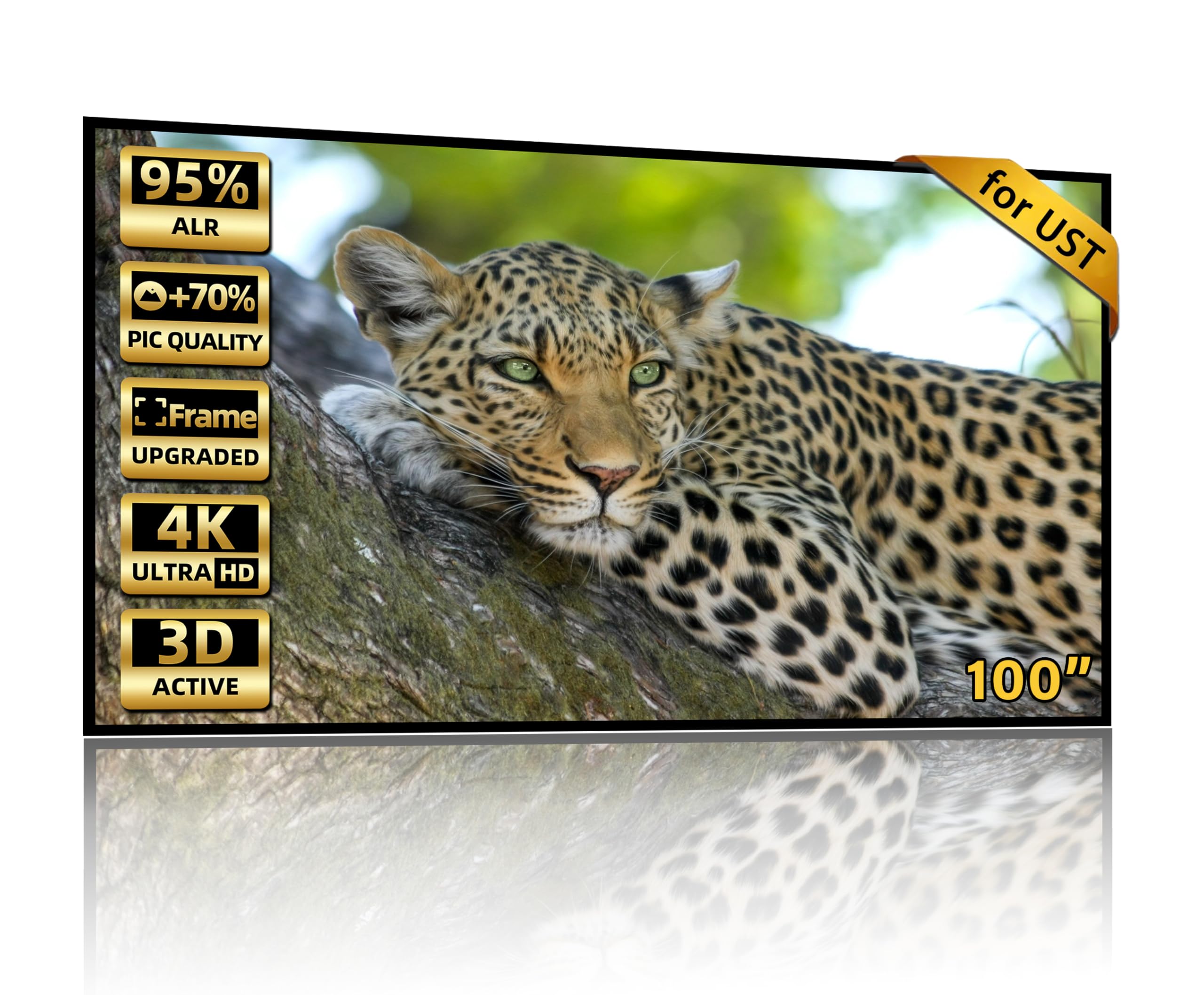
The WonTeam ALR screen uses a precision micro-toothed 3D structure with triangular grating—one side black, one side white—designed to absorb ambient light from above while directing the UST projector’s light toward the audience. With a 0.8 gain, it delivers excellent black levels and color saturation in daylight conditions without the hotspotting that higher-gain screens sometimes produce.
The 0.39-inch ultra-narrow bezel and velvet surface give it a premium appearance that belies its accessible price point. The dual-frame aluminum alloy construction with an adaptive spring tension system maintains a mirror-smooth surface. The black-backed upgraded PVC material resists deformation and offers self-healing properties against minor scratches.
Assembly is straightforward with an estimated 1–2 hour build time, and owners report that video instructions compensate for the basic printed manual. A small number of long-term users have reported sagging after 5–6 months, so ensuring the tension springs are properly adjusted during install is critical. For the price, the ALR performance is exceptional—reviewers consistently compare it favorably to screens costing twice as much.
Why it’s great
- Excellent ALR performance for the price.
- Ultra-slim 0.39-inch bezel and velvet trim.
- 0.8 gain delivers deep black levels.
Good to know
- Reports of sagging after several months in some units.
- 0.8 gain requires a bright projector.
8. Akia Screens 150 Inch Projector Screen Fixed Frame CineWhite UHD-B
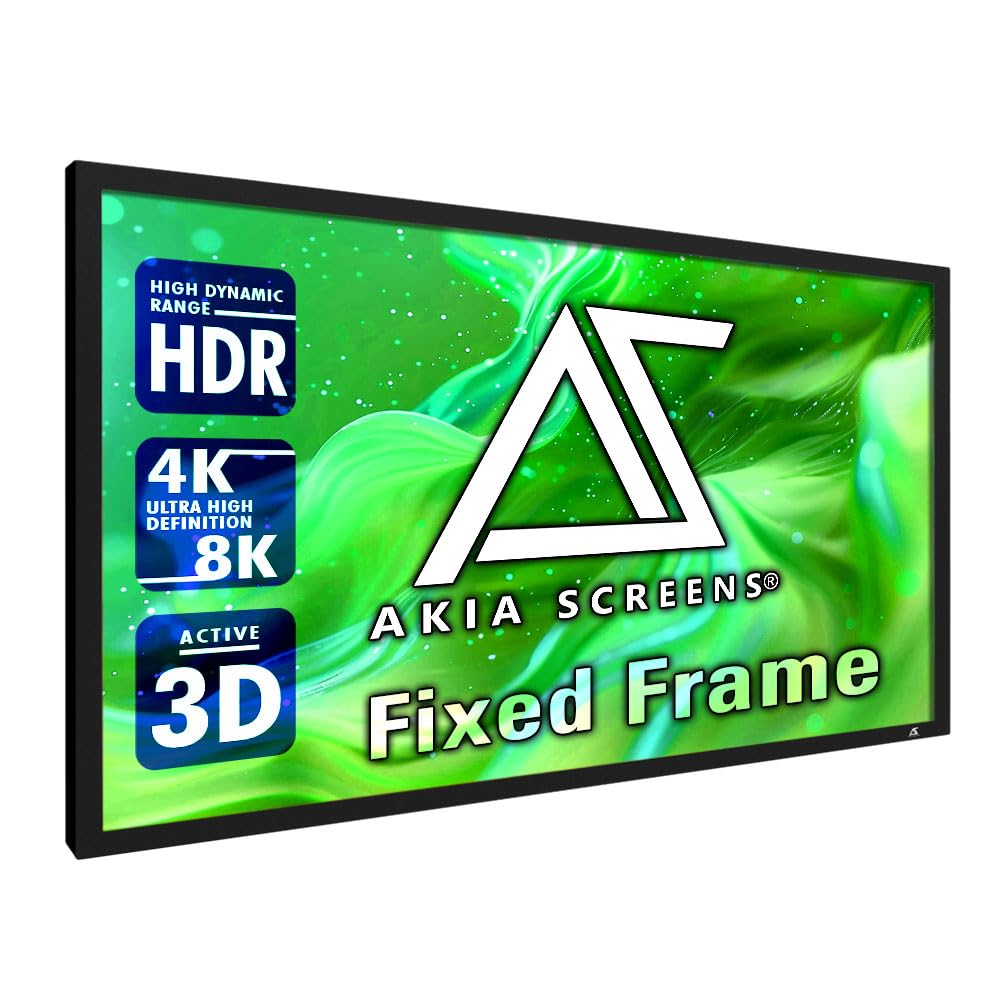
The Akia Screens 150-inch CineWhite UHD-B is not an ALR screen—it is a high-gain (1.3) matte white screen with ISF certification and full Lambertian diffusion for uniform brightness at a 180° viewing angle. It is included here as a reference point for buyers who need a massive screen size on a budget and can control their room lighting, or who want a comparison baseline for ALR performance.
The black velvet–wrapped aluminum frame absorbs projector overshoot and enhances perceived contrast, while the rod-and-spring tension system keeps the 150-inch surface wrinkle-free. It supports 8K, 4K UHD, HDR, and Active 3D formats, and its versatile design works with standard throw, short throw, and even UST projectors—unlike dedicated ALR panels which are throw-specific.
Assembly takes around 3 hours with needle-nosed pliers for the springs, but the heavy-duty aluminum frame and velvet border make the finished product look like a dedicated cinema screen costing much more. For dim or blackout rooms, this screen delivers a fantastic image at a fraction of the cost of an ALR panel of the same size.
Why it’s great
- Massive 150-inch diagonal at a budget price.
- Velvet frame absorbs overshoot for better contrast.
- Works with any projector throw type.
Good to know
- No ambient light rejection—needs a dark room.
- Spring tension system requires patience to assemble.
9. Elite Screens Spectrum Motorized Projection Screen, 150-INCH
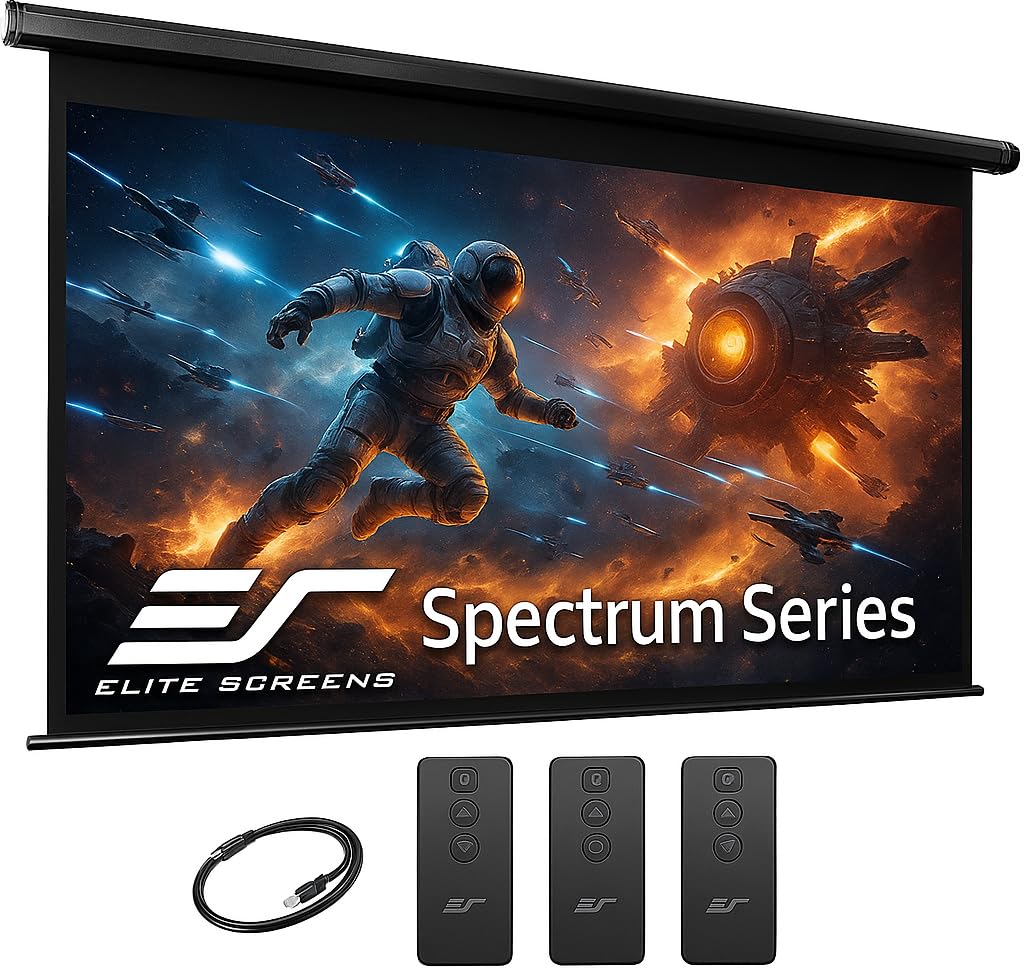
The Elite Screens Spectrum 150-inch motorized screen uses MaxWhite 2 front-projection material with 1.1 gain and a 180° viewing angle. This is not an ALR screen—it is a black-backed, matte white ISF-certified surface designed for controlled-light environments where a motorized drop-down solution is needed for space flexibility or ceiling-mounted projector setups.
The electric motor includes an IR remote, a detachable wall box controller, and an RJ45 input for third-party control integration. Programmable vertical drop positions let you set the exact screen height, and the unit arrives fully assembled for ceiling or wall mounting. GREENGUARD Gold certification confirms low chemical emissions for safe indoor air quality.
Motor noise is moderate—audible only during travel—and the screen rolls flat without the permanent wrinkles common in cheaper pull-down models. It is designed for standard throw projectors and is not compatible with ultra-short or short-throw units. For rooms where a fixed frame is impractical, this motorized screen balances convenience with Elite Screens’ build quality and 2-year warranty.
Why it’s great
- Fully motorized with remote and RJ45 control.
- ISF and GREENGUARD Gold certified.
- Arrives pre-assembled for easy mounting.
Good to know
- No ALR capability—requires controlled lighting.
- Not compatible with UST or short-throw projectors.
FAQ
Can I use an ALR screen with any projector?
How much does a good ALR screen improve daytime viewing?
Is a fixed frame ALR screen better than a motorized one for light rejection?
What is the difference between CLR and ALR?
Will an ALR screen fix a washed-out image from a low-lumen projector?
Final Thoughts: The Verdict
For most users, the best ambient light rejecting screen winner is the AWOL VISION C100 because it delivers 95% ceiling light rejection with a 170° viewing angle, making daytime UST viewing genuinely TV-like without sacrificing off-axis seating. If you want the absolute brightest daytime image for a long-throw projector in a central-seat theater, grab the Valerion Fresnel ALR with its 1.8 gain and 85% rejection. And for a budget-friendly UST upgrade that still punches well above its weight in light rejection, nothing beats the NothingProjector ALR for value-minded buyers who need 85% rejection at a mid-range price.

Mo Maruf
I created WellFizz to bridge the gap between vague wellness advice and actionable solutions. My mission is simple: to decode the research and give you practical tools you can actually use.
Beyond the data, I am a passionate traveler. I believe that stepping away from the screen to explore new environments is essential for mental clarity and physical vitality.