Our readers keep the lights on and my smoothie glass nicely filled. As an Amazon Associate, I earn from qualifying purchases.
The crackle of a distant station, the sudden fade of a baseball game, the frustration of scanning past dead air—these are the daily realities of a poorly chosen portable radio. For many, a reliable AM/FM receiver is a lifeline to local news, weather updates, and entertainment, but the market is flooded with models that promise strong reception and deliver only static. The difference between a radio that collects dust and one that becomes a trusted companion lies in a few critical specifications often buried in the product description.
I’m Mohammad Maruf — the founder and writer behind WellFizz. My work focuses on dissecting the hardware specifications of consumer electronics to separate genuine performance from marketing claims, with a particular emphasis on analog and digital radio reception quality.
Whether you need a weather-alert unit for emergencies, a compact model for the job site, or a simple set for an elderly relative, this guide cuts through the noise to pinpoint the best am/fm portable radio for your specific situation.
How To Choose The Best AM/FM Portable Radio
The perfect portable radio for you depends entirely on where you plan to use it and how much interference you are willing to manage. Start by assessing the signal strength in your typical listening location—basements and buildings with metal framing will challenge even the best receivers.
Tuner Type: Analog vs. Digital
Analog radios with a tuning dial offer simple, tactile control but can drift off frequency as the device warms up or the battery drains. Digital tuners use a phase-locked loop (PLL) to lock onto a frequency and hold it without drift, making them ideal for precise station access. However, analog models often feature a larger tuning knob, preferred by users with limited dexterity.
Antenna Design & Reception
AM reception relies heavily on an internal ferrite bar antenna, which is directional and picks up signal best when the radio is rotated. FM reception depends on a telescopic whip antenna; longer antennas (typically 20 to 30 inches) capture weaker signals more effectively. For emergency preparedness, a radio with both a robust internal AM ferrite and a long extendable FM whip is non-negotiable.
Power Source Flexibility
Portable radios fall into three power categories: battery-only (D or AA cells), rechargeable with lithium-ion packs, or AC-powered with a plug. For home use, an AC adapter saves on battery costs. For emergency kits, a model with multiple recharging methods—solar, hand crank, and USB-C—ensures the radio stays on when the grid goes down. Always verify whether the radio retains station presets or analog positions when the power source is disconnected.
Quick Comparison
On smaller screens, swipe sideways to see the full table.
| Model | Category | Best For | Key Spec | Amazon |
|---|---|---|---|---|
| FosPower A1 | Emergency | Emergency Preparedness | 7400mWh (2000mAh) Power Bank | Amazon |
| Jazmm Pocket Radio | Digital Multi-Band | Versatile Walkaround Use | 1250mAh Battery, 5W Speaker | Amazon |
| Mesqool Solar Radio | High-Capacity Solar | Extended Off-Grid Power | 12000mAh Battery, 260ft Flashlight | Amazon |
| NITIGO Emergency Radio | High-Capacity Emergency | Phone Charging & Alerting | 10000mAh / 37000mWh Battery | Amazon |
| TOMASHI Analog Radio | Analog Classic | Simple At-Home Listening | 23.62″ Extendable Antenna | Amazon |
| Raynic Weather Radio | Compact Emergency | Go-Bag & Travel Emergency | 5000mAh Battery, IPX3 Rating | Amazon |
| QAUYYW 74000mWh | Large Battery Emergency | Extended Power Outages | 20000mAh / 74000mWh Capacity | Amazon |
In‑Depth Reviews
1. FosPower NOAA Emergency Weather Radio A1
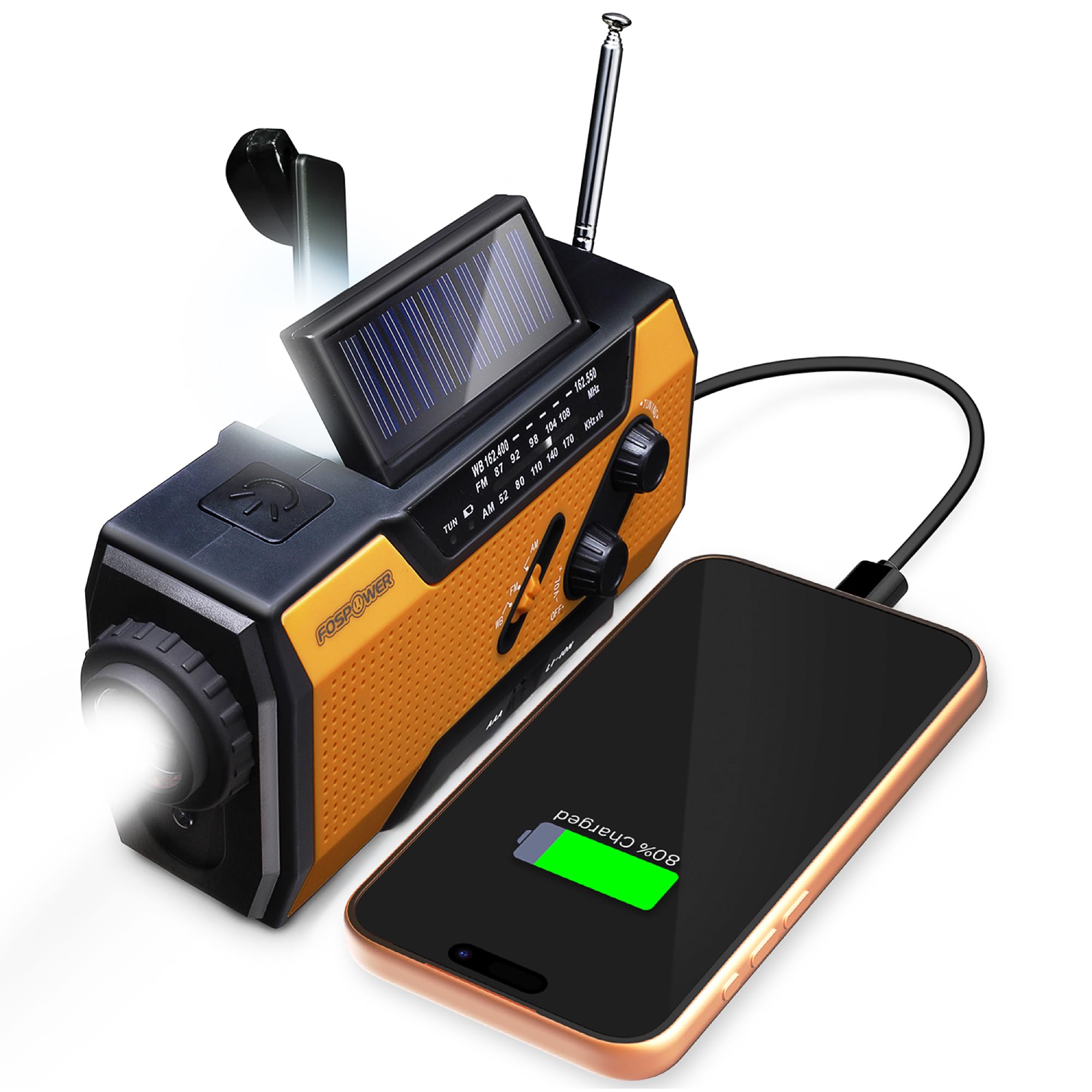
The FosPower A1 strikes an exceptional balance between reception quality and emergency utility. Its integrated 7400mWh power bank can recharge a smartphone in a pinch, while the hand crank and solar panel keep the radio operational when wall outlets are unavailable. The NOAA weather band tuning provides access to seven preset channels, delivering real-time emergency broadcasts without the need for a separate device.
Users consistently praise the radio’s durability and loud speaker output. The analog tuner, combined with a clear digital display for the weather band, makes operation straightforward even under stress. The inclusion of a 1W flashlight and a 4-LED reading lamp ensures you are never left in the dark, making this a true three-in-one survival tool.
Some reports mention that the radio speaker can fail after extended daily use, but for its intended purpose—emergency preparedness and intermittent use—the FosPower A1 remains a top contender. The AAA battery backup slot adds a layer of redundancy that many competing models lack entirely.
Why it’s great
- Built-in 7400mWh power bank charges phones
- Hand crank, solar, and AAA battery backup
- Loud, clear speaker for emergency alerts
Good to know
- Speaker may degrade with constant daily use
- Analog AM/FM tuning lacks precise digital lock
2. Jazmm Bluetooth AM FM Shortwave Radio

The Jazmm pocket radio packs a surprising amount of technology into a compact, belt-clip-friendly chassis. Beyond standard AM and FM bands, it receives shortwave (SW) frequencies and NOAA weather alerts, making it one of the most versatile portable radios in its tier. The built-in 1250mAh rechargeable battery delivers approximately 10 to 12 hours of playback on a single USB-C charge, eliminating the need for disposable cells.
Audio quality punches above the size class thanks to a 5W large speaker driver and a 6-band EQ that allows you to tailor the sound for music, voice, or news. The bright LCD display clearly shows the tuned frequency, while the back clip and wrist strap make it ideal for walks, biking, or keeping on a tool belt. Bluetooth 5.4 connectivity also lets it double as a wireless speaker for podcast or audiobook playback from a phone.
A few users note minor FM frequency drift, which is a common trait in compact digital receivers, and the AM reception can be somewhat noisy in urban environments with high electromagnetic interference. However, the ability to play MP3 files directly from a TF card adds a level of offline media capability rarely found in such a small package.
Why it’s great
- Multi-band reception: AM, FM, SW, NOAA
- Bluetooth 5.4 and TF card MP3 playback
- USB-C rechargeable with high-output 5W speaker
Good to know
- Minor FM drift reported on some units
- AM reception can struggle in high-interference zones
3. Mesqool 12000mAh Solar Hand Crank Radio
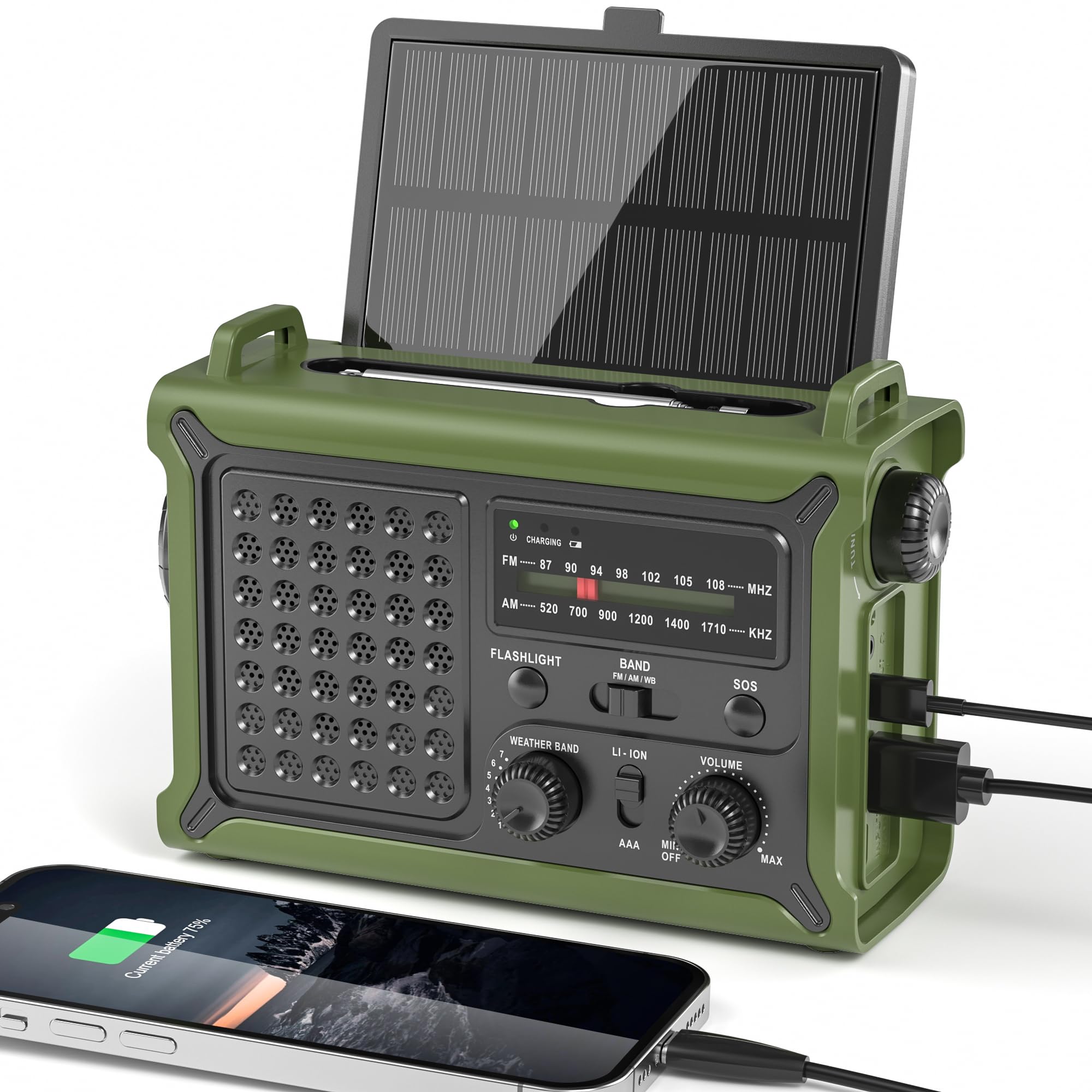
The Mesqool radio is engineered for users who need maximum power autonomy. Its true 12000mAh lithium battery is four to six times larger than typical emergency radios, allowing it to keep a smartphone charged over multiple days or run the radio and lights continuously through a weekend power outage. The 8500mm² monocrystalline solar panel is significantly larger than the decorative panels found on most competitors, enabling meaningful solar recharge even in overcast conditions.
Reception performance is robust, with a high-sensitivity DSP chip and an extended antenna that pulls in AM and FM stations with clarity. The flashlight projects a focused beam up to 260 feet, and the frosted reading lamp provides a warm, eyes-friendly glow. The high-torque crank assembly charges the internal battery roughly twice as fast as standard hand crank radios, requiring only three minutes of cranking to generate a meaningful amount of power.
The trade-off for this capacity is size and weight. At 1.6 pounds, it is heavier than a pocket radio and requires dedicated space in a go-bag. Additionally, the analog tuning dial lacks a precise frequency readout, which may frustrate users who need to dial in a specific station quickly.
Why it’s great
- Genuine 12000mAh battery for multi-day use
- Large monocrystalline panel for efficient solar charging
- Fast-charging hand crank mechanism
Good to know
- Heavier than typical portable radios
- Analog tuning without precise digital display
4. NITIGO 10000mAh Emergency Radio
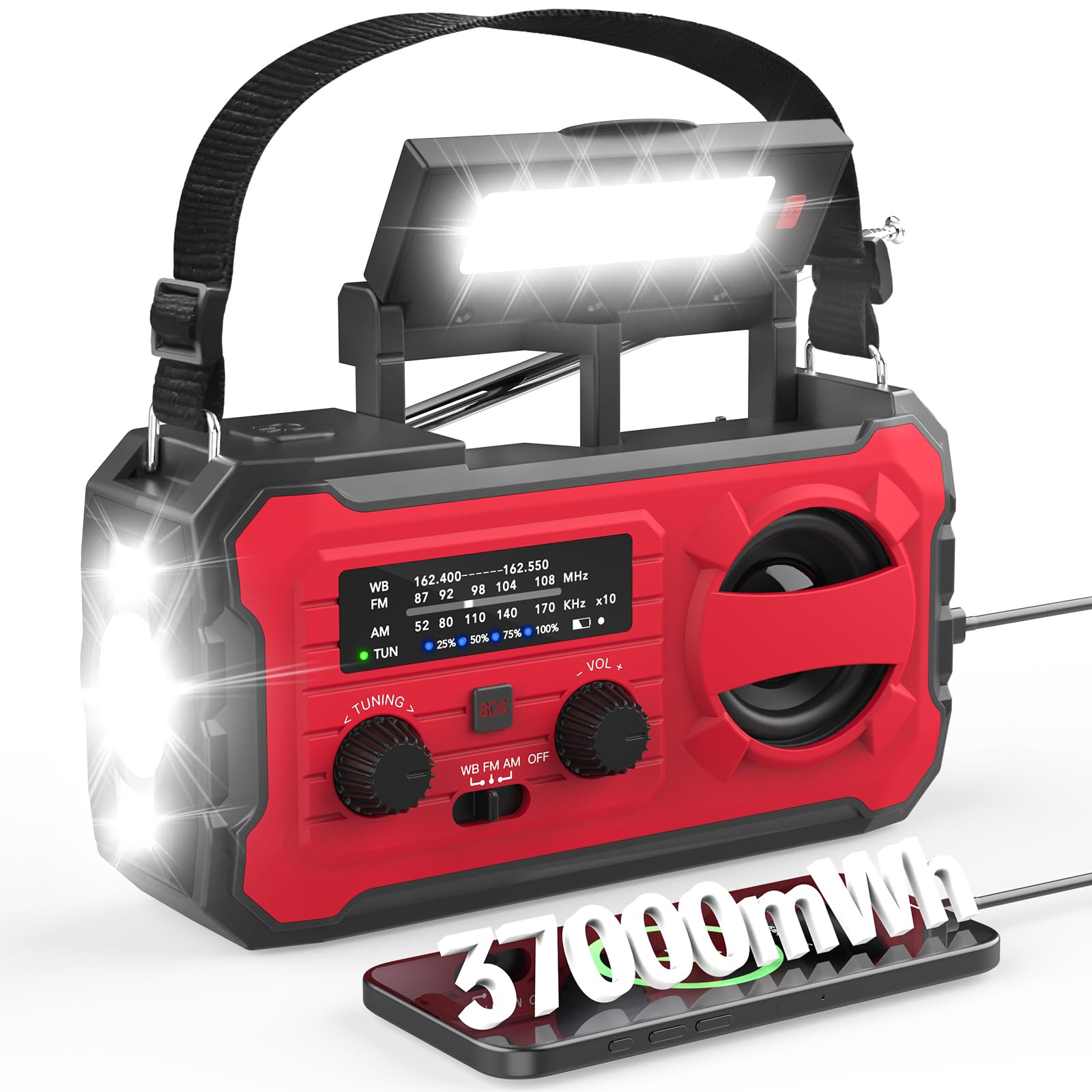
The NITIGO radio prioritizes raw power storage and device charging. With a 37000mWh (10000mAh) rechargeable battery, it can fully charge most smartphones two to three times over while still having enough reserve to run the radio for extended periods. The unit supports USB-C, solar, and hand crank charging, ensuring you have multiple paths to keep the battery topped off during an extended emergency.
The radio section covers AM, FM, and seven preset NOAA weather channels. The audio output is loud and clear, though the single speaker lacks the deep bass of larger units. The 90-degree rotating reading lamp is a clever design choice, allowing you to direct light exactly where needed without moving the entire radio. An ultra-bright 3-mode LED flashlight and a loud SOS alarm round out the emergency feature set.
The ABS plastic enclosure is rugged and feels durable, but the button layout can be somewhat cramped for larger hands. Some users note that the sound quality is functional rather than musical—adequate for news and alerts, but not ideal for extended music listening sessions.
Why it’s great
- High 10000mAh capacity for phone charging
- Rotating reading lamp for directed light
- USB-C input for modern charging convenience
Good to know
- Speaker is loud but lacks bass depth
- Button layout can feel tight for large hands
5. TOMASHI AM/FM Portable Radio

For listeners who prefer straightforward, no-nonsense operation, the TOMASHI analog radio delivers exactly what it promises. The large anti-slip tuning knob and easy-to-read dial make station selection effortless, even for users with arthritis or limited fine motor control. The internal magnetic AM receiver combined with the 23.62-inch extendable whip antenna provides solid reception in most suburban and rural environments.
The built-in big speaker produces loud, clear audio that fills a room without distortion. The 3.5mm headphone jack offers a private listening option, and the AC power cord lets you save batteries for portable use. The D-cell battery compartment provides long runtime on standard alkaline cells, making it a cost-effective choice for daily use around the house.
The analog tuner does have the potential to drift slightly as the device warms up, and the plastic chassis feels basic compared to more expensive models. However, for its intended role as a simple home radio for seniors or a workshop companion, the TOMASHI is hard to beat in terms of value and usability.
Why it’s great
- Large, easy-to-turn tuning knob
- Dual power: AC cord or 3 D-cell batteries
- Strong AM reception with internal ferrite antenna
Good to know
- Frequency may drift as unit warms up
- Plastic construction feels entry-level
6. Raynic Weather Radio with 5000mAh Battery

The Raynic radio is purpose-built for the backpack emergency kit. Its compact dimensions (7.5 x 3.5 x 4.7 inches) and 1-pound weight make it easy to slip into a go-bag without sacrificing essential features. It supports AM, FM, shortwave, and seven NOAA weather channels, giving you multiple information streams during a crisis. The IPX3 water resistance rating means it can withstand rain and splashes, a critical factor for outdoor survival gear.
The 5000mAh rechargeable battery provides enough power to charge a smartphone for a brief emergency call, while the hand crank and solar panel offer alternative charging methods. The 3W LED flashlight and 2.5W reading lamp are bright enough for navigation and reading maps. A built-in compass adds a touch of analog navigation capability that is rare in this price range.
Controls are tactile and crisp, with compartment covers that feel secure. The analog tuning is less precise than digital alternatives, and The SOS alarm and strobe light are startlingly loud and bright—by design, but worth noting if you test it indoors. The included carabiner and braided belt make it easy to attach to a pack.
Why it’s great
- Compact and lightweight for go-bag storage
- IPX3 water resistant for outdoor use
- Includes compass, carabiner, and SOS alarm
Good to know
- Analog tuner is less precise than digital
- Solar panel charges slowly in low light
7. QAUYYW 74000mWh Emergency Radio
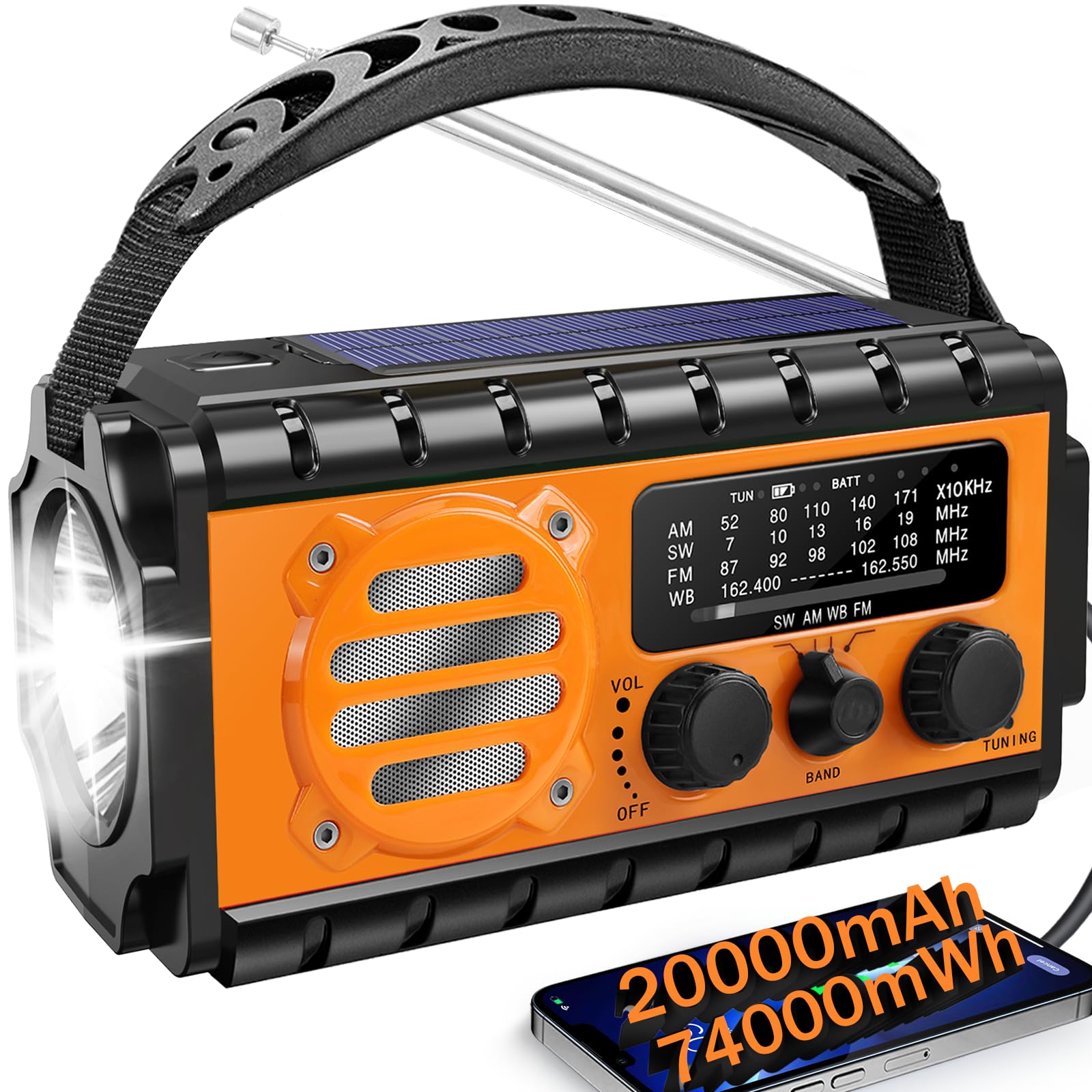
The QAUYYW radio boasts the largest battery capacity in this lineup at a true 20000mAh (74000mWh), allowing up to 35 hours of continuous radio playback at medium volume. This extended runtime makes it ideal for multi-day power outages or remote camping trips where recharging opportunities are scarce. The 52-centimeter extended antenna provides excellent signal pull across AM, FM, shortwave, and NOAA bands.
The build quality is notably solid, with a robust ABS plastic shell and a well-sealed battery compartment. The three-dial control system (volume, band selection, and function) is intuitive, and the large flashlight and reading lamp provide ample illumination. The unit also functions as a power bank for USB devices, with dual outputs allowing simultaneous charging of two devices.
At just 0.68 pounds, it is surprisingly light for its battery capacity. However, some users report that the included instructions could be clearer regarding initial setup and band selection. The analog display lacks the precision of a digital readout, so fine-tuning stations requires a patient hand.
Why it’s great
- Massive 20000mAh battery for extended off-grid use
- 35-hour continuous playtime at medium volume
- Long 52cm antenna for superior signal capture
Good to know
- Analog tuning lacks digital frequency precision
- Instruction manual could be more detailed
FAQ
Why does my AM radio sound worse indoors than outdoors?
Can a digital tuner really hold a station better than analog?
Final Thoughts: The Verdict
For most users, the best am/fm portable radio winner is the FosPower A1 because it integrates reliable weather alerts, a phone-charging power bank, and multiple recharging methods at a reasonable entry point. If you want maximum battery capacity for extended emergencies, grab the Mesqool 12000mAh. And for a pocket-sized digital multi-band model with Bluetooth that follows you everywhere, nothing beats the Jazmm compact receiver.

Mo Maruf
I created WellFizz to bridge the gap between vague wellness advice and actionable solutions. My mission is simple: to decode the research and give you practical tools you can actually use.
Beyond the data, I am a passionate traveler. I believe that stepping away from the screen to explore new environments is essential for mental clarity and physical vitality.