Our readers keep the lights on and my smoothie glass nicely filled. As an Amazon Associate, I earn from qualifying purchases.
Caring for a loved one with Alzheimer’s means anticipating needs they can no longer voice, from preventing a fall during a midnight bathroom trip to easing the confusion of waking without knowing the day or time. The right tools preserve their sense of independence while giving you genuine peace of mind, and the difference between products that work and those that create more frustration often comes down to sensor type, alarm placement, and display readability. I’m Mohammad Maruf — the founder and writer behind WellFizz, where I analyze caregiver support hardware and daily-living aids through the lens of real-world clinical feedback and engineering build quality. Whether you need a fall-prevention alarm that alerts you silently or a dementia clock that shows the full date at a glance, this guide breaks down the five essential products that consistently earn trust from families navigating Alzheimer’s care.
How To Choose The Best Alzheimer’s Products
Selecting the right Alzheimer’s product starts with identifying the specific daily challenge you want to solve. A door alarm that prevents wandering is a completely different tool from a bed sensor that catches a fall attempt before it happens, and a dementia clock helps with orientation but does nothing for mobility safety. Knowing which category fits your situation is the first step toward building a practical care plan.
Sensor Type and False-Alarm Rates
A pressure pad placed under the shoulders triggers every time your loved one rolls over, flooding your day with false alerts that numb your response. Look for a bed alarm with a pad designed to sit at hip level — this detects the actual act of sitting up and shifting weight toward standing, so you only get alerted when a real exit is in progress. The sensor material matters too: foam-backed pads that are incontinence-resistant last much longer than thin PVC alternatives that crack after a few months.
Alarm Location and Volume Control
In-room alarms that blast a loud tone directly beside the person with Alzheimer’s can cause agitation, fear, and even increase fall risk as they try to escape the noise. The CMS guidance cited by Lunderg explains why: these alarms are classified as a potential restraint. A better approach uses a pager that vibrates or sounds softly in the caregiver’s pocket while leaving the patient’s room quiet. If you need a bedside alarm, choose one with adjustable volume and a chime mode instead of a piercing siren.
Display Readability and Orientation Clues
A standard digital clock that only shows numbers can deepen confusion for someone with memory loss, especially when they wake at 3 PM and cannot tell whether it is morning or afternoon. The best dementia clocks use a 7-inch display with large bold text showing the day of the week, the full date, and a phase-of-day indicator (Morning, Afternoon, Evening, Night). Auto-dimming that reduces brightness after sunset prevents glare-based sleep disruption while ensuring the display stays readable during the night.
Quick Comparison
On smaller screens, swipe sideways to see the full table.
| Model | Category | Best For | Key Spec | Amazon |
|---|---|---|---|---|
| Lunderg Early Alert Bed & Chair Alarm | Bed / Chair Alarm | Fall prevention with caregiver pager | Hip-level pad placement + 400 ft range | Amazon |
| Pastigio 7″ Digital Clock | Dementia Clock | Time orientation with phase-of-day display | 1024×600 IPS + 5 phase indicators | Amazon |
| Nesthao Bed Sensor Alarm | Motion Sensor | Caregiver alerts when feet touch floor | 918 ft open-area range + 5 volume levels | Amazon |
| Mitoart Digital Alarm Clock | Dementia Clock | Simple day/date display with voice time | 7″ display + 9-language voice announcement | Amazon |
| METAK Door & Window Alarms | Door / Window Alarm | Wandering prevention at exit points | 120 dB max volume + 600 ft remote range | Amazon |
In‑Depth Reviews
1. Lunderg Wireless Early Alert Bed & Chair Alarm Set

The Lunderg set is the gold standard for fall prevention because it solves the two biggest problems with typical bed alarms: false triggers and patient distress. Instead of a pressure pad under the shoulders that fires on every roll, the 10×33-inch bed sensor sits at hip level and only activates when the person actually shifts weight to sit up and exit. The chair sensor pad catches stand-up moments from a seated position, giving you total coverage without gaps.
The entire system runs on a wireless pager you carry in your pocket or clip to a belt — zero noise in the patient’s room, which preserves their dignity and prevents the agitation that in-room alarms cause. The pager has adjustable volume from high down to a vibration-only mode, and the range extends up to 400 feet in open space, tested by caregivers who report the signal works three floors down and even to the street. Both sensor pads are foam interior with an incontinence-resistant surface, rated for 15 months compared to the 45-day lifespan of cheaper pads.
Setup requires no Wi-Fi, app, or tools; the pads pair to the same pager out of the box, and the included video guide walks through placement in under five minutes. The green LED on the pager stays lit constantly, which some users note is slightly bright at night, but the trade-off is a system that wakes you from deep sleep the instant your loved one stands up — before they take a single step. Backed by a US-based company with live human support, this is the set to trust for round-the-clock care.
Why it’s great
- Patented hip-level pad design eliminates false alarms from rolling or shifting in bed.
- Pager-based alert means no disruptive noise in the patient’s room.
- Incontinence-resistant foam pads last 15 months, far exceeding typical 45-day alternatives.
- FSA/HSA eligible and comes with all batteries included.
Good to know
- Green LED indicator on the pager stays on constantly, which may be distracting in a dark bedroom.
- Requires periodic sync check; if pads lose pairing, a quick resync is needed.
- Premium price point reflects the dual-pad system and extended durability.
2. Pastigio 7” Digital Clock for Dementia
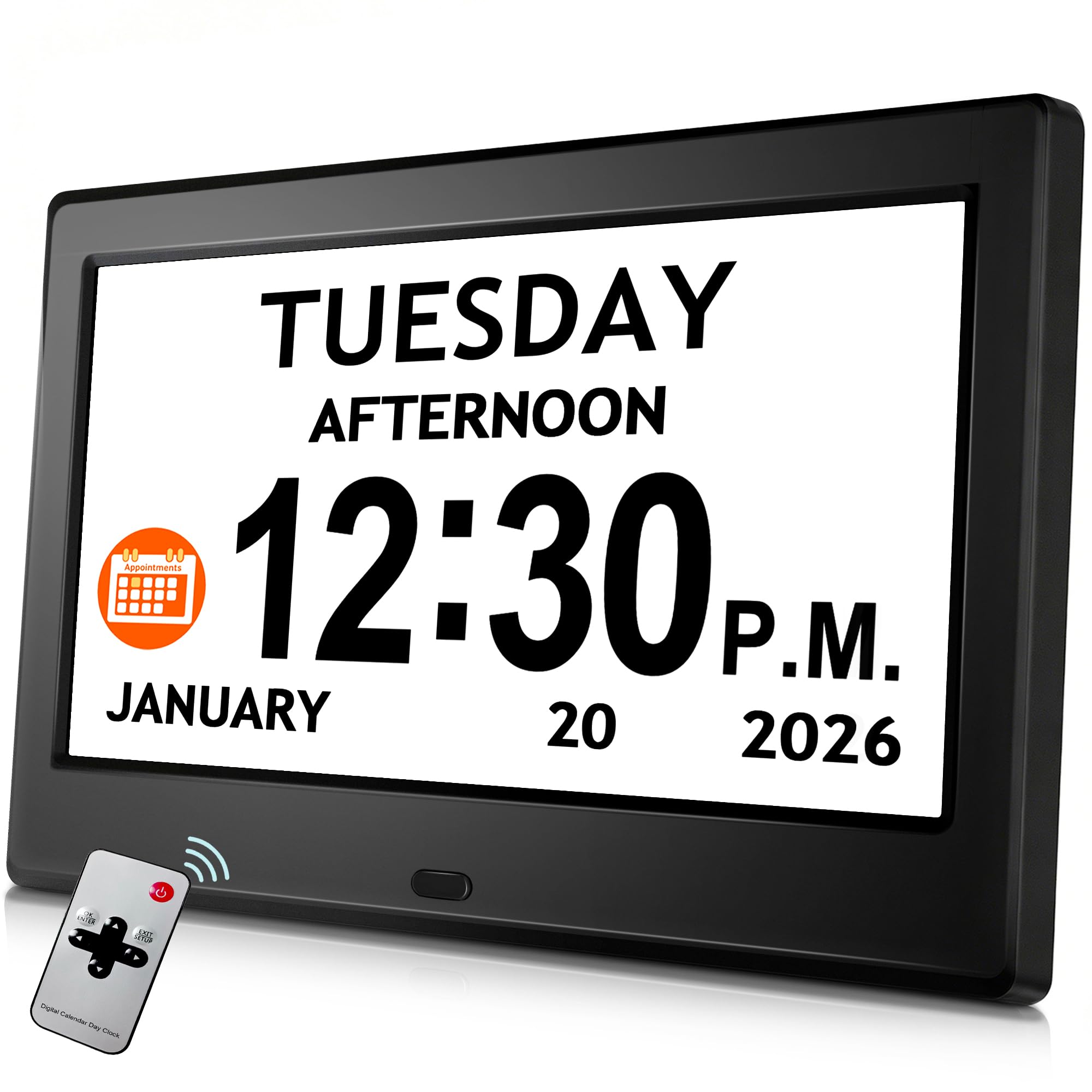
The Pastigio clock solves one of the most disorienting experiences for someone with Alzheimer’s: waking up and having no idea whether it is morning or night. Its 7-inch IPS display divides each day into five clear phases — Before Dawn, Morning, Afternoon, Evening, and Night — so the time of day is answered at a glance without needing to parse numbers. The 1024×600 resolution delivers sharp, bold text that remains readable from any angle in the room.
Auto-dimming adjusts the brightness to ambient light automatically, which prevents a too-bright display from disrupting sleep while keeping it readable at 3 AM. Five manual brightness levels are also available, and the clock offers 8 languages, 5 display styles, and 4 color themes so you can tailor the visual presentation to what reduces confusion. It helps to set 6 custom alarms and 10 daily reminders with visual icons for medication, hydration, and sleep schedules, making it useful beyond just telling time.
The remote control allows adjustments without touching the clock, and the onboard buttons are tucked away to prevent accidental changes. The unit must stay plugged in — there is no battery backup — and one customer reported a failure after a few days, though the majority of feedback praises its clarity and ease of setup. For a dementia clock that does double duty as a visual orientation tool and a reminder system, this is the most feature-complete option on the list.
Why it’s great
- Five-phase day indicator removes confusion about whether it is morning or night.
- Auto-dimming plus 5 manual brightness settings adapt to any room lighting.
- 6 alarms and 10 daily reminders with visual icons support medication and hydration tracking.
- Remote control allows adjustments without disturbing the user.
Good to know
- Must be plugged in at all times; no battery backup for power outages.
- Occasional reliability reports — a small number of units have stopped working short-term.
- Plastic frame may look utilitarian compared to decor-friendly options.
3. Nesthao Bed Sensor Alarm and Fall Prevention

The Nesthao sensor takes a different approach from pressure pads: it uses a motion detection beam that sits on the floor under the bed, triggering the caregiver pager the instant a foot swings down toward the ground. This design eliminates the false alarms from incontinence that plague fabric pressure pads because the sensor only activates when a leg enters the detection zone, not when the patient shifts or leaks. It also works as a door sensor when placed at an entrance to monitor room exits.
The wireless range reaches 918 feet in open space, and the pager offers five volume levels plus a flashing LED strobe for hearing-impaired caregivers. Multiple alarm tunes let you distinguish between the bed sensor and a door sensor if you buy two units, and the dual power supply (alkaline battery plus Micro USB backup) ensures the system stays online during battery changes. Setup is truly tool-free: the sensor is placed on the floor, and the 20-second self-test procedure calibrates the detection zone before active monitoring begins.
Several caregivers note that the lowest volume setting is still fairly loud, so the pager may not be ideal for use right next to a sleeping partner. The detection beam is also wide, which means a pet walking past or a leaf blown by a draft can trigger a false alert; some users solve this by adding cardboard blinders to narrow the beam. Despite these quirks, the Nesthao works well for caregivers who want floor-level detection without the expense of a pressure-pad system.
Why it’s great
- Floor-based motion sensor avoids false alarms from incontinence or rolling in bed.
- 918-foot open-area range covers large homes and multi-story houses.
- LED strobe alert assists caregivers with hearing difficulties.
- Micro USB backup power keeps the system running during battery swaps.
Good to know
- Lowest volume setting is still relatively loud; may disturb others in quiet rooms.
- Wide detection beam can trigger false alerts from pets or moving objects; may need manual blinders.
- Not suitable as a hip-level pad alternative if floor placement is obstructed by furniture.
4. Mitoart Digital Alarm Clock for Seniors
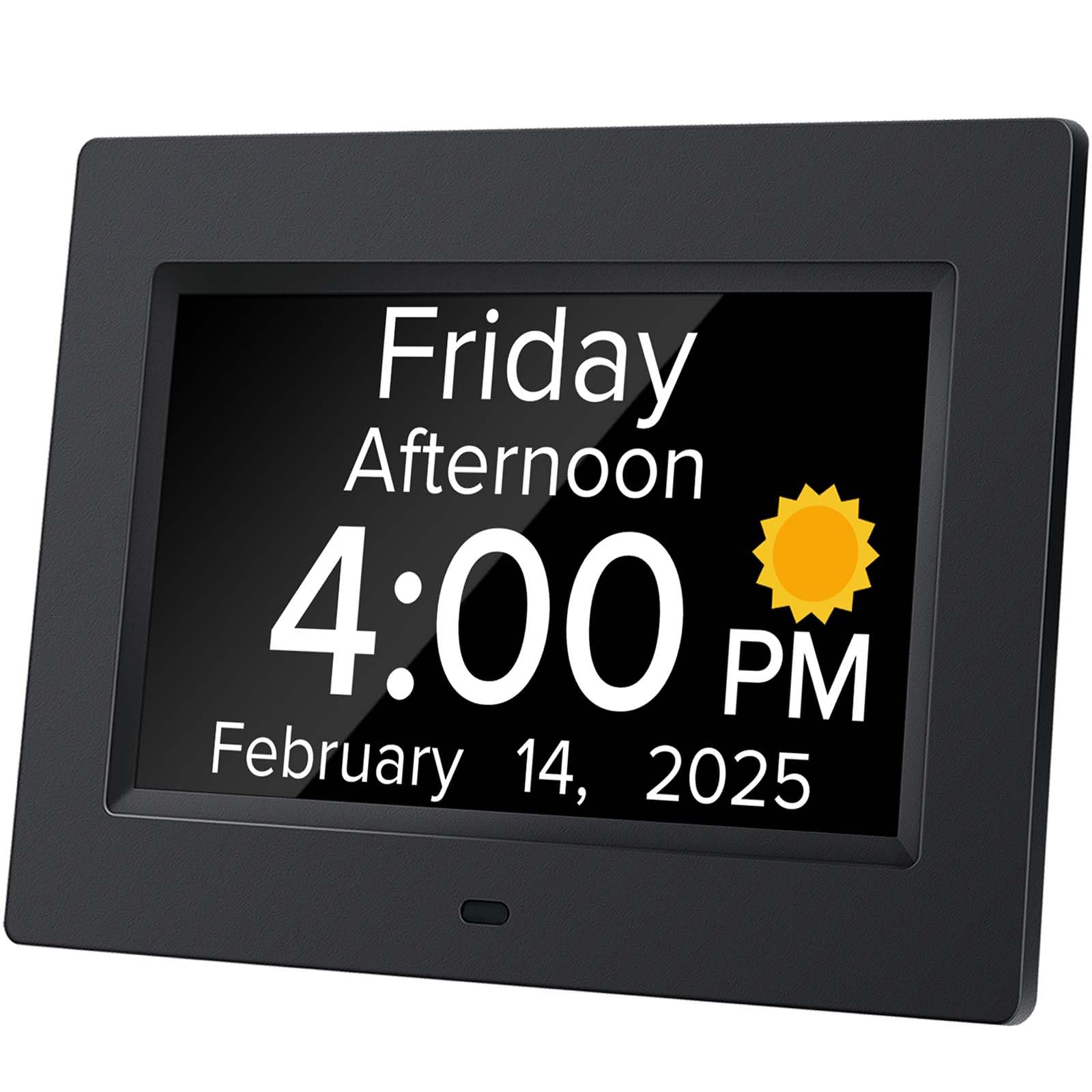
The Mitoart clock takes a straightforward approach to time orientation: a 7-inch display with large, high-contrast digits showing the day of the week, month, date, and time in full text without abbreviations. For someone whose vision is declining alongside their memory, the bold lettering makes a huge difference — the display is legible from across the room, and the auto-dimming drops from 250 cd/m² during the day to a soft 50 cd/m² after 7 PM, which prevents glare at night.
The standout feature is the voice announcement function: pressing a button on the back or using the remote control triggers a spoken announcement of the current time, supporting 9 languages. This is especially valuable for individuals who cannot focus their eyes on the screen or need an audio cue to orient themselves. The clock supports multiple alarms that can be used for medication reminders or schedule prompts, though the interface is intentionally simple to avoid overwhelming the user.
Setup is genuinely one-click, with no complicated menu system, and the remote control makes adjustments possible from across the room. The design is functional rather than decorative — the plastic housing looks a bit utilitarian — but every reviewer who bought it for a parent or spouse reported that it solved the daily problem of not knowing the time or day. One note: the clock runs on AC power, and the battery compartment uses a nonstandard cell that is not included, so a power outage will reset the display to factory defaults unless you install a battery.
Why it’s great
- Voice time announcement button helps users who struggle with reading the display.
- 7-inch display with full date and day in large bold text, no abbreviations.
- Auto-dimming adjusts brightness for day and night without manual switching.
- Supports 9 languages for diverse households.
Good to know
- Battery backup uses a nonstandard cell that is not included; power outage resets the clock.
- Aesthetic design is basic plastic; may not match decor preferences.
- No phase-of-day indicator — only displays the time and date in text.
5. METAK 2-Pack Door and Window Alarms

The METAK 2-pack offers a straightforward, low-cost solution for one of the most stressful Alzheimer’s behaviors: wandering. Each alarm uses a magnetic contact sensor that triggers a loud siren (selectable between 90 dB and 120 dB) when a door or window is opened, alerting the caregiver that the person has exited the room or house. The two-volume design lets you use the quieter 90 dB setting for internal doors where you want a discreet chime and save the full 120 dB for external exits that need a strong warning.
The included remote control works up to 600 feet away, allowing you to arm, disarm, and silence the alarms from across the house or yard. Installation uses strong 3M adhesive pads with no drilling required, and the magnetic sensor design is simple enough to place in minutes on any door, window, or sliding glass panel. The alarms also function as standard home security sensors when Alzheimer’s wandering is no longer the primary concern, adding long-term value beyond the immediate caregiving role.
Customer feedback confirms that the 120 dB volume is genuinely loud — neighbors reported hearing it during tests — which is exactly what you want for an exit alarm when you need immediate awareness. The occasional false trigger from wind on a sliding door can be managed by cleaning the surface thoroughly before mounting and ensuring the magnet gap stays tight. For caregivers on a budget who need immediate wandering protection at the most common exit points, the METAK 2-pack delivers reliable performance without complex installation.
Why it’s great
- Two volume settings (90 dB / 120 dB) allow quieter internal use and loud external alerts.
- 600-foot remote range enables arming/disarming from anywhere in the house.
- Tool-free adhesive installation with no wiring or drilling required.
- 2-pack covers two high-risk exit points right out of the box.
Good to know
- Runs on 2 AAA batteries per unit (not included) with no low-battery warning.
- Strong wind can cause false triggers on sliding doors if the magnet gap is not tight.
- No caregiver pager — alarm sounds only at the door unit itself.
FAQ
What is the difference between a bed pad alarm and a motion sensor alarm for Alzheimer’s fall prevention?
How do phase-of-day indicators help someone with Alzheimer’s read a clock?
Can I use a standard home door alarm to prevent Alzheimer’s wandering?
Final Thoughts: The Verdict
For most users, the best alzheimer’s product for fall prevention is the Lunderg Early Alert Bed & Chair Alarm because its hip-level pad design eliminates false alarms while preserving the patient’s dignity through a silent pager. If you need a time-orientation tool that reduces daily disorientation, grab the Pastigio 7” Digital Clock for its phase-of-day display and auto-dimming IPS screen. And for quick, affordable wandering protection at exit points, nothing beats the METAK 2-Pack Door and Window Alarms with their 120 dB siren and long-range remote.

Mo Maruf
I created WellFizz to bridge the gap between vague wellness advice and actionable solutions. My mission is simple: to decode the research and give you practical tools you can actually use.
Beyond the data, I am a passionate traveler. I believe that stepping away from the screen to explore new environments is essential for mental clarity and physical vitality.