Our readers keep the lights on and my smoothie glass nicely filled. As an Amazon Associate, I earn from qualifying purchases.
The constant cycle of repositioning, the worry of an open wound, and the silent pressure of a bony prominence against a mattress — this is the daily reality of bedsore management. An alternating pressure mattress isn’t a luxury; it’s a medical necessity that actively redistributes weight to maintain blood flow and prevent tissue breakdown.
I’m Mohammad Maruf — the founder and writer behind WellFizz. I spend my time cross-referencing medical device specs, analyzing pump reliability data from long-term care forums, and pressure-testing cycle-time claims against real patient outcomes to separate clinical tools from marketing fluff.
After evaluating dozens of models on air-cell design, pump decibel ratings, and true pressure redistribution, I have curated a definitive guide to the best alternating pressure mattress for bedsores that actually delivers on its promise of tissue offloading and user comfort.
How To Choose The Best Alternating Pressure Mattress For Bedsores
Selecting the wrong air mattress can mean delayed wound healing, wasted funds, and a patient stuck with a system that bottoms out or keeps the whole household awake. Focus on these four pillars rather than flashy marketing claims.
Air Cell Design and Cycle Time
Not all alternating pressure is created equal. A 2:1 cycle (one cell set inflates while two deflate) provides deeper pressure relief than a 1:1 or 3:1 pattern, making it preferred for treating existing Stage I-III ulcers. Look for individual cell construction rather than a single air chamber — replaceable cells mean a leak doesn’t render the entire mattress useless.
Pump Performance and Noise Floor
The pump is the heart of the system. Quiet operation (under 25 dBA) is critical in a home setting where the mattress sits feet from a sleeper’s head. Dual-core pumps with digital controls offer more consistent pressure regulation than analog dials. Diagnostic alarms — low pressure, power failure — separate hospital-grade units from consumer-grade alternatives.
Low Air Loss vs. Standard Alternation
Low air loss (LAL) technology uses micro-perforations to actively wick moisture away from the skin. For incontinent patients or those with heavy perspiration, LAL dramatically reduces skin maceration risk. Standard alternation without LAL is sufficient for dry-skinned, low-moisture patients but may accelerate deterioration if moisture is present.
Mattress Depth and Weight Capacity
An 8-inch replacement mattress prevents “bottoming out” against the bed frame far better than a 5-inch overlay. For bariatric patients, confirm 350–450 lb weight limits. Cell-on-cell designs maintain a lower layer of air during power loss, buying up to 24 hours of protection until power returns — a non-negotiable safety feature for bed-bound users.
Quick Comparison
On smaller screens, swipe sideways to see the full table.
| Model | Category | Best For | Key Spec | Amazon |
|---|---|---|---|---|
| MedVance LAL with Remote | Replacement | Full-featured clinical care | 450 lb capacity / 8 in deep | Amazon |
| ProHeal Cell-on-Cell | Replacement | Moisture management | Low air loss / 20 cells | Amazon |
| Drive Medical Med-Aire | Replacement | Stage 4 wound recovery | 84 in length / 4 cycle times | Amazon |
| Invacare MA500 | Replacement | Low-medium risk prevention | Natural heel slope / 350 lb | Amazon |
| Vive 8 inch | Replacement | Alternation with static pillow | Three static head cells / 8 in | Amazon |
| MedVance Comfort | Overlay | Quiet home use | Digital pump / under 20 dBA | Amazon |
| Vive 5 inch | Overlay | Budget bedside care | 16 sealed chambers / 300 lb | Amazon |
| Kölbs NSR Foam | Foam Replacement | Non-alternating support | 5.5 in high-density foam | Amazon |
| Lunderg Recliner Pad | Chair Overlay | Recliner wheelchair users | 23 dBA pump / 136 air cells | Amazon |
In‑Depth Reviews
1. MedVance Medical Low Air Loss Mattress Replacement System with Alarm

This is the most complete package for home caregivers treating Stage I-III pressure ulcers. The 8-inch cell-on-cell design with 24-hour power-outage protection means bottoming out is virtually eliminated, even during an unexpected outage. The digital pump operates below 20 dBA — genuinely quiet enough to share a room — and the dual-core output maintains consistent pressure across the 450-pound weight limit.
What elevates this system above others is the intuitive LED control panel that displays patient weight and current air pressure. Features like a dedicated “sitting” mode (inflates for 20 minutes during meals then returns to cycle), a static firm setting for transfers, and the CPR rapid-release tag make daily nursing tasks safer. The quilted PU cover is fluid-resistant and vapor-permeable, reducing shear and moisture buildup against the skin.
Real-world users consistently report that pressure sores healed within a month when using this mattress, and the wireless remote — though its IR aiming is finicky — is a genuine help during sheet changes. The pump is tough enough to withstand multiple pet jumps, and the individual replaceable air tubes prevent a single leak from ruining the whole unit.
Why it’s great
- Cell-on-cell construction prevents bottoming out during power failure
- Digital weight-based pressure adjustment with intuitive LED screen
- Dual-core pump is whisper-quiet at under 20 dBA
- Includes sitting, static, and CPR modes for daily care needs
Good to know
- IR remote requires direct line-of-sight to pump front
- Premium price point reflects full clinical feature set
2. ProHeal Low Air Loss Alternating Pressure Mattress (Cell on Cell Base)
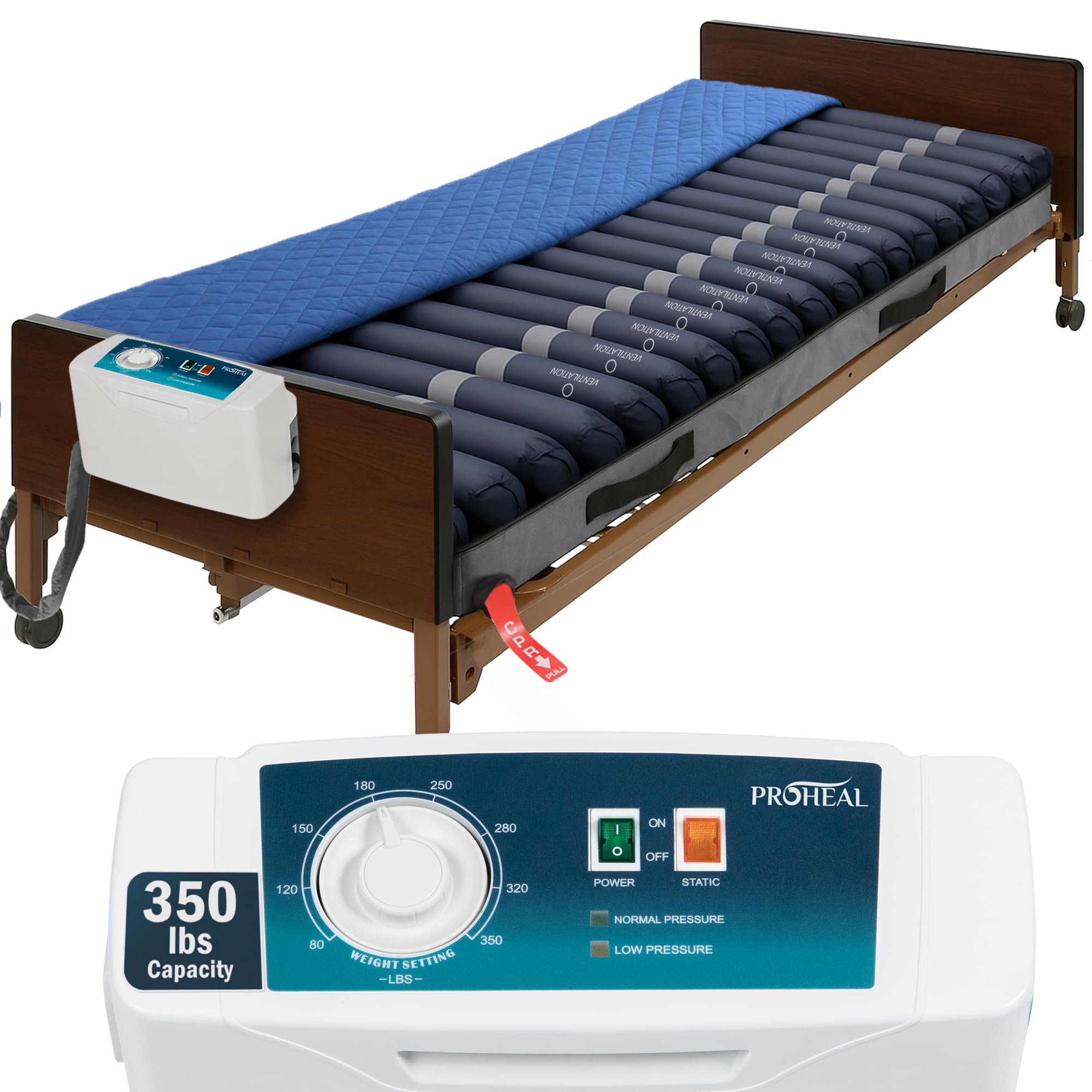
The ProHeal system distinguishes itself with 18 laser-drilled micro-holes across the mattress surface for active low air loss — a critical feature for patients who perspire heavily or experience incontinence. This moisture-wicking ventilation creates a microclimate that directly reduces skin maceration, the precursor to Stage I breakdown. The 10-minute alternating cycle shifts weight between the cell-on-cell bladders, maintaining a 4-inch lower air layer even if power is lost.
With 20 individual bladders arranged in a cell-on-cell pattern, this mattress provides superior envelopment compared to the 16-cell designs found at lower price points. The head formation prevents patient migration during the alternating cycle, and the adjustable airflow dial lets caregivers fine-tune pressure for the heel and buttock areas — the two most common sites for ulcer formation.
Users report that the pump is very quiet during normal operation, with only a low hum during inflation cycles, and the fluid-resistant, non-shear cover is easy to wipe down between uses. The spring tubing lining adds structural durability that prevents sagging over months of continuous use, making this a strong candidate for long-term care facilities and home hospice environments alike.
Why it’s great
- 18 micro-perforations provide active low air loss for moisture control
- 20 individual cell-on-cell bladders prevent bottoming out
- 10-minute cycle with head-formation anti-migration design
- Fluid-resistant, non-shear cover with non-skid bottom
Good to know
- Some units have reported low pressure alarms that are difficult to clear
- Heavier unit at nearly 26 pounds for setup and repositioning
3. Drive Medical Med-Aire Low Air Loss Mattress Replacement System

The Drive Medical Med-Aire is the system wound care nurses reach for when a patient presents with advanced breakdown. Its 84-inch length accommodates taller patients without pressure points at the footboard, and the 4 programmable cycle times (10, 15, 20, 25 minutes) give clinicians granular control over pressure redistribution frequency. The digital pump auto-returns from static mode after two hours, preventing accidental prolonged static pressure.
The 20 individual air cells maximize immersion and envelopment, meaning the patient sinks into the mattress surface rather than resting on top of it. This immersion directly reduces shear forces when the bed is articulated. The removable 4-way stretch PU cover is vapor permeable and low shear, which is essential for fragile skin that tears easily during repositioning. The pump’s diagnostic alarms include a red light and beep that activates if pressure drops below the set threshold.
Real-world feedback from caregivers managing Stage 4 wounds with exposed bone confirms that this mattress, paired with proper wound care, downgraded the wound stage significantly within six months. The control panel retains the weight setting after power loss — a small but vital detail — and the CPR belt allows instant deflation for emergencies. The unit arrives within days and fits standard twin sheets without bunching.
Why it’s great
- 84-inch length accommodates taller bed-bound patients
- 4 programmable cycle times for clinical flexibility
- Auto-return from static mode prevents accidental extended static pressure
- 4-way stretch PU cover reduces shear on fragile skin
Good to know
- Some units arrive with hose leaks requiring a replacement process with the manufacturer
- Foot-end air bladders may shift after months of use, causing uneven support
4. Invacare MA500 microAIR Alternating Pressure Mattress System
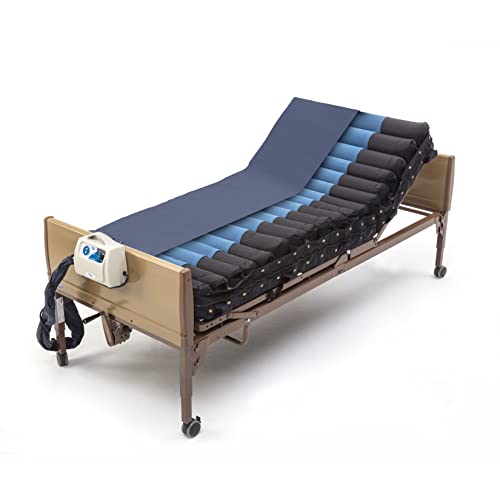
The Invacare MA500 carries the legacy of a trusted medical equipment manufacturer, and its clinical focus is evident in the natural heel slope — a feature deliberately designed to offload pressure from the calcaneus, the bony prominence most vulnerable to heel ulcers. The 2:1 cell cycle provides deeper offloading than consumer-grade 1:1 patterns, making it suitable for patients at low-medium risk or those with existing Stage I-III ulcers.
The cell-in-cell design serves as a fail-safe: if the outer cell loses pressure, the inner cell maintains contact with the patient, preventing complete bottoming out. The oversized pliable quilted nylon top cover is highly vapor permeable, addressing moisture and shear simultaneously. The soft nylon urethane-backed cells wipe clean with standard hospital disinfectants, simplifying the cleaning protocol for in-home caregivers.
User reports highlight that this system can resolve bedsores within three weeks when combined with basic wound care and medication. The pump is notably quiet enough for room-sharing arrangements, though one measurement placed it around 50 dBA — louder than the sub-20 dBA claims of competing models. The system arrives at a weight of just 13.5 pounds, making it the lightest full-replacement mattress in this lineup, which simplifies initial setup and seasonal rotation.
Why it’s great
- Natural heel slope offloads calcaneus pressure specifically
- Cell-in-cell construction prevents complete bottoming out
- Lightweight at 13.5 pounds for easy handling and setup
- Clinical-grade vapor-permeable cover reduces friction and moisture
Good to know
- Pump measured around 50 dBA in some user reports, not whisper-quiet
- 350-pound weight limit is lower than some premium alternatives
5. Vive 8″ Alternating Pressure Mattress with Low Air Loss

The Vive 8-inch model occupies a critical niche: it provides the depth of a full replacement mattress at a price point closer to mid-tier overlays. The 16 air chambers alternate on a variable cycle, and critically, the three cells at the head remain static, forming a stable pillow that prevents the patient’s head from sinking into the alternating rhythm — a feature that significantly improves sleep quality for those who are not fully bedridden.
The ultra-quiet pump attaches to the footboard with non-marking hooks, keeping the floor clear for caregiver movement. The waterproof vinyl cover is breathable and supports up to 350 pounds. Unlike many overlays, this unit comes with a one-year pump warranty and a 60-day mattress pad guarantee, offering longer protection than the typical 30-day window. The variable frequency control lets you shift between alternation and a full static mode.
Paraplegic and bed-bound users report that this mattress resolved existing bedsores within a week when used in conjunction with wound vac therapy. The hissing sound during cell deflation is minimal but present — caregivers note it increases slightly when the patient shifts weight. The 24-pound weight makes it a substantial unit that stays in place, and the non-marking hooks eliminate the need for a dedicated pump table or floor stand.
Why it’s great
- Three static head cells provide a stable pillow area for comfort
- Variable frequency alternation with full static mode option
- Breathable waterproof cover with 350-pound capacity
- One-year pump warranty and 60-day mattress coverage
Good to know
- Hissing noise from cell deflation may be noticeable in a quiet room
- Occasional pump failures reported within the first two months of use
6. MedVance Comfort Alternating Air Pressure Mattress Pad

The MedVance Comfort pad is an overlay designed to sit atop an existing mattress, which makes it an accessible entry point for families who already own a supportive bed frame but need active pressure redistribution. The digital pump operates at under 20 dBA — genuinely silent in a home bedroom — with dual-core output that maintains steady pressure without the surging sound typical of single-core pumps. The diagnostic alarms alert caregivers to pressure drops without waking the patient.
The hospital-grade nylon cover with a quilted poly PU top is water-resistant and has an anti-slip coating, addressing the common complaint of mattress shifting during the alternating cycle. The CPR pull-tag deflates the entire pad in under a second — a legally required safety feature for medical-grade overlays. The 6-minute inflation/deflation cycle is faster than the 10-minute cycle found on the ProHeal, which some users find more soothing, while others feel it is too rapid for deep sleep.
Owners report that the pad inflates in about 15 minutes (slightly longer than the advertised time) and that each hump is a removable, replaceable cell — a repair-friendly design that extends the product’s usable life. The included patch kit contains a spare cell, though the instructions do not clearly indicate this, so caregivers should inspect the patch bag carefully upon arrival.
Why it’s great
- Ultra-quiet pump at under 20 dBA for peaceful sleep environment
- Removable and replaceable individual air cells extend product life
- CPR pull-tag allows instant deflation for emergency access
- Anti-slip coating on cover prevents shifting on the bed frame
Good to know
- Some units fail within 3-4 weeks due to the mattress pad fully deflating under body weight
- Instructions may reference a different model, causing initial setup confusion
7. Vive 5″ Alternating Pressure Mattress Overlay
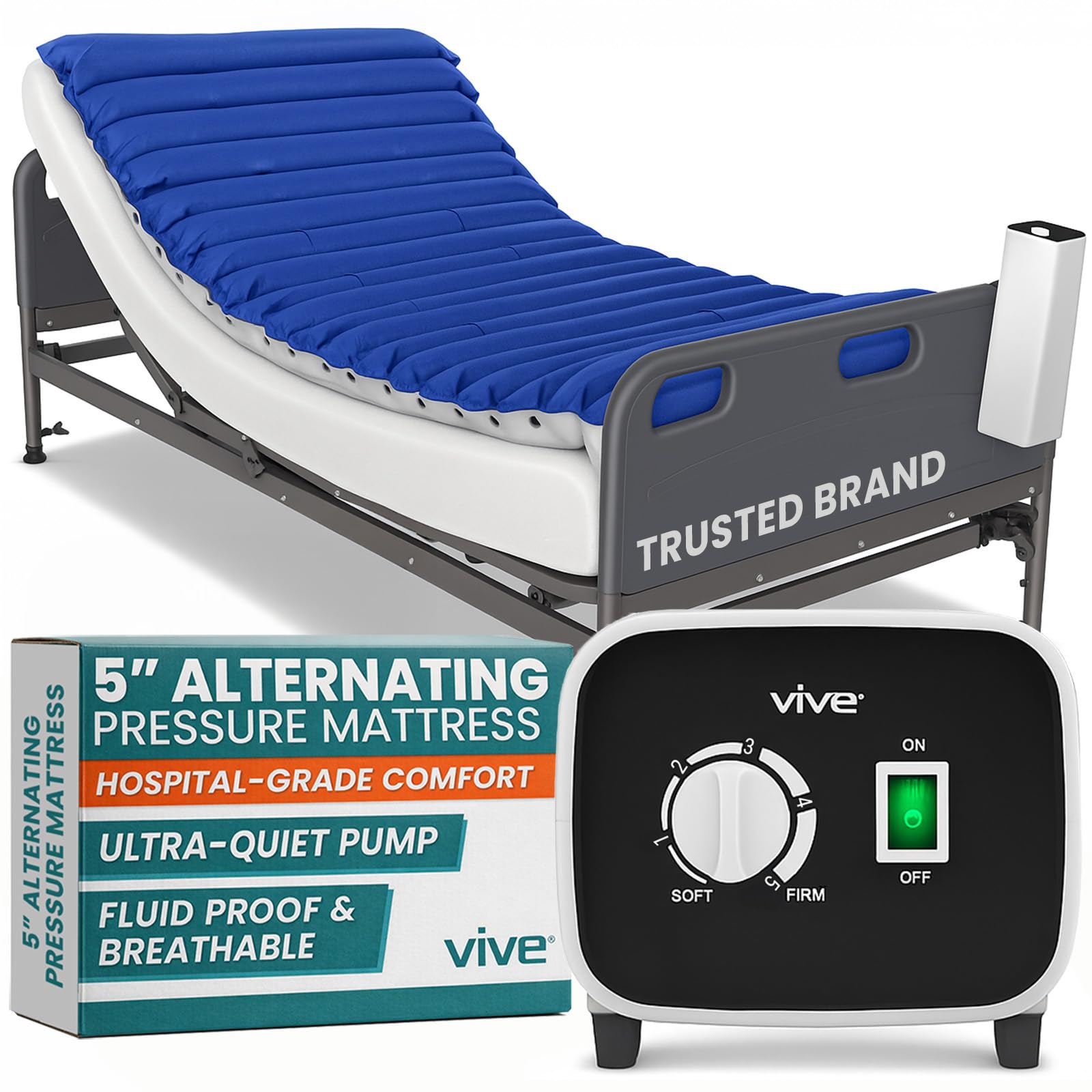
The Vive 5-inch overlay is the most cost-effective way to bring alternating pressure therapy into a home setting without committing to a full mattress replacement. Its 16 sealed air chambers use a variable-pressure pump that adjusts from soft to firm via a simple dial, and the ultra-quiet operation makes it tolerable for room-shared caregiving. The waterproof vinyl cover is latex-free and breathable, allowing heat to dissipate rather than trapping it against the skin.
Unlike many budget overlays, the Vive includes two non-marking hooks that attach the pump securely to the foot of the bed, keeping it from sliding onto the floor during the night. The FSA/HSA eligibility adds financial flexibility for families managing medical expenses. The low air alarm can be triggered by the three CPR plugs not being fully seated — a known minor issue that is resolved by double-checking all connectors during setup.
Users caring for bedridden MS patients report that the bumpy alternating pattern improved circulation and healed massive bedsores over several months of continuous use. The 300-pound weight limit covers most standard adult patients, though heavier users will want to step up to the 8-inch Vive or the MedVance. The 5-inch profile sits low enough that transferring from a wheelchair is easier than with thicker replacement mattresses, though the straps provided for securing it to the bed are borderline insufficient — adding a non-slip pad underneath is a common caregiver hack.
Why it’s great
- Affordable entry point for bringing alternating pressure into the home
- FSA/HSA eligible for healthcare spending accounts
- Ultra-quiet pump with simple soft-to-firm dial adjustment
- Latex-free waterproof cover prevents heat buildup
Good to know
- Straps provided are insufficient to prevent sliding on slick bed surfaces
- Low air alarm can be falsely triggered if CPR plugs are not fully seated
8. Kölbs NSR Long Term Care Pressure Redistribution Foam Hospital Mattress

The Kölbs NSR is not an alternating pressure mattress — it is a high-density foam replacement designed for pressure redistribution rather than active offloading. This distinction matters: foam mattresses provide static pressure relief by distributing weight across a larger surface area, making them suitable for low-risk patients who can shift independently but need better support than a standard spring mattress. The 5.5-inch profile is significantly thinner than air replacement systems.
The waterproof, removable cover is fire retardant, meeting hospital safety compliance standards. The non-slip underside keeps the mattress in place on a medical bed frame without requiring straps. The high-density foam core prevents pressure buildup by evenly distributing the patient’s weight, but it cannot match the dynamic pressure cycling of an air-based system for treating existing Stage II-IV ulcers. It works best as a supportive base under an alternating pressure overlay.
Users who paired this foam mattress with an egg crate or memory foam topper found it infinitely more comfortable than the standard hospital-issue spring mattress provided by insurance. The 22-pound weight makes it easy to flip and rotate for even wear. The 80 x 36-inch size fits full-size hospital beds but will not fit standard 75-inch twin frames — a important dimensional note for home setups using a standard twin bed.
Why it’s great
- High-density foam evenly distributes weight for static pressure relief
- Fire-retardant, waterproof cover with non-slip underside
- Lightweight at 22 pounds for easy flipping and rotation
- Serves as a supportive base layer under alternating pressure overlays
Good to know
- Not an active alternating pressure system — will not cycle or offload dynamically
- Slippery surface may cause fitted sheets to slide off unless corrected with a topper
9. Lunderg Alternating Air Pressure Pad for Recliner Chair

The Lunderg pad is purpose-built for a specific and often underserved population: patients who spend extended hours in recliners, lift chairs, or sofas rather than lying in a hospital bed. With 136 individual air cells, it provides high-density pressure redistribution across a smaller footprint than a full mattress overlay. The slow inflation and deflation cycle increases circulation and relieves pressure from bony prominences like the sacrum and ischial tuberosities — common sites for chair-related sores.
The upgraded pump operates at just 23 dBA, which users consistently describe as exceptionally quiet, with only a faint hiss during the release cycle. The static mode is a thoughtful addition: when the patient needs a stable surface for eating or watching television, all cells remain fully inflated, then resume alternating when the patient rests. The medical-grade 4-way stretch cover now includes anchor straps to prevent slippage, addressing a common complaint with earlier versions.
Caregivers of elderly parents report that this pad reduced soreness in pressure areas within days and helped heal existing pressure wounds. The slow cycle is less jarring than faster alternation patterns, making it more comfortable for light sleepers. The pad supports up to 300 pounds and fits most standard recliners without overhang. The 30-day return policy and responsive customer service provide peace of mind for first-time medical device buyers navigating this unfamiliar product category.
Why it’s great
- Specifically designed for recliner/sofa use, not just bed frames
- 136 air cells provide dense pressure distribution for chair users
- Whisper-quiet 23 dBA pump with static mode for seated activities
- Updated anchor straps on the cover prevent shifting on smooth upholstery
Good to know
- May still slide on some lounge chairs; rubberized backing would be an improvement
- Some units arrive faulty out of box, though customer service handles replacements quickly
FAQ
Can I use an alternating pressure mattress on a standard bed frame?
How often should the alternating cycle be set for Stage II pressure ulcers?
What does the CPR tag actually do?
Can I wash the mattress cover in a washing machine?
How do I know if the mattress is providing enough pressure relief for my patient?
Final Thoughts: The Verdict
For most users, the best alternating pressure mattress for bedsores winner is the MedVance Medical Low Air Loss Mattress Replacement System because it pairs cell-on-cell safety with a digital pump rated under 20 dBA, a 450-pound capacity, and intuitive controls that reduce caregiver error. If your priority is active moisture management for incontinent patients, grab the ProHeal Low Air Loss Mattress with its 18 micro-perforation ventilation. And for the specific scenario of a recliner-bound patient who needs alternating pressure without a hospital bed, nothing beats the Lunderg Recliner Pad — it is the only unit in this lineup purpose-built for chair-based pressure sore prevention.

Mo Maruf
I created WellFizz to bridge the gap between vague wellness advice and actionable solutions. My mission is simple: to decode the research and give you practical tools you can actually use.
Beyond the data, I am a passionate traveler. I believe that stepping away from the screen to explore new environments is essential for mental clarity and physical vitality.