Our readers keep the lights on and my smoothie glass nicely filled. As an Amazon Associate, I earn from qualifying purchases.
An alternating air pressure mattress isn’t a luxury; it’s a clinical necessity for anyone confined to a bed. The rhythmic inflation and deflation of air cells redistributes body weight, preventing capillary closure that leads to pressure ulcers. But the market is crowded with pumps that rattle all night, vinyl surfaces that trap heat, and pads that fail within weeks.
I’m Mohammad Maruf — the founder and writer behind WellFizz. My research focuses on the mechanical durability of medical-grade pumps, the density of foam alternatives, and the real-world cycle counts that separate a six-month pad from a five-year system.
This guide breaks down the measurable differences in pump noise, cell construction, and static-mode functionality so you can confidently select the best alternating air pressure mattress for your specific care scenario.
How To Choose The Best Alternating Air Pressure Mattress
Selecting the right system goes beyond price. You need to match the patient’s mobility level, skin condition, and sleep environment with a pump and pad that deliver consistent, quiet alternation. Focusing on a few key engineering details will prevent expensive returns and clinical setbacks.
Pump Noise and Cycle Time
Look for pumps rated at or below 23 dBA if the mattress is used in a bedroom. A louder pump disrupts sleep for both patient and caregiver. Cycle time — the interval at which cells alternate — typically falls between 5 and 9 minutes. Shorter cycles provide more frequent pressure redistribution, which is critical for patients with Stage 1 or Stage 2 ulcers.
Surface Material: Flocked vs. Vinyl vs. Quilted
Standard vinyl pads are waterproof but become hot and sticky. Flocked surfaces add a fabric-like layer that wicks moisture and feels cooler against the skin. Quilted poly-PU covers offer a hospital-grade balance of breathability and fluid resistance. If the patient sweats heavily or has sensitive skin, avoid bare vinyl and choose a flocked or quilted top.
Cell Design and Replaceability
Individual air cells (bubble design) allow for targeted support and are often replaceable if one fails. Tube-style channels are simpler but can bottom out under pressure at the hips or shoulders. Systems with 130 or more individual air cells distribute weight more evenly. Check if the manufacturer includes spare cells in the patch kit.
Quick Comparison
On smaller screens, swipe sideways to see the full table.
| Model | Category | Best For | Key Spec | Amazon |
|---|---|---|---|---|
| Drive Medical Med Aire | Mid-Range | Budget-conscious clinical care | 130 Air Cells | Amazon |
| Lunderg (Flocked) | Mid-Range | Comfort & moisture management | 23 dBA Pump | Amazon |
| Lunderg Queen | Mid-Range | Larger patients (up to 320 lbs) | 53 x 77 inch pad | Amazon |
| Vive 5″ Alternating | Mid-Range | Variable firmness control | 16 Sealed Air Chambers | Amazon |
| MedVance Comfort | Mid-Range | Hospital-grade with CPR release | >20 dBA Pump | Amazon |
| Livaclean Health Gel Foam | Premium | Non-alternating gel/foam comfort | 6 inch Gel Memory Foam | Amazon |
| Invacare Softform Premier | Premium | High-risk pressure injury prevention | 500 lb Capacity | Amazon |
| Drive Med-Aire Low Air Loss | Premium | Advanced wound care & moisture wicking | 20 Replaceable Bladders | Amazon |
| MedVance Digital Low Air Loss | Premium | Full-featured digital system with backup | 8 inch Cell Depth | Amazon |
In‑Depth Reviews
1. Drive Medical Med Aire Alternating Pressure Pump and Pad System

The Drive Medical Med Aire is a workhorse overlay that balances clinical effectiveness with a reasonable investment. Its 130 individual air cells alternate every 5 minutes, ensuring no single pressure point is left compressed for long. The heavy-gauge vinyl construction holds up well under consistent use, and the integrated end flaps keep the pad from sliding on the mattress.
The 4 LPM pump offers both fixed and variable pressure settings, giving caregivers control over firmness based on the patient’s weight and skin condition. At a 300-pound weight capacity, it accommodates most users without bottoming out. The pump is described as quiet but not silent—a few users note a low operational hum that fades into the background of a calm room.
Real-world reports confirm this pad has prevented bedsores for months in home care settings, with several users noting it outperforms more expensive alternatives. The main trade-off is the vinyl surface, which can feel warm; a thin cotton sheet over the pad resolves this easily. For a dependable, no-frills alternating system, the Med Aire delivers outstanding value.
Why it’s great
- 130-cell design distributes pressure evenly across the body
- End flaps and mounting brackets keep pad secure on adjustable beds
Good to know
- Vinyl surface can trap heat and moisture without a sheet layer
- Pump noise is moderate; may be noticeable for very light sleepers
2. Lunderg Alternating Air Pressure Mattress Pad with Flocking
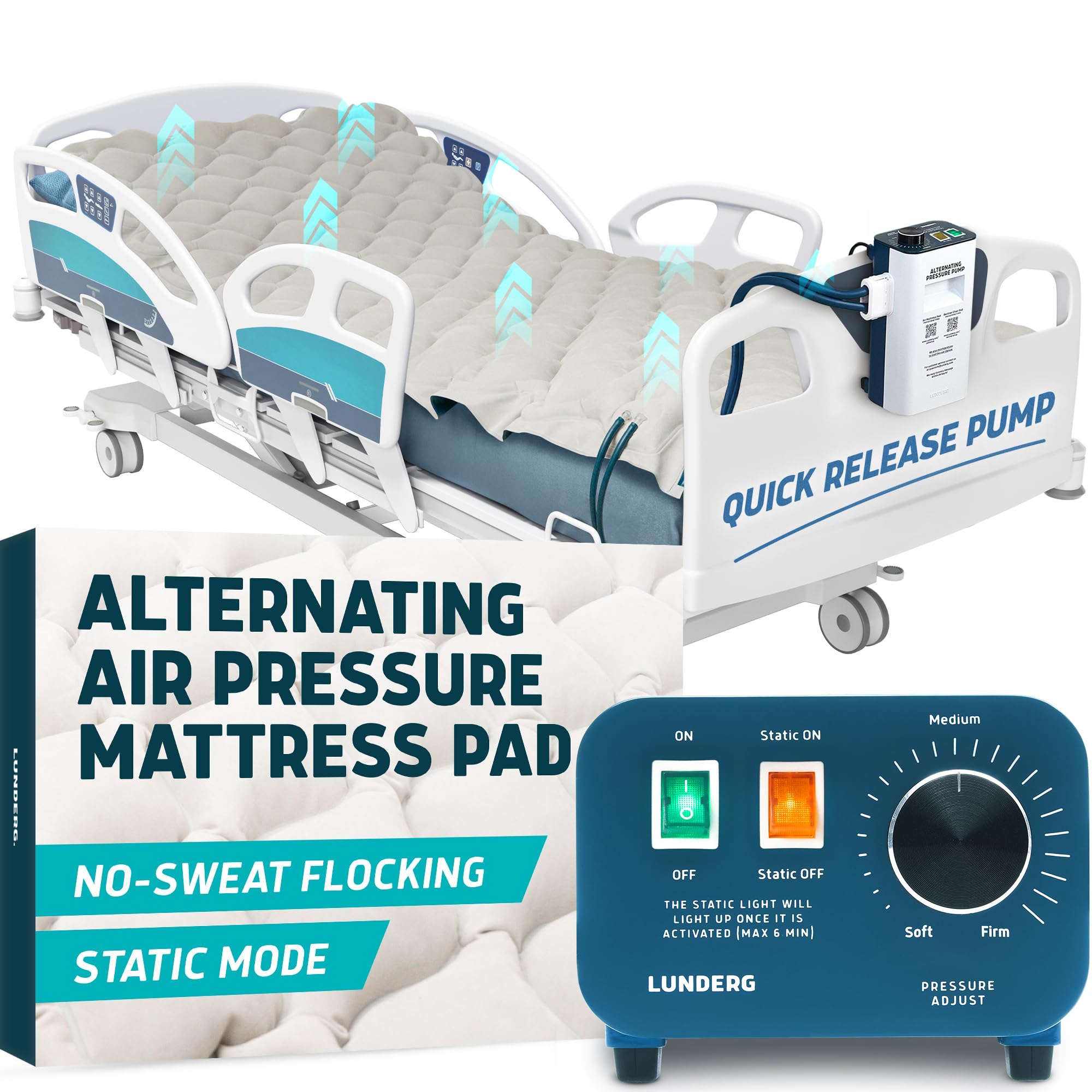
The Lunderg pad distinguishes itself with its patented flocking technology, which adds a soft, fabric-like layer over the vinyl air cells. This eliminates the sticky, sweaty sleep experience common with standard medical overlays. The surface wicks moisture and feels noticeably cooler, a critical feature for bedridden patients prone to night sweats.
The pump operates at an ultra-quiet 23 dBA, which several users confirm is nearly silent during operation. The addition of a static mode allows all cells to remain fully inflated, providing a stable surface for sitting up or when the patient simply wants a break from the alternating sensation. A quick-connector makes setup straightforward, and the patch kit adds long-term security.
Weight capacity is 300 pounds, and the pad fits standard twin to full-size beds. Reviews from paraplegic and tetraplegic users highlight the comfort of the flocked surface, with one noting it eliminated red marks after a month of use. The pump’s silence is praised universally. The only caveat is that the flocking may shed slightly over time, but this does not affect function.
Why it’s great
- Flocked surface prevents heat and moisture buildup better than bare vinyl
- Static mode offers a stable, non-alternating surface for sitting or resting
Good to know
- Flocking may show light wear or shedding after extended use
- Inflatable pad size is narrower than the full queen dimensions
3. Lunderg Queen Size Alternating Air Pressure Mattress Pad
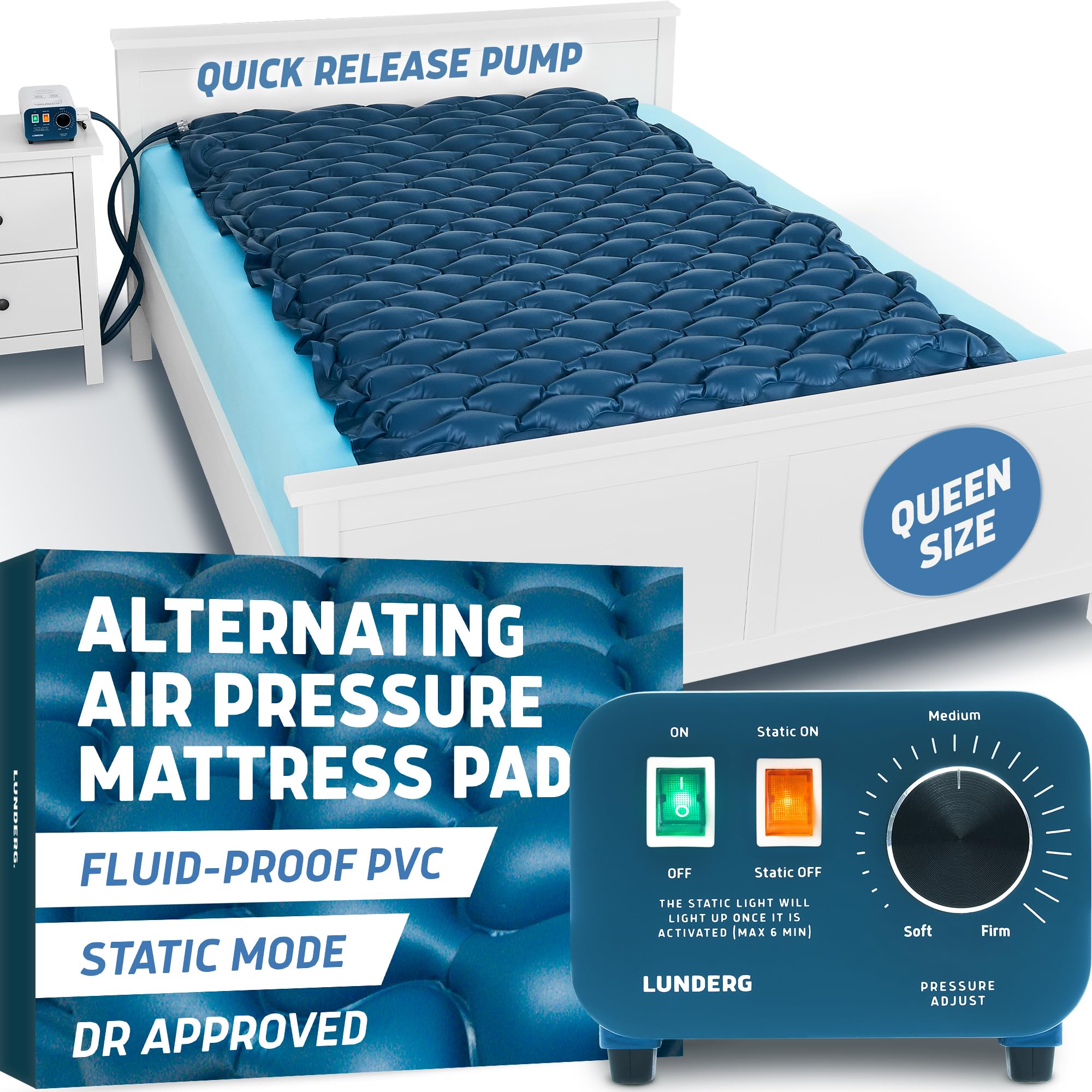
This queen-specific Lunderg model expands the coverage area to 53 by 77 inches, making it ideal for larger beds and patients up to 320 pounds. The pad uses the same proven PVC air-cell construction and quiet pump as its smaller sibling, with the same 23 dBA noise rating and static-mode functionality.
A waterproof mattress topper is included, adding a hygiene layer that protects the pad from spills and incontinence. The pump uses a quick-connector for the air hoses, and setup requires about 20 minutes for full inflation over three cycles. The pressure adjustment knob allows caregivers to dial in firmness from soft to firm based on the patient’s comfort level.
User feedback mirrors the positive experience of the standard Lunderg: silent motor, effective alternation that prevents pressure marks, and a noticeable improvement in sleep quality for elderly and post-surgery patients. The blue PVC surface is easy to wipe clean. The trade-off is that the surface remains vinyl-based rather than flocked, so a sheet is recommended for breathability.
Why it’s great
- Generous queen size fits larger beds and accommodates higher weight capacity
- Includes a waterproof topper and whisper-quiet 23 dBA pump
Good to know
- Vinyl surface without flocking may feel warm; sheet recommended
- Pad inflates to a thickness that may raise the sleeping height noticeably
4. Vive 5″ Alternating Pressure Mattress
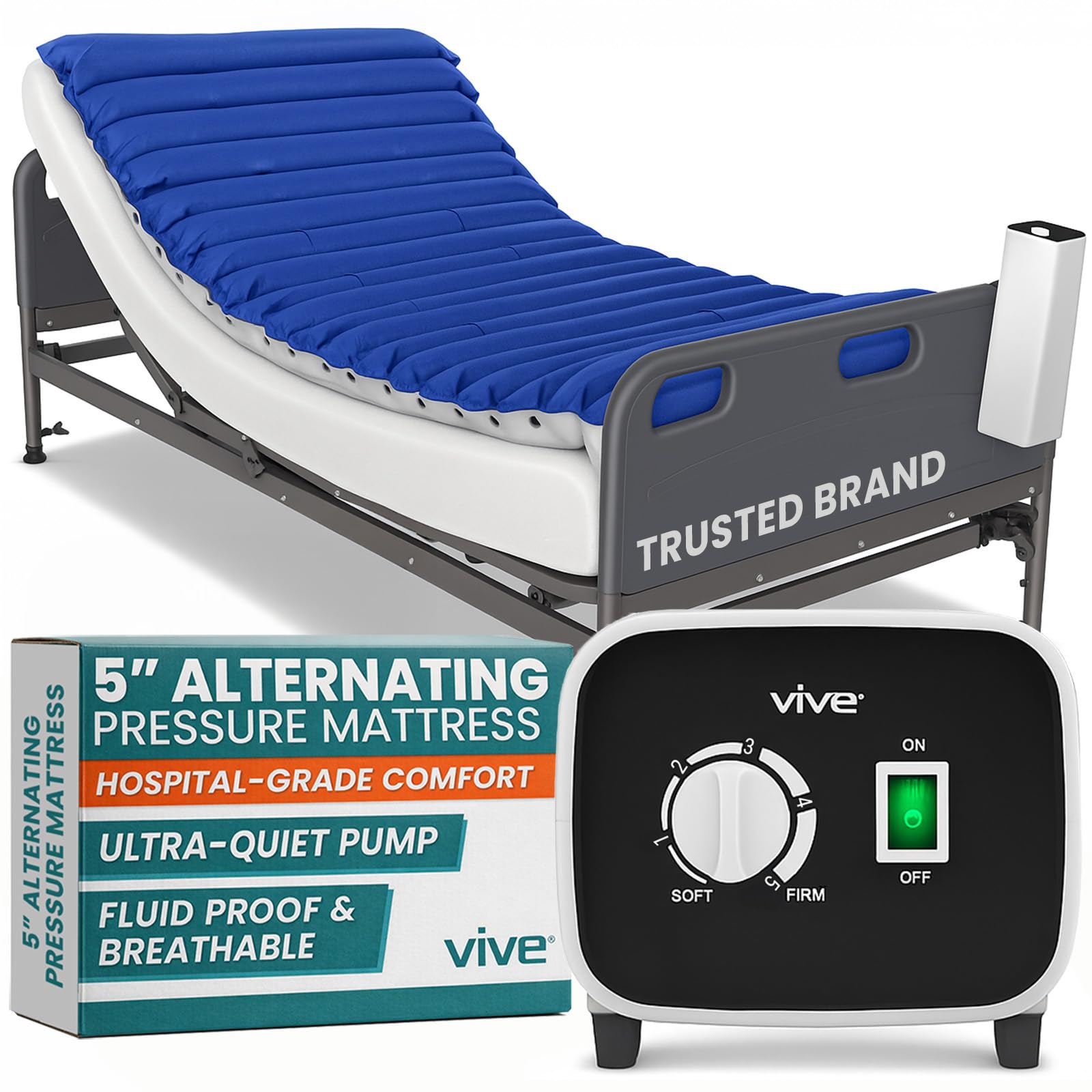
The Vive system uses 16 sealed air chambers that inflate to a 5-inch depth, providing significant immersion compared to thinner overlays. The variable pressure pump includes a dial that adjusts firmness from soft to firm, and an ultra-quiet motor that does not disturb sleep. The pump display keeps settings consistent once locked in.
The waterproof vinyl cover is latex-free and breathable, with a design that allows heat to dissipate. It supports up to 300 pounds and fits standard hospital and home beds. Notably, the pump includes a low-air alarm that alerts caregivers if pressure drops, a useful safety feature for high-risk patients.
Reviews highlight effective wound healing for bedridden MS patients and post-surgical recovery cases. The main complaint involves the retaining straps, which some users find ineffective at keeping the pad centered. A few users also report difficulty repackaging the system for returns. The alternating action is reliable and the pump is genuinely quiet.
Why it’s great
- 5-inch depth provides deeper pressure relief compared to standard overlays
- Low-air alarm adds a safety net for caregivers
Good to know
- Retaining straps may not hold the pad securely on all mattress types
- Return process can be cumbersome due to original packaging requirements
5. MedVance Comfort Alternating Air Pressure Mattress Pad

The MedVance Comfort pad combines a hospital-grade nylon cover with a digital pump that operates below 20 dBA. The quilted poly-PU top layer is water-resistant and breathable, with an anti-slip coating that keeps the pad in place. Adjustable straps attach to the bed frame for additional security.
A standout feature is the CPR emergency deflation tag. Pulling it instantly collapses all air cells, allowing chest compressions without obstruction. The pump includes diagnostic alarms and a digital control for precise pressure adjustment. The pad inflates fully in roughly 15 minutes, and individual cells are replaceable using the included spare and patch kit.
User feedback is generally positive, praising the quiet motor and effective pressure relief. However, some users note that the pump can be overly firm on the lowest setting, and the control knob is easy to accidentally adjust. The CPR function and replaceable cells are strong selling points.
Why it’s great
- CPR pull tag enables instant deflation for emergency situations
- Quilted nylon cover is breathable, water-resistant, and anti-slip
Good to know
- Some units have experienced early pad failure within weeks
- Pressure control knob can be bumped and change settings accidentally
6. Livaclean Health Hospital Bed Mattress

The Livaclean Health mattress is a non-alternating alternative that uses a 30mm gel memory foam layer over high-density support foam. This is not an air-cell system, but it provides effective pressure relief through material immersion, making it a suitable option for patients who do not require active alternation but still need protection against pressure buildup.
The mattress measures 80 by 36 by 6 inches, fitting standard twin XL hospital beds. The included waterproof cover is removable and breathable. Four corner straps secure the mattress to adjustable frames during position changes. The gel layer helps dissipate heat better than standard memory foam, and the overall construction supports up to 242 pounds.
Users appreciate the ease of cleaning and the firm-yet-comfortable feel. One caregiver noted that an elderly parent who resisted sleeping on an air cell system transitioned well to this foam mattress. The 8-year foam warranty provides long-term confidence. The key limitation is that it does not alternate, so it is not a direct replacement for an alternating pressure system when frequent repositioning is medically required.
Why it’s great
- Gel memory foam layer provides cooling and pressure relief without pump noise
- Removable waterproof cover simplifies hygiene and cleaning routines
Good to know
- Does not alternate pressure; not suitable for active wound prevention protocols
- Weight capacity of 242 lbs is lower than some air cell alternatives
7. Invacare Softform Premier Hospital Bed Mattress

The Invacare Softform Premier is a premium foam mattress designed for patients rated at “Very High Risk” for pressure injuries. It uses a unique U-core and contoured foam insert that creates independent zones for the head, mid-section, and feet. This zoned construction provides firmer support where it is needed most while allowing softer immersion around bony prominences.
The four-way stretch polyurethane cover is fluid-resistant and extends the mattress’s lifespan while making cleaning straightforward. The mattress itself is 6 inches thick and supports up to 500 pounds, making it bariatric-friendly. Its design reduces shear and friction during repositioning, a critical factor in preventing skin breakdown.
Real-world feedback from caregivers notes a significant reduction in bedsores after switching to this mattress. One user reports that their parent experienced immediate relief from tailbone and neck pain. The main preparation requirement is that the foam may take several days to fully expand to its 6-inch height after unboxing. The foam construction means there is no pump noise, which is a clear advantage for quiet sleep environments.
Why it’s great
- 3-zone foam construction provides targeted support for high-risk pressure areas
- 500-pound weight capacity makes it suitable for bariatric patients
Good to know
- Requires 48+ hours to fully expand after unboxing
- Does not provide alternating pressure; relies on static foam immersion
8. Drive Medical Med-Aire Low Air Loss Mattress Replacement System
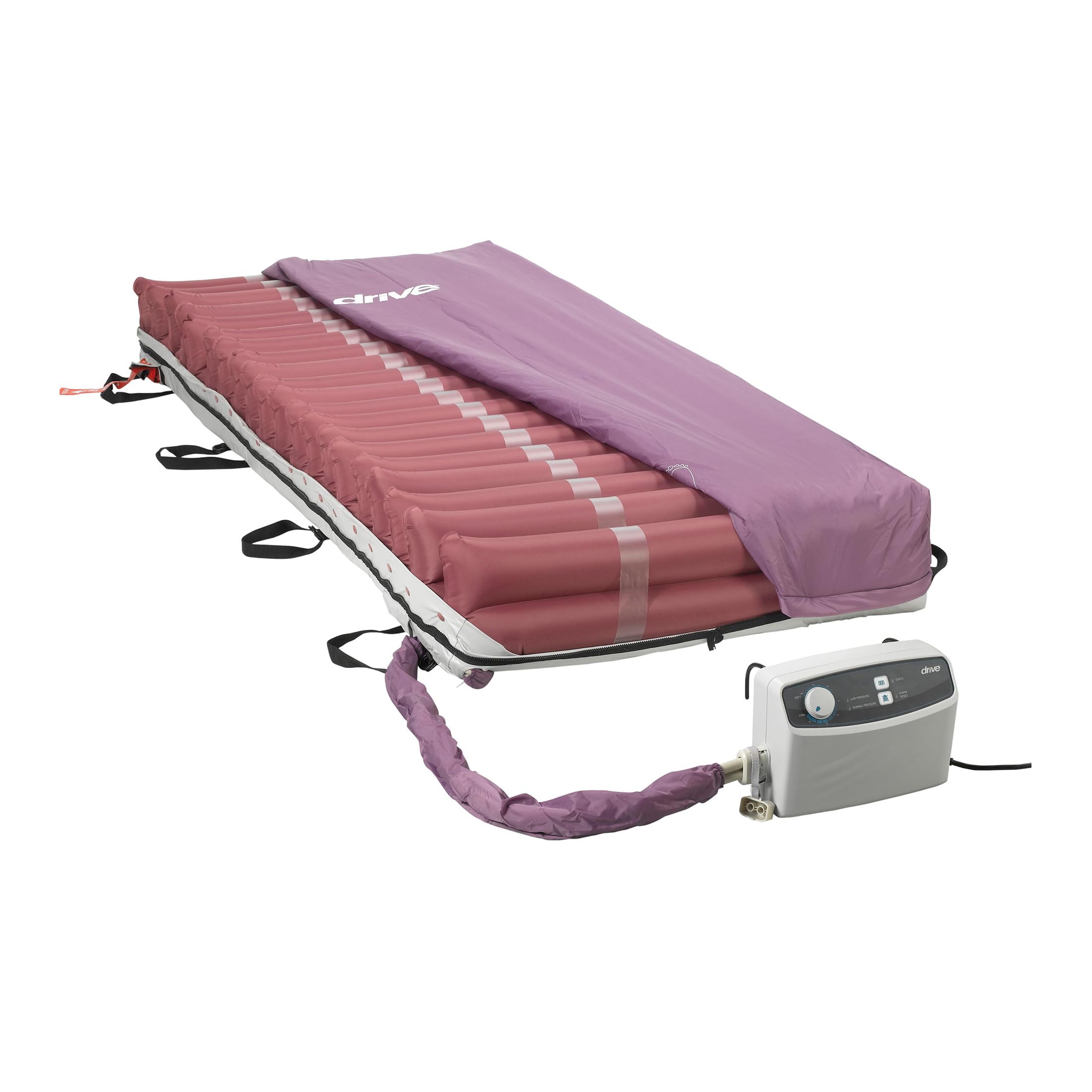
The Med-Aire Low Air Loss system is a full mattress replacement, not just an overlay. It features 20 individual replaceable air bladders that are 8 inches deep, providing substantial immersion. The low air loss technology continuously circulates air through the vapor-permeable cover, reducing moisture, friction, and heat buildup at the skin surface.
The pump includes an audio-visual alarm system that automatically monitors and alerts caregivers to low pressure. The alternating pressure cycle works in conjunction with the low air loss function to redistribute weight and keep the skin dry. A built-in pillow feature maintains inflation in the head cells for comfort during reading or watching TV.
Users report excellent outcomes for high-risk patients, with one noting the mattress healed existing bedsores over several months. The pump noise is described as a moderate hum, comparable to an aquarium pump, which can be mitigated by placing a pillow between the pump and the bed frame. A common recommendation is to use only a thin cotton sheet over the surface to preserve airflow. At about 5 years of typical use before a leak develops, this system offers a solid lifespan for its tier.
Why it’s great
- Low air loss function actively wicks moisture and reduces heat buildup
- Replaceable 8-inch bladders extend the system’s usable life significantly
Good to know
- Pump produces a moderate hum; may require dampening for light sleepers
- Full mattress replacement means the bed frame must be compatible
9. MedVance Medical Low Air Loss Mattress Replacement System

The MedVance system is the most feature-rich option in this lineup, with a fully digital pump that uses an LED screen to display weight and pressure settings. The cell-on-cell design creates an 8-inch depth that prevents bottoming out, even for patients up to 450 pounds. A 24-hour power outage backup maintains inflation, a critical safety net for electrically dependent systems.
Features include a pillow function for the top three cells, a “sitting” mode that inflates for 20 minutes to make meals and transfers easier, and a CPR rapid-release tag. The quilted nylon cover is water-resistant, anti-slip, and attaches securely to the bed frame. The pump operates below 20 dBA, and dual pump cores ensure continuous output even if one core is stressed.
Patients and caregivers report rapid healing of pressure sores, often within one month. The replaceable individual air tubes and sturdy build quality receive consistent praise. A notable complaint is the wireless remote, which has a narrow IR beam and requires direct line-of-sight to function properly. The pump itself is well-regarded for performance, though one user found the knock sound during cycling to be disruptive at night. Overall, this is a system built for long-term, high-acuity care.
Why it’s great
- Digital LED control with weight-based pressure adjustment and 24-hour backup
- Cell-on-cell 8-inch design prevents bottoming out up to 450 lbs
Good to know
- Wireless remote has poor range and requires direct line-of-sight
- Some users report a knocking sound during the alternating cycle
FAQ
Can I use an alternating pressure mattress on a regular bed frame?
How do I clean the surface of an alternating air pressure pad?
What is the difference between an alternating pressure overlay and a low air loss mattress?
How do I know the correct pressure setting for the patient?
Final Thoughts: The Verdict
For most users, the best alternating air pressure mattress winner is the Drive Medical Med Aire because its 130-cell design and reliable 5-minute cycle provide clinical-grade pressure redistribution at a practical investment. If you want a cooler, quieter experience with a soft flocked surface, grab the Lunderg with Flocking. And for a comprehensive clinical system with low air loss, replaceable bladders, and a 24-hour backup, nothing beats the MedVance Digital Low Air Loss System.

Mo Maruf
I created WellFizz to bridge the gap between vague wellness advice and actionable solutions. My mission is simple: to decode the research and give you practical tools you can actually use.
Beyond the data, I am a passionate traveler. I believe that stepping away from the screen to explore new environments is essential for mental clarity and physical vitality.