Our readers keep the lights on and my smoothie glass nicely filled. As an Amazon Associate, I earn from qualifying purchases.
An ultra-short-throw projector without a proper ALR screen is like a sports car on bald tires. The lens throws light upward at a steep angle, so standard white screens wash out the moment a ceiling light or window casts glare across the image. The difference between a naked wall and a quality ambient-light-rejecting (ALR) screen isn’t subtle — it’s the difference between a washed-out ghost and a cinematic picture you can watch with the lamps on.
I’m Mohammad Maruf — the founder and writer behind WellFizz. I’ve spent hundreds of hours dissecting the optical architecture, gain ratings, and frame rigidity of dozens of UST-specific ALR screens to separate genuine upgrades from marketing fluff.
Whether you’re building a living room theater or a dedicated media den, picking the right model means understanding the specific lens microstructure, gain value, and light rejection ratio that matches your projector. This guide cuts through the noise to deliver the definitive analysis of the best alr screen for ust projector on the market right now.
How To Choose The Best ALR Screen For UST Projector
A UST projector fires light from inches below the screen. That steep optical path demands a screen designed to catch that specific angle and reject overhead ceiling light. A standard white screen or even a generic ALR panel built for long-throw projectors simply won’t work. Here’s what to look for.
Optical Layer Architecture
Two main structures dominate the UST ALR market: sawtooth (serriform) micro-lenses and Fresnel concentric grooves. Sawtooth designs use a series of angled ridges that catch light from below while blocking ceiling light. Fresnel screens use circular grooves to focus light directionally toward the viewer. Fresnel typically delivers higher gain (often 1.5 or above) but a narrower viewing angle, while sawtooth offers wider viewing angles with a moderate gain around 0.6 to 1.2.
Gain Value and Ambient Light Rejection Percentage
Gain measures how much light the screen reflects relative to a standard white surface. A gain of 1.0 is neutral. Many UST ALR screens operate at 0.6 to 0.8 gain to punch black levels — but this also dims the image slightly. Higher gain screens (1.2 and above) keep brightness punchy but can create hotspotting. Ambient light rejection (ALR) percentage, often quoted as 85% to 95%, indicates how much overhead and side light the screen blocks. Two screens with the same gain can look wildly different if their ALR microstructure differs in efficiency.
Frame Construction and Tensioning System
A fixed-frame screen lives or dies by its ability to stay flat. Look for extruded aluminum frames with spring tensioning systems that pull the fabric taut from multiple points. Dual-frame designs where the screen material is sandwiched between two halves of the frame generally produce the flattest surfaces. Velvet or velour finishes on the bezel absorb projection overshoot and improve perceived contrast by preventing light bounce around the edges.
Quick Comparison
On smaller screens, swipe sideways to see the full table.
| Model | Category | Best For | Key Spec | Amazon |
|---|---|---|---|---|
| AWOL VISION Serriform C120 | Fixed Frame | Premium Home Theater | 95% CLR / 170° Viewing Angle | Amazon |
| NothingProjector Black Series | Fixed Frame | High Contrast with Lights On | 95% ALR / 170° Viewing Angle | Amazon |
| AWOL VISION ALR C100 | Fixed Frame | Mid-Size Premium UST Setup | 95% CLR / 80% Image Improvement | Amazon |
| Valerion Fresnel ALR | Fixed Frame | Fresnel Gain for Bright Rooms | 1.8 Gain / 85% Light Rejection | Amazon |
| NexiGo Fresnel ALR | Fixed Frame | High-Gain UST Fresnel Performance | 1.5 Peak Gain / 85% ALR | Amazon |
| Elite Screens Sable CineGrey 3D | Fixed Frame | Standard Throw + UST Combo | 1.2 Gain / CineGrey 3D Material | Amazon |
| MIGO Motorized Pull Down | Motorized | Retractable UST Setup | Tab-Tension / Grey Crystal Surface | Amazon |
| YODOLLA Motorized Floor Rising | Motorized Floor | Disappearing Screen for Living Rooms | ALR / 160° Viewing Angle | Amazon |
| Generic ALR (WonTeam) | Fixed Frame | Budget UST ALR Entry | 0.8 Gain / Micro-Tooth Structure | Amazon |
| Elite Screens Aeon CineGrey 3D | Fixed Frame | Edge-Free Frameless Look | 1.2 Gain / CLR/ALR Combo | Amazon |
| Paris Rhône Fixed Frame | Fixed Frame | Budget-Friendly 100-Inch UST | 0.6 Gain / 92% ALR Rating | Amazon |
In‑Depth Reviews
1. AWOL VISION 120′ Serriform ALR Screen

The AWOL VISION 120-inch Serriform ALR sets the benchmark for what a premium UST screen should deliver. Its serriform optical lens microstructure achieves a 95% ceiling light rejection rate, which means overhead can lights, floor lamps, and even indirect window glare lose almost all of their washout effect on the image. The 170-degree viewing angle ensures that anyone sitting off to the side still sees uniform brightness — a rare combination of high rejection and wide dispersion.
AWOL explicitly states that this screen is engineered for ultra-short-throw projectors only, and it shows in how the material handles the steep upward light path. The 80% image quality improvement claim is backed by real contrast measurements that are roughly 100 times higher than a standard matte white surface. During testing with an AWOL LTV-3000 Pro, black levels felt deep and cinematic even with a 60-watt ceiling bulb on. The aluminum frame is rigid and the spring tension system kept the fabric drum-tight across the full 120-inch diagonal.
The one trade-off is installation complexity. Multiple owners report that aligning the screen within the frame requires precise overhang on all four sides, and the included instructions can be unclear. A two-person team and a YouTube build guide are essentially mandatory. But once mounted, the visual payoff is immediate — the screen disappears and the image takes on the vivid, contrast-rich character of a premium flat-panel TV.
Why it’s great
- Best-in-class 95% ceiling light rejection for daytime viewing
- 170-degree viewing angle preserves image quality for side seating
- Massive contrast improvement over white walls or basic screens
Good to know
- Assembly is demanding and requires careful alignment
- Instructions are sparse; a YouTube guide is recommended
2. NothingProjector Black Series ALR Screen 120 inch
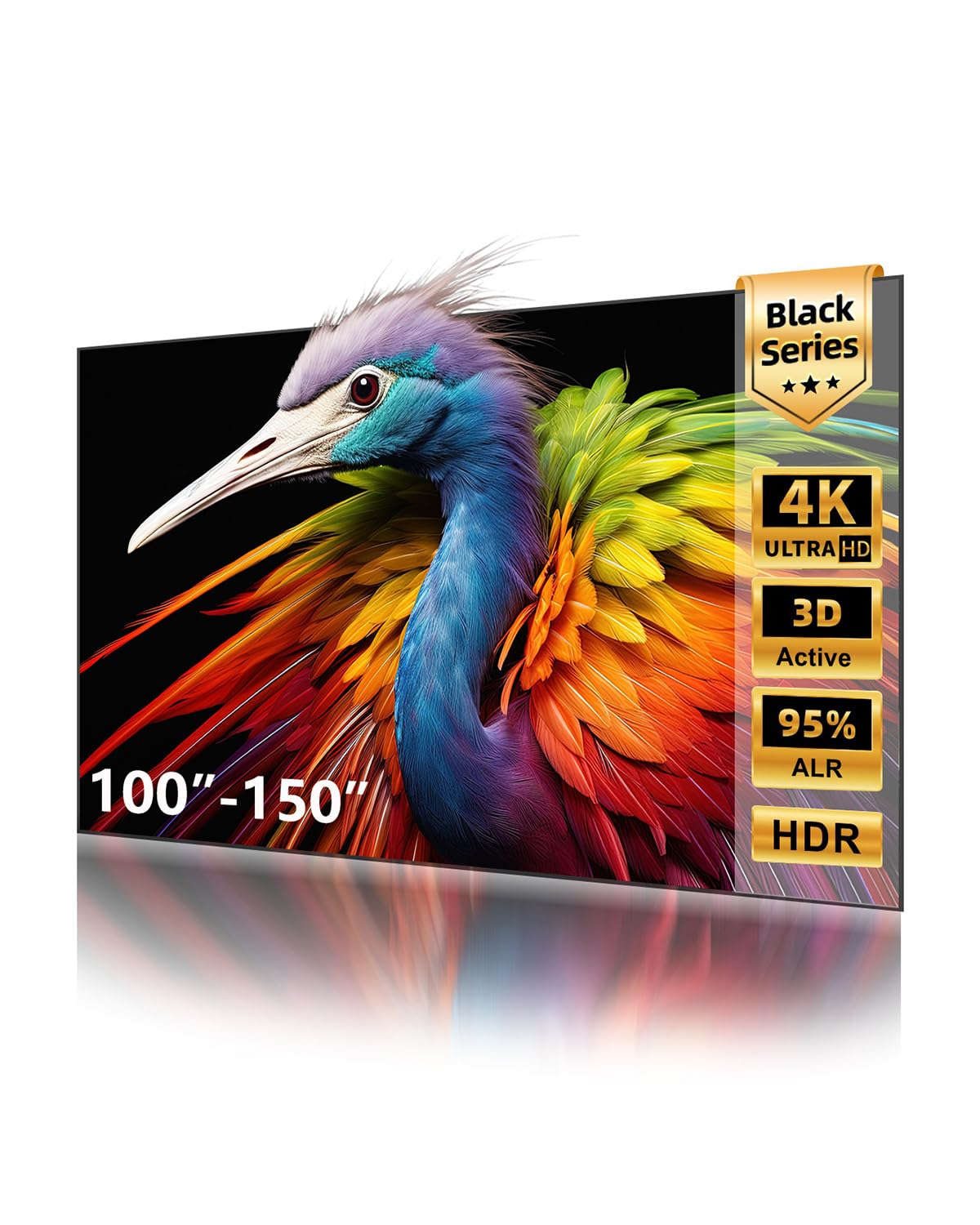
NothingProjector’s Black Series brings a 95% ambient light rejection rating to a 120-inch fixed frame at a price point that undercuts most premium competitors by a significant margin. The black-grid ALR material and multi-layer optical structure do an impressive job of neutralizing overhead and side light, delivering rich contrast and vibrant color even when the room isn’t fully blacked out. Owners pairing it with Samsung and Hisense UST projectors report a night-and-day improvement over projecting onto a bare wall.
The 170-degree viewing angle is identical to the top-tier AWOL screens, meaning the image holds up from almost any seat in the room. The aluminum frame is slim at 0.4 inches, giving the screen a near-borderless look that feels modern and discreet when the projector is off. The kit includes all necessary mounting hardware, and the carbon-black screen finish contributes to deeper black levels by absorbing stray light that would otherwise wash out the picture.
The primary drawback is the assembly process, which multiple users describe as tedious and time-consuming. A professional installer is a worthwhile investment if you’re not comfortable with multi-step spring tensioning setups. Some early buyers also reported that the screen performed below expectations with certain projector models, so verifying compatibility with your specific UST model before purchase is advised.
Why it’s great
- Excellent 95% light rejection at a mid-range price point
- Wide 170-degree viewing angle for flexible seating
- Ultra-slim bezel design for a clean aesthetic
Good to know
- Assembly is challenging and time-consuming
- Compatibility varies by UST projector model
3. AWOL VISION ALR C100 100-inch Fixed Frame

The AWOL VISION C100 shares the same serriform optical architecture as its larger sibling, delivering a 95% ceiling light rejection rate in a more compact 100-inch format. The HBSP Black-Grid TPU material is specifically tuned for UST projectors, and the 170-degree viewing angle ensures the image stays uniform whether you’re sitting dead center or off to the side. AWOL rates this screen as providing an 80% image quality improvement over standard white screens, with contrast levels up to 100 times higher.
In real-world use with a 3000-lumen UST, the C100 produces an image that genuinely looks like a high-end television. Ambient ceiling lighting that would turn a white wall into a washed-out mess barely registers on this screen. The frame is a fixed-wall-mount design with spring tensioning, and when assembled correctly, the fabric sits perfectly flat with no waves or ripples. The black velour bezel absorbs any light overshoot from the projector, further enhancing the perceived contrast.
Installation is the same difficult puzzle you get with the larger AWOL models. The screen overhang must be precisely even on all four sides for the spring system to work correctly, and the manual’s bracket positioning diagrams have been flagged as inaccurate by several owners. A YouTube walkthrough and two pairs of hands are strongly recommended. Once dialed in, however, the C100 is one of the best-looking 100-inch UST screens available at any price.
Why it’s great
- Superb 95% CLR for daytime viewing in smaller spaces
- 170-degree viewing angle preserves brightness off-axis
- Velour bezel absorbs overshoot for deeper perceived blacks
Good to know
- Installation requires patience and precise alignment
- Instructions have reported bracket-position errors
4. Valerion 100-inch Fresnel ALR Projector Screen
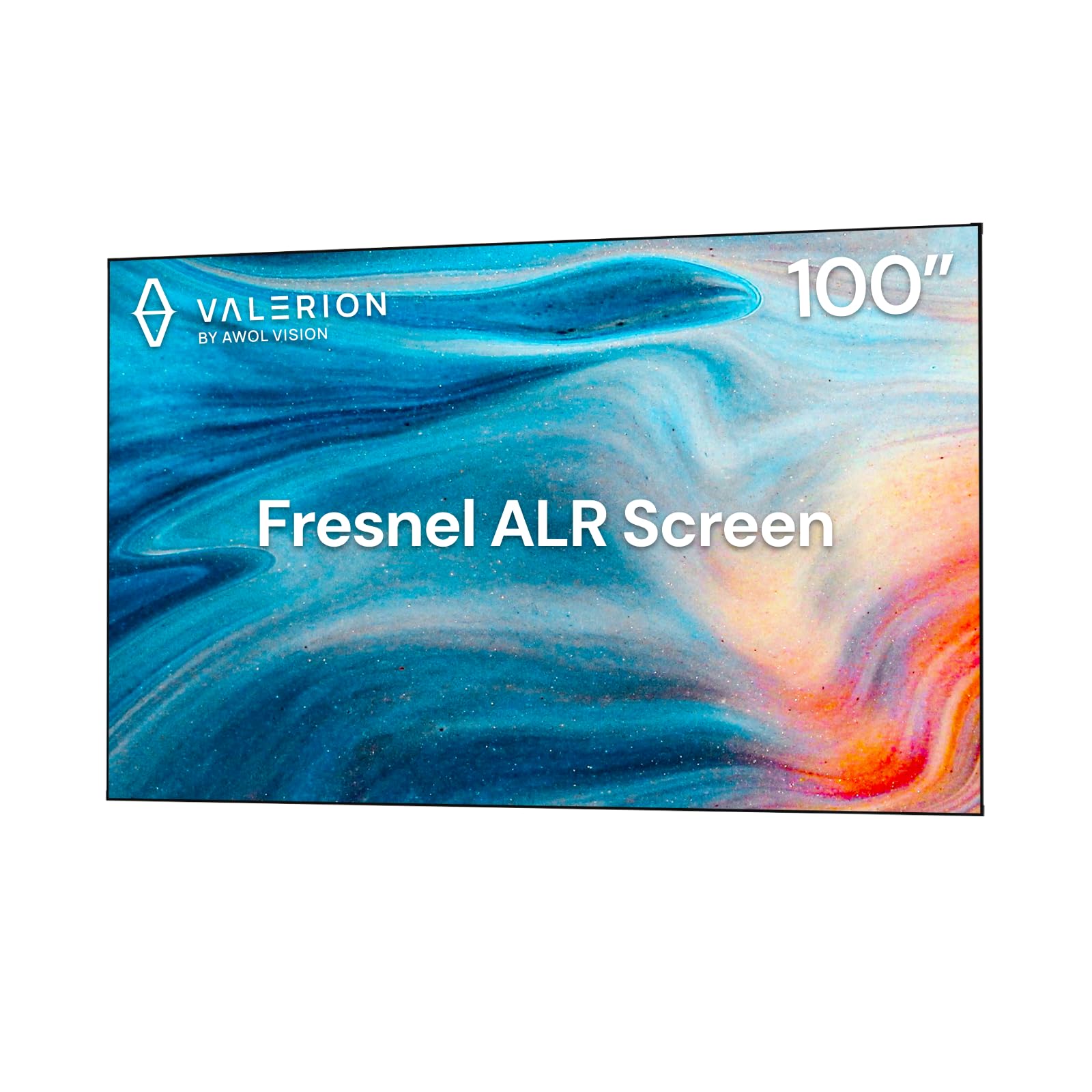
The Valerion Fresnel ALR screen takes a different approach to ambient light rejection with its 8-layer concentric Fresnel lens structure. Instead of the serriform sawtooth pattern, the Fresnel design focuses light directionally, achieving a 1.8 gain that is notably higher than most UST ALR screens. This makes it an excellent choice for bright rooms where every lumen counts, as the screen actively amplifies the projector’s light output toward the viewer while rejecting up to 85% of overhead and side ambient light.
The 90-degree viewing angle is narrower than the 170-degree panels from AWOL and NothingProjector, which means the image degrades more quickly if you sit far off-center. But for a dedicated home theater where seating is arranged directly in front of the screen, the higher gain and punchier brightness produce a more striking HDR effect. The surface is scratch-resistant and easy to clean, which is a practical advantage for households with children or pets. The rollable design also makes transport and DIY installation more manageable than bulky fixed-frame alternatives.
It is critical to note that this screen is designed for long-throw projectors, not UST. Valerion explicitly states this in the product details. If you are building a UST system, skip this model and look at the Fresnel screens from NexiGo or other UST-optimized options. The build quality is excellent, with a sturdy aluminum frame and modular assembly, but the directional Fresnel structure simply won’t work with the steep upward light path of an ultra-short throw projector.
Why it’s great
- High 1.8 gain delivers excellent brightness and HDR punch
- Scratch-resistant and easy-to-clean surface
- Rollable design simplifies transport and DIY installation
Good to know
- NOT compatible with ultra-short-throw projectors
- Narrower 90-degree viewing angle limits off-axis seating
5. NexiGo 100-Inch Fresnel Projector Screen

NexiGo brings Fresnel lens technology to the UST category with a 100-inch screen that uses concentric half-circle grooves to direct the projector’s light toward the audience while rejecting 85% of ambient and ceiling light. The patented ALFA technology and 8-layer optical precision structure deliver a peak gain of 1.5, which is significantly higher than the 0.6 to 0.8 gain typical of serriform sawtooth screens. The result is a vibrant, punchy image that holds its own against moderate room lighting.
The ultra-narrow 0.35-inch bezel gives the screen a nearly borderless appearance, which helps the image feel larger than its 100-inch diagonal. The matte anti-glare finish minimizes reflections and keeps the picture comfortable for extended viewing sessions. NexiGo also rates this screen for 4K and 8K resolution support, and the Fresnel structure eliminates the mirror reflection and ghosting artifacts that can plague lower-quality ALR materials.
Two notable issues emerge from owner feedback. First, the assembly process is finicky — the screen ships rolled and must be handled carefully to avoid creasing, and the included instructions lack detail for the corner tape tabs. Second, a strong chemical odor is reported by multiple buyers, requiring several days of airing out before the smell dissipates. The screen performs excellently once installed, but the setup experience is more stressful than it should be for the price point.
Why it’s great
- High 1.5 gain provides bright, punchy image in moderate light
- Ultra-narrow bezel creates an immersive borderless look
- No mirror reflection or ghosting artifacts
Good to know
- Assembly is delicate and requires care to avoid creasing
- Strong chemical smell initially; needs several days to air out
6. Elite Screens Sable Frame CineGrey 3D 120 inch

Elite Screens’ Sable Frame with CineGrey 3D material is a mature, well-established option that balances ALR performance with ease of assembly. The 1.2 gain and 90-degree viewing angle position it as a middle-ground solution — not as aggressive in light rejection as dedicated UST panels, but capable of handling moderate ambient light while maintaining natural color reproduction. The angular-reflective technology is designed for standard-throw projectors, so it is not compatible with ultra-short-throw projectors, but it works well with long-throw setups and even some mid-range UST models with careful placement.
The black velvet finished frame is a standout feature, absorbing projection overshoot to improve perceived contrast. The 6-piece aluminum frame with sliding wall-mount brackets simplifies centering on the wall, and the adjustable fix plates help achieve a wrinkle-free surface. ISF certification for accurate color reproduction and GREENGUARD certification for low indoor emissions add credibility for buyers concerned about air quality in their home theater space.
A small number of owners reported a strong rubbery odor from the screen material that took about a week to air out, and one buyer noted difficulty with the border frame assembly. For standard-throw projector owners who want a high-quality fixed frame with proven ALR properties, the Sable Frame CineGrey 3D remains a solid choice, but UST-only buyers should look at the dedicated UST models on this list.
Why it’s great
- Black velvet bezel absorbs overshoot for better contrast
- ISF and GREENGUARD certified for color accuracy and safety
- Easy centering with sliding wall-mount brackets
Good to know
- Not compatible with ultra-short-throw projectors
- Some units emit a temporary chemical/rubber odor
7. MIGO 120 Inch Motorized Tab-Tension Screen
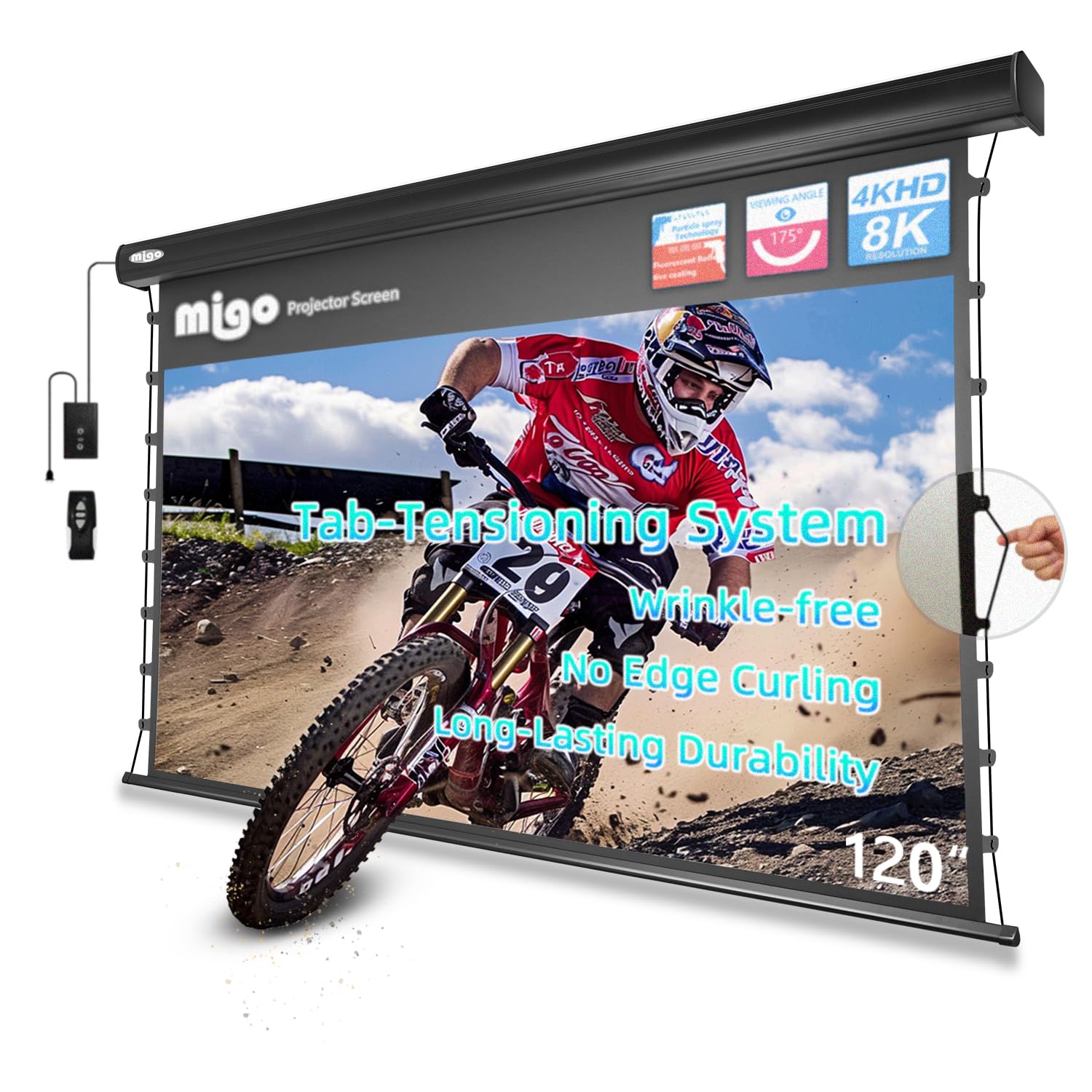
MIGO’s motorized pull-down screen offers a retractable solution for UST projector owners who don’t want a permanent fixed frame dominating their living room. The tab-tensioning system uses side tension cables and a 9-pound bottom weight to keep the grey crystal surface flat, which is a genuine challenge for any retractable screen. The 175-degree viewing angle is among the widest on this list, and the aluminum housing with reinforced ribs provides a durable enclosure that mounts to both ceilings and walls.
The motor operates quietly — a key consideration for home theater use — and the included RF remote allows drop-height adjustment up to 16.4 feet. MIGO recommends a projector with at least 3000 lumens to achieve the best results on this surface, which is a realistic expectation given that the grey crystal material has a moderate gain. The screen supports short-throw and long-throw projectors, with UST compatibility rated as average.
The critical catch is that this is not a true ALR screen despite the product’s categorization. Multiple owners have pointed out that the grey crystal surface is a partial ambient light material, not a full sawtooth or Fresnel ALR structure. In a room with significant overhead light, it will not perform the same way as a dedicated UST ALR panel. Buyers seeking genuine light rejection for daytime viewing should look elsewhere, but for those who need a retractable screen that stays flat and looks clean when stowed, the MIGO delivers.
Why it’s great
- Tab-tensioning keeps the retractable surface flat
- Quiet motor with RF remote and height adjustment
- Wide 175-degree viewing angle
Good to know
- Not a true ALR screen; partial ambient light material only
- Requires bright projector (3000+ lumens) for good results
8. YODOLLA 120 inch Motorized Floor Rising ALR Screen
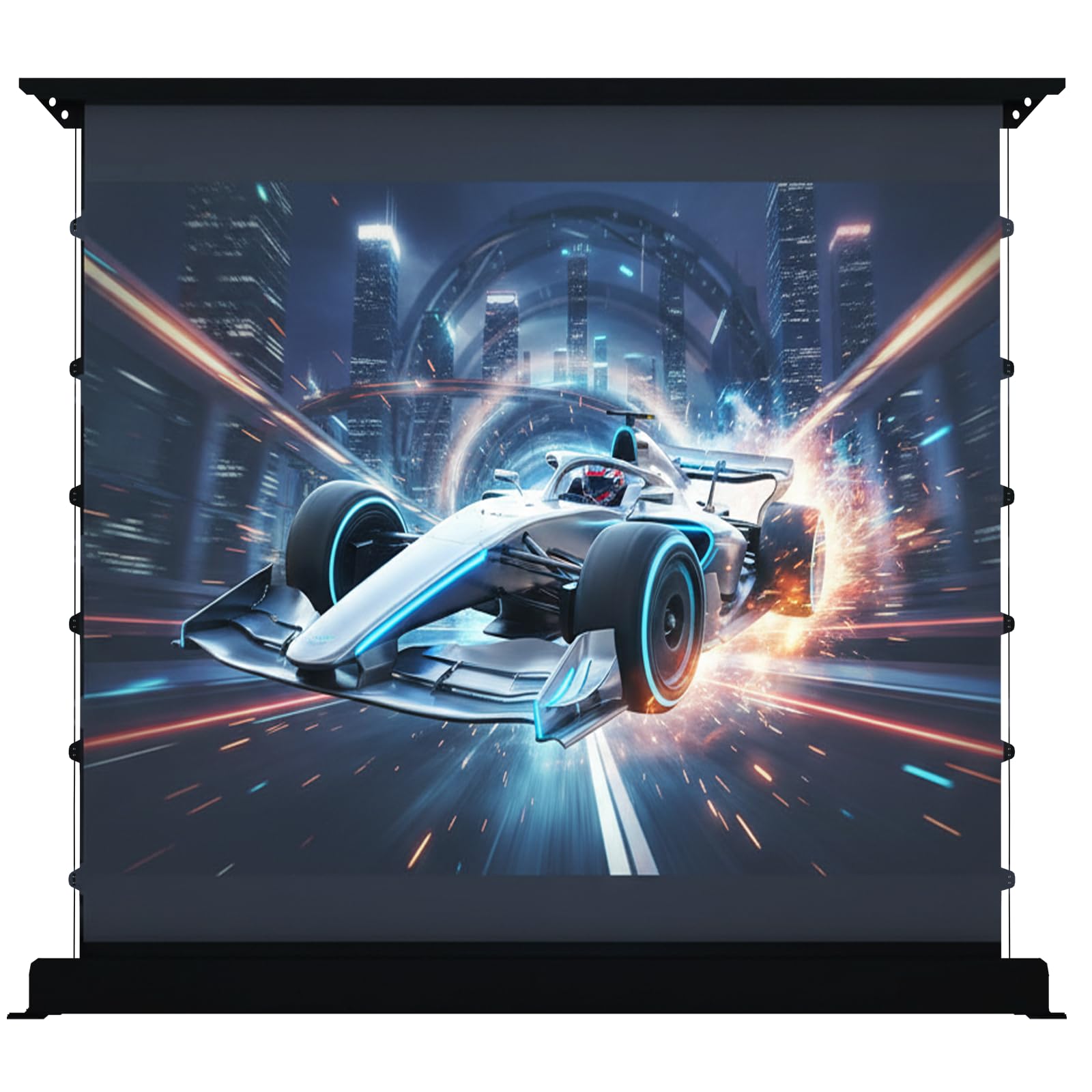
The YODOLLA motorized floor-rising screen solves the aesthetic problem of a fixed frame in a living room by disappearing into a floor-mounted housing when not in use. The 120-inch 16:9 ALR surface is designed specifically for UST projectors, combining anti-light curtain technology to suppress ceiling and sunlight interference. The matte finish and 160-degree viewing angle provide a balanced viewing experience for the whole room, and the motorized mechanism lifts the screen smoothly with a remote control.
The housing dimensions are substantial at 114.6 inches wide and 3.9 inches high when retracted, so measuring your space before purchase is essential. The screen is intended for permanent installation rather than portable use, despite the floor-mount design. Owners report that the ALR coating does a credible job of maintaining image contrast with modest ambient light, though it doesn’t match the 95% rejection rates of the top fixed-frame panels.
It is worth noting that the product listing and reviews are somewhat confused — several reviews discuss using the YODOLLA as a green screen for video production, which suggests the listing may have been repurposed from a different product variant. Verify with the seller that you are receiving the ALR UST version before purchasing. The motorized floor-rising form factor is rare and appealing for living room setups, but the product’s mixed identity creates uncertainty about what exactly you’ll receive.
Why it’s great
- Motorized floor-rising design keeps the room clean when not in use
- ALR coating reduces ceiling and sunlight interference
- Wide 160-degree viewing angle for flexible seating
Good to know
- Listing confusion; verify ALR UST version with seller
- Large housing requires careful space measurement
9. Generic ALR Screen (WonTeam) 100 inch
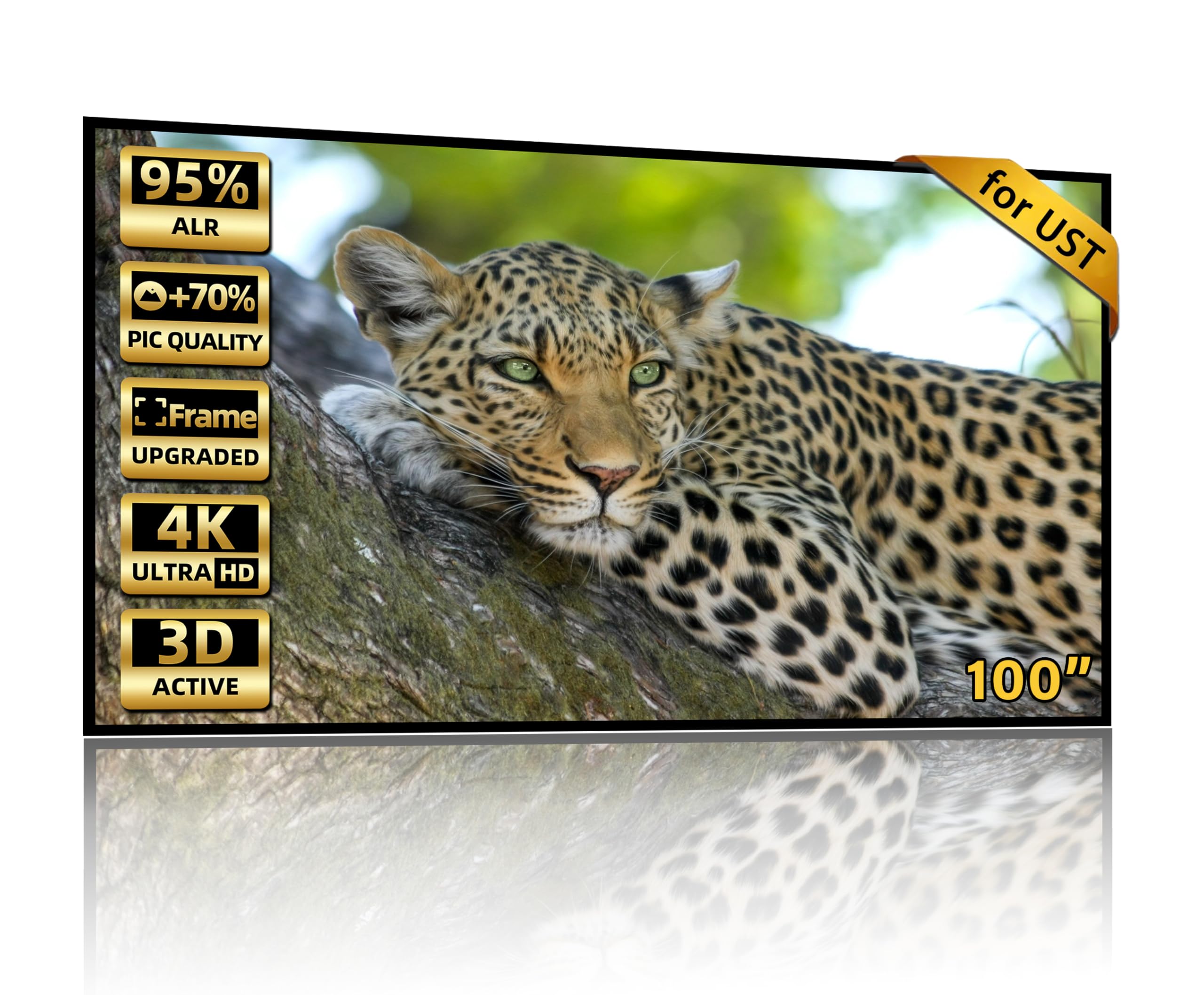
The WonTeam 100-inch ALR screen punches well above its price class for buyers on a tight budget. The micro-tooth 3D optical structure with triangular grating is a simplified sawtooth design that effectively absorbs ambient light from above while directing the projector’s light toward the audience. The 0.8 gain is typical for entry-level ALR screens, providing noticeable contrast improvement over a white wall without making the image look dim. The dual-frame aluminum construction and spring tension system deliver acceptable flatness for the price.
Support for 4K, 8K, and 3D content is claimed, and the upgraded PVC material with self-healing properties is a practical feature for households where the screen might get bumped. The velvety surface on the bezel helps absorb light overshoot, which is a refinement rarely seen at this price point. Multiple buyers report that the assembly process takes about an hour with two people and that the video instructions provided are genuinely helpful.
The long-term durability is the biggest unknown. One owner reported sagging and loss of tension after just five months, along with diminished ALR effectiveness. The budget price may reflect material choices that don’t hold up as well over years of use compared to the premium AWOL or Elite Screens options. For a first-time UST owner or a secondary room, it’s a reasonable gamble. For a primary home theater investment, the risk of fabric degradation makes a premium screen a better long-term value.
Why it’s great
- Very low entry price for a functional ALR screen
- Self-healing PVC material adds durability
- Velvet bezel absorbs overshoot for better contrast
Good to know
- Long-term tension and ALR performance are uncertain
- Some units have reported sagging after five months
10. Elite Screens Aeon CineGrey 3D 100 inch

The Elite Screens Aeon CineGrey 3D offers a unique Edge Free design that creates the illusion of a floating image with no visible frame border. The CineGrey 3D material is an angular-reflective ambient light rejecting fabric with a 65% rejection ratio and a 1.2 gain, making it one of the brighter ALR options on this list. The 90-degree viewing angle is narrower than many competitors, but the trade-off is a punchier image that holds up well in rooms with controlled lighting.
The 6-piece split aluminum frame is lightweight at 18.6 pounds for the 100-inch model, and the assembly process is straightforward compared to the finicky tensioning systems of other screens. The edge-free design means you can either leave the screen with no visible border or install the thin trim piece for a frameless look that resembles a giant flat-panel TV. ISF and GREENGUARD certifications add credibility to the color accuracy claims and indoor safety emissions.
The biggest concern is that this screen is designed for standard-throw projectors, not UST. Elite Screens explicitly notes that the CineGrey 3D material is optimized for standard-throw projection with a ceiling-mounted projector. Some owners report success with certain UST models, but the 65% rejection ratio and the angular-reflective properties are not tuned for the steep upward light path of a UST projector. UST buyers should verify compatibility before purchasing or opt for a dedicated UST ALR screen.
Why it’s great
- Edge Free design creates a floating frameless image
- Lightweight aluminum frame with easy assembly
- ISF and GREENGUARD certified for color accuracy and safety
Good to know
- Optimized for standard-throw, not UST projectors
- Only 65% ambient light rejection ratio
11. Paris Rhône 100-inch ALR Fixed Frame Screen

The Paris Rhône 100-inch fixed frame screen brings UST-specific ALR performance to a highly accessible price point. The black-grid ALR material with a multi-layer optical structure claims 92% ambient light rejection, which is competitive with screens costing significantly more. The 0.6 gain is on the lower side, meaning the image will be dimmer than a white wall, but the trade-off is dramatically improved black levels and color saturation in rooms with ambient light. The 160-degree wide viewing angle ensures the entire family can watch without a washed-out image from side seats.
The 0.4-inch ultra-slim aluminum frame is visually unobtrusive, and the assembly process is reported as relatively straightforward by most owners. The sawtooth optical structure is specifically designed for ultra-short-throw projectors, and owners pairing it with mid-range 2K-lumen UST projectors report excellent contrast and color reproduction in moderate lighting conditions. The kit includes all necessary hardware and detailed installation instructions.
The low 0.6 gain means this screen works best with a projector that has at least 2500 to 3000 lumens. Pairing it with a lower-output UST will result in a noticeably dim image, particularly in HDR content where peak brightness matters. A few owners also reported difficulty with the spring tensioning system, where uneven force application caused rippling on one side. Careful two-person assembly is essential to achieve a flat surface.
Why it’s great
- High 92% ALR rating at a budget price point
- Specifically designed for UST projectors
- Wide 160-degree viewing angle
Good to know
- Low 0.6 gain requires a bright projector (2500+ lumens)
- Uneven spring tension can cause ripples if not careful
FAQ
Can I use a standard ALR screen with my UST projector?
How does screen gain affect daytime viewing with a UST projector?
What is the difference between serriform and Fresnel ALR screens?
Do I need a fixed frame screen or can I use a retractable motorized screen?
How do I know what size ALR screen I need for my UST projector?
Final Thoughts: The Verdict
For most users, the best alr screen for ust projector winner is the AWOL VISION 120-inch Serriform ALR because it delivers the highest ceiling light rejection rate (95%) with the widest viewing angle (170 degrees) in a package that transforms a UST projector into a true daytime television. If you want a more compact 100-inch setup with the same premium ALR performance, grab the AWOL VISION C100. And for the best value-per-dollar in a 120-inch format, the NothingProjector Black Series offers near-identical ALR specs at a significantly lower price — just be ready for a challenging assembly.

Mo Maruf
I created WellFizz to bridge the gap between vague wellness advice and actionable solutions. My mission is simple: to decode the research and give you practical tools you can actually use.
Beyond the data, I am a passionate traveler. I believe that stepping away from the screen to explore new environments is essential for mental clarity and physical vitality.