Our readers keep the lights on and my smoothie glass nicely filled. As an Amazon Associate, I earn from qualifying purchases.
When your eyes feel like they’re full of sand and simultaneously burning from allergies, you need a drop that tackles both the histamine storm and the moisture deficit — not one that just masks the redness. The wrong formula can leave you with blurry vision or a stinging sensation that makes you wonder why you bothered in the first place.
I’m Mohammad Maruf — the founder and writer behind WellFizz. I’ve spent months analyzing the ophthalmology literature on ocular allergies, comparing active ingredient concentrations, preservative profiles, and patient-reported outcomes to find the honest intersection between antihistamine potency and dry eye comfort.
After cross-referencing real user experiences with the technical specs of dozens of formulas, the allergy medicine for dry eyes that consistently delivers on both fronts is one that combines a proven antihistamine with a preservative-free or gentle lubricating base.
How To Choose The Best Allergy Medicine For Dry Eyes
Finding a formula that calms allergic itching without stripping away your natural tear film requires understanding three key factors: the active ingredient class, the preservative system, and the concentration strength. Here is what to focus on.
Active Ingredient: Olopatadine vs. Ketotifen
Olopatadine is the dominant mast-cell stabilizer in modern allergy drops. Concentrations of 0.2% provide once-daily dosing and up to 16 hours of relief, while 0.7% extra-strength formulations push that to a full 24 hours. Ketotifen (found in Alaway) is also a mast-cell stabilizer but typically lasts 8 to 12 hours and may require twice-daily application during heavy pollen exposures. For dry eyes, olopatadine at 0.2% is often the better first choice because the lower concentration tends to sting less upon instillation.
Preservative Profile: Preserved vs. Preservative-Free
Benzalkonium chloride (BAK), the common preservative in multidose bottles, can exacerbate surface dryness over weeks of regular use. If you have chronic dry eye disease or use drops more than four times daily, a preservative-free multidose bottle — which uses a specialized valve system to maintain sterility — is the safer long-term play. OPTASE Allegro uses a preservative-free delivery system that dispenses up to 300 doses without BAK.
Concentration Strength and Dosing Frequency
0.2% olopatadine is approved for once-daily use in adults and children over two. The 0.7% extra-strength version also requires just one drop per day but delivers a higher drug load that can feel more viscous upon drop placement. If your eyes are already dry, the lower 0.2% strength typically integrates more comfortably into a compromised tear film.
Quick Comparison
On smaller screens, swipe sideways to see the full table.
| Model | Category | Best For | Key Spec | Amazon |
|---|---|---|---|---|
| Pataday Extra Strength Twin Pack | Extra Strength | All-day itch relief with 24-hour coverage | Olopatadine 0.7% | Amazon |
| Bausch + Lomb Advanced Eye Relief | Prescription-Strength | Once-daily 16-hour relief for seasonal allergies | Olopatadine 0.2% | Amazon |
| Alaway Antihistamine Twin Pack | Fast-Acting | Immediate relief from pet dander and grass | Ketotifen 0.035% | Amazon |
| Glenmark Olopatadine Twin-Pack | Value | Budget-friendly daily allergy maintenance | Olopatadine 0.2% | Amazon |
| OPTASE Allegro Lubricant | Preservative-Free | Dry eye relief alongside mild allergen exposure | HEC formula, 300 doses | Amazon |
In‑Depth Reviews
1. Pataday Once Daily Extra Strength Relief Twin Pack

Pataday’s extra-strength formula delivers 0.7% olopatadine — the highest concentration in this lineup — which blocks histamine release and provides a full 24 hours of relief from a single drop. Users consistently report that itching subsides within minutes and does not return until the next dose, making it especially reliable during high-pollen mornings when you need one-and-done protection.
The twin-pack format is a pragmatic choice for households with multiple allergy sufferers or for those who want a backup bottle in the car or office. The drop itself has a slightly thicker viscosity compared to the 0.2% formulations, which some users describe as a mild stickiness upon drying — easily resolved with a warm cloth or blink cycle.
Allergists frequently recommend Pataday as the go-to for patients whose primary complaint is itch, and the once-daily compliance rate is significantly higher than twice-daily ketotifen regimens. For anyone who needs maximum antipruritic power without re-dosing, this is the benchmark.
Why it’s great
- Full 24-hour itch control from one drop
- Extra-strength 0.7% olopatadine works at the source of histamine release
- Doctor-recommended for severe seasonal and pet allergies
Good to know
- Higher concentration can feel slightly sticky as it dries
- Small bottle volume relative to cost; best value is the twin-pack
2. Bausch + Lomb Advanced Eye Relief, Olopatadine 0.2%
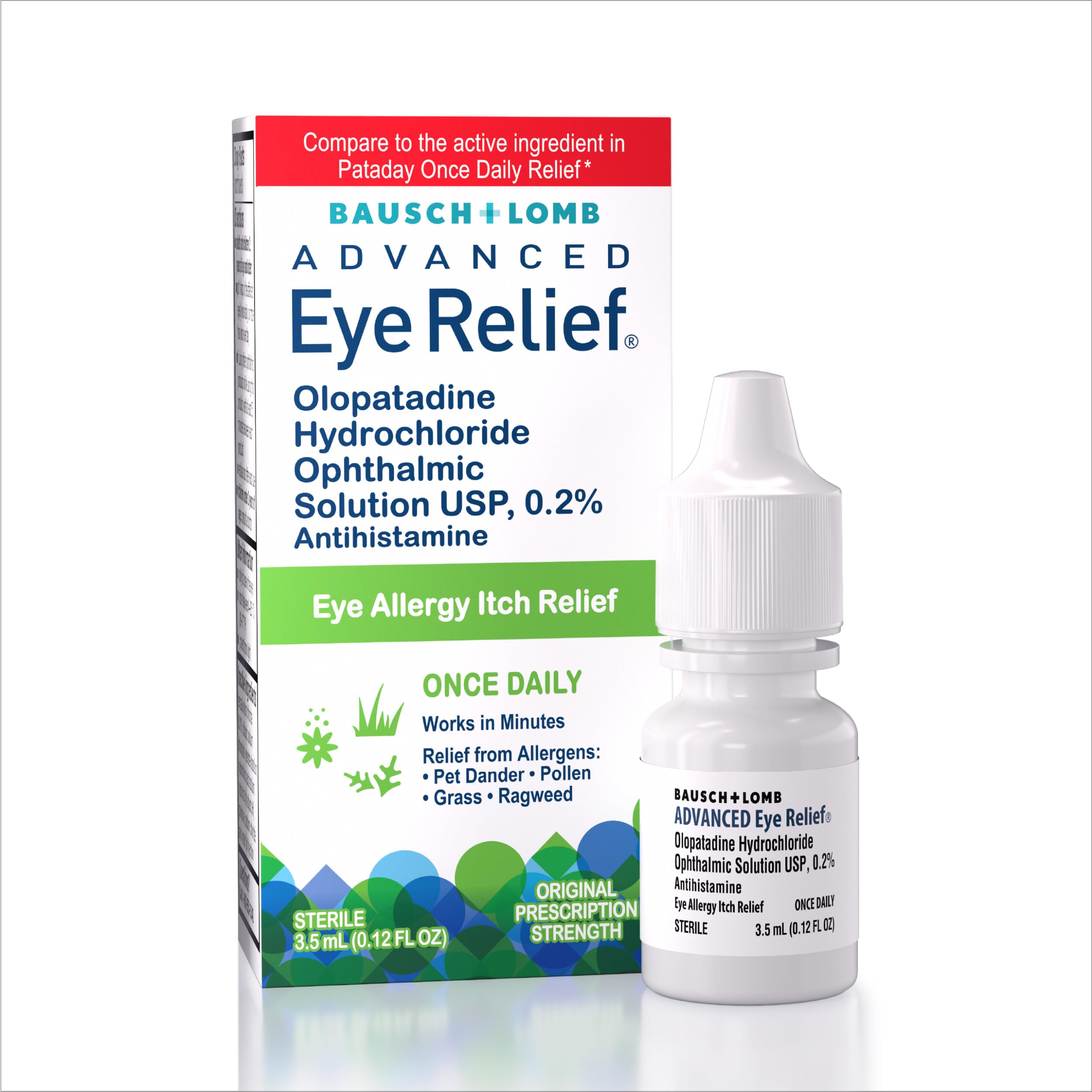
Bausch + Lomb brings the same prescription-strength 0.2% olopatadine that many eye doctors previously dispensed, now available without a script. The once-daily application starts working in minutes and maintains steady suppression of itch signals for up to 16 hours — a practical window that covers the typical waking day without needing a lunchtime re-dose.
The formula uses a preserved multidose bottle, which means it contains benzalkonium chloride to maintain sterility between uses. For most people who use drops once daily during allergy season, this is well tolerated, but those with very sensitive corneas or advanced dry eye may notice a mild sting that dissipates within seconds.
Customer reports consistently highlight that this drop eliminates the urge to rub eyes after exposure to pollen, ragweed, and pet dander. The 0.12 fl oz bottle is small, but the once-daily dosing means a single bottle lasts approximately 30 days, making it a solid mid-range option that balances efficacy with convenience.
Why it’s great
- Prescription-strength 0.2% olopatadine without a clinic visit
- Once-daily dosing covers 16 hours of allergy exposure
- Trusted brand with over a century of ophthalmic expertise
Good to know
- Contains BAK preservative, may sting on brittle corneas
- Very small bottle — one drop per eye per day depletes it in about a month
3. Alaway Antihistamine Eye Drops Twin Pack
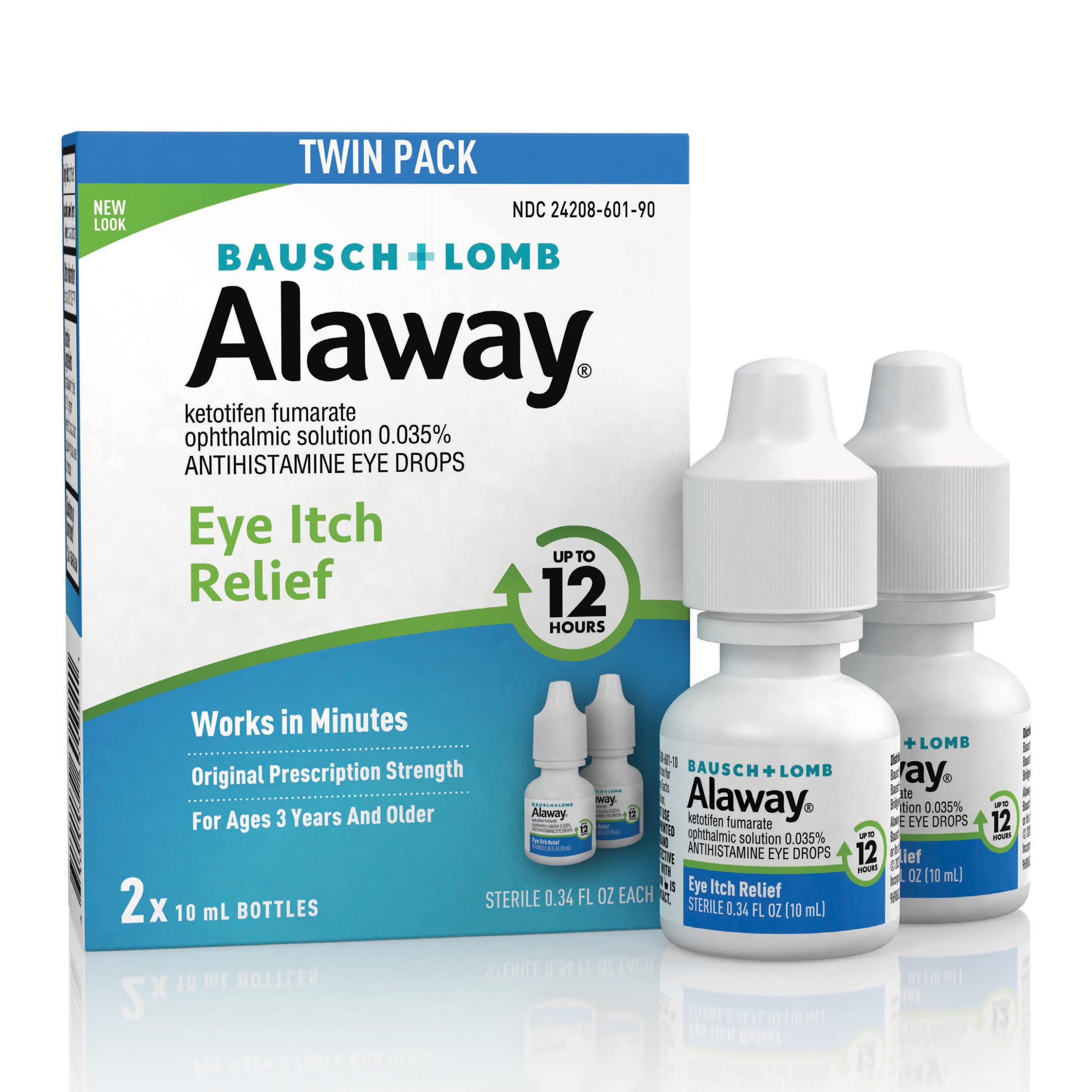
Alaway uses ketotifen fumarate 0.035% — an older but well-established mast-cell stabilizer that is equally effective at halting the itch-scratch cycle. The key difference from the olopatadine-based drops is duration: Alaway provides up to 12 hours of relief, meaning heavy-symptom days may require a second application before bedtime for overnight comfort.
The ketotifen molecule tends to produce a very mild transient sting upon instillation for some users, but this fades quickly as the drop penetrates. Users with cat dander or grass allergies specifically report that the fast-acting nature of ketotifen gives noticeable improvement within minutes — the drop works quickly enough to interrupt an active itch episode.
The twin-pack provides two 0.34 fl oz bottles, which is generous compared to many single-bottle offerings. Because it is preserved with BAK, the same dryness caution applies for frequent users. For those who need reliable, fast itch control and do not mind a twice-daily cadence during peak allergy season, Alaway remains a highly proven option.
Why it’s great
- Fast-acting relief within minutes for active itch episodes
- Clinically tested prescription-strength formula with ketotifen
- Large 0.34 fl oz bottles in twin-pack provide good total volume
Good to know
- 12-hour window may require twice-daily dosing during heavy pollen
- May cause a brief initial sting in sensitive eyes
4. Glenmark Therapeutics Olopatadine 0.2% Twin-Pack
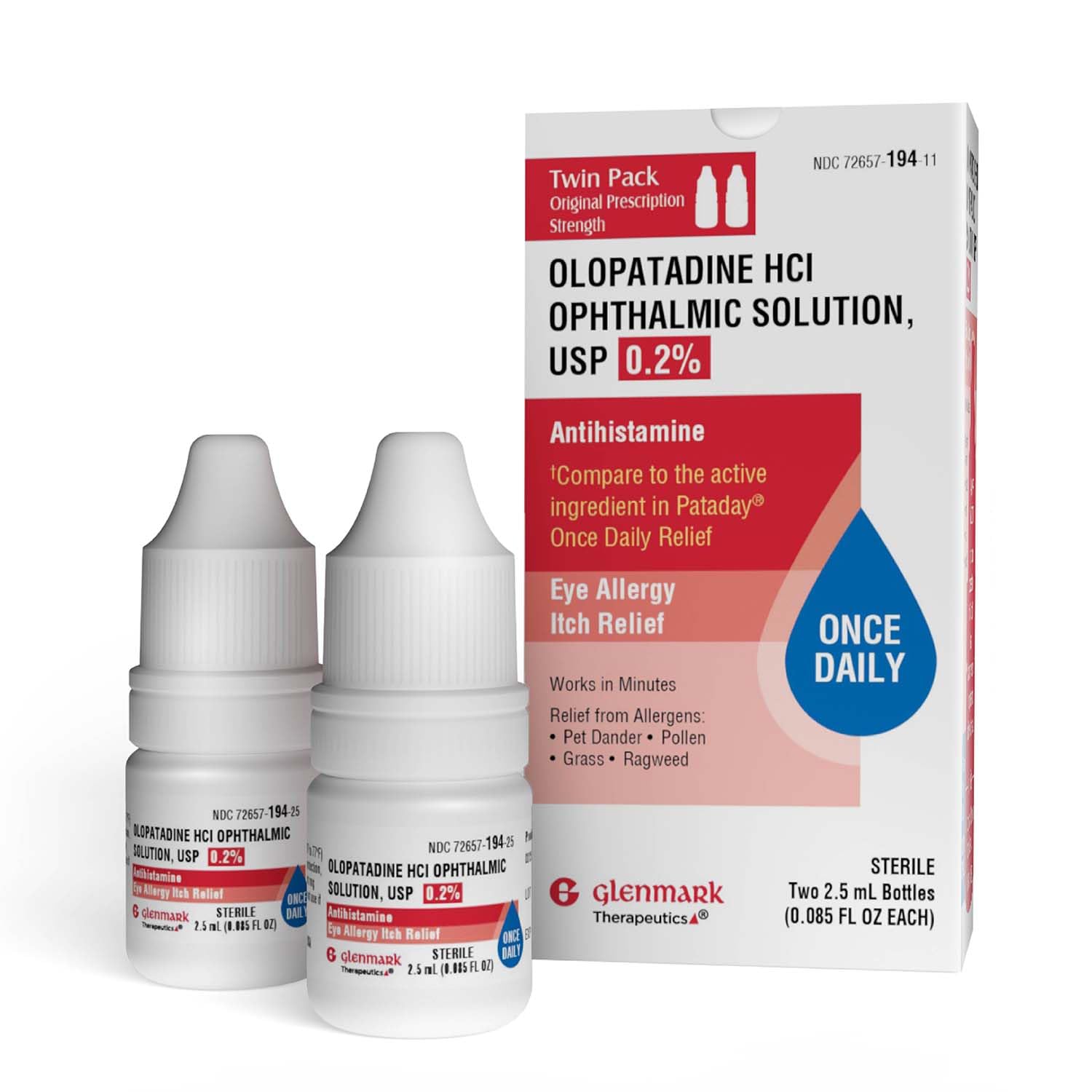
Glenmark’s twin-pack offers the same 0.2% olopatadine active ingredient as the Bausch + Lomb version but at a noticeably lower price point per bottle. Each 2.5 ml bottle yields a roughly 30-day supply if used once daily, and the twin pack covers two full months of allergy season without breaking the budget.
Users report that the drop does not burn or sting upon application — a common complaint with cheaper generic alternatives — and that it effectively stops the itching and twitching associated with grass and ragweed exposure. The main trade-off is the bottle design, which some users describe as small and slightly difficult to manipulate when aiming the drop.
Because it is a preserved formulation, the same considerations around BAK apply, but for seasonal allergy sufferers who use drops sparingly — one drop per eye per day — the exposure is minimal. This is a strong entry-level option for anyone new to olopatadine who wants to confirm efficacy before committing to a premium brand.
Why it’s great
- Same 0.2% olopatadine active ingredient as name brands
- No stinging or burning reported by most users
- Twin-pack delivers two months of relief per purchase
Good to know
- Bottle design is small and can be tricky to squeeze accurately
- Preserved with BAK — not ideal for chronic dry eye with frequent use
5. OPTASE Allegro Lubricant Eye Drops

OPTASE Allegro takes a fundamentally different approach: it is a lubricant, not an antihistamine. The preservative-free HEC (hydroxyethyl cellulose) formula works by supplementing your natural tear film and creating a gentle barrier against environmental irritants. For people whose primary issue is dry eye but who also experience mild allergic flare-ups, this drop provides the moisture foundation that antihistamines alone cannot supply.
The multidose bottle uses a proprietary valve system to keep the solution sterile for up to three months after opening — a breakthrough for preservative-free fans who dislike single-use vials. It delivers up to 300 drops per bottle, which is roughly 50 days of use at six drops per day. Users with meibomian gland dysfunction (MGD) report that it does not leave the cloudy residue that some preserved drops can leave on the lid margin.
Because it contains no antihistamine, it will not stop histamine-driven itching. However, for the dry eye sufferer whose mild itch is secondary to tear film instability, restoring moisture first can reduce the urge to rub much better than a drying antihistamine drop. This is the companion product an ophthalmologist would pair with an oral antihistamine or with an olopatadine drop.
Why it’s great
- Preservative-free even in a multidose bottle — no BAK exposure
- Up to 300 drops per bottle, sustainable for daily use
- Compatible with all contact lens types without residue
Good to know
- No antihistamine — will not stop histamine-driven itching
- Bottle pump can be inconsistent; some users report difficulty dispensing a single drop
FAQ
Can I use allergy eye drops if I wear contact lenses?
Why do some allergy drops sting and others do not?
How many times per day should I use olopatadine 0.2% drops?
Final Thoughts: The Verdict
For most users, the allergy medicine for dry eyes winner is the Pataday Extra Strength Twin Pack because 0.7% olopatadine delivers unmatched 24-hour itch control from a single drop. If you want a once-daily 0.2% formula that is gentler on compromised tear film, grab the Bausch + Lomb Advanced Eye Relief. And for dry eye sufferers whose mild allergies need moisture first, nothing beats the OPTASE Allegro Preservative-Free Lubricant.

Mo Maruf
I created WellFizz to bridge the gap between vague wellness advice and actionable solutions. My mission is simple: to decode the research and give you practical tools you can actually use.
Beyond the data, I am a passionate traveler. I believe that stepping away from the screen to explore new environments is essential for mental clarity and physical vitality.