Our readers keep the lights on and my smoothie glass nicely filled. As an Amazon Associate, I earn from qualifying purchases.
The blunt knife is the single greatest friction point in a home kitchen. It crushes herbs instead of cutting them, skids across tomato skin, and turns onion prep into a wrestling match. Finding a single blade that handles the full daily rotation—from paper-thin garlic slices to semi-frozen butternut squash—without dulling after a month is the real trick. That balance defines the category: one knife that earns its spot on the magnetic strip by being the first thing you reach for every single meal.
I’m Mohammad Maruf — the founder and writer behind WellFizz. I’ve spent years analyzing kitchen steel, comparing edge geometry, steel hardness ratings, and handle ergonomics across hundreds of chef knives to separate hollow marketing claims from actual cutting performance.
Once you understand what separates a 12-degree Japanese edge from a 20-degree German bevel, choosing the best all around kitchen knife becomes a matter of matching the blade’s hard specs to your own prep style and grip comfort.
How To Choose The Best All Around Kitchen Knife
An all-around kitchen knife must cover at least 90 percent of daily prep tasks: chopping onions, slicing meat, mincing garlic, dicing bell peppers, and carving a roast. That demands a specific combination of blade length, edge geometry, steel composition, and handle ergonomics. Focus on the specs that actually change how the knife moves through food.
Blade Steel and Hardness (HRC)
Rockwell hardness tells you how well the steel holds its edge. A rating of 56-58 HRC offers decent edge retention and is easy to sharpen with a standard honing rod. At 60-62 HRC, the blade stays sharper longer but becomes more brittle and requires diamond or ceramic sharpening stones. For an all-around knife, 58-60 HRC hits the sweet spot between lasting sharpness and practical maintainability.
Edge Angle and Blade Profile
The angle at which each side of the blade is ground determines cutting resistance. A 12-15 degree angle per side delivers laser-like slicing with minimal drag — typical of Japanese-style knives. A 20 degree angle per side is more durable and better suited for rocking cuts through dense vegetables — common in German-style knives. The blade profile matters too: a curved belly facilitates rocking, while a flatter edge excels at push-cutting and chopping.
Handle Construction and Balance
A full-tang blade — one piece of metal running through the entire handle — provides better weight distribution and prevents the knife from snapping at the bolster under heavy use. Handle materials range from moisture-resistant synthetic polymers (Fibrox, G10, POM) to natural Pakkawood or rosewood. Synthetic options offer a slip-free grip in wet conditions; wooden handles provide a warmer feel but require regular oiling to prevent drying and cracking.
Quick Comparison
On smaller screens, swipe sideways to see the full table.
| Model | Category | Best For | Key Spec | Amazon |
|---|---|---|---|---|
| Victorinox Fibrox Pro 8″ | Mid-Range | ATK-recommended all-purpose value | 7.9″ stainless blade, TPE handle | Amazon |
| WÜSTHOF Gourmet 8″ | Premium | German precision with lasting edge | High-carbon stamped blade, POM handle | Amazon |
| Dalstrong Kiritsuke 8.5″ | Premium | Pro-grade Kiritsuke profile | Forged German steel, G10 handle | Amazon |
| KYOKU Shogun 8″ | Mid-Range | Damascus VG10 for ultra-fine slicing | 67-layer VG10 steel, 58-60 HRC | Amazon |
| Victorinox Wood 8″ | Mid-Range | Rosewood handle with Swiss steel | Stamped stainless blade, maple handle | Amazon |
| Sunnecko 8″ Chef Knife | Budget | Entry-level Japanese-style edge | High-carbon steel, 12-15 deg edge | Amazon |
| Dexter-Russell 8″ Chef’s Knife | Budget | Commercial kitchen staple | High-carbon stamped, NSF certified | Amazon |
In‑Depth Reviews
1. Victorinox Fibrox Pro Chef’s Knife, 8 Inch
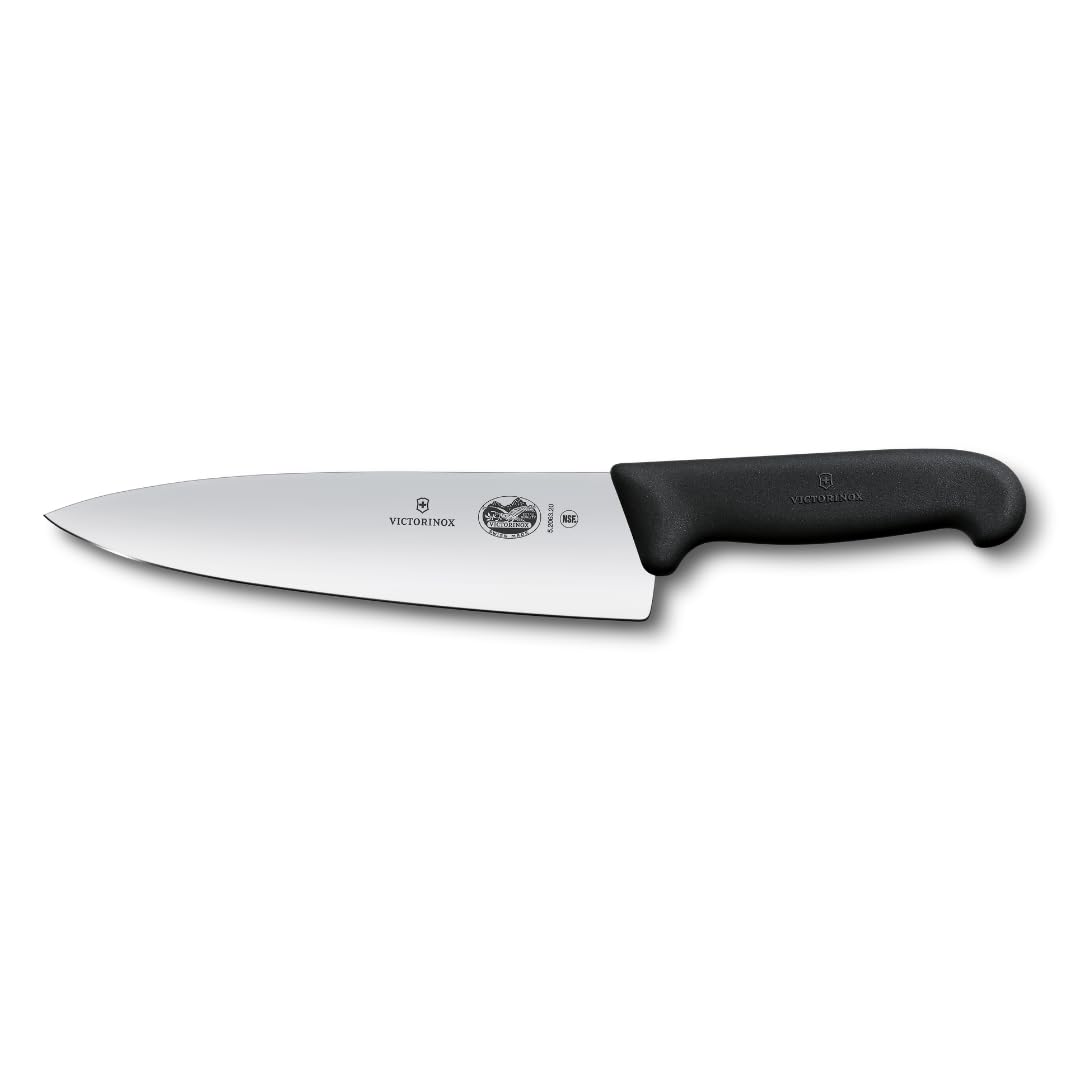
This is the knife America’s Test Kitchen has crowned their top pick under a benchmark budget for good reason. The Fibrox Pro uses a stamped high-carbon stainless steel blade tapered to a laser-tested edge that arrives factory-sharp enough to shave paper. At roughly 5.7 ounces, it feels noticeably lighter than most full-tang forged knives, reducing wrist fatigue during long prep sessions without sacrificing cutting authority.
The thermoplastic elastomer (TPE) handle is the star here — it provides a secure, non-slip grip even when your hands are slick with oil or water. The textured surface and slightly contoured shape accommodate both pinch-grip and full-hand grips comfortably. After months of daily use with regular steeling, the edge holds well enough that most home cooks won’t need to sharpen more than once or twice a year.
One genuine advantage is that Victorinox explicitly lists this knife as dishwasher safe, though hand washing still extends the edge life. The only real trade-off is the plain, utilitarian appearance — this knife looks like a tool, not a showpiece. For the cook who prioritizes reliable performance over blade aesthetics, this is the benchmark.
Why it’s great
- Famous ATK top pick with consistent factory-sharp edge
- TPE handle stays grippy when wet, reducing slip risk
- Lightweight profile minimizes hand fatigue during long preps
Good to know
- Stamped construction lacks the heft some cooks prefer
- Plain design won’t impress guests or match high-end sets
2. WÜSTHOF 8″ Gourmet Chef’s Knife

WÜSTHOF’s Gourmet series delivers the brand’s legendary Solingen quality in a precision laser-cut stamped format. The high-carbon stainless steel blade arrives incredibly sharp and holds its edge noticeably longer than budget options — reviewers report it staying keen after a full month of daily chopping without needing a steel. The 8-inch blade is well-balanced, offering enough heft to power through dense squash while remaining nimble for delicate herb work.
The handle is formed from polyoxymethylene (POM), a synthetic material that resists fading, heat, and impact far better than basic plastics. It provides a secure grip with a subtle texture that works well even with wet hands. The balance point sits right at the bolster, making the knife feel naturally weighted during rocking cuts — a direct benefit of WÜSTHOF’s seven-generation experience in blade manufacturing.
Hand washing is required, which is standard for this class. The knife does not include a sheath or blade guard, so you’ll need to buy a separate magnetic strip or knife block for safe storage. For the cook who wants a recognizable premium brand with a proven edge geometry and genuine long-term durability, this is the definitive stamped option.
Why it’s great
- Solingen steel holds edge exceptionally well for a stamped knife
- POM handle resists heat and impact without degrading grip
- Well-calibrated balance reduces wrist strain during heavy use
Good to know
- No sheath included — requires separate storage solution
- Hand wash only; dishwasher will damage the handle and edge
3. Dalstrong Kiritsuke Chef Knife – 8.5 inch – Gladiator Series Elite

The Dalstrong Gladiator Elite brings a Kiritsuke-style blade to the all-around category — a flat belly profile preferred by professional chefs for push-cutting and slicing proteins with minimal drag. The forged high-carbon German steel is hand-polished to a 14-16 degree edge per side and tempered to 56+ Rockwell, giving it a nice balance of edge retention and sharpenability. The 8.5-inch blade offers extra length and knuckle clearance compared to standard 8-inch knives.
The handle is black G10 — a high-pressure fiberglass laminate that is waterproof, heat-resistant, and much denser than standard Pakkawood. The full-tang construction with triple rivets gives this knife a satisfying heft that some home cooks will love and others may find a bit heavy for fine mincing. Early reviews confirm it ships sharp enough to shave arm hair, and the edge improves noticeably after a few passes on a ceramic rod.
The Kiritsuke profile has a flatter edge than a classic chef’s knife, so rocking through onions takes a slightly different wrist motion. For cooks who primarily do push-cuts, straight chops, and protein slicing, this knife performs brilliantly. The included sheath is a welcome addition, though some units have reported the pin hole alignment being slightly off. NSF certification makes this a legitimate option for semi-professional use.
Why it’s great
- Flat Kiritsuke profile excels at push-cutting and protein slicing
- G10 handle is dense, waterproof, and built for heavy rotation
- Forged full-tang construction with satisfying balance and heft
Good to know
- Heavier than typical 8-inch blades, may tire smaller hands
- Flat belly is less natural for rocking cuts on herbs or onions
4. KYOKU Chef Knife – 8″ Shogun Series

The KYOKU Shogun brings a 67-layer Damascus pattern with a VG10 steel core — a combination typically found on knives costing twice as much. The VG10 core (58-60 HRC) delivers outstanding edge retention and corrosion resistance, while the Damascus cladding adds visual appeal without compromising blade performance. The edge is sharpened to an 8 to 12 degree angle using the traditional Honbazuke method, making this one of the sharpest out-of-box edges in this roundup.
The handle is constructed from fiberglass-reinforced material with a mosaic pin, designed to withstand temperature changes and moisture without swelling or cracking. At 1.4 pounds, this knife has a solid, balanced feel that inspires confidence during heavy chopping. The tall blade profile provides excellent knuckle clearance — a detail that matters when processing large volumes of vegetables.
The included sheath and case add genuine value for storage and gifting. The thin edge geometry means this knife is not ideal for hacking through bones or frozen foods, but for standard prep work — slicing, dicing, mincing — it glides through with minimal resistance. The main consideration is that maintaining the 8-12 degree edge requires a high-grit water stone; standard pull-through sharpeners will ruin the blade geometry.
Why it’s great
- VG10 core with 67-layer Damascus delivers professional-level edge retention
- 8-12 degree Honbazuke edge is exceptionally sharp out of box
- Includes both protective sheath and storage case
Good to know
- Thin edge requires careful maintenance with water stones only
- Not suitable for cutting bones or frozen items
5. Victorinox Wood 8 Inch Chef’s Knife

Victorinox takes the same reliable Swiss stainless steel blade found in their Fibrox Pro and wraps it in a beautiful rosewood handle. The stamped high-carbon blade performs identically — sharp out of box, easy to maintain, and well-balanced — but the wood handle elevates the entire aesthetic. The natural grain and warm brown tone give this knife a traditional, artisan feel that the Fibrox version lacks entirely.
The ergonomic handle is shaped for comfort and features a brass rivet at the tang for added durability. However, wood requires care: the handle needs occasional mineral oil treatment to prevent drying and cracking, especially in kitchens with high humidity or frequent dishwashing.
At 0.1 kilograms, it feels lighter than full-tang forged knives, which some cooks love and others find too insubstantial. The blade performs equally well on vegetables, meats, and fish, making it a genuine all-arounder. The lack of a sheath is a minor oversight, and the knife is not dishwasher safe — the wood handle will absorb moisture and degrade over time. For cooks who value aesthetics alongside performance, this is a compelling middle-ground option.
Why it’s great
- Rosewood handle adds warmth and artisan feel to proven Swiss steel
- Lightweight profile with excellent edge retention for daily prep
- Comfortable ergonomic shape suits most hand sizes
Good to know
- Wood handle requires periodic mineral oil treatment
- No sheath included; hand wash only to preserve handle integrity
6. Sunnecko 8 Inch Chef Knife

Sunnecko has carved out a reputation for delivering Japanese-style cutting geometry at a fraction of the expected cost. This 8-inch chef knife is hand-sharpened to a 12-15 degree angle per side — the same edge profile found on knives five times its price. The high-carbon stainless steel blade is forged, not stamped, and features a laser-etched pattern that mimics traditional Damascus aesthetics without the labor cost.
The Pakkawood handle is ergonomically shaped and fitted with a stainless steel bolster for balance. Multiple verified reviews mention accidentally cutting themselves while washing the knife because it arrives genuinely razor-sharp — a strong indicator of the factory edge quality. The included PVC sheath is basic but functional, and the knife comes in a gift-ready box suitable for housewarming or birthday presents.
The edge retention is decent but not exceptional; after several weeks of daily use, the knife will benefit from honing and eventual sharpening. The high-carbon steel is more prone to staining than premium stainless alloys, so immediate drying after washing is necessary. For the budget-conscious cook who wants to experience a thin, sharp Japanese-style edge without a premium investment, this knife delivers remarkable value.
Why it’s great
- 12-15 degree hand-sharpened edge rivals much pricier Japanese knives
- Forged high-carbon steel with aesthetic laser Damascus pattern
- Ergonomic Pakkawood handle with balanced steel bolster
Good to know
- Edge retention is moderate; requires honing more frequently
- High-carbon steel can discolor if not dried promptly after use
7. Dexter-Russell 8″ Chef’s Knife – S145-10PCP SANI-SAFE
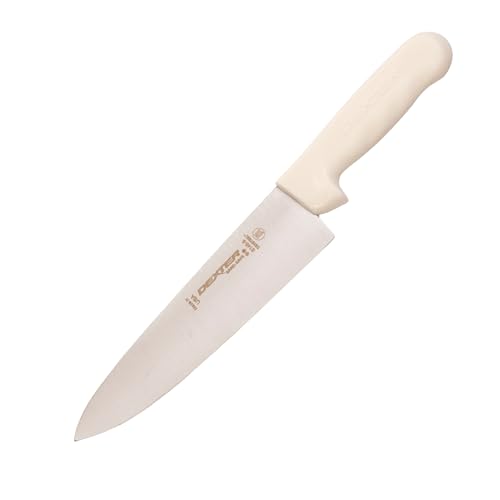
The Dexter-Russell SANI-SAFE is the knife you’ll find in commercial kitchens, butcher shops, and restaurant prep lines across the country. It is NSF certified for sanitation compliance and made in the USA from high-carbon stainless steel. The blade is individually ground and honed, producing a sharp edge that cuts through rib bones and dense vegetables without chipping. The stamped construction keeps the knife light and affordable, making it a popular choice for high-volume environments where knives get replaced regularly.
The textured white polypropylene handle is the defining feature of the SANI-SAFE series. It provides a slip-resistant grip even with wet, greasy hands, and the material’s bright color makes the knife easy to spot if it falls into a sink or trash bin. The handle feels cheap compared to wooden or G10 options, but it is supremely practical — it will not crack, swell, or degrade with repeated commercial dishwasher cycles.
The knife is lightweight at 7.2 ounces and has a curved blade profile that facilitates an efficient rocking motion. Experienced users note that the blade is thin and razor-sharp, ideal for slicing and soft vegetable work but not for hacking or cleaving through thick bones. The packaging is minimal and functional, not gift-quality. For home cooks who want a rugged, no-nonsense tool that professional kitchens trust, this is a solid entry-level choice with zero pretense.
Why it’s great
- NSF certified and made in USA — trusted by professional kitchens
- Textured polypropylene handle provides secure grip when wet
- Lightweight stamped blade reduces fatigue during extended prep
Good to know
- Handle feels inexpensive compared to wood or G10 alternatives
- Thin blade is not suitable for heavy bone or frozen food cutting
FAQ
Should I choose a German or Japanese edge angle for an all-around kitchen knife?
How do I maintain a 58-60 HRC VG10 steel blade without damaging the edge?
What handle material is best for a knife used daily in a home kitchen?
Final Thoughts: The Verdict
For most users, the best all around kitchen knife winner is the Victorinox Fibrox Pro 8″ Chef’s Knife because it combines a laser-tested edge, a slip-resistant TPE handle, and proven durability at a value that outperforms knives costing several times more. If you want a premium German-stamped blade with superior edge retention and brand heritage, grab the WÜSTHOF Gourmet 8″ Chef’s Knife. And for the budget-conscious cook who wants a genuine Japanese-style 12-15 degree edge with Damascus aesthetics, nothing beats the Sunnecko 8 Inch Chef Knife for its sharpness-to-cost ratio.

Mo Maruf
I created WellFizz to bridge the gap between vague wellness advice and actionable solutions. My mission is simple: to decode the research and give you practical tools you can actually use.
Beyond the data, I am a passionate traveler. I believe that stepping away from the screen to explore new environments is essential for mental clarity and physical vitality.