Our readers keep the lights on and my smoothie glass nicely filled. As an Amazon Associate, I earn from qualifying purchases.
Standard tap water might taste flat or carry a faint chlorine note, but a dedicated alkaline pitcher transforms that into a crisp, mineral-rich glass. You get elevated pH levels, added electrolytes like magnesium and calcium, and the peace of mind that comes from reducing common contaminants — all without expensive bottled water or under-sink plumbing. The challenge is picking the right model from a shelf crowded with filtration claims.
I’m Mohammad Maruf — the founder and writer behind WellFizz. I’ve spent years analyzing consumer water filtration hardware, from gravity-fed pitchers to electric dispensers, focusing on the real-world performance data buyers need to sort marketing from measurable quality.
Whether you want to soften coffee’s acidity, increase daily mineral intake, or remove fluoride without a plumber’s visit, the right pitcher handles all of that. This guide delivers a tightly researched selection of the best alkaline water filter pitcher models available, each picked for its specific real-world strengths.
How To Choose The Best Alkaline Water Filter Pitcher
An alkaline pitcher does more than remove chlorine — it raises the pH and adds specific minerals. But not every pitcher delivers a stable pH over the filter’s full lifespan, and some use ion-exchange resins that add unwanted sodium. Know which spec to prioritize before you buy.
Filtration Media: Bioceramic vs. Ion Exchange Resin
The core material that alkalizes your water matters more than the brand name. Bioceramic filters (natural mineral balls and activated coconut carbon) raise pH without adding sodium — a clear advantage if you watch your salt intake. Resin-based filters work, but they release sodium ions as a byproduct of the exchange process. Look for “no ion exchange resin” on the spec sheet if you want the cleanest mineral profile.
Filter Lifespan & Gallon Capacity
Gravity pitchers typically deliver 40 to 100 gallons per filter, while electric or high-end bio-ceramic models can reach 200 to 400 liters (roughly 105 gallons). A longer filter life saves money and reduces waste, but you must confirm the pH stays stable past the halfway point. Review data on this guide shows some filters drop from pH 9 to pH 7.5 soon after their rated limit — replace on schedule, not by guess.
Real Contaminant Reduction (Not Just pH)
Do not assume every alkaline pitcher reduces heavy metals, fluoride, or PFAS. Many models only raise pH and add minerals. If you need chlorine, lead, or microplastic removal, check for third-party certifications (NSF/ANSI 42 for chlorine, NSF/ANSI 372 for lead-free materials, or independent lab reports). The best alkaline pitchers combine a carbon block stage with the alkalizing media.
Quick Comparison
On smaller screens, swipe sideways to see the full table.
| Model | Category | Best For | Key Spec | Amazon |
|---|---|---|---|---|
| Waterdrop PT-07B-A | Gravity Pitcher | Upgrading from standard Brita | 100 gal / pH 8.0-9.5 | Amazon |
| ZeroWater 22-Cup | Dispenser | Pure water (0 TDS target) | 22 cups / 5-stage ion exchange | Amazon |
| AQUA CREST 06-AL | Replacement Filter | Brita owners wanting alkalinity | 6-pack / 2-month each | Amazon |
| Waterdrop ED01AW | Electric Dispenser | Instant on-demand filtered water | 200 gal / 30-day battery | Amazon |
| Brita OB03 | Gravity Pitcher | Budget everyday filtration | 10 cups / 40 gal | Amazon |
| Alkanatur Drops Pitcher | Bioceramic Pitcher | Fluoride removal + no sodium | 1.4 L / 400 L filter life | Amazon |
| Alkanatur Hydrogen Pitcher | Bioceramic Pitcher | Antioxidant (ORP -350) water | 1.4 L / pH 9.5 + magnesium | Amazon |
In‑Depth Reviews
1. Waterdrop PT-07B-A Alkaline Water Filter Pitcher

Waterdrop’s entry-level alkaline pitcher punches well above its tier. The 6-stage filter uses a Japanese ACF (activated carbon fiber) layer to reduce chlorine, fluoride, and heavy metals, then passes water through a mineralizing stage that pushes pH into the 8.0–9.5 range. That dual action — contaminant reduction followed by alkalization — is rare at this price point. Users consistently report noticeably sweeter-tasting tap water and a measurable improvement in coffee smoothness thanks to reduced acidity.
The 10-cup (100-gallon) design includes a gravity-fed indicator light that tracks filter usage, so you do not have to guess when to swap. Filtration speed is significantly faster than comparable Brita models, with reviewers noting a full pitcher in under two minutes. The outer shell uses high-grade BPA-free plastic with an ergonomic handle that feels solid during pouring.
One clear caveat: this pitcher does NOT lower TDS. If your incoming water is already high in dissolved solids, the alkalizing stage adds minerals on top of that, not in place of it. For RO system owners, however, this is a feature — the mineralizing stage fixes the flat taste reverse osmosis leaves behind.
Why it’s great
- Exceptionally fast flow rate for a gravity pitcher (under 2 min).
- 100-gallon filter life reduces replacement frequency.
- Elevates pH reliably into 9.0 range for coffee and drinking water.
Good to know
- Does not reduce TDS — not for users who want “pure” low-ppm water.
- Indicator light is convenient but not a TDS meter.
2. ZeroWater 22-Cup 5-Stage Water Filter Dispenser

ZeroWater occupies a different lane from the other pitchers here — it aims for zero total dissolved solids, not high pH. The 5-stage ion-exchange filter pulls out virtually everything: lead, chromium, mercury, PFOA/PFOS, and common minerals. The built-in TDS meter lets you watch the number drop in real time. Users in high-mineral areas (500+ ppm tap water) report seeing 0–3 ppm after filtration, which is unmatched by any standard alkaline pitcher.
The 22-cup dispenser is the largest capacity on this list, making it a strong fit for families or anyone who fills multiple bottles daily. The sliding hatch design is spill-free and the spigot releases water without tipping the whole container. IAPMO certification backs the contaminant reduction claims, covering PFOA/PFOS beyond what most alkalizing filters address.
The trade-off comes from the same aggressive removal: it strips beneficial minerals like calcium and magnesium, leaving water that some describe as “flat.” For those who want water that is analytically pure, this is the tool. For those who want mineral-alkaline water, pair ZeroWater with a remineralizing additive or use a dedicated alkaline filter alongside it.
Why it’s great
- Highest contaminant removal rate of any pitcher here (0 TDS capable).
- IAPMO certified for PFOA/PFOS, lead, and chromium.
- 22-cup capacity reduces refill frequency for large households.
Good to know
- Removes all minerals, which can make water taste flat.
- Filter life varies heavily by source water (30–105 days reported).
3. AQUA CREST 06-AL Alkaline Water Filter (6-Pack)

This is not a full pitcher — it is a drop-in replacement filter designed to fit all standard Brita pitchers and dispensers (except the Stream and Hub Instant lines). AQUA CREST’s 06-AL uses a non-woven fabric layer, coconut shell activated carbon, and an alkalizing mineral stage that adds calcium, magnesium, potassium, and selenium. The result is a Brita-compatible upgrade that delivers pH elevation and mineral enrichment without replacing your existing plastic pitcher.
NSF/ANSI 42 certification covers chlorine, taste, and odor reduction, while NSF/ANSI 372 ensures the materials are low-lead. Each filter is rated for two months or roughly 40 gallons, and the 6-pack covers a full year. Users coming from standard Brita white filters report water that tastes markedly less bitter and a visible reduction in limescale buildup in tea kettles.
The main complaint in user reviews is occasional black carbon fines in the first few batches — common with fresh carbon filters. A thorough 5-minute flush (as directed) usually resolves it. If you already own a Brita pitcher and want alkaline water without buying another appliance, this is the most efficient path.
Why it’s great
- Direct swap for Brita pitchers — no new hardware needed.
- NSF/ANSI 42 and 372 certified for contaminant and material safety.
- Adds four essential minerals while raising pH.
Good to know
- Some carbon fines may appear in initial water runs (flush well).
- Not compatible with Brita Stream or Hub Instant models.
4. Waterdrop ED01AW Electric Water Filter Pitcher

Waterdrop’s ED01AW flips the gravity paradigm by adding a rechargeable pump. Press a button and filtered water dispenses automatically into your glass — no tipping, no waiting for the top chamber to drain. The 5-micron carbon block filter reduces over 30 contaminants, including chlorine, lead, and PFOA/PFOS, while the alkaline stage raises pH by 1.5–2.5 points. Total filter capacity hits 200 gallons, double that of most gravity pitchers.
The internal battery lasts about 30 days on a single USB-C charge (assuming three liters of daily usage), making it genuinely portable for kitchens, offices, and camping setups. The 15-cup upper reservoir holds enough water for a full day, and the one-touch dispensing works for all ages — no strength needed to pour a full pitcher. Size measurements (12.5” x 12.2” x 7.8”) mean it needs counter space but fits under most standard cabinets.
Note: Like the Waterdrop PT-07B, this unit does NOT lower TDS. It alkalizes and filters but does not remove dissolved solids. The pump mechanism adds a potential failure point (one reviewer reported a pump failure resolved by warranty replacement), but Waterdrop’s customer service appears responsive. If you value on-demand dispensing and high contaminant reduction, this is the most feature-dense option.
Why it’s great
- Electric dispensing eliminates tipping and waiting.
- 200-gallon filter life — best in this lineup for longevity.
- USB-C rechargeable battery lasts 30 days per charge.
Good to know
- Does not reduce TDS.
- Pump and electronics add complexity vs. a simple gravity pitcher.
5. Brita Large Water Filter Pitcher (OB03)

Brita’s OB03 is the baseline that every other pitcher here measures against. Its 10-cup BPA-free body fits most fridge doors, the easy-fill locking lid prevents spills, and the standard filter reduces chlorine taste and odor, mercury, copper, zinc, and cadmium. It is a reliable, low-hassle entry into filtered water — no electric parts, no TDS meters, no complex media layers.
The 40-gallon filter life is shorter than the Waterdrop and Alkanatur options, and the Brita design does not alkalize. If you want mineral-enhanced, high-pH water, you would pair this with AQUA CREST’s alkaline replacement filters (discussed above) or stick with the Brita Elite filter for better contaminant reduction. The flow rate is slower than the Waterdrop gravity pitcher, taking roughly 5–7 minutes for a full batch.
Brita’s strength is its ubiquity: replacement filters are available at virtually any grocery store, and the pitcher’s geometry is optimized for refrigerator shelves. For anyone who wants a simple, known-quantity filter without the alkaline upcharge, the OB03 gets the job done. But for this guide’s focus — alkalinity — it serves best as a proven platform that can be upgraded with third-party alkaline cartridges.
Why it’s great
- Widely available replacement filters at retail stores.
- Fridge-friendly design with locking lid.
- Proven standard contaminant reduction (chlorine, mercury, copper).
Good to know
- Does not raise pH or add minerals on its own.
- Slower flow rate compared to premium gravity pitchers.
6. Alkanatur Drops Pitcher
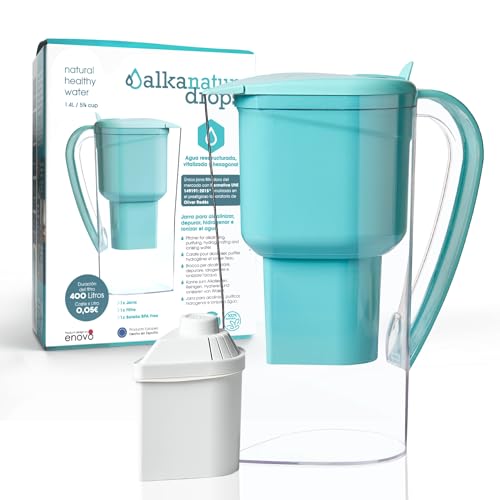
Alkanatur’s Drops Pitcher uses a patented bioceramic filter that does not rely on ion-exchange resin — meaning it alkalizes and purifies without adding sodium. This is a meaningful distinction for anyone monitoring blood pressure or avoiding processed sodium. The filter removes chlorine, heavy metals, fluoride, microplastics, and nitrites, then raises pH to between 8.5 and 9.5 while adding magnesium for electrolyte balance.
Certifications back the claims: the filter is certified by the Instituto Cerámico de Galicia (Santiago de Compostela University) and meets CE, ROHS, and SGS standards. The included BPA-free water bottle is a thoughtful bonus, and the 1.4-liter capacity works well for individuals or couples. User reports show stable pH in the 8.5–8.9 range for the first two months, with a measured drop to 7.5 only after exceeding the recommended filter change window.
The main concern from user reviews is carbon particle shedding in the first few uses — typical for fresh bioceramic filters but worth noting. Some also feel the build quality does not match the investment tier, though the water quality reports are consistently positive. If fluoride removal and sodium-free alkalization are non-negotiables, this is the most certified option available.
Why it’s great
- No ion-exchange resin means zero sodium addition.
- Removes fluoride — a feature most alkaline pitchers skip.
- Stable pH (8.5–9) for full filter lifespan.
Good to know
- Initial carbon fines may appear (flush thoroughly before use).
- Smaller 1.4 L capacity compared to larger dispensers.
7. Alkanatur Alkaline Hydrogen Water Filter Pitcher
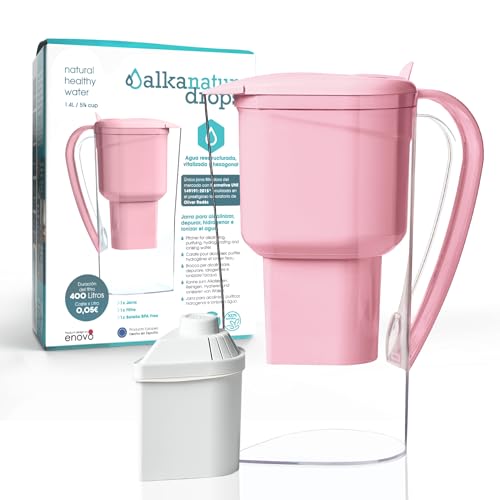
This second Alkanatur model builds on the Drops Pitcher’s foundation with an additional focus on antioxidant capacity. The bioceramic filter ionizes water molecules, producing an oxidation-reduction potential (ORP) of up to -350 mV — a measure of the water’s ability to neutralize free radicals. Combined with pH elevation to 9.5 and the addition of magnesium, this pitcher targets users who want both alkalinity and antioxidant properties from a single countertop device.
The same sodium-free filtration architecture applies (no ion-exchange resin), and the contaminant reduction list matches the Drops model: chlorine, fluoride, heavy metals, microplastics, PFAS, and nitrites. The pitcher includes a BPA-free water bottle, and the 1.4-liter size mirrors the Drops model for easy fridge storage. Certifications include FDA, CE, ROHS, and SGS, plus the same university-level ceramic institute certification from Spain.
User feedback echoes the Drops pitcher experience: stable pH for three to four months, excellent taste improvement, and effective fluoride removal. The same carbon-particle caveat applies during the break-in period. The premium investment gets you the antioxidant ORP spec and the most comprehensive independent certification set in this roundup — worth it if those metrics matter to your hydration goals.
Why it’s great
- Measurable antioxidant effect (ORP down to -350 mV).
- FDA, CE, and university certified for contaminant reduction.
- No sodium addition — pure bioceramic alkalization.
Good to know
- Same carbon-shedding break-in as the Drops model.
- 1.4-liter capacity may need frequent refills for large households.
FAQ
Will an alkaline pitcher lower my water’s TDS?
How often should I replace the filter in an alkaline pitcher?
Does an alkaline filter remove fluoride?
Final Thoughts: The Verdict
For most users, the best alkaline water filter pitcher winner is the Waterdrop PT-07B-A because it delivers fast flow, a 100-gallon filter lifespan, and a reliable pH boost to 9.5 without breaking the mid-range barrier. If you want the highest contaminant reduction and don’t mind remineralizing separately, grab the ZeroWater 22-Cup Dispenser. And for fluoride removal with no added sodium, nothing beats the Alkanatur Drops Pitcher.

Mo Maruf
I created WellFizz to bridge the gap between vague wellness advice and actionable solutions. My mission is simple: to decode the research and give you practical tools you can actually use.
Beyond the data, I am a passionate traveler. I believe that stepping away from the screen to explore new environments is essential for mental clarity and physical vitality.