Our readers keep the lights on and my smoothie glass nicely filled. As an Amazon Associate, I earn from qualifying purchases.
Waking up shouldn’t feel like a negotiation. Yet millions of people start their day hitting snooze, stumbling through a groggy haze, or sleeping right through their phone’s vibration. The difference between a productive morning and a chaotic one often comes down to a single device. A proper alarm clock radio uses tangible hardware—decibels, radio antennas, dedicated speakers, and backup batteries—to break through your sleep cycle where a smartphone app simply fails.
I’m Mohammad Maruf — the founder and writer behind WellFizz. I’ve spent years analyzing the raw specs of hundreds of electronic home products, cross-referencing customer feedback with what the engineering data actually says about long-term reliability.
This guide cuts through the noise to identify the best alarm clock radio for your specific sleep style, whether you need a 115dB sonic boom to wake up or a gradual sunrise simulation that respects your circadian rhythm.
How To Choose The Best Alarm Clock Radio
Finding your perfect alarm clock radio means matching its engineering to your biology. Heavy sleepers need brute-force volume or physical vibration. Light sleepers need gradual light and gentle sounds. Everyone needs a readable display that doesn’t act as a nightlight. Here are the four factors that separate a good morning device from an annoying desk ornament.
Wake-Up Mechanism: Sound, Light, or Vibration
Your nervous system’s arousal threshold dictates which mechanism works. Standard beep-style radios top out around 80dB—enough for most people but useless for deep sleepers or those with hearing loss. For those users, you need a unit pushing 110-115dB or a wireless bed shaker that physically rattles the mattress. On the opposite end, sunrise simulation clocks use a gradual 30-minute light ramp that signals your brain to reduce melatonin production before the audio alarm activates. This is ideal for light sleepers who want to avoid cortisol spikes first thing in the morning.
Display Brightness and Dimmer Range
A clock that glows like a beacon can fragment your sleep cycles. Look for units that offer a full 0-100% dimmer range or a dedicated “display off” mode. Some lower-end models only offer three fixed levels, meaning the lowest setting may still be too bright for a completely dark bedroom. Red LED displays are generally better for maintaining night vision than blue or white ones. The best units in this category let you kill the display entirely while retaining alarm functionality.
Audio Quality and Alarm Sounds
If you plan to use FM radio or Bluetooth streaming as your wake-up source, speaker quality matters. A cheap 2-inch driver produces muddy, tinny sound that makes listening to morning news or podcasts unpleasant. Look for units with passive radiators or larger bass diaphragms for richer audio. For alarm sounds specifically, avoid units with only a single harsh buzzer. The best options offer 6-8 distinct sounds including nature sounds, gradual chimes, and FM radio, so you can rotate sounds to prevent habituation.
Backup Power and Alarm Memory
During a power outage, a clock that resets to 12:00 blinking is useless. Two types of battery backup exist: coin-cell batteries that retain time and alarm settings but don’t power the speakers, and larger AAA or AA batteries that keep the alarm fully functional. For heavy sleepers who rely on loud alarms, a unit with AAA backup that continues sounding during an outage is critical. For general use, a CR2032 coin cell that remembers settings so the clock re-syncs when power returns is sufficient.
Quick Comparison
On smaller screens, swipe sideways to see the full table.
| Model | Category | Best For | Key Spec | Amazon |
|---|---|---|---|---|
| Soundfreaq Sound Rise II | Premium Radio | Audio quality & bedside charging hub | 20W USB-C fast charge + passive radiator | Amazon |
| Sharp Digital Alarm Clock | Large Display | Easy-to-read 8.9″ screen | 8.9″ display with AccuSet auto time | Amazon |
| ANJANK Wooden Bluetooth Speaker | Bluetooth Hub | Qi wireless charging + wood aesthetics | Qi 10W wireless charging, Bluetooth 5.0 | Amazon |
| Broserengy Alarm Clock Speaker | RGB & Speaker | Dual 5W speakers & RGB light modes | Dual 5W speakers, RGB night light | Amazon |
| ANJANK Extra Loud w/ Bed Shaker | Vibrating Shaker | Heavy sleepers & hearing impaired | 112dB alarm + wireless bed shaker | Amazon |
| Dekala Sunrise Alarm Clock | Sunrise Simulator | Gentle gradual wake-up | Sunrise simulation 10-100%, 8 sleep sounds | Amazon |
| Acedeck Super Loud Alarm | Heavy Duty | Extreme loudness on a budget | 115dB max volume, AAA battery backup | Amazon |
In‑Depth Reviews
1. Soundfreaq Sound Rise II (SFQ-16)

The Soundfreaq Sound Rise II represents the highest audio standard in the alarm clock radio category. Its custom-tuned monophonic driver paired with a passive radiator delivers bass response and vocal clarity that surpasses virtually every other bedside radio. The 6-level dimmable LCD screen means you can drop the brightness to near-invisibility for pitch-black bedrooms, while the three fast-charging USB ports—including a 20W USB-C and a 18W QC3.0—make this the definitive charging hub for a modern nightstand.
Functionally, this unit checks every box a power user needs: dual alarms with progressive wake-up volume, six nature sounds including ocean waves and forest sounds, and an FM radio with real antenna reception. The Bluetooth streaming works as a secondary audio source with sleep timer ranging from 10 to 120 minutes. The gradual volume ramp prevents the cortisol spike of a sudden buzzer, making it appropriate for light sleepers who still want audio quality.
Where the Sound Rise II stumbles is in button differentiation—the separate Alarm 1 and Alarm 2 buttons are hard to distinguish by touch in a dark room. Additionally, the price point is steep for a category where many functional units exist under . But for buyers who prioritize audio fidelity, reliable timekeeping, and multi-device charging from a single compact footprint, this is the unit that outperformed five other clock radios tested by owners, including models at double the price.
Why it’s great
- Class-leading audio with passive radiator bass enhancement
- Three fast-charging ports (20W USB-C, 12W USB-A, 18W QC3.0)
- 6 nature sounds and FM radio with progressive wake volume
- 6-level dimmable display with backup battery for time retention
- Sleep timer and gradual alarm ramp for gentle wake-up
Good to know
- Alarm 1 and Alarm 2 buttons feel identical by touch
- No auto-dimming or ambient light sensor
- Wood-faced version costs significantly more than black
2. Sharp Digital Alarm Clock (B0B7K6BRR7)

Sharp’s 8.9-inch display trumps nearly every competitor by 48% in screen real estate, making its 3-inch red digits legible from across a master bedroom. The tilt and swivel mechanism means you aren’t locked into a single viewing angle—critical for anyone who positions their clock off-center or on a low nightstand. The AccuSet automatic time programming pre-loads the correct time once you set your time zone and DST preference, eliminating the manual-setting headache that plagues cheaper units.
The FM radio stores up to 10 presets and delivers decent sound through its built-in speaker, though audiophiles should temper expectations—this is a functional radio, not a music-grade driver. The dual USB charging ports provide 2-amp rapid charging, which is above the 1-amp standard found on many competitors. The 3-level brightness adjustment (Off/Low/High) is functional but lacks the granular dimming needed for those sensitive to any glow during sleep.
The Achilles’ heel here is the AccuSet feature’s handling of Daylight Saving Time—multiple user reports note the clock fails to auto-adjust for DST, requiring a manual switch that effectively defeats the purpose of automatic time setting. The red LED display preserves night vision better than blue or white alternatives, and the pre-installed CR2032 battery retains settings during outages. For people with visual impairments who need large, high-contrast numbers, this is the top option in the category, provided you can manage the DST quirk.
Why it’s great
- 8.9-inch display with 3-inch red digits—best for low vision
- Tilt and swivel display for adjustable viewing angle
- AccuSet auto time programming (pre-loaded before shipping)
- Dual 2-amp USB fast charge ports (10W total)
- CR2032 backup battery retains time settings during outages
Good to know
- AccuSet does not auto-adjust for Daylight Saving Time
- Only 3 brightness levels—no 0-100% stepless dimming
- Display cannot be turned completely off while powered
3. ANJANK Wooden Bluetooth Speaker Alarm Clock (AC190BT-Grey)

The ANJANK Wooden Bluetooth Alarm Clock achieves a rare design feat in this category—it looks like a piece of furniture you’d want on your nightstand, not a plastic gadget from 2005. The real wood enclosure (in grey finish) houses a 10W Bluetooth 5.0 speaker that auto-syncs time via your phone’s network, eliminating manual setting entirely. Its Qi-certified wireless charging pad supports 5W/7.5W/10W charging, which neatly handles iPhone and Samsung devices through most cases.
FM radio coverage spans 87.5-108 MHz with an external antenna for signal stability, and the sleep timer lets you set 10-120 minute intervals for drift-off listening. The 1.4-inch digital display offers 0-100% stepless brightness adjustment via a rear dial, meaning you can kill every photon for dark-room sleepers. The alarm offers 8 nature sounds plus FM radio as wake sources, with dual-alarm support for couples with different schedules.
Reliability concerns surface around the exposed speaker grille on the rear, which is vulnerable to dust and physical damage. Some users report that the time fails to auto-correct after DST if Bluetooth disconnects from the phone at the wrong moment. The absence of AAA battery backup means this unit is fully reliant on AC power—if the power goes out, the clock loses all functionality until restored. For buyers seeking a multifunctional bedside device that prioritizes aesthetics and wireless charging over brute-force wake-up capabilities, this is a standout option in the mid-premium tier.
Why it’s great
- Real wood construction offers premium desktop aesthetic
- Qi-certified 10W wireless charging pad built into top surface
- Bluetooth 5.0 with auto time sync from phone
- 0-100% stepless display dimmer via rear dial
- Sleep timer and 8 nature sounds for wind-down routine
Good to know
- No battery backup—clock dies completely during power outages
- Exposed rear speaker grille susceptible to dust accumulation
- Time may not auto-sync after DST if Bluetooth disconnects
4. Broserengy Alarm Clock Speaker with Wireless Charger (B0CRDVRNTD)

The Broserengy alarm clock takes a multi-sensory approach, pairing dual 5W speakers with an RGB light strip that cycles through static, breathing, and music-synced modes. The dual-driver configuration delivers noticeably better stereo separation than the single-speaker units in this price range, making it viable as a desktop computer speaker alongside its alarm functions. The Qi wireless charging pad on top works reliably with most smartphones, even those in thicker OtterBox cases.
Wake-up features include a thoughtful combination of gradual sound and light—the alarm volume increases progressively while a wake-up light slowly brightens, creating an integrated gentle transition from sleep. Six alarm ringtones are available, ranging from standard beeps to more melodic options, and the dedicated large snooze button is easy to hit without opening your eyes. The Bluetooth 5.0 connection includes AUX and USB fallback for devices that lack wireless support.
The primary trade-off is display brightness. Even at the lowest of its six levels, some users report the blue-tinted LED screen remains too bright for pitch-black bedrooms. The plastic build quality feels mid-range compared to the wood or metal competitors in the premium tier. Battery backup uses a coin cell for time retention only—the alarm will not sound during a power outage. For buyers who want a multifunctional nightstand device that doubles as an ambient light source and Bluetooth speaker while offering reliable dual-alarm functionality, this unit provides strong value at the upper end of the mid-range.
Why it’s great
- Dual 5W speakers for stereo playback in desktop mode
- RGB light strip with music sync, breathing, and static modes
- Qi wireless charging works through thicker phone cases
- Gradual wake-up light with progressive volume ramp
- Bluetooth 5.0, AUX, and USB connectivity options
Good to know
- Lowest brightness setting still too bright for dark sleepers
- No battery backup for alarm function during power outages
- Plastic construction lacks premium feel of wood/metal units
5. ANJANK Extra Loud Alarm Clock with Wireless Bed Shaker (KX213)

The ANJANK KX213 is engineered for the most difficult wake-up scenarios. Its 112dB front-facing speaker is 40% louder than standard alarm clocks, and the sound can be shaped through 10-level volume control across 8 sounds ranging from sharp buzzer tones to nature sounds like rain and piano. But the real differentiator is the wireless bed shaker—a vibrating puck that sits under your pillow and communicates with the main unit wirelessly up to 32.8 feet away, with a rechargeable battery lasting 2-3 months per charge.
The 9-color nightlight with 6 brightness levels includes a complete off-state, allowing total darkness for sensitive sleepers. The RGB time display offers white, red, blue, or gradient options, and the 0-100% dimmer lets you kill the screen entirely. Dual alarms with independent schedules are supported, and each alarm can be assigned a different sound and vibration intensity. USB-C output lets you charge your phone overnight from the clock’s powered port.
Reliability is the critical concern here. Multiple user reports indicate the alarm can stop functioning within 30 days of purchase, a red flag for anyone depending on it for time-sensitive obligations. The unit requires constant AC power—there is no battery backup whatsoever, meaning a power outage renders it completely silent. The max volume at 112dB can cause a ringing sensation at close range. For heavy sleepers and hearing-impaired users who have failed with every other alarm, the shaker mechanism is uniquely effective, but the longevity data suggests buying with a protection plan is wise.
Why it’s great
- 112dB alarm with wireless bed shaker (32.8 ft range)
- Rechargeable 1500mAh shaker lasts 2-3 months per charge
- 0-100% display dimmer with complete off capability
- 8 alarm sounds with 10-level precise volume control
- 9-color nightlight with 6 brightness levels
Good to know
- No battery backup—clock dies completely during power outages
- Reported reliability issues with alarm ceasing within 30 days
- Max volume can cause physical ringing sensation at close range
6. Dekala Sunrise Alarm Clock (ACA-002-B)

The Dekala Sunrise Alarm Clock delivers a premium circadian-friendly wake-up feature set at a price point that undercuts competitors by 30-50%. Its core technology is a gradual light ramp that increases from 10% to 100% brightness over 30 minutes before the audio alarm triggers—this mimics natural dawn and reduces morning grogginess by aligning with your body’s cortisol rhythm. The sunset simulation does the reverse, dimming from 100% to 0% over a customizable duration to help you wind down.
Beyond light therapy, this unit packs 7 alarm sounds including FM radio (76-108 Hz spectrum), 8 soothing sleep sounds, and dual alarms for couples with staggered schedules. The display brightness offers 4 fixed levels plus a dedicated night mode that virtually eliminates screen output. The snooze function provides 9-minute increments up to 5 times, accessible via a top-surface button that is easy to locate without visual confirmation. The white plastic housing is lightweight but appears more premium than its price suggests.
The FM radio reception can be finicky in concrete-walled apartments, and the speaker output is adequate for background noise but won’t satisfy audiophiles. Users who sleep with their head fully under the covers report that the sunrise light effect is partially blocked, reducing its effectiveness. The unit requires constant AC power with no battery backup options, meaning a power cut will reset all settings. For budget-conscious buyers who want the biological benefits of sunrise simulation without spending -100, this is the strongest value proposition in the entire lineup.
Why it’s great
- 30-minute sunrise simulation from 10% to 100% brightness
- Sunset simulation feature for gradual wind-down to sleep
- 7 alarm sounds including FM radio and 8 sleep sounds
- Dual alarms with 5x 9-minute snooze capability
- 4-level display brightness plus night mode for darkness
Good to know
- No battery backup—settings lost during power outages
- FM radio reception weak in buildings with concrete walls
- Light simulation less effective if sleep with head under covers
7. Acedeck Super Loud Alarm Clock (B0FJFLYCBP)
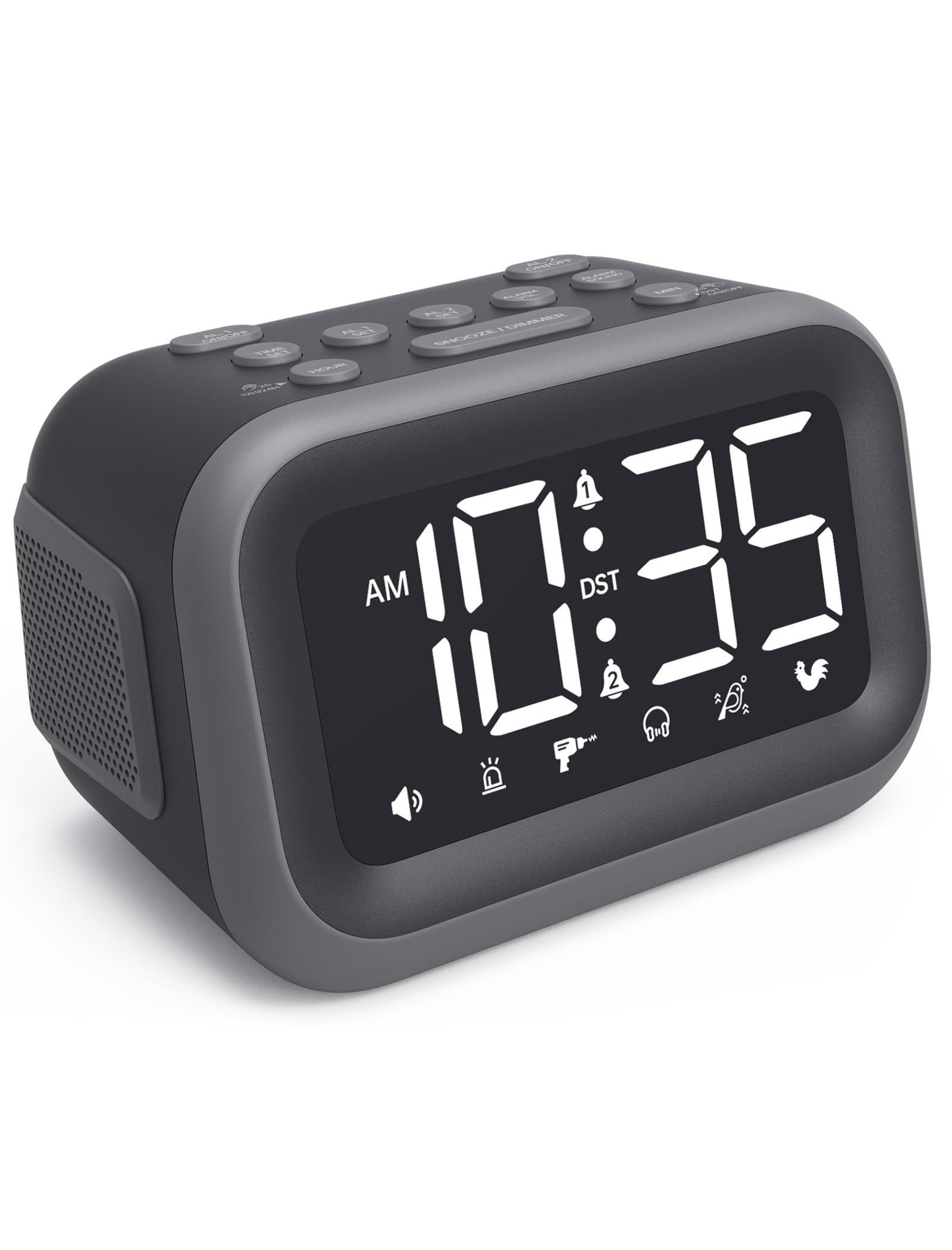
The Acedeck Super Loud Alarm Clock delivers the highest raw decibel rating in this lineup—115dB—and backs it with a gradual volume ramp that prevents the full blast from hitting you immediately. Six distinct alarm sounds are available, including multiple buzzers and tones, and the 4.2-inch LED display offers adjustable brightness to prevent night glow disruption. The build quality feels robust for its entry-level price point, with large, tactile buttons that are easy to operate in a morning haze.
The alarm memory feature is a standout at this price: with 3 AAA batteries installed, the clock retains all time and alarm settings during a power outage, and the alarm will still sound when the power returns—something many premium units fail to deliver. A USB-A charging port allows overnight phone charging at standard 5V/1A speeds. The gray plastic housing with white digits is utilitarian but not offensive, and the compact footprint (4.8 x 3.15 inches) fits on cramped nightstands.
The trade-offs are clear: no FM radio, no Bluetooth, no sunrise simulation—this is a single-purpose loud alarm clock, not a multifunctional bedside device. The USB port charges slowly compared to the 2-amp or fast-charging ports on more expensive units. The display cannot be turned completely off; its lowest brightness setting may still be visible in total darkness. For heavy sleepers who need a reliable, deafening wake-up signal and don’t care about aesthetics or extra features, the Acedeck provides the best ratio of decibel output to price in this comparison.
Why it’s great
- 115dB maximum alarm—loudest unit in this review
- AAA battery backup for time retention and outage alarm
- 6 alarm sounds with gradual volume ramp
- Adjustable 4.2-inch LED display brightness
- Compact footprint for small nightstand spaces
Good to know
- No FM radio, Bluetooth, or sunrise simulation features
- USB charging port is standard 5V/1A (not fast charging)
- Display cannot be set to completely off at night
- Batteries not included despite requiring 3x AAA
FAQ
Is a 115dB alarm clock safe for my hearing?
Can I use a sunrise alarm clock without internet access?
Why does my FM radio reception sound static-y indoors?
What’s the real difference between automatic time setting and AccuSet?
Final Thoughts: The Verdict
For most users, the best alarm clock radio winner is the Soundfreaq Sound Rise II because it combines premium audio quality, fast multi-device charging, reliable dual alarms with progressive wake volume, and a dimmable display that respects sleep—all in a compact footprint. If you are a heavy sleeper who consistently sleeps through standard alarms, grab the ANJANK KX213 with Wireless Bed Shaker for its physical vibration and 112dB peak volume. And for budget-conscious buyers seeking gentle circadian-friendly mornings, nothing beats the Dekala Sunrise Alarm Clock, which delivers the biological benefits of sunrise simulation at a fraction of the typical cost.

Mo Maruf
I created WellFizz to bridge the gap between vague wellness advice and actionable solutions. My mission is simple: to decode the research and give you practical tools you can actually use.
Beyond the data, I am a passionate traveler. I believe that stepping away from the screen to explore new environments is essential for mental clarity and physical vitality.