Our readers keep the lights on and my smoothie glass nicely filled. As an Amazon Associate, I earn from qualifying purchases.
An air source heat pump extracts warmth from ambient air, but once outdoor temperatures dip into single digits many units simply stop delivering. The difference between a system that coasts through a polar vortex and one that sputters above freezing comes down to the compressor technology, the defrost logic, and the specific cold-climate rating that few spec sheets advertise upfront.
I’m Mohammad Maruf — the founder and writer behind WellFizz. I’ve spent years analyzing compressor maps, coefficient-of-performance curves, and real-world test data to separate the cold-climate performers from the fair-weather machines.
After comparing nine different systems ranging from mini-split inverters to whole-home package units, I’ve singled out the models that consistently deliver useful heat below 5°F. This guide is built around the best air source heat pump for cold climates.
How To Choose The Best Air Source Heat Pump For Cold Climates
Selecting a heat pump for a region that regularly sees sub-zero temperatures requires looking past the brochure. Three factors dominate real-world cold-weather performance.
Inverter vs. Single-Stage Compressor
An inverter-driven compressor ramps up and down continuously rather than cycling on and off. In cold weather this matters enormously: a single-stage unit either runs at full capacity or shuts off, which triggers frequent defrost cycles and large temperature swings. An inverter unit holds a steady low-stage output, maintaining indoor comfort and reducing defrost interruptions when outdoor coils ice up.
Cold-Climate Certification and COP
The Coefficient of Performance (COP) at 5°F is the single most comparable spec for cold-climate use. A COP of 2.0 means the unit delivers two units of heat for every one unit of electricity. Some mini-splits now maintain a COP above 2.5 at -13°F. Look for units that publish performance data down to -22°F and carry an Energy Star Most Efficient designation for cold climates.
Defrost Strategy
Every air source heat pump accumulates frost on the outdoor coil in humid, cold conditions. What separates a strong cold-climate unit is the defrost logic: sensor-based initiation that fires only when needed, not on a fixed timer, and a defrost duration under 10 minutes. Units that rely on simple timer-based defrost will waste energy cycling unnecessarily on milder winter days and still ice up during heavy snowfall.
Backup Heat Provision
No air source heat pump can cover 100 percent of a home’s load during a -20°F blizzard without help. A system that integrates electric resistance strips or a gas furnace backup is essential for northern climates. The most reliable approach is a dual-fuel setup where the heat pump handles the mild and moderate cold while the backup kicks in for the extreme peaks.
Quick Comparison
On smaller screens, swipe sideways to see the full table.
| Model | Category | Best For | Key Spec | Amazon |
|---|---|---|---|---|
| Goodman 3 Ton GLZS4BA3610 | Central Split | Whole-home with backup heat | 15 SEER2, R-32, 36,000 BTU | Amazon |
| Goodman 2 Ton GLZS4BA2410 | Central Split | Smaller homes with backup | 15.2 SEER2, R-32, 24,000 BTU | Amazon |
| Cooper & Hunter 28K 2-Zone | Mini-Split | Two-room heating without ducts | 25 SEER2, inverter, -13°F operation | Amazon |
| ROVSUN 42K 2-Zone | Mini-Split | Large garages or open spaces | 20 SEER2, R-32, 42,000 BTU | Amazon |
| Della 28K 2-Zone | Mini-Split | Multi-room budget entry | 20 SEER2, 9K+18K heads | Amazon |
| Senville AURA 33K | Mini-Split | Single-zone extreme cold | 33,000 BTU, -22°F operation | Amazon |
| Goodman 3.5 Ton GPH1442H41 | Package Unit | Ground-level slab installation | 14 SEER, R-410A, 42,000 BTU | Amazon |
| VARMINPOOL V18 Pro | Pool Heat Pump | Pool water heating down to 10°F | 65,000 BTU, inverter, 43 dB | Amazon |
| MICOE 100K BTU | Pool Heat Pump | Large pool heating | 100,000 BTU, auto-defrost | Amazon |
In‑Depth Reviews
1. Goodman 3 Ton 15 SEER2 GLZS4BA3610
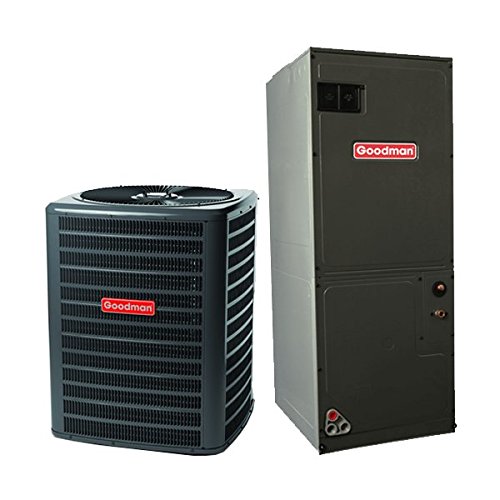
This three-ton split system pairs the GLZS4BA3610 heat pump with an AMST36CU1300 air handler, giving you a complete matched set that achieves 15 SEER2 efficiency. The scroll compressor handles cold starts better than reciprocating designs, and the switch to R-32 refrigerant means lower global-warming potential and slightly better thermodynamic performance in low ambient temperatures compared to R-410A.
The multi-position air handler uses grooved aluminum tubing for improved heat transfer, which helps maintain a steady COP when outdoor conditions get rough. Because this is a single-stage system, performance depends heavily on correct sizing — an oversized unit will short-cycle and struggle with humidity in shoulder seasons, while a properly matched installation keeps the defrost cycles short.
Buyers in truly severe climates will want the optional electric heat kit (HKSC/HKSX series) installed during the initial setup. The 10-year parts warranty is solid, but it requires registration within 60 days. Professional installation is non-negotiable here — this is a full ducted system that demands proper brazing and evacuation.
Why it’s great
- Matched air handler with grooved coil for better heat exchange
- Runs on R-32 for improved low-temp performance
- 10-year warranty with straightforward registration
Good to know
- Single-stage only — no inverter modulation for partial loads
- Requires external heat kit for sub-zero conditions
- Line-set brazing can be tight on small valve take-offs
2. Goodman 2 Ton GLZS4BA2410
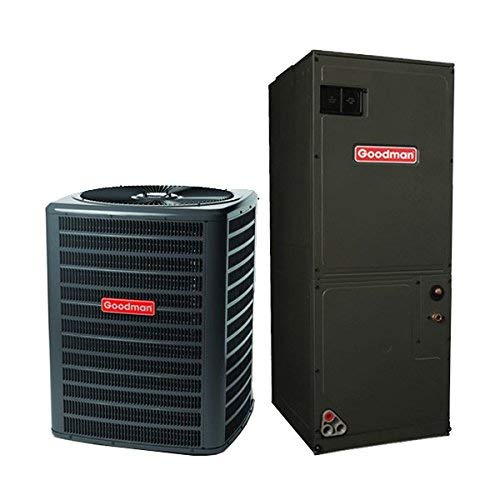
This two-ton system uses the same proven scroll compressor platform as the three-ton model but in a smaller footprint better suited for homes under 1,500 square feet. The pre-charged tubing (15 feet) simplifies the install for a licensed pro, and the factory-installed filter drier ensures the refrigerant loop stays clean from day one.
The GLZS4BA2410 achieves a 15.2 SEER2 rating, which is slightly above the federal minimum and reflects modest but honest efficiency. In a cold climate the real work comes from the backup heat kit — Goodman explicitly recommends ordering a heat kit for cold regions, and this system is designed to accept the HKSC/HKSX series without modification.
Customer feedback highlights the quiet operation and reliable performance, though several buyers reported cosmetic damage from shipping. The packaging leaves the coil and cabinet exposed to handling dents, so inspect the unit before the installer starts the job. The 10-year parts warranty applies only with professional installation and online registration.
Why it’s great
- Compact two-ton size for smaller floor plans
- Factory-installed filter drier for clean operation
- Straightforward backup heat kit integration
Good to know
- Shipping damage is common — inspect before install
- Single-stage design, not inverter-driven
- Heat kit is sold separately
3. Cooper & Hunter 28,000 BTU 2-Zone
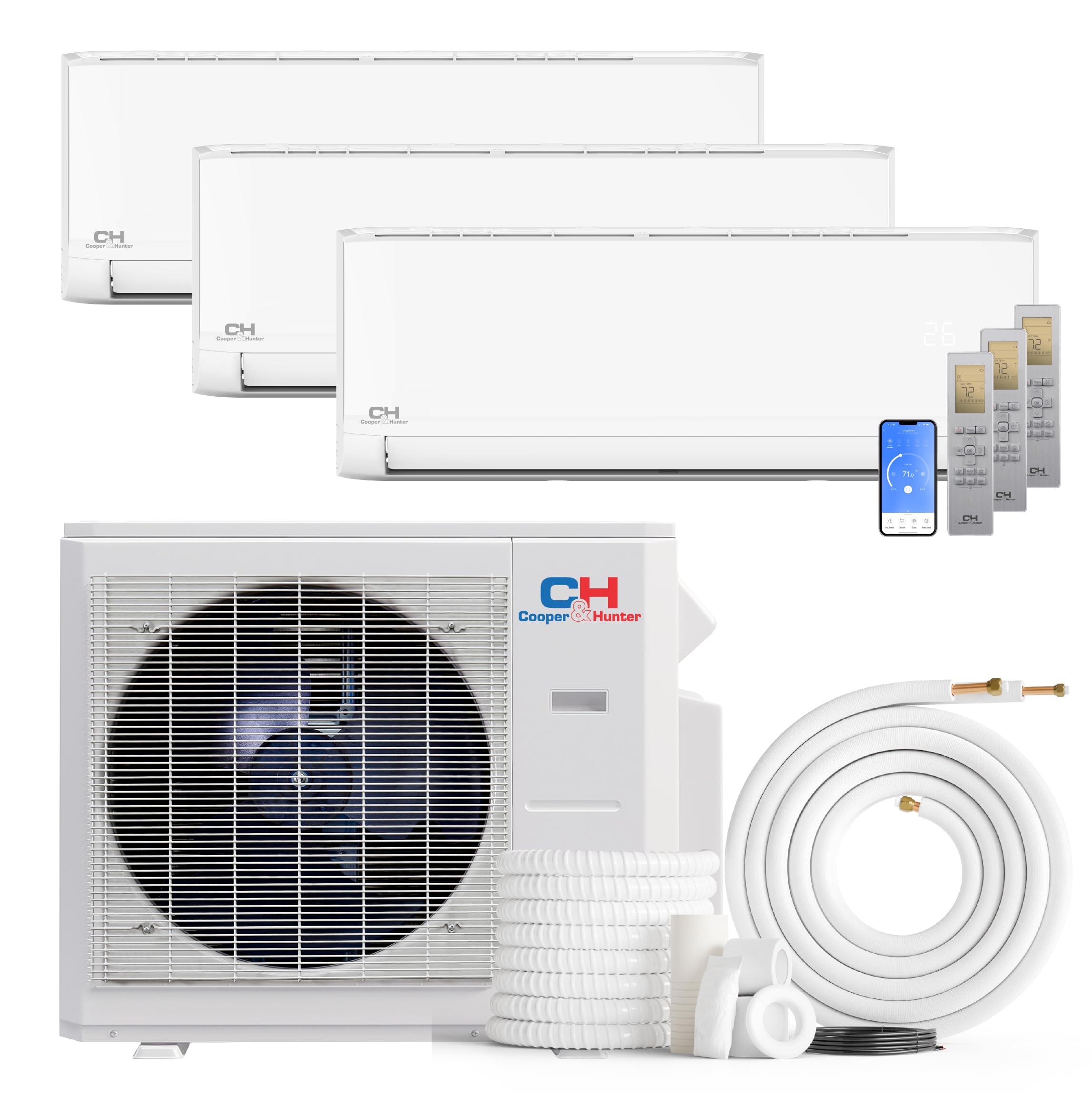
With a 25 SEER2 rating and an inverter scroll compressor, this dual-zone mini-split is built for efficiency at part-load conditions — exactly what happens during a typical winter day when the unit runs at 40 percent capacity. The 9,000 BTU head covers a bedroom while the 18,000 BTU unit handles a main living area, and each zone has independent temperature control via the included smart kits.
The outdoor condenser is rated for ambient temperatures down to -13°F, and the inverter technology means the compressor doesn’t slam on and off like a single-stage unit. This steady-state operation reduces defrost cycles significantly compared to budget mini-splits. The pre-charged 25-foot line sets are generous enough for most residential layouts without needing a refrigerant top-off.
On the downside, the provided installation instructions are sparse, and the remote control layout makes accidental mode changes easy. Some long-term owners reported failures after five years, with repair costs approaching half the unit price. A third-party extended warranty is worth considering given the lack of a robust US-based service network beyond the first year.
Why it’s great
- 25 SEER2 inverter efficiency for low partial-load losses
- Independent zone control with smart app integration
- Rated for operation down to -13°F
Good to know
- Poor installation documentation
- Remote control buttons are too close together
- Long-term reliability is inconsistent beyond year five
4. ROVSUN 42,000 BTU 2-Zone
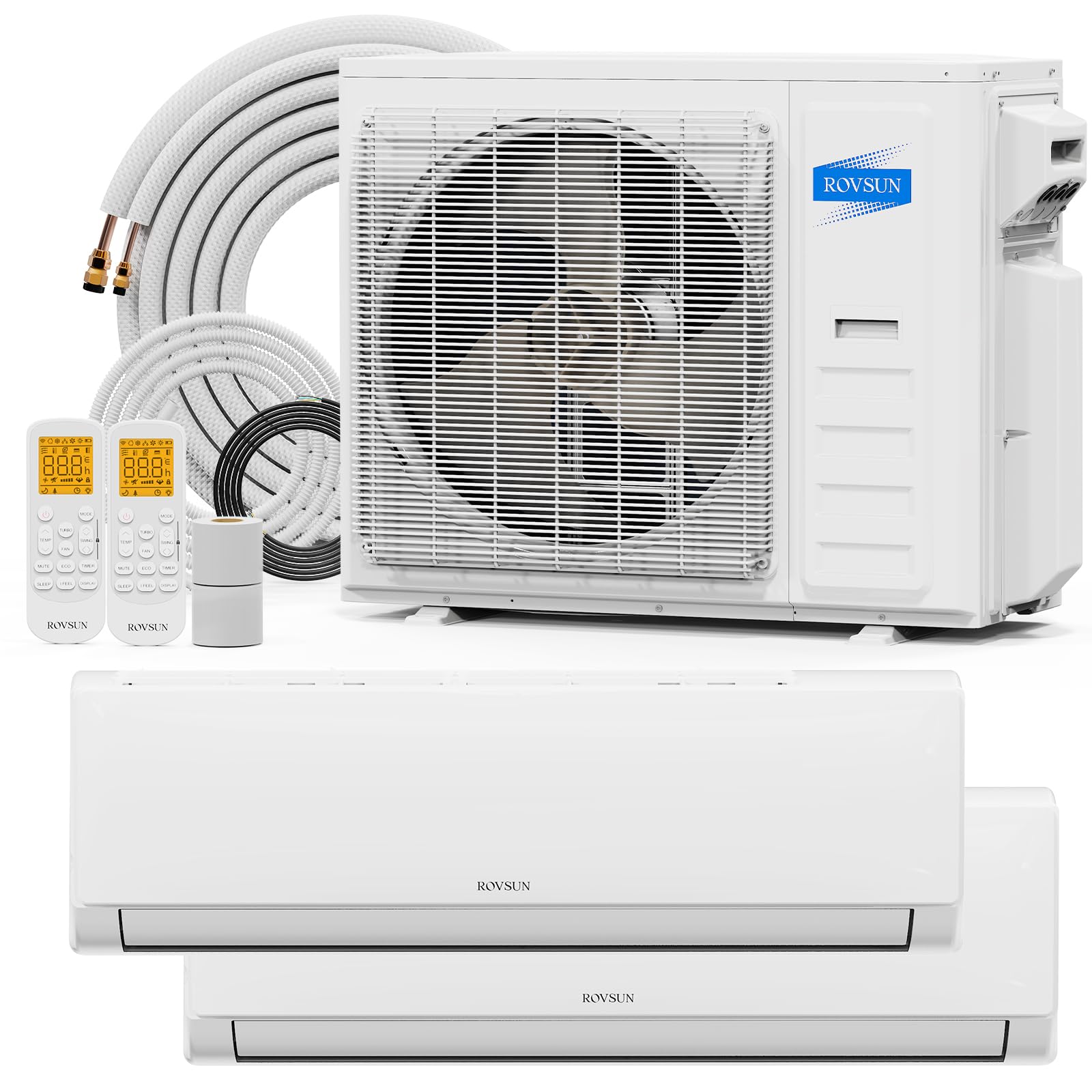
This three-and-a-half-ton dual-zone system pushes 42,000 BTU of total heating capacity, making it one of the highest-output mini-split configurations available for residential use. Each of the two 18,000 BTU wall mounts can handle a separate room or a large open area. The inverter heat pump holds its coefficient of performance well into the mid-20s Fahrenheit, though the official rating goes down to -4°F.
The 20 SEER2 rating is respectable for a system this powerful, and the R-32 refrigerant contributes to a smaller charge volume compared to R-410A. The included 25-foot line sets are pre-charged, which means a professional installer won’t need to add refrigerant as long as the line length stays within spec. The automatic defrost function is demand-based rather than timed, which reduces unnecessary cycles in milder weather.
A few owners reported that all indoor units must be set to the same mode (cool or heat) to avoid error codes — a limitation common to many multi-zone systems. Customer support is email-only with a 24-48 hour response window, which can be frustrating if a problem arises during a cold snap. This system is best for users who have a reliable local HVAC contractor for post-install support.
Why it’s great
- 42,000 BTU total capacity for large spaces
- Demand-based defrost saves energy on mild winter days
- Two 25-foot pre-charged line sets included
Good to know
- All zones must operate in the same mode
- No phone support — email only
- Heavy outdoor unit requires two-person installation
5. Della 28,000 BTU 2-Zone
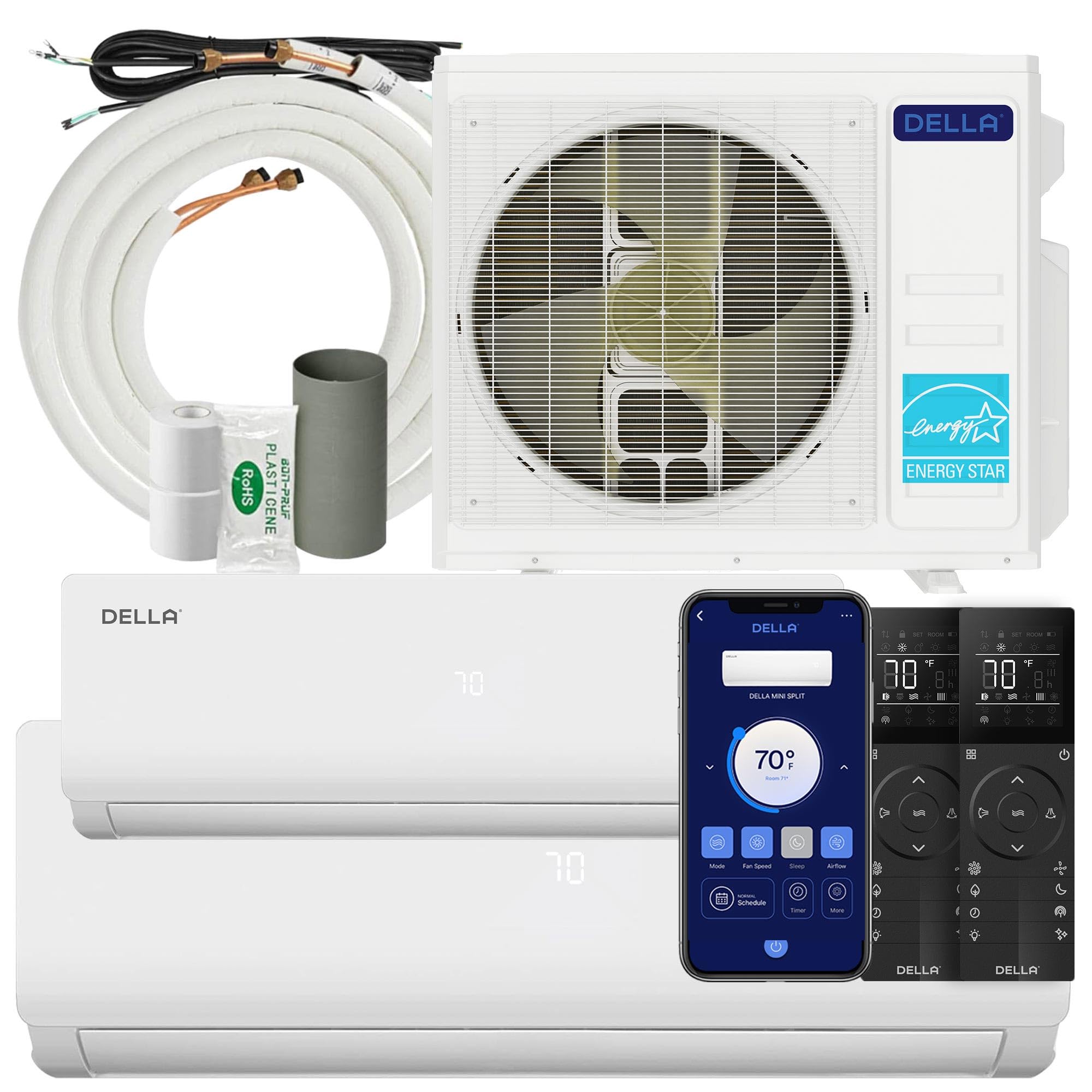
This entry-level dual-zone system pairs a 9,000 BTU indoor head with an 18,000 BTU head, covering up to 1,400 square feet with 28,000 BTU of total capacity. The 20 SEER2 rating and the use of R454B refrigerant — a lower-GWP alternative to R-410A — make this a reasonably efficient choice for buyers on a tighter budget.
Della rates this unit for heating operation down to 5°F, but the compressor is a rotary design rather than a scroll, which means the low-temperature performance curve falls off more steeply. The auto-defrost works, but the cycle length is longer than on premium inverter units, so you will feel brief temperature dips during heavy frost conditions. The 32 dBa indoor noise rating is genuinely quiet — good for bedrooms or home offices.
The installation instructions omit a critical step: opening the main service valve after evacuation. Several customers had to contact support to resolve a no-heat issue that was simply a forgotten valve. Support is responsive overall, but the documentation gap means this is not a system for first-time mini-split buyers. Professional installation is strongly recommended.
Why it’s great
- Very quiet indoor operation at 32 dBa
- Uses environmentally friendly R454B refrigerant
- Individual zone control with app and remote
Good to know
- Heating capacity drops sharply below 15°F
- Install instructions miss a critical valve step
- Rotary compressor is less durable at low ambient temps
6. Senville AURA 33,000 BTU

Senville’s AURA series is one of the few mini-splits that publishes a certified operating range down to -22°F, making it a legitimate contender for the coldest parts of the northern US and Canada. The 33,000 BTU single-zone unit uses a DC inverter scroll compressor and a silver-ion antimicrobial filter to maintain indoor air quality while the condenser handles severe frost conditions.
The Energy Star certification and AHRI rating confirm that the published efficiency numbers hold up in independent testing. Users report that the unit can cool a three-car garage effortlessly in summer and that the heating performance in winter is roughly one-third the operating cost of a central ducted system running on electric resistance. The 16-foot line set is adequate for most single-room applications.
Installation requires professional tools — a vacuum pump and manifold gauge set are mandatory, and the system must be evacuated to 500 microns for the compressor to run correctly. A few DIY-oriented buyers managed a self-install, but the warranty terms explicitly require professional installation. The app connectivity is smooth, and Alexa integration works without additional hubs.
Why it’s great
- Certified heating operation down to -22°F
- Very high COP at low ambient temperatures
- DC inverter scroll compressor for durability
Good to know
- Not a DIY install — requires vacuum and gauges
- Single zone only; cannot serve multiple rooms
- Drain hose and power cord are shorter than line set
7. Goodman 3.5 Ton GPH1442H41

This 3.5-ton package heat pump sits on a concrete slab outside and contains everything — compressor, air handler, and coil — in a single cabinet. The 14 SEER rating is the federal minimum, but the real strength here is simplicity. With no refrigerant lines running through the house and no separate indoor unit, installation is faster and there are fewer leak points to worry about in freezing conditions.
The Goodman GPH1442H41 uses a scroll compressor and R-410A refrigerant. While it doesn’t have the extreme cold rating of an inverter mini-split, it’s a durable design that Goodman has been building for years. Owners report units lasting 15 years or more in barns and workshops with minimal maintenance. The package format also makes it straightforward to add electric heat strips inside the cabinet for backup heating.
One install consideration: you may need to build a new curb or modify an existing one, since the footprint differs from older package units. The 400-pound weight requires a lifting bar or crane for placement. The warranty is the standard Goodman 10-year parts plan, but this unit ships without a remote thermostat — you will need to source that separately.
Why it’s great
- All-in-one package unit — minimal leak paths
- Scroll compressor with proven longevity
- Easy to add electric heat strips
Good to know
- 14 SEER is basic efficiency for a cold climate
- Heavy unit — requires equipment for placement
- No thermostat included
8. VARMINPOOL V18 Pro
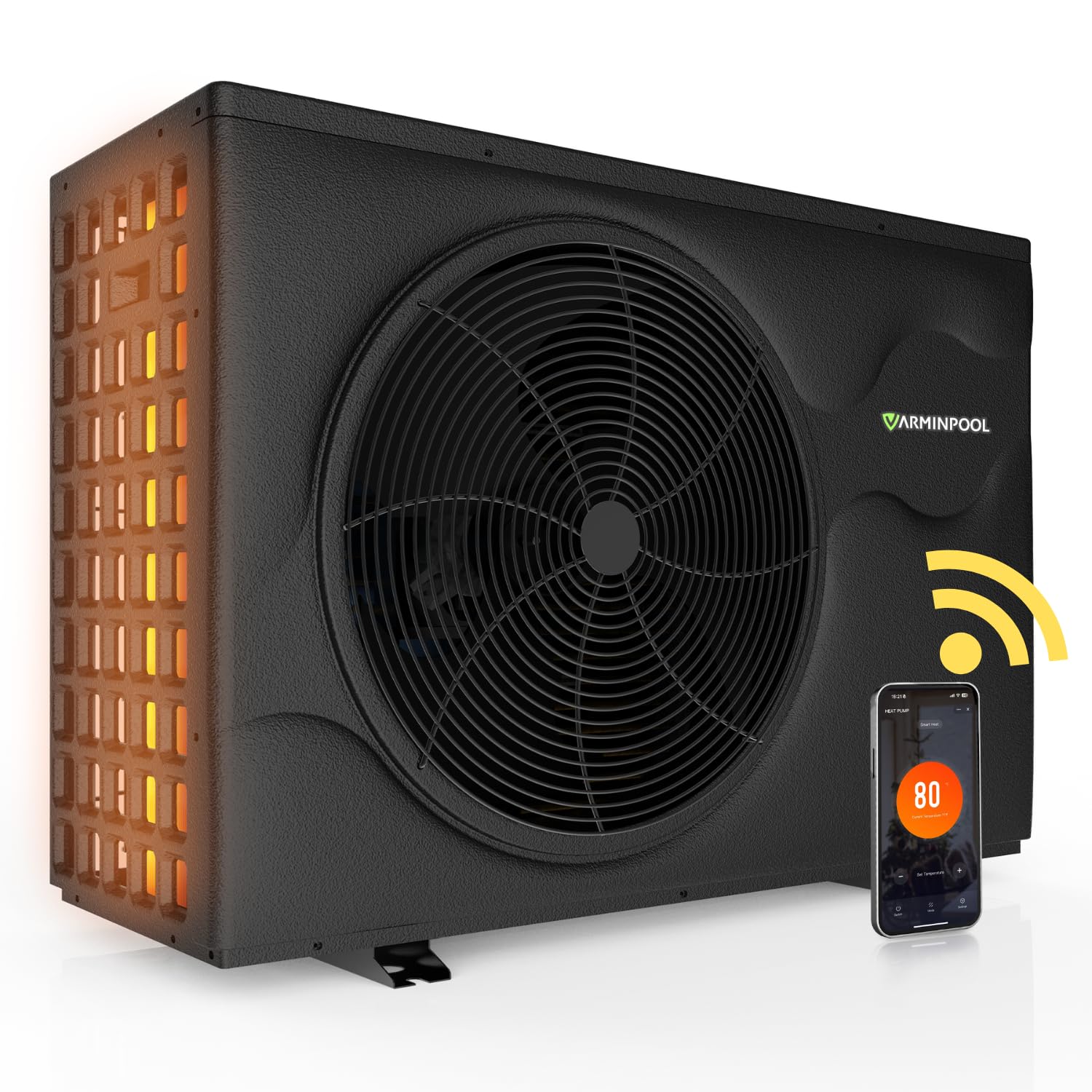
This 65,000 BTU inverter pool heat pump is designed to heat pools up to 20,000 gallons, and it maintains operation in outdoor temperatures as low as 10°F. The inverter compressor adjusts power draw based on the temperature difference between the water and the ambient air, achieving up to 73 percent operating cost savings compared to a traditional gas heater.
The titanium heat exchanger resists corrosion from saltwater pools, and the IPX4-rated housing handles rain and snow exposure without issue. The smart defrost system monitors coil temperature and initiates defrost cycles only when needed, which keeps the unit running efficiently during the late-season and early-spring pool months. At 43 dB it’s genuinely quiet for a unit this size.
Customer support is a strong point — multiple owners reported that the company sent free replacement parts and followed up proactively when issues arose. Some users experienced connectivity problems with the WiFi app, but the unit continues to operate on its own schedule regardless of app status. This is a niche product but an excellent one for pool owners who want to extend their swimming season into the shoulder months.
Why it’s great
- Operates down to 10°F ambient air temperature
- Titanium heat exchanger for saltwater pools
- Exceptionally quiet at 43 dB
Good to know
- WiFi app occasionally disconnects
- Heavy at 110 pounds
- Requires variable-speed pump for slow water flow
9. MICOE 100,000 BTU
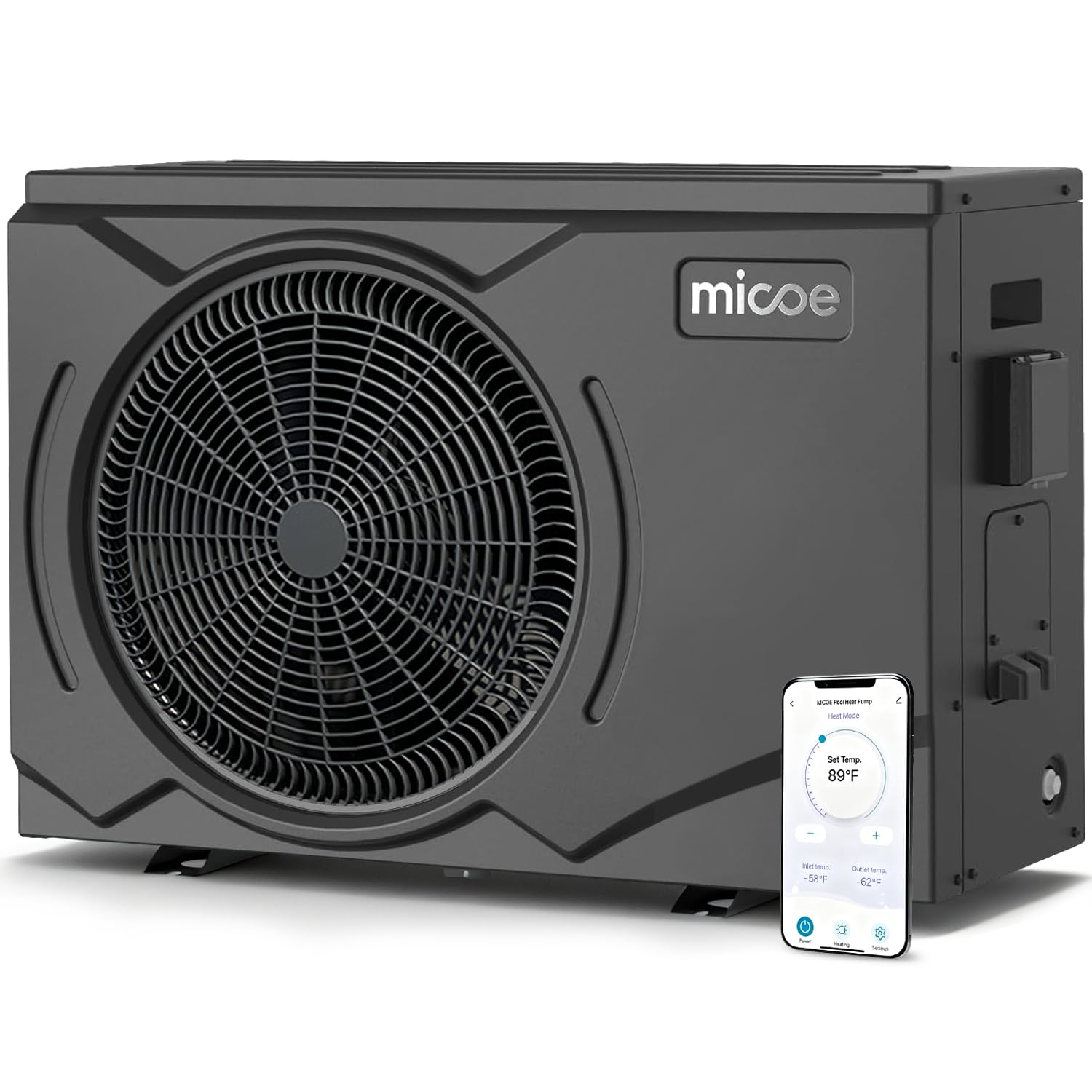
With a 100,000 BTU output, this MICOE pool heat pump is an oversized option for pools up to 26,000 gallons. The titanium heat exchanger handles both freshwater and saltwater chemistry, and the unit is rated to operate in outdoor temperatures from 32°F up to 109°F. The air-source heat pump technology captures ambient heat rather than burning fuel, keeping operating costs well below a propane or natural gas heater.
The auto-defrost function allows the unit to keep running during the colder spring and fall nights when frost is most likely. The 50 dB noise level is noticeable but not intrusive — about as loud as a modern refrigerator compressor. The mobile app provides remote control of temperature setpoints and mode switching, and the digital panel on the unit itself is straightforward for local adjustments.
The biggest concern is the control panel durability: a few owners reported that the panel stopped working within a few weeks. Customer support in those cases was not helpful, as the return window had expired. The electrical installation is more involved than expected — the wiring diagram is confusing, and the unit requires 6-gauge wire and a waterproof conduit for code compliance. This is not a plug-and-play product.
Why it’s great
- 100,000 BTU heats large pools quickly
- Titanium heat exchanger for corrosion resistance
- Auto-defrost extends the shoulder swimming season
Good to know
- Control panel failure reported in some units
- Wiring diagram is poorly documented
- Customer support limited after the return window
FAQ
Can an air source heat pump heat my home when it is below zero outside?
What size heat pump do I need for a 2,000 square foot home in a cold climate?
How often will a heat pump defrost in freezing weather?
Is it worth buying a heat pump with a backup gas furnace?
Final Thoughts: The Verdict
For most users, the best air source heat pump for cold climates winner is the Goodman 3 Ton GLZS4BA3610 because it combines a reliable scroll compressor, R-32 refrigerant, and a matched air handler in a configuration that integrates cleanly with electric backup heat for the harshest winter days. If you want a ductless option that operates down to -22°F, grab the Senville AURA 33K. And for a two-zone setup with high efficiency, nothing beats the Cooper & Hunter 28K 2-Zone.

Mo Maruf
I created WellFizz to bridge the gap between vague wellness advice and actionable solutions. My mission is simple: to decode the research and give you practical tools you can actually use.
Beyond the data, I am a passionate traveler. I believe that stepping away from the screen to explore new environments is essential for mental clarity and physical vitality.