Our readers keep the lights on and my smoothie glass nicely filled. As an Amazon Associate, I earn from qualifying purchases.
The air inside your home can be up to five times more polluted than outdoor air, yet most of us have no way to measure what we’re breathing. An air quality monitor acts as your personal environmental analyst, revealing invisible particles and gases that affect sleep, focus, and long-term health.
I’m Mohammad Maruf — the founder and writer behind WellFizz. My work involves deep market research and granular analysis of product specifications and consumer data to separate marketing hype from genuinely impactful features in the wellness technology space.
This guide is the result of evaluating hundreds of data points from leading models, focusing on sensor accuracy, smart integration, and real-world reliability. Finding the right best air quality monitor provides the data needed to improve indoor air, boost well-being, and make informed health decisions at home.
How To Choose The Best Air Quality Monitor
Selecting an air quality monitor isn’t about getting the most sensors; it’s about matching the right sensors to your specific concerns. The best device for a new parent in a city apartment differs from what a remote worker in a rural home needs.
Identify Your Primary Concern
Start by pinpointing what you want to measure. For general air quality and allergens, focus on PM2.5 and PM10 sensors. If you’re concerned about ventilation, stuffiness, or cognitive function, a precise CO2 sensor is non-negotiable. For chemical sensitivities or after renovations, TVOC and formaldehyde detection become key.
Evaluate Sensor Quality and Calibration
Not all sensors are created equal. Look for specifics: NDIR technology for CO2 is the gold standard, while laser scattering is preferred for particulate matter. Check stated accuracy ranges (e.g., ±50 ppm for CO2) and whether the device offers manual calibration features to maintain long-term accuracy.
Consider Connectivity and Data Access
A standalone screen is useful, but smart features unlock true insight. Wi-Fi or Bluetooth connectivity allows for remote monitoring via an app, historical data graphs, and integration with other smart home devices like air purifiers or thermostats for automated responses.
Assess Form Factor and Power
Decide where the monitor will live. A portable, battery-powered unit is great for spot-checking different rooms, while a sleek, plugged-in device is ideal for a permanent desk or wall mount. Consider display readability, brightness adjustment, and whether any alarms or lights could be disruptive in a bedroom.
Quick Comparison
On smaller screens, swipe sideways to see the full table.
| Model | Type | Best For | Key Feature | Amazon |
|---|---|---|---|---|
| SAF Aranet4 Home | CO2 Focus | Long-term, battery-powered precision | 4-year battery, E-Ink screen | Amazon |
| BREATHE Airmonitor Plus | 8-in-1 Pro | Comprehensive pollutant analysis | Detects HCHO & PM1.0 | Amazon |
| Qingping Air Monitor Gen 2 | Smart Display | Desktop monitoring with premium UI | 4″ IPS touchscreen, noise sensor | Amazon |
| Amazon Smart Air Monitor | Ecosystem | Alexa users seeking simplicity | Seamless Alexa integration | Amazon |
| SwitchBot CO2 Detector | Portable NDIR | Accurate CO2 on a budget | Large screen, 12-month battery | Amazon |
| LifeBasis 11-in-1 Monitor | All-in-One | Portable, multi-pollutant checking | 11 metrics, color-coded alerts | Amazon |
| INKBIRDPLUS 6-in-1 | Balanced Monitor | Grow tents & workshops | Hook for wall mounting | Amazon |
| GoveeLife Smart Monitor | Smart Home | Govee ecosystem automation | 2-year data storage, auto-purifier control | Amazon |
| SONOFF Smart Monitor | Matter Compatible | Future-proof smart homes | Matter support, PM10 tracking | Amazon |
| Temtop CO2 Monitor | Portable CO2 | Bedrooms & sleep monitoring | 70-day battery, dark-screen mode | Amazon |
| AEOCKY Air Purifier | Purifier + Monitor | Large rooms needing purification | Built-in AI air quality sensor | Amazon |
In‑Depth Reviews
1. SAF Aranet4 Home
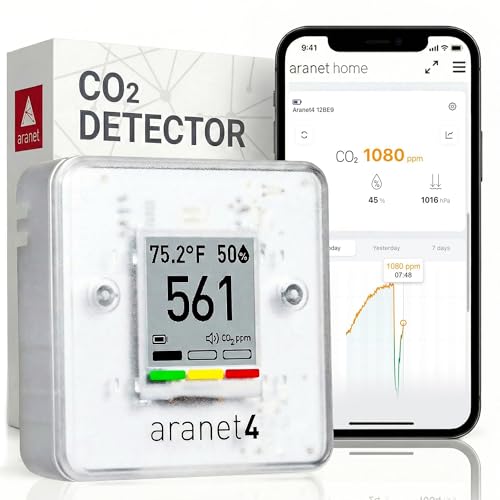
The SAF Aranet4 Home sets the benchmark for reliable, set-and-forget CO2 monitoring. Its use of a professional-grade NDIR sensor ensures that the carbon dioxide readings you see are trustworthy, which is critical when using data to guide ventilation habits for better sleep and concentration. The e-ink display is a masterstroke, providing perfect readability in any light while consuming almost no power.
Where this device truly excels is in its unmatched practicality. With a battery life measured in years from standard AA cells, it liberates you from cords and outlets, allowing placement anywhere—on a nightstand, bookshelf, or even in a car. The free app provides clean graphs of CO2, temperature, humidity, and pressure over 90 days, offering tangible proof of how habits affect your air.
While it doesn’t measure particulate matter or VOCs, its laser focus on CO2 is its strength. The color-coded display and optional buzzer give immediate feedback, making it intuitive for the whole family. For anyone prioritizing long-term accuracy, portability, and effortless operation to manage ventilation, the Aranet4 is the definitive choice.
Why it’s great
- Industry-respected NDIR CO2 sensor for high accuracy.
- Exceptional multi-year battery life from standard AA batteries.
- Cord-free, portable design with a clear, always-on e-ink display.
- Helpful app with robust data history and export capabilities.
Good to know
- Does not monitor particulate matter (PM2.5/PM10) or VOCs.
- Bluetooth-only connectivity means no remote access outside of range.
- The premium positioning reflects its specialized sensor quality.
2. BREATHE Airmonitor Plus
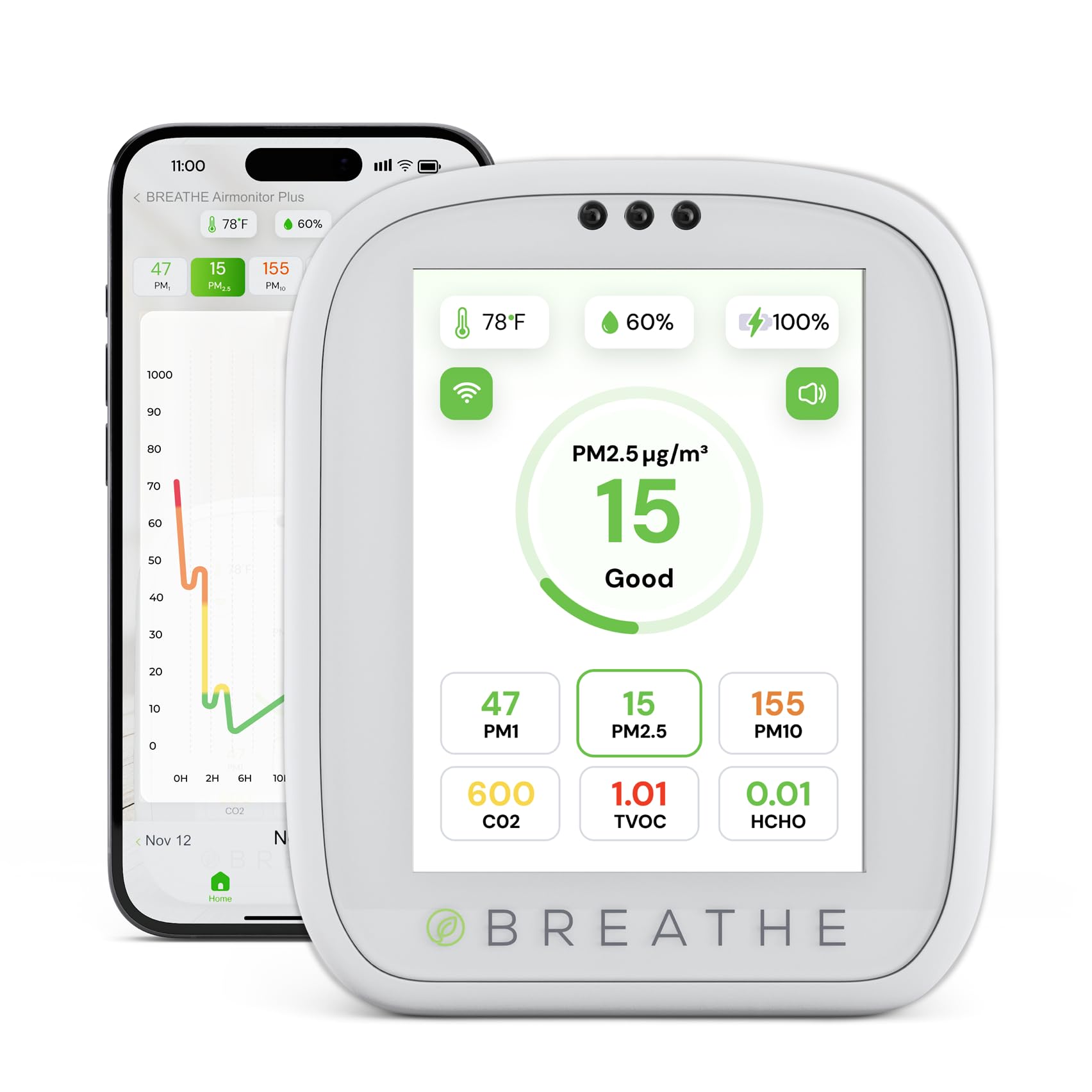
The BREATHE Airmonitor Plus is a powerhouse for those who want a complete picture of their indoor environment. It goes beyond basics by including formaldehyde (HCHO) detection and PM1.0 measurement, capturing the finest particulate matter. This suite of eight sensors makes it ideal for post-renovation checks, homes with new furniture, or for users with multiple chemical sensitivities.
Its compact design houses advanced gas and particle sensing technology, providing a detailed breakdown of what’s in your air. The companion app is a highlight, delivering instant alerts and maintaining 30 days of historical data with clear graphs, helping you correlate activities like cooking or cleaning with air quality dips. The ability to calibrate key sensors ensures readings remain accurate over time.
Note that for continuous monitoring, it’s best kept plugged in, as the internal battery provides only a short runtime. The display is bright and informative, but the proximity sensor for auto-off can be finicky. For the individual who wants laboratory-grade insight into a wide array of pollutants from a consumer device, the Airmonitor Plus is a top-tier analytical tool.
Why it’s great
- Comprehensive sensor array includes formaldehyde (HCHO) and PM1.0.
- Smart app with reliable alerts and insightful 30-day data history.
- Offers manual calibration for maintaining sensor accuracy.
- Sleek, modern design that fits discreetly in any room.
Good to know
- Battery life is very short; designed for primarily plugged-in use.
- Display brightness is high and the auto-off sensor may not work consistently.
- App connectivity setup can occasionally require a specific reset procedure.
3. Qingping Air Quality Monitor Gen 2

The Qingping Air Monitor Gen 2 feels like a premium smart device for your desk, boasting one of the best user interfaces in the category. Its 4-inch IPS touchscreen is sharp, responsive, and beautifully presents seven metrics, including a unique noise level sensor. The replaceable PM sensor module is a thoughtful design for long-term maintenance, ensuring the device doesn’t become obsolete when that component ages.
Operation is intuitive—swipe through data screens, adjust settings, and even set an alarm clock directly on the device. The Qingping+ app provides seamless remote monitoring and data export, supporting both 2.4GHz and 5GHz Wi-Fi bands for flexible connectivity. The automatic brightness adjustment and color-coded indicators make it easy to assess your environment at a glance from across the room.
The main compromise is battery life; it’s intended to be used while plugged in, offering only a few hours of portable operation. Some users have reported sensitivity to power sources, so using a standard 5V/1A charger is advisable. For a feature-rich, visually stunning monitor that serves as a centerpiece for your home office or bedroom, the Qingping Gen 2 is exceptional.
Why it’s great
- Stunning 4-inch IPS touchscreen with an incredibly polished user interface.
- Unique addition of a noise level sensor among seven tracked metrics.
- Future-proof withreplaceable PM sensor design for long-term device lifespan.
- Supports both 2.4GHz and 5GHz Wi-Fi for easy app integration.
Good to know
- Battery life is limited to a few hours; designed for plugged-in use.
- Can be sensitive to higher-voltage chargers; requires 5V/1A input.
- The premium positioning reflects its display and interface quality.
4. SwitchBot CO2 Detector

The SwitchBot CO2 Detector delivers professional-grade NDIR sensor performance in a user-friendly, accessible package. Its large, 92mm screen clearly displays CO2, temperature, humidity, time, and a comfort level indicator, making it exceptionally easy to interpret at a glance. The promise of up to 12 months of battery life on a single charge is a major practical advantage for cord-free placement anywhere in your home.
This monitor strikes an impressive balance between accuracy and convenience. The Swiss-made NDIR sensor provides reliable CO2 readings that users have found to closely match much more expensive dedicated monitors. The device offers three alert methods (sound, screen, app) and integrates with the SwitchBot ecosystem for automation, though a separate hub is required for smart notifications.
It’s important to note that some units may require an initial outdoor calibration for maximum accuracy, and the measurement interval is slower on battery power versus when plugged in. However, for someone seeking a trustworthy, portable, and long-lasting CO2 monitor that doesn’t cut corners on sensor quality, the SwitchBot represents outstanding value.
Why it’s great
- Features a high-quality NDIR CO2 sensor for reliable, accurate readings.
- Impressive year-long battery life enables true portability and flexible placement.
- Large, clear screen that shows multiple data points simultaneously.
- Strong value proposition for NDIR sensor technology.
Good to know
- May benefit from an initial manual calibration outdoors for baseline accuracy.
- Smart notifications require the purchase of a separate SwitchBot Hub.
- CO2 reading refresh rate is slower on battery power than when plugged in.
5. LifeBasis 11-in-1 Air Quality Monitor

The LifeBasis monitor is for the data enthusiast who wants to carry a full air quality lab in their hand. Tracking an impressive 11 parameters—including AQI, PM1.0, PM2.5, PM10, CO2, TVOC, HCHO, temperature, and humidity—it provides a comprehensive snapshot of air quality anywhere you take it. Its portable, flat design is more pocket-friendly than many bulkier competitors.
The color-coded screen and dual audible/visual alarm system make it simple to understand which pollutant is problematic. Independent testing suggests it uses distinct sensors for different gases, a sign of a more sophisticated design that doesn’t just infer readings from a single sensor. The ability to manually calibrate the CO2 sensor is another plus for maintaining accuracy over time.
Battery life is about 11-12 hours, making it a great tool for spot checks or short-term monitoring in different locations, but not for permanent, plugged-in display. The fan has a faint hum, and as with any multi-sensor device at this point, absolute precision across all metrics should be seen as indicative rather than laboratory-grade. For a portable, all-in-one analyzer, it’s incredibly capable.
Why it’s great
- Extremely wide range of 11 air quality metrics in one portable device.
- Intuitive color-coded display and dual alarms for immediate feedback.
- Appears to use separate sensors for different gases, improving reliability.
- Includes manual calibration function for the CO2 sensor.
Good to know
- Battery life supports hours, not days, of continuous use.
- The internal fan produces a faint but audible hum during operation.
- Readings are excellent for trends and comparisons, not necessarily lab-grade precision.
6. Amazon Smart Air Quality Monitor

If you live firmly within the Amazon ecosystem, this monitor offers a beautifully simple, integrated experience. It tracks five key factors—PM2.5, VOCs, carbon monoxide, humidity, and temperature—and presents a single, easy-to-understand air quality score in the Alexa app. The color-coded LED on the device gives an immediate, glanceable status without needing to check your phone.
Its greatest strength is its deep integration. You can receive notifications on your phone or Echo devices when air quality drops, and create routines to automatically turn on compatible air purifiers, fans, or dehumidifiers. Setup is arguably the easiest of any device here; if you have other Amazon devices, it often connects almost automatically.
The trade-off for simplicity is a lack of granular data. You won’t see exact PM2.5 or VOC numbers on the device itself, and the app focuses on the overall score. The VOC sensor can be sensitive to harmless household scents like candles or citrus. For users who want actionable alerts and smart automation without diving into complex data, this is the perfect, fuss-free choice.
Why it’s great
- Seamless, automatic setup and integration within the Alexa ecosystem.
- Enables powerful smart home routines to automate purifiers and fans.
- Simple, clean design with a helpful color-coded status LED.
- Provides clear, actionable alerts rather than overwhelming data.
Good to know
- Does not display raw sensor data (e.g., exact PM2.5 numbers) on the device.
- VOC sensor can be triggered by non-harmful scents like cooking or air fresheners.
- Designed for Amazon users; limited functionality outside that ecosystem.
7. INKBIRDPLUS 6-in-1 Indoor Air Quality Monitor
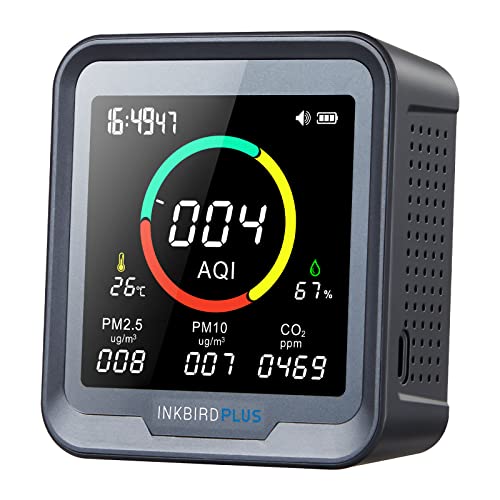
The INKBIRDPLUS PTH-9A is a solid, no-nonsense monitor that excels in utility spaces like workshops, garages, or grow tents. It tracks six key parameters: CO2, PM2.5, PM10, AQI, temperature, and humidity. The built-in hook and stand allow for flexible placement on a desk or hanging on a wall, making it adaptable to different environments.
This device is appreciated for its straightforward operation. It features a clear color LED screen, an audible alarm that triggers when AQI exceeds 100, and a manual calibration function for the CO2 sensor. Users in workshops and for 3D printing have found it responsive, accurately registering changes in particulate levels when machines are active or windows are opened.
Battery life is a practical concern, lasting only a few days, so for permanent placement, keeping it plugged in is recommended. Some users note the particulate sensors can be less sensitive in very dusty environments than expected. However, for a reliable, durable monitor that provides essential data for hobbyists and DIYers, the INKBIRDPLUS offers great utility.
Why it’s great
- Versatile form factor with a hook for easy wall-mounting in workshops.
- Monitors a practical mix of CO2 and particulate matter (PM2.5/PM10).
- Includes a manual CO2 calibration function for maintaining accuracy.
- Responsive to environmental changes, useful for DIY and hobby spaces.
Good to know
- Battery life is relatively short, best used while plugged in.
- Particulate sensors may not be as sensitive in extremely dusty conditions as some expect.
- Audible alarm cannot be fully disabled, which can be triggered by cooking.
8. GoveeLife Smart Air Quality Monitor

The GoveeLife monitor is an excellent entry point into smart air quality tracking, especially if you own or plan to own other GoveeHome appliances like air purifiers or humidifiers. It measures PM2.5, temperature, and humidity with a fast two-second refresh rate, providing a solid foundation for understanding basic indoor air conditions.
Its killer feature is automation within the Govee ecosystem. You can set target air quality levels, and the monitor will automatically turn linked Govee purifiers or humidifiers on and off. The GoveeHome app is robust, offering remote monitoring, graphical data views for 13 days, and the impressive ability to export two full years of historical data for deeper analysis.
The device itself has a clean LED display with a button to switch between clock and PM2.5 readouts. It requires a constant power connection via the included Type-C cable. While it doesn’t measure CO2 or VOCs, its strength lies in providing actionable, automatable data for the most common air quality concerns at a very accessible point.
Why it’s great
- Enables powerful automation with other Govee smart home devices.
- App provides extensive two-year data storage and export capabilities.
- Fast sensor refresh rate and clear, functional display.
- Strong value for basic PM2.5, temperature, and humidity monitoring.
Good to know
- Monitors only three metrics (PM2.5, temp, humidity), not CO2 or VOCs.
- Requires a constant wired power connection; no battery option.
- Smart features are most valuable within the Govee device ecosystem.
9. SONOFF Smart Indoor Air Quality Monitor
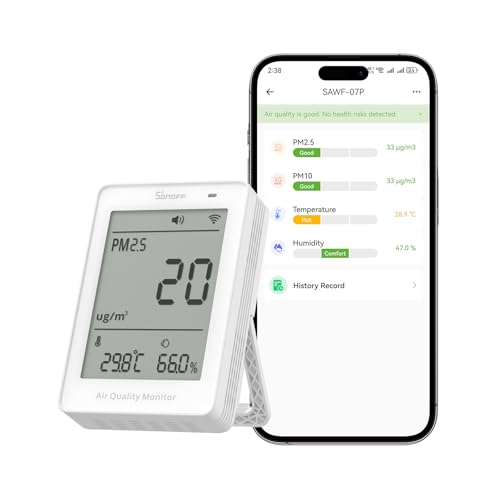
The SONOFF monitor is a forward-thinking choice for tech-savvy users building a unified smart home. Its headline feature is Matter compatibility, allowing it to seamlessly integrate with Apple Home, Google Home, Amazon Alexa, SmartThings, and Home Assistant without relying on a proprietary bridge. This future-proofs your investment as smart home standards evolve.
Beyond connectivity, it’s a capable device, monitoring PM2.5, PM10, temperature, and humidity on a sizable 3.73-inch screen. It employs a triple-alert system (sound, LED, app) and offers a full year of data tracking in the eWeLink app. The inclusion of a PM10 sensor is a bonus for tracking larger dust particles.
The display is not backlit, so it requires ambient light to read, and it must be plugged in via USB-C (adapter not included). Setup can involve navigating between the eWeLink app and your Matter platform of choice. For those prioritizing open standards and long-term smart home interoperability over absolute premium finish, the SONOFF is a uniquely strategic pick.
Why it’s great
- Matter support ensures compatibility with all major smart home platforms.
- Includes both PM2.5 and PM10 particulate sensors.
- Provides a full year of historical data tracking within the app.
- Triple-alert system (sound, light, app) for comprehensive notifications.
Good to know
- Display lacks a backlight, requiring good ambient light to read.
- Requires a constant wired power connection (USB-C power adapter not included).
- Setup involves both the eWeLink app and your chosen Matter platform.
10. Temtop CO2 Monitor

The Temtop CO2 Monitor is purpose-built for two things: long-lasting portability and bedroom-friendly operation. Its standout feature is a remarkable 70-day battery life in power-saving mode, allowing you to move it from room to room or even take it on trips without worrying about constant charging. For sleep monitoring, it’s ideal because the screen has no backlight and both audio alerts and the display can be turned off completely.
It uses a photoacoustic NDIR sensor for CO2 detection, paired with temperature and humidity tracking. The focus is squarely on ventilation quality, which is crucial for sleep and cognitive function. The portable, slim design and included bracket make it easy to place on a nightstand or mount in a discreet location.
The trade-off for the long battery and dark screen is a basic, non-illuminated LCD that can be faint in low light. Some users have reported screen reliability issues over time. However, if your primary goal is to discreetly monitor bedroom CO2 levels overnight without light or frequent charging, the Temtop is a specialized tool that excels at its core task.
Why it’s great
- Exceptional battery life enables true weeks-long portable use.
- Designed for bedrooms: screen has no backlight and all alerts can be disabled.
- Compact, lightweight design with a mounting bracket for flexible placement.
- Focuses on the critical sleep metric of CO2 (plus temp and humidity).
Good to know
- Basic LCD screen can be faint and is not illuminated.
- Some users have reported screen durability issues over several months.
- Functionality is focused on CO2; does not measure particulate matter.
11. AEOCKY Air Purifier with Monitor
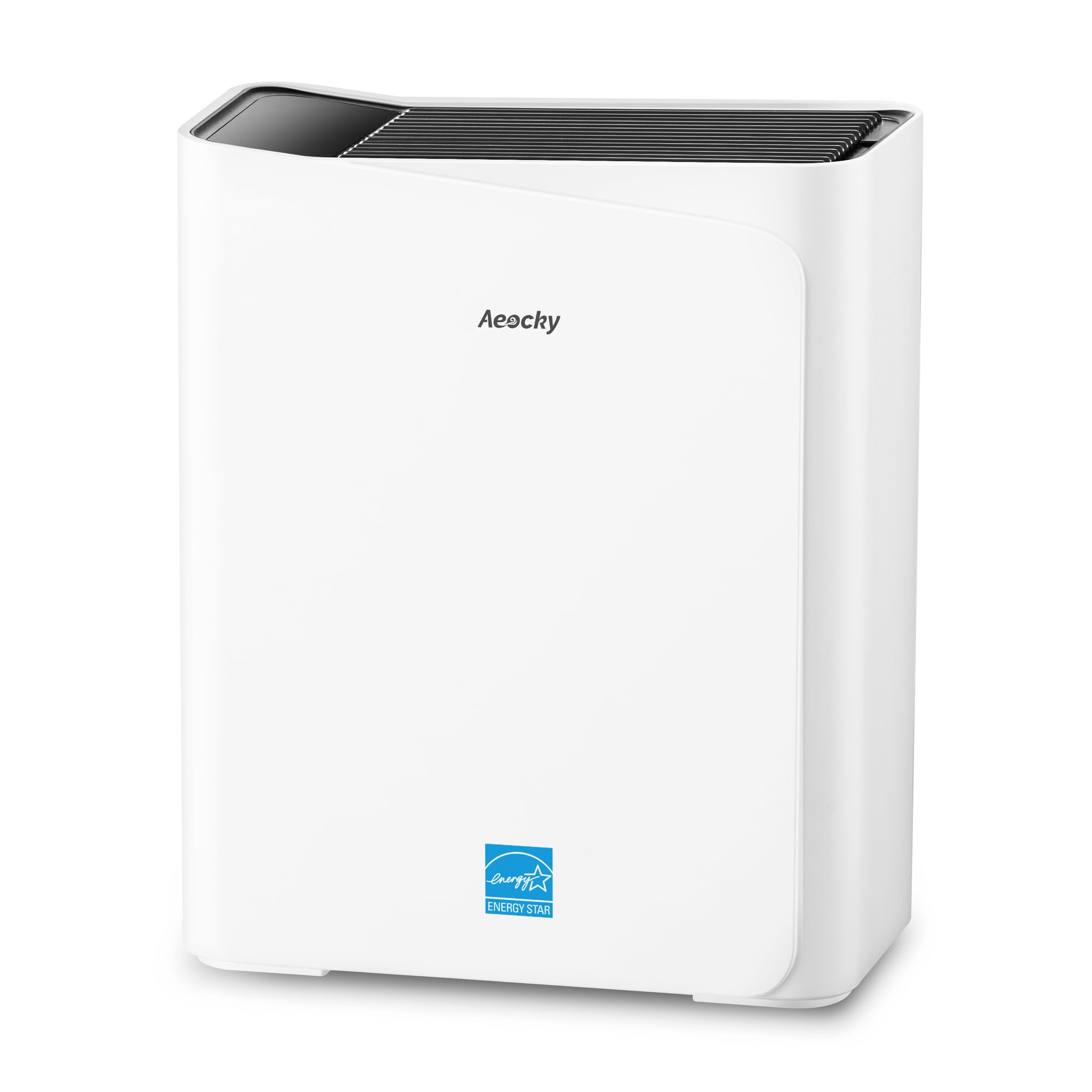
This AEOCKY unit is a powerful two-in-one solution for large rooms, combining a high-CADR air purifier with a built-in, AI-driven air quality monitor. The integrated sensor is designed for high accuracy and fast response, powering an effective Auto Mode that adjusts fan speed based on real-time air conditions. This creates a closed-loop system that actively cleans the air while monitoring the results.
The purifier itself is the main event, featuring a proprietary long-life HEPA filter and washable pre-filters. The monitor component provides the necessary data to drive its automation, displaying air quality status and ensuring the purifier reacts promptly to pollutants from cooking, pets, or outdoor events like wildfires. It’s an energy-efficient, set-and-forget solution for whole-room air management.
As a monitor, it is not a standalone device and its sensor data is primarily used to control the purifier it’s built into. You cannot move it to another room to take readings. This product is best for someone whose primary goal is purifying the air in a large space (up to 2300 sq ft) and who values the convenience of an integrated, automated system over a dedicated, portable sensor.
Why it’s great
- Combines a powerful air purifier with an accurate, automated monitoring system.
- Ideal for large rooms, with Auto Mode that intelligently responds to air quality changes.
- Eliminates the need to purchase and coordinate separate purifier and monitor devices.
- Features a long-life filter and energy-efficient operation.
Good to know
- The monitor is not a standalone device; it’s fixed to the purifier unit.
- Designed primarily for air purification, with monitoring as an automation driver.
- A larger appliance, not a discreet sensor for multi-room monitoring.
Understanding the Specs
Sensor Types Explained
NDIR (Non-Dispersive Infrared): The gold standard for measuring carbon dioxide (CO2). It works by measuring how much infrared light is absorbed by CO2 molecules in the air, offering high accuracy and long-term stability. Look for this in monitors focused on ventilation quality.
Laser Scattering: Used for detecting particulate matter (PM1.0, PM2.5, PM10). A laser beam illuminates particles, and a sensor measures the scattered light to determine particle size and concentration.
Metal Oxide Semiconductor (MOS): Commonly used for detecting Volatile Organic Compounds (VOCs) and formaldehyde (HCHO). These sensors change electrical resistance when exposed to certain gases. They are sensitive but can require calibration and may react to a broad range of compounds.
Key Metrics & What They Mean
PM2.5: Fine inhalable particles with diameters of 2.5 micrometers or smaller. These can penetrate deep into the lungs and are linked to serious health effects. Sources include combustion, dust, and smoke.
CO2 (Carbon Dioxide): Measured in parts per million (ppm). Elevated levels (above 1000 ppm) indicate poor ventilation, leading to drowsiness, reduced focus, and impaired cognitive function. It’s a key proxy for air freshness.
TVOC (Total Volatile Organic Compounds): A measure of the total concentration of various organic chemicals emitted as gases. Sources include paints, cleaning products, adhesives, and furnishings. High levels can cause irritation and long-term health concerns.
Relative Humidity: The amount of water vapor in the air. Ideal indoor humidity is between 30% and 50%. Levels that are too high can promote mold growth; levels that are too low can cause dry skin and respiratory irritation.
FAQ
Where is the best place to put an air quality monitor?
How often do I need to calibrate the sensors?
Can an air quality monitor detect mold or carbon monoxide?
What’s the difference between AQI and raw PM2.5 readings?
Final Thoughts: The Verdict
For most people, the best air quality monitor winner is the SAF Aranet4 Home because its unmatched accuracy, multi-year battery life, and simple reliability make it the most trustworthy tool for managing indoor ventilation and CO2. If you want comprehensive pollutant analysis, grab the BREATHE Airmonitor Plus for its detailed breakdown of everything from formaldehyde to the finest particles. And for outstanding NDIR CO2 value, nothing beats the SwitchBot CO2 Detector with its large screen and impressive battery longevity.

Mo Maruf
I created WellFizz to bridge the gap between vague wellness advice and actionable solutions. My mission is simple: to decode the research and give you practical tools you can actually use.
Beyond the data, I am a passionate traveler. I believe that stepping away from the screen to explore new environments is essential for mental clarity and physical vitality.