Our readers keep the lights on and my smoothie glass nicely filled. As an Amazon Associate, I earn from qualifying purchases.
Mold spores are invisible, silent, and often undetected until the musty smell or respiratory issues arrive. Standard air quality monitors miss the specific humidity and particulate triggers that mold needs to grow, leaving you guessing. A dedicated mold-focused monitor tracks the precise environmental conditions—elevated relative humidity, stagnant CO₂, and fine particulate matter—that signal a potential mold problem before it becomes visible.
I’m Mohammad Maruf — the founder and writer behind WellFizz. I’ve spent dozens of hours cross-referencing sensor specifications, reading technical datasheets, and analyzing user-reported accuracy across dozens of air quality monitors to understand exactly which sensors matter for mold detection and which features separate a useful tool from a gimmick.
Whether you live in a humid climate, have a finished basement, or simply want peace of mind about your indoor air, finding the right device means understanding sensor types, data logging capabilities, and alert systems. This guide breaks down the best options to help you choose the best air quality monitor for mold for your specific situation.
How To Choose The Best Air Quality Monitor For Mold
Choosing a monitor for mold detection requires more than just picking the most popular model. The key is understanding which environmental parameters create a hospitable environment for mold and ensuring your monitor can track those specific metrics accurately over time.
Sensor Coverage: Beyond CO₂
While CO₂ is a useful proxy for ventilation quality, mold thrives on moisture and organic particulates. A monitor that tracks relative humidity (RH) is non-negotiable — aim for one that reports RH with an accuracy of ±2-3%. PM2.5 and PM10 sensors detect the airborne particulate matter that includes mold spores themselves. TVOC and HCHO sensors can pick up the chemical byproducts of mold growth, often before visible signs appear.
Data Logging and Trend Analysis
A single high-humidity reading isn’t a crisis, but a week of sustained 70%+ RH in your basement is a red flag. Monitors with built-in data storage or app-based history let you spot trends, identify the time of day when humidity peaks, and correlate events like cooking or showering with spikes in particulate matter. Look for models that offer at least 30 days of historical data either on-device or through a companion app.
Portability vs. Continuous Power
Battery-powered monitors let you move from room to room, checking for problem areas after a flood or during seasonal humidity changes. However, for long-term mold prevention monitoring in a single critical room — like a basement or nursery — an AC-powered unit provides uninterrupted data collection without the risk of a dead battery breaking your trend line. Consider your monitoring style before deciding.
Quick Comparison
On smaller screens, swipe sideways to see the full table.
| Model | Category | Best For | Key Spec | Amazon |
|---|---|---|---|---|
| BREATHE Airmonitor Plus | Premium | Comprehensive multi-sensor mold detection | PM1/PM2.5/PM10 + TVOC + HCHO + RH | Amazon |
| GoveeLife Smart Air Quality Monitor | Mid-Range | Smart home integration + trend tracking | NDIR CO₂ sensor ±40ppm + 5% | Amazon |
| bonoch 16-in-1 | Premium | Large display + 12-hour battery portability | 3500mAh battery, 7″ LED display | Amazon |
| 16-in-1 Large Display Monitor | Mid-Range | Visible multi-parameter readout at a glance | 7-inch display with 9 AQI metrics | Amazon |
| KDWKD Indoor Air Quality Monitor | Mid-Range | Portable VOC and formaldehyde detection | 9-hour battery, HCHO + TVOC + PM | Amazon |
| LifeBasis 11-in-1 | Budget-Friendly | Entry-level multi-sensor at low cost | NDIR CO₂ + laser particle + 2500mAh | Amazon |
| Airthings Corentium Home 2 | Specialty | Radon-specific mold risk correlation | Alpha spectrometry radon + RH + temp | Amazon |
In‑Depth Reviews
1. BREATHE Airmonitor Plus
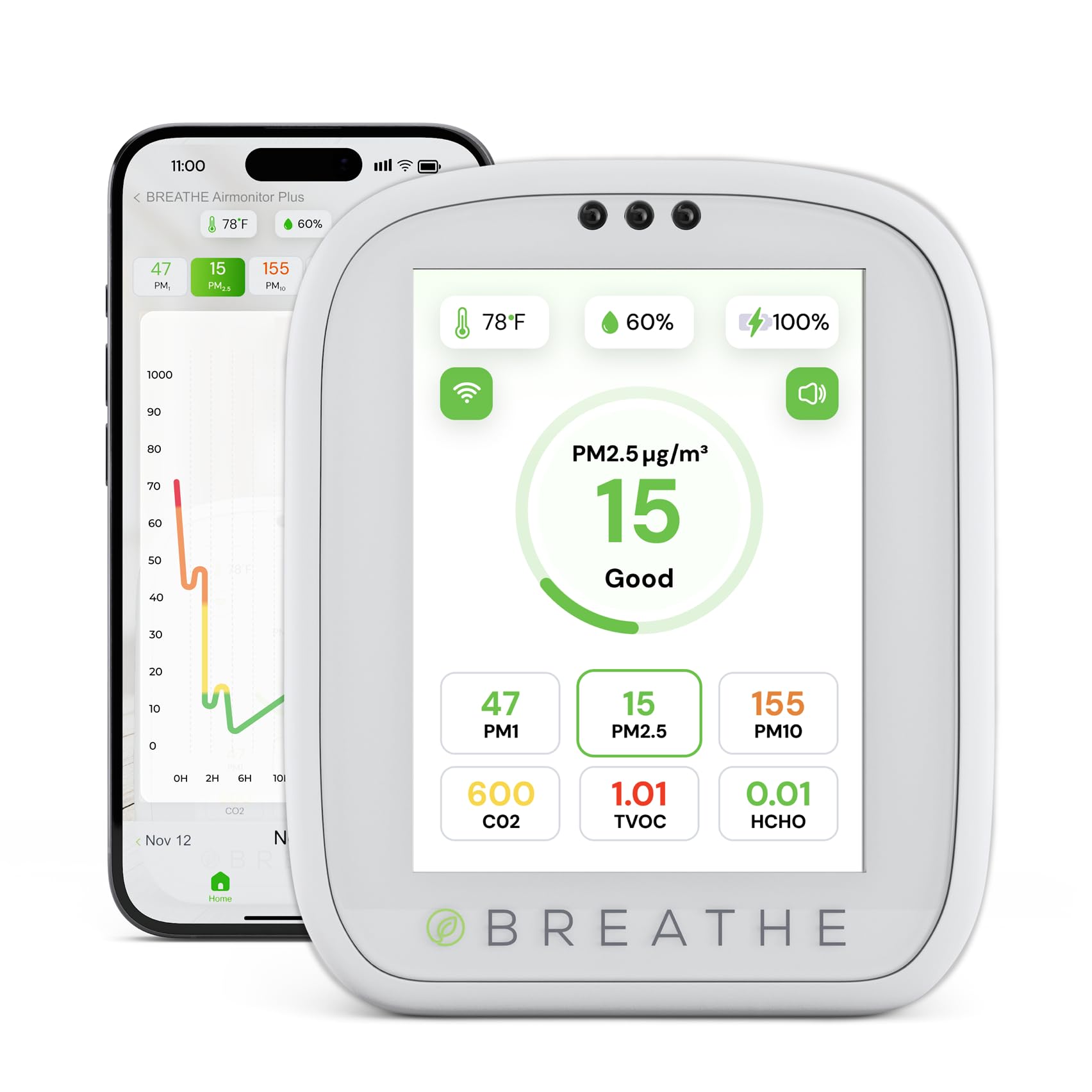
The BREATHE Airmonitor Plus is the most complete package for mold-conscious buyers. It tracks not just CO₂ and humidity but also PM1, PM2.5, PM10, TVOC, and formaldehyde — all critical for identifying the precise conditions that allow mold to proliferate. The compact white enclosure integrates into any room, and the free Breathe Tech app provides remote monitoring and 30-day data history so you can correlate humidity spikes with specific activities.
Users report that the CO₂ readings respond accurately to occupancy changes — one reviewer measured readings that dropped from 4,500 ppm to 405 ppm after ventilation, proving the sensor’s dynamic range. The particulate sensor aligns well with HEPA filter performance, giving you feedback on whether your air purification efforts are reducing spore-sized particles. The device also includes built-in calibration tools for CO₂, VOC, and HCHO sensors.
The main trade-off is the limited battery life — it requires near-constant AC power for continuous monitoring, and the display brightness cannot be dimmed enough for a dark bedroom. Some users also note that the app’s alarm thresholds could be more customizable. However, for sheer sensor breadth and professional-grade accuracy at a mid-range price, this is the strongest mold-prevention tool on the list.
Why it’s great
- Covers every relevant mold parameter: PM, VOC, HCHO, RH, CO₂
- 30-day app data history with trend graphs
- Professional-grade sensor accuracy with easy recalibration
Good to know
- Battery life is short; best left plugged in continuously
- Display too bright for nighttime use in a bedroom
- App alarm notifications can be persistent without a true mute
2. GoveeLife Smart Air Quality Monitor
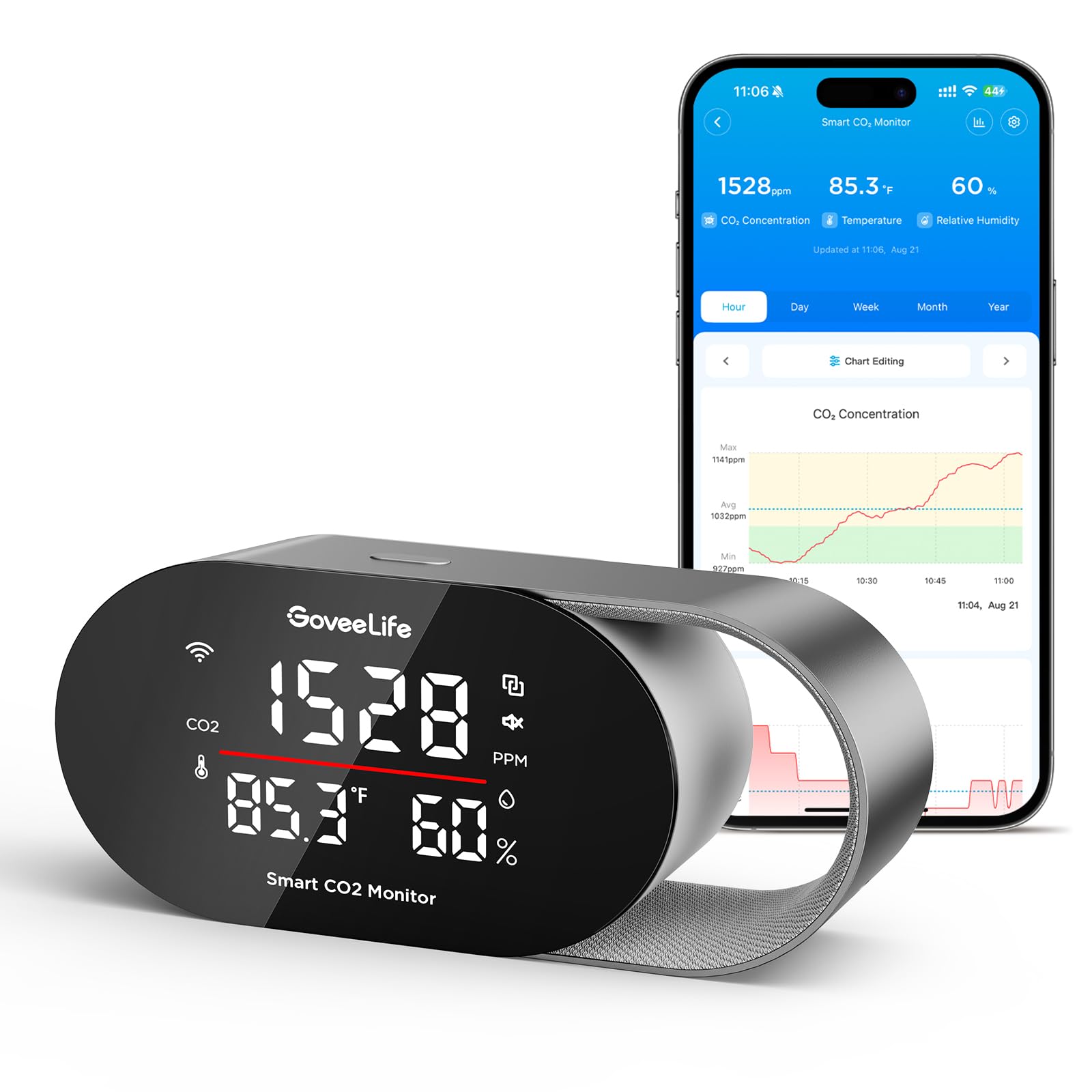
The GoveeLife H5140 focuses on CO₂, temperature, and humidity with exceptional precision, using the SCD4x photoacoustic NDIR sensor that delivers ±40ppm +5% accuracy with a 5-second refresh rate. For mold detection, its humidity tracking is the star feature — combined with CO₂ data, you can identify rooms that are both poorly ventilated and damp, the classic breeding ground for mold. The tri-color light bar and customizable LED display adapt brightness to day/night cycles via the app.
Users consistently highlight how the monitor reveals the cognitive impact of CO₂ buildup — one reviewer reported improved focus after using it to time ventilation breaks during work-from-home days. The triple alert system (buzzer, app notification, email) ensures you never miss a warning when humidity or CO₂ exceeds thresholds. The integration with Alexa and Google Assistant allows voice queries and smart home linkages with humidifiers and fans to automate air correction.
The biggest limitation is that this unit does not measure particulate matter at all — no PM2.5 or PM10 data. For mold detection, this means you are relying solely on humidity and ventilation proxies rather than directly detecting airborne spores. It is also AC-powered, so room-to-room portability requires unplugging. If you want a dedicated, always-on monitor for a single problem room, this is excellent; for multi-room sweeps, consider a battery-powered alternative.
Why it’s great
- Lab-grade CO₂ sensor with altitude compensation
- Smart home voice and automation integration
- Two-year data history exportable as CSV
Good to know
- No PM2.5, PM10, or VOC sensor for direct spore detection
- Requires AC power — not portable for room-to-room checks
- Wi-Fi connectivity can be finicky if placed far from router
3. bonoch 16-in-1 Air Quality Monitor
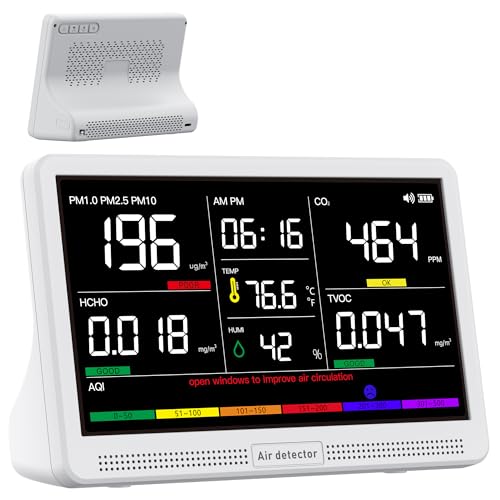
The bonoch 16-in-1 solves the portability problem with a massive 3500mAh battery that delivers up to 12 hours of cordless operation — enough to spend a full day moving between basement, bedroom, and kitchen to identify problem zones. The 7-inch LED display shows CO₂, PM2.5, PM1.0, PM10, HCHO, TVOC, temperature, humidity, and AQI simultaneously, so you never have to navigate menus to see whether humidity is creeping toward dangerous levels.
User reviews confirm the screen is readable from across the room, and the alarm system with 7 distinct alert modes ensures you notice when any parameter exceeds safe bounds. The external high-precision sensors achieve 0.001-level accuracy for HCHO and TVOC, making this one of the few monitors that can detect the chemical signature of active mold growth before particulates become visible. The adjustable 3-level brightness helps it work in both bright offices and dim bedrooms.
The trade-off is that the alarm can be startling — some users disable it for continuous monitoring, preferring to check the display manually. The battery, while generous, realistically lasts 6-8 hours with the display at full brightness. It also requires using the included USB-C adapter for optimal charging; third-party chargers may not work reliably. For anyone who needs to scout multiple rooms or take readings on vacation, this is the most untethered option.
Why it’s great
- 12-hour battery enables true whole-home mold scouting
- 0.001-level accuracy for formaldehyde and TVOC
- Giant 7-inch display shows all metrics at once
Good to know
- Alarm can be loud; mute button is a welcome inclusion
- Real-world battery closer to 6-8 hours at high brightness
- Bulky at 1.48 pounds; not truly pocket portable
4. 16-in-1 Large Display Air Quality Monitor
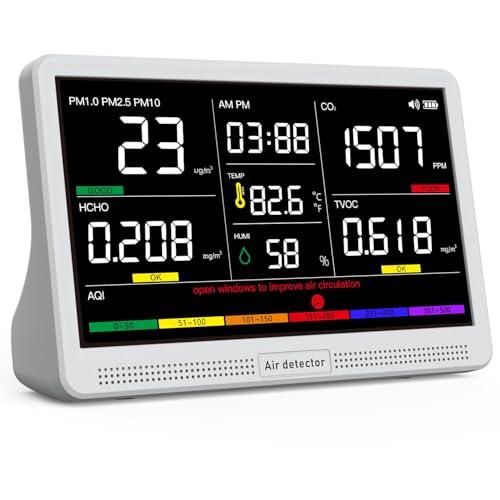
This 16-in-1 monitor from YNAK puts nine air quality parameters plus time on a bright 7-inch LED screen with three adjustable brightness settings. It uses external high-precision sensors that claim 0.001-level accuracy for HCHO and TVOC, and the multi-sensor array with enhanced airflow design detects even subtle environmental changes — useful for catching the early rise in humidity before it crosses the mold threshold. The 7 distinct AQI alert buzzers can be muted when needed.
Reviewers praise its instant sensitivity: one user noted that cooking, lighting candles, and using hairspray immediately registered on the display, proving the sensor’s responsiveness. Another used it to monitor PM from vape smoke and TVOCs from a UV printer, finding detection delays of only 3-7 seconds. The included 2500mAh battery provides about 8 hours of use, making it a solid choice for room-to-room checks.
A few users reported that strong chemical cleaners did not trigger TVOC or HCHO changes as expected, raising questions about long-term sensor drift or calibration. The instruction manual is thin on calibration guidance, so you may need to experiment with outdoor baseline readings. For the price, the display size and sensor variety are unmatched, but accuracy consistency appears slightly behind the premium-tier options.
Why it’s great
- Massive 7-inch display readable from across a room
- Instantaneous response to cooking, candles, and sprays
- External sensors with 0.001 accuracy for HCHO and TVOC
Good to know
- Some users reported slow or no response to strong chemical odors
- Manual lacks detailed calibration instructions
- Battery life around 8 hours; best plugged in for constant use
5. KDWKD Indoor Air Quality Monitor
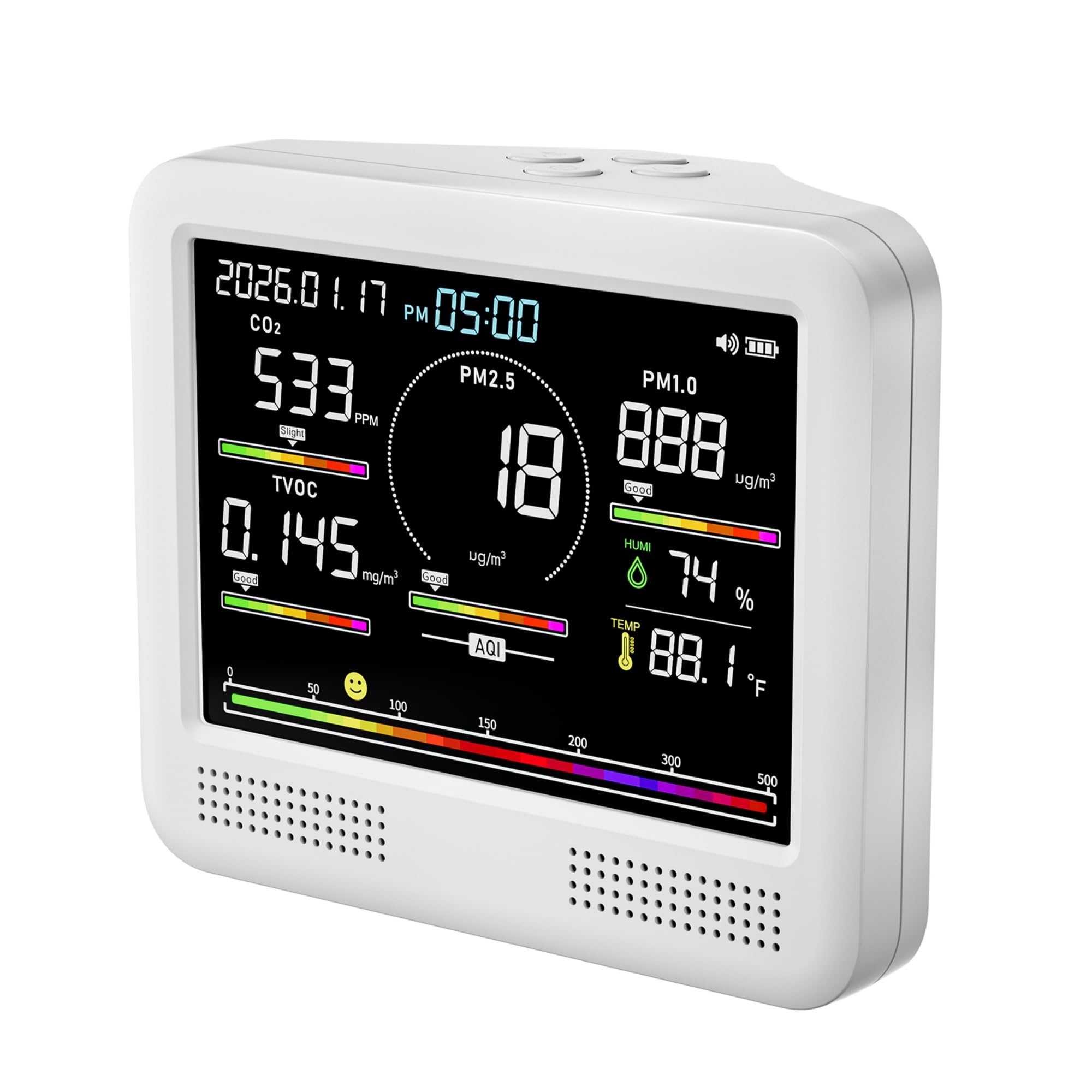
The KDWKD monitor puts a premium on portability and chemical detection, packing HCHO, TVOC, PM0.3, PM0.5, PM1.0, PM5.0, and PM10 sensors into a compact white ABS enclosure that runs for up to 9 hours on a single charge. For mold detection, the TVOC and HCHO sensors are critical — they can detect the volatile organic compounds released by actively growing mold colonies, often before PM levels rise. The audible alarm alerts you immediately when thresholds are breached.
Users report that it is excellent for new construction or recent remodeling projects, where high formaldehyde and VOC levels from paints and adhesives can create conditions that trap moisture. The battery-powered design means you can place it temporarily in a damp basement corner or a recently flooded area without worrying about outlet proximity. The sleek design fits neatly on a shelf or nightstand.
The customer reviews for this product have some confusing entries where reviewers appear to be discussing unrelated items (cups and lids), so the user feedback should be weighed with caution. The sensor accuracy for PM2.5 is not independently verified against a reference monitor in the reviews, and the company does not specify the NDIR or laser sensor type used for CO₂. For targeted short-term mold checks after water damage, it is a solid tool, but for long-term trend monitoring, a model with better documentation may be preferable.
Why it’s great
- Detects formaldehyde and TVOCs — early mold chemical markers
- 9-hour battery for placement anywhere, even without outlets
- Ideal for post-renovation or flood recovery assessments
Good to know
- Mixed review quality makes accuracy claims hard to verify
- Sensor type for CO₂ is not specified
- No app integration for data logging or trend graphs
6. LifeBasis 11-in-1 Air Quality Monitor

The LifeBasis 11-in-1 punches above its price point by including an NDIR infrared CO₂ sensor, a laser particle sensor for PM1.0, PM2.5, and PM10, plus semiconductor and photoelectric sensors for HCHO and TVOC. For mold detection, the combination of PM2.5 and humidity tracking gives you two of the three critical data points (along with temperature) at a very accessible cost. The 2500mAh battery delivers 11-12 hours of continuous use, easily enough for a full day of multi-room testing.
User reviews confirm the temp and humidity readings are accurate, and the PM2.5 readings matched a PurpleAir reference monitor in side-by-side testing. The dual alert system changes the display icon color from green to yellow to orange to red, while an audible ticking sound warns when any parameter exceeds safe levels. The flat, pocket-friendly design is uniquely portable — one reviewer even joked about using it as a “flatulence alerter” in various settings, proving its sensitivity to organic VOCs.
Where it falls short is the lack of Wi-Fi or Bluetooth connectivity — there is no app, no data logging, and no remote monitoring. You have to be physically present to read the display. Some users also note a faint fan hum from the internal cooling for the laser sensor. If you want a simple, accurate, and affordable tool to manually check rooms for mold-friendly conditions, this is the best budget option, but serious mold detectives may want app-based trend tracking.
Why it’s great
- Real NDIR CO₂ sensor at a budget-friendly price
- PM2.5 accuracy validated against PurpleAir reference
- Ultra-portable design with 12-hour battery life
Good to know
- No app, Wi-Fi, or Bluetooth for data tracking
- Faint fan noise may be noticeable in a quiet room
- Cannot detect carbon monoxide — separate detector needed
7. Airthings Corentium Home 2
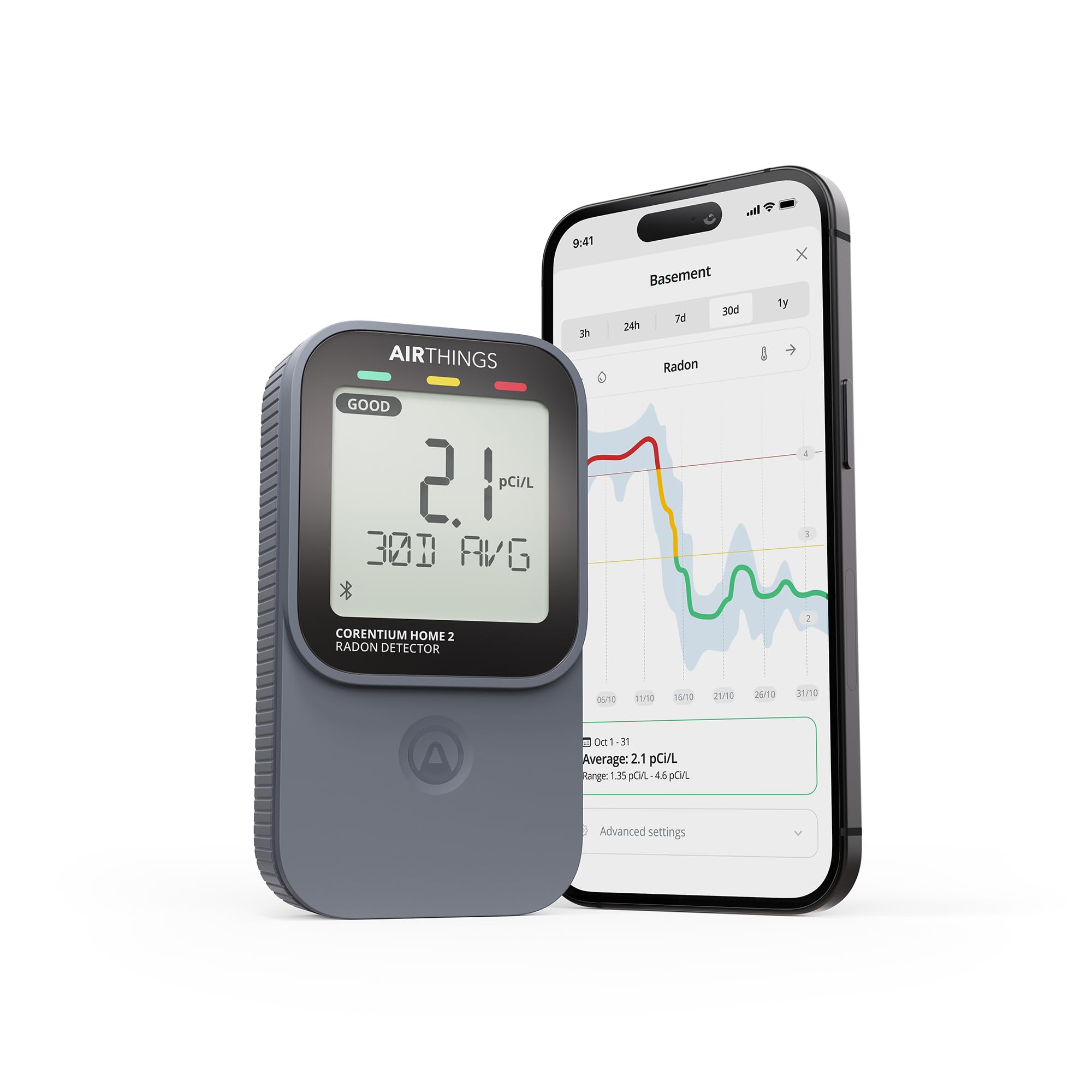
The Airthings Corentium Home 2 is a radically different tool — it uses alpha spectrometry to detect radon gas, a known carcinogen that often coexists with mold problems in basements and crawl spaces. While it does not measure PM2.5 or CO₂, it tracks temperature and humidity, giving you the moisture data needed to assess mold risk alongside radon levels. The Bluetooth connectivity streams data to the Airthings app, which displays short-term (24-hour, 7-day) and long-term (30-day, yearly) rolling averages with simple GOOD, FAIR, or POOR indicators.
Users consistently confirm its accuracy against traditional short-term and long-term radon test kits, and the ability to monitor continuously removes the uncertainty of single-use tests. The humidity sensor provides the critical mold context — if radon levels are high and humidity is creeping above 60%, you know your basement has a ventilation and moisture problem that could support mold. The battery-powered design runs on two AA alkaline batteries for months, requiring no cords or outlet placement.
This is a specialized tool rather than a general-purpose air quality monitor. It will not tell you about CO₂ buildup from occupancy or VOCs from cleaning products. If your primary concern is radon and you want to cross-reference it with humidity for mold risk, this is the gold standard. For broad-spectrum mold detection that includes spore-sized particulates and chemical markers, you would need to pair this with a PM/VOC monitor from the options above.
Why it’s great
- Proven alpha spectrometry radon detection trusted by inspectors
- Long-term rolling averages eliminate single-test uncertainty
- Battery lasts months — set it and forget it in the basement
Good to know
- No PM, CO₂, or VOC sensors for general air quality
- Bluetooth range limits monitoring to same floor without Hub
- Higher investment for a single-parameter specialty device
FAQ
Can an air quality monitor detect mold before I see it?
What humidity level is considered dangerous for mold growth?
Is PM2.5 the same as measuring mold spores directly?
Do I need an app-connected monitor for mold detection?
Final Thoughts: The Verdict
For most users, the best air quality monitor for mold winner is the BREATHE Airmonitor Plus because it combines PM1/2.5/10, TVOC, HCHO, CO₂, and humidity sensors in a compact app-connected package that tracks trends over 30 days. If you want smart home integration and AC-powered continuous monitoring for a single room, grab the GoveeLife Smart Air Quality Monitor. And for maximum portability to scout multiple rooms after a water leak or during seasonal humidity changes, nothing beats the bonoch 16-in-1 with its 12-hour battery life.

Mo Maruf
I created WellFizz to bridge the gap between vague wellness advice and actionable solutions. My mission is simple: to decode the research and give you practical tools you can actually use.
Beyond the data, I am a passionate traveler. I believe that stepping away from the screen to explore new environments is essential for mental clarity and physical vitality.