Our readers keep the lights on and my smoothie glass nicely filled. As an Amazon Associate, I earn from qualifying purchases.
An air purifier isn’t a luxury appliance — for anyone managing seasonal allergies, pet dander, kitchen odors, or urban dust, it’s the one device that physically changes how your lungs feel by morning. But when you cap your search at two hundred dollars, the market floods with everything from whisper-quiet bedside units to oversized towers that claim to scour 3,000 square feet. The trick isn’t finding one that works — it’s finding one that works for your actual room size without dumping noise into your living space or costing you triple in replacement filters down the road.
I’m Mohammad Maruf — the founder and writer behind WellFizz. I’ve spent years dissecting air purifier CADR ratings, filter media grades, and fan motor curves to separate the marketing claims from the measurable performance that keeps your home’s air clean without draining your wallet.
Whether you are battling wildfire smoke, dusting a multi-pet household, or simply tired of waking up with a stuffy nose, this guide breaks down the most capable air purifier under $200 models based on real-world specs and owner feedback.
How To Choose The Best Air Purifier Under $200
Staying within this budget means you are trading off either raw coverage area, smart features, or filter longevity. The trick is knowing which trade-off matters most for your specific room.
Match Coverage Claims to Actual Air Changes
A unit that claims 2,000 square feet of coverage likely achieves that at a single air change per hour. For allergy relief, you want 4.8 air changes per hour (ACH) in a smaller bedroom. Cross-reference the claimed coverage with the CADR number — a smoke CADR above 200 CFM is where you start seeing meaningful multi-room performance.
Filter Grade and Replacement Costs
True HEPA (H13 or H14) captures 99.97% of particles at 0.3 microns. Some budget units use HEPA-type or H10 media, which drops capture rates significantly. Also check the cost of replacement filters — a purchase can turn into /year in media. Units with washable pre-filters extend the main filter’s life considerably.
Noise at Night vs. Motor Power
The quietest sleep modes hover around 24 dB — barely audible. But that same unit on high speed may jump to 50+ dB, which is intrusive in a bedroom. If the purifier is for your sleeping space, prioritize a unit with a dedicated sleep mode that dims lights and drops fan speed without sacrificing too much CADR.
Quick Comparison
On smaller screens, swipe sideways to see the full table.
| Model | Category | Best For | Key Spec | Amazon |
|---|---|---|---|---|
| LEVOIT Core 400S-P | Smart / Premium | Large room, open floor plans | Smoke CADR: 231 CFM | Amazon |
| WINIX 5510 | Premium / Value | Whole-home coverage, odor control | Sleep Mode: 23.5 dB | Amazon |
| LUNINO K2 | Mid-Range | Large rooms, washable filter | Double-sided intake | Amazon |
| LEVOIT Core 300-P | Mid-Range | Bedrooms, small apartments | 24 dB Sleep Mode | Amazon |
| GermGuardian AC4825E | Mid-Range | Large rooms, UV-C light | 0.3-micron HEPA filter | Amazon |
| HAP-602 | Budget-Friendly | Large spaces, auto mode | 360° airflow | Amazon |
| PuroAir 100i | Budget-Friendly | Small rooms, portable use | HEPA-13 filter | Amazon |
In‑Depth Reviews
1. LEVOIT Core 400S-P

The Core 400S-P sits at the ceiling of this budget bracket for good reason. Its AHAM Verified smoke CADR of 231 CFM means it can refresh a 1,733-square-foot space in one hour, making it the strongest performer here for open-concept living. The AirSight Plus laser sensor continuously broadcasts real-time PM2.5 levels, so you watch the number drop when you turn on Auto Mode — no guesswork.
Sleep Mode dips to 24 dB, which is genuinely quiet for a unit of this size. The 360° intake pulls air from all sides, and the ARC Formula carbon layer handles VOCs and cooking odors better than most units at this price. The VeSync app adds timers, filter life tracking, and voice control via Alexa or Google Assistant.
Replacement filters run about –, which is fair for the H13 HEPA media and carbon pre-filter. The main trade-off is physical footprint — at 20.5 inches tall and nearly 13 pounds, it is not a bedside companion you tuck away.
Why it’s great
- Highest smoke CADR (231 CFM) in this price tier
- Real-time PM2.5 laser sensor with auto mode
- Quiet 24 dB sleep mode suitable for bedrooms
Good to know
- Heavier and taller than most competitors
- Wi-Fi setup can be finicky initially
- Replacement filters add ongoing cost
2. WINIX 5510

The WINIX 5510 inherits the reliable DNA of the 5500-2 but adds app support and a refined auto mode. Its four-layer filtration stack — washable pre-filter, activated carbon, True HEPA, and Plasmawave ionizer — captures 99.99% of airborne particles down to 0.01 microns while the carbon sheet handles odors from cooking, pets, and smoke.
At 23.5 dB in Sleep Mode, this is one of the quietest large-room purifiers available. The automatic light sensor switches to Sleep Mode when the room darkens — no button pressing. Real-world owners report that the auto sensor detects stove gas, air fresheners, and even mouthwash, adjusting fan speed instantly.
The unit is AHAM Verified for a 392-square-foot room but can clean up to 1,882 square feet in an hour. Replacement filters average around each and last 12 months, making this one of the more cost-effective long-term choices here.
Why it’s great
- Ultra-quiet 23.5 dB sleep mode
- Washable pre-filter extends HEPA life
- Smart auto sensor with app and voice control
Good to know
- Vertical side openings may reduce efficiency against walls
- Plasmawave feature may concern ozone-sensitive users
- Bulky footprint for tight spaces
3. LUNINO K2
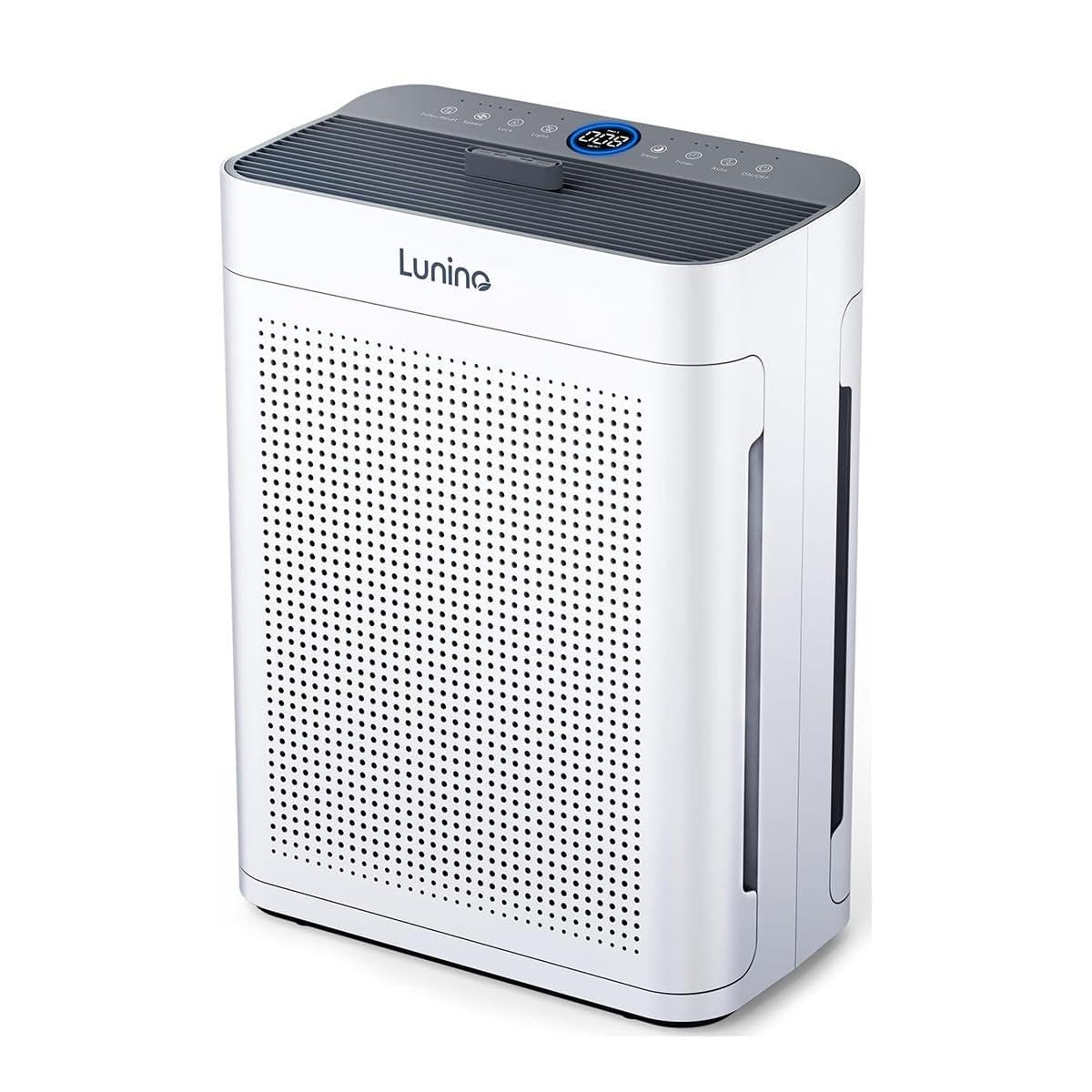
The LUNINO K2 stands out with a double-sided intake design that pulls air from both sides simultaneously, effectively doubling the airflow rate compared to conventional single-intake units. This allows it to cover up to 3,000 square feet at a single air change per hour — territory usually reserved for units costing significantly more.
Its three-stage system includes a washable pre-filter that can be vacuumed or rinsed, dramatically extending HEPA filter life to 12–18 months. The built-in PM2.5 sensor displays real-time air quality on the front panel and auto-adjusts fan speed across six modes, including a 15 dB Sleep Mode that is genuinely silent.
Owners report that the auto sensor responds rapidly to cooking smoke and pet odors, ramping up within seconds. The aromatherapy pad on top is a thoughtful addition, though it is not why you buy this unit — you buy it for the oversized coverage and low long-term filter cost.
Why it’s great
- Double-sided intake for faster room turnover
- Washable pre-filter saves on replacement costs
- 15 dB sleep mode is near-silent
Good to know
- Coverage claim of 3,000 sq ft is at 1 ACH
- PM2.5 sensor needs a warm-up period
- Replacement HEPA filters available only from LUNINO
4. LEVOIT Core 300-P

The Core 300-P is the bedroom benchmark in this price range. Powered by a 56W high-torque motor, it delivers a 143 CFM smoke CADR — enough to cycle a 222-square-foot room 4.8 times per hour. Sleep Mode drops to 24 dB, which is genuinely whisper-quiet, and the display lights can be fully turned off for zero light pollution at night.
Its 3-in-1 filter captures 99.97% of particles down to 0.3 microns. Owners report noticeable relief from pollen and pet dander allergies within days, and the compact 8.7-inch square footprint fits easily on a nightstand or desk. The timer offers 2, 4, 6, or 8-hour settings, so you can run it only during sleep hours.
The main downside is noise at speed 3 — it reaches levels that compete with TV dialogue and music. Keep it on low or medium for living spaces and save high speed for quick purging after cooking.
Why it’s great
- 24 dB sleep mode for undisturbed rest
- AHAM Verified with 143 CFM smoke CADR
- Compact design fits small spaces
Good to know
- High speed is noticeably loud
- Replacement filters cost –
- No smart app or auto mode
5. GermGuardian AC4825E

It is Zero Ozone certified, so you get UV sanitation without ozone concerns.
The tower design stands 22 inches tall with a 10.25 x 6.75-inch footprint, making it a good fit for corners in living rooms or large bedrooms. It cleans a 153-square-foot room in 12.5 minutes and handles up to 743 square feet per hour. The washable pre-filter catches larger particles, reducing how often you need to replace the main HEPA filter.
Owners with asthma report reduced symptoms and less dust accumulation after several months of use. The UV-C light is bright at night, so it is best placed away from the bed or used without the UV feature in sleep spaces. Replacement filters run about – and last 6–8 months with regular pre-filter cleaning.
Why it’s great
- UV-C light reduces airborne germs and mold
- Standby mode at lowest speed is quiet
- Proven track record with consistent filter availability
Good to know
- UV-C light is distracting in dark bedrooms
- High speed is noticeably loud
- No smart features or auto sensor
6. HAP-602 Air Purifier
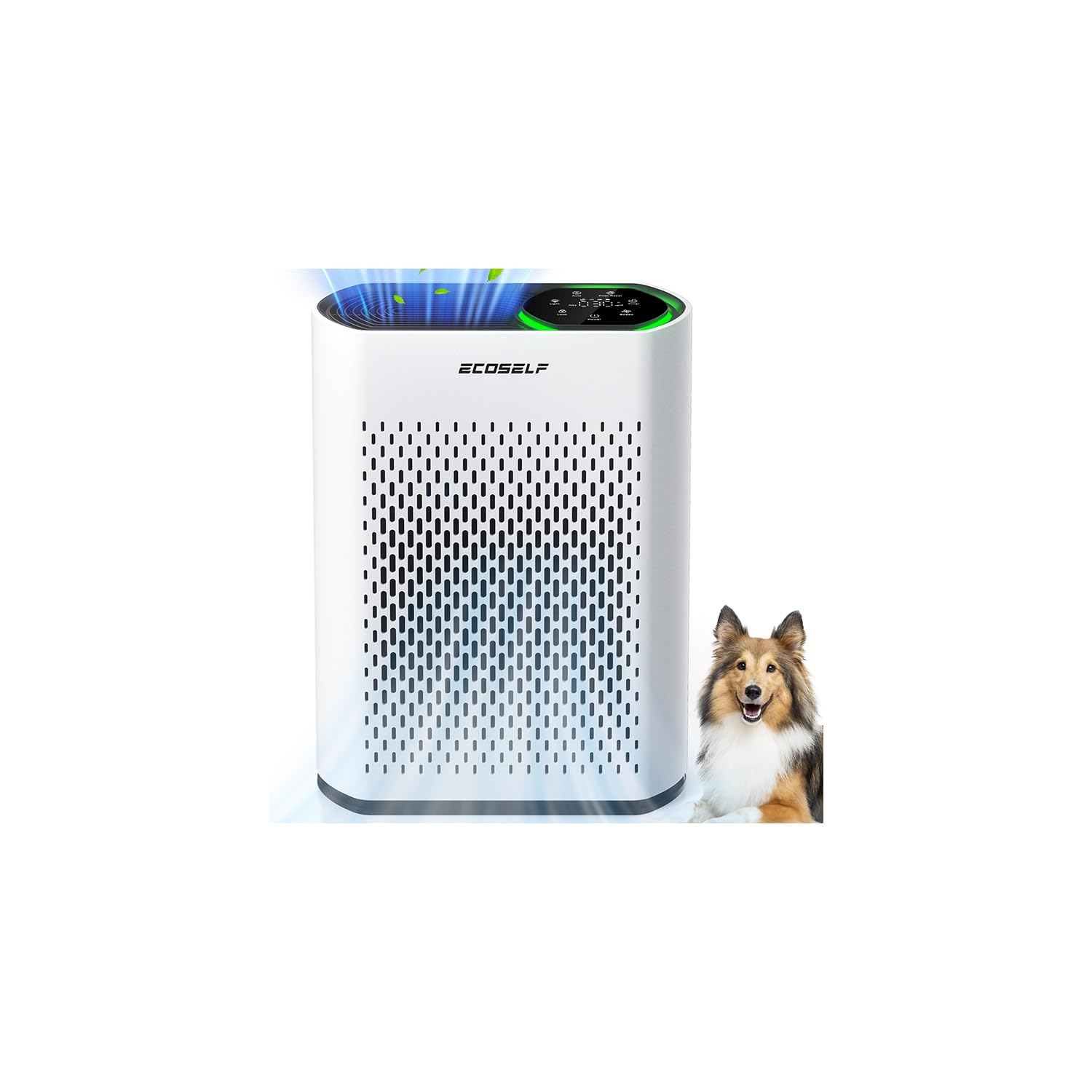
The HAP-602 punches well above its price point with a claimed coverage of up to 2,400 square feet and a 30-minute rapid cleaning cycle. Its 360° airflow design pulls polluted air from all sides, improving circulation and delivering more consistent purification across the entire room.
The advanced three-stage filtration system — pre-filter, HEPA, and activated carbon — effectively captures dust, pollen, pet dander, and smoke. The built-in PM2.5 display and touch control panel give you real-time feedback on air quality, while Sleep Mode keeps noise to a minimum for overnight use.
Owners consistently report that the auto mode responds quickly to cooking odors and pet smells, and many note a significant reduction in allergy symptoms within the first week. The unit is compact and lightweight at 6.6 pounds, making it easy to move between rooms.
Why it’s great
- Large coverage claim at entry-level price
- 360° intake improves room circulation
- Responsive auto mode with PM2.5 display
Good to know
- Coverage numbers may be optimistic for real-world use
- Filter replacement schedule not clearly stated
- Build does not feel as premium as LEVOIT or WINIX
7. PuroAir 100i
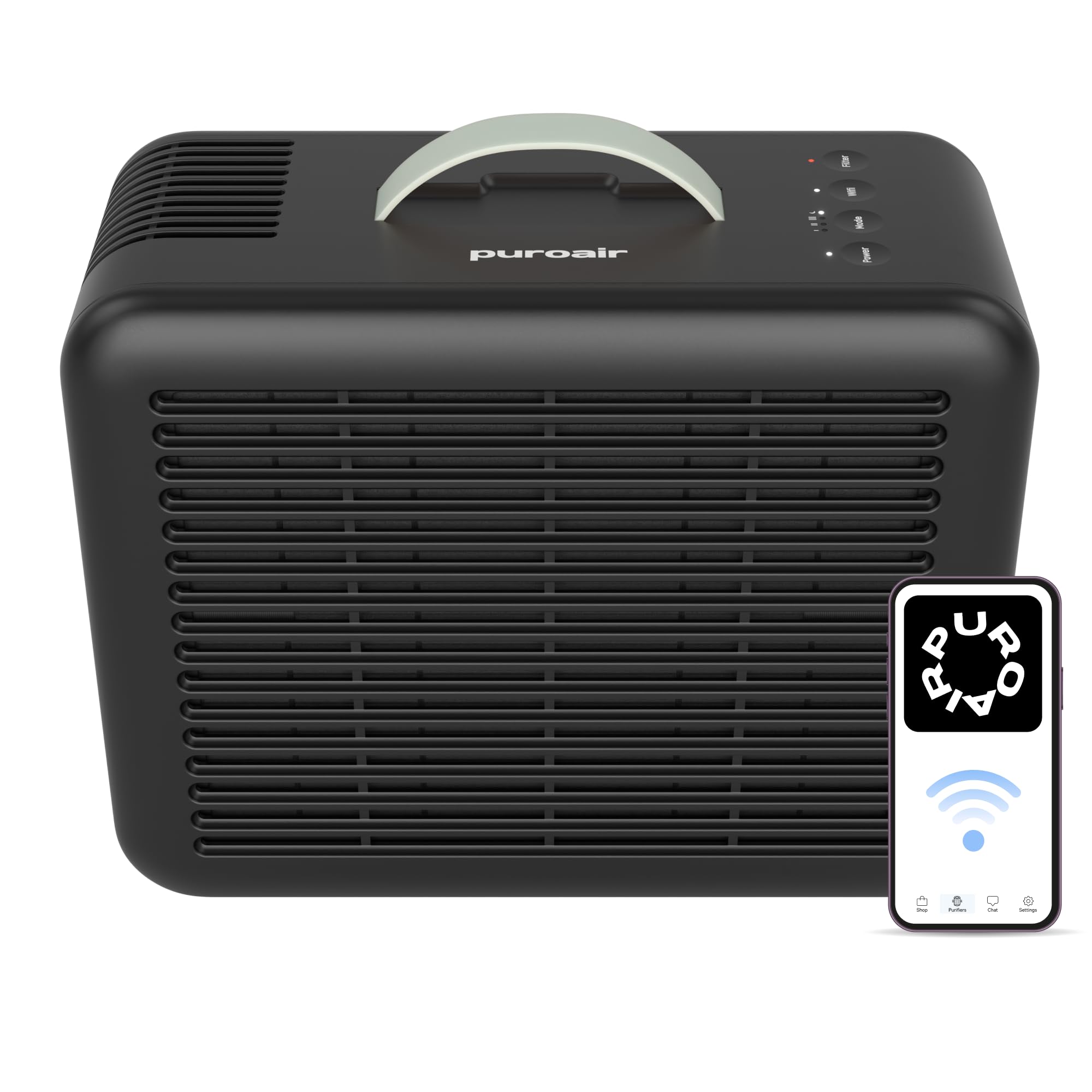
The PuroAir 100i packs a HEPA-13 filter into a compact 12.2 x 5.1 x 8.7-inch chassis, making it one of the most portable options here. Despite its small size, it covers rooms up to 550 square feet in one hour and uses a three-layer filtration system — pre-filter, HEPA, and activated carbon — that is 500 times stronger than standard competitors, according to the manufacturer.
The smart app integration lets you control fan speed and settings from your phone, and owners report that the Wi-Fi connection is reliable and easy to set up. Sleep Mode is genuinely quiet, and the magnetic filter change design makes replacements tool-free. The included handle adds to its portability between rooms.
Customer feedback consistently notes that it removed cigarette and dog smells within the first day and reduced visible dust and asthma-triggered symptoms within two weeks. The 2-year warranty and partnership with the American Lung Association add peace of mind, though the unit is best suited for smaller bedrooms or home offices rather than open living areas.
Why it’s great
- True HEPA-13 filter in a compact frame
- Smart app control with Wi-Fi connectivity
- Magnetic filter door for easy swaps
Good to know
- Best suited for rooms under 550 sq ft
- Replacement filters may be proprietary
- App features are basic compared to LEVOIT
FAQ
How often should I replace the filter in my air purifier?
Does a higher fan speed always mean cleaner air faster?
Can I leave my air purifier on 24/7?
Final Thoughts: The Verdict
For most users, the air purifier under $200 winner is the LEVOIT Core 400S-P because it combines the highest smoke CADR in this price range with real-time PM2.5 monitoring and smart control. If you want the quietest sleep-mode performance with washable filters, grab the WINIX 5510. And for budget-conscious buyers covering a large space with minimal long-term filter costs, nothing beats the LUNINO K2.

Mo Maruf
I created WellFizz to bridge the gap between vague wellness advice and actionable solutions. My mission is simple: to decode the research and give you practical tools you can actually use.
Beyond the data, I am a passionate traveler. I believe that stepping away from the screen to explore new environments is essential for mental clarity and physical vitality.