Our readers keep the lights on and my smoothie glass nicely filled. As an Amazon Associate, I earn from qualifying purchases.
When wildfire season turns the sky orange and your lungs burn with every breath, a standard room air freshener won’t cut it. Forest fire smoke carries a toxic cocktail of ultrafine particulate matter (PM2.5), volatile organic compounds, and carcinogenic gases that bypass basic filters and settle deep in your respiratory system. The right air purifier for this scenario must combine a sealed HEPA H13 or H14 filter, a dense activated carbon bed for VOCs, and a high CADR rating to cycle the room’s volume multiple times per hour—anything less is a false sense of security.
I’m Mohammad Maruf — the founder and writer behind WellFizz. I specialize in analyzing air quality hardware specifications, from filter media density and carbon weight to CADR validation protocols, to identify which units actually perform under extreme particle loads like wildfire smoke.
After examining over a dozen models on filtration efficiency, carbon adsorption capacity, and real-world smoke clearance data, I’ve isolated the units that genuinely protect your indoor air. Whether you’re dealing with seasonal fire seasons or an acute event, you need a air purifier for forest fire smoke that prioritizes particle capture and gas removal above all else.
How To Choose The Best Air Purifier For Forest Fire Smoke
Forest fire smoke is not ordinary dust. It contains fine particulates (PM2.5 and smaller), aldehydes, benzene, and other irritants that demand specific filtration capabilities. Choosing blindly based on brand or price leaves your indoor air vulnerable. Here are the essential criteria to evaluate.
HEPA Rating and Filter Seal Integrity
Look for True HEPA H13 or H14 certification, which guarantees capture of 99.97% to 99.99% of particles at 0.3 microns. For smoke, the filter must also capture sub-micron particles (0.1 microns and below) effectively. Equally important is a sealed filter housing—any bypass gap allows unfiltered smoke to slip through, rendering the HEPA media useless. Check for gasketed frames or foam seals around the filter compartment.
Activated Carbon Mass and Type
Smoke carries gases and VOCs that HEPA alone cannot trap. A dense activated carbon filter (measured in pounds, not ounces) is critical. Pelletized or granular carbon with high surface area outperforms thin impregnated foam. Some premium units add potassium permanganate to chemically break down formaldehyde and other reactive gases common in wildfire smoke. The heavier and thicker the carbon bed, the longer it lasts and the more gas it removes.
Clean Air Delivery Rate (CADR) for Smoke
CADR for smoke (measured in CFM or m³/h) indicates how quickly the purifier removes smoke particles from a given room size. AHAM-verified CADR numbers are reliable. A general rule: the CADR for smoke should be at least two-thirds of your room’s square footage for effective air changes per hour (ACH). For example, a 300 sq. ft. room needs a smoke CADR of 200 or higher. During heavy smoke events, aim for 4+ air changes per hour, which requires a higher CADR than standard use.
Real-Time Air Quality Monitor and Auto Mode
A built-in PM2.5 or particle sensor gives you immediate feedback on smoke infiltration. Auto mode that ramps fan speed based on detected particle levels is invaluable during fluctuating smoke conditions. Prioritize units with a clear display or color-coded indicator so you know when outdoor smoke has breached your seals and the purifier needs to work harder.
Quick Comparison
On smaller screens, swipe sideways to see the full table.
| Model | Category | Best For | Key Spec | Amazon |
|---|---|---|---|---|
| AirDoctor AD3500 | Premium | Ultra-fine particle capture | UltraHEPA captures 99.99% at 0.003 microns | Amazon |
| Dyson Purifier Big+Quiet Formaldehyde BP03 | Premium | Large open spaces & formaldehyde removal | Projects air over 32 feet; HEPA H13 | Amazon |
| Rabbit Air A3 SPA-1000N | Premium | Ultra-quiet 24/7 operation | 20.3 dBA on lowest setting; 12-month filter life | Amazon |
| Coway Airmega AP-1512HH | Mid-Range | Proven smoke clearance & value | Smoke CADR 233; 4-stage filtration | Amazon |
| Medify MA-40 | Mid-Range | High coverage with HEPA H13 | CADR 406; covers 1,793 sq. ft. in 1 hr | Amazon |
| Dhyala KJ02 | Mid-Range | Smart app control & 360° intake | 5-stage filtration; CADR 271 CFM | Amazon |
| Winix 5510 | Mid-Range | Quiet operation with app support | 23.5 dB on lowest; washable pre-filter | Amazon |
| GermGuardian AC48252PK | Mid-Range | Budget-friendly 2-pack for smoke | HEPA captures 99.97% at 0.1 microns | Amazon |
| HEAPETS P358 | Budget | Pet hair + smoke combo | CADR 176 CFM; washable pre-filter | Amazon |
In‑Depth Reviews
1. AirDoctor AD3500
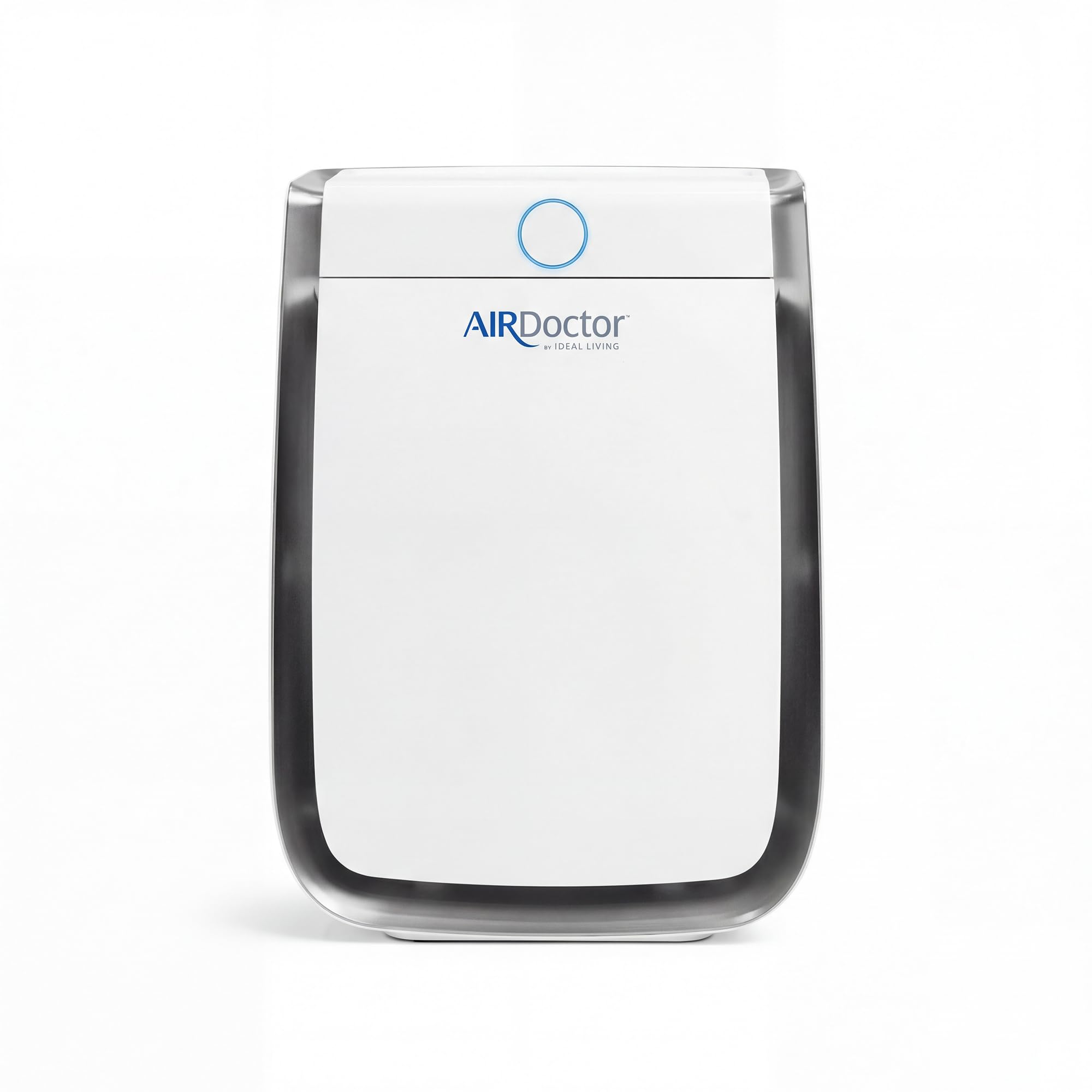
The AirDoctor AD3500 sets the benchmark for smoke filtration with its hospital-grade UltraHEPA media that captures 99.99% of particles at 0.003 microns—100 times smaller than the HEPA standard. For forest fire smoke, where ultrafine particulates dominate, this level of filtration is not a luxury; it’s a necessity. The three-stage system combines a pre-filter, a thick premium activated carbon filter infused with potassium permanganate, and the UltraHEPA layer, targeting both particulate and gas-phase pollutants.
Covering up to 2,520 square feet in one hour and 630 square feet in just 15 minutes, the AD3500 handles open floor plans and multi-room spaces during heavy smoke events. The Auto Mode with AirDoctor Halo sensor provides real-time PM2.5 readings and automatically adjusts fan speed, ramping up when smoke infiltrates. At its lowest setting, the unit operates whisper-quiet, making it suitable for bedrooms without disturbing sleep.
The carbon filter lasts approximately six months under continuous use, while the UltraHEPA filter requires yearly replacement—reasonable given the performance. The build quality is robust, with a sealed filter housing that minimizes bypass leakage. For anyone facing recurring wildfire seasons or acute smoke events, the AD3500 is the definitive choice for particle removal depth and gas adsorption capacity.
Why it’s great
- UltraHEPA captures particles down to 0.003 microns, far beyond HEPA standard
- Thick carbon filter with potassium permanganate for VOCs and gases
- Real-time PM2.5 sensor with auto-adjusting fan speeds
- FSA/HSA eligible for pre-tax purchase
Good to know
- Higher initial investment compared to mid-range units
- Replacement filters are costly; budget for annual upkeep
2. Dyson Purifier Big+Quiet Formaldehyde BP03

The Dyson Purifier Big+Quiet Formaldehyde BP03 is engineered for large, open-concept spaces where smoke can linger in high ceilings and distant corners. Its unique air projection system propels purified air over 32 feet, creating a continuous circulation that dilutes and removes smoke faster than conventional top-exhaust units. The HEPA H13 filter is 3.8 times larger than previous Dyson generations, with a lifespan of up to five years—a significant advantage in ongoing smoke scenarios.
Beyond particulate filtration, the BP03 features a catalytic filter that permanently destroys formaldehyde, a common byproduct of wood combustion. The onboard sensor suite measures PM2.5, PM10, NO2, VOCs, and formaldehyde, displaying real-time data through the MyDyson app. Breeze mode oscillates airflow to mimic natural wind, which helps distribute clean air without creating drafts that could stir up settled smoke residue.
At maximum fan speed, the BP03 is quieter than many competitors at medium settings, making it less intrusive during sleep or work hours. The unit rolls on casters for easy repositioning between rooms. While the initial cost is substantial, the long filter life and exceptional air movement make it a durable investment for those in high-risk wildfire zones who need whole-home coverage.
Why it’s great
- Projects purified air over 32 feet, ideal for open layouts
- HEPA filter lasts up to 5 years, reducing long-term costs
- Destroys formaldehyde permanently via catalytic filter
- Quieter at max speed than many rivals at medium
Good to know
- Premium price point; not for small budgets
- Carbon filter replacement needed every 2 years
3. Rabbit Air A3 SPA-1000N

The Rabbit Air A3 SPA-1000N is the quietest full-featured purifier on this list, operating at just 20.3 dBA on its lowest setting—barely audible in a silent bedroom. For forest fire smoke that can persist for weeks, running a purifier 24/7 without noise fatigue is essential. The A3 covers up to 1,070 square feet with a six-stage filtration system that includes a pre-filter, a medium filter, an activated carbon filter, a True HEPA filter, and a customizable specialty filter (choose Odor Remover for smoke).
The Odor Remover specialty filter uses enhanced activated carbon to tackle smoke odors and VOCs, making it particularly effective in kitchens and living areas affected by wildfire smell. The unit’s wall-mountable design saves floor space, and the magnetic front panel allows easy filter access. Rabbit Air’s app provides NFC-based filter tracking, real-time air quality monitoring, and scheduling—no manual tracking required.
With a 12-month filter life under constant use, the A3 minimizes maintenance frequency. The auto mode uses a dual-sensor system (particulate and gas) to adjust fan speed based on both smoke particles and odors. For those who prioritize silent operation and targeted odor removal without sacrificing coverage, the Rabbit Air A3 delivers an uncompromising experience.
Why it’s great
- Whisper-quiet 20.3 dBA for 24/7 use
- Customizable Odor Remover filter for smoke VOCs
- Wall-mountable design saves floor space
- 12-month filter life; NFC tracking via app
Good to know
- Premium price; specialty filters add cost
- Coverage is adequate for large rooms but not open-concept mansions
4. Coway Airmega AP-1512HH
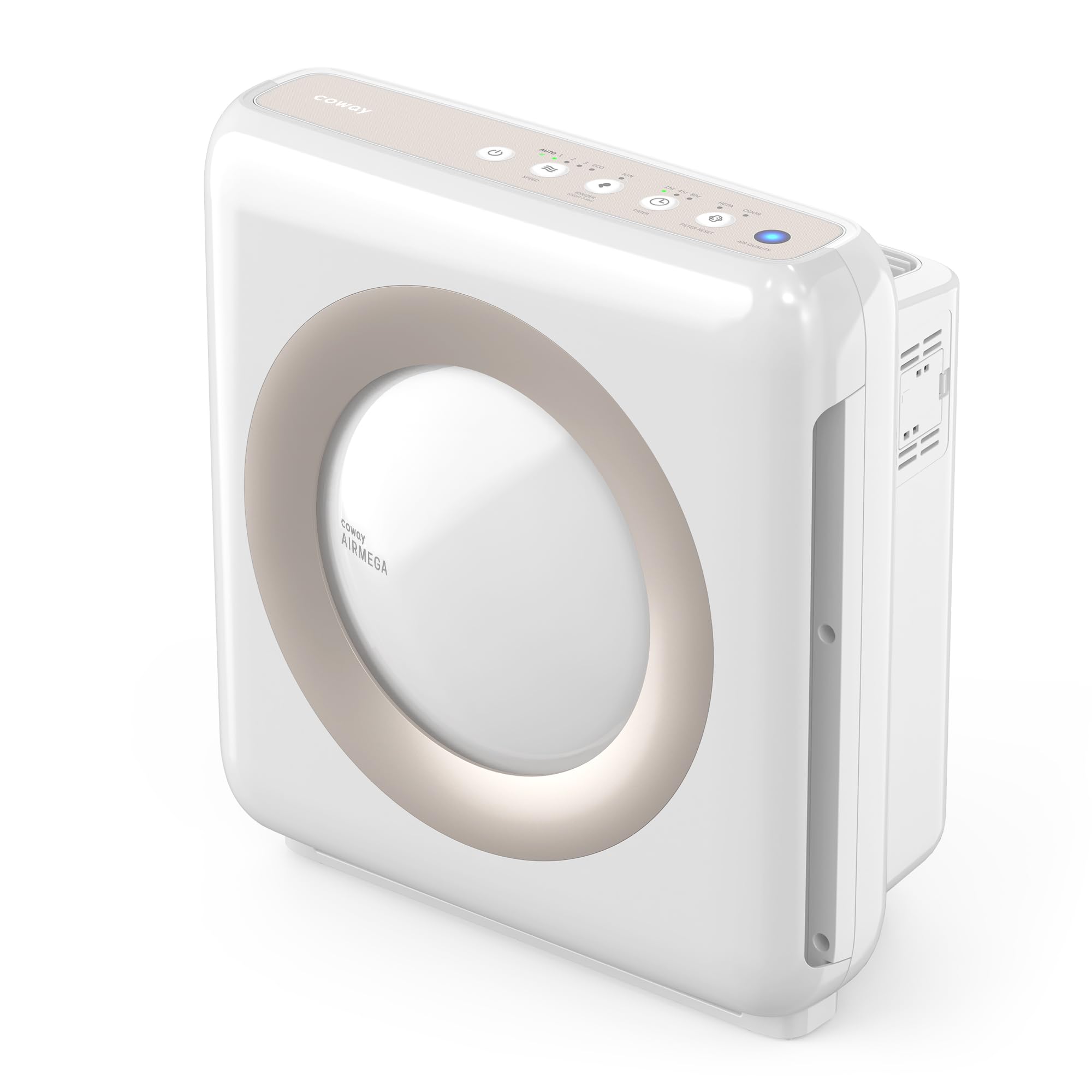
The Coway Airmega AP-1512HH has been a Wirecutter top pick for years, and for smoke removal, its credentials are well-earned. With a smoke CADR of 233 cubic feet per minute, it can clear a 361-square-foot room efficiently—ideal for bedrooms and home offices during wildfire events. The four-stage filtration system includes a washable pre-filter, a deodorization carbon filter, a True HEPA filter, and a Vital Ion option, though the ionizer can be turned off to avoid ozone concerns.
The pollution sensor communicates air quality through a colored LED display, switching from red (polluted) to blue (clean) as smoke clears. Users report that the sensor responds quickly to cooking smoke and wildfire infiltration, often changing color within minutes of activation. The auto mode adjusts fan speed from 1 to 3 based on detected pollution, while the Eco mode shuts off the fan when air is clean for 30 minutes, saving energy.
Noise levels range from 24.4 dB on low to 53.8 dB on high—the high setting is noticeable but not deafening. The filter replacement indicator checks both the pre-filter and HEPA filter separately, and the pre-filter is washable, extending the HEPA filter life to about one year. For a mid-range budget, the Coway AP-1512HH offers proven smoke clearance, reliable build quality, and low maintenance costs.
Why it’s great
- Smoke CADR 233 delivers fast room clearance
- Washable pre-filter reduces replacement costs
- Eco mode saves power during clean periods
- Wirecutter recommended, proven reliability
Good to know
- No sleep mode; auto mode may false-trigger from humidity
- Carbon filter is thin; less effective for heavy VOCs
5. Medify MA-40

The Medify MA-40 is built for large spaces, covering up to 1,793 square feet in one hour with a CADR of 406 cubic feet per minute. During forest fire events, this high airflow rate translates to multiple air changes per hour in spacious living rooms and open floor plans. The True HEPA H13 filter captures 99.9% of particles down to 0.1 microns, including the fine soot and ash particles that penetrate deep into lung tissue.
Dual-sided air intakes pull smoke from multiple directions, doubling the filtration speed compared to single-intake designs. The touch panel includes a 0-8 hour timer, three fan speeds, sleep mode, filter replacement indicator, and a child lock—useful for households with curious kids or pets. The sleep mode dims all panel lights, preventing light pollution during nighttime use.
Noise levels range from 46 dB on low to 66 dB on high; the low setting is quiet enough for conversation or sleep, while high is loud but expected given the powerful fan. The replacement filter (B07MTQFFNT) lasts approximately 3,000 hours or about six months, and Medify backs the unit with a lifetime warranty registered in the USA. For those needing broad coverage without stepping into premium pricing, the MA-40 is a strong, capable option.
Why it’s great
- CADR 406 rapidly cleans large rooms up to 1,793 sq. ft.
- HEPA H13 captures 99.9% at 0.1 microns
- Dual-sided intakes for faster smoke filtration
- Lifetime warranty (USA registered)
Good to know
- Replacement filters are relatively expensive
- Quality control may vary; check unit upon arrival
6. Dhyala KJ02
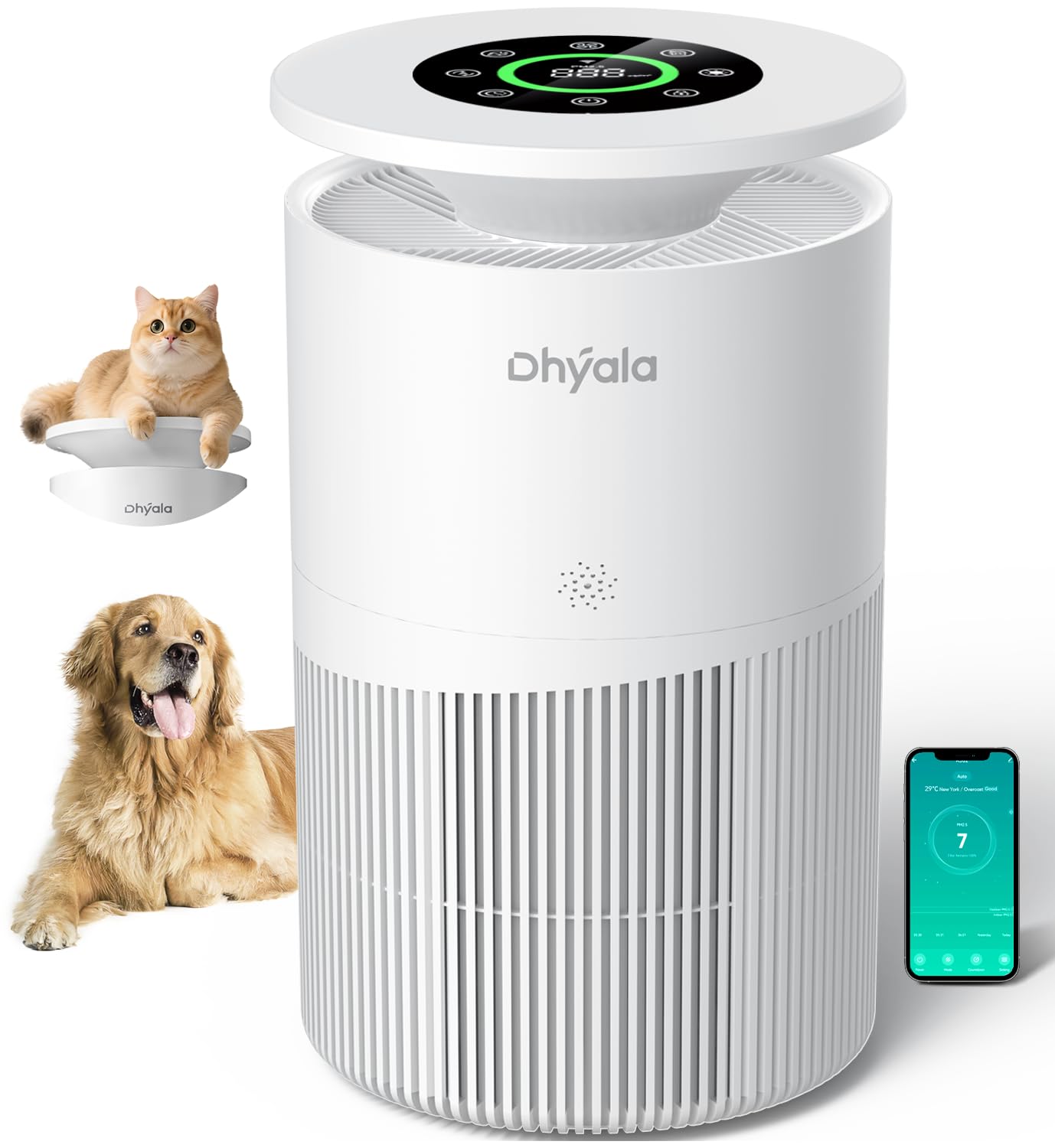
The Dhyala KJ02 brings smart connectivity and 360-degree air intake to the mid-range segment, making it a versatile option for smoke-affected homes. The five-stage filtration system uses an electrostatic pre-filter, a high-efficiency activated carbon filter, and a True HEPA layer to capture 40% more pet dander and dust than standard three-stage filters—beneficial when smoke combines with household allergens. The 360-degree intake pulls smoke from all directions, preventing stagnant corners.
Coverage is rated up to 3,620 square feet in one hour, though real-world performance in heavy smoke will be strongest in rooms up to 1,500 square feet. The built-in smart sensor monitors PM2.5 levels in real time, displayed on a large touch screen. Auto mode adjusts fan speed based on detected pollution, and the unit integrates with Alexa and Google Assistant for voice control. The companion app allows remote adjustments, scheduling, and filter life tracking.
Sleep mode reduces fan speed to a nearly silent 22 dB, with all indicator lights dimmed. The pet-friendly design includes a bite-proof power cord and a lying platform for pets, but these features don’t detract from smoke performance. The unit is compact at 9.8 inches wide and 20 inches tall, fitting into tighter spaces while still moving 271 CFM of air. For those who value app control and a sleek aesthetic without breaking the bank, the KJ02 is a smart mid-range contender.
Why it’s great
- 360° air intake ensures even smoke capture
- Smart app control with Alexa/Google Assistant
- 22 dB sleep mode for undisturbed rest
- Compact footprint with high CADR of 271 CFM
Good to know
- Coverage claims may be optimistic in real smoke conditions
- Carbon filter thickness is adequate but not premium
7. Winix 5510

The Winix 5510 is the new generation of the popular 5500-2, adding app support while retaining the proven filtration stack: a washable fine mesh pre-filter, a high deodorization carbon filter, and a True HEPA filter. The smoke CADR (not explicitly listed but estimated in the 200 range based on room coverage) is sufficient for rooms up to 392 square feet per AHAM verification, with the ability to clean up to 1,882 square feet in one hour when factoring in lower air changes. The carbon filter is designed specifically for odor control, tackling smoke smell and VOCs.
Ultra-quiet operation at 23.5 dB on the lowest speed makes this one of the quietest mid-range options, ideal for nurseries or bedrooms where noise sensitivity is high. The built-in air quality sensor with LED indicator (blue/orange/red) provides visual feedback, and the auto mode adjusts fan speed accordingly. The light-automated sleep mode dims the display and slows the fan when the room darkens, returning to auto mode when light returns—no manual switching needed.
The Winix Smart App adds remote monitoring and control, including integration with Amazon Alexa and Google Assistant. The washable pre-filter extends the life of the main filters, which typically last 12 months. The PlasmaWave technology can be turned off if ozone sensitivity is a concern. For a balanced combination of quiet operation, app connectivity, and effective smoke odor removal, the Winix 5510 delivers strong mid-range value.
Why it’s great
- Ultra-quiet 23.5 dB on lowest speed
- App, Alexa, and Google Assistant compatible
- Washable pre-filter reduces waste and cost
- Auto sleep mode with light sensor
Good to know
- Airflow feels weak below 75% speed
- PlasmaWave ionization produces trace ozone if left on
8. GermGuardian AC48252PK (2-Pack)

The GermGuardian AC48252PK comes as a 2-pack, making it an attractive option for covering multiple rooms during a smoke event without a single large investment. Each unit uses a True HEPA filter that captures 99.97% of particles as small as 0.1 microns, including smoke particulates. The three-layer protection includes a pre-filter, the HEPA filter, and an optional UV-C light that reduces airborne germs, bacteria, and mold spores—useful if smoke has caused secondary moisture issues.
Each unit covers up to 743 square feet per hour (153 square feet in 12.5 minutes), so placing one in the bedroom and one in the living room provides whole-home protection. The three-speed fan is controlled by a simple rotary dial; the low setting is quiet enough for sleep, while high is noticeable but effective for rapid smoke clearance. The UV-C light can be turned off independently, and the unit is Zero Ozone certified for safety.
Genuine replacement filters (FLT4825 series) are widely available and affordable, lasting 6-8 months depending on usage. The washable pre-filter captures large particles first, extending HEPA filter life. Users consistently report noticeable improvements in air quality, reduced morning congestion, and elimination of smoke smells within days. For budget-conscious households large enough to benefit from two units, the GermGuardian 2-pack is a practical and proven solution.
Why it’s great
- 2-pack covers multiple rooms for one price
- HEPA 99.97% at 0.1 microns captures smoke effectively
- Zero Ozone certified; UV-C optional
- Easy to find, affordable replacement filters
Good to know
- High speed is loud; may be disruptive in quiet environments
- No auto mode or air quality sensor
9. HEAPETS P358

The HEAPETS P358 is an entry-level option that combines pet hair management with smoke filtration, making it suitable for households with animals where wildfire smoke is an intermittent concern. The U-shaped air inlet and static pre-filter are designed to trap pet dander and floating hair before they reach the H13 HEPA filter, which then captures smoke particles down to 0.1 microns. The activated carbon layer targets odors from pets, smoke, and cooking.
Coverage is rated up to 2,500 square feet with a CADR of 176 CFM, though effective smoke clearance is best in rooms up to 500 square feet. The built-in PM2.5 air quality monitor displays real-time readings and activates a colored indicator, giving visual confirmation when smoke levels rise. The unit offers five fan speed modes including Auto, Pet Mode, and a Quiet Sleep Mode that dims lights and reduces noise.
The washable pre-filter extends the main HEPA filter life from 3 to 6 months, cutting replacement costs by approximately 50%. The compact footprint (roughly A4 paper size) fits on small tables or nightstands. While the carbon layer is not as thick as premium units, the P358 provides a cost-effective solution for light-to-moderate smoke infiltration combined with pet dander control. For those on a tight budget or with smaller rooms, it serves as a functional first line of defense.
Why it’s great
- U-shaped inlet captures pet hair before HEPA filter
- Built-in PM2.5 monitor with real-time display
- Washable pre-filter reduces replacement cost by 50%
- Compact size fits small spaces
Good to know
- CADR 176 CFM is lower; best for smaller rooms
- Carbon layer is thin; heavy smoke VOCs may overwhelm it
FAQ
Can a regular HEPA air purifier handle wildfire smoke?
How often should I replace the filter during a wildfire event?
Is there a risk of ozone from air purifiers during smoke events?
What room size do I need for effective smoke clearance?
Final Thoughts: The Verdict
For most users, the air purifier for forest fire smoke winner is the AirDoctor AD3500 because it combines UltraHEPA filtration (capturing particles down to 0.003 microns) with a thick carbon-potassium permanganate filter that handles both particulates and toxic gases from wildfire smoke. If you want ultra-quiet 24/7 operation with customizable odor removal, grab the Rabbit Air A3. And for covering large open-concept spaces with exceptional air projection and formaldehyde destruction, nothing beats the Dyson Purifier Big+Quiet Formaldehyde BP03.

Mo Maruf
I created WellFizz to bridge the gap between vague wellness advice and actionable solutions. My mission is simple: to decode the research and give you practical tools you can actually use.
Beyond the data, I am a passionate traveler. I believe that stepping away from the screen to explore new environments is essential for mental clarity and physical vitality.