Our readers keep the lights on and my smoothie glass nicely filled. As an Amazon Associate, I earn from qualifying purchases.
Basements are the toughest room in any house to keep clean. High humidity, poor ventilation, and constant exposure to concrete dust, mold spores, and radon-breakdown particles create a unique air-quality challenge that standard bedroom purifiers simply cannot handle. You need a machine built for continuous-duty operation and high-efficiency particle capture below grade.
I’m Mohammad Maruf — the founder and writer behind WellFizz. For years I’ve analyzed CADR ratings, carbon bed depths, and real-world noise profiles specifically for below-ground spaces where air exchange is minimal and contaminant loads are high.
After evaluating dozens of units against basement-specific demands like extended filter life, mold resistance, and sustained airflow, I’ve narrowed the field to the nine models that actually deliver. This guide covers the best air purifier for basement across every budget and use case.
How To Choose The Best Air Purifier For Basement
Basements trap contaminants because they lack the natural air exchange of above-ground rooms. A unit that works in a living room can struggle with the higher humidity, musty odors, and constant fine-particle load of a finished or unfinished basement. You must prioritize a few non-negotiable specs.
CADR and Room-Size Matching
Clean Air Delivery Rate (CADR) tells you how quickly the unit filters smoke, pollen, and dust in cubic feet per minute. For a basement, aim for a CADR of at least 200 for smoke. A lower CADR means the unit will run continuously without ever fully cycling the room’s volume, leaving stagnant pockets of poor air.
Carbon Filter Depth for Odors and VOCs
Basements often harbor musty smells, off-gassing from stored items, and VOCs from paints or solvents. A thin carbon sheet does very little here. Look for a measured weight of activated carbon — ideally over two pounds — or a specialized carbon/zeolite blend that can adsorb a broader range of gases and neutralize persistent basement odors.
Continuous-Run Reliability and Filter Life
A basement purifier will likely run 24/7. You need a unit built for extended duty cycles with filter replacement intervals of at least six months. Models with washable pre-filters extend the life of the main HEPA filter, saving you money over time. Avoid units that require filter swaps every 90 days unless the replacement cost is negligible.
Noise Level at Operating Speeds
Basements are often used as home theaters, workshops, or guest bedrooms. A unit that produces 50 dB on its lowest setting will be intrusive in a quiet space. Prioritize models with a true sleep mode that drops below 30 dB and a manual fan speed override so you can balance airflow against noise without relying on an auto sensor.
Quick Comparison
On smaller screens, swipe sideways to see the full table.
| Model | Category | Best For | Key Spec | Amazon |
|---|---|---|---|---|
| Winix 5510 | Mid-Range | Smart control & quiet sleep mode | 23.5 dB lowest speed | Amazon |
| Coway Airmega Mighty2 | Mid-Range | Real-time PM display & Eco Mode | 19 dB sleep mode | Amazon |
| PuroAir 400 | Mid-Range | Lab-tested allergy relief | 2,000 sq ft coverage | Amazon |
| AirDoctor AD3500 | Premium | UltraHEPA & VOC reduction | UltraHEPA 0.003 microns | Amazon |
| Austin Air HealthMate Plus | Premium | Heavy carbon/zeolite odor removal | 15 lbs activated carbon | Amazon |
| Dyson Big+Quiet BP03 | Premium | Formaldehyde detection & airflow | 32-ft air projection | Amazon |
| BlueDri Air Shield 550 | Commercial | Restoration & renovation dust | 550 CFM airflow | Amazon |
| BLUEAIR Blue 211+ | Premium | Stylish side-table form factor | 3,385 sq ft coverage | Amazon |
| SIESEAN AP-400 | Budget | Large-room value & low dB | 235 CFM CADR | Amazon |
In‑Depth Reviews
1. Winix 5510 Air Purifier

The Winix 5510 strikes the ideal balance between smart features and basement-specific filtration. Its washable fine mesh pre-filter catches large debris first, protecting the True HEPA and advanced carbon filters from premature clogging — a critical advantage in dusty basements. The AHAM-verified 392 sq ft room size means it fully cycles a standard basement volume multiple times per hour.
What sets the 5510 apart is its ultra-quiet 23.5 dB slowest speed combined with an ambient light sensor that automatically triggers Sleep Mode when the room darkens. In a basement guest room or home theater, you get continuous purification without any glowing distraction. The Winix Smart App and Alexa/Google support let you adjust settings without walking downstairs.
The three-stage filtration — washable pre-filter, carbon, and HEPA — keeps long-term costs low. Users report filter life extending to 12 months, and replacement filters run around . The auto mode responds quickly to cooking or musty odors, and the air quality indicator provides clear visual feedback. For most basement scenarios, this is the unit to beat.
Why it’s great
- Washable pre-filter extends HEPA life significantly
- Near-silent sleep mode for bedroom use
- App, Alexa, and Google Assistant compatible
- Low filter replacement cost
Good to know
- Vertical side openings may reduce intake efficiency against walls
- Turbo mode is loud, similar to a box fan
2. Coway Airmega Mighty2 AP-1512N
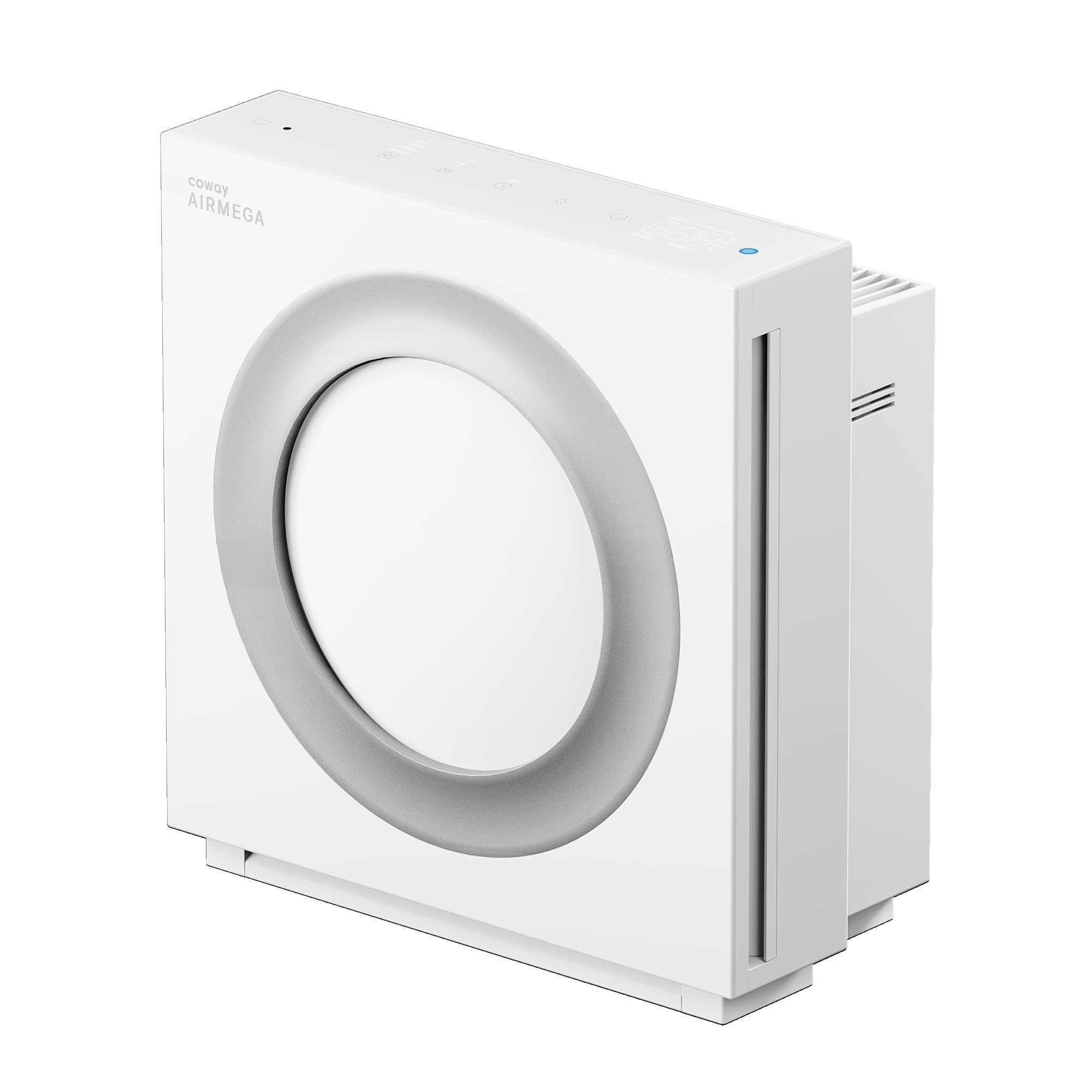
Coway engineered the Mighty2 as a direct upgrade to the Wirecutter-favorite AP-1512HH, and the improvements matter for basements. The Megascan laser sensor detects particles down to PM1.0 and displays real-time numeric readings — not just color bars. In a basement, where you might not visually detect odor sources, this data helps you track exactly when air quality degrades.
The IEST-certified HEPA and Active Carbon Max2 filter captures 99.97% of 0.3-micron particles while reducing VOCs and fumes like NH3 and CH3CHO. The Eco Mode automatically switches to energy-saving operation (max 56W) when air is clean, and the built-in light sensor triggers a whisper-quiet 19 dB sleep mode. The top-mounted air outlet prevents drafts, which is welcome in a cooler basement.
Filter maintenance is unusually transparent: the digital display shows exact remaining lifespan (100% to 0%) for both the pre-filter and the Max2 filter. The pre-filter slides out without opening the front cover, making monthly cleaning effortless. With a 3-year warranty and replacement filters lasting about a year, the long-term ownership cost is low for a unit this capable.
Why it’s great
- Real-time PM1.0, PM2.5, and PM10 readings
- Slide-out washable pre-filter for quick maintenance
- Three-year warranty for peace of mind
- Lowest sleep mode noise at 19 dB
Good to know
- No app control available; touch panel only
- Auto mode cannot set medium speed as default
3. PuroAir 400 HEPA Air Purifier
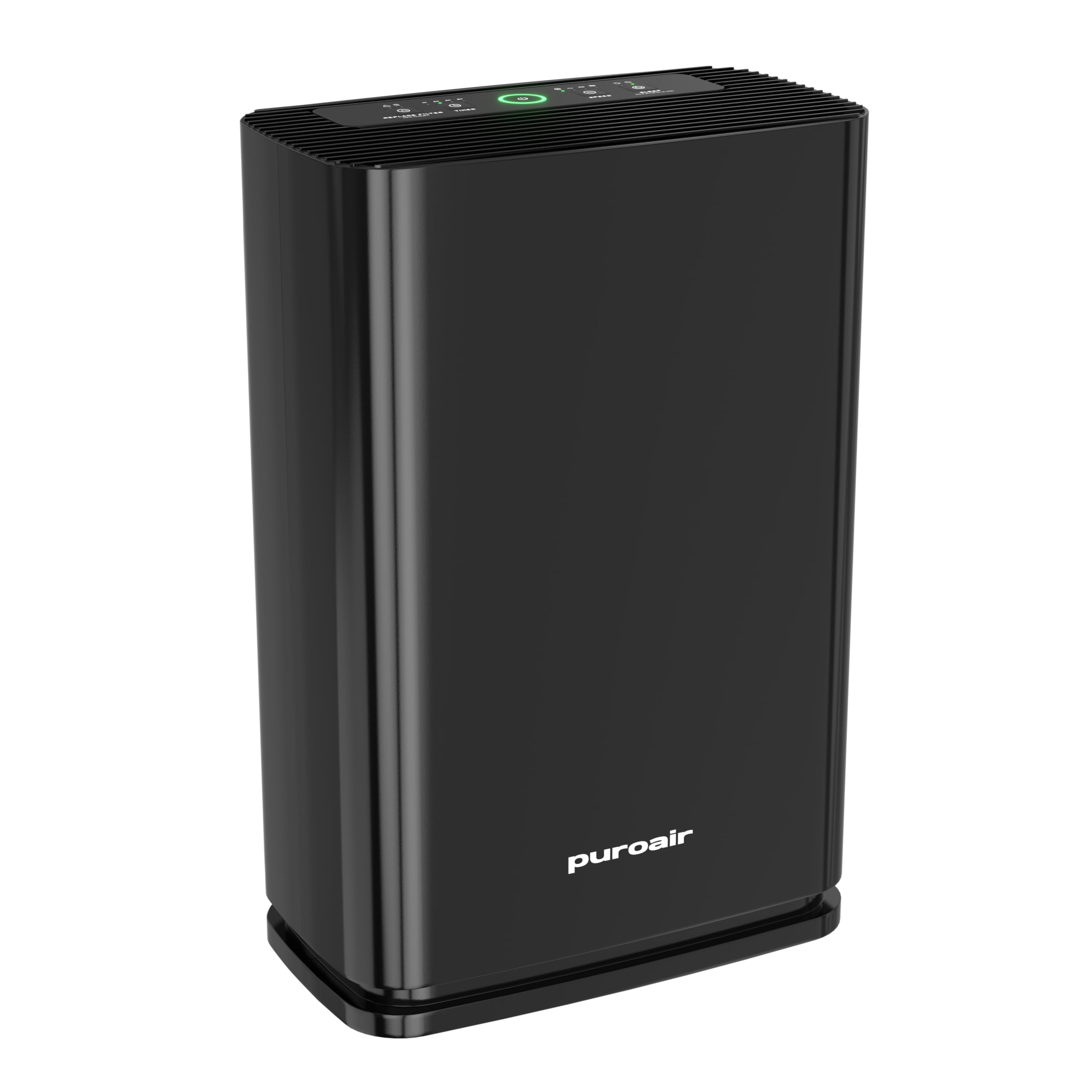
PuroAir packs a three-layer filtration system — pre-filter, HEPA, and activated carbon — into a compact 17.5 x 10.6-inch footprint that fits easily on a basement shelf or utility table. Independent testing in an ISO 17025 certified lab confirms it filters particles 700 times smaller than a human hair, making it effective against mold spores and fine concrete dust common below grade.
The built-in smart particle sensor monitors air quality and ramps up fan speed when pollutants spike. Users report that after setup, the unit reduced air quality from red to green within minutes in a bedroom-sized basement. The sleep mode operates quietly enough for 24/7 use, and the app lets you track filter life and adjust settings remotely.
PuroAir backs the unit with a 2-year risk-free warranty, and the replacement filter cycle runs about 6 months for the carbon and 12 months for the HEPA. The only recurring complaint is that aftermarket filters shorten performance to under 3 months, so sticking with genuine PuroAir filters is essential for maintaining the certified performance.
Why it’s great
- ISO 17025 lab-tested filtration performance
- Compact footprint for tight spaces
- App control with filter life tracking
- 2-year risk-free warranty
Good to know
- Genuine replacement filters are more expensive than some competitors
- Aftermarket filters degrade performance quickly
4. AirDoctor AD3500
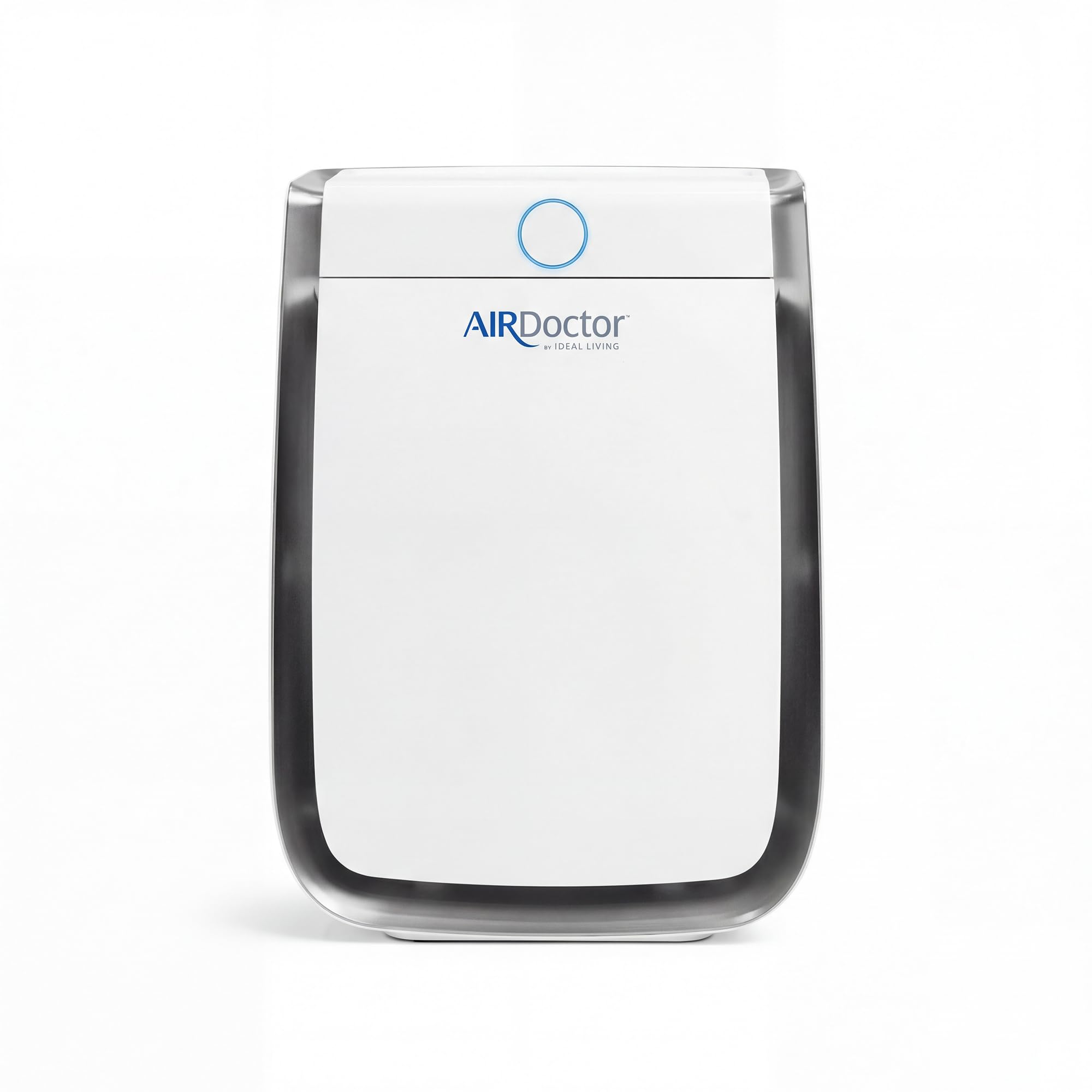
The AirDoctor AD3500 uses a three-stage system with a premium activated carbon filter and an UltraHEPA filter that captures 99.99% of particles as small as 0.003 microns — 100 times smaller than the standard HEPA threshold. For a basement with mold, bacteria, or virus concerns, this level of filtration offers real clinical-grade protection. The unit covers 2,520 sq ft in one hour, making it one of the fastest cyclers for large below-ground spaces.
The Halo PM2.5 sensor provides color-coded air quality feedback, and Auto Mode adjusts fan speed and engages Boost when it detects a spike. Users report that the AD3500 removes about 90% of cooking smells and responds to dishwasher steam and nebulizer treatments within seconds. The carbon filter uses activated carbon and potassium permanganate to absorb and chemically break down gases, which is particularly effective against musty basement VOCs.
Filter life is reasonable — replace the carbon every 6 months and the UltraHEPA every 12 months — and the unit is FSA and HSA eligible. The main drawback is the upfront cost, but for homeowners with severe basement allergies, mold sensitivity, or medical conditions like COPD, the AD3500’s particle capture performance justifies the premium.
Why it’s great
- UltraHEPA captures particles at 0.003 microns
- Potassium permanganate carbon filter for gas absorption
- FSA and HSA eligible
- Rapid 2,520 sq ft coverage
Good to know
- High upfront investment
- Genuine filter replacements are necessary for performance
5. Austin Air HealthMate Plus B450

The Austin Air HealthMate Plus is the heavy artillery for basement odor problems. Its four-stage filtration system includes 15 pounds of activated carbon and zeolite — a massive bed that adsorbs VOCs, smoke, cooking fumes, and musty smells far more effectively than the thin carbon sheets found in most consumer purifiers. This unit is built specifically for situations where neighbor smoke seeps through basement walls or strong chemical odors persist.
The 1,500 sq ft coverage is conservative for a machine this capable; users report effectively cleaning 1,200 sq ft on the medium setting and eliminating 90% or more of incoming smoke. The steel body and 47-pound weight mean it stays put and the durable motor is designed for continuous operation. Replacement filters last up to five years, which dramatically lowers the annual cost compared to units requiring quarterly swaps.
On the lowest setting the unit is nearly silent, but on high it produces a noticeable fan flutter and noise comparable to a light vacuum. For a basement workshop or utility room where sound isn’t critical, this is a minor trade-off. The potassium iodide-impregnated carbon (HealthMate Plus version) also handles formaldehyde better than standard carbon, making it a strong option for newer basements with off-gassing from construction materials.
Why it’s great
- 15 lbs activated carbon/zeolite for serious odor removal
- Five-year filter life minimizes maintenance
- Steel construction for durability
- Handles neighbor smoke seepage effectively
Good to know
- High setting is loud; not suitable for quiet spaces
- Replacement filters are expensive upfront (~+)
6. Dyson Purifier Big+Quiet BP03

The Dyson BP03 is engineered for large, open basement spaces with high ceilings. Its unique cone aerodynamics project purified air more than 32 feet, creating continuous room-wide circulation that prevents stagnant corners. The HEPA H13 grade filter is 3.8 times larger than the previous generation and lasts up to five years, which is a substantial long-term savings on replacement media.
What truly distinguishes the BP03 is its formaldehyde detection and destruction capability. The catalytic filter continuously breaks down formaldehyde molecules without needing replacement, addressing a specific concern in basements with new drywall, paint, or pressed-wood shelving. The MyDyson app provides real-time data on PM2.5, PM10, NOx, VOCs, humidity, and formaldehyde levels, giving you a complete air-quality dashboard.
Breeze Mode recreates a natural airflow sensation, which is a welcome feature in windowless basements that lack any feeling of air movement. The magnetic remote attaches to the top of the unit, and the built-in wheels make it easy to reposition. At maximum speed the BP03 moves more air than most competitors while remaining quieter, according to direct comparisons, making it the clear choice for homeowners who want both data-driven purification and furniture-grade design.
Why it’s great
- Catalytic formaldehyde destruction without replacement
- 32-foot air projection for large spaces
- Five-year HEPA filter life
- Comprehensive air quality monitoring
Good to know
- Highest upfront cost in this guide
- Carbon filter replacement every two years adds
7. BlueDri Air Shield 550

The BlueDri Air Shield 550 is not a consumer appliance — it is a commercial-grade air scrubber built for water damage restoration, construction sites, and heavy renovation work. If your basement is unfinished, undergoing remodeling, or frequently used for woodworking, this unit will outperform any residential purifier. It delivers at least 40% more CFM than leading competitors in its class, cycling through dust clouds from drywall sanding or concrete cutting in minutes.
The three-stage system uses a large-particle pre-filter followed by a true HEPA filter that captures 99.97% of particles down to 0.3 microns. An optional carbon filter (sold separately) can be added for odor control in restoration scenarios. The daisy-chain capability lets you connect multiple units to a single control, covering a large basement renovation zone without needing separate power management.
At 39 pounds with a rugged single-piece housing, the Air Shield 550 is built to survive job-site conditions. Users report vacuuming the HEPA filter for reuse, and standard-size replacement filters are widely available. For homeowners who want one machine that can handle both renovation dust and everyday basement air quality without breaking down, this is the only truly industrial option on this list.
Why it’s great
- Commercial CFM outperforms residential units 2:1
- Daisy-chain capable for large spaces
- HEPA filter can be vacuumed for extended use
- Built for construction and restoration environments
Good to know
- Loud at all speeds; not for living spaces
- Carbon filter for odors is sold separately
8. BLUEAIR Blue 211+ Signature
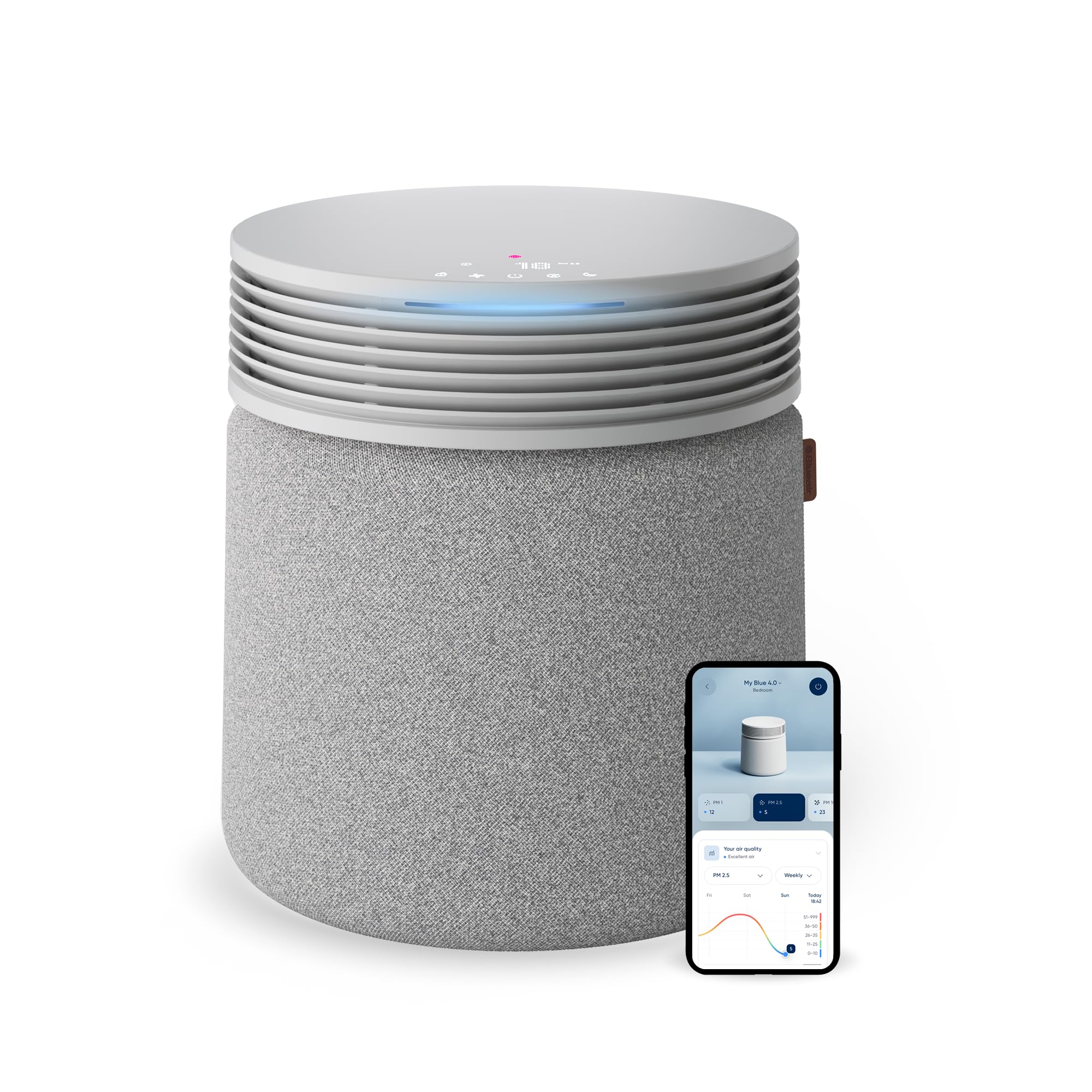
The BLUEAIR Blue 211+ Signature solves a specific problem: how to put a powerful purifier in a finished basement without it looking like industrial equipment. Its furniture-grade design doubles as a side table, blending seamlessly into a basement media room or guest suite. Despite the discreet appearance, it cleans up to 3,385 sq ft in one hour, making it one of the highest-coverage units for its physical size.
BLUEAIR’s proprietary HEPASilent technology combines electrostatic and mechanical filtration to capture dust, pollen, pet dander, and smoke while maintaining very low noise levels. Even on higher fan speeds the unit remains conversation-friendly, and on low it is nearly imperceptible. The smart sensors automatically adjust airflow based on real-time air quality, and the Blueair app lets you monitor and control the unit remotely.
Filter replacements are the main long-term cost — genuine Blueair filters are more expensive than some competitors, and the app can occasionally be slow to respond. However, the combination of whisper-quiet operation, wide coverage, and a design that doesn’t demand attention makes the Blue 211+ the top choice for homeowners who want effective purification without visual compromise in a finished basement.
Why it’s great
- Furniture-style design fits finished basements
- Very quiet even on higher fan speeds
- Covers 3,385 sq ft in one hour
- Smart app control with real-time monitoring
Good to know
- Replacement filters are expensive
- App can be slow or unreliable
9. SIESEAN AP-400 Air Purifier
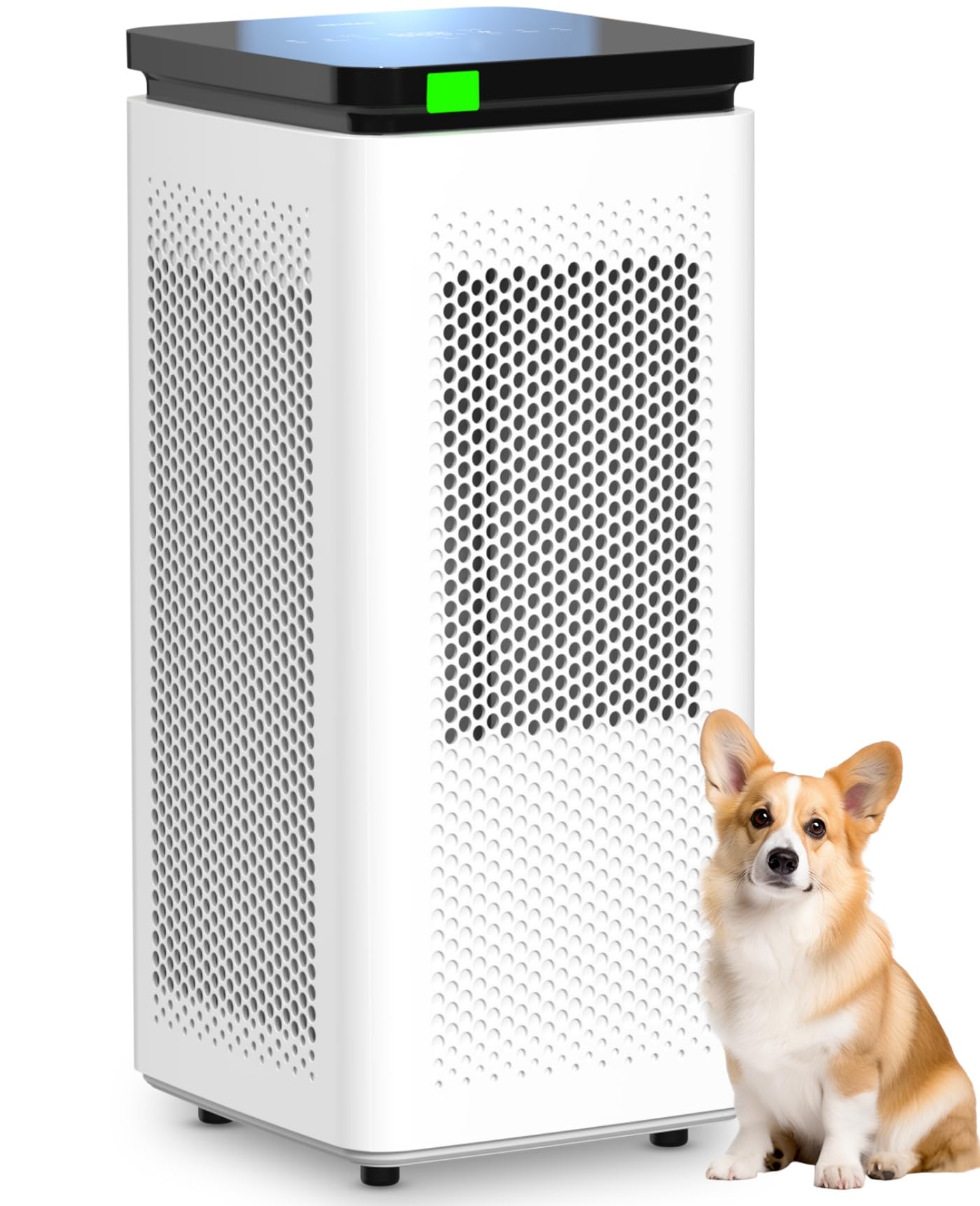
The SIESEAN AP-400 is the surprise entry that delivers genuinely impressive specs at a budget-friendly price point. Its dual-sided intake pulls air through four filters — two H13 True HEPA and two activated carbon beds — producing a 235 CFM CADR that competes with purifiers costing twice as much. Users report it dropping PM2.5 levels to 13 in minutes, describing it as “clinical-grade” performance for a fraction of the expected cost.
The unit covers up to 3,500 sq ft with its dual-inlet airflow design, cleaning a 500 sq ft room in 15 minutes. Sleep Mode drops to 30 dB with a dimmable display, making it suitable for a basement bedroom. The built-in PM2.5 display and Auto Mode provide real-time feedback without requiring a phone app, which is a plus for users who prefer a standalone device.
Filter replacement is straightforward, with a reminder indicator and a recommended 3-4 month cycle under heavy use. The floor-standing design with child lock and timer adds safety for households with kids or pets. For homeowners on a tight budget who refuse to compromise on CADR or filtration redundancy, the AP-400 is the clear value winner — it simply moves more air than anything else in its bracket.
Why it’s great
- Four-filter design (dual HEPA + dual carbon)
- 235 CFM CADR at an entry-level price
- 30 dB sleep mode with dimmable lights
- Floor-standing design with child lock
Good to know
- Filter replacement every 3-4 months under heavy use
- No smart app connectivity
FAQ
Can one air purifier handle an entire unfinished basement?
Do I need a separate dehumidifier alongside a basement air purifier?
How often should I replace filters in a basement air purifier?
Is an air purifier effective against radon?
What does the blue light on my air purifier mean?
Final Thoughts: The Verdict
For most users, the best air purifier for basement winner is the Winix 5510 because it balances smart features, ultra-quiet sleep mode, and low replacement filter costs with a washable pre-filter that handles basement dust without clogging. If you need clinical-grade particle capture for allergies or mold sensitivity, grab the AirDoctor AD3500. And for severe neighbor smoke or chemical odors, nothing beats the Austin Air HealthMate Plus with its 15 pounds of activated carbon and zeolite.

Mo Maruf
I created WellFizz to bridge the gap between vague wellness advice and actionable solutions. My mission is simple: to decode the research and give you practical tools you can actually use.
Beyond the data, I am a passionate traveler. I believe that stepping away from the screen to explore new environments is essential for mental clarity and physical vitality.