Our readers keep the lights on and my smoothie glass nicely filled. As an Amazon Associate, I earn from qualifying purchases.
Waking up congested, sneezing through the afternoon, or dealing with a scratchy throat that never seems to go away — these are the hallmarks of an indoor air quality problem that directly impacts asthma and allergy sufferers. The right air purifier acts as a sealed sentry, trapping the microscopic particulates that trigger your symptoms before they ever reach your lungs.
I’m Mohammad Maruf — the founder and writer behind WellFizz. For years I have analyzed air purification hardware, filter technologies, and independent test data to understand exactly which specs translate to real symptom relief for sensitive households.
This guide breaks down CADR ratings, filter media, and room coverage to help you find the absolute best air purifier for asthma and allergies based on your specific space and sensitivity level.
How To Choose The Best Air Purifier For Asthma And Allergies
Not all air purifiers are built to tackle the specific particulate sizes that trigger asthmatic reactions or allergic rhinitis. You need a machine that moves enough air through a certified filter to make a measurable difference in your breathing.
CADR — The Real Performance Number
Clean Air Delivery Rate (CADR) tells you how many cubic feet of air per minute the purifier cleans of smoke, dust, and pollen. For asthma and allergy control, look for a CADR of at least 200 for the room size you intend to use it in. A higher CADR means faster particulate removal, which is critical during high-pollen seasons or when cooking smoke aggravates your airways.
True HEPA vs. HEPA-Type — Know the Difference
True HEPA filters capture 99.97% of particles at 0.3 microns — the hardest size to catch. HEPA-type or “HEPA-like” filters lack third-party verification and often let through more fine particulates. For asthma and allergies, always choose a unit that explicitly states True HEPA filtration on the box and preferably carries an AHAM Verifide seal.
Room Size Matching and ACH
Air Changes per Hour (ACH) measures how often the purifier cycles the entire room’s air. A unit rated for a 1,000 sq. ft. room running in a 200 sq. ft. bedroom will clean your air four to five times per hour. Always match the purifier’s maximum coverage to at least double the square footage of your target room for effective asthma and allergy relief.
Quick Comparison
On smaller screens, swipe sideways to see the full table.
| Model | Category | Best For | Key Spec | Amazon |
|---|---|---|---|---|
| Coway Airmega 250 | Premium | Whole-home coverage | 1,860 sq. ft. | Amazon |
| LG PuriCare 360 | Premium | 360-degree filtration | 2,059 sq. ft. | Amazon |
| Nuwave OxyPure ZERO | Premium | Zero filter waste | 2,002 sq. ft. | Amazon |
| AirDoctor AD3500 | Premium | Ultra-fine particle capture | 0.003 microns | Amazon |
| WINIX 5510 | Mid-Range | Smart control & app | 1,881 sq. ft. | Amazon |
| LEVOIT Vital 100 | Mid-Range | Compact & quiet | 788 sq. ft. | Amazon |
| Clorox Turbo | Mid-Range | Quick smoke removal | 1,000 sq. ft. | Amazon |
| LEVOIT Core 300-P | Budget | Entry-level value | 1,073 sq. ft. | Amazon |
| GermGuardian AC4825E | Budget | Proven track record | 743 sq. ft. | Amazon |
In-Depth Reviews
1. Coway Airmega 250

The Coway Airmega 250 sits at the top of this list because its HyperCaptive filtration system — combining a washable pre-filter, activated carbon, and a True HEPA filter — achieves 99.97% efficiency at 0.3 microns while covering up to 1,860 square feet. That means a single unit can handle an entire open-plan apartment or a large living room with ease, pulling in air from every direction through its dual-intake design.
The Smart Mode continuously monitors air quality and adjusts the fan speed automatically, which is ideal for households where allergen levels fluctuate throughout the day. Users have reported that the Airmega 250 cleared smoky air from cooking and even wildfire haze within an hour, and families with dogs noted a measurable drop in allergic reactions after running it continuously for a week.
On the quieter end, the unit runs almost silently on its lowest setting, and the auto sensor kicks in only when it detects a spike in particulates. The washable pre-filter reduces long-term costs, and the single large HEPA filter costs about per year to replace — far less than many competitors.
Why it’s great
- Exceptional 1,860 sq. ft. coverage for whole-home use
- Smart Mode auto-adjusts to real-time air quality changes
- Washable pre-filter lowers ownership cost significantly
Good to know
- No WiFi or app control for remote monitoring
- Dimensions are larger — check cabinet clearance at 19.7 inches tall
2. LG PuriCare 360
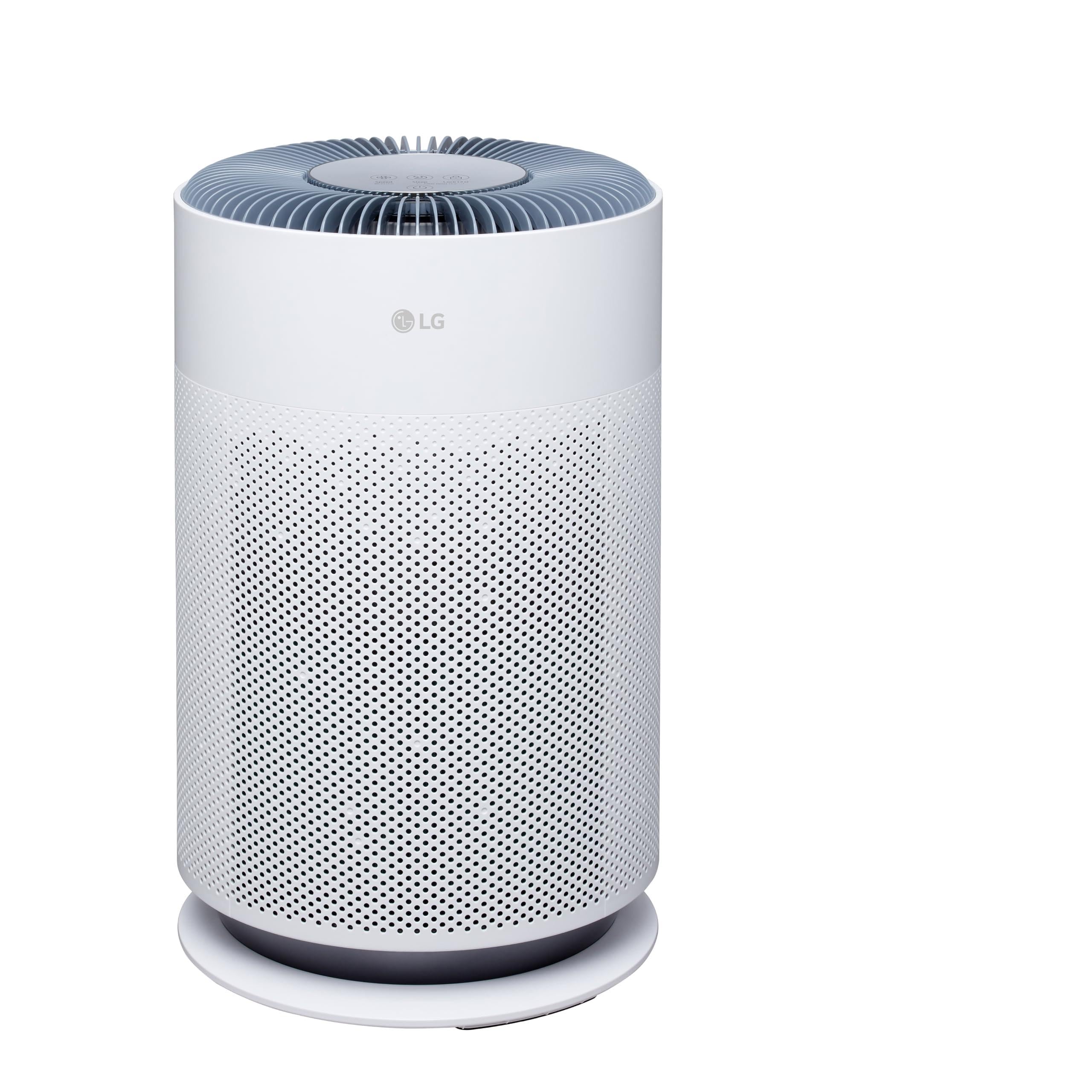
LG’s PuriCare 360 uses a cylindrical NanoFiber True HEPA filter that draws air from all 360 degrees, maximizing air intake without creating a draft. The PM 1.0 sensor detects particles as small as one micron, offering a level of sensitivity that matters when you’re trying to catch asthma triggers like cooking smoke or fine dust that would otherwise bypass standard sensors.
The three-stage filtration — a pre-filter for large debris, the NanoFiber HEPA for 99.97% particle capture at 0.3 microns, and an activated carbon layer for odors — works in concert to keep the air fresh. Users have noted that the unit is whisper-quiet, becoming inaudible beyond one foot, and the turbo mode can eliminate the smell of cigarette smoke in under two minutes with a window open.
The LG ThinQ app provides remote control, filter life tracking, and a stealth mode that turns off all indicator lights for undisturbed sleep. With coverage up to 2,059 square feet, it’s one of the largest single-unit solutions available, making it a strong option for open-concept homes where asthma triggers can travel freely.
Why it’s great
- 360-degree air intake for even particulate capture
- PM 1.0 sensor detects finer particles than typical sensors
- Whisper-quiet operation on low and auto modes
Good to know
- Turbo mode is noticeably loud for close-range use
- Replacement filters are specific to LG, limiting third-party options
3. Nuwave OxyPure ZERO

The OxyPure ZERO eliminates the recurring cost of filter replacements — its dual 4-stage system uses stainless-steel pre-filters, ozone removal filters, and two patented Bio-Guard filters that are all washable and reusable, designed to last up to 20 years. This is a game-changer for asthma and allergy sufferers who need continuous purification without budgeting for new HEPA filters every 6 to 12 months.
Independent Intertek lab testing shows the ZERO captures up to 100% of airborne particle pollutants as small as 0.1 microns, including smoke, dust, and pollen. Users have reported that the unit significantly reduced congestion from CPAP and BiPap machines, and severe allergy sufferers found immediate relief inside the home during high-pollen seasons.
The adjustable 30°, 60°, and 90° directional vents let you direct airflow exactly where you need it, whether that’s across a bed or into a kitchen corner. The night-time sleep mode drops noise to 21.41 dB, which is barely audible, and the WiFi-enabled app provides remote control for adjusting speeds or checking air quality from another room.
Why it’s great
- Washable filters eliminate ongoing replacement costs
- Intertek certified 100% capture at 0.1 microns
- Adjustable air vents for targeted purification
Good to know
- Must be manually reconnected to WiFi after power loss
- Weighs 22 pounds — not easily portable without its built-in wheels
4. AirDoctor AD3500
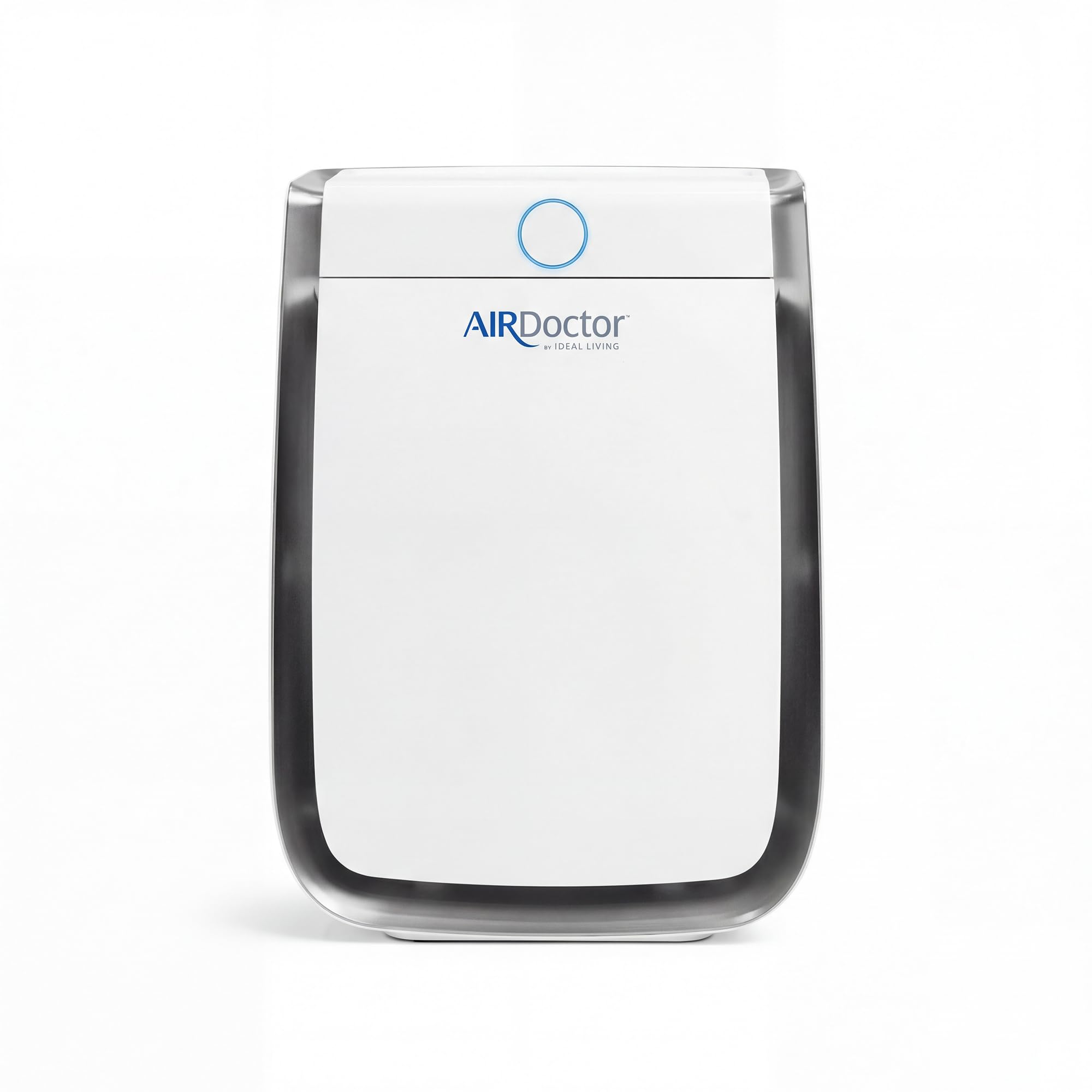
The AirDoctor AD3500 sets a benchmark with its UltraHEPA filtration, capturing 99.99% of airborne particles at 0.003 microns — that is 100 times smaller than the standard HEPA rating. For asthma and allergy sufferers, this means it traps the tiniest particulate matter, including bacteria and viruses, that can penetrate deep into lung tissue and trigger severe reactions.
The three-stage system pairs the UltraHEPA filter with a premium activated carbon and potassium permanganate layer, which is specifically formulated to break down volatile organic compounds, cooking fumes, and wildfire smoke. Users have noted that the AD3500 eliminated stuffiness overnight, and those living in wildfire zones found it essential for maintaining breathable air when outdoor conditions were hazardous.
Auto Mode uses PM2.5 sensors and a color-coded Halo display to adjust fan speed in real time, and the unit is quiet enough for uninterrupted sleep. Replacement filters are significant investments — about for the carbon and for the UltraHEPA annually — but the peace of mind for an asthma-prone household often justifies the premium.
Why it’s great
- UltraHEPA captures 99.99% of particles down to 0.003 microns
- Carbon and potassium permanganate filter handles VOCs and gas odors
- Large coverage cleans 2,520 sq. ft. in one hour
Good to know
- Replacement filters are expensive — two per year required
- Unit height is 27 inches, requiring ample floor or table space
5. WINIX 5510

The WINIX 5510 is the new-generation version of the popular 5500-2 model, now with app support integrated for remote control via Amazon Alexa, Google Assistant, or the Winix Smart App. Its True HEPA filter captures 99.99% of airborne allergens as small as 0.01 microns, making it highly effective against pollen, pet dander, and dust mite debris — all common asthma triggers.
The advanced odor control carbon filter is designed to reduce VOCs from cooking, pets, and smoke, while the washable fine mesh pre-filter extends the life of the main HEPA filter. Users have noted that the auto mode responds quickly to changes in room particulates, shifting fan speed based on the built-in air quality sensor, and the sleep mode automatically activates when the room darkens.
At a noise level of 23.5 dB on its slowest speed, the 5510 is nearly silent, and the air quality indicator uses a simple blue/orange/red LED system to show real-time conditions. With coverage up to 1,881 square feet, it easily handles large living areas while maintaining a compact footprint.
Why it’s great
- App, Alexa, and Google Assistant control for convenience
- 99.99% capture rate for particles down to 0.01 microns
- Washable pre-filter reduces maintenance costs
Good to know
- PlasmaWave ionization can be turned off but defaults to on
- Airflow feels lower than older 5500-2 at equivalent speeds
6. LEVOIT Vital 100

The LEVOIT Vital 100 delivers AHAM Verifide performance in a compact 13.8 x 8 x 17.6-inch chassis that fits neatly into bedrooms, small offices, and nursery corners. With a CADR of 105 CFM, it can clean rooms up to 788 square feet once per hour, though for asthma control it is best suited to spaces under 300 square feet where it will achieve multiple air changes per hour.
The three-stage filtration includes a pre-filter for hair and large debris, a main filter for fine particulates, and a carbon layer for odors and VOCs. Users have reported noticeable dust reduction and fresher air after running the Vital 100 consistently, and the sleep mode drops noise to 24 dB — quiet enough not to disturb light sleepers.
Smart features include Wi-Fi connectivity with app control, a timer for 2, 4, or 8 hours, and a check filter indicator that removes guesswork. The downside is that the unit does not restart automatically after a power outage, so it requires manual re-engagement if you rely on automation.
Why it’s great
- Compact footprint fits tight bedroom and desk spaces
- Sleep mode at 24 dB is truly quiet for overnight use
- Wi-Fi connected with app control for remote scheduling
Good to know
- Does not restart after a power interruption
- Replacements filters must be Levoit brand for best performance
7. Clorox Turbo
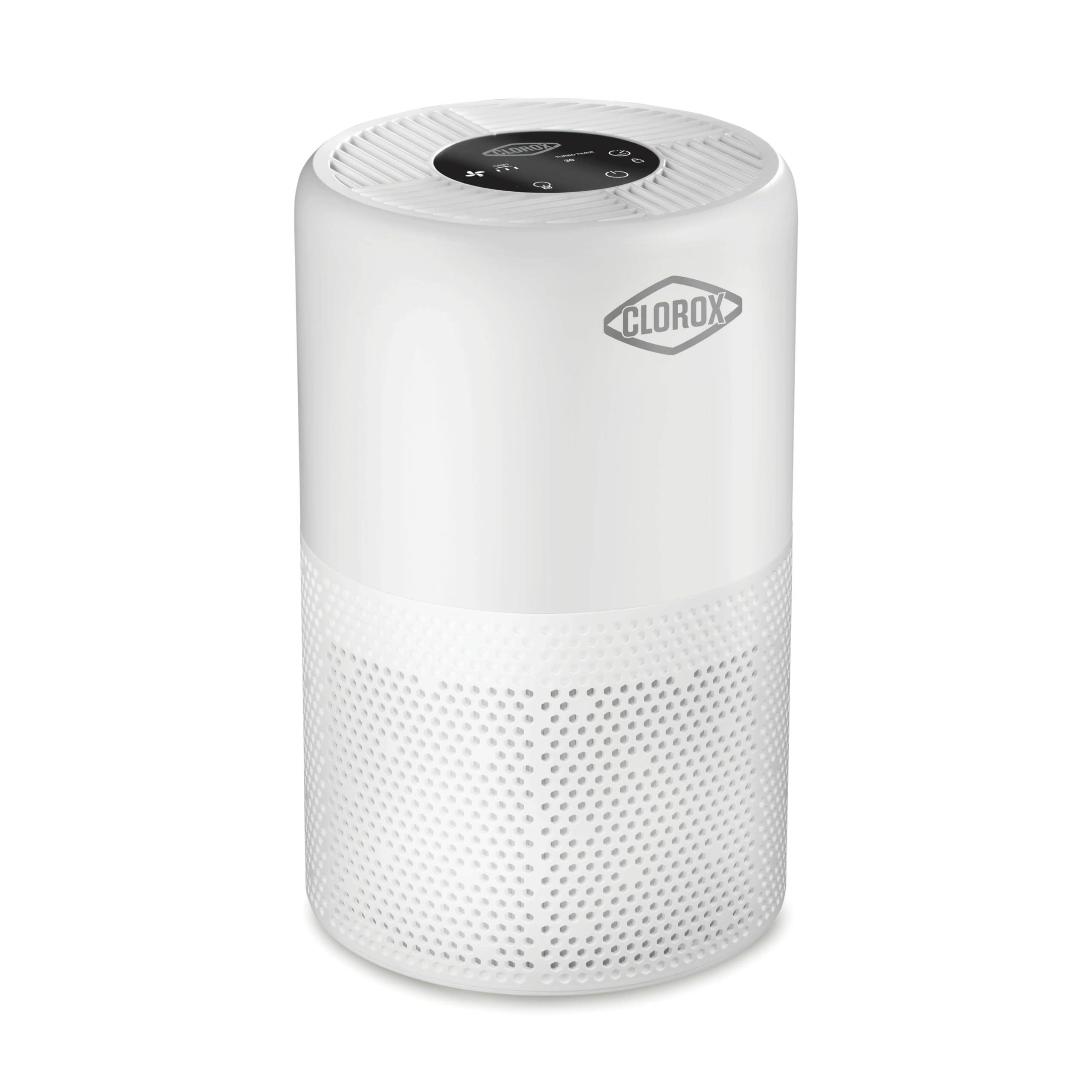
The Clorox Turbo brings the brand’s cleaning reputation into air purification with a True HEPA filter that captures 99.97% of airborne particles and a 360-degree intake design that pulls air from all sides. Its unique Turbo Timer can be set for 10, 20, or 30 minutes of maximum airflow, making it particularly effective for rapidly clearing smoke after cooking or when allergen levels spike in a medium-sized room.
The three-stage 360 filtration includes a pre-filter for large particles, the True HEPA layer for allergens, and an activated carbon filter for VOCs and odors. Users have reported that the unit eliminates burnt food smells and wildfire smoke quickly, and that allergies noticeably improve within days of use.
At only 5.2 pounds, the Clorox Turbo is unusually lightweight for its coverage class, and the four-speed fan system — low to turbo — gives you flexibility. The display brightness can be set to on, dim, or off, ensuring it doesn’t disturb sleep, and the compact cylindrical design fits easily into tight corners or on side tables.
Why it’s great
- Turbo Timer provides rapid particulate clearing for short bursts
- Lightweight 5.2-pound design is easy to move between rooms
- 360-degree intake improves air capture efficiency
Good to know
- Maximum coverage of 1,000 sq. ft. is at single ACH only
- Turbo speed is significantly louder than standard modes
8. LEVOIT Core 300-P

The LEVOIT Core 300-P is a budget-friendly entry point that does not compromise on certification — it is AHAM Verifide, FCC Certified, ETL Listed, and CARB Compliant. The 56W high-torque motor drives a 143 CFM CADR for smoke, 153 CFM for dust, and 167 CFM for pollen, which means it can refresh a 222-square-foot room 4.8 times per hour or a 1,073-square-foot room once per hour.
The 3-in-1 filter system uses a HEPA-grade main filter — while Levoit is careful to note it meets HEPA-grade filtration based on IEST RP C001.7 rather than the stricter HEPA standard, independent tests still show 99.97% filtration efficiency for 0.1 to 0.3 micron particles. Users have successfully used the Core 300-P to reduce dust, allergens, smoke, and pet dander, with multiple customers reporting reduced allergy symptoms and fresher-feeling air.
Sleep Mode drops noise to a near-silent 24 dB using QuietKEAP Technology, and the display lights can be fully turned off. The timer offers 2, 4, 6, or 8-hour intervals, and the unit accepts multiple filter variants — Toxin Absorber, Smoke Remover, or Pet Allergy — letting you tailor filtration to your specific asthma triggers.
Why it’s great
- AHAM Verifide certification for performance transparency
- QuietKEAP Sleep Mode at 24 dB is ideal for bedrooms
- Multiple specialized filter options for target allergens
Good to know
- Replacement filters are relatively expensive for the entry-level tier
- HEPA-grade, not certified True HEPA — subtle filtration gap
9. GermGuardian AC4825E

The GermGuardian AC4825E has been a consistent performer since 2011, building a reputation among asthmatic households for reducing symptoms and lowering dust accumulation. Its True HEPA filter captures 99.97% of allergens down to 0.1 microns, and the optional UV-C light provides an additional layer of airborne pathogen reduction — useful for families where respiratory illness is a concern alongside allergies.
The three-speed system includes a quiet sleep mode, and users have noted that on low speed the unit is nearly inaudible, making it suitable for overnight use. The washable pre-filter extends the life of the main HEPA, and the filter replacement indicator light takes the guesswork out of timing — most users report 6 to 8 months between HEPA changes.
Covering 743 square feet at one ACH or 153 square feet at four ACH, the AC4825E is best positioned for medium rooms. Users have commented that the high speed is notably loud, but the trade-off is rapid air turnover. The simple mechanical dial interface means no app, no WiFi, and no complex settings — just reliable filtration.
Why it’s great
- Proven long-term performance with consistent user satisfaction
- True HEPA certification at a accessible price point
- Optional UV-C light adds pathogen reduction capability
Good to know
- Highest speed is loud — not ideal for close-range use
- Lacks smart features like apps or air quality sensors
FAQ
Is a True HEPA filter necessary for asthma and allergies?
What CADR rating should I look for in a bedroom air purifier?
How often should I replace the filter for allergy control?
Can an air purifier help with pet dander asthma?
Should I worry about ozone emissions from air purifiers?
Final Thoughts: The Verdict
For most users, the best air purifier for asthma and allergies overall is the Coway Airmega 250 because it combines exceptional 1,860-square-foot coverage, a washable pre-filter, and True HEPA certification into a reliable package that requires minimal maintenance and runs nearly silently on auto mode. If you want zero filter replacement costs and directable airflow, grab the Nuwave OxyPure ZERO. And for the largest homes or those needing the most thorough particle capture down to 0.003 microns, nothing beats the AirDoctor AD3500.

Mo Maruf
I created WellFizz to bridge the gap between vague wellness advice and actionable solutions. My mission is simple: to decode the research and give you practical tools you can actually use.
Beyond the data, I am a passionate traveler. I believe that stepping away from the screen to explore new environments is essential for mental clarity and physical vitality.