Our readers keep the lights on and my smoothie glass nicely filled. As an Amazon Associate, I earn from qualifying purchases.
A stiff neck can ruin the first day of any trip. Standard U-shaped pillows are bulky, and hotel pillows rarely offer the support you need in an upright seat. An inflatable design solves both problems: it packs down to nothing and lets you dial in the exact firmness your neck requires.
I’m Mohammad Maruf — the founder and writer behind WellFizz. I’ve spent years analyzing travel gear specifications, from valve durability to fabric coatings, to separate the real winners from the aisle-fillers.
Whether you are a frequent flyer or an occasional road-tripper, choosing the right air pillow for travel comes down to valve reliability, material feel, and how small the whole package actually folds.
How To Choose The Best Air Pillow For Travel
Not all inflatable pillows are created equal. The difference between a restful flight and a restless one often comes down to three critical factors: the bladder material, the valve mechanism, and the overall shape.
Bladder Material: PVC vs. TPU
The inner bladder determines how long the pillow holds air. Standard PVC is common on entry-level models; it is affordable and rigid but can develop micro-cracks over time. TPU (thermoplastic polyurethane) is thinner, more flexible, and far more resistant to punctures. For anyone who travels more than twice a year, a TPU bladder is worth the small premium.
Valve Design: Flat vs. Click-Valve
A flat valve requires pinching to release air and can be frustrating to operate one-handed. A click-valve or button-valve allows instant deflation and a secure seal when closed. The best valves also let you micro-adjust firmness without losing air, so you can find that sweet spot between a rock-solid neck brace and a floppy rag.
Shape and Support Profile
Some pillows wrap around the neck for lateral support, while others are flat rectangles meant for the tray table or lumbar region. The right shape depends on your sleeping position. Side sleepers usually prefer a wrap-around design, while forward leaners do better with a compact rectangular pillow that fills the gap between the chest and the tray table.
Quick Comparison
On smaller screens, swipe sideways to see the full table.
| Model | Category | Best For | Key Spec | Amazon |
|---|---|---|---|---|
| Trekology Aluft 2.0 | Camping / Travel | Backpackers & side sleepers | TPU bladder, 3.9 oz, anti-slip dots | Amazon |
| Trekology Inflatable Neck Pillow | Neck Support | Long-haul flights | Machine-washable cover, 3.5 oz | Amazon |
| Skyrest Inflatable Travel Pillow | Economy-Friendly | Tray table & forward leaning | PVC bladder, face hole, eye mask included | Amazon |
| Povinmos Inflatable Travel Pillow | Multipurpose | Neck, head & lumbar support | PVC flocking, large air valve, 3D eye mask | Amazon |
| UWILLION Inflatable Camping Pillow | Outdoor / Camping | Backpacking & car camping | TPU bladder, curved shape, strap | Amazon |
In‑Depth Reviews
1. Trekology Aluft 2.0 Ultralight Inflatable Camping Travel Pillow

The Trekology Aluft 2.0 sets the standard for what an inflatable travel pillow should be. Its TPU bladder is noticeably more durable than standard PVC and resists micro-cracks even after dozens of trips. The entire pillow folds down to the size of a soda can and weighs only 3.9 ounces, making it the best option for backpackers and minimalist travelers.
What truly sets it apart is the anti-slip dot pattern on the back and the included latch strap. These features keep the pillow anchored to a sleeping pad or seat, so you are not constantly chasing it around in the middle of the night. The click-button valve allows precise firmness adjustment and rapid deflation.
The 16 x 12 x 4 inch inflated size provides generous coverage for side sleepers and back sleepers alike. While it is more camping-oriented than airplane-specific, its versatility as a lumbar or leg spacer pillow makes it a worthwhile companion for any trip.
Why it’s great
- TPU bladder resists leaks far better than PVC
- Anti-slip base and strap keep pillow in place
- Packs smaller than any comparable model
Good to know
- Not designed for wrap-around neck support
- Valve has a slight learning curve for first-time users
2. TREKOLOGY Inflatable Neck Pillow For Traveling

This model from Trekology focuses on the classic neck-wrap shape but adds two important upgrades: a removable machine-washable cover and a featherlight weight of just 3.5 ounces. The polyester cover removes the plastic feel that many inflatable pillows suffer from, making it more comfortable for direct skin contact during long flights.
The click-valve system allows one-handed inflation and micro-adjustments, a feature that most budget models lack. Users report that the pillow holds air reliably for 17-hour flights without needing a top-up. The ergonomic curve cradles the cervical spine better than flat inflatable pillows, which helps prevent that stiff, sore feeling after landing.
One minor trade-off is the fabric feel on one side of the pillow, which some users describe as slightly scratchier than the other. The snap closure is sufficient but not as secure as a buckle. Still, for frequent fliers who prioritize comfort and hygiene, this is a strong contender.
Why it’s great
- Removable cover is machine-washable for easy cleaning
- Click-valve offers precise firmness control
- Ultralight design packs to roughly the size of a coffee cup
Good to know
- Fabric can feel scratchy on the non-washable side
- Single snap closure may loosen with heavy movement
3. Skyrest Inflatable Travel Pillow

The Skyrest pillow takes a different approach with a hole in the middle of the face panel. This design allows you to rest your head forward on the tray table without suffocating, and it also works well for window-side leaning. The PVC bladder is standard but reinforced at the seams to reduce the risk of leaks.
Inflation takes only a few breaths, and deflation is equally fast. The whole unit rolls up into a small drawstring bag that clips onto a backpack or carry-on. At 12 ounces, it is noticeably heavier than TPU-based pillows, but the extra weight comes from the thicker material that feels more substantial in hand.
The included eye mask and earplugs add real value for travelers who want a complete sleep kit. Some users note that the pillow sits a bit short for lap use, but it excels on the tray table. The forehead may feel a slight pressure mark after extended use, but that is typical for any front-leaning pillow design.
Why it’s great
- Face hole allows comfortable tray table napping
- Includes eye mask, earplugs, and carry bag
- Reinforced PVC seams improve durability
Good to know
- Heavier than TPU competitors at 12 ounces
- May leave temporary marks on forehead with prolonged use
4. Povinmos Inflatable Travel Pillow

The Povinmos pillow uses a PVC flocking material that gives the surface a soft, velvet-like feel instead of the typical plastic texture. This makes a noticeable difference when pressing your face against it for extended periods. The large air valve simplifies both inflation and deflation, which is a welcome change from fiddly mini-valves.
It is designed as a multifunctional support pillow—usable around the neck, behind the head, or under the lower back. The ergonomic shape aims to keep the cervical spine aligned, which can reduce shoulder tension during long flights. It also comes with a 3D eye mask and earplugs as part of the package.
A few buyers mention that the pillow feels slightly too tall for shorter users, especially those under 5 feet 7 inches. The flocking material also attracts dust and hair, so keeping a lint roller handy is advisable. For travelers who want a soft-touch inflatable with multiple use positions, this is a solid choice.
Why it’s great
- Flocking material feels soft and less plasticky
- Large air valve for quick inflation and deflation
- Works for neck, head, and lumbar support
Good to know
- Flocking attracts hair, dust, and lint
- May feel too tall for shorter individuals
5. UWILLION Inflatable Camping Pillow
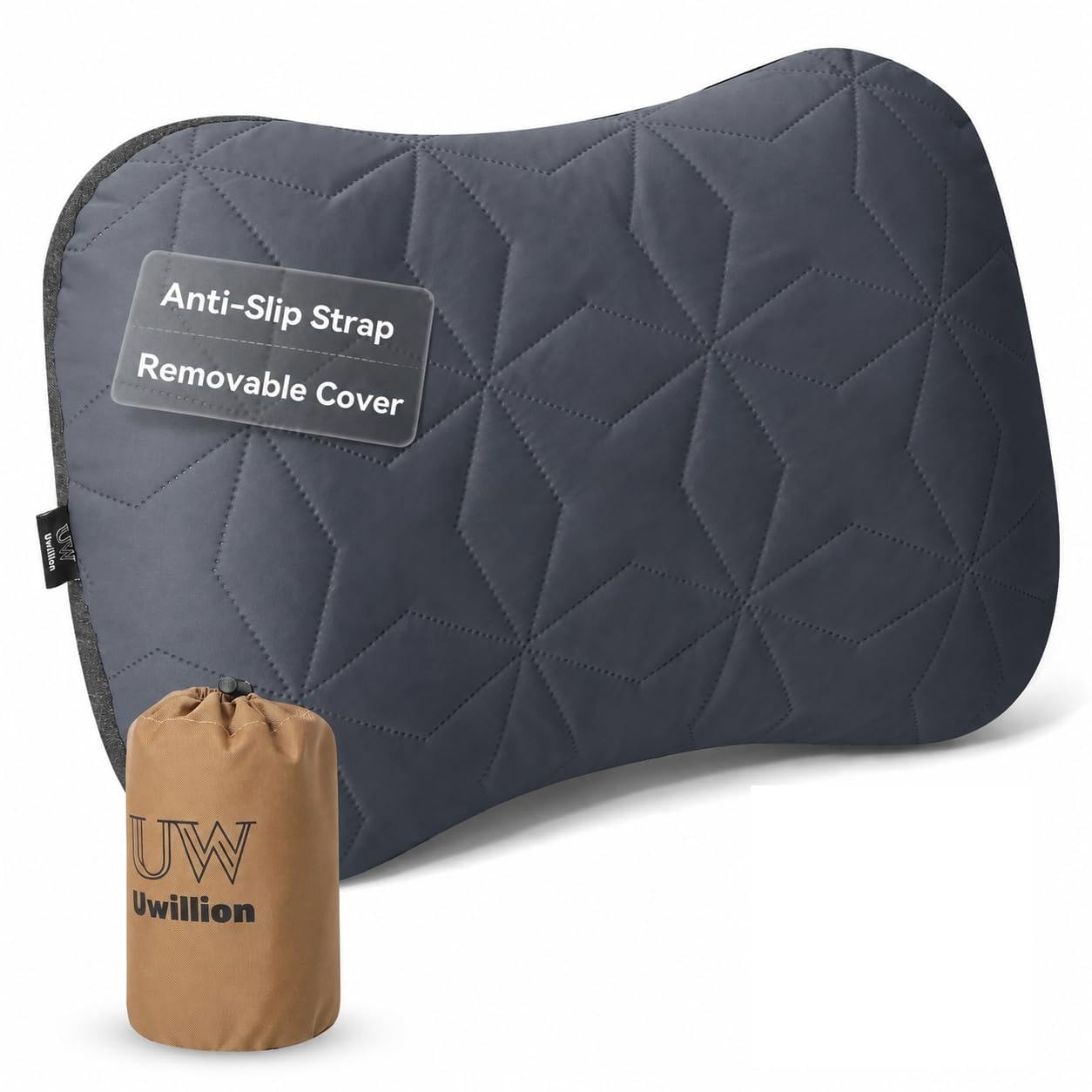
The UWILLION pillow uses a thickened leak-resistant TPU bladder paired with a soft cotton-polyester cover. This combination minimizes the crinkly noise that plagues many air pillows, making it a quiet option for shared sleeping spaces like tents or train compartments. The curved shape provides good neck and head support while also working as a lumbar or knee cushion.
Inflation takes about 5 to 8 breaths, and the fast-deflate valve releases air in seconds. A secure strap helps attach the pillow to a sleeping pad or cot, reducing the midnight shift that can interrupt sleep. Users report that it holds air all night without needing a re-inflation, which is a key reliability marker for camping use.
Some users note that the pillow can slide around slightly on smooth surfaces despite the strap, and it leans toward the firmer side when fully inflated. However, for those who need a compact, quiet, and versatile pillow for both travel and outdoor use, the UWILLION delivers strong performance in a small package.
Why it’s great
- TPU bladder is quiet and leak-resistant
- Soft cotton-polyester cover is removable and washable
- Versatile shape works for head, lumbar, or knee support
Good to know
- May slide slightly on smooth sleeping pads
- Firmer feel when fully inflated may not suit all sleepers
FAQ
How long does an inflatable travel pillow hold air through the night?
Can I use an inflatable pillow as a lumbar support on an airplane?
Final Thoughts: The Verdict
For most users, the air pillow for travel winner is the Trekology Aluft 2.0 because it combines a durable TPU bladder, an anti-slip base, and the smallest pack size in this test. If you want a machine-washable cover for long-haul flights, grab the TREKOLOGY Inflatable Neck Pillow. And for tray table sleepers who need a face hole, nothing beats the Skyrest Inflatable Travel Pillow.

Mo Maruf
I created WellFizz to bridge the gap between vague wellness advice and actionable solutions. My mission is simple: to decode the research and give you practical tools you can actually use.
Beyond the data, I am a passionate traveler. I believe that stepping away from the screen to explore new environments is essential for mental clarity and physical vitality.