Our readers keep the lights on and my smoothie glass nicely filled. As an Amazon Associate, I earn from qualifying purchases.
That faint hiss you can’t quite place, or the slow decline in your car’s AC performance, isn’t just annoying—it’s costing you money and potentially putting your safety at risk. Finding the source of an air, gas, or refrigerant leak can feel like searching for a needle in a haystack without the right tool.
I’m Mohammad Maruf — the founder and writer behind WellFizz. For over a decade, my process has involved deep-dive market analysis, dissecting technical specifications, and cross-referencing thousands of user experiences to identify which tools deliver real-world results versus marketing hype.
This guide breaks down the critical differences between simple bubble solutions, sensitive electronic sniffers, and powerful smoke machines, empowering you to make a confident choice. best air leak detector choice for your specific task, whether it’s a home gas line or an automotive AC system.
How To Choose The Best Air Leak Detector
Selecting the right tool isn’t about finding the most expensive option; it’s about matching the technology to the leak you’re hunting. Using a refrigerant sniffer on a vacuum leak will leave you frustrated, just as using a bubble solution on a tiny, hard-to-reach fitting might not reveal anything at all.
Define Your Target Leak Type
This is the most critical step. Are you checking a natural gas line for your stove? Diagnosing a slow Freon leak in your car’s air conditioning? Or hunting for a vacuum leak in your engine’s intake? Liquid bubble detectors are excellent for pressurized gas and air lines at fittings. Electronic halogen sniffers are designed specifically for refrigerants. Combustible gas detectors target methane and propane. Smoke machines are the ultimate tool for finding elusive vacuum or EVAP system leaks in engines.
Consider Sensitivity and Reach
For tiny, slow leaks—like a schrader valve losing refrigerant over a season—you need high sensitivity measured in ounces per year. A flexible probe or gooseneck is non-negotiable for reaching into cramped engine bays or behind appliances. For large, obvious leaks, a basic tool will suffice, but investing in adjustable sensitivity gives you the precision to pinpoint the exact source.
Evaluate Ease of Use and Maintenance
Some tools are truly “point and shoot,” with automatic calibration and clear visual/audible alarms. Others, like bubble solutions, require proper surface preparation and interpretation. Consider ongoing costs: electronic sensors have a finite lifespan and may need replacement, while smoke machines require fluid (like mineral oil). A tool that’s simple and reliable for your skill level will get used more often.
Quick Comparison
On smaller screens, swipe sideways to see the full table.
| Model | Type | Best For | Key Feature | Amazon |
|---|---|---|---|---|
| AUTOOL SDT101 | Smoke Machine | Automotive vacuum/EVAP leaks | Requires external air, includes regulator | Amazon |
| Klein Tools ET120 | Combustible Gas Sniffer | Professional gas line inspection | 18-inch flexible gooseneck, dual sensitivity | Amazon |
| TopTes Guard-101 | 4-Gas Monitor | Industrial/confined space safety | Monitors H2S, CO, LEL, O2 simultaneously | Amazon |
| Solary SD302 | Smoke Machine | DIY automotive leak detection | Built-in air pump, portable 12V operation | Amazon |
| WJL-6000PRO | Refrigerant Sniffer | AC leaks with UV dye verification | LCD screen, built-in UV & LED light | Amazon |
| TopTes PT199 | Combustible Gas Sniffer | Home gas appliance checks | Pocket-sized, visual & audio alarm | Amazon |
| Elitech WJL-6000S | Refrigerant Sniffer | Budget-friendly Freon detection | 7 adjustable sensitivity levels | Amazon |
| CRC Aerosol | Bubble Leak Detector | Low-pressure air & gas leaks | Aerosol spray, water-based, no residue | Amazon |
| Elitech CLD-100 | Refrigerant Sniffer | Entry-level AC leak checks | Flexible 8-inch probe, fast response | Amazon |
| Swagelok Snoop | Liquid Leak Detector | Precision gas fitting inspection | Non-toxic, dries clean, professional-grade | Amazon |
| RectorSeal Better Bubble | Liquid Leak Detector | General-purpose leak location | Biodegradable, wide temperature range | Amazon |
In‑Depth Reviews
1. AUTOOL Automotive Smoke Machine

The AUTOOL SDT101 represents a professional-tier approach to leak detection, specifically engineered for complex automotive systems. Unlike sniffers that rely on trace gases, this machine generates a thick, visible smoke that you introduce into a sealed system like an intake or EVAP line. Any leak, no matter how small, becomes immediately apparent as smoke pours out, visually pinpointing the exact location of the problem. This method is considered the gold standard for diagnosing elusive vacuum leaks, faulty gaskets, and cracked hoses that cause engine performance issues.
What sets this unit apart in its category is the inclusion of a built-in pressure regulator and flow meter. This allows you to carefully control the pressure of the smoke entering sensitive engine components, preventing potential damage from over-pressurization—a common concern with simpler smoke machines. The kit is remarkably comprehensive, coming with a wide array of cones and adapters designed to fit various vehicle service ports, intake openings, and even exhaust pipes (with an inflatable plug).
User feedback consistently highlights its effectiveness in solving problems that other methods couldn’t. Mechanics and advanced DIYers appreciate that it pays for itself in a single use by avoiding costly misdiagnoses and parts swapping. It requires an external air source (like a shop compressor) and fluid (mineral or baby oil), but this reliance on robust, external components contributes to its durability and powerful, consistent smoke output.
Why it’s great
- Visually unmistakable leak location; smoke pours directly from the source.
- Extremely versatile for EVAP, intake, vacuum, and exhaust system testing.
- Built-in regulator protects sensitive engine components from over-pressure.
- Comes with a professional array of adapters for nearly any vehicle.
Good to know
- Requires an external air compressor, which not all home users have.
- Needs separate smoke fluid (mineral/baby oil), not included.
- Has a learning curve; understanding system pressurization is key.
- More setup is involved compared to a simple point-and-detect tool.
2. Klein Tools ET120 Gas Leak Detector

When your safety and peace of mind depend on accurately finding a combustible gas leak, the Klein Tools ET120 brings trusted professional-grade reliability to the task. Built with the durability expected from the Klein brand, this detector is designed for repeated use in demanding environments. Its core strength lies in a wide detection range (50 to 10,000 ppm for methane) and a practical, 18-inch flexible gooseneck that lets you snake the sensor into tight spaces behind appliances, under furnaces, or along gas line fittings with ease.
The tool intelligently guides the user with a clear, escalating alarm system. As gas concentration increases, five LED lights illuminate in sequence and the 85dB audible beep quickens, providing immediate feedback on leak severity and helping you zero in on the source. The dual-sensitivity mode is a critical feature: a High setting for pinpointing tiny, hard-to-find leaks and a Low setting for assessing larger leaks without overwhelming the sensor. It performs an automatic zero-point calibration every time you power it on, ensuring accuracy from the start.
Reviews from plumbers, HVAC technicians, and concerned homeowners consistently praise its superior sensitivity compared to budget alternatives. Users report it detecting leaks they could smell but that cheaper tools missed. The over-molded body provides a secure grip, and the auto shut-off preserves battery life. This is the tool you reach for when you need definitive answers on natural gas or propane lines.
Why it’s great
- Professional-grade build quality and reliable, repeatable performance.
- Long, flexible gooseneck provides excellent access to confined areas.
- Escalating visual/audio alarm makes leak severity intuitively clear.
- Automatic calibration at startup ensures ready-to-use accuracy.
Good to know
- Positioned at a premium level, reflecting its professional features.
- Sensor life is finite (typical for all electronic sniffers).
- Best for combustible gases, not for refrigerant or vacuum leaks.
- Can be overly sensitive to residual gas when first checking a repaired fitting.
3. TopTes Guard-101 4-Gas Monitor

The TopTes Guard-101 operates in a different league altogether—it’s a personal safety monitor designed for hazardous environments. While it can detect combustible gases (LEL), its primary function is to continuously monitor atmospheric levels of oxygen (O2), carbon monoxide (CO), and hydrogen sulfide (H2S). This makes it indispensable for work in confined spaces like crawl spaces, basements, utility vaults, or industrial settings where multiple invisible hazards can be present simultaneously.
Its robust, waterproof, and explosion-proof housing is built for job site durability. The device offers triple-alarm protection through a loud audible alert, bright visual LEDs, and a strong vibration, ensuring the alarm is noticed even in loud or visually obstructed conditions. With a battery life of up to 14 hours on a charge, it’s designed for full-day monitoring. The data logging function allows you to review exposure history, which is crucial for safety compliance and understanding environmental conditions over time.
User testimonials often highlight its life-saving potential, with stories of detecting dangerous CO buildup or oxygen depletion that would have gone unnoticed. For the serious DIYer tackling projects in potentially hazardous areas, or for professionals needing a reliable multi-gas monitor, the Guard-101 provides a critical layer of safety that goes beyond simple leak detection.
Why it’s great
- Comprehensive protection from four critical atmospheric hazards at once.
- Vibration alarm is essential for noisy environments or when wearing hearing protection.
- Long battery life and durable, safety-rated construction for all-day use.
- Data storage function is valuable for safety records and incident review.
Good to know
- Overkill for simple, one-off gas line checks around the house.
- Sensors have a defined service life and require eventual replacement/calibration.
- Primary function is area monitoring, not necessarily pinpointing a tiny leak source.
- More complex to operate than a basic sniffer due to multiple gas readings.
4. Solary Automotive Smoke Machine

The Solary SD302 brings the power of smoke testing to DIYers and home mechanics with a brilliantly simple, self-contained design. Its key advantage is the integrated air pump, eliminating the need for an external air compressor. You simply connect it directly to a 12V car battery, add a small amount of baby oil or glycerin, and it generates a steady stream of diagnostic smoke in about 10 seconds. This plug-and-play portability makes it ideal for use anywhere, from a home garage to a driveway.
It excels at finding the same types of leaks as more advanced smoke machines—vacuum leaks in intake manifolds, cracks in EVAP system hoses, and leaks in low-pressure turbo systems. The thick smoke it produces makes even pinhole leaks visible, often revealing problems that spraying soapy water or using an electronic sniffer would miss. The included silicone hoses and adapters cover most common automotive applications, making it ready to use out of the box.
User reviews frequently mention how this tool solved long-standing, intermittent check engine lights related to EVAP codes. Its ease of use and immediate, visual results are highly praised. For anyone tired of guessing which hose or gasket is causing an engine performance issue, the Solary offers a straightforward and highly effective diagnostic method at an accessible point.
Why it’s great
- Fully self-contained; no separate air compressor needed.
- Extremely portable and easy to set up using a car battery.
- Produces thick smoke quickly for clear, visual leak detection.
- Exceptional value for bringing professional smoke testing capability to home garages.
Good to know
- Does not include smoke fluid; you must supply your own (mineral/baby oil).
- The built-in pump provides less controllable pressure than a regulated shop air system.
- Best used in calm conditions, as wind can disperse the smoke.
- The internal pump is a potential point of failure with heavy, continuous use.
5. WJL-6000PRO Refrigerant Leak Detector

This upgraded refrigerant sniffer is designed for the DIYer or apprentice who wants more feedback than just a beep. The standout feature is its backlit LCD screen, which visually displays both the selected sensitivity level and the relative concentration of detected gas as a bar graph. This visual feedback helps you understand the leak’s intensity and track it to its source more methodically, reducing guesswork.
It packs additional utility with a built-in dual-light system: a bright white LED flashlight to illuminate dark engine bays or HVAC units, and a UV lamp. The UV light is specifically for working with fluorescent dye, which is often added to AC systems to pinpoint leaks. This combination makes it a versatile two-in-one tool for both electronic detection and visual dye verification. With a claimed sensitivity of up to 0.14 oz/year and a flexible 7.9-inch probe, it’s capable of finding very small leaks in hard-to-reach places.
Feedback from users who take on their own car or home AC repairs is positive, with many appreciating the extra context the screen provides compared to older, beep-only models. The inclusion of the lights is seen as a thoughtful bonus that eliminates the need for a separate flashlight during diagnostics.
Why it’s great
- LCD screen provides valuable visual feedback on leak concentration.
- Built-in UV light is perfect for systems with fluorescent dye.
- Includes a white LED flashlight, a simple but highly useful addition.
- Good sensitivity and a flexible probe for detailed inspections.
Good to know
- Like all corona discharge sensors, it can give false positives in humid or dusty air.
- Requires careful calibration in clean air at startup for accurate operation.
- The UV light is a basic model, not an industrial-strength dye detector.
- Batteries are typically not included.
6. TopTes PT199 Natural Gas Leak Detector

For homeowners and RV owners who want a reliable, easy-to-use tool for periodic checks of gas appliances, the TopTes PT199 hits a sweet spot. Its compact, pocket-sized design makes it effortless to store in a kitchen drawer or tool bag, ready for a quick inspection of stove connections, water heater valves, or furnace fittings. It comes with batteries included, so it’s truly ready to use out of the box after a short 30-second warm-up.
Operation is straightforward: power it on, let it calibrate, and slowly move the tip near potential leak sources. The tool responds with both an audible beep and a clear visual alarm on its LCD screen that changes color and shows a warning icon. The alarm intensifies as gas concentration increases, helping guide you to the source. Its sensitivity is sufficient for detecting leaks at fittings and valves, which are the most common failure points in residential systems.
User reviews are filled with stories of successfully finding small leaks at water heaters and stove connections, providing significant peace of mind. Many note that it detected problems they could smell but couldn’t locate, validating its usefulness. It’s not intended for professional, all-day use, but as a dedicated home safety tool for occasional checks, it performs exceptionally well.
Why it’s great
- Extremely compact and user-friendly, perfect for homeowners.
- Comes with batteries and a storage bag, ready for immediate use.
- Clear visual and audible alarms make interpretation simple.
- Excellent value for its intended purpose of home gas appliance checks.
Good to know
- Sensor is best for checking specific points, not scanning large areas for ambient gas.
- Auto shut-off after 5 minutes can be inconvenient during long inspections.
- Not designed for refrigerant or automotive AC leak detection.
- Build quality is good for occasional use but not for daily professional abuse.
7. Elitech WJL-6000S Refrigerant Leak Detector

The Elitech WJL-6000S is a time-tested workhorse in the world of budget-friendly refrigerant sniffers. Its popularity stems from a straightforward, effective design: a rotary knob controls seven distinct sensitivity levels, allowing you to start on high to find a general leak area and then dial it down to pinpoint the exact source. This manual control, while requiring a bit more user knowledge, prevents the tool from being overwhelmed by a large leak and helps reduce false alarms from background contaminants.
It features a flexible probe for accessing confined spaces and provides clear alarms through a buzzer and a blinking LED. The six-second warm-up time is quick, getting you to work almost immediately. This model has built a strong reputation among DIY auto enthusiasts and HVAC beginners for reliably finding leaks in car AC systems and home mini-splits, often paying for itself by avoiding a single service call.
Long-term user feedback highlights its durability and consistent performance when used correctly. The key to success, as noted by experienced users, is to follow the calibration procedure in clean air and to move the probe slowly (about half an inch per second) when scanning. It’s a tool that rewards a careful, methodical approach.
Why it’s great
- Manual sensitivity control offers precision and avoids sensor overload.
- Proven track record over many years with a large user base.
- Fast warm-up and response time for efficient diagnostics.
- Great balance of capability and affordability for entry-level users.
Good to know
- No visual display; relies solely on audible beep and LED blink patterns.
- Corona sensor technology can be triggered by humidity, dust, or cleaning chemicals.
- Requires user understanding of how to use sensitivity settings effectively.
- Batteries are not included.
8. CRC Aerosol Leak Detector

When you need to check a large area or a complex assembly for an air leak—like an entire pneumatic system, an inflatable pool, or an air rifle reservoir—the CRC Aerosol Leak Detector is a highly efficient choice. Its aerosol spray format allows for quick, broad coverage without the mess of mixing soapy water or using a brush. The water-based, non-flammable formula is safe on most surfaces and leaves no oily residue, making cleanup a non-issue.
This product is designed for detecting leaks in pressurized air and gas systems under low pressure, where traditional bubble solutions might not form effectively. The fine mist clings to surfaces and immediately forms bubbles at the source of any leak, providing instant visual confirmation. It’s particularly favored by air rifle enthusiasts, pneumatic system technicians, and anyone maintaining inflatables or onboard air systems in vehicles.
User reviews consistently praise its convenience and effectiveness, especially when compared to homemade solutions. The aerosol can is easy to store and use at any angle, and one can lasts for many applications. It’s a modern, clean, and fast alternative to traditional bubble leak detectors for non-refrigerant applications.
Why it’s great
- Extremely easy to apply with no-mess aerosol spray.
- Water-based and non-flammable, safe for various surfaces.
- Leaves no residue, eliminating post-inspection cleanup.
- Excellent for covering large areas or complex assemblies quickly.
Good to know
- Not for use on CPVC piping or with refrigerant gases.
- Requires the system to be pressurized to work.
- The aerosol can may not include an extension tube for hard-to-reach spots.
- Can be depleted faster than a bottle of liquid concentrate for very large jobs.
9. Elitech CLD-100 Refrigerant Leak Detector

The Elitech CLD-100 is a straightforward, entry-level electronic sniffer for those taking their first steps into DIY AC repair. It’s an upgraded version of older corona discharge models, with a six-second preheat time and an adjustable sensitivity dial. The flexible 8-inch probe is its standout physical feature, allowing you to carefully navigate around AC lines and fittings in a crowded engine compartment or condenser unit.
This tool is designed to detect all common halogenated refrigerants, including older R22 and modern R410A and R134a. It provides both audible beeping and a visual LED indicator to alert you to a leak. For the budget-conscious homeowner with a slow-leaking refrigerator or a car that needs a yearly Freon top-up, this detector can help confirm a leak’s presence and general location before deciding on a repair.
Feedback suggests it works well when used correctly in a clean, draft-free environment. As with all corona discharge sensors, it can be prone to false positives from humidity or contaminants, so it requires a careful, slow scanning technique. It’s a capable tool for basic verification, positioning itself as an affordable first step into electronic leak detection.
Why it’s great
- Very affordable entry point for electronic refrigerant detection.
- Long, flexible probe is excellent for reaching tight spaces.
- Simple operation with visual and audible alarms.
- Fast preheating gets you started quickly.
Good to know
- Sensitivity and false alarm rate require a practiced technique.
- Build quality is functional but not rugged for professional daily use.
- Batteries are not included.
- Lacks the advanced features and display of more modern mid-range models.
10. Swagelok Snoop Liquid Leak Detector
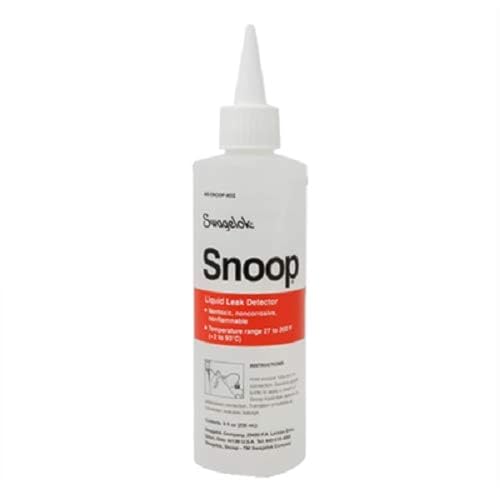
Swagelok Snoop is the professional’s choice for precision leak testing on gas fittings, high-purity tubing, and critical fluid systems. Trusted in industries from petrochemicals to semiconductor manufacturing, its reputation is built on consistent, reliable performance. The liquid is non-toxic, non-flammable, and formulated to dry clean without leaving a sticky residue or attracting dust, which is crucial in sensitive applications.
The unique applicator bottle is designed for controlled, drip-free application, allowing you to place a single drop exactly where you need it, even on vertical surfaces or overhead fittings. This precision prevents waste and mess. It creates stable, easy-to-see bubbles that clearly pinpoint even the slightest leak in pressurized gas or air lines, making it ideal for testing propane connections, compressed air fittings, and hydraulic lines.
Decades of user testimonials from technicians and engineers attest to its reliability. It’s the benchmark against which other bubble solutions are measured. While it comes at a higher point than basic options, its performance, clean operation, and professional-grade formulation justify the investment for those who require dependable results.
Why it’s great
- Industry-standard reliability trusted by professionals for decades.
- Dries clean without residue, perfect for sensitive equipment.
- Precision applicator allows for controlled, drip-free use.
- Non-toxic and non-flammable for safe use in various environments.
Good to know
- Positioned at a higher point than general-purpose bubble solutions.
- The bottle design, while precise, holds a smaller volume than some aerosols.
- Still a bubble solution, so it requires a pressurized system and visual inspection.
- Best for point-checking specific fittings rather than covering large areas quickly.
11. RectorSeal Better Bubble Leak Detector

For a reliable, no-frills bubble solution that gets the job done on a tight budget, RectorSeal’s Better Bubble is a proven contender. This blue liquid is formulated to work on a wide range of surfaces and under varied temperature and pressure conditions, from HVAC line sets to natural gas fittings. It’s biodegradable and contains no oils or corrosive ingredients, making it safe for metal, plastic, and rubber components.
It comes in a squeezable bottle with a brush applicator built into the cap, allowing you to dab it directly onto fittings or brush it along a seam. The viscosity is designed to cling well and form persistent bubbles that make leaks easy to spot. It’s a favorite among HVAC apprentices and DIY plumbers for its effectiveness in checking flare connections on mini-split systems or testing gas line joints after installation.
User reviews consistently highlight its value and effectiveness for common tasks. The main takeaway is that it performs exactly as expected: it makes bubbles where there are leaks. It’s a simple, tangible, and affordable tool that belongs in every basic maintenance kit for periodic checks of gas and air systems.
Why it’s great
- Extremely affordable and effective for its purpose.
- Works on refrigerant, natural gas, LPG, and air.
- Biodegradable and non-corrosive formula is safe for components.
- Includes a handy brush applicator for precise application.
Good to know
- Liquid can bubble from shipping motion; let it settle before use.
- Brush application can be messier than a spray for large areas.
- Not for use on CPVC piping.
- Requires visual inspection and a pressurized system, like all bubble solutions.
Understanding the Specs
Detection Method
This defines how the tool finds a leak. Bubble Solutions (liquid or aerosol) require a pressurized system and form visible bubbles at the leak point. Electronic Sniffers use sensors (corona discharge, heated diode, semiconductor) to detect specific gas molecules and trigger an alarm. Smoke Machines introduce visible smoke into a sealed system, making the leak visually obvious as smoke escapes.
Sensitivity
Measured in parts per million (ppm) for gas detectors or ounces per year (oz/yr) for refrigerant sniffers, sensitivity indicates the smallest leak the tool can detect. Higher sensitivity (lower ppm/oz/yr) is crucial for finding slow, expensive leaks. However, ultra-high sensitivity can lead to false alarms from background contamination, which is why adjustable sensitivity is a valuable feature.
Alarm Type
Feedback is key. Visual Alarms include LED lights, LCD screens, or color-changing displays that indicate leak concentration. Audible Alarms use beeping that often increases in frequency near the leak. Vibration Alarms (on safety monitors) are essential in loud environments. The best tools combine multiple alarm types for clear communication.
Probe & Reach
A flexible probe or gooseneck (typically 8 to 18 inches) is non-negotiable for automotive or HVAC work, allowing you to navigate cramped spaces. For gas line checks, a shorter, rigid sensor may suffice. Consider where your potential leaks are located—if they’re behind an appliance or deep in an engine bay, reach is a critical spec.
FAQ
Can one leak detector find all types of leaks?
Why does my electronic leak detector beep all the time?
Is a smoke machine better than a sniffer for car leaks?
How often do electronic sensors need replacement?
Final Thoughts: The Verdict
For most people, the best air leak detector winner is the AUTOOL Automotive Smoke Machine because its visual, smoke-based method provides undeniable proof for the trickiest automotive vacuum and EVAP leaks. If you want peace of mind checking home gas lines, grab the Klein Tools ET120 for its professional sensitivity and reach. And for DIY refrigerant checks on a budget, nothing beats the proven value of the Elitech WJL-6000S. Your choice ultimately hinges on identifying the specific type of leak you’re hunting and selecting the tool engineered to find it.

Mo Maruf
I created WellFizz to bridge the gap between vague wellness advice and actionable solutions. My mission is simple: to decode the research and give you practical tools you can actually use.
Beyond the data, I am a passionate traveler. I believe that stepping away from the screen to explore new environments is essential for mental clarity and physical vitality.