Our readers keep the lights on and my smoothie glass nicely filled. As an Amazon Associate, I earn from qualifying purchases.
The pop of a seized bolt yielding under a sudden blast of rotational force is the sound of progress. An air impact driver doesn’t just spin fast; it delivers a series of concussive hammer blows to break free rusted suspension components and stubborn lug nuts that a standard ratchet would round off. The difference between a frustrating afternoon with a breaker bar and a five-minute wheel change is entirely about choosing the right pneumatic hammer mechanism and torque curve.
I’m Mohammad Maruf — the founder and writer behind WellFizz. My research focuses on the mechanical engineering details of pneumatic tools, analyzing twin-hammer versus pin-clutch mechanisms, motor vane count, and the relationship between CFM demands and real-world compressor pairing to separate marketing specs from actual shop-floor performance.
Whether you are pulling wheels at a dealership or building a home garage setup, finding the right combination of breakaway torque, weight balance, and air consumption defines your efficiency. This guide breaks down the seven best models on the market to help you find the best air impact driver for your specific workload.
How To Choose The Best Air Impact Driver
Selecting a pneumatic impact wrench goes beyond the sticker torque number. The real-world ability to snap a corroded bolt free depends on the hammer mechanism design, the motor’s vane configuration, and how much air your compressor can feed it at working pressure. A tool that demands 10 CFM will perform poorly on a small 20-gallon tank set at 90 PSI. Pay attention to the balance between raw power and ergonomic comfort—a heavy, loud gun will cause fatigue over a full day of tire rotations.
Torque: Working vs. Maximum Loosening
Manufacturers list maximum loosening torque (the peak spike) and working torque (sustained output). A gun with 1300 ft-lbs of breakaway torque can crack axle nuts, but you need at least 400-550 ft-lbs of working torque for daily tasks like brake caliper brackets and suspension bolts. Entry-level units around 450 ft-lbs handle most car work. Professional models above 750 ft-lbs handle heavy trucks and equipment. Always check both numbers—a high peak torque with poor working torque means the gun stalls on continuous use.
Hammer Mechanism: Twin-Hammer vs. Pin Clutch vs. Jumbo Hammer
The twin-hammer mechanism uses two hammers rotating around an anvil, delivering balanced, high-power blows with less vibration. Pin-clutch designs are simpler and cheaper but produce more vibration and noise. Jumbo hammer systems use a single, larger hammer mass for lower RPM but high per-blow impact—ideal for rusted fasteners where sustained power matters more than speed. Air impact wrenches with a smooth twin-clutch or twin-hammer design also run quieter, which reduces fatigue over an eight-hour shift.
Weight and Ergonomics: The Fatigue Factor
A full-size 1/2-inch air impact driver typically weighs between 4.3 and 5.5 pounds. Composite bodies shave weight compared to full metal housings, reducing wrist strain during overhead work. The handle diameter and grip texture matter when using the tool for hours—look for contoured rubber grips that absorb vibration. Extended-length models offer reach but add leverage strain. Flex-head angle impact drivers trade raw power for access, fitting into tight engine bays where standard guns cannot reach.
Quick Comparison
On smaller screens, swipe sideways to see the full table.
| Model | Category | Best For | Key Spec | Amazon |
|---|---|---|---|---|
| AirCat 1250-K | Premium Twin-Clutch | Max breakaway torque + quiet operation | 1300 ft-lbs loosening / 86 dBA | Amazon |
| Ingersoll Rand 232TGSL | Mid-Range Metal | High RPM (10,000) for pit crew speed | 625 ft-lbs reverse / steel hammer case | Amazon |
| CRAFTSMAN 1/2-in | Mid-Range Composite | Variable speed control with gloved hands | 750 ft-lbs torque / 4 power dial | Amazon |
| Chicago Pneumatic CP7732 | Premium Compact | Tight spaces + lightweight (2.87 lb) | 450 ft-lbs / 9000 RPM / 4.41″ head | Amazon |
| Astro Tool 1834 Nano | Specialty Flex-Head | Brake calipers and engine-bay bolts | 400 ft-lbs / 3.34″ head length | Amazon |
| Ingersoll Rand 2115TiMAX | Premium 3/8″ | Suspension/brake work + lightweight | 300 ft-lbs / titanium hammer case | Amazon |
| WORKPRO 1/2-Inch | Entry-Level | Home garage tire rotations | 880 ft-lbs max / 550 ft-lbs working | Amazon |
In‑Depth Reviews
1. AIRCAT 1250-K 1/2-Inch Nitrocat
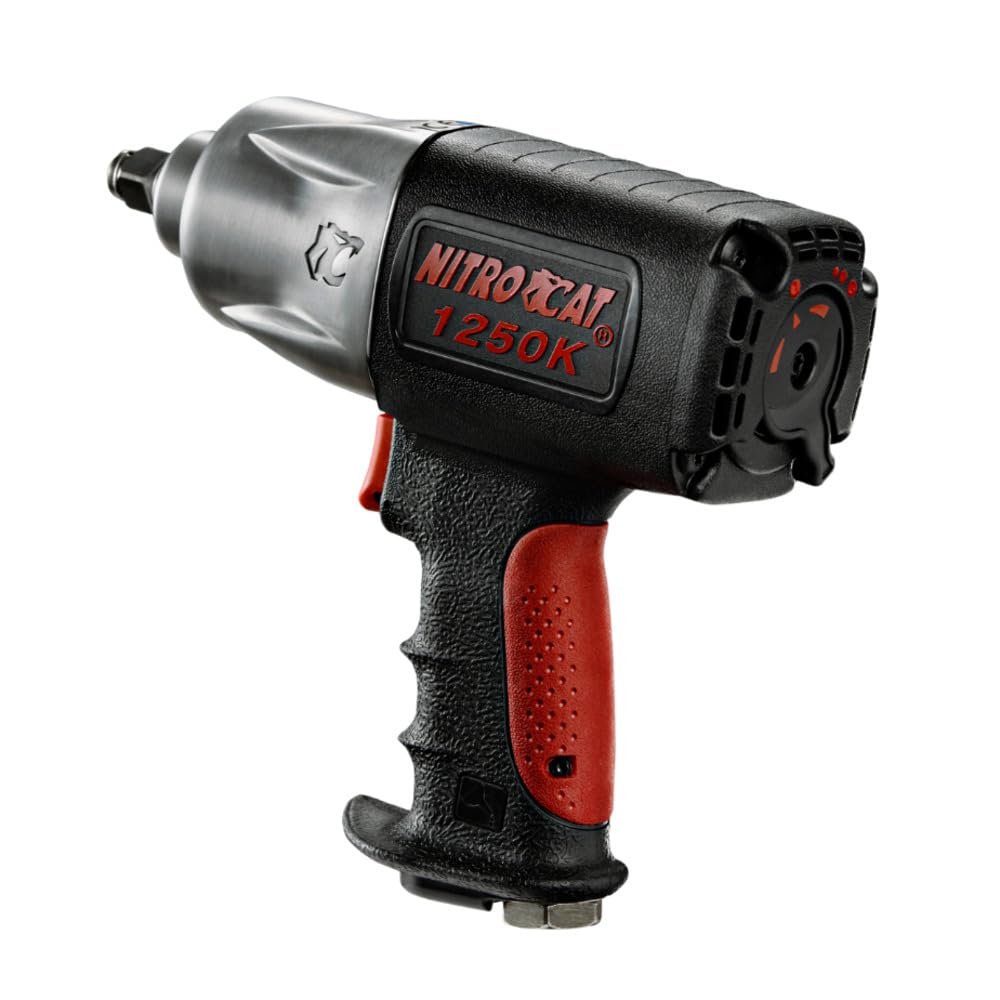
The AIRCAT 1250-K sets the ceiling for this category. Its patented quiet-tuned exhaust system brings operating noise down to 86 dBA—roughly the level of a busy restaurant instead of the screaming jet-engine roar typical of high-torque guns. The smooth twin-clutch mechanism delivers 1300 ft-lbs of loosening torque with markedly less vibration than twin-hammer designs, meaning you can work through a full shift without your hand going numb. The 950 ft-lbs of maximum torque is more than enough to tear through axle nuts, rusted leaf spring bolts, and heavy equipment fasteners.
At 8.25 inches in length and 4.85 pounds, this is a full-size unit, so it is not the lightest option for overhead work. The friction ring anvil holds sockets securely but lacks the positive retention of a hog ring. Users consistently report that it outperforms Snap-on and Matco guns costing significantly more, making it a value proposition for professional mechanics who demand power without the tool-truck markup. The twin-clutch mechanism also runs smoother under load, reducing wrist fatigue during extended use.
The one trade-off is air consumption: this gun needs a compressor that can deliver consistent volume at 90 PSI—a small 20-gallon unit will struggle to keep up under continuous use. Pair it with a 1/2-inch air hose and high-flow couplers to unlock its full breakaway potential. For technicians who value quiet operation, brute force, and longevity, this is the benchmark.
Why it’s great
- Quiet operation at 86 dBA reduces hearing fatigue
- 1300 ft-lbs loosening torque handles heavy truck fasteners
- Twin-clutch mechanism produces less vibration than twin-hammer designs
Good to know
- Requires high-flow couplers and 1/2-inch hose to reach full power
- Full-size 8.25-inch length limits access in tight engine bays
2. Ingersoll Rand 232TGSL 1/2-inch

The Ingersoll Rand 232TGSL is a legend in the shop for one reason: speed. At 10,000 RPM free speed, this is the fastest 1/2-inch air impact wrench in the IR lineup, zipping off lug nuts in under five seconds. The 625 ft-lbs of maximum reverse torque is achieved through a twin-hammer mechanism housed in a steel hammer case and metal body, giving it the durability to survive drops off a lift—one user reported a 40-foot fall with only cosmetic damage.
The trade-off for that speed is noise. This gun runs loud—genuinely loud enough that coworkers will complain. The 10,000 RPM motor produces a high-pitched NASCAR rumble that cuts through earplugs. The weight is also significant at just under six pounds, and the front-heavy balance can cause thumb knuckle fatigue during heavy use. The factory-installed air fitting often leaks and needs Teflon tape to seal properly. On the positive side, the adjustable forward torque settings give you fine control for installing wheels without over-torquing.
For a professional tire tech or dealership mechanic doing multiple rotations per day, the sheer speed of this gun saves hours per week. The metal housing also holds up better to oil and chemical exposure than composite bodies. Just be prepared to invest in high-quality hearing protection and accept that this is not the tool for quiet, careful work near customers.
Why it’s great
- 10,000 RPM free speed removes lug nuts faster than any competitors
- Steel hammer case and metal housing survive harsh shop environments
- Adjustable forward torque settings for wheel installation precision
Good to know
- Extremely loud—requires quality hearing protection
- Heavy front-end balance causes wrist fatigue during all-day use
3. CRAFTSMAN 1/2-in 750 ft-lbs

The CRAFTSMAN 1/2-inch delivers a solid 750 ft-lbs of torque in a lightweight composite body that reduces arm fatigue without sacrificing power. The standout feature here is the large adjustment dial with four forward power settings plus one reverse setting, all accessible while wearing thick mechanic gloves. This level of variable speed control is rare at this tier and allows you to dial back power for installing wheel nuts or ramping up for stubborn suspension bolts.
At 4.3 pounds, this is one of the lightest full-power 1/2-inch models on the market. The push-button forward/reverse switch is ergonomically placed for one-handed operation, and the 7,000 RPM free speed provides enough speed for comfortable daily use without the ear-splitting noise of higher-RPM guns. Air consumption is reasonable at 5 SCFM at 90 PSI, meaning it works well with a standard 30-gallon compressor most home mechanics already own.
Some users report that the gun struggles to crack lug nuts torqued to spec on the first hit, occasionally requiring a breaker bar to get the initial break. This seems to be an issue with lower air pressure—running it at 100 PSI instead of the minimum 90 PSI eliminates the problem. The composite body also lacks the dent resistance of a full metal housing, so dropping it on concrete may crack the handle.
Why it’s great
- Large adjustment dial works easily with gloved hands for precise torque control
- Lightweight 4.3-pound composite body reduces fatigue during extended use
- Moderate 5 SCFM air consumption pairs well with mid-size home compressors
Good to know
- May need 100 PSI input to break factory-torqued lug nuts reliably
- Composite housing is less impact-resistant than full metal constructions
4. Chicago Pneumatic CP7732 1/2-inch

The Chicago Pneumatic CP7732 proves that big power can come in a small package. Weighing just 2.87 pounds with a head length of only 4.41 inches, this is the lightest full-size 1/2-inch air impact wrench in this lineup. The compact dimensions let you reach upper control arm bolts and alternator fasteners that a standard gun cannot fit.
The trigger modulation is excellent—users praise the ability to feather the throttle for light fastening without stripping threads. The socket wobble is minimal, thanks to precision machining on the anvil. The aluminum body with a steel front cover provides good durability without the weight penalty. At 9,000 RPM, it spins fast enough to remove lug nuts quickly, though it lacks the shear breakaway power of a twin-hammer design for heavily rusted components.
The weak point is the plastic forward/reverse switch. Multiple users report this breaking after six to twelve months of daily professional use, and it is not user-serviceable. The single hammer mechanism also produces more vibration than twin-hammer designs, which can be fatiguing over a full workday. For the weekend mechanic or occasional professional use on passenger vehicles, the weight savings and compact profile make this a strong choice.
Why it’s great
- Ultra-light 2.87 pounds reduces wrist strain during overhead and extended work
- Compact 4.41-inch head length accesses tight engine bay spaces easily
- Excellent trigger modulation allows precise throttle control for delicate fastening
Good to know
- Plastic FWD/REV switch is fragile and prone to breaking under hard use
- 450 ft-lbs torque is insufficient for rusted heavy truck or equipment bolts
5. Astro Tool 1834 Nano Flex-Head

The Astro Tool 1834 Nano Flex-Head solves a problem no standard air impact driver can address: how to apply impact torque at an angle. The patented design features a 180-degree flex head that angles both forward and backward, combined with a 360-degree swivel handle. This allows you to position the tool around brake caliper brackets, behind engine blocks, and inside frame rails where straight-line access is impossible. The head length is just 3.34 inches—the industry’s shortest—making it the go-to tool for body mount bolts and transmission bell housing fasteners.
The dual air intake motor and twin hammer mechanism produce 400 ft-lbs of maximum torque and 280 ft-lbs of working torque. This is not enough power to break axle nuts or heavily rusted suspension bolts, but it excels on smaller fasteners like sway bar links, caliper bracket bolts, and interior hardware. The front exhaust keeps debris away from the work area. Users report that after a year of weekly use, the flex mechanism remains tight with no slop, demonstrating solid build quality.
The trade-off is specialization. At roughly , you pay a premium for the flex-head engineering, and the torque output is comparable to a 3/8-inch gun rather than a full-power 1/2-inch. It also lacks a variable power dial—the trigger serves as your only speed control. If your work involves pulling engines or performing brake jobs on modern vehicles with tight packaging, this tool pays for itself in saved time. For general wheel work, a standard gun offers more torque per dollar.
Why it’s great
- 180-degree flex head and 360-degree swivel reach bolts no standard gun can access
- Miniature 3.34-inch head length fits into the tightest engine bay pockets
- Front exhaust design keeps oil and debris away from the workpiece
Good to know
- 400 ft-lbs torque is underwhelming for rusted suspension or axle nuts
- No variable power adjustment dial limits torque control during installation
6. Ingersoll Rand 2115TiMAX 3/8-inch
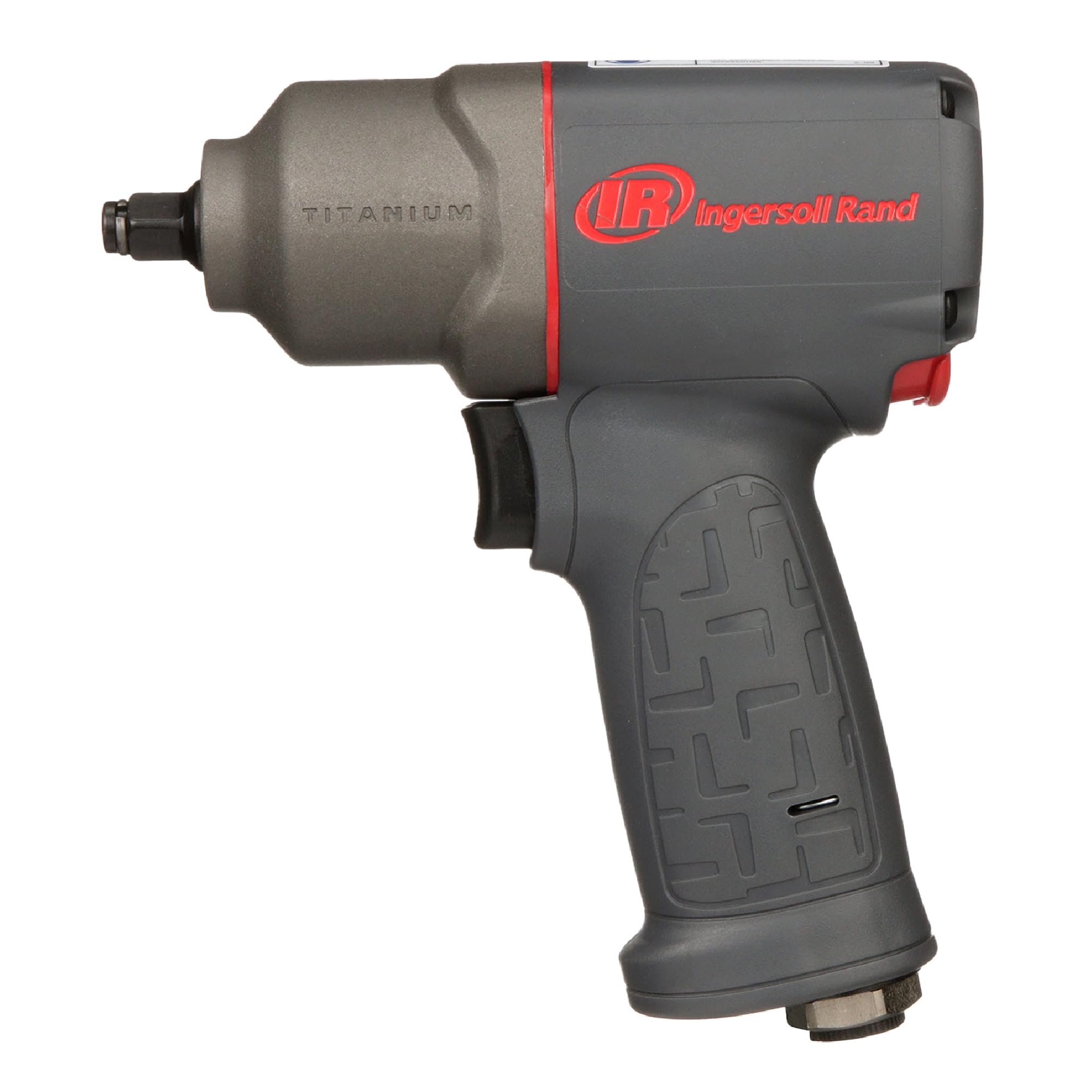
The Ingersoll Rand 2115TiMAX is a 3/8-inch drive impact wrench designed for technicians who need power in a lightweight, compact form factor. The 7-vane motor delivers 300 ft-lbs of maximum torque in reverse, which competes with many entry-level 1/2-inch guns while weighing only 2.5 pounds. The titanium hammer case reduces weight without sacrificing durability—this is the same impact mechanism used in IR’s professional 1/2-inch line, scaled down. The result is a tool that fits into tight spaces where a 1/2-inch gun cannot go, such as between the engine and firewall for starter motor bolts or behind the wheel hub for ABS sensor fasteners.
The feather-touch trigger and four-position power regulator give exceptional control for fasteners like valve cover bolts and intake manifold nuts where over-torquing can cause damage. Users report that with a high-output compressor (80-gallon tank at 175 PSI), this gun removes F-150 lug nuts easily using a 1/2-inch adapter, proving that 300 ft-lbs is often enough for everyday passenger car work. The composite housing with the titanium case is also resistant to chemical damage from brake cleaner and oil.
The main drawback is that the 3/8-inch drive limits socket availability compared to the universal 1/2-inch standard. You will need adapters for lug nuts, and using a 1/2-inch socket on a 3/8-inch anvil with an adapter reduces torque transfer and increases the risk of breaking the adapter. The gun also requires more frequent oiling than standard models—the manufacturer recommends three oiling points, and neglecting this can cause the mechanism to seize. For dedicated suspension and brake work where space is at a premium, this is an excellent specialist tool.
Why it’s great
- 7-vane motor delivers 300 ft-lbs torque in a lightweight 2.5-pound package
- Titanium hammer case provides professional-grade durability at reduced weight
- Four-position power regulator offers precise control for delicate fasteners
Good to know
- 3/8-inch drive requires adapters for lug nuts, reducing torque efficiency
- Requires frequent oiling at three separate points to prevent mechanism seizing
7. WORKPRO 1/2-Inch Air Impact Wrench

The WORKPRO 1/2-inch air impact wrench is the budget-conscious entry point that nevertheless delivers serious numbers: 880 ft-lbs of maximum loosening torque and 550 ft-lbs of working torque. The twin-hammer mechanism and alloy steel construction provide the structural integrity needed for heavy maintenance work, including removing stubborn lawn mower blades, automotive suspension bolts, and wheel bearings. The 7.5-inch length and 4.85-pound weight are perfectly middle-of-the-road—not the lightest, not the heaviest—making it a balanced tool for the home mechanic.
The rear exhaust design keeps air and oil mist away from the workpiece, which is handy when working on painted surfaces or clean engine components. The forward/reverse knob allows torque adjustment, though it lacks the graduated power settings found on more expensive models. The lubricant included in the box is a thoughtful touch, as all pneumatic tools require regular oiling. Users running it at 100 PSI instead of the minimum 90 PSI report that it breaks loose lug nuts easily, contradicting negative reviews that may have resulted from insufficient air pressure or lacking sealant tape on the air fitting.
This is not a professional-grade tool for daily dealership use. The composite handle and powder-coated finish will show wear faster than metal-bodied guns. Some users report that the anvil wobble is more pronounced than on premium models, and the trigger modulation is less refined, making it harder to feather power during installation. For a homeowner rotating tires twice a year, pulling an engine, or working on farm equipment, it provides impressive power at an entry-level investment.
Why it’s great
- 880 ft-lbs max loosening torque rivals models costing significantly more
- Rear exhaust keeps oil and debris off the workpiece during use
- Balanced 4.85-pound weight and 7.5-inch length suit varied garage tasks
Good to know
- Trigger modulation is less refined, making precision fastening difficult
- Anvil socket wobble is more pronounced than on premium-priced competitors
FAQ
How much torque do I really need for automotive work?
Should I choose a twin-hammer or a pin-clutch mechanism?
Can I use a 3/8-inch impact wrench for lug nuts?
How often should I oil my air impact driver?
Why does my air impact driver feel weak with my compressor?
Final Thoughts: The Verdict
For most users, the best air impact driver winner is the AIRCAT 1250-K because it combines immense 1300 ft-lbs of breakaway torque with remarkably quiet operation at 86 dBA, making it the top choice for professional mechanics who need power without the noise and vibration fatigue. If you want the fastest wheel removal for high-volume tire work, grab the Ingersoll Rand 232TGSL for its 10,000 RPM speed. And for home garage use requiring versatility with a budget-friendly entry point, nothing beats the WORKPRO 1/2-Inch for delivering 880 ft-lbs of max torque at a surprisingly accessible tier.

Mo Maruf
I created WellFizz to bridge the gap between vague wellness advice and actionable solutions. My mission is simple: to decode the research and give you practical tools you can actually use.
Beyond the data, I am a passionate traveler. I believe that stepping away from the screen to explore new environments is essential for mental clarity and physical vitality.