Our readers keep the lights on and my smoothie glass nicely filled. As an Amazon Associate, I earn from qualifying purchases.
Specs are compiled from manufacturer listings and verified buyer reviews and can change over time — please confirm the key details on the product page before buying.
Picking the right air conditioner for your camper is the difference between a trip you remember fondly and one you remember sweating through. The wrong unit strains your electrical system, drowns out conversation, or just can’t keep up when the sun is beating down on the roof. This guide matches each of the ten best options to your rig size, power setup, and comfort needs—no marketing claims.
I’m Mohammad Maruf — the founder and writer behind WellFizz. This guide is built by comparing the manufacturers’ published specifications and the patterns across verified customer reviews, so you get each pick’s real strengths and trade-offs instead of marketing spin.
Scroll through for the full breakdown, from ultra-quiet inverter units that sip battery power to high-BTU rooftop workhorses that cool a 40-foot fifth wheel. This is your honest, spec-first look at the best air conditioner for camper choices available right now.
Our Picks at a Glance

How To Choose The Best Air Conditioner For Camper
Every camper AC purchase depends on three non-negotiable factors: your power source, the space you need to cool, and your noise tolerance. Ignore any one, and the unit will frustrate you every trip.
Power Source: 12V DC vs 110-120V AC
This is the fork in the road. A standard rooftop unit running on 110-120V AC almost always requires shore power, a generator, or a hefty inverter to run off your house batteries. A 12V DC unit, by contrast, draws directly from your camper’s battery bank, making it the only realistic option for true off-grid boondocking. If your solar panel setup or battery capacity is modest, a 12V unit like the Outequip products lets you run cooling without firing up a generator.
BTU Rating and Rig Size
BTU (British Thermal Unit) measures raw cooling power. A 10,000 BTU unit handles a small trailer or van (16 to 20 feet), while 13,500 to 15,000 BTU rigs cover 25 to 35-foot coaches. Going too large causes short-cycling and humidity issues; too small means the unit runs constantly without catching up.
Ducted vs Non-Ducted Installation
Check your camper’s existing ceiling setup. A ducted system pushes cool air through hidden ceiling channels to multiple rooms, while a non-ducted unit dumps air directly from the unit’s shroud. Many newer units—like the RecPro offerings—ship with compatibility for both, but you need to know which configuration your camper’s roof opening and air distribution box support before you buy.
Quick Comparison
| Model | Best For | Cooling Power (BTU) | Noise Level (dB) | Weight | Amazon |
|---|---|---|---|---|---|
| RecPro 15K Quiet AC Heat Pump★ Best Overall | Large RVs needing low amp draw | 15,000 BTU | ~58 dB | ~100 lbs | Amazon |
| Dometic FreshJet 3 SeriesTop Performer | Dometic direct replacement with high airflow | 13,500 BTU | Quieter than Brisk II | 14% lighter than Brisk II | Amazon |
| Outequip 12V 10K BTU (w/o heater)Best Value | Off-grid vans and pop-ups | 10,000 BTU | Very quiet | 43 lbs | Amazon |
| Outequip 12V 10K BTU (w/ heater) | Off-grid use with supplemental heat | 10,000 BTU | ~40 dB | 43 lbs | Amazon |
| RecPro 13.5K Non-Ducted | Direct replacement on a budget | 13,500 BTU | ~59.7 dB | — | Amazon |
| TOSOT 16K BTU Heat Pump | Quiet cooling with WiFi control | 16,000 BTU | ~43 dB | — | Amazon |
| TURBRO Inverter 13.5K BTU | Energy savings with a heat pump | 13,500 BTU | Quieter than Penguin II | Thicker than Penguin II | Amazon |
| Coleman-Mach 15 Plus | Crucial replacement of Coleman units | 15,000 BTU | Quieter than older models | — | Amazon |
| Furrion Chill Cube 18K BTU | Max performance in a lightweight package | 18,000 BTU | Very quiet | 72.4 lbs | Amazon |
| Dometic Penguin II | Low-profile Dometic replacement | 13,500 BTU | ~ 15 dB | — | Amazon |
In‑Depth Reviews
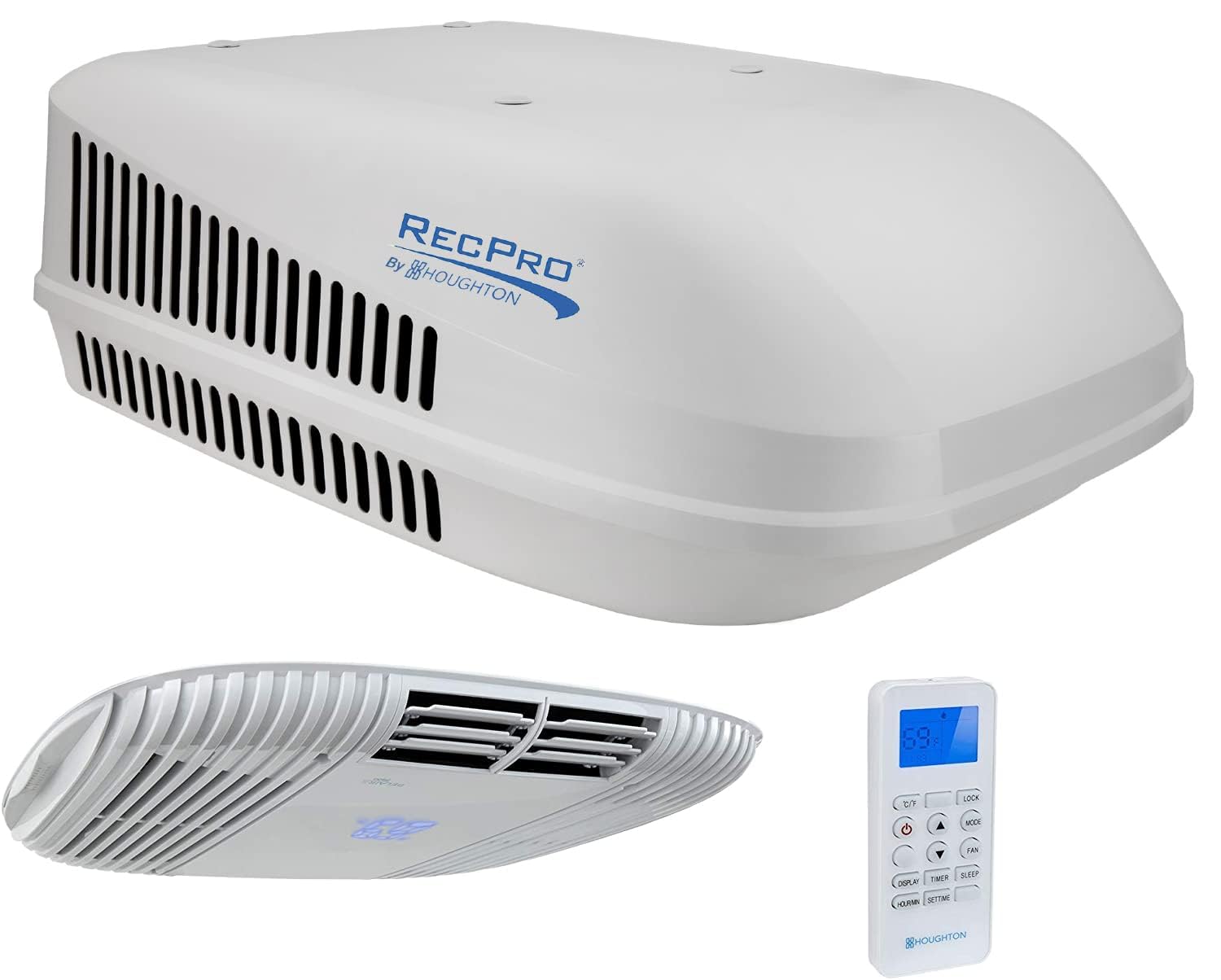
1. RecPro 15K Quiet AC Heat Pump Non-Ducted White 110-120V
Our pick — 4.5★ from 300+ verified ratings; the strongest balance of quality and price.
The powerhouse that keeps a 36-foot coach cool without tripping your breaker.
This 15,000 BTU unit from RecPro hits the balance where cooling power meets energy efficiency. It draws so little current that buyers report running two of them on a single generator, a trick the old Coleman Mach units couldn’t manage. The built-in heat pump adds four-season versatility, warming the camper on chilly evenings without needing to fire up the furnace. Owners mention the noise level at a genuinely quiet 58 dB on low and 65 dB on high—comparable to a gentle rain, not a roaring compressor.
Installation is straightforward for a two-person job, though the unit is heavy at over a hundred pounds. The control method includes both a wireless remote and a touchscreen LED panel, letting you switch between cool, dry, fan, sleep, and timer modes. One real-world note: a few owners mention a timer bug where setting the clock activates the timer, but removing the remote battery resets it easily.
The UV-resistant plastic shell and aerodynamic profile reduce drag during travel. For off-grid setups, its low amp draw makes it compatible with many generators without overloading the system. Just be prepared for the weight and plan for a helper during the lift onto the roof.
Why Owners Are Sold
- Quiet operation—58 dB low, 65 dB high—keeps the cabin restful.
- Low amp draw lets you run multiple appliances without tripping breakers.
- Integrated heat pump provides supplemental warmth for cool evenings.
The Fine Print
- Heavy unit (over 100 lbs) requires two people for roof installation.
- A few units arrived with cracked covers due to shipping.
- Timer function has a minor software quirk that needs a battery pull to reset.
The Verdict: Buy this if you have a larger RV, want to boost generator efficiency, and value a near-silent cabin over minimal weight.
Who Should Pause: Solo installers and pop-up camper owners will struggle with the weight and the dedicated 20-amp circuit requirement.
2. Dometic FreshJet 3 Series, 13.5K BTU RV Rooftop Air Conditioner
A 21 SEER efficiency champ that is 14% lighter than its predecessor.
The Dometic FreshJet 3 Series delivers a higher cooling capacity than many competing rooftop units while weighing less than Dometic’s own Brisk II models. Its 21 SEER efficiency rating means it uses less electricity per BTU than the average RV AC, which matters when you are running on generator time. The unit is backwards-compatible with existing Dometic and competitor air distribution boxes, making it a plug-and-play upgrade for many rigs.
In real-world use, customers note that it brings a camper from 80°F down to 64°F in about 30 to 45 minutes. The noise level is described as much quieter than the Brisk Air 2 it replaces. However, the annual energy consumption is listed at 12,264 kilowatt hours per year, which is noticeably higher than some competing units. Durability concerns appear in the reviews, with multiple accounts of units arriving with cracked mounting tabs or broken components.
The installation is rated easy—unclip the eight-pin connector, remove four bolts, and drop the new unit in. The FreshJet works in both ducted and non-ducted applications, though it ships without a control box or trim, so you need to reuse your existing thermostat or purchase a separate controller. For Dometic loyalists looking for a quiet, efficient swap, this is a natural fit—just inspect the box carefully on delivery.
Strengths at a Glance
- High 21 SEER efficiency reduces generator runtime.
- 14% lighter than Dometic Brisk II for easier roof handling.
- Plug-and-play compatibility with most existing Dometic distribution boxes.
Watch For
- Fragile packaging; several units have arrived damaged.
- Annual energy consumption is higher than some 15K BTU competitors.
- No control box or trim included—plan for a separate purchase.
Best For: Dometic owners upgrading from a Brisk Air or Brisk II who want a direct electrical swap with better efficiency.
Not Ideal For: Budget-focused buyers or anyone without a pre-existing compatible air distribution box in their camper.
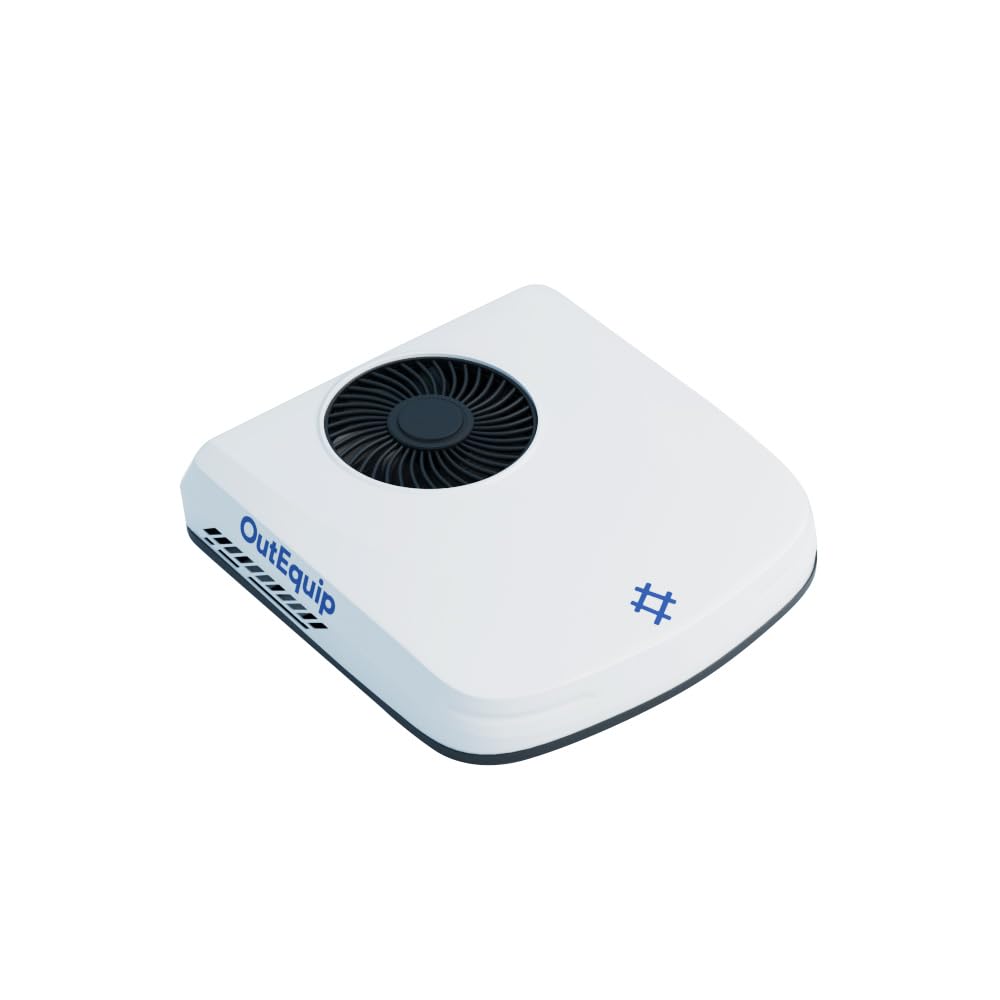
3. Outequip RV Air Conditioner, 12V 10000 BTU Rooftop (No Heater)
The 43-pound unit you can lift and install solo without any roof modifications.
This Outequip unit is built for the off-grid crowd who want to run air conditioning straight from their camper’s 12V battery bank without an inverter. At 10,000 BTU, it cools a small to mid-sized trailer or van in about 15 minutes according to the specs. The key numbers that matter: it draws 960 watts, weighs just 43 pounds, and promises eight hours of cooling from a 480Ah battery bank. A buyer who installed it in a VW Westfalia bus called it “quiet and draws surprisingly low power on eco mode.”
The low profile design means it sits flush on the roof without needing any structural changes, and reviewers point out that the brushless copper motor fans keep exterior noise surprisingly low—quieter than a roof vent fan. The unit includes a remote control with eco, sleep, and turbo modes. The main trade-off is that this is a cooling-only unit with no heat pump, so it won’t help on chilly mornings. It uses spring-supported mounts and a directional duct to minimize vibration transfer into the RV shell.
The annual energy consumption of 960 watts is extremely low compared to standard 110V rooftop units, making this the go-to choice for solar-powered setups. Just make sure your roof opening is the standard 14.25 x 14.25 inches and that your roof thickness can accommodate the included hardware. One installer noted that if your roof is thin, you need a spacer, and it’s important not to overtighten the screws.
Solo Install Champ: At only 43 pounds, you can realistically get this onto the roof yourself—an almost unheard-of advantage in this category.
The Catch: No built-in heater means it’s a three-season solution unless you have a separate furnace or plan to winterize.
Reach For It If: You live off-grid, have a small to mid-size camper, and want the lightest possible DIY install.
skip it if: You need year-round heat from the same unit or have a larger coach that needs more than 10,000 BTU.
4. Outequip RV Air Conditioner, 12V 10000 BTU (With Heater)
The same lightweight 12V design but with a 4,500 BTU PTC heater for cool mornings.
This version of the Outequip adds a PTC heater, bumping the package to both cooling and supplementary warmth. The heater puts out 4,500 BTU, which the manufacturer clearly states is not a primary heat source for extreme cold but works well for taking the chill off during spring and fall shoulder seasons. At 43 pounds, it matches the cooling-only version’s featherweight status, and shoppers say that the variable speed compressor draws around 16 amps on eco mode, conserving battery for longer off-grid stays.
The installation feedback is largely positive, with owners noting clear instructions and a complete kit that includes 15 feet of 6 AWG wire and a fuse. One owner running a Ram Promaster conversion paired it with a 24V 200Ah battery and 870W solar, reporting that the AC outperformed expectations and the heat was adequate for mild cold. The external dimensions are low profile—about 2 to 3 inches shorter than a Dometic or RTX unit—which gives you more room for solar panels on the roof.
The noise level is reported as moderate on turbo mode but extremely quiet on low, with the brushless fans keeping the exterior nearly silent. The unit includes a Bluetooth app for easy control, though a few owners found the initial installation tricky—specifically the lid screws, which can be hard to remove and have fragile connectors. The 10,000 BTU cooling power is a good match for a van or small trailer, not a large fifth wheel.
Best Use Case: DIY van conversions and small campers where weight and battery draw are the top constraints.
One Important Note: The PTC heater is a supplementary warmth source—don’t rely on it as your only heat in freezing weather.
Pick This Over The Non-Heater Version If: You camp in mild shoulder seasons and want to avoid firing up a propane furnace for a light chill.
Swap For A Higher BTU Unit If: Your camper is larger than about 20 feet or you regularly camp in triple-digit heat.
5. RecPro 13.5K Non-Ducted RV Air Conditioner, White, Cooling Only

The most-reviewed AC on this list, with 378 ratings, is the entry point for smart budget shoppers.
The RecPro 13.5K Non-Ducted unit is a straightforward cooling-only machine that hits the most common replacement spec for RVs. At 13,500 BTU, it handles small to mid-size campers well, and buyers report it keeps a 23-foot GMC motorhome comfortable even in 99°F SoCal sun. The noise level is rated at a reasonable 59.7 dB, described by buyers as 20 dB quieter than a Furrion unit and with a compressor that is nearly inaudible when running.
The installation is a standard four-bolt job with the plenum included, and owners consistently praise the clear directions. The annual energy consumption matches the larger RecPro 15K at 5,694 kilowatt hours per year. It works with both ducted and non-ducted setups, giving you flexibility if you change rigs later. However, there is one recurring complaint worth noting: in humid climates, the fan stays on after the compressor cycles off, which can dump moisture back into the cabin. One Florida-based owner reported this was a significant issue and ended up switching back to their old unit.
The remote requires a direct line of sight to the unit, which is a minor inconvenience compared to RF-based controls. For the price, you get a solid, quiet cooler that is a proven performer in dry heat, but if you camp in the Gulf states or the Pacific Northwest, you may want to look at the inverter models above that maintain better humidity control.
The Good
- 378 ratings make it the most vetted option here—owners agree it’s quiet and effective in dry climates.
- Easy four-bolt installation with included plenum; fits both ducted and non-ducted rigs.
- Low amp draw compatible with 2,200W generators using a Softstart.
The Less Good
- Fan re-circulates moisture after compressor cycles off—not ideal for humid regions.
- Remote requires line-of-sight aiming; no RF or Bluetooth option.
- Cooling only—no heat pump for brisk mornings.
The Verdict: A well-proven budget pick for dry-climate campers who want reliable cooling without the premium price of an inverter unit.
Look Elsewhere If: You camp in high-humidity areas where moisture management is critical for comfort.
6. TOSOT 16000 BTU RV Air Conditioner, 43dB Ultra Quiet

The quietest full-size RV AC at 43 dB—and it talks to your phone.
The TOSOT unit boasts 16,000 BTU of cooling and 12,500 BTU of heat pump warmth, making it among the most powerful all-in-one systems on this list. But the headline number is 43 dB—the manufacturer claims it’s 32% quieter than standard RV ACs, and owners confirm it’s barely audible on low. It operates in ambient temperatures from 23°F to 115°F, so it works year-round in most climates. The WiFi connectivity via the Gree+ app lets you adjust temperature and fan speed from anywhere in your RV.
The installation is a non-ducted design that fits the standard 14.25 x 14.25-inch rooftop opening. One owner reported that their Winnebago Revel Sprinter install took about two hours with a helper. In practice, the unit maintained 70°F inside the trailer when the outside temperature hit 105°F, and on high cooling it draws only about 800W—low enough to enable boondocking with a decent solar setup. However, owners note that the heat pump struggles when cooling in temperatures above 95°F, and the unit ships in two separate packages that sometimes arrive on different days.
For light sleepers, this is likely the best option on the shelf. The 43 dB rating is verified by buyer reports of 48 dB on low. The included remote and app control work well, though the remote’s user interface could be clearer. The 2-year warranty adds confidence for such a pricey investment. Just be patient with the two-box delivery and check both packages before scheduling installation.
What Stands Out
- 43 dB operation is quieter than a normal conversation—perfect for sleeping.
- Powerful 16,000 BTU cooling and 12,500 BTU heat pump cover all four seasons.
- WiFi control via Gree+ app gives you remote thermostat access.
Know Before You Buy
- Cooling performance drops above 95°F ambient temperature.
- Ships in two packages that may not arrive simultaneously.
- Internal screw alignment for the ceiling unit can be fiddly.
Ideal For: Light sleepers and families who prioritize a whisper-quiet cabin above all else.
Consider A Different Unit: If you regularly camp in desert conditions above 100°F where cooling headroom matters more than silence.
7. TURBRO Inverter 13.5K BTU RV Air Conditioner with Cooling and Heat Pump

An inverter compressor that delivers up to 30% greater efficiency than a standard RV AC.
The TURBRO Inverter is built around a variable-speed compressor that automatically adjusts its output instead of cycling on and off. This means no more cold-hot-cold spikes, and the gentle startup eliminates the need for a separate soft starter device—a major perk for generators. The unit provides 13,500 BTU of both cooling and heating, with a heat pump that the manufacturer claims delivers up to four times the output of traditional electric heaters. It operates in ambient temperatures from 19.4°F to 109.4°F.
The physical profile is a standout: at just 10 inches thick, it’s up to 35% slimmer than many competing rooftops, reducing air resistance and potentially improving fuel economy during travel. The ceiling assembly includes an atmosphere light with blue, yellow, or white options controlled via the remote or app. Owners mention that it cools a 35-foot coach effectively in 90°F-plus weather, and the WiFi scheduling works reliably. The inverter design also allows it to run for an extended period on a 2,200W Honda generator in eco mode—about seven hours according to one camper owner.
Annual energy consumption is 4,204.8 kWh—the lowest figure on this list, even beating the smaller BTU options. However, the average rating of 3.9 stars reflects some mixed feedback on noise, with a few owners finding the unit louder than expected, particularly at higher speeds. The built-in thermostat can read inaccurately if cold air from the unit blows directly onto its sensor, a known design quirk that may require a workaround via the Tuya smart home app.
Inverter Advantages
- Smooth, variable-speed operation eliminates noisy start-stop cycles and high amp draws.
- At 10 inches thick, it’s one of the slimmest rooftops available—cuts wind drag.
- Annual energy consumption of 4,204.8 kWh is the lowest on the list.
Potential Headaches
- Thermostat sensor can read 10+ degrees low due to cold plastic nearby, causing overcooling.
- Some customers note the unit is not as quiet as expected on higher fan speeds.
- Plastic clips holding the inner panel are fragile.
Best For: Energy-conscious RVers who want inverter-level efficiency and a slim roof profile for better fuel economy.
Think Twice If: You are extremely sensitive to white noise variations—the fan runs continuously, which some find more noticeable than a cycling unit.
8. Coleman-Mach 48204-069 Mach 15 Plus, 15,000 BTU A/C

A drop-in Coleman replacement that uses Puron refrigerant for better heat exchange.
The Coleman-Mach 15 Plus is a 15,000 BTU medium-profile unit designed specifically as a replacement for existing Coleman roof air conditioners. It uses Puron refrigerant (R410A)—which owners say produces a 30°F temperature differential between the suction and discharge lines, meaning it moves heat out efficiently. The installation is straightforward for anyone comfortable with basic tools: one owner reports a one-hour swap with help. However, the unit ships without a control box, so you must either reuse your existing one or purchase it separately.
Owner feedback highlights its solid cooling performance even in poorly insulated 40-foot RVs, keeping the interior at 75°F when the outside temperature is 90°F. The noise level is described as quieter than older Mach models, but it’s still a conventional compressor unit—don’t expect the silence of the inverter TOSOT. The black color is a nice visual upgrade over the standard white plastic, but note that the box is prone to shipping damage, with a few owners finding the outer casing dented on arrival.
Coleman recommends using a lightning protection device on the power line and turning off the AC during electrical storms, as the control boards can be sensitive to power surges. This is a no-frills, high-BTU cooler that does its job well for those loyal to the Coleman ecosystem. Just account for the extra cost of a control board with a freeze sensor if your old one is dead.
Claim to Fame: The most straightforward replacement for any existing Coleman-Mach roof opening—a true direct fit.
The Fine Print: No control board included; if your old one is shot, you are looking at an extra purchase before the unit will run.
Perfect For: Coleman owners replacing an old unit who want maximum cooling with minimal electrical changes.
Look Elsewhere If: You are building from scratch and don’t already have Coleman wiring and a compatible thermostat in place.
9. Furrion Chill Cube 18k BTU Variable Speed RV Rooftop Air Conditioner

At 72.4 pounds it’s about 10% lighter than other units—without skimping on 18K BTU power.
The Furrion Chill Cube is the highest BTU unit on this list, pumping out 18,000 BTU of cooling from a variable-speed compressor that runs constantly to maintain a consistent temperature. That constant-running design eliminates the abrupt amp draw spikes of standard units, making it easier on batteries and generators. The R32 refrigerant is more efficient and has a lower global warming potential than older refrigerants. Despite the massive cooling capacity, the unit weighs just 72.4 pounds, which is about 10% lighter than comparable models, making roof maneuvering less of a backbreaker.
In real-world conditions, reviewers point out that it drops the interior temperature by 11 degrees in 14 minutes and draws roughly half the electricity of the previous 12-year-old Dometic it replaced. The ducted-only design works with existing RV ductwork, delivering cool air evenly throughout the rig. The variable-speed compressor keeps the noise level low—buyers consistently call it “super quiet.” One owner with a 37-foot fifth wheel says even the turbo mode is quieter than their old unit on high.
The catch: this is the AC unit only. You must purchase the Furrion air distribution box separately (part number B0F147CJCT), which includes all necessary installation components. Without that box, the unit is not functional. Additionally, a small number of shoppers say a noticeable compressor vibration that transfers through the RV frame, though this seems to be an installation-specific issue rather than a widespread design flaw.
Why It’s A Heavyweight
- 18,000 BTU is the highest cooling power available—ideal for large fifth wheels and motorhomes.
- 72.4-pound weight is impressively light for this cooling class.
- Variable-speed compressor draws half the energy of a standard unit on average.
Installation Notes
- Requires a separately purchased air distribution box—factor that into your total cost.
- A small number of buyers report frame-transmitted compressor vibration.
- Ducted only—not compatible with non-ducted rigs without modification.
Best For: Owners of large RVs who want the most powerful, energy-efficient cooling available in a relatively lightweight package.
Not For: Anyone who needs a complete kit in one box or has a non-ducted camper.
10. Dometic Penguin II High Efficiency, Low Profile Rooftop Air Conditioner, 13.5K BTU

Dometic’s low-profile classic with an EPP foam housing that reduces weight while boosting efficiency.
The Penguin II is a familiar face in the RV world, known for its sleek, aerodynamic design that cuts wind resistance on the highway. It uses EPP foam housing not just to shed weight but to improve thermal insulation around the cooling core. The 13,500 BTU output is standard for medium to large campers, and it works with either CCC2 or CT thermostats in single or multi-zone configurations—a plus for complex RVs. The unit is eco-friendly, using R410A refrigerant that cools more efficiently and has less environmental impact than older refrigerants.
Owner feedback is generally positive, with installation described as easy when using the existing roof opening and cable connections. One pop-up camper owner called the cooling “powerful” and the install straightforward. However, the noise level gets mixed marks: some say it’s quieter than the old unit, while others find it “not very quiet” overall. The rib-reinforced base pan is built for longevity and can withstand rough road conditions. But the unit ships without pre-installed controls, meaning you need to have compatible thermostat hardware ready.
The value for money is a strong point in the reviews, though the price tag is premium. Just be cautious with delivery—multiple accounts mention the unit arriving damaged, with one arriving completely cracked. Given the cost, confirm the seller’s return policy before purchasing. This is a strong choice for Dometic loyalists who want the proven low-profile design, but it faces stiff competition from the more modern, inverter-driven units at similar price points.
The Legacy Pick: Dometic’s reputation for reliability and the aerodynamic low profile are the main draws here.
Heads Up: The noise level is not class-leading; if whisper-quiet is your mission, the TOSOT or Furrion are quieter alternatives.
Go With This If: You have an existing Dometic-compatible thermostat and want the proven, low-profile Penguin design.
Consider The Competition If: Silence is your top priority, or you want modern inverter technology and WiFi control for a similar price.
Understanding the Specs
BTU: Cooling Power
BTU stands for British Thermal Unit—the standard measure of how much heat an air conditioner can remove from your camper in one hour. More BTU means more raw cooling power, but it’s not always better. A 10,000 BTU unit is generally right for a small van or pop-up (under 20 feet), while 13,500 to 15,000 BTU units cover 25 to 35-foot coaches. The 18,000 BTU Furrion is overkill for a small rig and will short-cycle, leaving the air clammy rather than crisp.
Inverter vs Standard Compressor
A standard compressor runs at full speed until the thermostat is satisfied, then shuts off completely—causing temperature swings and a high current draw on startup. An inverter compressor varies its speed continuously, maintaining a steady temperature without those on-off spikes. This makes inverter units more energy-efficient and gentler on generators and batteries. Most of the premium picks on this list (TURBRO, Furrion) use inverter technology; the budget options use standard compressors.
12V DC vs 110-120V AC
A 12V DC air conditioner connects directly to your camper’s battery bank, making it the only viable choice for true off-grid boondocking without a generator. A standard 110-120V AC unit requires shore power, a generator, or a large inverter to run from batteries. The Outequip units on this list are the only true 12V DC models; all others run on standard 110-120V AC. If you primarily boondock, the decision is simple: skip the 110V units and focus on the 12V options.
Noise Level (dB)
Decibels measure sound pressure. A difference of 3 dB is barely perceptible to the human ear, but a jump of 10 dB is perceived as roughly twice as loud. A quiet library is about 40 dB; a normal conversation around 60 dB. The TOSOT at 43 dB is the quietest on this list, followed by the RecPro 15K at 58 dB. Older units like the Dometic Penguin II are described as “not very quiet” though no exact spec is given. If you or your family are light sleepers, prioritize units with dB ratings in their spec sheets.
FAQ
Can I run a standard 110V RV AC off my camper batteries without a generator?
What size air conditioner do I need for my camper?
Will a 12V air conditioner drain my battery fast?
Is a heat pump worth the extra cost for a camper?
Can I install a rooftop AC myself?
What does ducted vs non-ducted mean for my installation?
How quiet should a camper air conditioner be for sleeping?
What is the difference between R410A and R32 refrigerant?
Do all rooftop ACs fit the same roof opening?
My RV AC needs a soft starter—do all units require one?
Final Thoughts: The Verdict
For most buyers, the best air conditioner for camper is the RecPro 15K Quiet AC Heat Pump because it delivers the best balance of high BTU output, very low amp draw, and quiet operation for the price, backed by hundreds of positive owner experiences. If you live off-grid and need 12V DC power, grab the Outequip 12V 10K BTU for its unbeatable 43-pound weight and direct battery hookup. And for whisper-quiet comfort above all else, the TOSOT 16K BTU Heat Pump at 43 dB is the one to reach for.
How We Picked
We do not accept paid placement. Every pick is matched to a real buyer and a real use-case; we do not hands-on test units.
Sources & Methodology
Specifications: manufacturer listings and product documentation. Review insights: verified customer reviews, as of July 2026. Pricing: not shown on this page (it changes often); check the current price via the retailer link.
As an Amazon Associate, WellFizz earns from qualifying purchases. This does not affect which products we feature.
Related Guides

Mo Maruf
I created WellFizz to bridge the gap between vague wellness advice and actionable solutions. My mission is simple: to decode the research and give you practical tools you can actually use.
Beyond the data, I am a passionate traveler. I believe that stepping away from the screen to explore new environments is essential for mental clarity and physical vitality.