Our readers keep the lights on and my smoothie glass nicely filled. As an Amazon Associate, I earn from qualifying purchases.
Water in your air lines isn’t just an annoyance; it’s a silent killer of expensive pneumatic tools and a saboteur of flawless paint jobs. Finding the right guardian for your compressed air system can feel overwhelming with countless options. This guide cuts through the noise with a data-driven analysis of the most reliable solutions.
I’m Mohammad Maruf — the founder and writer behind WellFizz. Over years of researching workshop essentials, I’ve developed a method for analyzing product specifications and customer feedback patterns to identify what truly works in real-world conditions, not just on paper.
This deep dive compares key performance metrics, build quality, and practical design to help you select a separator that protects your investment, ensuring your next project isn’t ruined by unseen moisture in your best air compressor water separator.
How To Choose The Best Air Compressor Water Separator
Selecting a separator goes beyond just grabbing the first one you see. It’s about matching the device’s capabilities to your compressor’s output and your project’s demands. A mismatch can lead to poor performance or inadequate protection.
Understand Your Primary Need
Are you a hobbyist spray painter needing bone-dry air for a flawless finish? Or are you running sandblasters and impact wrenches where some moisture is tolerable but particulate filtration is key? For painting and plasma cutting, look for fine filtration (1-5 micron). For general shop tools, a standard water/oil separator is often sufficient.
Evaluate Flow Capacity (SCFM)
This is a critical, often overlooked spec. If a separator’s maximum flow rate is lower than your tool’s air consumption, it creates a bottleneck. This restricts airflow, starving your tool of power and causing pressure drops. Always check the separator’s SCFM rating at a given PSI and ensure it meets or exceeds your most demanding tool’s requirement.
Consider the Drain System
Separators trap water; you need to remove it. A simple push-button manual drain is common and effective if you remember to use it. Semi-automatic drains open when system pressure is released, which is convenient. For high-moisture environments or forgetful users, this feature can be a major quality-of-life improvement.
Quick Comparison
On smaller screens, swipe sideways to see the full table.
| Model | Type | Best For | Key Feature | Amazon |
|---|---|---|---|---|
| NANPU Filter Regulator Combo | Filter/Regulator | Precise pressure control | Built-in pressure gauge & regulator | Amazon |
| LE LEMATEC AI303 | Inline Separator | Direct tool protection | Rugged aluminum housing | Amazon |
| NEIKO 30253A (150 PSI) | Inline Separator | Higher pressure tools | 150 PSI rating, metal body | Amazon |
| Hromee Filter Regulator Combo | Filter/Regulator | Complete air prep station | Includes ball valve, bracket | Amazon |
| TCP Global Aluminum | Inline Separator | Durable budget upgrade | Metal body over plastic | Amazon |
| LE LEMATEC Air Dryer | Inline Separator | Fine filtration needs | 1-micron reusable element | Amazon |
| NANPU 3/8″ FRL Combo | FRL Unit | High-flow systems | 3-in-1 with lubricator | Amazon |
| NANPU 5 Micron Filter | Inline Filter | Effective moisture trapping | Semi-auto drain, brass element | Amazon |
| NEIKO 30252A (90 PSI) | Inline Separator | Entry-level protection | Clear bowl for monitoring | Amazon |
| TCP Global Mini | Inline Separator | Ultra-compact setups | Very small footprint | Amazon |
| PneumaticPlus Pro Unit | Filter/Regulator | Industrial, high-PSI use | Metal bowl, 250 PSI max | Amazon |
In‑Depth Reviews
1. NANPU Filter Regulator Combo

This mid-range piggyback unit excels by combining two essential air preparation functions into one compact, space-saving device. It provides not only moisture and particulate separation with its 5-micron brass filter element but also precise downstream pressure control via an adjustable regulator and a clear, easy-to-read gauge. This makes it an ideal central hub for a workshop air line.
The inclusion of a semi-automatic drain is a standout feature for maintenance. It automatically vents trapped water when the system pressure drops to zero, significantly reducing the chance of an overflow that could send moisture downstream. Users appreciate that it comes as a complete kit with mounting bracket and basic fittings, offering immediate setup out of the box.
Analysis of user feedback confirms its effectiveness for general shop use, airbrushing, and protecting tools like plasma cutters. The main consideration is its flow rate, which, while generous for many applications, may be restrictive for high-CFM tools like large sandblasters or heavy-duty die grinders used continuously.
Why it’s great
- Excellent value combining filtration and regulation.
- Semi-automatic drain reduces maintenance hassle.
- Comes as a complete, ready-to-install kit.
Good to know
- Flow capacity may limit very high-demand tools.
- The supplied thread seal tape is often reported as low-quality; use your own.
- Gauge accuracy can have a minor variance.
2. LE LEMATEC AI303
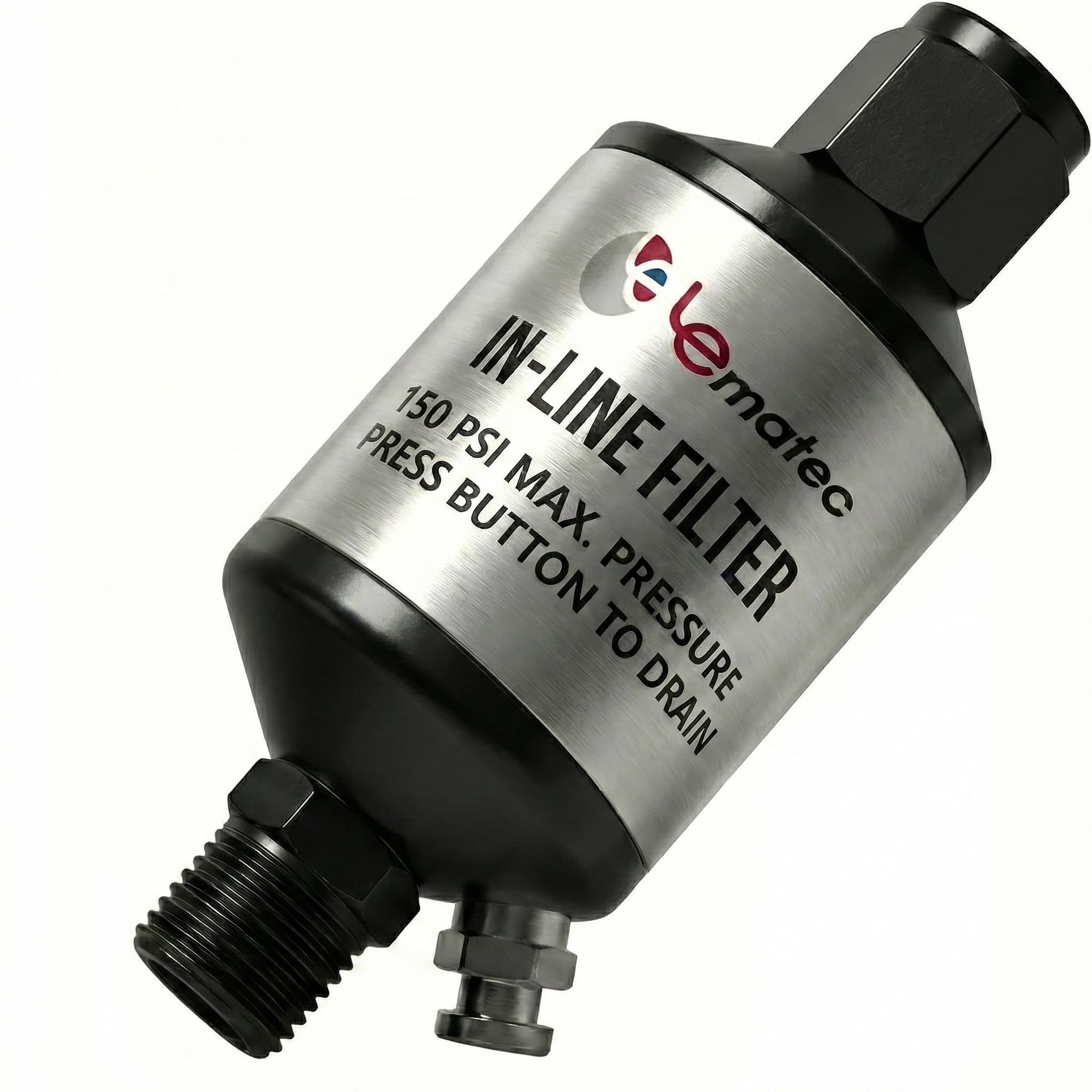
Constructed with a solid aluminum body and brass fittings, this separator is built for the rigors of a busy garage or workshop where plastic units might feel inadequate. Its primary role is as a robust, last-line-of-defense moisture trap, perfect for mounting directly before a spray gun, sandblaster, or plasma cutter to catch any condensation that formed in the air hose.
The design prioritizes durability and straightforward function. The push-button drain valve is large and positive, making it easy to purge accumulated water even with gloved hands. Its compact, cylindrical shape allows it to be installed in tight spaces or right at the tool inlet without adding excessive bulk or weight that could strain hose connections.
Customer experiences highlight its effectiveness at capturing moisture and its sturdy feel. However, some note the threading (male inlet, female outlet) can be non-standard, occasionally requiring an extra adapter for a desired hose configuration. A small percentage of units have also been reported with drain valve leaks, though the manufacturer is noted for responsive customer service.
Why it’s great
- Extremely durable metal construction withstands shop abuse.
- Effective at removing water and protecting tools.
- Large, easy-to-use manual drain button.
Good to know
- Thread orientation may require adapters for some setups.
- Potential for drain valve leaks in rare cases.
- Basic design lacks a regulator or gauge.
3. NEIKO 30253A (150 PSI)

This unit serves users who operate their air tools at the higher end of the pressure spectrum, such as for certain sandblasting or industrial cleaning tasks. Its 150 PSI operating rating provides a comfortable safety margin over typical 120-135 PSI shop compressors, offering peace of mind and reducing the risk of component failure under load.
The all-metal, black-anodized aluminum housing is both a practical and aesthetic upgrade over clear plastic bowls, offering better resistance to impact and UV degradation. The filtration media inside is designed to separate both water and oil aerosols, which is crucial for protecting tools that are sensitive to lubricant contamination, like paint sprayers.
Feedback from users running sandblasters and similar equipment is particularly positive, noting a visible reduction in moisture-related issues. A point of consideration is that, unlike some filters, the internal element does not appear to be easily removable for cleaning or drying, making it more of a sealed, long-term component.
Why it’s great
- Higher pressure rating suitable for demanding applications.
- Durable, non-cracking metal housing.
- Effective for both water and oil separation.
Good to know
- Internal filter element is not serviceable.
- Some assembly friction fits rely on O-rings which can leak if not perfectly seated.
- You cannot see moisture buildup without a clear bowl.
4. Hromee Filter Regulator Combo

Positioned as a comprehensive air preparation station, this combo unit stands out for its notably complete accessory package. Beyond the filter and regulator, it includes a forged brass ball valve and a double male NPT fitting, which are often separate purchases. This makes it a fantastic value for someone setting up a new air line from scratch.
The use of a brass filter element, as opposed to a fiber or sintered plastic one, typically promises longer service life and consistent filtration performance. The transparent polycarbonate bowl allows for easy visual monitoring of water accumulation, and the manual drain is straightforward to operate.
Users setting up home shops or dedicated workstations praise its all-in-one nature. It’s important to note that some reviewers have mentioned the regulator may vent air continuously when the output pressure is set significantly lower than the inlet pressure, which could be a consideration for certain low-pressure applications.
Why it’s great
- Exceptional value with included ball valve and fittings.
- Long-life brass filter element.
- Clear bowl for easy moisture monitoring.
Good to know
- Regulator may vent air in specific pressure differential scenarios.
- Instructions can be difficult to interpret.
- As with many combo units, maximum flow is limited.
5. TCP Global Aluminum

This separator represents a step up from the common all-plastic mini filters, offering the reliability of metal construction at a mid-range point. The aluminum body is far less prone to cracking from overtightening, accidental impacts, or the stresses of thermal cycling compared to its plastic counterparts.
Its function is focused and effective: separating oil, water, and dirt from the air line to protect downstream tools. The push-button drain is integrated cleanly into the bottom of the unit. Its compact size makes it ideal for portable setups or for installing directly on a tool where space is at a premium, such as on an airbrush or a small blow gun.
Customer reviews generally affirm its solid feel and performance. The most common issue reported revolves not around the separator itself, but around achieving leak-free connections with the necessary adapters when downsizing fittings for specific tools, which is a challenge with any inline device of this type.
Why it’s great
- Robust metal construction avoids plastic fatigue and cracks.
- Trusted brand with a reputation for quality.
- Very compact and lightweight for tool-mounted use.
Good to know
- May require additional fittings for non-standard connections.
- Some units have had defective drain valves that leak from new.
- No visual indicator for moisture level.
6. LE LEMATEC Air Dryer
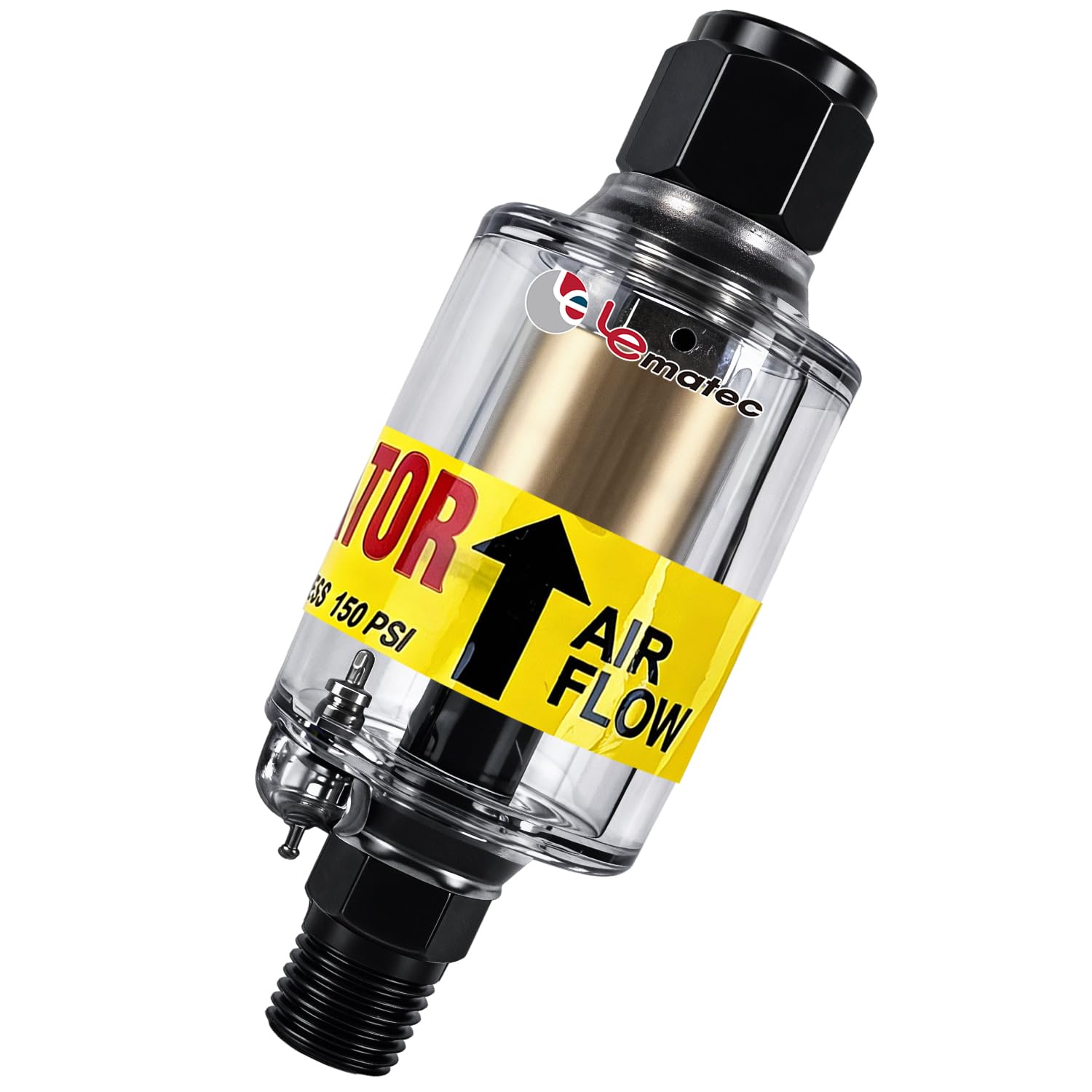
Where this model distinguishes itself is in its filtration fineness. The 1-micron reusable element is capable of capturing much smaller particles and aerosolized moisture than standard separators, making it a top choice for applications where air purity is paramount. This includes detailed airbrushing, automotive painting, and protecting sensitive equipment like plasma cutters.
Its operating range is versatile, functioning from a low 2 PSI up to 150 PSI, accommodating everything from delicate airbrushes to more powerful tools. The inclusion of a one-way valve is a thoughtful addition that prevents backflow, which can protect the filter media and maintain system integrity.
Users employing it as a final-stage filter right at their spray gun report excellent results in eliminating water spots and contamination. A minor but noted drawback is that the threading can sometimes be non-intuitive, potentially requiring an adapter to fit a standard hose setup directly.
Why it’s great
- Superior 1-micron filtration for the cleanest air.
- Wide pressure range suits many tools.
- Reusable filter element offers long-term value.
Good to know
- Thread configuration may not be standard.
- The sticker residue can be stubborn to remove.
- Finer filtration can be more restrictive to airflow.
7. NANPU 3/8″ FRL Combo
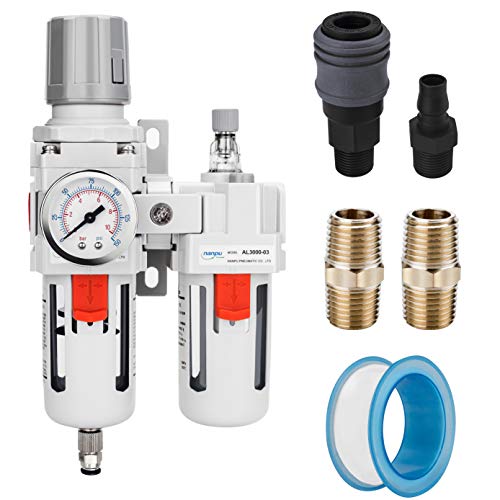
This is a premium, high-capacity unit designed for larger air systems. The “FRL” stands for Filter, Regulator, and Lubricator, providing complete air preparation for tools that require oil mist lubrication, such as pneumatic motors, jackhammers, and certain air tools. Its 3/8″ NPT ports and 60 SCFM flow rate handle the demands of serious shop tools.
The filter stage uses a 5-micron brass element for water and particulate removal, the regulator provides precise pressure control, and the lubricator injects a fine oil mist into the air stream to keep internal tool components running smoothly. The semi-automatic drain on the filter bowl adds convenience for maintenance.
This is not a product for the casual user; it’s for setting up a dedicated, high-performance air line. Feedback indicates it works well for its intended purpose, though some users note that the plastic bowls may require extra care with sealing (additional Teflon tape on threads) to prevent slow leaks.
Why it’s great
- Complete 3-in-1 air preparation for professional tool setups.
- High flow capacity supports multiple or large tools.
- Semi-automatic drain on a large-capacity unit.
Good to know
- Overkill for basic moisture protection needs.
- Lubricator is not needed and can be harmful for painting/spraying tools.
- Sealing the bowl threads may require extra attention.
8. NANPU 5 Micron Filter

This standalone filter unit wins praise for its intelligent semi-automatic drain mechanism. The design is elegantly simple: when the system is pressurized, the drain valve seals shut. When you shut off the air and pressure drops to zero, a spring pushes the valve open, allowing any collected water to drain out automatically. This “set-and-forget” feature is highly valued for consistent maintenance.
It features a 5-micron brass filter element housed in a clear polycarbonate bowl, allowing you to see both the element and the trapped contaminants. The included bracket facilitates secure mounting on a wall or bench, making it a neat and permanent part of your air system setup.
Users confirm it is highly effective at trapping moisture, especially when installed with some air hose between the compressor tank and the filter (allowing air to cool and condense). The primary caution from reviews is to immediately replace the included, thin Teflon tape with a higher-quality product to ensure leak-free connections from the start.
Why it’s great
- Brilliant semi-automatic drain reduces maintenance to almost zero.
- Clear bowl and brass element offer visibility and durability.
- Excellent moisture trapping performance for its class.
Good to know
- Absolutely requires better thread seal tape than what is supplied.
- Bowl attachment mechanism is different from standard spin-on bowls.
- Some users report it collects less moisture if airflow is very high.
9. NEIKO 30252A (90 PSI)

This model is a classic, budget-friendly introduction to air line protection. Its defining feature is the fully transparent body, which lets you see exactly how much water and oil it has collected. This visual confirmation is satisfying and educational for new users, clearly demonstrating the value of a separator.
It’s designed for general-purpose use with air tools and small paint spray guns, with a 90 PSI operating limit that is adequate for many common compressors and tools. The manual push-button drain is easy to access and use. The aluminum housing with brass fittings gives it a sturdier feel than all-plastic alternatives.
Feedback consistently notes that it works well for light to medium duty. The most significant limitation highlighted is airflow restriction. For high-volume tools like large HVLP spray guns or sandblasters running continuously, this unit can create a noticeable pressure drop, limiting tool performance.
Why it’s great
- Excellent value for basic moisture protection.
- Clear design provides immediate visual feedback.
- Sturdier than plastic-only units.
Good to know
- Can be restrictive for high-CFM tools.
- 90 PSI limit may be low for some applications.
- Clear bowl can crack if over-tightened or impacted.
10. TCP Global Mini

This is the quintessential mini inline filter, offering the most compact footprint possible. Its tiny size makes it the go-to choice for attaching directly to the inlet of a small paint gun, airbrush, or blow-off nozzle where adding any significant bulk or weight is undesirable. The clear plastic reservoir allows you to see contaminant buildup.
It serves as a effective last-chance trap for liquid water droplets and larger particulate matter like rust flakes from an older tank. For very light, intermittent use or as a secondary safety filter, it provides a basic level of protection.
Customer experiences are mixed, which highlights its limitations. It works well when kept in a vertical orientation so water pools at the drain. However, if installed horizontally in a hose line, its effectiveness plummets. Furthermore, the all-plastic construction has led to reports of bodies cracking under sustained pressure, making it less reliable for permanent, high-pressure installation.
Why it’s great
- Extremely small and lightweight for tool-mounted use.
- Catches liquid water and debris effectively when vertical.
- An incredibly budget-friendly starting point.
Good to
Good to know
- Plastic construction is prone to cracking under pressure.
- Only effective when mounted vertically.
- Not suitable for primary moisture removal in humid conditions.
Good to know
- Plastic construction is prone to cracking under pressure.
- Only effective when mounted vertically.
- Not suitable for primary moisture removal in humid conditions.
11. PneumaticPlus Pro Unit

This is the professional-grade powerhouse of the list, designed for industrial environments, large shop compressors, or any application where reliability under high pressure is non-negotiable. With a maximum supply pressure of 250 PSI and a robust metal bowl with sight glass, it’s built to handle demanding cycles and is resistant to solvents that can damage polycarbonate bowls.
The 10-micron particulate element provides solid filtration, and the unit boasts an impressive flow rate of 176 SCFM at 90 PSI, ensuring it won’t bottleneck even the most air-hungry tools. The inclusion of a manual drain, pressure gauge, and bracket makes it a complete, ready-to-install solution for a primary air line coming off a large tank.
User reviews from those running serious shop equipment are overwhelmingly positive, noting its accurate pressure regulation and lack of leaks when properly installed. The primary consideration is its positioning in the premium tier, reflecting its robust construction and higher capacity. The metal mounting bracket, while sturdy, has been noted in some reviews to be fragile during shipping, so inspection upon arrival is advised.
Why it’s great
- Industrial-grade construction for heavy-duty use.
- Extremely high flow rate and pressure rating.
- Metal bowl is durable and chemical-resistant.
Good to know
- Positioned in the premium category.
- Mounting bracket may be susceptible to damage in transit.
- Overkill for small, portable compressor setups.
Understanding the Specs
Micron Rating
This number indicates the size of particles the filter can capture. A 1-micron filter removes finer contaminants (ideal for painting) than a 5 or 10-micron filter. Lower numbers mean cleaner air but can slightly restrict flow. Choose based on your tool’s sensitivity.
Flow Rate (SCFM)
Standard Cubic Feet per Minute measures the volume of air the device can pass at a given pressure (e.g., 90 PSI). Your separator’s SCFM must meet or exceed your tool’s consumption. A mismatch causes pressure drops and poor tool performance.
FAQ
Where should I install a water separator?
Can a water separator remove all moisture from my air?
How often should I drain the separator?
What’s the difference between a filter and a separator?
Final Thoughts: The Verdict
For most people, the best air compressor water separator winner is the NANPU Filter Regulator Combo because it offers the perfect balance of effective moisture removal, precise pressure control, and convenient maintenance at a mid-range point. If you want industrial durability and high-flow capacity, grab the PneumaticPlus Pro Unit. And for ultra-fine filtration right at your spray gun, nothing beats the LE LEMATEC Air Dryer.

Mo Maruf
I created WellFizz to bridge the gap between vague wellness advice and actionable solutions. My mission is simple: to decode the research and give you practical tools you can actually use.
Beyond the data, I am a passionate traveler. I believe that stepping away from the screen to explore new environments is essential for mental clarity and physical vitality.