Our readers keep the lights on and my smoothie glass nicely filled. As an Amazon Associate, I earn from qualifying purchases.
An AIO laser color printer is the single most consequential office hardware decision a small business or demanding home office makes. Choose poorly and you face slow output, faded graphics, or a machine that disconnects from Wi-Fi mid-project. Choose well and the print, scan, copy, and fax workflow fades into a quiet, reliable background hum — exactly where office equipment should live.
I’m Mohammad Maruf — the founder and writer behind WellFizz. Over the past several years I’ve analyzed hundreds of multifunction printers, comparing print engine architectures, total cost of ownership, duplex scan speeds, and manufacturer lock-in policies to help buyers separate genuine value from marketing noise.
This guide walks through every critical spec and real-world performance factor you need to confidently choose the best aio laser color printer for your specific workload, volume, and connectivity requirements.
How To Choose The Best AIO Laser Color Printer
An all-in-one color laser printer is a multi-year investment. Focusing on the wrong spec — like a high single-page-per-minute rating while ignoring paper handling — leads to frustration long after the purchase excitement fades. Here are the four decision points that separate a sound purchase from a regret.
Print Speed vs. First-Page-Out Time
A printer rated at 31 ppm might still take 12 seconds to start printing a one-page invoice. First-page-out time (FPOT) matters far more for typical office workflows where most jobs are one to three pages. For bulk mail merges or long reports, sustained ppm matters. Look for FPOT under 11 seconds in color and sustained speeds that don’t drop after ten sheets.
Paper Handling and Monthly Duty Cycle
The standard 250-sheet cassette works fine for a single user printing a few dozen pages daily. For a team of five, a second 250-sheet cassette or a 50-sheet multipurpose tray prevents constant refill interruptions. The monthly duty cycle — typically 30,000 to 60,000 pages — indicates the printer’s internal build quality. The recommended monthly volume is usually 10% of the duty cycle. Exceeding that consistently shortens roller, fuser, and transfer belt life.
Total Cost Per Page (TCPP)
Starter toner cartridges included in the box usually yield only 500 to 1,000 pages. Once those expire, the real cost emerges. Standard-yield cartridges cost more per page than high-yield (XL or XXL) alternatives. Calculate TCPP by dividing the full set of four toner cartridges by their combined yield. A printer with cheap hardware but expensive toner can cost twice as much over three years as a pricier model with affordable high-yield supplies.
Connectivity and Driver Ecosystem
Ethernet is the most reliable data path for an office printer — it never drops, auto-negotiates speed, and bypasses router congestion. Dual-band Wi-Fi (2.4 GHz and 5 GHz) is essential for placing the printer anywhere without a cable run. Some manufacturers lock certain features — like scan-to-network or cloud connectivity — behind proprietary apps or email-based workflows. Verify that the app ecosystem supports your OS version before purchasing.
Quick Comparison
On smaller screens, swipe sideways to see the full table.
| Model | Category | Best For | Key Spec | Amazon |
|---|---|---|---|---|
| Brother MFC-L3780CDW | Premium | High-volume small teams | 31 ppm, 50-sheet one-pass duplex ADF | Amazon |
| Canon imageCLASS MF753Cdw | Premium | Print-centric offices needing speed | 35 ppm, 069 High-Capacity toner | Amazon |
| HP Color LaserJet Pro MFP 4301fdw | Premium | Teams needing security features | 35 ppm, HP Wolf Pro Security | Amazon |
| HP Color LaserJet Pro MFP 3301fdw | Mid-Range | Reliable color for small teams | 26 ppm, TerraJet toner | Amazon |
| Brother MFC-L3720CDW | Mid-Range | Budget-conscious home offices | 19 ppm, 3.5″ color touchscreen | Amazon |
| Canon imageCLASS MF644Cdw | Mid-Range | Versatile all-in-one with mobile | 22 ppm, 5″ color touchscreen | Amazon |
| Canon imageCLASS MF642Cdw | Mid-Range | Small offices with moderate print volume | 22 ppm, 250-sheet paper capacity | Amazon |
| Xerox C325dni | Mid-Range | High-speed color printing | 35 ppm, 4.3″ touchscreen | Amazon |
| Xerox C235dni | Value | Entry-level color laser | 24 ppm, Wi-Fi Direct | Amazon |
| Lexmark CX331adwe | Value | Compact office with steel frame | 26 ppm, steel-frame construction | Amazon |
| Epson EcoTank Pro ET-5800 | Premium | Ultra-low cost-per-page printing | 25 ppm, 7,500-page ink bundle | Amazon |
In‑Depth Reviews
1. Brother MFC-L3780CDW

The Brother MFC-L3780CDW occupies the sweet spot where speed, build quality, and intelligent features converge. Its 31-ppm output in both black and color eliminates the stuttering feel of slower office lasers, while single-pass duplex copy and scan means multi-page originals are digitized in one smooth pass rather than being flipped by the ADF twice. The TN229 toner series — available in standard, high, and super-high yields — allows you to calibrate supply costs to your actual monthly volume without being locked into a subscription.
Network connectivity is comprehensive: dual-band Wi-Fi with 2.4 GHz and 5 GHz support ensures the printer can maintain a consistent connection even in crowded airwaves, and Gigabit Ethernet provides a rock-solid fallback for teams that can’t tolerate wireless hiccups. Wi-Fi Direct also enables guest printing without granting full network access. The 3.5-inch color touchscreen offers 48 customizable shortcuts, which significantly reduces time spent navigating menus for recurring tasks like scanning to a specific folder or cloud service.
Build quality feels noticeably denser than entry-level AIOs. The paper path has fewer sharp turns, which reduces curl on heavier stock, and the fuser unit is rated for a long service life. A handful of users report that Brother’s Refresh subscription service can be tricky to cancel, so consider that a minor administrative friction rather than a hardware flaw. For any team printing 500 to 1,500 pages per month, this unit delivers the best balance of features and long-term value in the current market.
Why it’s great
- Single-pass duplex ADF speeds up multi-page scanning and copying dramatically.
- Super-high-yield TN229XXL toner reduces per-page cost for high-volume users.
- Gigabit Ethernet plus dual-band Wi-Fi offers flexible, reliable connectivity.
Good to know
- Brother Refresh subscription can be cumbersome to manage if you decide to cancel.
- Color output is document-grade excellent but not photo-lab quality.
2. Canon imageCLASS MF753Cdw

At 35 ppm in both black and color, the MF753Cdw is among the fastest AIO color lasers in this tier. Its 069 high-capacity toner — with a black yield of 2,100 pages and color yields of 1,100 pages per cartridge — keeps the replace cycle interval longer than competitors that force replacements every 500 to 800 pages. The standard 250-sheet cassette is supplemented by a 50-sheet multipurpose tray, and adding the optional PF-K1 cassette expands paper capacity to 850 sheets — sufficient for teams that batch-print large reports without refilling mid-job.
One-pass duplex scanning at 35 ipm is genuinely useful for archiving contracts or digitizing incoming mail, and the 50-sheet ADF handles stacks without frequent reloading. The 3-year limited warranty is longer than the industry-standard one-year coverage, reflecting Canon’s confidence in the engine reliability. The color registration accuracy is tight enough that marketing flyers and client-facing presentations look crisp at standard reading distance.
The primary drawback is the setup experience. A number of users report that the initial configuration menus are non-intuitive, particularly around SMTP settings for scan-to-email, and the 4.5-hour support hold times mentioned by some reviewers are unacceptable for a business-critical device. Once configured, the printer runs reliably, but the installation friction is real. Additionally, some units sold through third-party sellers appear to be gray-market models not eligible for Canon USA warranty, so verify the serial number if buying from non-authorized resellers.
Why it’s great
- Industry-leading 35 ppm speed in both color and mono.
- 069 High-Capacity toner reduces replacement frequency for moderate-volume offices.
- 3-year limited warranty provides peace of mind for a major office purchase.
Good to know
- Setup menus are confusing and lack on-page help for network settings.
- Gray-market units may not be covered by Canon USA warranty.
3. HP Color LaserJet Pro MFP 4301fdw
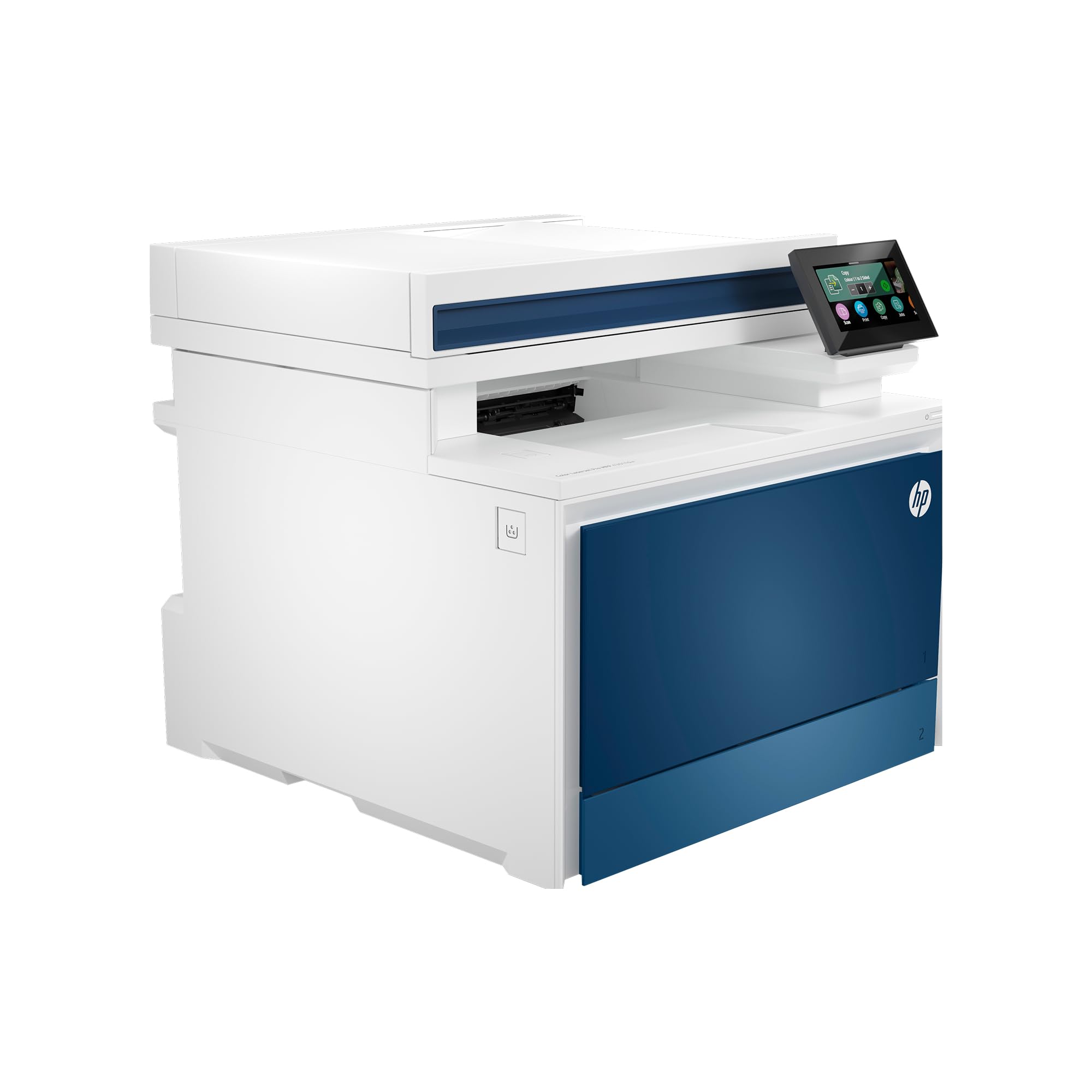
The 4301fdw is HP’s answer to the small team that needs more than just speed — it needs security. HP Wolf Pro Security provides customizable settings that control access to printer functions, audit trails for sensitive document output, and automatic threat detection for the firmware layer. For legal, medical, or financial practices handling confidential information, this built-in security stack eliminates the need for a separate print management server.
Print speed reaches 35 ppm in black and 33 ppm in color, powered by HP’s TerraJet toner formulation that produces more vivid color saturation than previous-generation HP color lasers. The auto-document feeder handles two-sided scanning in a single pass, and the 250-sheet input tray can be supplemented with an optional second cassette. Intelligent Wi-Fi with self-reset automatically detects and resolves connection drops without manual intervention — a genuinely useful feature for busy offices that can’t babysit a network printer.
Two significant issues shadow this machine. The printer is designed to block non-HP cartridges via firmware enforcement, and periodic updates maintain that restriction, so you are fully dependent on HP’s supply chain for toner. Several users report premature hardware failures — false paper jam errors, streaking, and units that stopped printing after light use — with HP support described as difficult to navigate. The introductory toner cartridges yield only 1,200 pages black and 1,000 color, so budget for immediate replacement cartridges when purchasing.
Why it’s great
- HP Wolf Pro Security offers enterprise-grade features without a separate server.
- Self-healing Wi-Fi auto-resolves connection drops.
- High-yield cartridges (7,500 black cycles) significantly lower long-term cost per page.
Good to know
- Firmware blocks third-party toner aggressively — no cost-saving alternatives.
- Multiple user reports of hardware failure after light use.
4. HP Color LaserJet Pro MFP 3301fdw
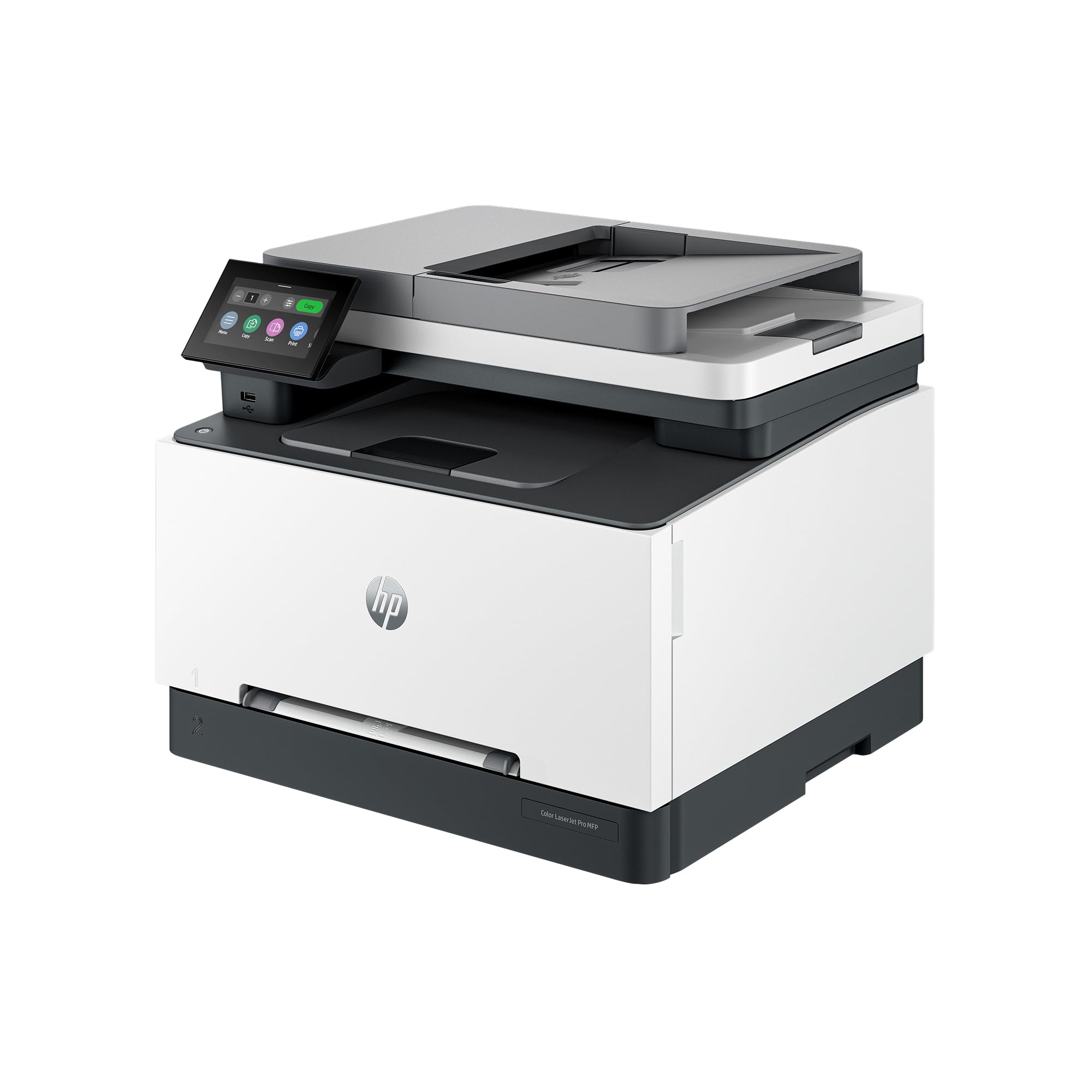
The 3301fdw sits one rung below the 4301fdw in HP’s lineup, but retains the core print engine quality and TerraJet toner technology that produces rich, smudge-resistant color output. At 26 ppm in both black and color, it is not the fastest machine in this roundup, but for a small team printing 200 to 500 pages per week, the speed is sufficient and the first-page-out time is quicker than older HP models. The auto-duplex scanning and 50-sheet ADF handle multi-page documents efficiently for a mid-range unit.
From a usability standpoint, the touchscreen is responsive and the initial setup — including Wi-Fi configuration — is streamlined for non-technical users. The printer integrates well with Apple devices via AirPrint and supports Mopria for Android. The compact footprint is slightly smaller than the previous-generation HP color lasers, which matters if your desk real estate is tight. Build quality feels solid, and the paper path handles cardstock and envelopes without jamming.
The catch is HP’s toner dependency model. The introductory cartridges yield roughly 50 pages in some cases, forcing an immediate purchase of standard or high-yield replacements. HP’s firmware updates periodically reinforce the block on non-OEM cartridges, so third-party alternatives carry a risk of being rejected mid-cartridge life. A small but notable number of users reported severe color defects — streaks and missing toner — that HP support struggled to resolve during the initial launch months. This model works best if you accept HP toner as a fixed operating cost.
Why it’s great
- TerraJet toner delivers noticeably richer color than prior HP color laser generations.
- Setup is genuinely straightforward — no driver hunting required.
- Compact footprint saves valuable desk surface area.
Good to know
- Introductory starter cartridges run out extremely quickly.
- Firmware blocks non-HP toner — supply costs are fixed by OEM pricing.
5. Brother MFC-L3720CDW

The MFC-L3720CDW is a more budget-friendly entry into Brother’s color laser ecosystem, sharing the same TN229 toner architecture as the faster L3780CDW but with a 19-ppm engine. For a home office or a very small team printing fewer than 300 pages per month, this speed trade-off is entirely acceptable, and the lower upfront investment leaves room in the budget for extra paper trays or a full set of high-yield toner cartridges. The 3.5-inch color touchscreen supports 48 customizable shortcuts, which is unusual at this price tier.
Wireless connectivity supports both 2.4 GHz and 5 GHz bands, and Wi-Fi Direct allows direct device-to-printer connections without a router. The 50-sheet ADF handles multi-page scan jobs without manual intervention, and automatic duplex printing works reliably for double-sided documents. Print quality is consistent with Brother’s reputation: crisp text, solid black fills, and color graphics that look professional for internal reports and client handouts, though not glossy enough for high-end marketing collateral.
A few users have noted that the printer stops mid-print when a toner cartridge is detected as “empty” based on page count rather than actual toner level — a firmware behavior that Brother has not offered a user-accessible override for. Paper feed jams and sheet curling due to multiple heated rollers are occasional complaints. The bundled subscription trial for Brother’s Refresh program can auto-enroll you in toner delivery, so read the fine print during setup to avoid unwanted charges. Overall, this is a solid, no-nonsense color laser for the budget-aware buyer.
Why it’s great
- TN229 toner family offers very competitive per-page costs with high-yield cartridges.
- Customizable touchscreen shortcuts reduce menu navigation for recurring tasks.
- Dual-band Wi-Fi and Wi-Fi Direct provide flexible connectivity options.
Good to know
- Printer may stop printing based on toner page count, not actual remaining toner.
- Occasional paper feed jams and sheet curl reported by multiple users.
6. Canon imageCLASS MF644Cdw

The MF644Cdw elevates the user interface experience with a 5-inch color touchscreen that feels more like a smartphone than a typical office printer panel. Application Library support allows you to customize the home screen with shortcuts tailored to your workflow — scan-to-email, cloud upload, or recurring copy jobs. The print engine delivers 22 ppm in both color and mono, with a first-print-out time of 10.3 seconds that makes single-page jobs feel responsive rather than sluggish.
Out of the box, the printer includes Cartridge 054 starter toners with 680-page color yields and a 1,500-page black yield, which is slightly more generous than the introductory cartridges from some competitors. The standard 250-sheet cassette handles letter and legal paper, and the 50-sheet ADF scans both sides in one pass. Wi-Fi Direct creates a hotspot for direct mobile connections when no network is available, and the printer works with Alexa for low-ink alerts and smart reorders.
Some users have reported that the printer goes offline after entering sleep mode, requiring a manual power cycle to reconnect to the network — a known quirk with this generation. The touchscreen, while impressive for a printer, is slightly slow when typing email addresses for scan-to-email jobs. Also, Canon’s Windows driver does not always auto-install correctly; downloading the full driver package from Canon’s website with administrative privileges avoids this issue. The MF644Cdw is a strong choice if you value interface polish and don’t mind a minor sleep-mode hiccup.
Why it’s great
- Large 5-inch touchscreen with customizable home screen makes daily operations intuitive.
- Application Library enables tailored workflow shortcuts for scan and copy tasks.
- One-pass duplex scanning and printing reduces time on multi-page jobs.
Good to know
- Sleep mode can cause the printer to drop from the network, requiring a reboot.
- Full driver manual download is often needed — Windows auto-install may fail.
7. Canon imageCLASS MF642Cdw

The MF642Cdw is essentially the MF644Cdw’s slightly more streamlined sibling, sharing the same 22-ppm engine and Cartridge 054 toner system but using a simpler control panel without the larger touchscreen. For buyers who don’t need a smartphone-like interface and prefer physical buttons for basic copy and scan functions, this model saves a bit upfront while delivering identical output quality. First-print-out time remains fast at 10.3 seconds, and the automatic duplex printing is reliable for double-sided documents.
The 250-sheet paper cassette accommodates letter and legal sizes, and the multipurpose tray handles envelopes and heavier stock. Mobile connectivity is solid — AirPrint, Mopria, and Canon’s PRINT Business app all work without significant setup friction. The 3-year limited warranty is a strong selling point, especially for a printer in this price tier where competitors typically offer only one year. Print quality is characteristically Canon: vibrant colors with good saturation, and black text that remains sharp down to 6-point fonts.
A few technical caveats from user reports: the touchscreen, while functional, is slow when typing long email addresses for scan-to-email jobs. Windows may auto-install a generic driver that lacks full features — manually downloading the Canon-specific driver with admin rights is advisable. Some users have had Wi-Fi drop after several days and found Ethernet to be significantly more reliable. For buyers who plan to connect via Ethernet from the start, this is a polished, well-supported AIO that represents strong value.
Why it’s great
- 3-year limited warranty exceeds the typical one-year coverage from competitors.
- Fast 10.3-second first-print-out in color keeps quick jobs moving.
- Compact desktop footprint with 250-sheet capacity fits tight workspaces.
Good to know
- Wi-Fi connection can drop after a few days — Ethernet is more reliable.
- Touchscreen is slow when entering text for scan-to-email addresses.
8. Xerox C325dni
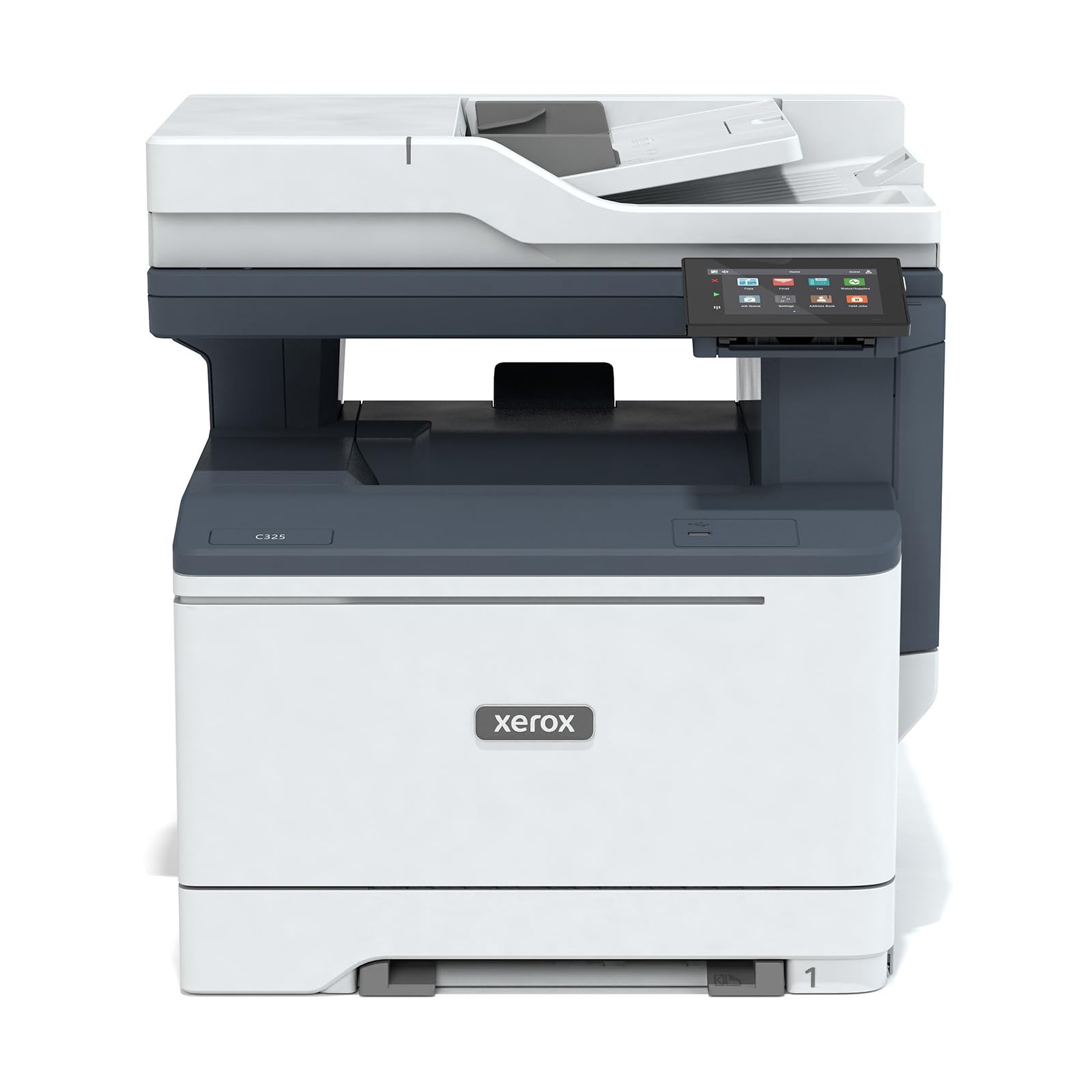
Xerox brings its office heritage to bear in the C325dni, a 35-ppm color laser that competes head-to-head with HP and Canon’s fastest mid-range offerings. The 4.3-inch touchscreen is responsive and the web-based configuration interface — while a bit clunky for initial setup — gives granular control over network scanning, security certificates, and user shortcuts. The starter toner yields are notably better than average: 1,500 pages black and 1,000 pages per color cartridge, giving you a realistic run before the first replacement purchase.
High-yield cartridge options support monthly volumes up to 2,500 pages, making this a candidate for busy small offices. Duplex printing and scanning work reliably, and the printer handles cardstock through the rear feed for occasional heavier jobs without jamming. The paper output stays within the printer’s boundaries, which saves desk space compared to models with sliding output trays. The built-in Wi-Fi, AirPrint, and Mopria support ensure compatibility across operating systems without additional software.
The dark side is toner economics. At roughly to per color cartridge and real-world yields that some users report as low as 1,000 copies — well below the rated 1,800 for high-yield — the cost per page can climb steeply. A single user reported monthly toner costs of for a busy office, which is unsustainable for most small businesses. If you can align your volume with the high-yield ratings, the C325dni is a fast, capable machine. If your output is unpredictable, the ongoing expense may outweigh the speed advantage.
Why it’s great
- Blazing 35 ppm speed in both black and color keeps large jobs moving.
- Starter toner yields are more generous than most competitors.
- Compact design with internal output tray saves desk space.
Good to know
- Toner costs are high and real-world yields may fall short of rated capacity.
- Web interface for advanced settings feels dated compared to app-based management.
9. Xerox C235dni
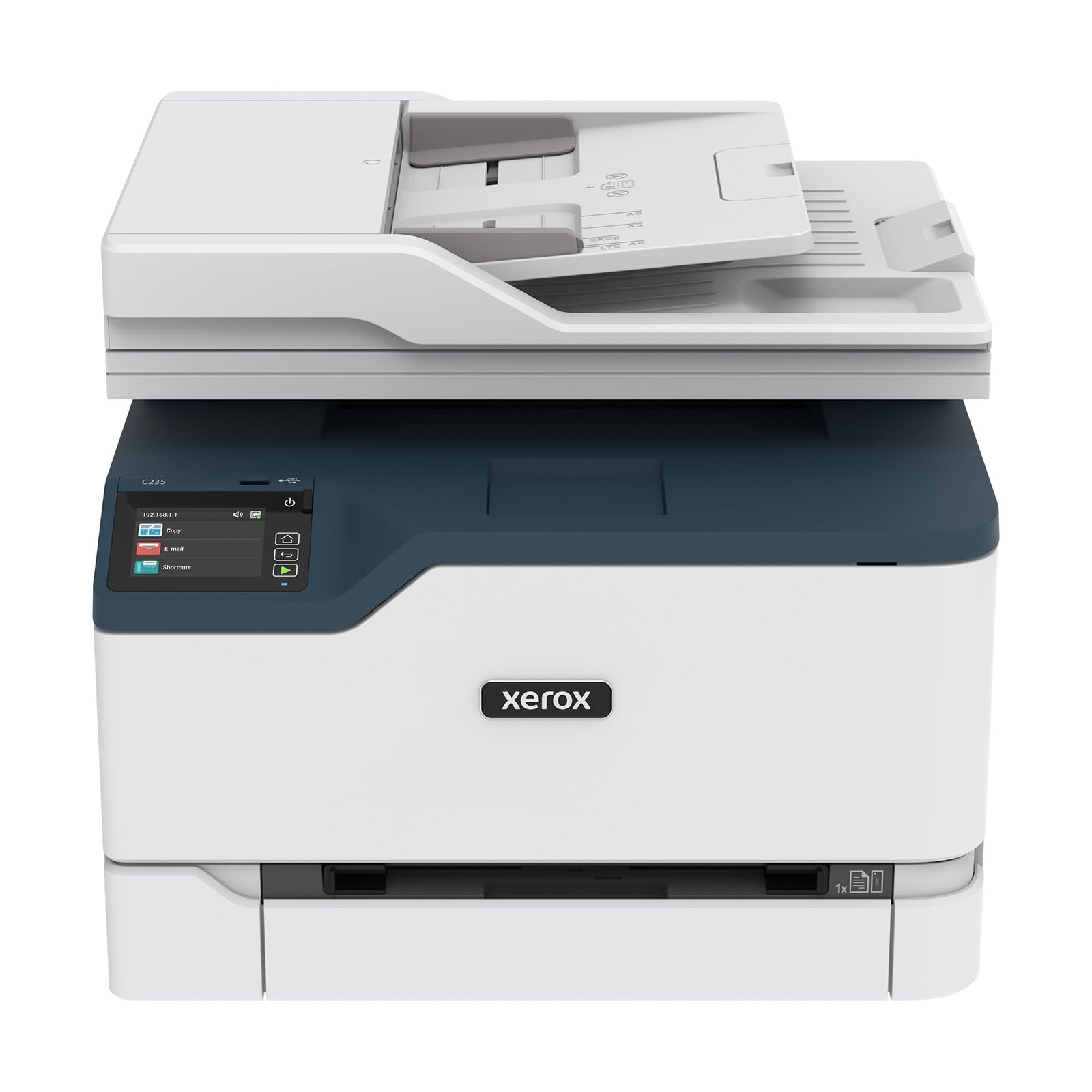
The C235dni is Xerox’s cost-conscious color laser AIO, offering a 24-ppm engine at a more accessible price point than the higher-end C325dni. The starter toner yield is 500 pages, which is on the low side, but the printer supports high-yield cartridges that bring per-page costs into a reasonable range for small offices printing perhaps 1,500 pages per month. Setup is guided by the Xerox Easy Assist App, which simplifies wireless configuration and avoids the old driver CD workflow.
Print quality for text documents is sharp and color graphics are vibrant enough for client presentations. The automatic duplex printing and scanning are handled smoothly by the 50-sheet ADF. Wi-Fi Direct allows mobile devices to print without joining the office network, which is convenient for guest users. The machine runs reliably when set up correctly, and several users report flawless performance for years after installation.
However, the setup process has a non-trivial failure rate. Some users experience the default driver printing extremely light output, which is resolved by disabling Eco mode and using higher-quality paper like Hammermill Premium. The Xerox SmartStart driver fails to discover the printer on Windows 11 for some customers, forcing them to configure the network settings manually through the printer’s front panel. Scanner output has also been criticized for being excessively light with a white band in the center — an issue that may be unit-specific but appears in multiple reviews. This is a viable entry-level color laser if you are comfortable troubleshooting initial configuration quirks.
Why it’s great
- 24 ppm speed is adequate for a small office or home-based business.
- Easy Assist App simplifies the initial wireless connection process.
- High-yield toner options reduce long-term cost per page.
Good to know
- SmartStart driver may not detect the printer on Windows 11, requiring manual setup.
- Default settings can produce light prints; Eco mode and paper type significantly affect output quality.
10. Lexmark CX331adwe

Lexmark may not command the same brand recognition as Canon or Brother in the consumer space, but the CX331adwe is built to a durability standard that is rare in this tier. The internal frame is constructed from heavy-gauge steel — not the thin stamped metal or plastic found in many sub- AIOs — which contributes to the unit’s weight and stability, and suggests a significantly longer service life for moving parts like the paper feed rollers and drive gears. Print speed is a solid 26 ppm in both black and color, with automatic duplex printing standard.
The wireless connectivity works well through a standard Wi-Fi connection, and the Lexmark Mobile Print app provides a straightforward interface for mobile device printing. The printer also supports USB and Ethernet for legacy connections. The scanner and copier functions are basic but reliable — nothing fancy, but they complete the all-in-one role without fuss. The control panel is utilitarian, with a small monochrome display and physical buttons, which some users prefer for its simplicity over touchscreens.
The catch is reliability over time. One review documents a unit that powered off after ten months and could not be turned back on — while this could be an isolated defect, it aligns with Lexmark’s mixed reputation for consumer electronics longevity. The scan-to-computer utility is also noted as less intuitive than competitors, requiring some trial and error to configure. For a buyer who values physical robustness and plans to keep the printer in a wired, stationary location, the CX331adwe offers genuine build quality advantages. But warranty and support experience should be weighed carefully.
Why it’s great
- Steel internal frame provides exceptional durability for a printer in this size class.
- 26 ppm speed with automatic duplex printing handles typical office jobs efficiently.
- Manual paper feed for envelopes and heavy stock works without jams.
Good to know
- Scan-to-computer setup is unintuitive compared to rival implementations.
- Some users report sudden power failure after less than a year of use.
11. Epson EcoTank Pro ET-5800

The ET-5800 is not a laser printer — it uses Epson’s PrecisionCore Heat-Free inkjet technology — but it competes directly with color laser AIOs on total cost of ownership. The bundled ink bottles deliver an aggregate yield of 7,500 black pages and 6,000 color pages, which translates to roughly two cents per ISO color page versus the 14-cent average for standard-capacity color laser cartridges. For high-volume users, this cost advantage is transformative, shaving hundreds of dollars annually in supplies.
Print quality is high: DURABrite pigment inks are water-resistant, instant-dry, and produce smudge-proof output on plain paper that rivals laser printers for text sharpness and color consistency. The two front paper trays hold a combined 500 sheets, and the rear specialty feed handles cardstock up to 100 lb. The motorized output tray is a thoughtful detail that extends automatically when printing begins. The large tilting LCD makes navigation easy for copying and scanning tasks, and duplex printing and scanning are standard.
The trade-off is in long-term error handling and support. Several users report frequent false error messages — “printer busy” on Apple devices, “incorrect password” on Wi-Fi credentials that work for other devices — that interrupt workflow. Epson’s support is described as rigid and difficult to resolve issues with remotely. Additionally, the pigment ink system is not designed for photo paper; glossy photo prints will not match the quality of dye-based inkjet printers or the color depth of some color lasers. For pure document printing at dramatically lower cost, the ET-5800 is compelling — but be prepared for occasional software quirks.
Why it’s great
- Extremely low cost per page — about 2 cents per color page versus laser cartridge averages.
- Comes with enough ink for 7,500 black and 6,000 color pages in the box.
- Pigment inks are instant-dry and water-resistant for professional documents.
Good to know
- Inkjet technology means slower color output (12 ppm) than typical color lasers.
- False error messages and rigid support process can be frustrating to resolve.
FAQ
How much does a color laser cost per page compared to an inkjet?
Why does my color laser print lighter on certain paper?
Can I use third-party toner in my color laser without voiding the warranty?
Is Ethernet still necessary if my printer has Wi-Fi?
Final Thoughts: The Verdict
For most users, the best aio laser color printer winner is the Brother MFC-L3780CDW because it combines fast 31-ppm speed with single-pass duplex scanning and a flexible toner ecosystem that scales from standard to super-high-yield supplies. If you want absolutely the highest color speed and a generous 3-year warranty, grab the Canon imageCLASS MF753Cdw. And for an ultra-low total cost of ownership that rivals cartridge-based lasers, nothing beats the Epson EcoTank Pro ET-5800 if you are willing to trade laser speed for ink-based savings.

Mo Maruf
I created WellFizz to bridge the gap between vague wellness advice and actionable solutions. My mission is simple: to decode the research and give you practical tools you can actually use.
Beyond the data, I am a passionate traveler. I believe that stepping away from the screen to explore new environments is essential for mental clarity and physical vitality.