Our readers keep the lights on and my smoothie glass nicely filled. As an Amazon Associate, I earn from qualifying purchases.
Specs are compiled from manufacturer listings and verified buyer reviews and can change over time — please confirm the key details on the product page before buying.
You want clear audio for your YouTube channel, hands-free recording for teaching, or reliable sound for interviews — without spending a lot. But many cheap wireless mics have dropouts, weak batteries, or muddy sound that ruins your footage. The BOYA V30 solves all that with 36 hours of battery life and 328 feet of range at a price that still leaves room for other gear. This guide covers the mics that balance cost, battery life, and real-world performance so you can record with confidence.
I’m Mohammad Maruf — the founder and writer behind WellFizz. This guide is built by comparing the manufacturers’ published specifications and the patterns across verified customer reviews, so you get each pick’s real strengths and trade-offs instead of marketing spin.
Whether you are a podcaster, filmmaker, or remote worker, the right wireless mic transforms your audio instantly. Here is your no-nonsense shortlist for the best affordable wireless microphone for every creator and budget.
Our Picks at a Glance

How To Choose The Best Affordable Wireless Microphone
Picking the right mic for your pocket starts with three things: how long you need to record, where you’ll be shooting, and what gear you already own. Focus on the real-life scenarios below instead of getting lost in spec sheets.
Battery Life and Charging Case
If you are filming interviews or a full day of content, a mic that offers 20 to 30 hours total (including recharges from the case) is a lifesaver. A charging case that gives you two or three full charge cycles means you dock the mics between sessions, just like wireless earbuds. For shorter vlog clips, even 8 to 10 hours of transmitter runtime may be plenty.
Noise Cancellation Levels
Not all noise reduction is created equal. Basic mode is great for a quiet office or indoor talking head videos, while stronger or dual-level AI mode handles wind, traffic, or crowded cafés. Some mics let you toggle through 3 modes or 14 levels of cancellation via an app, which is ideal if your recording environment changes often. A furry windscreen (a “dead cat” cover that blocks wind blast) is still your best friend outdoors.
Compatibility and Connections
A USB-C receiver works smoothly with recent Android phones and iPhones (15 series and later), but older iPhones with a Lightning port need a separate adapter. If you shoot on a DSLR or mirrorless camera, look for a version with a 3.5mm TRS cable — a standard audio cable that fits most camera microphone jacks. Always check if the package includes the right dongle for your device before you buy.
Quick Comparison
| Model | Best For | Battery Life | Wireless Range | Noise Cancellation | Amazon |
|---|---|---|---|---|---|
| BOYA V30★ Best Overall | All-day shoots on a budget | 36 hours | 328 feet | Dual-mode (1-click) | Amazon |
| FIFINE M9Best Value Set | Multi-device creators | 30 hours | 164 feet | One-button | Amazon |
| NEEWER CM26 ProAI Noise Pick | AI noise control fans | 50 hours | 330 feet | 2-level AI (A1/A2) | Amazon |
| SYNCO G2(A2) | Camera-first interviewers | 8 hours per TX | 656 feet | One-touch | Amazon |
| DJI Mic Mini | Premium DJI ecosystem users | 48 hours | 400 feet | 2 levels (Basic/Strong) | Amazon |
| MAONO Wave T5 | App-based audio tweakers | 30 hours | 300 feet | 3 modes / 14 levels (ENC) | Amazon |
| RØDE Wireless Micro | Ultra-compact smartphone kit | 18 hours (w/ case) | — | GainAssist (intelligent) | Amazon |
| Hollyland Lark M2 | Long-range pro recording | 40 hours | 1000 feet | One-click | Amazon |
In‑Depth Reviews
1. BOYA V30 Wireless Lavalier Microphone
The budget champ that goes the distance — 36 hours of total battery.
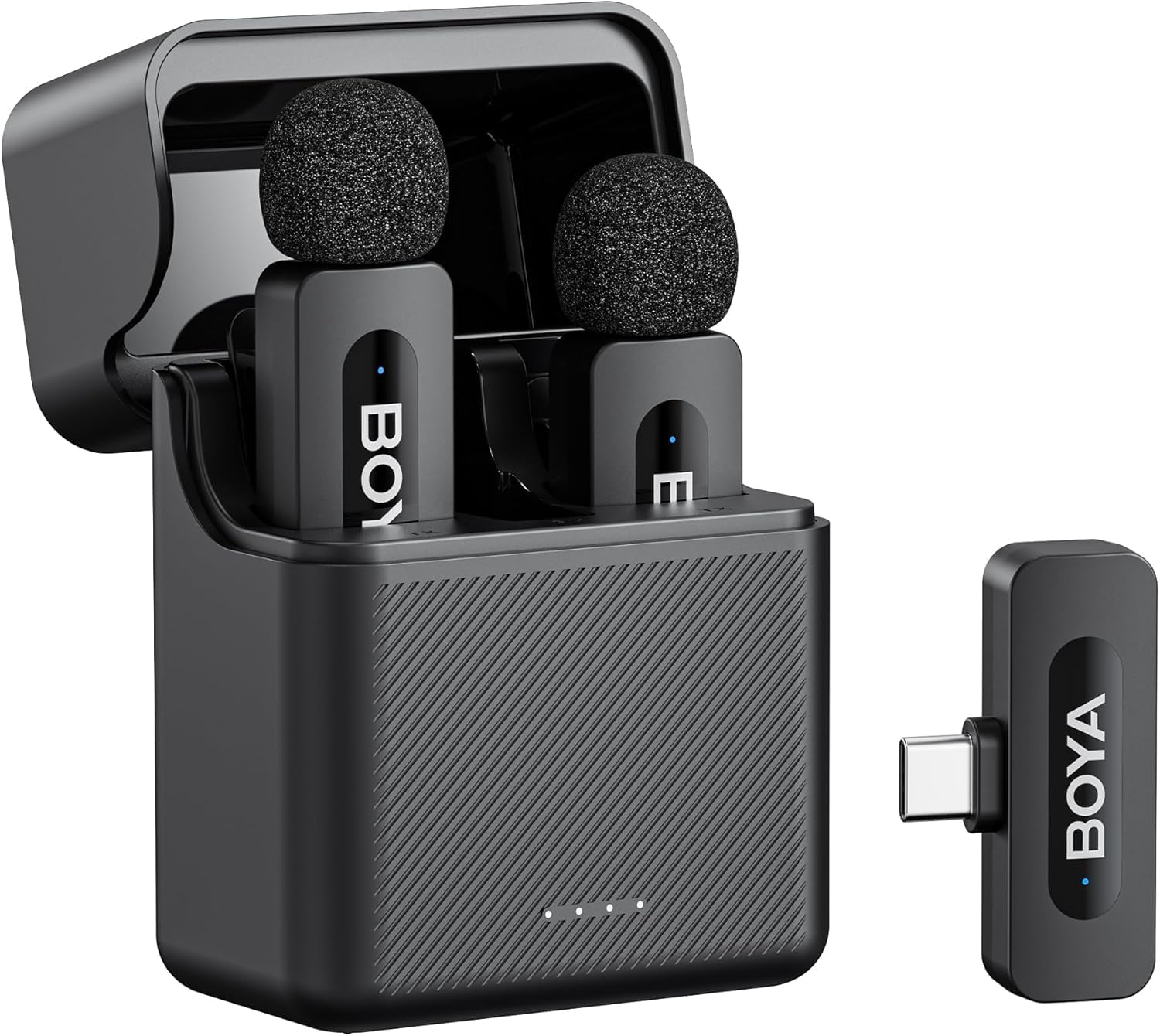
The BOYA V30 redefines what entry-level can do, starting with its standout battery life. You get a 95mAh (milliamp-hour) rechargeable battery in each transmitter, good for up to 9 hours of use per charge, and the charging case bumps the total to a whopping 36 hours. That means a 7 a.m. start and a 9 p.m. wrap without hunting for a wall outlet. The wireless range extends to 328 feet using advanced 2.4GHz (a common short-range radio frequency) technology, a full 2x gap over the FIFINE M9’s 164 feet, so you can roam a large room or outdoor stage free from cable anxiety. For noisy environments, the one-click noise cancellation paired with a dense windproof foam cover cuts wind and background hum effectively; as buyers report, “Los probé en un escenario de mucho ruido y funcionaron perfecto.” The audio quality itself holds up at 48kHz/16bit (capturing sound 48,000 times per second with 16 bits of data per sample) with an 80dB (decibel) signal-to-noise ratio — how much stronger the audio signal is than background hiss — and a 120dB maximum sound pressure level, keeping vocals clear even during loud bursts. The plug-and-play receiver (USB-C) works with Android phones, iPhone 15/16 series, and laptops — no apps, no adapters needed.
The receiver features a USB-C charging port, so you can power your phone while recording, a thoughtful touch for long livestreams. The 360° rotatable clip attaches easily to collars, and the compact build (1.97 x 1.57 x 3.94 inches, just 10.5g per transmitter) slides into any pocket. Playback works without unplugging the receiver, letting you review audio instantly. The only recurring critique is that the clip takes some effort to open, especially with larger hands, and the high treble can exaggerate sibilance (a hissing “s” sound) for some voices. Still, for a system that delivers this much runtime and range, the value is undeniable.
Endurance champion: The 36-hour case is the headline — you can shoot all weekend without a recharge, and the 328-foot range keeps you connected across a large room or outdoor set.
Trade-off to know: The clip is stiff to open, and a few found the treble a touch sharp. If you have large hands or are sensitive to sibilance, try before you commit.
Reach for this if: You need maximum battery and range at a low cost — perfect for all-day conferences, outdoor shoots, or backpack travel.
Look elsewhere if: You prize a silky-smooth clip mechanism or need zero sibilance on high-frequency voices.
2. FIFINE Wireless Lavalier Microphone M9
Two mics, one case, and 30 hours of recording time for less than many single-mic kits.
The FIFINE M9 is a two-pack cordless lapel system that punches well above its price point. The charging case fully recharges both transmitters nearly three times, giving up to 30 hours of total use, while the working range hits 164 feet — enough for most indoor interviews or outdoor vlogging. Audio capture is driven by a -38dB sensitivity with a 90dB SPL (sound pressure level) ceiling and a frequency response from 20Hz to 20kHz (the full range of human hearing), keeping natural details in your voice even on a windy street or noisy crowd. What wins people over is the combination of audio quality and portability: the set includes a compact case, detachable furry windscreens, and cables for 3.5mm TRS (tip-ring-sleeve, the standard stereo jack) and TRRS (tip-ring-ring-sleeve, for smartphones) connections, making it a true multi-device kit for cameras, Android phones, and iPhones. As one owner put it, the audio quality “matches competitors” at a fraction of the cost, with a noise cancellation mode that slightly edges out other budget mics. This is a better pick than the BOYA V30 if you need to connect to both a camera and a phone without buying extra cables.
For camera users, the receiver’s display screen shows audio levels, volume settings (three levels), and which mic is connected, so you monitor everything at a glance. The main downside is compatibility with Lightning iPhones: the M9 requires a separate 3.5mm-to-Lightning adapter or a USB-C cable (not included) to fix initial echoey or distorted audio. Once that cable is in place, owners mention sound on par with larger corded mics. The 40-foot range reported by some is shorter than the advertised 164 feet in real-world use, but for most interview and vlog setups within a room, it holds steady.
Solid all-rounder: The dual-mic set and 30-hour case give you a complete kit for interviews or dual-host shows, all in a package that fits in a coat pocket.
Watch for: iPhone users will need the correct adapter cable — without it, audio can sound hollow. Factor that into your total cost.
Best suited for: Creators who record on multiple devices (camera, phone, laptop) and want a ready-to-go two-mic bundle while staying affordable.
Not ideal for: Pure iPhone shooters who want a true plug-and-play without buying an extra dongle.
3. NEEWER CM26 Pro AI Wireless Microphone
50 hours of runtime and two levels of AI-driven silence for busy locations.
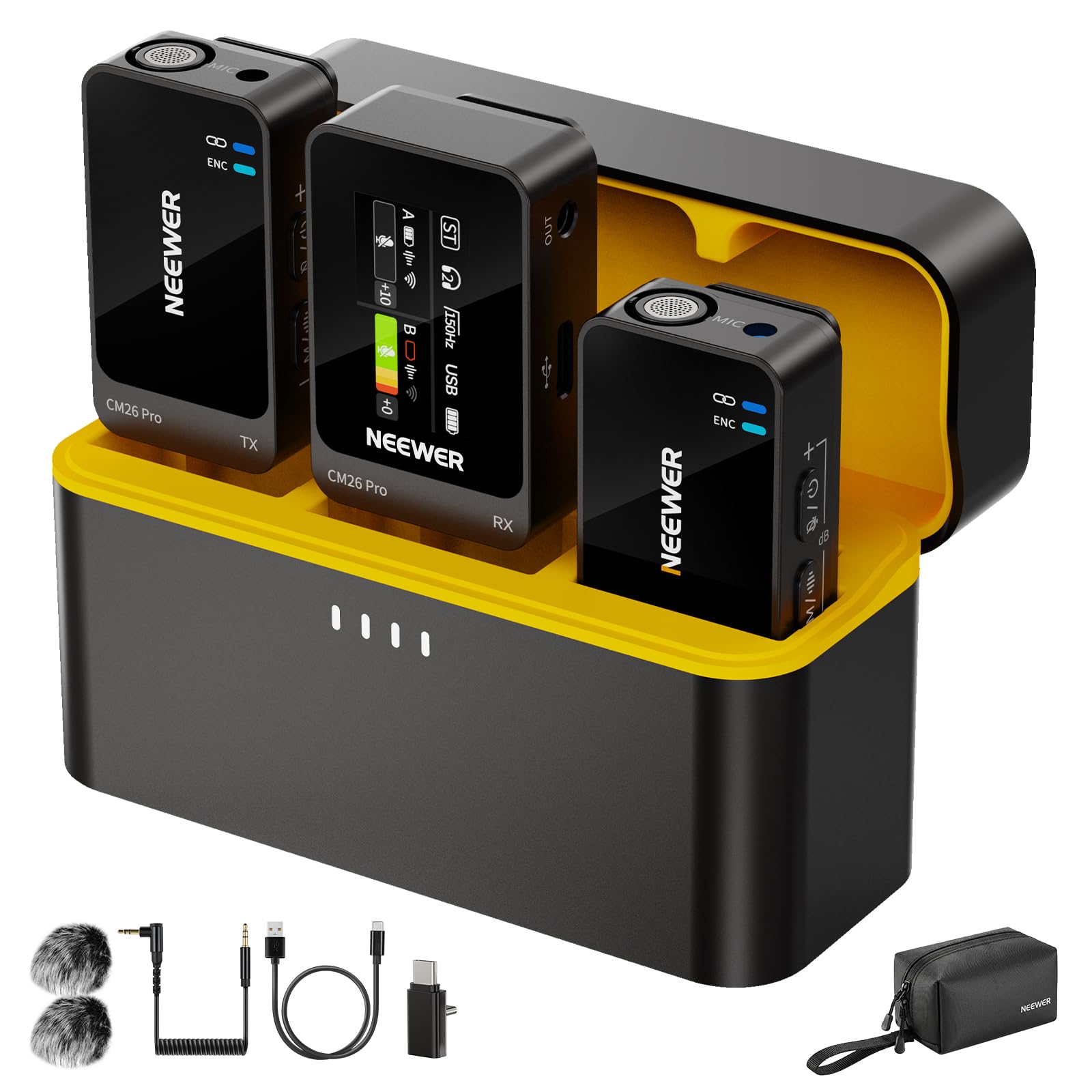
The NEEWER CM26 Pro outlasts the BOYA V30 by 14 hours with its 50-hour total battery, making it the endurance king of this guide. Its DSP (digital signal processor) and MCU (microcontroller unit) dual chips offer two AI noise cancellation levels — A1 for mild indoor sounds and A2 for aggressive outdoor wind and traffic — all controllable from the NEEWER MIC app. The studio-level sound chain includes 48kHz/24bit (higher resolution than the BOYA V30’s 16-bit), a 20Hz–20kHz frequency range, 88dB SNR, and a 120dB SPL ceiling, plus adaptive automatic gain control (AGC, which automatically adjusts volume levels) and a distortion limiter that save you from heavy post-editing. Battery life is the standout: the charging case provides 1.5 to 1.8 full recharges, pushing total runtime to 50 hours, the highest of any set here. The wireless transmission reaches 330 feet forward and 98 feet backward in open areas, so you can move freely during a shoot.
The package includes two transmitters, magnets for behind-the-collar placement, and furry windscreens. Owners particularly praise the build quality and fit, with many saying it feels comparable to systems costing three times more. The recurring caution is connectivity and battery consistency — some experienced volume variations or distortion when noise cancellation was active. Running with noise reduction off yielded cleaner audio for a few users. For the price, the audio quality and sheer flexibility of the app-based controls make this a compelling option for creators who want to tweak every setting.
Powerhouse endurance: 50 hours of total battery means you can leave the charger at home for a multi-day shoot, and the dual AI noise levels handle everything from a quiet office to a busy street.
Keep in mind: A small number of owners hit volume quirks with noise cancellation on — turning it off solved the issue. Not a dealbreaker, but worth testing.
Go for it if: You want max battery life and the ability to fine-tune noise reduction per scene without post-production.
Skip if: You need a dead-simple, no-app experience and are sensitive to occasional sound processing quirks.
4. SYNCO G2(A2) Wireless Lavalier Microphone

A camera-first wireless system that reaches 656 feet with rugged clips.
The SYNCO G2(A2) is built for serious camera work, offering a 2.4GHz digital transmission with Syncoder technology that reaches up to 656 feet line-of-sight — the longest range in the list aside from the Hollyland Lark M2. The system handles two transmitters simultaneously and supports Mono, Stereo, and a unique Safety Channel mode that records a lower-volume backup track to prevent the whistling sound of clipped audio during post-processing. Each transmitter weighs only 39g and lasts up to 8 hours on a single charge, recharged via a 3-in-1 cable in just 1.5 hours. The TFT (thin-film transistor) display screens on both transmitter and receiver show recording mode, battery status, and audio level at a glance, even in bright light.
Creators who replaced more expensive systems like RØDE did so because the SYNCO clip is rugged and magnetic, resisting the breakage that plagues some high-end brands. The 0-6 level gain control and one-touch noise cancellation give you flexibility without menu diving. The caveat is that the lavalier capsule can distort with very loud singers or high SPL sources, and the receiver auto-times-out when mics are disconnected, which is a minor frustration during multi-camera setups. Still, with sound quality being the most-discussed strength, this is a reliable workhorse for interviewers, documentary shooters, and anyone who needs a confident wireless link at long distances.
Range and reliability: The 656-foot link is real in open line-of-sight, and the safety channel is a lifesaver when you cannot monitor levels during a take.
Minor friction: The auto-power-off timer when mics are unplugged can catch you off-guard, and loud vocals can push the lavalier into distortion. Not for rock concert level audio.
Ideal for: Filmmakers and interviewers who need rock-solid range and a safety backup track without spending on pro cinema gear.
Consider alternatives if: You record loud music or vocals regularly, as the lavalier clips on high SPL sources.
5. DJI Mic Mini (2 TX + 1 RX + Charging Case)

DJI’s tiniest mic packs 48 hours of sound into a 10-gram transmitter.
The DJI Mic Mini is a featherlight powerhouse at just 10g per transmitter, making it the most discreet option on your collar for all-day vlogging or livestreaming. Despite its size, it delivers detail-rich audio with 48kHz sampling and 120dB SPL handling, plus a maximum transmission range of 400 feet for stable recording even in bustling environments. The charging case provides a total of 48 hours of battery life — enough for a week of daily shoots. For DJI ecosystem users, the OsmoAudio feature lets a transmitter connect directly to Osmo Action cameras and Pocket 3 without a receiver, a smooth integration that speeds up your setup.
Noise cancellation offers two levels: Basic for quiet indoor spaces and Strong for noisy environments, both of which keep vocals clear without the tinny processing of some competitors. The automatic limiting feature prevents audio clipping (distortion from too-loud signals) if you get loud mid-sentence. Owners rave about the build quality and the clarity of the audio, with many noting it rivals much larger systems. The catch is the premium price and the fact that the small size makes the transmitters easy to misplace, especially the magnets. Outdoor wind noise can also sneak in without the included windscreen, so budget a few seconds to attach it before going outside.
Studio sound, pocket size: The audio quality is the star here — warm, full, and well-handled in noisy spots, all from a transmitter you barely feel on your shirt.
Trade-off: The tiny size comes with a price tag above the rest, and the magnets are easy to lose between shoots. A case organizer is essential.
Perfect for: DJI Action camera users and creators who want the best portable audio in a premium, ultra-light build.
Not the best fit: Budget-first buyers or those prone to losing small accessories.
6. MAONO Wave T5 Wireless Lavalier Microphone

Pro audio presets and app-based noise controls in a 9-gram body.
The MAONO Wave T5 brings broadcast-quality features to the affordable segment, starting with a very lightweight 9g transmitter that feels like nothing on your collar. The key differentiator is the Maono Link App, which lets you choose from 4 one-tap voice filters — Vocal Enhancer, Brightness, Warmth, and Magnetic Radio — so you can dial in a podcast-ready sound or an energetic vlog tone without post-processing. The intelligent noise cancellation uses a dedicated ENC (Environmental Noise Cancellation) chip with 3 modes and 14 levels of adjustment, controllable via the app, making it the most granular system here for background noise rejection. Audio quality is true 48kHz/24-bit with an 80dB SNR and a 120dB SPL limit, capturing subtle depth while handling sudden loud moments cleanly.
The charging case provides a total of 30 hours of battery, with each transmitter running 9 hours per charge. The 300-meter open-area range and 100-meter behind-the-body range keep audio stable even when you turn your back to the receiver. Owners consistently highlight the clarity, the strong magnetic clip (which comes with a neck strap), and the premium feel of the packaging and case. The only downside is the price edge — it sits near the top of the affordable bracket — and the fact that the receiver itself does not need charging but draws power from your device. For creators who want sound shaping at their fingertips without extra gear, this is a versatile studio in your pocket.
Sound customization king: Four pro presets and 14 noise cancellation levels give you control that cheap mics simply don’t offer — great for varying recording conditions.
Price consideration: It is one of the pricier options here, but the app integration and build quality justify the spend for serious creators.
Choose this if: You want to tweak your voice profile and noise reduction from your phone without opening a DAW (digital audio workstation).
skip it if: You just want a simple, no-frills plug-and-play — the app is optional but you pay for the option.
7. RØDE Wireless Micro
RØDE’s smallest wireless kit slips onto your phone with no cables at all.
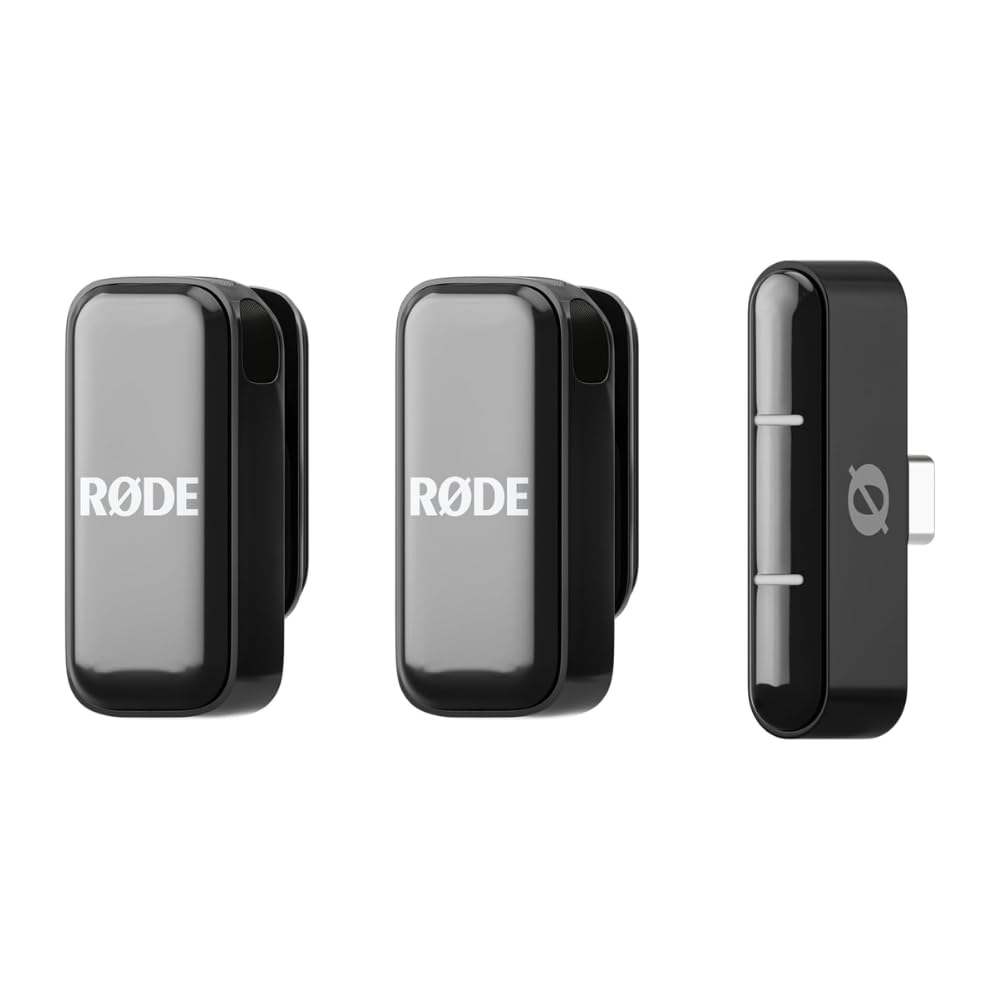
The RØDE Wireless Micro is designed specifically for smartphone content creation, connecting directly to any USB-C device with zero cables needed. The two transmitters and USB-C receiver are ultra-compact and weigh just 102.4g overall, making this the most grab-and-go kit in the list. The included charging case provides two additional full charges, bringing total battery life to 18 hours — enough for a long day of shooting. RØDE’s intelligent GainAssist technology automatically adjusts audio levels, so you never have to worry about distorted peaks or whispered voices during an interview. The magnetic attachments snap onto the receiver securely, and the furry windscreens are included for outdoor use.
Audio quality is crisp with an impressively low noise floor (the level of background hiss, here 73dB of audible noise), and owners say it beats many competitors in clarity, including slightly cheaper alternatives. The main limitation is the receiver’s short USB-C plug — it will not fit through a thick phone case, so you may need to remove the case or buy a right-angle adapter. There is no headphone monitoring jack on the receiver itself, though the RØDE Capture app can handle audio processing. For mobile-first creators who want premium RØDE quality in a pocket-sized format, this is a top contender, but the short plug is a real friction point for case lovers.
Cable-free convenience: The direct USB-C connection and automatic leveling make this the simplest premium mic to use on a phone — open the case, clip it on, and record.
Friction point: The receiver is so short it bumps into thick phone cases. You may need to go bare or buy an adapter, which adds to the bulk.
Great for: Mobile journalists, TikTok creators, and anyone who hates managing cables and wants RØDE’s reputation for audio quality.
Not for: People with rugged or thick phone cases who do not want to remove them every time they record.
8. Hollyland Lark M2 Wireless Lavalier Microphone
1000 feet of range and 40 hours of battery in a 9-gram body.
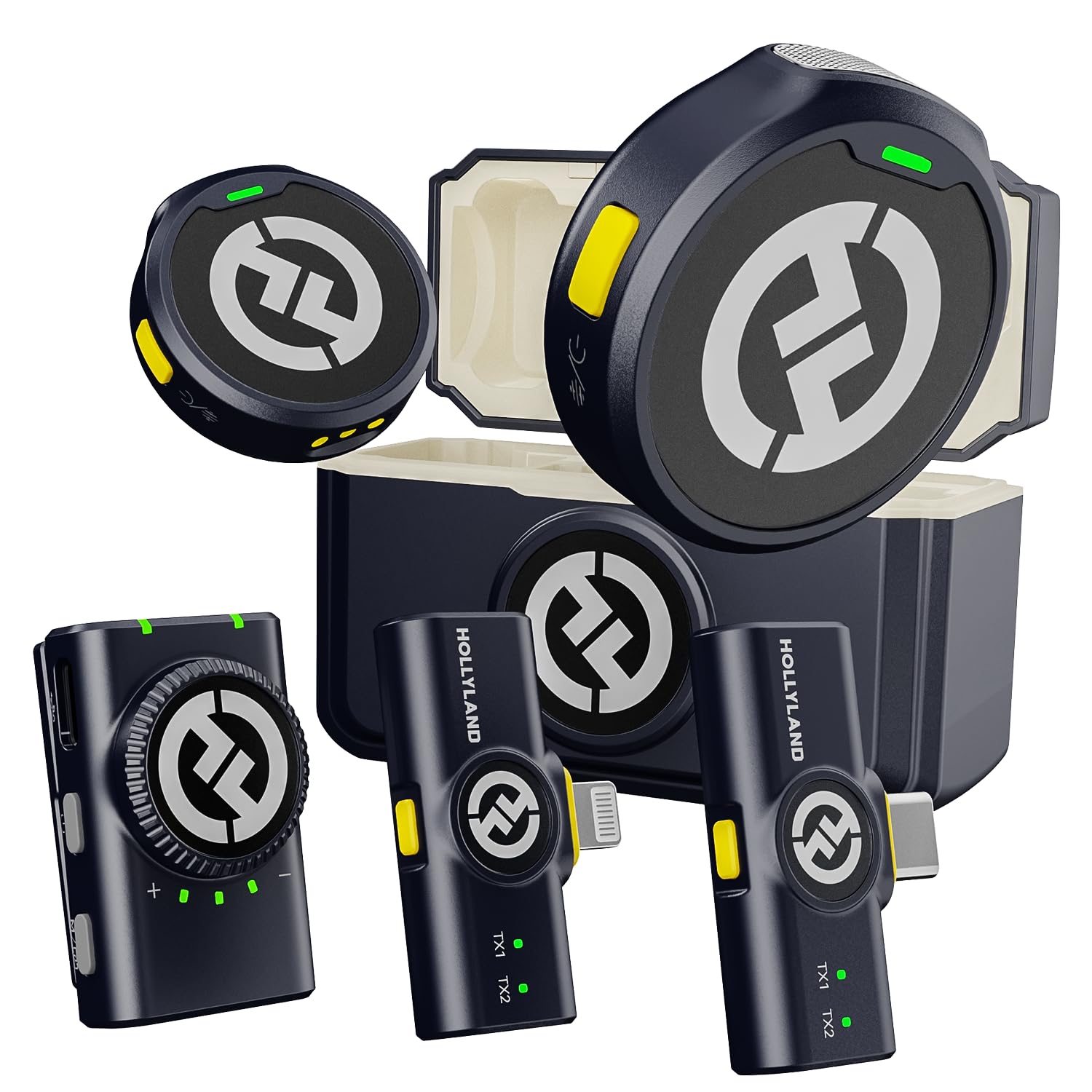
The Hollyland Lark M2 is a professional-grade system that pushes into premium territory with a 1,000-foot line-of-sight range — enough to cover an entire auditorium or outdoor field. Each transmitter weighs just 9g, the same featherlight class as the DJI Mic Mini, and the charging case supplies 40 hours of total battery life for extended event coverage. Audio quality is studio-grade at 48kHz/24bit with a 70dB signal-to-noise ratio and 115dB maximum SPL, capturing clear vocals even in high-pressure sound environments. One-click noise cancellation is activated via a yellow button on the transmitter, and the receiver’s top LED indicators show when it is active — no app needed. The system supports both mono and stereo recording modes, switchable directly on the camera version’s receiver.
The kit comes with three different receivers (Lightning, USB-C, and 3.5mm TRS), making it the most versatile compatibility option from the start: you can switch between an iPhone, an Android phone, and a DSLR camera without buying extra adapters. The LDS (laser direct structuring) antenna eliminates interference from your own body, so turning your back on the receiver doesn’t cause dropouts. Owners consistently say the audio is crisp, the magnetic clip is strong enough for heavy fabric, and the plug-and-play connection is genuinely instant. The only honest note is the higher price tag, but for those who need the longest range and fastest setup across all devices, it earns every dollar.
class-leading range and multi-device kit: 1,000 feet is real, and three included receivers mean you never fumble for a dongle when switching from phone to camera.
Premium investment: It costs the most here, but the build quality, range, and all-in-one compatibility justify the spend for pros.
Ideal for: Event videographers, stage performers, or teachers in large halls who need reliable audio from any distance — without a bag full of adapters.
Reconsider if: Your shoots never go beyond 100 feet and you are watching your budget closely.
Understanding the Specs
Battery Life (Total vs. Per Charge)
Look at two numbers: the transmitter run time per charge (usually 6–9 hours) and the total life with the charging case (18–50 hours). A high case total matters for all-day shoots; a high per-charge number helps if you forget to dock the mics between takes. The charging case essentially acts like a power bank for your transmitters, so a larger case battery translates to fewer nights charging.
Noise Cancellation Levels
Noise cancellation is not a single on/off switch. Basic mode handles constant hum (fan, air conditioner), while Strong or AI mode tackles sudden noises like traffic or chatter. Some mics let you adjust up to 14 levels via an app, giving you fine control over how much background bleed you allow. For outdoor or windy conditions, always pair the electronic noise reduction with a fuzzy windscreen for the best result.
Wireless Range and Real-World Use
The advertised range (164–1,000 feet) is measured in open, line-of-sight conditions — no walls, no crowds. In real use, expect 50–70% of that number. A mic with a 300-foot spec is still comfortable in a large conference room (about 100 feet), while a 1,000-foot system can handle a full auditorium. The 2.4GHz frequency is standard, but some mics use LDS antennas or frequency-hopping to avoid dropout when you turn your back to the receiver.
Plug-and-Play and Compatibility
True plug-and-play means the receiver acts like a regular headphone or charging dongle — no Bluetooth pairing, no app setup. USB-C receivers work with most Android phones, iPhones 15/16, and laptops. Older iPhones (Lightning) need either a dedicated Lightning receiver or a 3.5mm/Lightning adapter. For cameras, a 3.5mm TRS cable is the standard connection. Always check which cables are included in the box to avoid surprises on set.
FAQ
Will an affordable wireless microphone work with my iPhone 14 with a Lightning port?
What is the difference between mono, stereo, and safety channel modes?
How important is the charging case for a wireless microphone?
Can I use two microphones at the same time for interviews?
What is a good wireless range for a budget microphone?
How does AI noise cancellation differ from standard one-click noise cancellation?
Will these microphones work with my DSLR or mirrorless camera?
What does a 48kHz/24bit audio format mean for my recordings?
Final Thoughts: The Verdict
If you want one dependable pick, the best affordable wireless microphone winner is the BOYA V30 because it delivers the best combination of battery life (36 hours), range (328 feet), and reliable noise cancellation at a price that leaves room for other gear. If you want a two-mic kit with flexible connections for camera and phone, grab the FIFINE M9. And for maximum battery endurance and app-based audio tweaks, the NEEWER CM26 Pro is the one to reach for. The biggest takeaway from thousands of ratings is simple: You do not need to spend a fortune to sound great — the right budget mic makes your voice the star of the show.
How We Picked
We do not accept paid placement. Every pick is matched to a real buyer and a real use-case; we do not hands-on test units.
Sources & Methodology
Specifications: manufacturer listings and product documentation. Review insights: verified customer reviews, as of July 2026. Pricing: not shown on this page (it changes often); check the current price via the retailer link.
As an Amazon Associate, WellFizz earns from qualifying purchases. This does not affect which products we feature.
Related Guides

Mo Maruf
I created WellFizz to bridge the gap between vague wellness advice and actionable solutions. My mission is simple: to decode the research and give you practical tools you can actually use.
Beyond the data, I am a passionate traveler. I believe that stepping away from the screen to explore new environments is essential for mental clarity and physical vitality.