Our readers keep the lights on and my smoothie glass nicely filled. As an Amazon Associate, I earn from qualifying purchases.
The biggest trap in buying studio speakers is mistaking loudness for accuracy. A speaker that flatters your room will ruin your mix, and the affordable market is full of models that hype the low end at the cost of a transparent midrange. The goal here is not to find the cheapest pair of speakers that make noise — it is to find a pair that tells you the truth about your audio, without draining your budget.
I’m Mohammad Maruf — the founder and writer behind WellFizz. I’ve spent hundreds of hours cross-referencing driver materials, amplifier topologies, frequency response graphs, and real-world owner feedback to separate the genuinely useful from the merely marketed in the affordable studio monitor space. This guide digs into each spec and tradeoff so you know exactly what your money is buying.
From active bookshelf speakers to proper near-field reference monitors, the market for best affordable studio speakers has never been deeper, and this guide will help you navigate the key specs that separate a good purchase from a regrettable one.
How To Choose The Best Affordable Studio Speakers
Selecting a pair of studio monitors on a budget is about understanding tradeoffs. Unlike consumer speakers, studio monitors aim for a flat frequency response — no artificial bass boost, no smiley-face EQ curve. The following factors will help you decide which compromise you can live with and which one you cannot.
Driver Configuration and Woofer Size
A 4-inch woofer is typically enough for desktop near-field listening but will roll off noticeably below 80 Hz. A 5-inch driver extends bass down to around 50–55 Hz with decent authority, while 6.5-inch and 8-inch drivers push deeper but require more room and can excite standing waves in smaller untreated spaces. Match the driver size to your room volume — a 5-inch monitor is the safe sweet spot for most home studios.
Amplifier Topology and Power Ratings
Class-D amplifiers are now standard in affordable monitors because they run cool and efficient, but not all Class-D implementations are equal. Look for bi-amped designs that dedicate separate amplifier channels to the woofer and tweeter — this reduces intermodulation distortion and improves clarity at moderate volumes. Total wattage matters less than how cleanly the amp delivers power; a well-designed 30-watt amplifier can sound clearer than a cheap 80-watt one.
Cabinet Design and Port Placement
Front-ported monitors give you more placement flexibility because the port can breathe without needing clearance from a rear wall. Rear-ported models often deliver deeper extension but require at least 6–12 inches of space behind the cabinet to avoid boomy, inaccurate bass. If your desk is pushed against a wall, front-ported or sealed designs are the safer bet in this price bracket.
Connectivity and Input Options
Balanced connections (TRS or XLR) reject electrical noise better than unbalanced RCA, which is critical when running long cable runs near computer power supplies. Bluetooth is convenient for casual listening but introduces latency that makes it unsuitable for critical mixing or video sync. If you plan to connect directly to an audio interface, XLR or TRS inputs are the priority; if you are connecting to a consumer device like a laptop or turntable, RCA or Aux inputs become more relevant.
Quick Comparison
On smaller screens, swipe sideways to see the full table.
| Model | Category | Best For | Key Spec | Amazon |
|---|---|---|---|---|
| Micca PB42X | Active Bookshelf | Desktop near-field with natural mids | Carbon fiber woofer, 30W total | Amazon |
| Edifier R1280T | Active Bookshelf | Casual home listening with remote | 42W RMS, 4-inch driver | Amazon |
| PreSonus Eris E4.5 BT | Studio Monitor | Bluetooth convenience with acoustic tuning | 4.5-inch woven composite, 50W | Amazon |
| Kali Audio LP-6 V2 | Studio Monitor | Flat response in challenging rooms | 6.5-inch driver, 80W bi-amped | Amazon |
| JBL 305P MkII | Studio Monitor | Wide sweet spot and imaging | 5-inch woofer, 82W total | Amazon |
| JBL 306P MkII | Studio Monitor | Larger rooms needing deeper bass | 6.5-inch woofer, 112W total | Amazon |
| KRK Rokit 7 G4 | Studio Monitor | Players who punchy low end | 7-inch Kevlar driver, Class-D | Amazon |
| JBL 308P MkII | Studio Monitor | Maximum bass extension without a sub | 8-inch woofer, 112W total | Amazon |
| Yamaha HS5 | Studio Monitor | Reference-grade transparency for mixing | 5-inch cone, 70W bi-amped | Amazon |
In‑Depth Reviews
1. Micca PB42X

The Micca PB42X is the most transparent active speaker in the entry-level tier. Its woven carbon fiber woofer delivers surprisingly fast transient response, and the silk dome tweeter avoids the harshness that plagues cheaper metal-dome designs. The crossover is well-optimized — vocals sit forward and natural, and the stereo imaging is precise for near-field desk positioning. Bass rolls off around 80 Hz, so electronic and hip-hop producers will want a sub, but for acoustic, podcast, and mix-critical work, the PB42X gives you an honest picture.
At just 15 watts per channel, the built-in Class-D amplifier is clean but not powerful enough to fill a large untreated room cleanly above moderate listening levels. The binding posts are functional but feel less robust than the metal terminals on pricier monitors. Magnetic grilles are a nice touch, and the compact footprint makes them easy to place on a crowded desk. Out of the box, you are getting an Audiophile-adjacent sound signature that punches well above its price.
Every reviewer consistently highlights the clarity and neutrality of the PB42X as its standout strength. The bass limitation is real, but it forces you to rely on the subwoofer for low-end decisions, which is arguably better for mixing accuracy. If you work with a sub and prioritize midrange truth, is the best desk monitor at its price.
Why it’s great
- Woven carbon fiber woofer delivers fast, accurate transient response
- Silk dome tweeter provides smooth and fatigue-free treble
- Compact magnetic grilles and clean industrial design
Good to know
- Bass extension drops off around 80 Hz; subwoofer recommended
- 15W per channel limits clean headroom at high volumes
- No Bluetooth or balanced inputs — wired RCA only
2. Kali Audio LP-6 V2
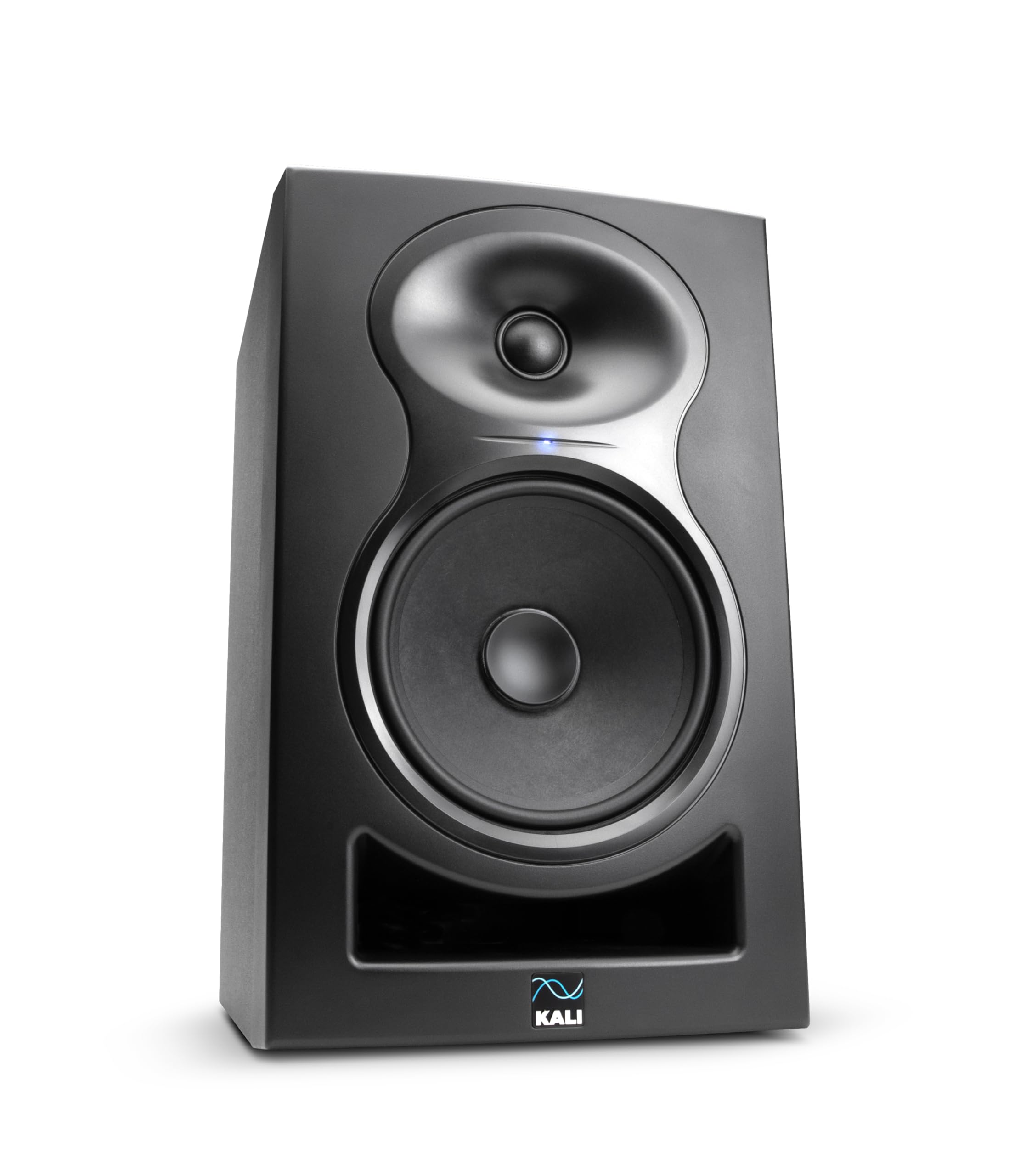
The Kali Audio LP-6 V2 is a serious step up in monitoring fidelity. The 6.5-inch woven composite woofer combines with a 1-inch silk dome tweeter in a bi-amped configuration — 40 watts for the woofer and 40 watts for the tweeter — delivering a total of 80 watts of clean power. The DSP-based boundary EQ system allows you to compensate for wall or desk placement, which is a rare feature at this price. The front port eliminates the need for rear clearance, making it one of the most placement-flexible monitors in its class.
With a frequency response of 47 Hz to 21 kHz and a max SPL of 115 dB, the LP-6 V2 can handle dynamic mixes without strain. The cabinet is made from dense MDF, which keeps resonance low even at higher output levels. The only downside reported by users is an occasional hissing noise on some units, which appears to be a quality control inconsistency rather than a design flaw. The bright front LED is mentioned as distracting in dark rooms, but a piece of tape solves that easily.
If you are mixing in a room where you cannot place speakers a foot away from the wall, the LP-6 V2’s front port and boundary EQ make it the logical choice. The accuracy is excellent, and the dip switches on the back let you fine-tune the response to match your acoustics without needing expensive room correction software.
Why it’s great
- Boundary EQ dip switches allow room-specific frequency tuning
- 80W bi-amped design provides ample headroom for near-field mixing
- Front port eliminates the need for rear wall clearance
Good to know
- Occasional hissing or humming reported on some units
- Bright front LED can be distracting in low lighting
- No Bluetooth input — wired XLR, TRS, and RCA only
3. PreSonus Eris E4.5 BT

The PreSonus Eris E4.5 BT bridges the gap between a casual listening speaker and a functional near-field monitor. The 4.5-inch woven composite woofer delivers more bass authority than the 4-inch drivers found on cheaper competitors, and the 1-inch silk dome tweeter keeps the high end smooth. Bluetooth 5.0 is built in for streaming from a phone or tablet, and the three input options — balanced TRS, unbalanced RCA, and front-panel Aux — provide flexible connectivity for a hybrid studio and entertainment setup.
The acoustic tuning controls on the rear panel let you adjust high and low frequencies by up to ±6 dB, which helps compensate for room modes or personal preference. The built-in headphone jack on the front is a practical touch for late-night monitoring without disturbing neighbors. The Class AB amplifier delivers 25 watts per channel, which is modest compared to more expensive bi-amped models but sufficient for desktop use up to moderate volumes.
Some users report that the Bluetooth connection can occasionally drop or fail to pair on the first try, and the midrange has a slight emphasis that can cause ear fatigue during long sessions. The lack of a remote control is also noted as an inconvenience. That said, for a monitor that handles both mixing and casual listening through a single pair of speakers, the E4.5 BT is a versatile and cost-effective choice.
Why it’s great
- Bluetooth 5.0 for wireless streaming from mobile devices
- Acoustic tuning controls help adapt to room acoustics
- Front-panel headphone jack and Aux input for quick access
Good to know
- Midrange emphasis can cause listening fatigue over time
- Bluetooth can occasionally disconnect or fail on first pairing
- No remote control included for volume adjustment
4. Edifier R1280T

The Edifier R1280T is a popular choice for users who want a powered bookshelf speaker with studio-style sound but need the convenience of a remote and dual auxiliary inputs. The 13mm silk dome tweeter and 4-inch full-range driver produce a balanced sound signature that leans slightly warm, making it forgiving for casual listening. The MDF wood cabinet with wood-grain vinyl finish looks more expensive than it is and fits naturally into living room or bedroom decor.
With 42 watts of total RMS power, the R1280T fills a small to medium room with ease. The side-panel bass and treble adjustment knobs let you dial in the EQ without needing an external mixer. Dual Aux inputs allow you to connect two devices simultaneously — for example, a computer and a turntable — without unplugging cables. The remote control adds genuine convenience for volume adjustments from across the room.
That said, the R1280T is not a flat studio monitor. The bass is present but lacks the tightness and extension of a dedicated studio subwoofer, and the cabinet produces some resonance at high volumes due to the relatively thin MDF. The lack of balanced inputs means it is more susceptible to noise from long cable runs. For mixing-critical work, these are outclassed by true monitors, but for enjoying music and simple content creation, they offer fantastic value.
Why it’s great
- Dual Aux inputs allow simultaneous connection of two devices
- Remote control provides convenient volume adjustment
- Attractive MDF wood cabinet blends with home decor
Good to know
- Lacks the flat frequency response needed for critical mixing
- Cabinet can resonate at higher volume levels
- No balanced XLR or TRS inputs for noise rejection
5. JBL 305P MkII (Pair)

JBL’s 305P MkII is widely considered the benchmark for affordable studio monitoring, and the MkII revision refines an already strong design. The patented Image Control Waveguide delivers a broad, well-defined sweet spot, which means you do not have to sit perfectly centered to get an accurate stereo image. The 5-inch woofer is driven by a dedicated 41-watt Class-D amplifier, and a separate 41-watt amp powers the 1-inch tweeter, giving you 82 watts total in a bi-amped configuration.
The Boundary EQ switch on the rear panel compensates for desk or wall proximity without introducing phase issues. The Slip Stream port reduces low-frequency turbulence, so the bass stays clean even when you push the volume. The cabinet is made from ABS rather than MDF, which slightly reduces cabinet resonance but also lowers weight. The overall frequency response is remarkably neutral, and the HF Trim switch lets you attenuate high frequencies in bright rooms.
User feedback consistently praises the 305P MkII for its clarity, depth, and separation. The transition from smaller budget monitors to the 305P MkII is often described as hearing new detail in familiar tracks. The only compromises are the ABS cabinet, which feels less premium than MDF, and a faint hiss that is present at idle but becomes inaudible once audio plays. For a balanced, accurate sound that translates well to other systems, this is the pair to beat.
Why it’s great
- Image Control Waveguide creates a wide and accurate sweet spot
- Bi-amped design with 41W per driver delivers clean headroom
- Boundary EQ and HF Trim switches adapt to room placement
Good to know
- ABS cabinet feels less premium than MDF enclosures
- Faint hiss at idle that disappears with audio playback
- Requires balanced TRS or XLR cables for optimal performance
6. JBL 306P MkII (Pair)

The JBL 306P MkII takes everything that works in the 305P and scales it up to a 6.5-inch woofer, delivering deeper bass extension and higher maximum output without sacrificing neutrality. The bi-amped configuration provides 56 watts to the woofer and 56 watts to the tweeter for a total of 112 watts, which provides plenty of clean headroom for medium-sized rooms. The Image Control Waveguide is retained, so the off-axis response remains consistent.
The larger cabinet and driver mean this pair needs more physical space and benefits from a little distance from the listening position — a minimum of 3 to 4 feet is ideal. The Boundry EQ and HF Trim switches are present, giving you the same placement flexibility as the smaller 305P. The bass response extends lower with more authority, allowing you to work on bass-heavy genres without immediately needing a subwoofer.
Users upgrading from 5-inch monitors note the added warmth and weight in the low midrange. The pair excels in spaces where a subwoofer is not practical but deeper bass is required. The only real catch is the physical size — these are large for a desktop setup — and the same faint idle hiss present in the 305P MkII remains. For a larger room or a producer working in bass-heavy genres, the 306P MkII is the logical upgrade.
Why it’s great
- 6.5-inch woofer provides deeper bass extension than the 305P
- 112W bi-amped power delivers high headroom for medium rooms
- Boundry EQ and Image Control Waveguide maintain placement flexibility
Good to know
- Large physical footprint requires significant desk space
- Idle hiss is faint but noticeable in quiet environments
- Best paired with an audio interface for clean signal routing
7. KRK Rokit 7 G4 (Pair)

The KRK Rokit 7 G4 is the most visually distinctive monitor in this guide, with its yellow Kevlar cone and front-firing port. The 7-inch woofer made from Kevlar composite is stiff and lightweight, giving the Rokit a punchy, articulate low end that handles electronic music and hip-hop particularly well. The built-in 1-inch tweeter uses a Kevlar dome as well, and the visual DSP-driven EQ on the front allows you to adjust the sound profile across three bands.
This is not the flattest monitor in its price range. The Rokit 7 G4 introduces a slight bump in the low mids that makes mixes sound more exciting than the source material — useful for vibing but risky for critical mixing decisions. The onboard DSP features multiple EQ modes and an LCD screen for adjustments, which is ahead of most competitors in usability. Bluetooth is built in for streaming, though again, latency prevents it from being useful for video work.
Users appreciate the build quality and clear audio at conversational volumes. The Class-D amplifier runs cool, and the front LED logo doubles as a power indicator — a polarizing design choice. The Rokit 7 G4 excels as a monitor for listening and production in genres where a slightly enhanced low end is desirable, but purists looking for transparent room correction may prefer a more neutral option like the Kali LP-6 V2 or the JBL 305P MkII.
Why it’s great
- Kevlar driver provides punchy, articulate bass response
- Onboard LCD-enabled DSP EQ offers flexible sound tuning
- Front-firing port allows placement close to walls
Good to know
- Not perfectly flat; slight low-mid bump colors the sound
- Front LED logo is bright and may be distracting
- Bluetooth adds latency, limiting its use for video sync
8. JBL 308P MkII (Pair)

The JBL 308P MkII moves to an 8-inch woofer, giving you the deepest bass extension of any monitor in this roundup without requiring a separate subwoofer. The bi-amped design delivers 56 watts to the woofer and 56 watts to the tweeter — same amplifier architecture as the 306P MkII — but the larger cone area moves more air, extending the usable response down into the low 40 Hz range. The 8-inch driver also handles higher SPL before distorting, making this pair suitable for larger rooms or high-volume monitoring.
The rear port requires at least 6 to 12 inches of clearance from the wall to avoid boomy bass, but the Boundry EQ switch can help compensate. The Image Control Waveguide remains excellent, with a broad sweet spot that maintains accuracy even when you shift your listening position. The cabinet is larger and heavier — each unit weighs about 24 pounds — so stable speaker stands or a sturdy desk are essential.
Users note that the HF Trim switch often needs to be set to -10 dB for near-field desktop use, as the tweeter can be overly bright in untreated rooms. The plastic covering on the cabinet is prone to micro-scratches, so careful handling is advised. For producers who need to feel the bass in their chest without adding a sub, the 308P MkII delivers that experience while staying in the balanced JBL family sound.
Why it’s great
- 8-inch woofer provides deep bass extension into the low 40 Hz range
- Bi-amped 112W design handles high SPL without distortion
- Broad sweet spot from the Image Control Waveguide
Good to know
- Large and heavy; requires substantial desk or stand space
- HF Trim often needs adjustment for near-field listening
- Rear port requires clearance to avoid boomy bass
9. Yamaha HS5 (Pair)

Yamaha’s HS5 is a reference-standard monitor that emphasizes sonic purity above all else. The 5-inch cone woofer and 1-inch dome tweeter are housed in a two-way bass reflex cabinet, and the bi-amped system delivers 45 watts to the low-frequency driver and 25 watts to the tweeter. The frequency response is specified at 54 Hz to 30 kHz, and the presentation is ruthlessly neutral — there is no coloration, no hype, just the signal as it was recorded.
The room control and high trim switches on the rear panel allow subtle adjustments for placement, but the HS5 rewards careful positioning. The response takes no prisoners; if your mix has harshness in the upper mids, the HS5 will reveal it without flinching. This is exactly what you want for mastering and mix translation, but it can be fatiguing for casual listening. Many users report that pairing the HS5 with a subwoofer is necessary for full-range monitoring.
The build quality is exceptional for the price — the MDF cabinet is stiff and damped, and the XLR and TRS inputs support balanced and unbalanced signals. Buyers consistently call the HS5 a huge upgrade from cheaper monitors, citing improved stereo imaging and detail retrieval. The only real downsides are the modest bass extension and the clinical nature of the sound, which is not to everyone’s taste. For reference mixing and mastering on a budget, the HS5 remains the gold standard.
Why it’s great
- Exceptionally neutral and transparent frequency response
- Bi-amped 70W design provides clean, detailed sound
- Sturdy MDF cabinet with high-quality XLR and TRS inputs
Good to know
- Bass extension is limited; a subwoofer is recommended
- Clinical sound can be fatiguing for extended listening
- Requires careful placement and an audio interface for best results
FAQ
Do I need an audio interface for studio monitors?
How far should I sit from near-field studio monitors?
What is the difference between a studio monitor and a bookshelf speaker?
Can I use Bluetooth studio monitors for mixing?
Should I buy a subwoofer with affordable studio monitors?
Final Thoughts: The Verdict
For most users, the best affordable studio speakers winner is the JBL 305P MkII because it offers the best balance of neutral frequency response, wide sweet spot, room-adjustment flexibility, and consistent build quality at a price that undercuts most competitors. If you want deeper bass without a subwoofer, grab the JBL 306P MkII. And for pure reference-grade transparency in a compact form factor, nothing beats the Yamaha HS5.

Mo Maruf
I created WellFizz to bridge the gap between vague wellness advice and actionable solutions. My mission is simple: to decode the research and give you practical tools you can actually use.
Beyond the data, I am a passionate traveler. I believe that stepping away from the screen to explore new environments is essential for mental clarity and physical vitality.