Our readers keep the lights on and my smoothie glass nicely filled. As an Amazon Associate, I earn from qualifying purchases.
Finding a pair of speakers that deliver clear highs, tight bass, and a convincing soundstage without bankrupting you is the holy grail of budget audio. The market is flooded with plastic boxes claiming high fidelity, but the real gems use proper crossover networks, silk dome tweeters, and rigid MDF cabinets to keep distortion low and imaging precise.
I’m Mohammad Maruf — the founder and writer behind WellFizz. I’ve spent years analyzing frequency response graphs, crossover slopes, and driver materials to separate genuine value from marketing hype in the stereo speaker space.
Whether you are building a desk setup, a living room system, or a home theater on a tight budget, this guide to the best affordable stereo speakers will help you match the right drivers and design to your room and amplifier.
How To Choose The Best Affordable Stereo Speakers
The right choice depends heavily on whether you already own an amplifier, how much space you have, and what kind of sound signature you prefer. Here are the three factors that separate a good budget speaker from a disappointing one.
Passive vs. Powered: Which Architecture Fits Your Setup?
Passive speakers (like the Audio Express Koe’ B102 or Sony CS5M2) require a separate stereo receiver or amplifier to drive them. They offer maximum flexibility for future upgrades and typically use higher-quality crossover components because the power supply lives in the amp. Powered speakers (like the PreSonus Eris Accent or Edifier R1280T) have the amplifier built into one cabinet. They simplify the setup to just a source cable and a power cord, making them ideal for desks, turntable rigs, or spaces where an AVR feels like overkill.
Driver Size and Cabinet Volume: The Physics of Low End
A 4-inch woofer in a sealed box (Micca MB42X G2) will give you fast, tight bass down to roughly 55Hz. A 6.5-inch driver in a ported tower cabinet (Rockville RockTower 68C or Dayton Audio T65) can reach to 30Hz, but the speaker will be much larger. If you listen to acoustic jazz or vocals, compact bookshelf speakers work beautifully. For electronic music or action movies, a larger driver or a dedicated subwoofer will prevent the speakers from sounding thin at moderate volumes.
Tweeter Material and Crossover Quality: The Fatigue Factor
Silk dome tweeters (found on the Pyle 5.25″, Sony SS-CS5M2, and Dayton T65) deliver smooth, non-fatiguing highs that let you listen for hours without ear strain. Aluminum or titanium tweeters (Klipsch R-41M) can sound more detailed and aggressive, but they may cause listening fatigue in smaller rooms or with bright amplifiers. A well-designed crossover network—typically a 12dB/octave slope—ensures the woofer and tweeter blend seamlessly, preventing a harsh “shouty” midrange.
Quick Comparison
On smaller screens, swipe sideways to see the full table.
| Model | Category | Best For | Key Spec | Amazon |
|---|---|---|---|---|
| Klipsch R-41M | Passive Bookshelf | High sensitivity with horn-loaded detail | 90dB sensitivity / 4″ IMG woofer | Amazon |
| Dayton Audio T65 | Passive Tower | Full-range floorstanding bass without a sub | Dual 6.5″ woofers / 150W RMS | Amazon |
| Edifier R1280T | Powered Bookshelf | Simple plug-and-play for turntables or PCs | 42W RMS / Dual AUX input | Amazon |
| Sony SS-CS5M2 | Passive Bookshelf | 3-way design for detailed mids and highs | 3-way / 5.12″ woofer / Hi-Res Audio | Amazon |
| PreSonus Eris Accent | Powered Bookshelf | Studio monitor sound with remote control | 50W RMS / 4″ woofer / USB-C input | Amazon |
| Audio Express Koe’ B102 | Passive Bookshelf | Individually tested pairs with SPL graph | 5.25″ woofer / 100W RMS | Amazon |
| Pyle 5.25″ Pair | Passive Bookshelf | Wood-finish aesthetics with rubber surrounds | 200W max / 6-ohm impedance | Amazon |
| Micca MB42X G2 | Passive Bookshelf | Compact 4″ carbon fiber woofer for nearfield | 4″ CF cone / 55Hz-20kHz | Amazon |
| Rockville RockTower 68C | Passive Tower | 3-way tower with dual 6.5″ woofers | 500W peak / 87dB sensitivity | Amazon |
In‑Depth Reviews
1. Klipsch R-41M Reference Bookshelf Speakers (Pair)
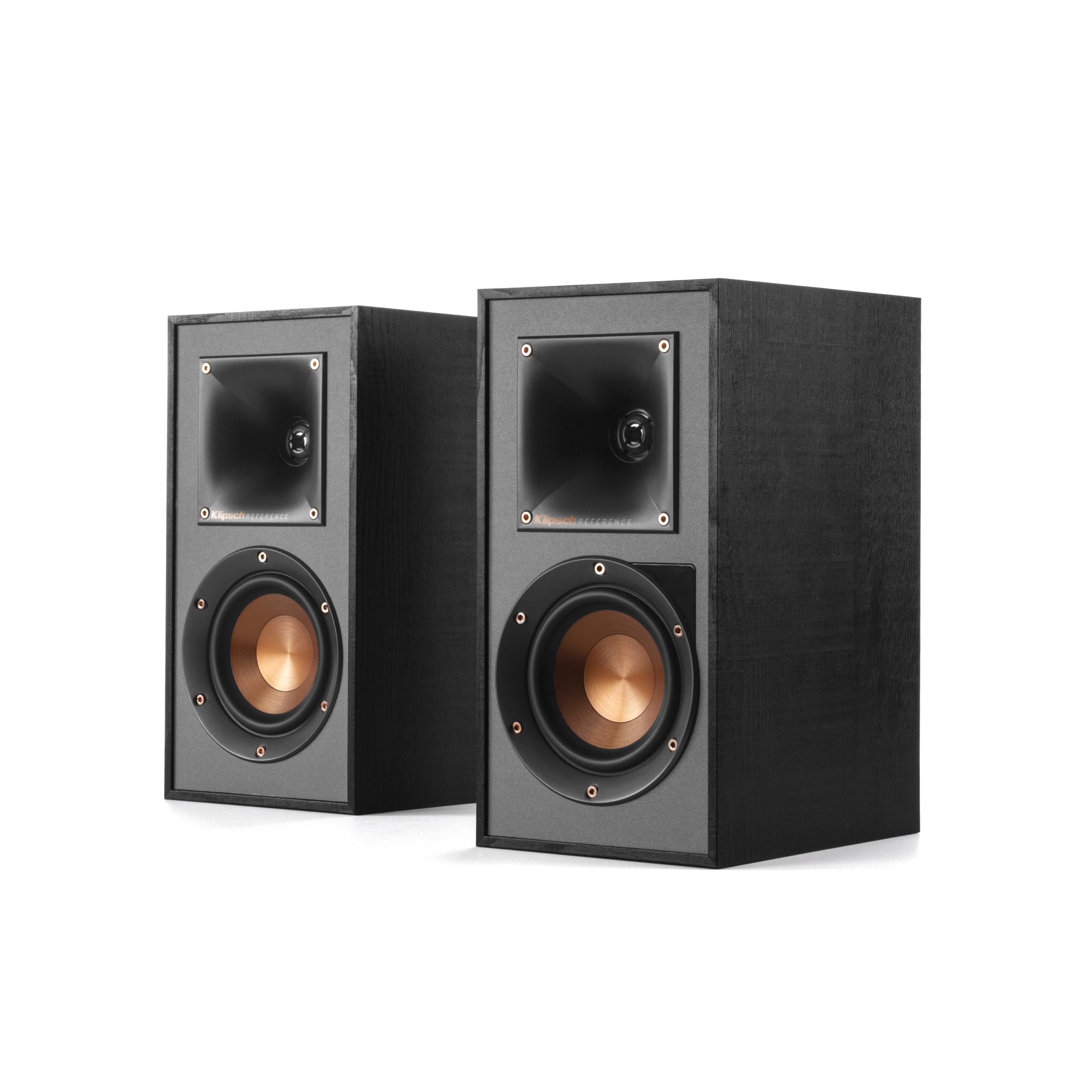
The Klipsch R-41M is the benchmark for high-efficiency budget speakers. With a 90dB sensitivity rating, they produce substantial volume from even modest amplifiers—a 20-watt tube amp drives them to room-filling levels with ease. The 1-inch aluminum LTS tweeter mated to a 90×90 square Tractrix Horn delivers crisp, articulate highs, though some listeners may find it too bright in small reflective rooms without careful toe-in adjustment.
The 4-inch spun-copper IMG woofer produces tight, punchy mid-bass but does not reach deep into sub-50Hz territory. In a nearfield desk setup or small living room, the R-41M creates a wide soundstage with excellent imaging. The reinforced MDF cabinet with textured wood grain vinyl resists scratches and keeps cabinet resonance low, preserving clarity even at moderately high volumes.
These speakers reward quality source material and pairing with a subwoofer crossed at 80Hz. The 8-ohm nominal impedance and 50W continuous power rating make them compatible with most budget stereo receivers. Just be ready for a slight break-in period—the aluminum tweeter softens after about 20 hours of play, smoothing out any initial harshness.
Why it’s great
- High 90dB sensitivity works with low-power amps
- LTS aluminum tweeter provides exceptional detail and airiness
- Solid MDF cabinet reduces coloration and resonance
Good to know
- Horn-loaded tweeter can sound bright in rooms with hard surfaces
- 4-inch woofer struggles with deep bass, subwoofer recommended
- Requires careful placement to avoid listener fatigue
2. Dayton Audio Classic T65 Floor-Standing Tower Speaker Pair

The Dayton Audio T65 tower speakers skip the need for stands by placing the 1-inch silk dome tweeter at ear level in a cabinet that stands over 39 inches tall. That tall, bass-reflex cabinet houses two 6.5-inch polypropylene woofers, giving them an air-moving advantage over any bookshelf speaker in a similar price bracket. The result is full-bodied, punchy bass that fills a medium-sized room without a separate subwoofer.
The crossover network uses real components—not just a capacitor on the tweeter—which produces a cohesive blend between the woofers and the tweeter. The silk dome tweeter remains smooth and non-fatiguing across long listening sessions, handling complex passages in orchestral music without grain. Gold-plated binding posts accept banana plugs for a clean, secure connection with 12 AWG speaker wire.
These speakers shine with a minimum of 50W RMS from a quality stereo receiver. They do require about 30 hours of break-in for the woofers to loosen up and the bass to become less pronounced and more controlled. If you want floorstanding presence and real low-end extension without spending on stands or a sub, the T65 delivers.
Why it’s great
- Dual 6.5-inch woofers produce deep, room-filling bass
- Silk dome tweeter remains smooth and fatigue-free
- No stands needed—integrated floorstanding design
Good to know
- Initial bass can seem boomy before 30-hour break-in
- Requires a receiver with at least 50W RMS per channel
- Oak veneer finish is basic, not furniture-grade
3. Edifier R1280T Powered Bookshelf Speakers

The Edifier R1280T is the quintessential entry-level powered speaker for anyone who wants good sound without buying a separate amplifier. The built-in amplifier delivers 42 watts RMS—21 watts per channel—which is enough to fill a bedroom or small office with clear, balanced audio. The 13mm silk dome tweeter and 4-inch full-range driver work together to produce a natural, non-fatiguing sound signature suited for everything from podcasts to vinyl playback.
Dual AUX inputs let you connect two sources simultaneously, such as a turntable and a smartphone, without unplugging cables. The included remote control adjusts volume from across the room, while bass and treble knobs on the side panel give you quick tonal adjustment. The MDF cabinet with wood-effect vinyl looks clean on a desk or media console and keeps cabinet vibrations low compared to plastic alternatives.
The primary limitation is bass extension—the 4-inch drivers roll off below 60Hz. Adding a powered subwoofer via the headphone output transforms the system into a capable 2.1 setup. Setup is genuinely five minutes: connect the supplied RCA cable, plug in power, and you’re listening. For pure simplicity at a reasonable cost, the R1280T is hard to beat.
Why it’s great
- Simple plug-and-play, no separate amplifier needed
- Dual AUX inputs allow two devices connected at once
- Side-panel bass and treble controls with included remote
Good to know
- Limited bass extension, subwoofer recommended for full range
- No Bluetooth—must use wired connection
- Speaker wire between left and right units is fixed length
4. Sony CS Speakers, SS-CS5M2 3-Way Bookshelf Pair

The Sony SS-CS5M2 is a rare three-way bookshelf speaker at this price point, with a dedicated 5.12-inch woofer, a high-precision tweeter, and a wide-dispersion super tweeter. This configuration delivers superior midrange detail and airiness in the top octaves compared to typical two-way designs. The frequency response extends to 50kHz for Hi-Res Audio content, revealing subtle harmonics and spatial cues in well-recorded tracks.
The bass-reflex enclosure with a reinforced cellular cone keeps distortion low even when pushed near the 80W peak rating. In a medium-sized room paired with a quality AVR, the CS5M2 produces a wide, enveloping soundstage. The mids are forward enough for clear dialogue in movies, and the super tweeter adds an effortless sense of space that makes cymbals and strings sound natural rather than etched.
These speakers benefit from a subwoofer for deep bass below 50Hz and from careful rear-port clearance—at least six inches from the wall. The 6-ohm impedance is stable with most modern receivers. If you prioritize midrange clarity and treble detail over raw bass slam, the Sony SS-CS5M2 delivers a sophisticated listen that punches well above its budget placement.
Why it’s great
- Three-way design with dedicated super tweeter for airy highs
- Hi-Res Audio certified with 50kHz upper limit
- Excellent midrange clarity for vocals and acoustic instruments
Good to know
- Requires rear port clearance of at least 6 inches
- Subwoofer needed for full low-end extension
- Best performance when paired with a quality external amplifier
5. PreSonus Eris Accent Powered Bookshelf Speakers
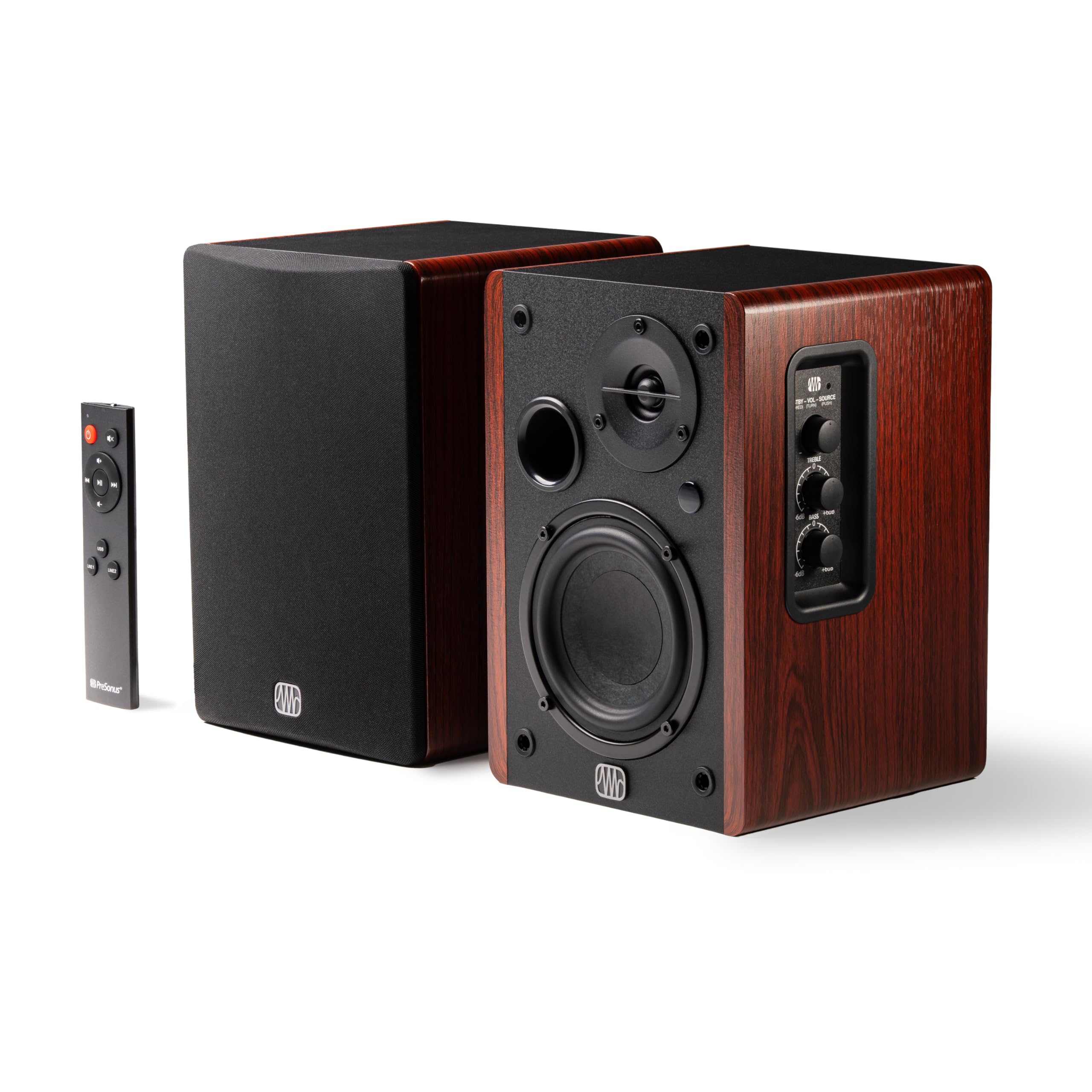
The PreSonus Eris Accent brings studio-monitor DNA to the budget powered speaker category. With 50 watts RMS total (25W per channel) driving a 4-inch paper woofer and a half-inch silk dome tweeter, these speakers deliver a relatively flat, honest frequency response suited for music production, critical listening, and desktop use. The 2.8kHz crossover point is well-chosen to keep the vocal region smooth and natural.
Flexible connectivity sets the Eris Accent apart: USB-C for direct connection to a computer, plus RCA inputs for a turntable or CD player. The RCA subwoofer output lets you add a sub without adapters. Onboard volume, treble, and bass controls let you dial in the sound to your room, and the included remote adjusts volume and media playback from your listening position. The wood grain vinyl finish looks more expensive than it is.
The default voicing is slightly bass-heavy, which some users will enjoy for pop and electronic music, but a quick adjustment of the bass knob flattens the response. The 4-inch woofers cannot produce deep sub-bass, but the mid-bass punch is satisfying for their size. If you want a powered set with studio monitor lineage, remote control, and modern connectivity, the Eris Accent is a strong contender.
Why it’s great
- USB-C input for direct computer connection with clean audio
- Remote control and separate treble/bass knobs for easy tuning
- RCA subwoofer output simplifies adding a sub
Good to know
- Default sound is slightly bass-heavy, needs EQ adjustment
- 4-inch woofers limit deep bass extension
- Grilles slightly muffle the high frequencies when attached
6. Audio Express Koe’ B102 Passive Bookshelf Speakers

The Audio Express Koe’ B102 is a passive bookshelf speaker that punches above its weight through rigorous quality control. Each pair ships with its own SPL and frequency response graph, verifying that the left and right units are closely matched—a practice usually reserved for speakers costing three times as much. This level-matching translates directly to accurate stereo imaging and a cohesive soundstage.
The 5.25-inch dynamic driver in a ported MDF cabinet produces surprisingly deep, tight bass for its size, while the silk dome tweeter delivers crisp, non-harsh highs. At 100W RMS power handling, these speakers pair well with vintage receivers and modern compact amplifiers alike. The low-resonance cabinet construction and precision-wound voice coils minimize distortion even at moderate to high listening levels.
Users report that these speakers deliver a soundstage that rivals the Klipsch R-51M at a fraction of the cost, with deep bass and clear mids that work well for both music and home theater. They are wall-mountable with keyhole brackets and compact enough for desktop use. If you value precision-matched performance and don’t mind a passive setup, the Koe’ B102 offers audiophile consistency on a budget.
Why it’s great
- Each pair ships with an individual SPL/frequency response graph
- 5.25-inch woofer delivers impressive bass extension for the size
- Low-resonance MDF cabinet and precision crossover design
Good to know
- Passive design requires an external amplifier or receiver
- Black vinyl veneer finish is basic, not premium wood grain
- Best performance requires careful speaker placement
7. Pyle 5.25″ Home Audio Bookshelf Speakers Pair
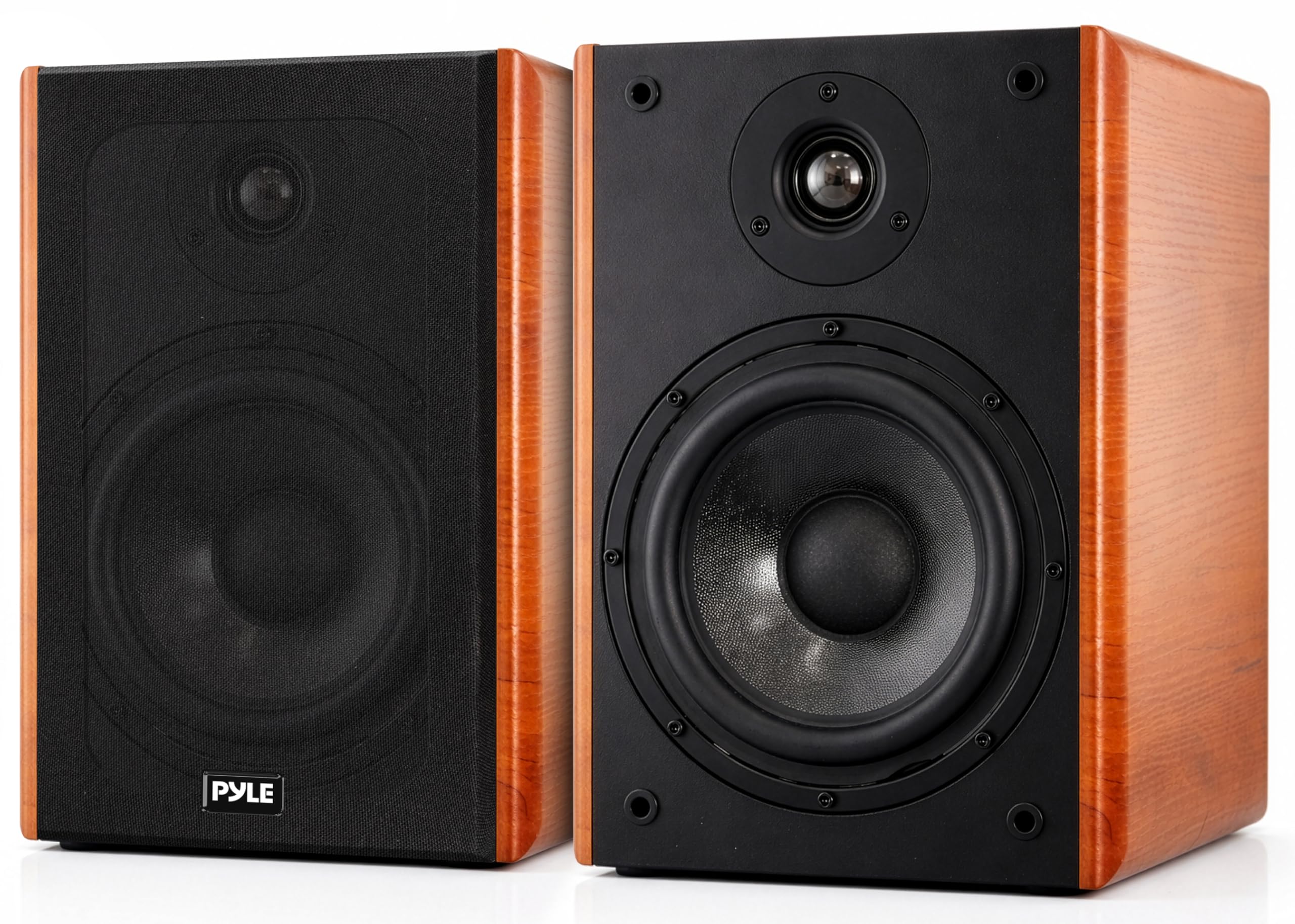
The Pyle 5.25-inch bookshelf speakers offer a classic wood-grain appearance that blends easily with traditional home decor. The 1-inch silk dome tweeter is paired with an aluminum voice coil and a rubber-surround composite woofer, producing sound that is clear and free of distortion up to the 200W max peak. At 100W RMS and 6-ohm impedance, they are easy to drive with most home theater receivers or stereo amplifiers.
Reviewers consistently note that these speakers outperform their modest price tag, with some comparing the clarity favorably to premium Klipsch models costing nearly three times as much. The rubber surrounds on the woofer help extend the life of the driver and improve low-end response by allowing longer cone excursion without damage. The detachable magnetic grille adds a clean aesthetic when the drivers are hidden or a traditional look when attached.
These speakers are best suited for small to medium rooms where they can be placed on a bookshelf or desk. The compact dimensions (11.4 x 7.5 x 9.5 inches) fit well in tight spaces. The bass is tight and punchy but does not reach sub-40Hz territory; a subwoofer will fill the bottom octave. For a budget-friendly passive pair that looks and sounds better than the price suggests, the Pyle 5.25″ speakers deliver.
Why it’s great
- Classic wood-grain finish fits traditional home decor
- Rubber surrounds on woofers improve durability and bass response
- Detachable grille offers flexible aesthetic options
Good to know
- Bass extension is limited, subwoofer recommended for full range
- 6-ohm impedance may limit compatibility with some budget amps
- Bluetooth specification is listed but requires external adapter
8. Micca MB42X G2 Passive Bookshelf Speakers

The Micca MB42X G2 is the refined successor to a classic budget speaker, upgrading to a 4-inch carbon fiber woven woofer with a rubber surround. The carbon fiber cone is stiffer and lighter than the original material, resulting in faster transient response and cleaner bass for its size. The precision-tuned 12dB/octave crossover ensures a neutral tonal balance, with the 0.75-inch silk dome tweeter rolling in smoothly rather than abruptly.
In nearfield listening on a desk, the MB42X G2 creates a surprisingly spacious soundstage with well-defined imaging. The ported enclosure helps extend the low end to 55Hz, producing more bass than you would expect from a 4-inch driver. Vocals are clear and present without being shouty, and the tweeter has been tamed compared to the first generation, reducing fatigue over long listening sessions.
These speakers do their best work when paired with a subwoofer crossed around 80Hz—without one, you will miss the bottom octave of bass-heavy tracks. They also require a 100-hour break-in period for the woofer suspension to loosen. The compact size (9.5 x 5.8 x 6.5 inches) and 80W RMS power handling make them ideal for a desktop 2.1 system or a small surround setup.
Why it’s great
- Carbon fiber woven woofer offers fast, clean transient response
- Neutral, 12dB/octave crossover for balanced, non-fatiguing sound
- Compact size fits easily on a desk or shelf
Good to know
- Needs 100+ hours of break-in for optimal performance
- Subwoofer required for deep bass extension
- 4-inch driver limits maximum SPL in large rooms
9. Rockville RockTower 68C Passive Tower Speaker

The Rockville RockTower 68C is a three-way tower speaker built for buyers who want floorstanding presence without spending on separate bookshelf stands. The configuration includes dual 6.5-inch woofers, a 6.5-inch midrange driver, and a 1-inch silk dome tweeter, producing a frequency response from 30Hz to 20kHz. The 8-ohm impedance and 87dB sensitivity mean they perform well with most home theater receivers.
The classic wood grain MDF cabinet with a detachable grille mimics the look of vintage towers without the weight. Despite the tall form factor, these speakers are relatively lightweight and easy to position. Users report clear mids and highs with a strong bass presence, though the low end benefits from a subwoofer for the deepest notes. The 500W peak handling gives them headroom for party-level volume without immediate distortion.
The RockTower 68C is sold as a single speaker, so you need to order two for a stereo pair. They are best suited for a home theater setup where the 3-way design adds clarity to dialogue and effects. For pure music listening, they deliver solid performance that reviewers say improves noticeably over older bookshelf speakers. If you want the look and feel of towers at an entry-level price, the RockTower 68C delivers.
Why it’s great
- Three-way design with dedicated midrange driver improves clarity
- Dual 6.5-inch woofers deliver substantial bass presence
- Classic wood grain finish blends with most home decor
Good to know
- Sold individually—buy two for a stereo pair
- Bass response benefits from a subwoofer for deep extension
- Lightweight construction may not match heavier, pricier towers
FAQ
Do I need a subwoofer with affordable bookshelf speakers?
Can I use affordable passive speakers with a cheap mini amplifier?
Does the wood grain vinyl finish affect sound quality?
How much space should I leave behind a rear-ported speaker?
Final Thoughts: The Verdict
For most users, the best affordable stereo speakers winner is the Klipsch R-41M because its 90dB sensitivity and horn-loaded tweeter deliver stunning clarity and dynamics from low-power amplifiers, making it the most versatile performer across desk, living room, and home theater setups. If you want deep, floorstanding bass without a separate subwoofer, grab the Dayton Audio T65 with its dual 6.5-inch woofers. And for pure plug-and-play simplicity with studio monitor roots, nothing beats the PreSonus Eris Accent with its remote control and USB-C input.

Mo Maruf
I created WellFizz to bridge the gap between vague wellness advice and actionable solutions. My mission is simple: to decode the research and give you practical tools you can actually use.
Beyond the data, I am a passionate traveler. I believe that stepping away from the screen to explore new environments is essential for mental clarity and physical vitality.