Our readers keep the lights on and my smoothie glass nicely filled. As an Amazon Associate, I earn from qualifying purchases.
Specs are compiled from manufacturer listings and verified buyer reviews and can change over time — please confirm the key details on the product page before buying.
You want a real camera—something with interchangeable lenses, a proper viewfinder, and the ability to capture the moment your kid scores the winning goal or the light hits the landscape just right. But the price tags on the newest mirrorless bodies can make your eyes water. That is where this guide steps in. It cuts through the noise of specs and marketing hype to find you an affordable digital slr that delivers real performance without demanding you take out a loan.
I’m Mohammad Maruf — the founder and writer behind WellFizz. This guide is built by comparing the manufacturers’ published specifications and the patterns across verified customer reviews, so you get each pick’s real strengths and trade-offs instead of marketing spin.
The market for entry-level and mid-range DSLRs is surprisingly deep, with fantastic used and renewed models from both Canon and Nikon that serve beginners and experienced hobbyists alike.
Our Picks at a Glance


How To Choose The Best Affordable Digital SLR
Picking your first DSLR (digital single-lens reflex camera — the traditional camera that uses a mirror to show you exactly what the lens sees through the viewfinder) can feel overwhelming. There are acronyms like APS-C, terms like ISO, and a dizzying array of autofocus points. This section breaks down the few things that actually matter when you are buying on a budget, so you can focus on taking pictures instead of figuring out jargon.
Megapixels and Sensor Size: More Isn’t Always Better
Every camera in this guide uses an APS-C sensor (a sensor about the size of a postage stamp that balances image quality and cost). You will see numbers like 24.1MP or 24.2MP. For most people, that difference is invisible in practice. What matters more is how the camera handles that resolution. A clean 24MP image from a well-built sensor will look fantastic for prints, social media, and family albums. Do not get fixated on the race to a slightly higher number; all the cameras here deliver excellent detail.
Autofocus Points: How the Camera Tracks Your Subject
This is a spec that directly affects your success rate with moving subjects. A camera with more autofocus (AF) points — like 39 or 51 — can track a running child or a dog across the frame more reliably than one with just 9 or 11 points. Think of AF points as tiny sensors across the image that lock focus. More points give the camera more coverage of the scene, meaning it can follow action into the corners of your photo, not just the center. For static portraits and landscapes, even 9 points are plenty.
Frame Rate (fps): Capturing the Action
Measured in frames per second (fps), this tells you how many photos the camera can take in one second while you hold down the shutter button. A rate of 3 to 5 fps is standard for affordable models. 3 fps is fine for portraits and still life. 5 fps or 6 fps gives you a much better chance of catching the peak moment in sports or pets. If you shoot action, lean towards the Nikon D3500’s 5 fps or the D7200’s 6 fps.
ISO Range: Your Low-Light Friend
ISO is how sensitive the camera’s sensor is to light. A higher number lets you shoot in darker conditions without a flash. Affordable DSLRs typically go from ISO 100 up to 6400 or 12800. A camera that performs well at ISO 1600 or 3200 allows you to take sharp, usable indoor shots of a birthday party or a dimly lit concert. The Nikon D7200 is a standout here for its exceptional low-light performance, letting you use faster shutter speeds to freeze motion even without perfect lighting.
Renewed vs. New: Getting More for Your Money
Many of the best options in the affordable category are “Renewed” — they have been returned, inspected, and repaired by the manufacturer or a third party to work like new. They come with a warranty, usually 90 days, and a significantly lower price than a brand-new model. This is a fantastic way to access a higher-tier camera body for less money. The key is buying from a reputable seller with a clear return policy.
Quick Comparison
In‑Depth Reviews
1. Canon EOS Rebel T7 DSLR Camera EF-S 18-55mm f/3.5-5.6 IS II Lens Kit
The crowd-favorite beginner Canon that balances proven image quality with rock-solid ease of use.
This is the camera thousands of new photographers start with for a clear reason. The 24.1 Megapixel CMOS (APS-C) sensor paired with a DIGIC 4+ image processor delivers sharp, vibrant images right from the start. It comes with an 18-55mm Image Stabilization lens, which helps reduce blur from shaky hands. The built-in Wi-Fi and NFC technology let you instantly transfer your best shots to your phone for sharing, a feature the budget Nikon models lack.
The 9-point AF system with AI Servo AF handles moving subjects reasonably well, and the ISO range goes from 100 up to 6400 (expandable to 12800) for decent indoor performance. What really wins owners over is its sheer simplicity. They praise its quality, picture quality, and suitability for beginners above everything else.
It does not help you grow into pro features like a deep buffer for rapid bursts or a ton of autofocus points, but for learning the fundamentals of aperture (the lens opening that controls light), shutter speed (how long the sensor is exposed), and composition, it is a nearly perfect classroom.
Why New Photographers Flock to It
- Brilliant 24.1MP image sensor produces professional-looking results.
- Built-in Wi-Fi and NFC for easy photo sharing.
- 9-point AF system is simple and effective for learning.
- Lightweight body makes it easy to carry on long shoots.
A Few Limitations to Know
- Does not come with a memory card — you will need to buy an SD card separately.
- Burst shooting at just 3 fps is slow for fast action sports.
- 9 AF points are few compared to advanced models, making action tracking harder.
The smartest first step: Reach for the Rebel T7 if you want a reliable, top-rated camera from Canon with built-in sharing, perfect for learning on. It is the most complete entry-level package.
Another body if: You need to shoot fast-moving sports regularly and require more autofocus points and a higher frame rate.
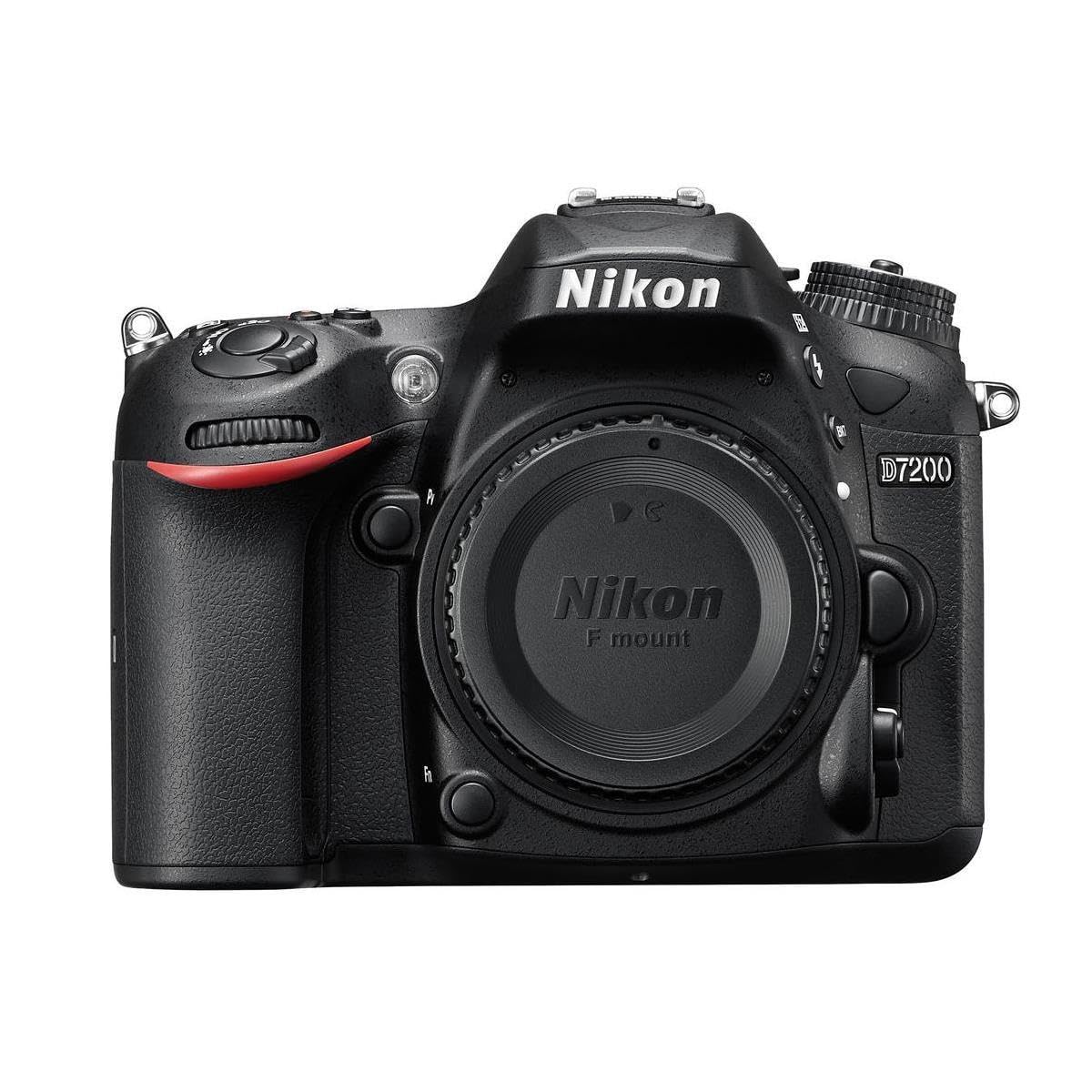
2. Nikon D7200 DX-format DSLR Body (Black)
The enthusiast’s choice that offers pro-level controls and exceptional low-light performance without the pro price.
This is a major step up. The Nikon D7200 features a 24.2 MP DX-format CMOS sensor with no Optical Low-Pass Filter (OLPF), meaning you get sharper, more detailed images right out of the camera. It is built around a 51-point autofocus system—leaps ahead of the 9 or 11-point systems on the entry-level models. This gives you incredible accuracy for tracking moving subjects, whether it is a bird in flight or a kidat images.” The weather-resistant construction is a major plus for shooting outdoors.
While it lacks built-in Wi-Fi, it delivers sharp RAW images without an AA filter and performs admirably at ISO 6400. The dual card slots are a professional touch for backup. This camera is a massive leap from a beginner model. Its sheer build quality and feature set are what owners praise most—211 owners call out its quality. The main limitation is its small buffer, which fills quickly during bursts of RAW files.
It is a perfect next step for someone who has outgrown a D3000 or Rebel series body.
Reach for this if: You need a tough, semi-pro camera body with excellent autofocus and you are comfortable buying a body-only, pair it with your own lens.
Look elsewhere if: Built-in Wi-Fi is a must-have, or you need the latest sensor technology for extreme low-light work.
3. Nikon D5600 DX-Format Digital SLR w/AF-P DX NIKKOR 18-55mm f/3.5-5.6G VR
A lightweight mid-ranger that brings a vari-angle touchscreen and strong video capabilities into your budget.
The D5600 is a fantastic bridge between entry-level and enthusiast cameras. It has a 24.2 MP DX-format sensor and a 39-point autofocus system that gives you excellent coverage for tracking moving subjects. The headline feature here is the 3.2-inch 1.037m-dot vari-angle touchscreen, which allows you to shoot from creative low or high angles and even take selfies. It is lighter than the D5300, making it a great travel companion.
It records Full HD 1080p video at 60 fps (frames per second, so motion looks smooth), making it one of the better video performers in this affordable bracket. It also uses SnapBridge Bluetooth and Wi-Fi with NFC (near-field communication, for quick tap-to-pair) for smooth connectivity to your smartphone. Image quality is excellent, with owners calling it “crystal sharp.” The main recurring complaint is the buggy SnapBridge app, which sometimes requires re-pairing.
It is an ideal camera for someone who wants a mix of photo and video in a lightweight, versatile package with a modern articulating screen.
What Makes It Stand Out
- Vari-angle touchscreen is perfect for vlogging and creative angles.
- Excellent Full HD 1080p video at 60 fps.
- Lightweight body that is easy to carry.
- 39-point AF system for reliable subject tracking.
A Few Hiccups
- SnapBridge Bluetooth/Wi-Fi connectivity can be buggy.
- Single command dial limits manual control speed.
- No USB charging; battery life is average at best.
Your move: If you want a modern, lightweight DSLR with a flip-out screen for photos and video, this is the most versatile pick in the mid-range.
Better options for: A rock-solid wireless experience or if you prefer a camera with dual control dials for faster manual shooting.
4. Nikon D5300 24.2 MP CMOS Digital SLR Camera with Built-in Wi-Fi and GPS Body Only (Black)

An older mid-range king that still punches above its weight with built-in GPS and superb image quality.
The D5300 was a mid-range powerhouse when it launched, and it remains a. The D3200 uses a 24.2 MP DX-format CMOS sensor with EXPEED 3 image processing. This combination produces image quality that is still competitive with cameras released years later. In plain English, it makes gorgeous, high-resolution photos. It has 11 autofocus points and can shoot Full HD 1080p video. The 18-55mm lens is a solid, sharp starter.
Owners are overjoyed with its performance. The battery lasts about 500 shots in 3-4 hours, which is great for a full day of casual shooting. The autofocus works well most of the time. One owner summed it up, calling it “the perfect beginner’s SLR.” The 11 AF points are a 22% more gap over the 9 points on the T7, making it slightly better for tracking. The main limitation is no Wi-Fi — you need a separate adapter for wireless transfers.
It is durable, easy to use in auto or manual mode, and offers incredible value for a beginner who wants Nikon’s excellent image quality.
Absolute budget king: The renewed D3200 offers 24.2MP and a sharp NIKKOR lens for about the price of a new point-and-shoot. Owners say it “performs like new” and “outperforms older, more expensive models.”
Pick this if: The price is your absolute limit. You get a fantastic 24MP sensor and a great kit lens. It is a perfect camera to learn the basics on.
Consider an upgrade if: You want built-in Wi-Fi, a higher frame rate for action, or a vari-angle screen. The D3500 is the logical next step up.
5. Canon EOS 4000D / Rebel T100 Digital SLR Camera Body w/Canon EF-S 18-55mm f/3.5-5.6 Lens 3 DSLR Kit (Renewed)
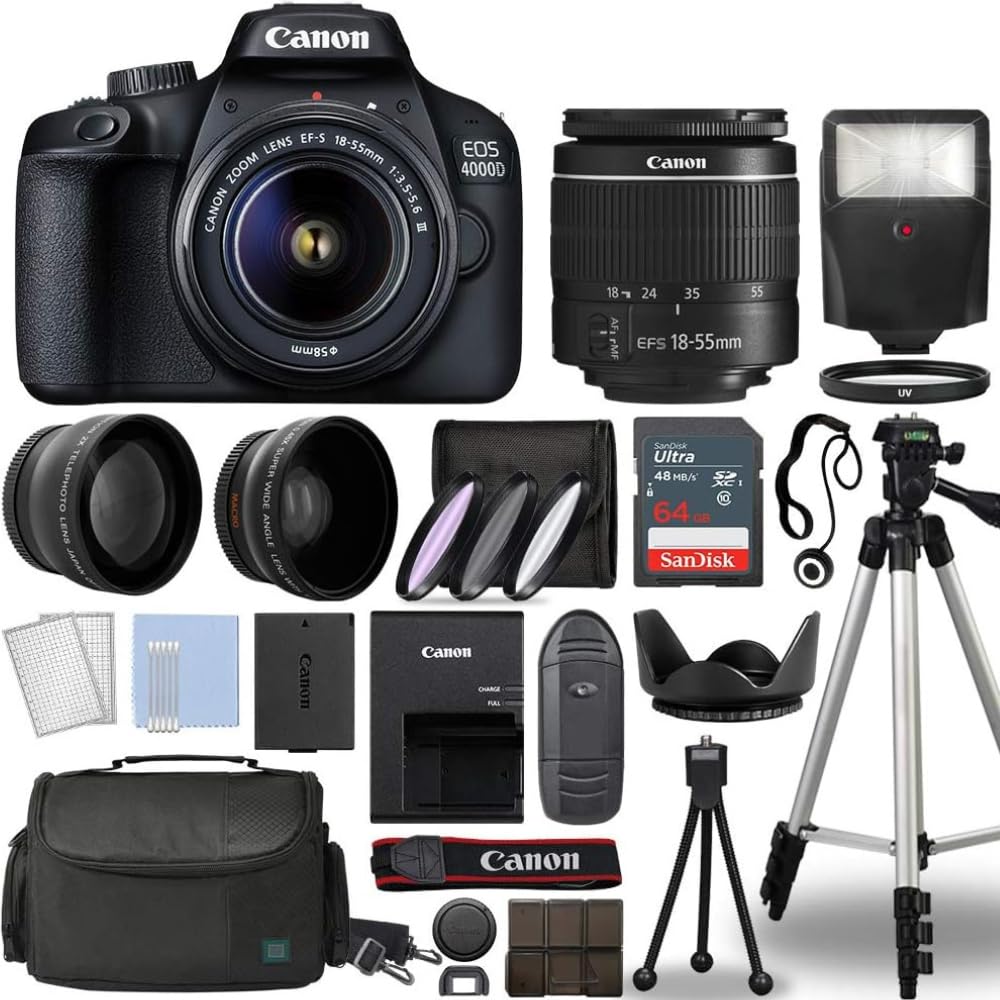
The most affordable Canon DSLR kit that gets you into the EOS system with a huge set of starter accessories.
The Canon EOS 4000D (also known as the Rebel T100) is the absolute entry point into Canon’s DSLR world. It features an 18.0MP APS-C CMOS sensor and a DIGIC 4+ image processor. While 18MP is lower than the 24MP of the others, for a beginner making prints up to 8×10 inches and sharing online, it is still very capable. This bundle comes with the 18-55mm lens, plus a wide-angle and telephoto attachment, a 64GB memory card, a case, a filter kit, a flash, and a tripod.
It records Full HD 1080p video at 30 fps and has a 9-point AF system. Built-in Wi-Fi is a nice touch for sharing. Owners appreciate it as a “great starter camera,” praising the camera quality, image quality, and the value of the accessories. One owner bought it for a 12-year-old daughter, calling it an “excellent beginner camera” and noting the great nature shots from camping trips. The kit is perfect for a child or a complete novice.
The limitations are clear: the 18MP sensor is behind the times, the 2.7-inch 230k-dot LCD screen is smaller and lower resolution than its siblings, and the accessories, while plentiful, are basic.
The “Everything” Starter Box
- Massive bundle includes a camera, lenses, flash, tripod, and bag.
- Easy to use with Scene Intelligent Auto mode.
- Very inexpensive way to get into Canon’s lens system.
- Built-in Wi-Fi for sharing photos.
Compromises to Know
- 18MP sensor is lower resolution than all other picks here.
- Small, low-resolution 2.7-inch LCD screen.
- 3 fps burst rate is the slowest among the cameras listed.
- International model has no manufacturer warranty.
Perfect for: A young photographer or absolute beginner who wants to play with a lot of accessories and learn the ropes without a big investment.
Upgrade if: You want the best image quality, a bigger screen, or need a faster burst rate for action. The 4000D is a learning toy, not a long-term creative tool.
Understanding the Specs
Megapixels (MP)
Megapixels measure the resolution of the camera’s sensor. One megapixel equals one million pixels. A 24-megapixel camera (like 24.1MP or 24.2MP) produces images that are very large and can be printed as big posters without losing detail. More megapixels is not always better for beginners; most people cannot tell the difference between an 18MP and a 24MP photo on social media. The benefit is having more room to crop a photo while still keeping a sharp print.
Autofocus (AF) Points
Autofocus points are tiny sensors on the camera’s image sensor that detect contrast and lock focus on a subject. A camera with 9 AF points has its focus sensors clustered around the center of the frame. A camera with 39 or 51 points spreads those sensors out across the entire picture area. This makes it much easier to track a moving subject (like a running child) as it moves from the center to the edge of your shot, keeping it in focus.
FAQ
What is the difference between a DSLR and a mirrorless camera?
Will an affordable DSLR last me for several years?
Is it worth buying a renewed or used DSLR over a new one?
Which is better for a beginner, Canon or Nikon?
What lenses should I buy next after the kit lens?
How many frames per second (fps) do I need?
Can I use old film lenses on a modern affordable DSLR?
What is the difference between an optical and an electronic viewfinder?
How important is a vari-angle LCD screen?
Do I need a flash for anentry-level DSLR?
Final Thoughts: The Verdict
For most buyers, the affordable digital slr winner is the Canon EOS Rebel T7 because it delivers consistent, crowd-pleasing image quality with the most user-friendly interface and built-in Wi-Fi for sharing. If you want the best low-light performance and pro-level controls for not much more, grab the Nikon D7200. And for the absolute cheapest way to get into the game with a great sensor, the Nikon D3200 (Renewed) is the one to reach for.
How We Picked
We do not accept paid placement. Every pick is matched to a real buyer and a real use-case; we do not hands-on test units.
Sources & Methodology
Specifications: manufacturer listings and product documentation. Review insights: verified customer reviews, as of July 2026. Pricing: not shown on this page (it changes often); check the current price via the retailer link.
As an Amazon Associate, WellFizz earns from qualifying purchases. This does not affect which products we feature.
Related Guides

Mo Maruf
I created WellFizz to bridge the gap between vague wellness advice and actionable solutions. My mission is simple: to decode the research and give you practical tools you can actually use.
Beyond the data, I am a passionate traveler. I believe that stepping away from the screen to explore new environments is essential for mental clarity and physical vitality.